MAGI-2 vs Kling 4.0: Which Handles Camera Motion Better?
One motorcycle drifts. One runner crosses a glass bridge. See which model keeps the action readable, how long each take took and what a 1080p retry costs.
 Chloe Murphy
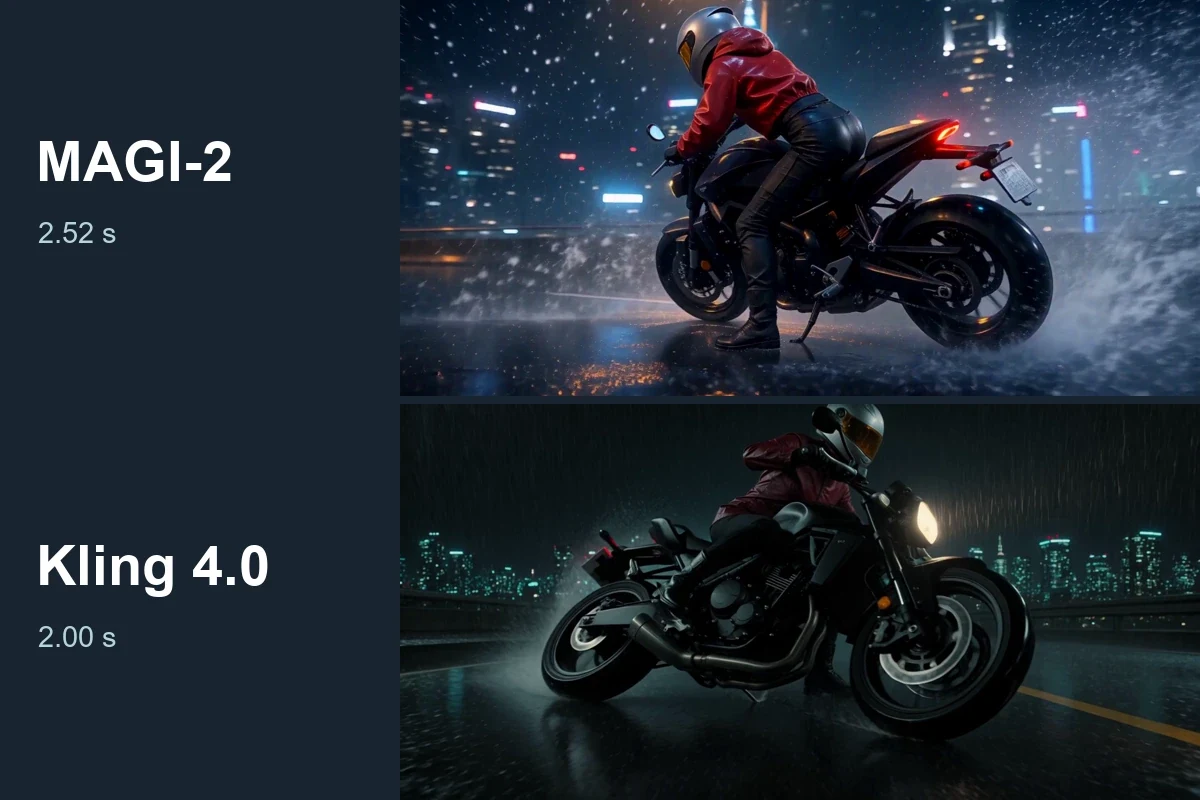
When a motorcycle skids past the lens, do you want to see the far side of the bike, or hold the instant the rear tire breaks loose? In our six-second drift, MAGI-2 gave us the changing angle. Kling 4.0 gave us the low wheel shot and a longer held skid.
MAGI-2 vs Kling 4.0 Specs
Kuaishou released its Kling 4.0 flagship on October 15, ahead of Sand.ai’s November 24 release of MAGI-2. For these comparisons we used the standard Kling flagship available on November 27. The faster Flash edition has its own prices.
Planning a shot | MAGI-2 | Kling 4.0 flagship |
|---|---|---|
Longest single generation | 30 seconds, 1080p, 25 fps | 30 seconds. Our 720p files played at 24 fps. |
Reference material | Up to 20 inputs across 10 images, 5 videos and 5 audio files | Up to 15 reference assets, or up to 10 keyframes in the keyframe workflow |
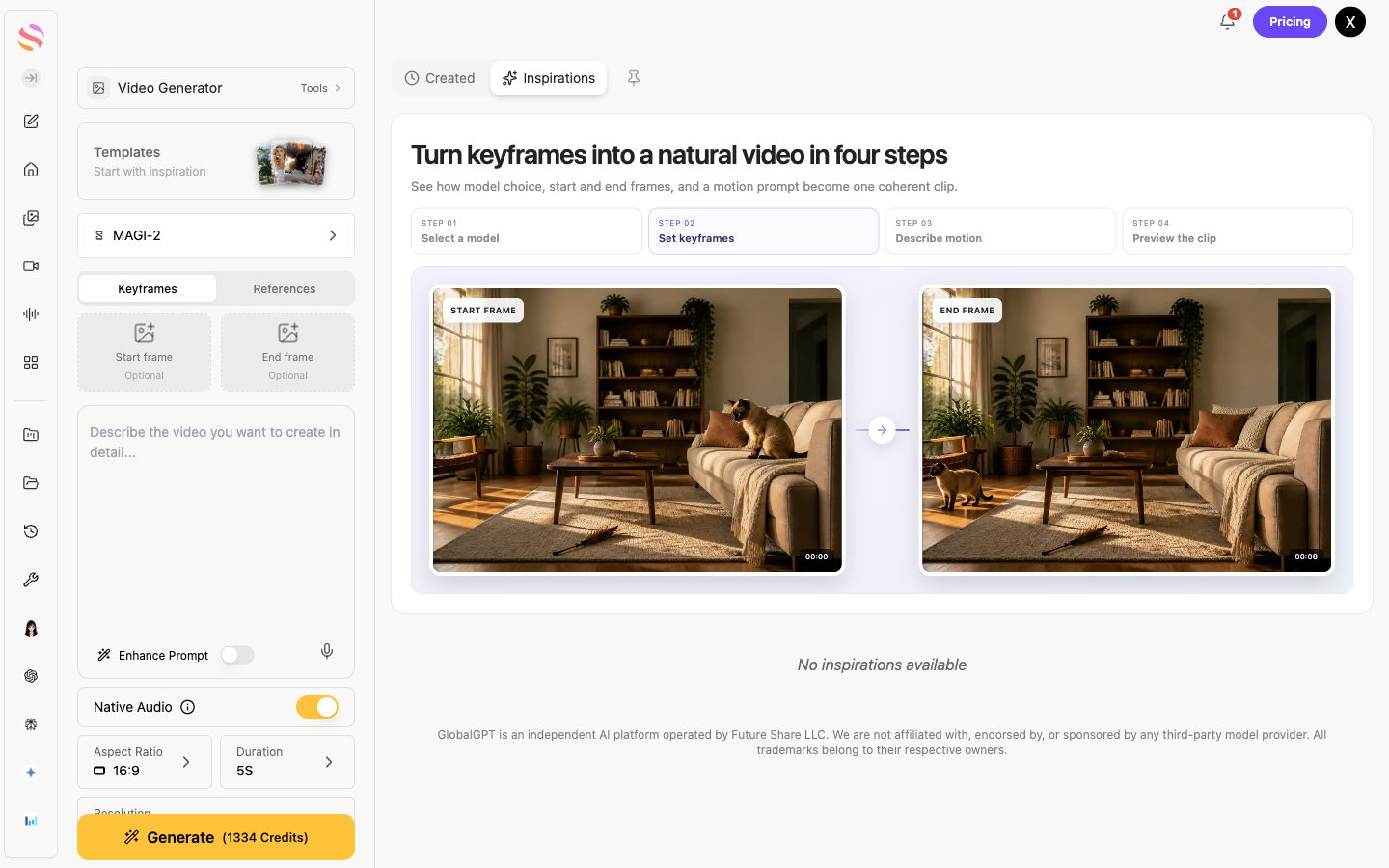
What you can direct | Time a cut or a sound cue in the prompt. On GlobalGPT, image-to-video also accepts an optional end frame. | Lay out a sequence of keyframes, or supply a motion reference for the camera to follow. |
Suppose your shot starts close enough to see the veins in a petal and finishes above the whole garden. With MAGI-2, you can supply a character image, a garden reference and an audio cue for the reveal. With Kling, you can lay out the intermediate views as keyframes when the route between those two compositions matters.
MAGI-2 vs Kling 4.0 Pricing
At 1080p, the GlobalGPT quote for a ten-second take is 2,667 credits with MAGI-2 and 5,500 with Kling 4.0. If the first drift misses the camera move, a second MAGI attempt brings the total to 5,334 credits. At 30 seconds, one take costs 8,000 or 16,500 credits respectively.
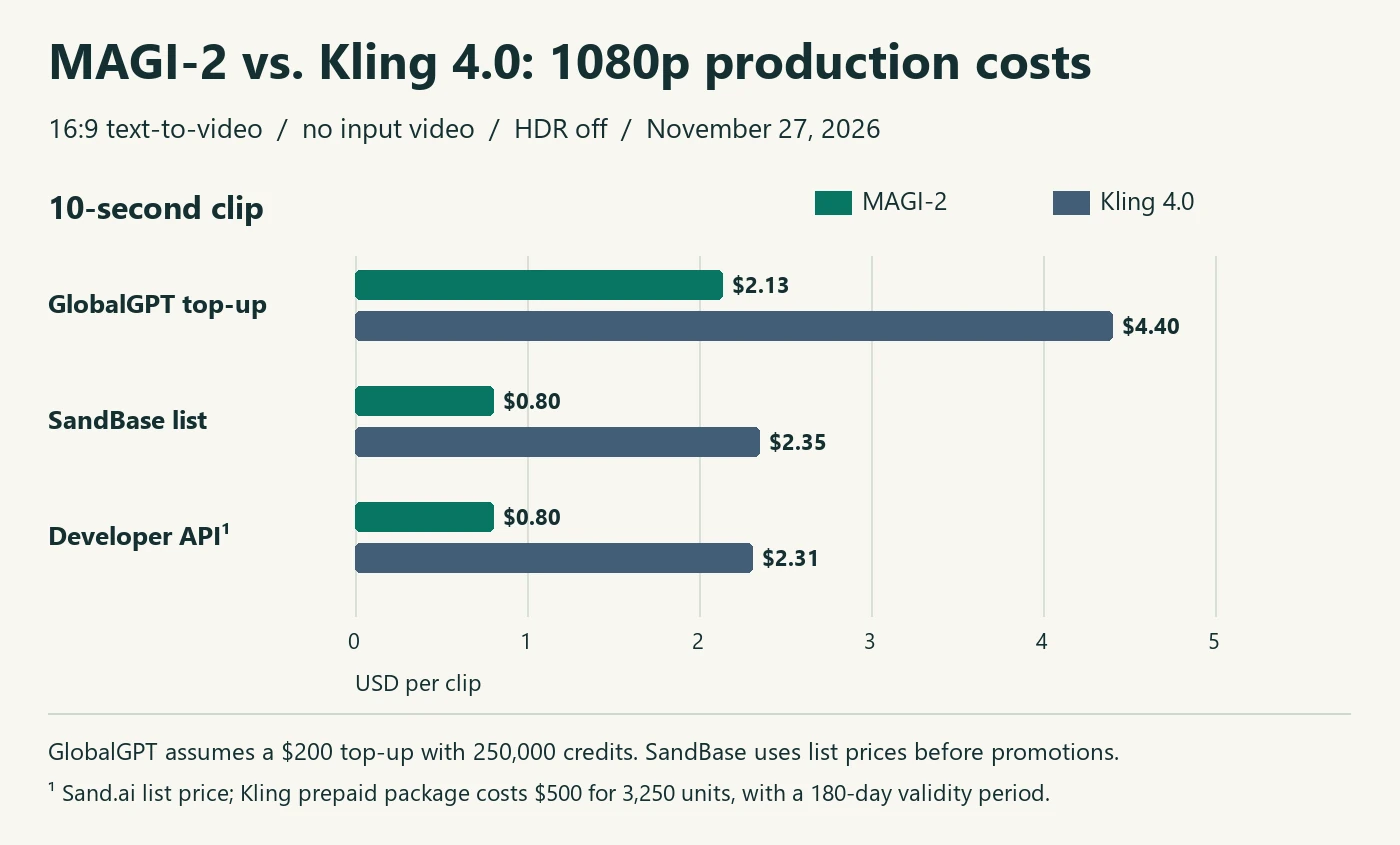
The GlobalGPT bars assume you use the full $200 credit pack, including the bonus. For the API bars we used Sand.ai’s per-second rate and the unit price of Kling’s $500 prepaid package, with HDR off and no video input. The hosted comparison uses SandBase’s published prices before discounts.
Adding a reference clip changes the math. Kling can bill for the input footage as well as the output, so a lower rate per second can still mean a larger bill. Our worked example for a 30-second Kling shot follows both durations through the calculation.
MAGI-2 vs Kling 4.0 Benchmarks
MAGI-2 was 24 Elo points ahead on the image-to-video board with audio on November 27. When voters judged clips made from a text prompt alone, the gap fell to six. The intervals overlap in both cases. A vote for the better-looking clip tells us little about whether its camera completed the requested orbit.
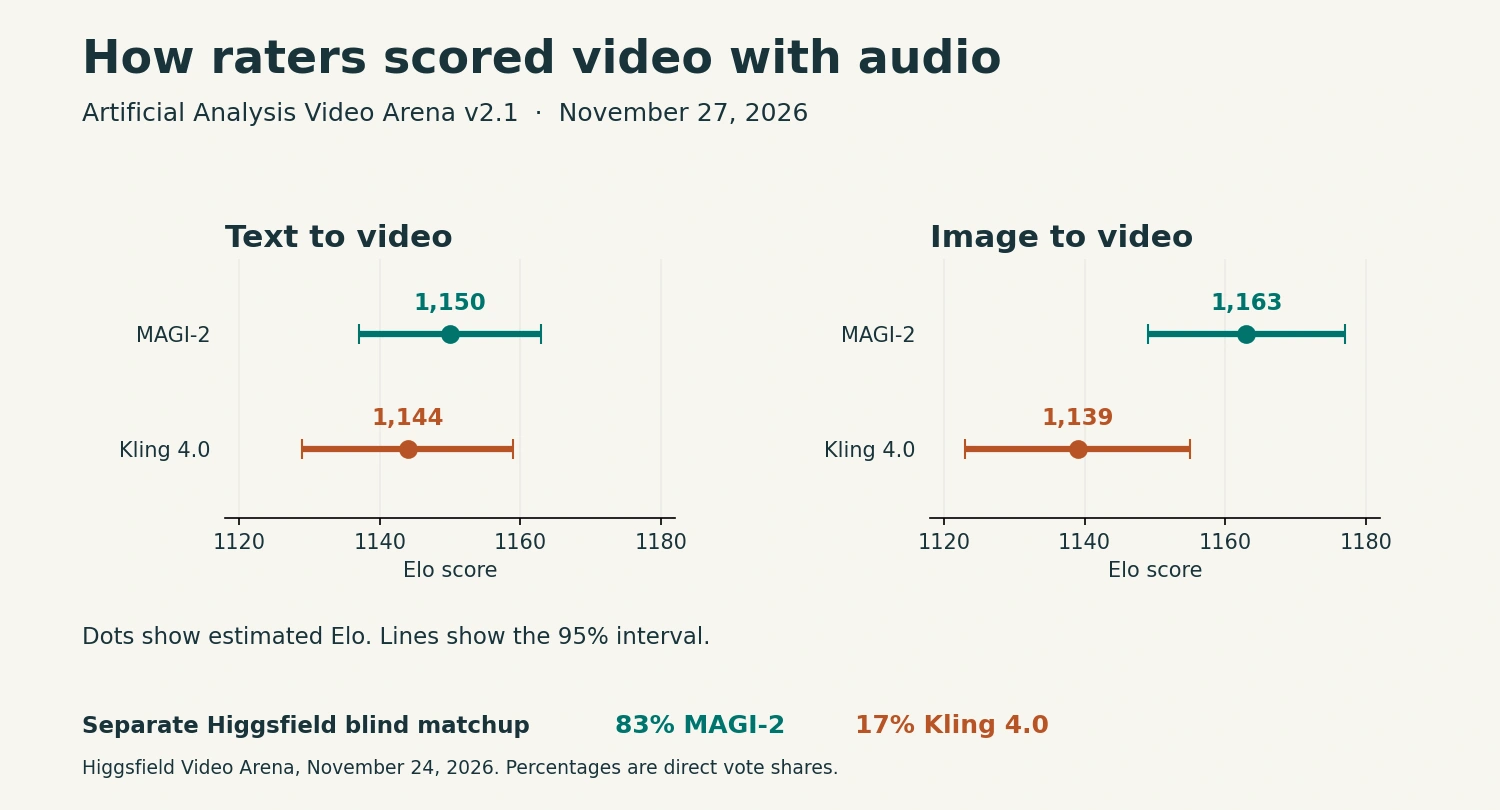
In Higgsfield’s November 24 blind matchup, viewers picked MAGI-2 in 83% of direct votes against Kling 4.0. The lower panel shows that vote share, while the upper panels show Elo scores across a larger field.
MAGI-2 vs Kling 4.0 Official Demos
At three seconds in Sand.ai’s Into the Giant Flower World, a woman in a blue headscarf brushes a fern close to the lens. The next cut puts her under a rose several times her height. By eight seconds we are looking up at a purple bloom. The headscarf gives the eye a familiar point through each change of scale.
The piano gives Kling’s storm sequence a point to return to. We first see the bow through the spray, then the pianist from behind. At eleven seconds his fingers fill the frame. The wide shot near twenty seconds shows how exposed he is, with the piano still on deck and a wave rising behind him.
MAGI-2 vs Kling 4.0 Video Tests
We used the same text for each pair, requested six seconds at 16:9 and used no references or prompt enhancement. Each player shows one original GlobalGPT take. MAGI-2 ran at 1080p with audio off. The Kling files are 720p with stereo audio. We compared movement and staging only.
Motorcycle drift · Orbit through suspended spray
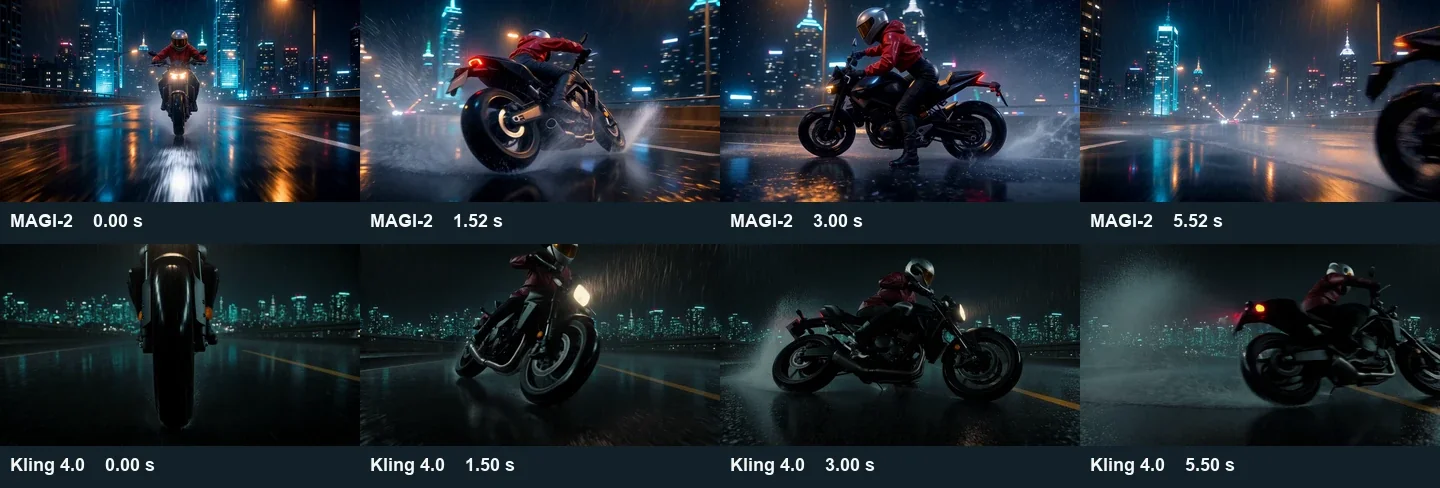
At 1.52 seconds MAGI-2 shows the tail. By four seconds the headlight is back in view. The rider turns too, so the exact camera arc is hard to isolate. Kling stays low beside the tire and holds the rider in profile. We used the same suspended-spray drift in our Kling and Seedance shootout, which gives editors a third take on this particular move.
Read the exact prompt used for both clips
Create a six-second live-action science-fiction action shot, widescreen 16:9. A lone adult female motorcycle courier wears a silver full-face helmet with a narrow amber visor and a cropped crimson rain jacket. Her motorcycle is matte black with one thin amber headlight. It is midnight on a rain-soaked elevated road above a dense city. Cyan architecture and warm amber headlights reflect in the asphalt. One rider, one motorcycle. Premium theatrical cinematography, wet practical surfaces, convincing tire contact, restrained anamorphic flares.
0–1.5 seconds: Begin inches above the wet asphalt, tracking backward ahead of the approaching front wheel. The courier brakes into a controlled sideways drift across the lane. The rear tire throws a curved wall of water toward the lens. Make the skid physically readable: the bike leans, the rider counterbalances, and both wheels remain on the road.
1.5–4.5 seconds: Time abruptly slows almost to a standstill at the most dramatic point of the drift. The rider, wheels, raindrops and curling spray become almost suspended while the camera alone continues moving at normal speed. Move through an open gap in the spray and arc 90 degrees around the motorcycle to a low side view. Nearby droplets sweep past the lens with strong parallax; the distant skyline moves much less. Keep the bike, helmet and red jacket unchanged. The camera never passes through the rider, motorcycle or road.
4.5–6 seconds: Time snaps back to normal. The suspended spray collapses, the rear tire regains traction, and the courier accelerates out of frame to the right, leaving a widening amber reflection on the wet road. End on the falling spray with the city visible beyond it. One continuous shot, no cuts, no duplicate riders, no text, no logos. The image must tell the action without dialogue or music.
Glass bridge · Track a footfall, then pull wide
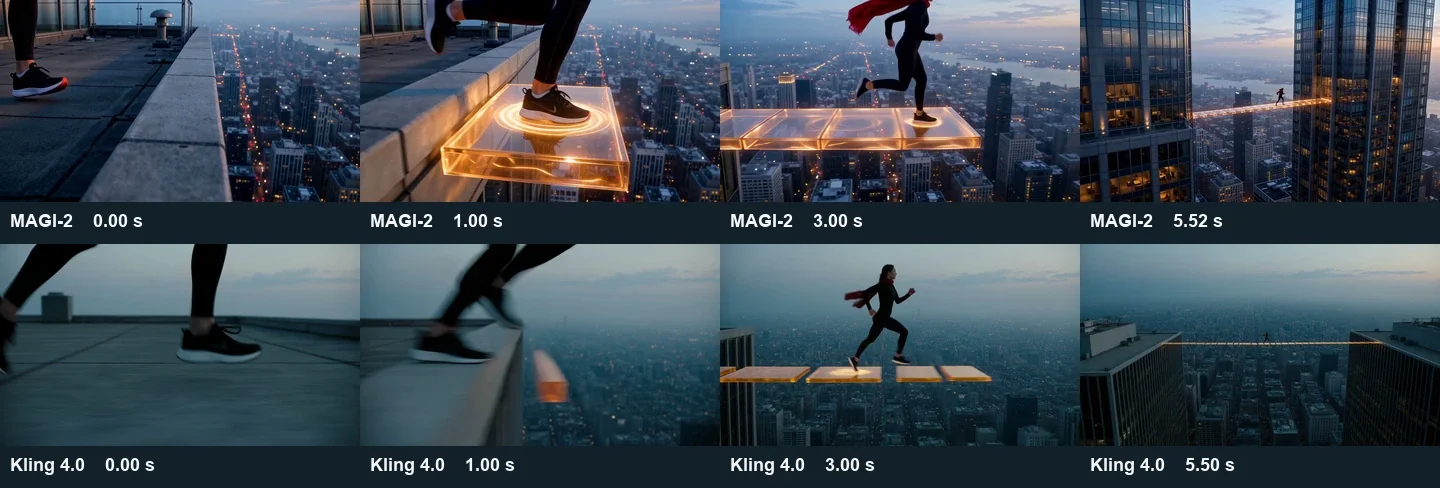
At 1 second, MAGI-2 puts the gold ripple under the shoe and keeps the glass panels connected. Kling has several tiles waiting ahead by 3 seconds. Its payoff comes at 5.5 seconds, when you can see the runner’s size against both rooftops.
Read the exact prompt used for both clips
Create a six-second live-action fantasy action shot, widescreen 16:9. A lone adult woman in a fitted black running suit with a short crimson scarf sprints toward the edge of a skyscraper roof at blue hour. Across a deep open gap is a second skyscraper at the same height. The city far below is realistic and immense. The only supernatural element is a bridge made of translucent amber glass panels: each new panel materializes just ahead of her next footfall, extending from the first roof toward the second. Once formed, panels remain solid and stationary. Wind pulls the scarf backward. High-end architectural photography, cool city haze, warm refracted light inside the glass, realistic human proportions.
0–2 seconds: Start in a low lateral tracking close shot of her shoes as she reaches the roof edge. As her leading foot comes down beyond the concrete lip, the first amber glass panel forms beneath it, fully solid before the shoe makes contact. A tight ripple of golden light travels outward from the landing point. Show the foot bearing weight instead of passing through the panel.
2–4 seconds: Track alongside her as the next panels form one after another just ahead of her steps. She keeps running with an ordinary alternating stride; the new bridge supports her. Previously formed panels remain visible behind her. No floating human body, no wings, no leap across the entire gap.
4–6 seconds: The camera sweeps outward and rises into a wide side view, revealing the runner halfway across the chasm on a narrow glowing bridge between the two towers. Fresh panels continue forming in front of her, with the completed span clearly stretching back to the original roof. Finish with the tiny runner silhouetted against the enormous city. One continuous shot, no teleporting, no changing buildings, no text or logos. The action must read without dialogue or music.
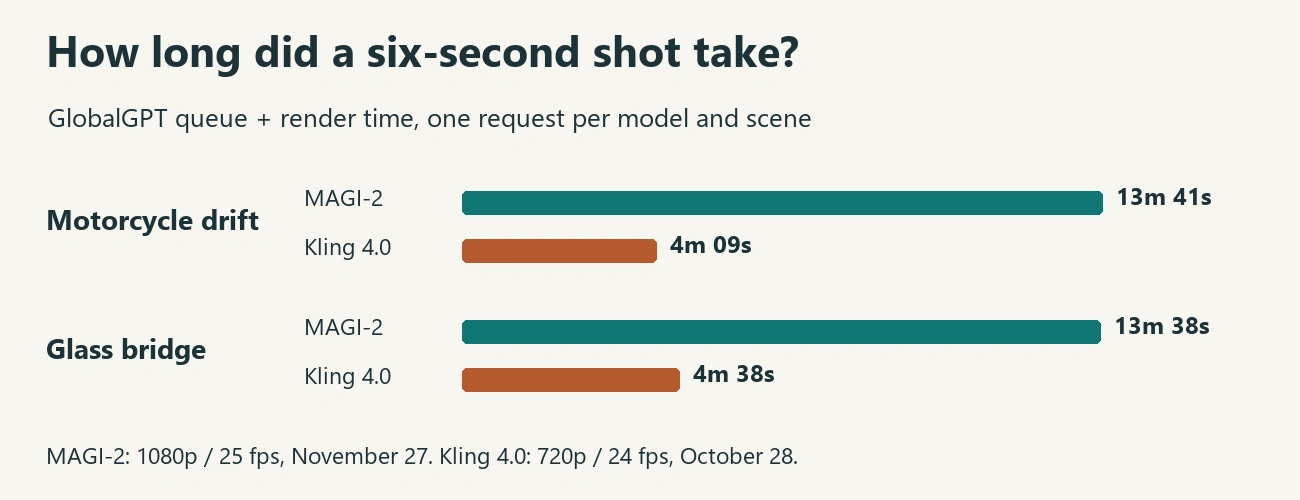
How long did each render take?
MAGI-2 vs Kling 4.0 Verdict
Start with MAGI-2 if the edit hinges on a change of angle or an effect landing on a particular step. It gave us both moments and left room in the budget for a second 1080p take.
Start with Kling 4.0 if you need a held wheel close-up, a wide shot that shows the distance between rooftops, or several keyframes to lay out a shot. The final rooftop composition was the Kling frame we would keep.
MAGI-2 vs Kling 4.0 FAQ
Is Kling 4.0 Flash the version used here?
We used the standard Kling 4.0 flagship for both GlobalGPT shots, credit quotes and Artificial Analysis scores. Flash is a separate variant.
Can I give MAGI-2 a first and last frame?
Yes. In GlobalGPT’s MAGI-2 image-to-video workflow, add the opening image first and then an optional end frame. Our two text-only tests used neither.
Which model should I use for a 30-second storyboard?
Both support a 30-second generation. Kling 4.0 accepts up to ten keyframes if you have intermediate compositions ready. MAGI-2 suits a brief built from mixed image, video and audio references.
How much should I budget for three 10-second takes?
For 1080p text-to-video on GlobalGPT, reserve 8,001 credits for three MAGI-2 takes or 16,500 for three standard Kling 4.0 takes at the November 27 rates.