GPT-6.2 Sol vs GPT-6.1 Sol: Is Upgrading Worth It?
Compare the Sol generations on professional work, coding, response style and shared capabilities. See what changes at the same API rates, plus a practical GlobalGPT workflow and bounded output checks.
 Ariette Wynn

Quick answer: should you upgrade?
GPT-6.2 Sol is a sensible upgrade candidate for an existing GPT-6.1 Sol workflow, but it deserves a trial before a full switch. The standard API token prices are identical. OpenAI reports stronger professional-work performance, while an independent coding-agent evaluation found a regression. The useful question is whether your finished work needs fewer corrections.
If you mainly draft, summarize or revise documents, test the new model against a brief you already know well. If your workflow depends on repository knowledge or preserving every exception, make fact retention an explicit acceptance requirement. A more fluent answer can still leave out the detail that determines whether someone can use it. The evidence below separates OpenAI’s findings from Artificial Analysis’s coding results, with sources beside the relevant results.
That same brief-to-deliverable process is a practical reason to use GlobalGPT: one subscription brings multiple AI models and functions into a workspace for research, drafting and revisions. Keep the requirements and your review checklist together so the model choice serves the work you need to finish.
GPT-6.2 Sol vs GPT-6.1 Sol: the same-price baseline
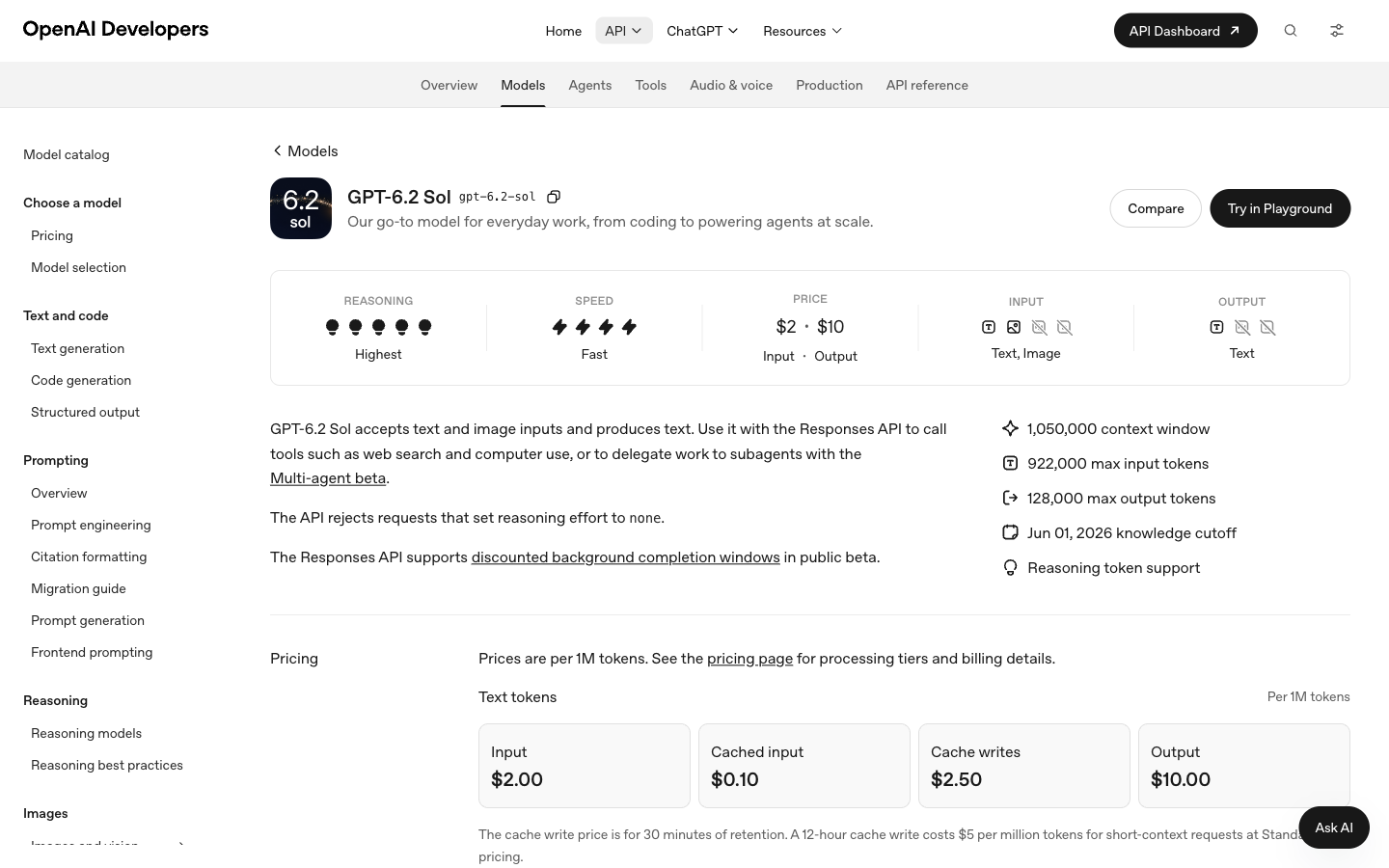
The GPT-6.2 Sol specification and GPT-6.1 Sol specification establish a familiar baseline. These are direct OpenAI API limits and prices, checked November 27, 2026.
Standard API baseline | GPT-6.1 Sol | GPT-6.2 Sol |
|---|---|---|
Input / 1M tokens | $2 | $2 |
Cached input / 1M tokens | $0.10 | $0.10 |
Output / 1M tokens | $10 | $10 |
Context window | 1,050,000 tokens | 1,050,000 tokens |
Maximum output | 128,000 tokens | 128,000 tokens |
Input → output | Text/images → text | Text/images → text |
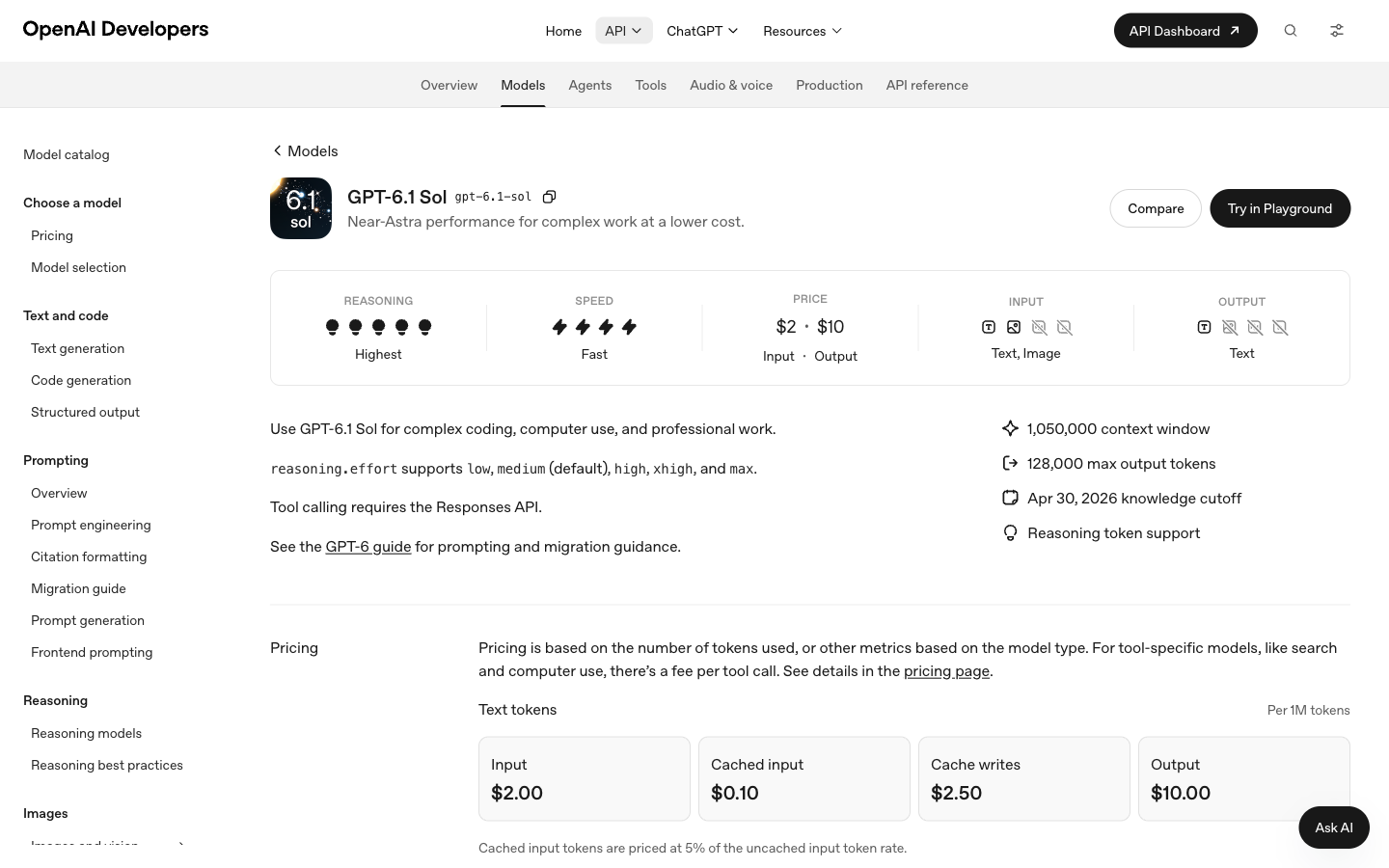
Above 272,000 input tokens, input/cache rates double and output rises 1.5 times for the full request. Tool and cache-write charges are separate. Capacity does not establish completeness.
For the earlier model’s broader background, see our GPT-6.1 Sol’s capabilities and limitations. The comparison here is narrower: whether an established process earns enough from migration to justify changing it.
Equal token prices are only the starting point
If you work in the Codex app rather than paying per API call, compare the subscription and API billing options before applying the token table to your monthly budget.
Picture a weekly customer-support handoff. One answer arrives quickly but omits the refund exception; someone must reopen the brief, correct the summary and check it again. Another takes longer but is usable immediately. Counting only the first response rewards the wrong result.
For a small trial, record three separate measures: the total API charge across attempts, the number of outputs accepted, and the time spent reviewing and correcting them. Divide the charge by accepted outputs for a useful cost measure. Keep review time alongside it rather than pretending it is already included in the token bill.
What actually changes between the two Sol generations?
GPT-6.1 Sol already covered complex coding, professional documents and multistep business work. Its launch included evaluations using dense PDFs and business workflows. GPT-6.2 Sol’s everyday-work positioning broadens the practical default; it does not turn a previously basic chatbot into a capable work model.
Dimension | GPT-6.1 Sol | GPT-6.2 Sol | Decision |
|---|---|---|---|
Work focus | Complex coding and professional workflows | Everyday technical and nontechnical work | Compare finished deliverables |
Performance profile | Stronger repository-Q&A result in the cited comparison | Higher broad index; coding regression | Separate coding tasks |
Response style | Your existing workflow baseline | Concise, actionable preference | Require missing-input questions |
Visual inputs | Text/images in; text out | Text/images in; text out | Continuity, not a new modality |
Tool discovery | Already supported | Still supported | Check the actual integration |
Delayed API work | Flex listed | Completion-window beta | Compare the processing option |
Professional work: the final document matters
OpenAI reports that GPT-6.2 Sol gains 5.3 percentage points over GPT-6.1 Sol on its internal GDPval v2 evaluation of long professional workflows. That is a vendor-reported result for a defined workload, not a promise that every document, code change or answer improves by that amount. Source: OpenAI launch report.
Consider an illustrative finance brief built from a report and a spreadsheet. Extracting the right figures is only the first step: the final memo must distinguish actuals from forecasts, carry the reporting period through every comparison and leave a decision someone can act on. This is a useful reason to trial the successor on a whole deliverable. It does not establish that it will make fewer mistakes in your files.
Response style: directness can help, but questions still matter
OpenAI’s system card connects reduced context-seeking partly with a preference for concise, actionable replies. In selected internal Codex replays, instruction-following flags were 4.66% for 6.2 Sol versus 3.21% for 6.1; overall flags rose while high-severity flags fell. Those selected simulations are not everyday failure rates. Source: GPT-6.2 system card.
A complete brief can benefit from getting to the deliverable quickly. An incomplete one needs questions first. If a client has supplied a launch date but omitted the approval owner, a confident plan is less useful than naming that gap. Ask the model to list missing facts separately and keep assumptions out of confirmed requirements. This is a prompting recommendation, not a claim that either version always asks the right question.
Context, vision and tools: distinguish continuity from an upgrade
The baseline table describes shared capacity, not a new long-context advantage. The knowledge cutoff moves from April 30 to June 1, 2026; that is not live knowledge. Neither date settles a question about today’s policy or price.
Either model’s image-input route can support a screenshot-to-brief task. Image analysis and image generation are separate operations. Reading a chart should lead to a checked explanation; creating an illustration calls for the appropriate image tool. No direct vision-quality improvement between these versions was established here.
Tool search can load definitions when needed rather than putting every tool into the initial context; it is shared capability, not a 6.2 invention. For a workflow that reads a source, looks up a record and writes a report, the integration must still supply access and handle tool results. A new model does not create those connections.
Delayed work: the processing option can change the value
GPT-6.2 launches without Flex. Its public-beta Standard completion windows offer model-token discounts of 30% for two hours and 40% for eight hours. The target applies to the initial response, not an entire multistep project. Source: background-mode guide. GPT-6.1’s specification lists Flex at 50% below Standard.
For overnight document classification, compare the processing route as well as answer quality before migrating an existing discounted workload. Someone waiting in a chat has a different priority. These API options do not describe GlobalGPT subscription charges, and we did not run a background job.
What improved—and where did coding slip?
Artificial Analysis’s model summaries list Intelligence Index scores of 57 for 6.2 Sol and 55 for 6.1 Sol at max effort, using index v5.0.2. Their evaluation cost per task is $1.01 and $1.27 respectively. Those figures support an efficiency case on that benchmark workload; they are not a forecast of your application’s bill. 6.2 Sol results · 6.1 Sol results.
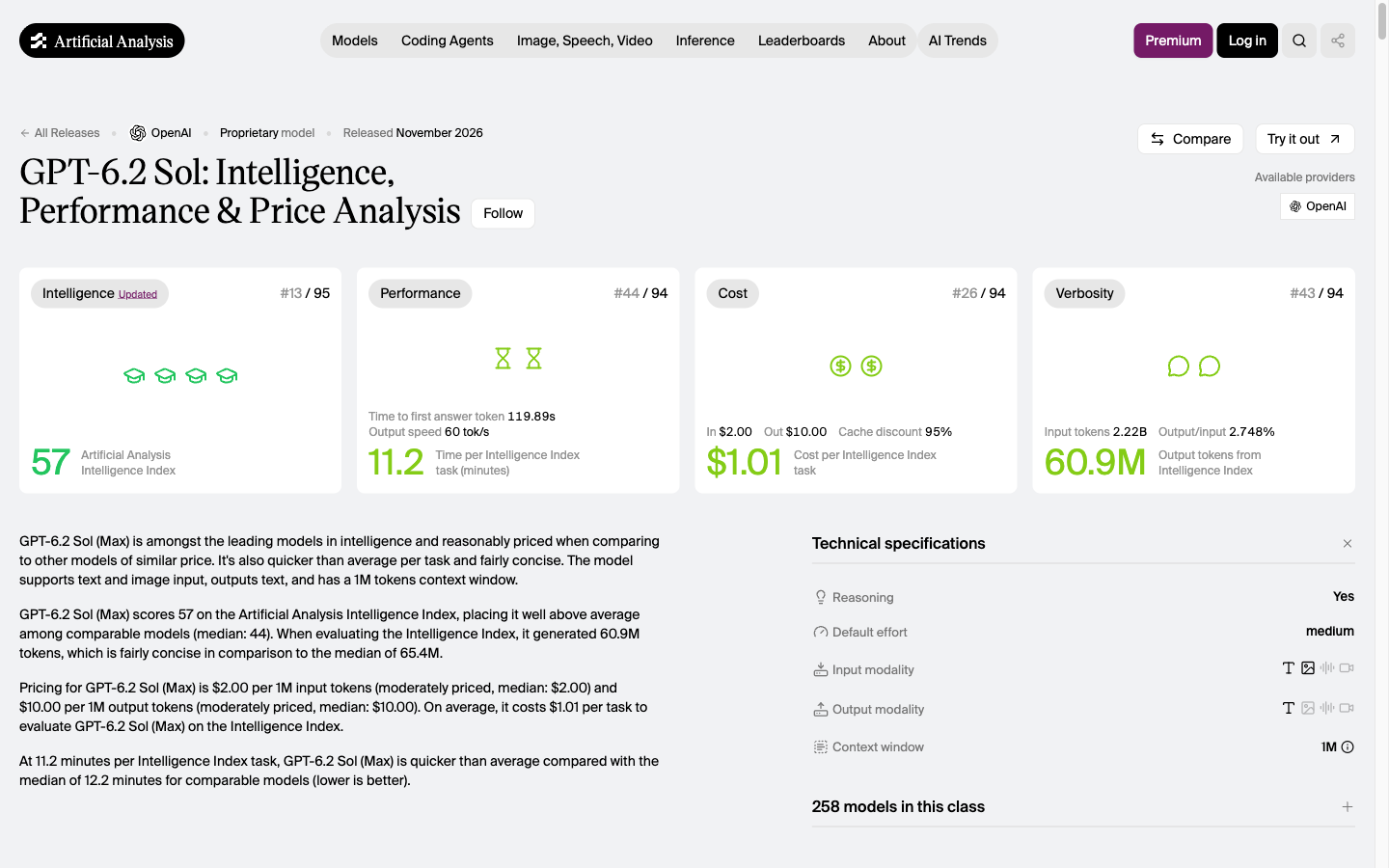
The counterexample matters. In its November 17 report, Artificial Analysis found that 6.2 Sol lost 3 points in the Coding Agent Index relative to 6.1 Sol, using the Codex harness at max effort. It linked the decline to a 14-point drop on SWE-Atlas-QnA-AA, where omitted key facts hurt answers. Source: independent release analysis.
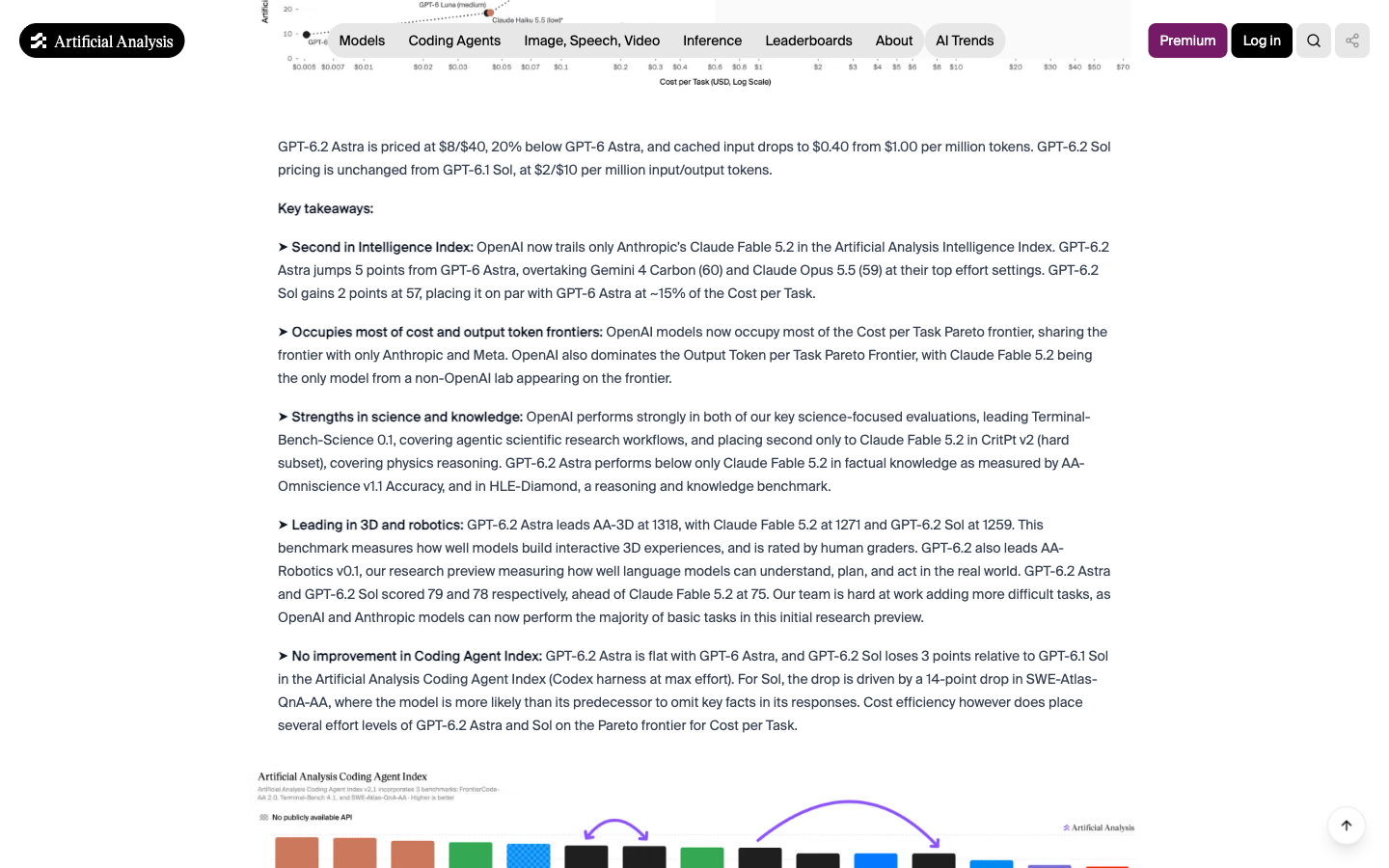
Practical implication: test whether the answer preserves required facts before deciding that a shorter answer is more efficient. Concision helps only when the missing words were unnecessary.
A general intelligence index and a coding-agent evaluation measure different things. They can move in opposite directions without either result being false. Neither substitutes for checking your own repository questions, handoffs or revisions.
Our output-retention checks: what happened in real use?
We tested GPT-6.1 Sol and GPT-6.2 Sol through GlobalGPT on November 27, 2026, using three fictional tasks: a dense handoff, a two-turn support email and a request-migration review. Each pair received the same supplied inputs. We requested medium effort and an 8,192-token completion ceiling, omitted temperature, and kept the first completed response. The support follow-up included each model’s actual first answer unchanged.
Scope: these were no-tool API responses. We checked the answers against predefined requirements; neither model browsed, inspected a repository or ran the inventory tool. The returned identifiers matched the requested models. Effort was requested through the service, but internal reasoning allocation was not independently observable. There were no repeat runs for stability, and the timings below describe this run only. Actual account charges were not exposed.
A handoff with 14 requirements
A colleague needed an actionable handoff under a word limit, including a blocked approval, a customer count, privacy rules and rollback triggers. We checked the short handoff itself as well as the accompanying requirement map.
Check | GPT-6.1 Sol | GPT-6.2 Sol |
|---|---|---|
Required facts in handoff | 14/14 | 14/14 |
Requirement-map entries | 14/14 | 14/14 |
Handoff words | 194 | 202 |
Target account count | 18,100 — correct | 18,100 — correct |
Rollback OR and approval block | Preserved | Preserved |
Observed call time | 13.01s | 9.96s |
Reported completion tokens | 702 | 659 |
Quality tie. Both preserved the details that could change the colleague’s next action. The independent omission regression did not appear in this supplied-text case; it remains a reason to check harder repository questions.
The migration is blocked: the signed EU processing addendum has not been supplied. Until the addendum is approved, this handoff is a plan, not authorization to execute. Mira Chen owns the customer import, with Omar Ruiz as her fallback. The planned start is 02:00 UTC on 2026-12-08, with a maximum write pause of 45 minutes.
View exact prompt and inputs
[
  {
    "role": "system",
    "content": "Complete the supplied task using only the information provided. Do not browse or claim to have run tools. Give the requested deliverable, not hidden reasoning. Do not invent missing facts."
  },
  {
    "role": "user",
    "content": "Summarize this fictional customer migration handoff for a colleague who has not seen it. Preserve all 14 numbered requirements; do not add facts.\n\nR01: Owner Mira Chen controls the customer import; deputy Omar Ruiz is the fallback.\nR02: The import starts at 02:00 UTC on 2026-12-08, with a 45-minute maximum write pause.\nR03: There are 18,420 source accounts, but 320 archived accounts must be excluded; target import count is not the source count.\nR04: Deduplicate using normalized email (trim surrounding whitespace and lowercase); do not merge by display name.\nR05: Retain original customer_id as legacy_customer_id, including leading zeros.\nR06: A record with missing consent must go to quarantine, not the production import.\nR07: The EU tenant requires all customer data and backups to stay in the EU region.\nR08: Compare totals and verify 25 sampled records before lifting the pause; no release before both checks.\nR09: Roll back if count mismatch exceeds 10 accounts OR any sampled record exposes another customer's private data; either condition is sufficient.\nR10: Rollback owner is Omar Ruiz; restore from snapshot NX-1207 and preserve the failure log.\nR11: Do not email customers; notifications are an internal status update to Mira only.\nR12: Tax identifiers must be masked in the internal report, retaining only their last four characters.\nR13: Temporary exports must be deleted within 24 hours after validation; the failure log is retained for 30 days.\nR14: The signed EU processing addendum has not been supplied. The migration is blocked until it is approved; the current document is a plan, not execution authorization.\n\nReturn JSON only with three keys:\n\"handoff\": a clear English handoff of 170–220 words, retaining operationally necessary details without merely listing R01–R14 labels;\n\"target_account_count\": integer;\n\"requirements\": object with exactly R01–R14, each containing a concise substantive paraphrase, not just \"retained\".\nThe word limit applies only to handoff. Treat every condition as important; do not soften the rollback OR into AND or claim execution occurred."
  }
]
View full outputs from both models
gpt-6.1-sol · turn-1
{
  "handoff": "This is a plan, not execution authorization: migration is blocked until the outstanding signed EU processing addendum is supplied and approved. Mira Chen owns the import; Omar Ruiz is her fallback. Start is scheduled for 02:00 UTC on 2026-12-08, with a maximum 45-minute write pause. Exclude 320 archived accounts from 18,420 source accounts; the target is 18,100, not the source total. Deduplicate by email after trimming surrounding whitespace and lowercasing, never by display name. Preserve original customer_id as legacy_customer_id, including leading zeros. Quarantine records missing consent rather than importing them into production. Keep all EU-tenant customer data and backups in the EU region. Before lifting the pause, both compare totals and verify 25 sampled records; neither check alone permits release. Roll back if the count mismatch exceeds 10 accounts OR any sampled record exposes another customer's private data; either condition independently triggers rollback. Omar owns rollback: restore snapshot NX-1207 and preserve the failure log. Do not email customers; send internal status updates only to Mira. Mask tax identifiers in the internal report, showing only their last four characters. Delete temporary exports within 24 hours after validation, and retain the failure log for 30 days.",
  "target_account_count": 18100,
  "requirements": {
    "R01": "Mira Chen owns the customer import; Omar Ruiz is the fallback.",
    "R02": "Scheduled start is 02:00 UTC on 2026-12-08; the write pause must not exceed 45 minutes.",
    "R03": "Exclude 320 archived accounts from 18,420 source accounts, giving a target of 18,100.",
    "R04": "Deduplicate by email normalized through surrounding-whitespace trimming and lowercasing; never merge by display name.",
    "R05": "Preserve the original customer_id as legacy_customer_id, including leading zeros.",
    "R06": "Quarantine records with missing consent; do not import them into production.",
    "R07": "Keep all EU-tenant customer data and backups in the EU region.",
    "R08": "Compare totals and verify 25 sampled records before lifting the pause; both checks are mandatory.",
    "R09": "Roll back if the count mismatch exceeds 10 accounts OR any sampled record exposes another customer's private data; either condition suffices.",
    "R10": "Omar Ruiz owns rollback; restore snapshot NX-1207 and preserve the failure log.",
    "R11": "Do not email customers; notifications are internal status updates to Mira only.",
    "R12": "Mask tax identifiers in the internal report, retaining only their last four characters.",
    "R13": "Delete temporary exports within 24 hours after validation; retain the failure log for 30 days.",
    "R14": "The signed EU processing addendum has not been supplied. Migration remains blocked until it is approved; this document is a plan, not execution authorization."
  }
}
gpt-6.2-sol · turn-1
{
  "handoff": "The migration is blocked: the signed EU processing addendum has not been supplied. Until the addendum is approved, this handoff is a plan, not authorization to execute. Mira Chen owns the customer import, with Omar Ruiz as her fallback. The planned start is 02:00 UTC on 2026-12-08, with a maximum write pause of 45 minutes.\n\nThe target is 18,100 accounts: exclude 320 archived accounts from the 18,420 source accounts. Deduplicate by email after trimming surrounding whitespace and lowercasing it, never by display name. Keep the original customer_id as legacy_customer_id, including leading zeros. Quarantine records missing consent rather than importing them into production. Keep all EU tenant customer data and backups in the EU region.\n\nBefore lifting the pause, compare totals and verify 25 sampled records. Roll back if the count mismatch exceeds 10 accounts or if any sampled record exposes another customer's private data. Either condition alone requires rollback. Omar owns rollback: restore snapshot NX-1207 and preserve the failure log.\n\nDo not email customers. Send an internal status update only to Mira. Mask tax identifiers in the internal report, leaving only the last four characters visible. Delete temporary exports within 24 hours after validation and retain the failure log for 30 days.",
  "target_account_count": 18100,
  "requirements": {
    "R01": "Mira Chen controls the customer import; deputy Omar Ruiz is her fallback.",
    "R02": "The planned import start is 02:00 UTC on 2026-12-08, and the write pause may not exceed 45 minutes.",
    "R03": "Exclude 320 archived accounts from the 18,420 source accounts, yielding a target of 18,100.",
    "R04": "Deduplicate by email after trimming surrounding whitespace and converting to lowercase. Do not merge by display name.",
    "R05": "Store the original customer_id as legacy_customer_id, preserving leading zeros.",
    "R06": "Send records with missing consent to quarantine, not to the production import.",
    "R07": "Keep all EU tenant customer data and backups in the EU region.",
    "R08": "Compare totals and verify 25 sampled records. Do not lift the write pause until both checks are complete.",
    "R09": "Roll back if the count mismatch exceeds 10 accounts or any sampled record exposes another customer's private data. Either trigger is sufficient.",
    "R10": "Omar Ruiz owns rollback. Restore from snapshot NX-1207 and preserve the failure log.",
    "R11": "Do not email customers. Send an internal status update to Mira only.",
    "R12": "Mask tax identifiers in the internal report so that only the last four characters remain visible.",
    "R13": "Delete temporary exports within 24 hours after validation and retain the failure log for 30 days.",
    "R14": "The signed EU processing addendum has not been supplied. Migration is blocked until the addendum is approved; this document is a plan, not authorization to execute."
  }
}
A warmer email without a new refund exception
We asked for a customer email, then requested a warmer revision while adding optional photos. The important test was whether tone changes would quietly turn a conditional return into an approved refund.
Check | GPT-6.1 Sol | GPT-6.2 Sol |
|---|---|---|
Policy conditions, both turns | Retained | Retained |
Email words: first / revised | 140 / 159 | 143 / 163 |
Refund / excluded shipping | $89 / $6.50 — correct | $89 / $6.50 — correct |
Photos in revision | Optional | Optional |
Refund or label claimed sent | No | No |
Observed call time (first + revision) | 9.46s + 7.39s | 5.99s + 6.49s |
Reported completion tokens (first + revision) | 300 + 267 | 234 + 262 |
Quality tie. Both kept the delivery-based return window, the review step and the warehouse-receipt-and-inspection trigger for processing. Both revisions asked for the missing delivery date and order number.
If we approve your return, we’ll send you a prepaid return label. I understand you’re asking for a full refund, including shipping. The refund would cover the $89.00 you paid for the headset, but the original $6.50 outbound shipping charge isn’t refundable. Once our warehouse receives and inspects the returned headset, refund processing takes 5–7 business days.
View exact prompt and inputs
[
  {
    "role": "system",
    "content": "Complete the supplied task using only the information provided. Do not browse or claim to have run tools. Give the requested deliverable, not hidden reasoning. Do not invent missing facts."
  },
  {
    "role": "user",
    "content": "Write an English customer support email for fictional Northline Audio. Use only this policy and case. Return JSON only, with \"subject\" and \"email\". Email body must be 130–170 words; subject at most 10 words.\n\nCase: customer Dana purchased one headset for $89.00 and paid $6.50 outbound shipping on November 20, 2026. Today is November 27, 2026. Dana reported a faulty left speaker and asks for a full refund including shipping. The agent has NOT approved the return yet.\nPolicy: customers must request returns within 30 calendar days of delivery, NOT purchase. The delivery date is missing; ask Dana to provide it and the order number. A reported fault requires review before approval. Once approved, the product refund is $89.00; the original $6.50 outbound shipping is not refundable. A prepaid return label is supplied after approval. Once the warehouse receives and inspects the return, refund processing takes 5–7 business days. Do not ask for a password or full payment-card information. Do not guarantee approval, claim a refund was issued, or claim a label has already been sent.\n\nThe body must explicitly distinguish the delivery-based request window, fault review, excluded outbound shipping, conditional prepaid label and the warehouse-receipt-and-inspection trigger for the 5–7-business-day processing period. End with one clear action request for both missing details. Sign as \"Northline Support\"."
  }
]
The exact first assistant response below was appended before this follow-up:
{
  "role": "user",
  "content": "Revise that same email for Dana to sound warmer and less legalistic. Keep every earlier policy condition and every relevant amount; do not grant new exceptions. Add this newly confirmed service detail: photos of the faulty speaker are optional and may help the review, but are not required. Return the same JSON schema. Revised email body must be 150–190 words; subject at most 10 words. Keep the action request for delivery date and order number, and the signature. Do not pretend anything was approved or sent."
}
View full outputs from both models
gpt-6.1-sol · turn-1
{
  "subject": "Information Needed to Review Your Headset Return",
  "email": "Hi Dana,\n\nI'm sorry to hear about the faulty left speaker on your headset. I understand you're requesting a full refund, including shipping, for your November 20 purchase.\n\nOur return policy requires requests within 30 calendar days of delivery, not purchase. We need your delivery date to confirm whether your request falls within that window. The reported fault also requires review before we can approve a return; your return has not yet been approved.\n\nIf approved, your product refund will be $89.00. The original $6.50 outbound shipping charge is not refundable. We will provide a prepaid return label only after approval. Once our warehouse receives and inspects the returned headset, refund processing takes 5–7 business days; that period does not begin when you request the return or ship it.\n\nPlease reply with your delivery date and order number.\n\nNorthline Support"
}
gpt-6.1-sol · turn-2
{
  "subject": "Helping With Your Headset Return",
  "email": "Hi Dana,\n\nI'm sorry your headset's left speaker isn't working properly. I understand you'd like a full refund, including shipping, for your November 20, 2026 purchase, and I'm happy to help with the next steps.\n\nReturn requests must be made within 30 calendar days of delivery—not the purchase date—so we'll need your delivery date to check that timing. We'll also need to review the reported fault before deciding whether to approve the return. Your return hasn't been approved yet. Photos of the faulty speaker are optional and may help with the review, but they aren't required.\n\nIf your return is approved, the product refund will be $89.00; the original $6.50 outbound shipping charge isn't refundable. We'll provide a prepaid return label after approval. Refund processing takes 5–7 business days once our warehouse receives and inspects the returned headset, not from the date you request or ship the return.\n\nPlease reply with your delivery date and order number.\n\nNorthline Support"
}
gpt-6.2-sol · turn-1
{
  "subject": "Your Northline Audio headset return request",
  "email": "Hi Dana,\n\nI’m sorry the left speaker on your headset isn’t working. I understand you’re asking for a refund for both the headset and the original shipping charge. Your return has not yet been approved, and we’ll need to review the reported fault before we can make a decision.\n\nReturn requests must be made within 30 calendar days of delivery, not purchase. We know you purchased the headset on November 20, 2026, but we don’t have the delivery date to confirm whether your request is within that window.\n\nIf your return is approved, we’ll provide a prepaid return label. The refund would cover the $89.00 headset price, but the original $6.50 outbound shipping charge is not refundable. Refund processing takes 5–7 business days after our warehouse receives and inspects the returned headset.\n\nPlease reply with your delivery date and order number.\n\nNorthline Support"
}
gpt-6.2-sol · turn-2
{
  "subject": "Next steps for your headset return",
  "email": "Hi Dana,\n\nI’m sorry the left speaker on your headset isn’t working. I know how frustrating that is, and I’m happy to help you with the next steps.\n\nReturn requests need to be made within 30 calendar days of delivery, rather than the purchase date. We have your November 20, 2026 purchase date, but we’ll need the delivery date to check whether your request falls within that window.\n\nWe’ll also review the reported fault before deciding whether to approve your return. Photos of the faulty speaker may help with that review, but they’re entirely optional.\n\nIf we approve your return, we’ll send you a prepaid return label. I understand you’re asking for a full refund, including shipping. The refund would cover the $89.00 you paid for the headset, but the original $6.50 outbound shipping charge isn’t refundable. Once our warehouse receives and inspects the returned headset, refund processing takes 5–7 business days.\n\nPlease reply with your delivery date and order number.\n\nNorthline Support"
}
An API migration review that respects execution limits
We supplied current integration rules and a deliberately flawed inventory request. This measured whether the proposed replacement and explanation followed those rules, not whether either model discovered fresh documentation or successfully queried stock.
Check | GPT-6.1 Sol | GPT-6.2 Sol |
|---|---|---|
Responses endpoint / strict schema | Correct | Correct |
Initial read-only instruction | Retained | Retained |
Later length request | Appended as user message | Appended as user message |
Unsupported effort / audio | Rejected | Rejected |
Inventory lookup claimed executed | No | No |
Observed call time | 15.00s | 9.38s |
Reported completion tokens | 796 | 639 |
Quality tie on the supplied rules. Both produced a correctly shaped Responses request, kept inventory read-only and required actual tool execution before showing a verified status.
View representative B3 output excerpts
Representative excerpts only: the full supplied-rules prompt, corrected request bodies and remaining explanations are omitted here. Both models reviewed the same intentionally flawed inventory request.
gpt-6.1-sol — representative excerpt
{
  "endpoint": "POST /v1/responses",
  "later_instruction": {
    "role": "user",
    "content": "Keep replies under 80 words."
  },
  "execution_boundary_excerpt": "This review establishes a request design consistent with the supplied integration rules; it does not execute an API request, retrieve stock, or verify any inventory count."
}
gpt-6.2-sol — representative excerpt
{
  "endpoint": "POST /v1/responses",
  "later_instruction": {
    "role": "user",
    "content": "Please keep replies under 80 words."
  },
  "execution_boundary_excerpt": "This review confirms that the proposed request follows the supplied integration rules."
}
What these cases support: 6.2 Sol returned the checked deliverables faster in this run while matching 6.1 on the material requirements. That is a useful pilot result, not proof of a universal quality improvement, stable latency advantage or better performance in an autonomous coding workflow.
How to switch through OpenAI
In ChatGPT Work or Codex
Open the account and workspace you intend to use, then enter ChatGPT Work or Codex.
Open the Work model picker or Codex model selector and choose GPT-6.2 Sol.
Start a trial with a known task and its existing acceptance checklist. Keep a copy of the original input and the 6.1 result for comparison.
If the option is missing, check the account, workspace permissions and app version. Codex CLI needs version 0.166.0 or later.
Model options depend on plan, seat and workspace settings. Existing Work conversations can retain their current model; regular Chat has different model choices. Use the official access instructions for the product you actually use.
Before moving a full workday over, check how Codex usage windows and credits work. A successful test call does not tell you how much of a coding allowance a longer task will consume.
For a direct API integration
Start with a small request, then replay representative inputs. This Python example uses the OpenAI SDK and an API key supplied through the environment; it is an integration example, not a repository-agent benchmark.
from openai import OpenAI

client = OpenAI()
response = client.responses.create(
    model="gpt-6.2-sol",
    reasoning={"effort": "medium"},
    input=[
        {"role": "developer", "content":
         "Preserve every supplied exception, owner and deadline. "
         "Flag missing information instead of inventing it."},
        {"role": "user", "content":
         "Create a handoff checklist: Priya owns review; "
         "approval is due Friday; refunds exclude used credits."}
    ],
)
print(response.output_text)A model-name swap is not a migration test. Validate the request, retained instructions and actual tool result against OpenAI’s integration guidance.
In the migration-review case, the old request was deliberately invalid: 6.1 already rejected none and minimal.
With GPT-6.2, editing earlier conversation content can discard retained reasoning. Keep reusable instructions stable and append updates; inspect an integration that rewrites its initial message.
Do not change the model, prompt, tool definitions and effort setting together if you want to understand which change helped. First establish a comparable baseline, then optimize one part of the workflow at a time.
Use GlobalGPT to carry the upgraded model into a finished workflow
For a concrete example of the handoff, see how to create a launch brief and revise it with Yukie. That workflow is about improving the deliverable; it is separate from the model-version tests here.
GlobalGPT lists both Sol generations alongside writing, research and creative functions. Keep a reusable task packet—a source brief, non-negotiable facts and the intended output—so moving to a newer model does not mean rebuilding your instructions from memory. For a product update, that packet might become a release summary, a customer-facing FAQ and an illustration brief.
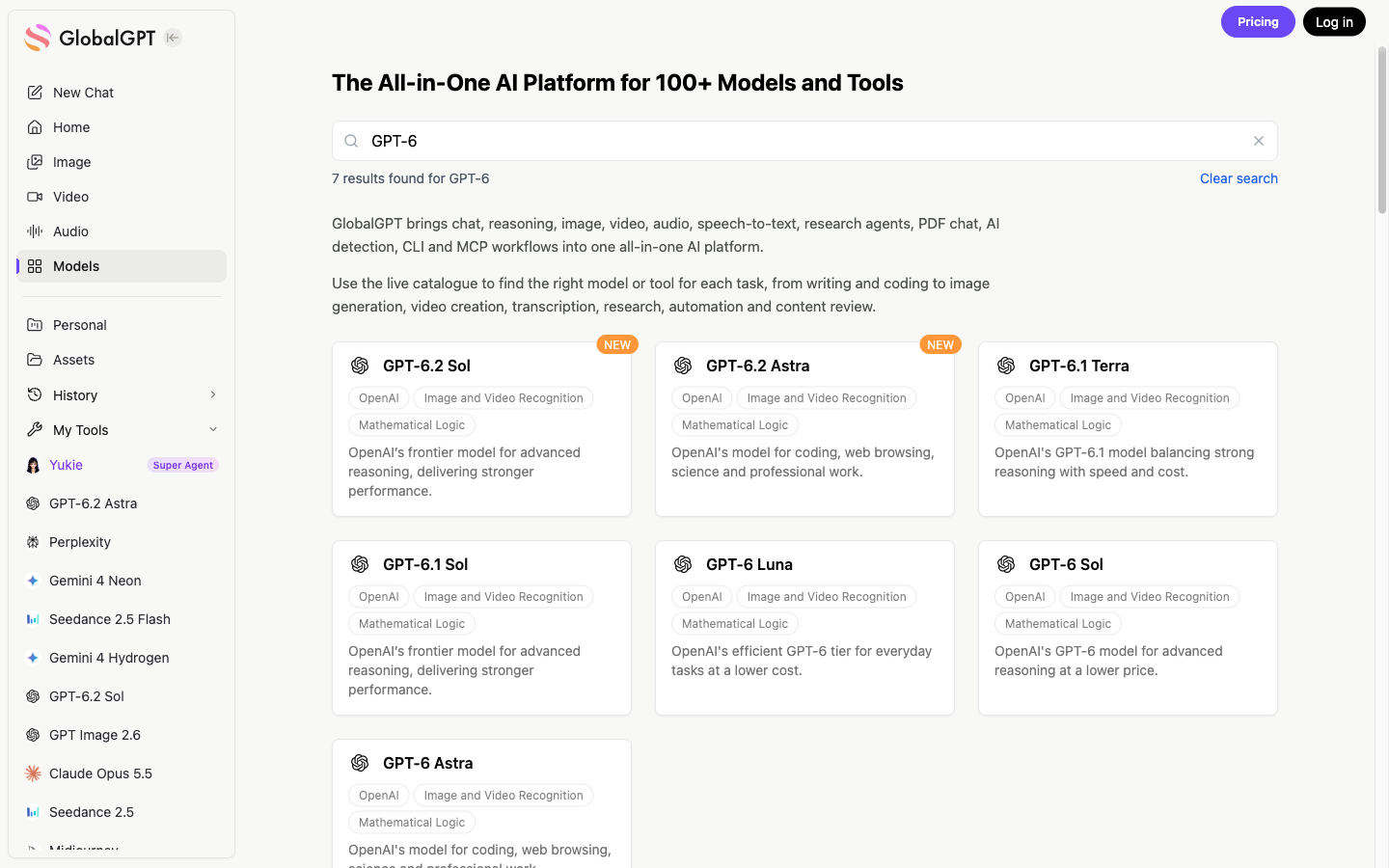
Start with the model and brief. Open the GlobalGPT workspace and choose the Sol entry for your task. Supply the source material and the requirements together.
Revise a specific deliverable. Ask for the release summary first, then a FAQ that retains the same exceptions. Keep your own copy of the task packet when moving between conversations or functions.
Continue into the next function. If the project needs artwork, take the approved illustration brief into an image tool; review that result as a separate deliverable.
Check the finished set. Verify names, dates and exclusions against the source before sharing the summary, FAQ or asset.
For terminal-based work, the set up GlobalGPT inside Codex connects this model-and-tool workflow with your existing workspace. The practical benefit is continuing from a model’s draft to the formats and assets your project needs.
Subscription value is a separate choice from the unchanged API token rates. Consider whether one workspace covers the models and creative functions you need across the project, then judge the finished output and review effort. A model upgrade alone does not establish better subscription value.
A migration checklist you can actually sign off
Use tasks from your own work rather than questions whose answers you will not check. A reasonable small pilot includes one typical task, one dense handoff, one multi-turn revision and one case that previously failed. This is a suggested starting set, not a statistical sample or a published performance claim.
Acceptance check | Evidence to keep | Reason to pause migration |
|---|---|---|
Required facts survive | Map each requirement to the final output | A missing exception changes the action someone takes |
Revisions retain earlier constraints | Compare the final answer with all prior instructions | A friendlier rewrite silently removes a rule |
The integration behaves correctly | Request, response, tool result and error records | A working text answer hides a broken tool path |
Value improves | Charge per accepted output plus correction time | Extra attempts cancel the first-response saving |
The switch is reversible | Saved model setting, prompt and known-good examples | You cannot reproduce the prior workflow |
Write the pass conditions before reading the new outputs. If an omitted fact would make a handoff unsafe or unusable, make that a failure even when the prose looks better. Where the results are close, repeat the important cases and keep the repeat results separate from the first attempt.
If you are choosing between the Sol tier and a heavier model rather than between Sol versions, our GPT-6.1 Sol versus the original GPT-6 Astra addresses that different decision. Keep the generation named there in mind when reading its prices.
Should you upgrade to GPT-6.2 Sol?
Trial 6.2 Sol for routine drafting, handoffs and revisions; migrate only after it meets your existing acceptance checks. In our three bounded cases, both versions preserved the required information. The new model completed the observed calls sooner, but these first responses did not establish a quality winner.
Keep a known-good 6.1 setup available while you test omission-sensitive repository work and longer tool sequences. The independent coding-agent regression gives that caution a concrete basis. Move a workflow when its facts survive, its tools succeed and its total correction burden improves—not simply because the model name is newer.
For your next deliverable, bring one real brief and its non-negotiable details into GlobalGPT. Use the same checklist through drafting and revision, then choose the model that gets the work ready to use.
FAQ
Is GPT-6.2 Sol cheaper than GPT-6.1 Sol?
Both have the same standard API unit rates. A useful value comparison also counts tokens, repeat attempts and review time per accepted output.
Is GPT-6.2 Sol better for coding?
The evidence is mixed. Artificial Analysis reported a 3-point decline against 6.1 Sol in its Coding Agent Index at Codex max effort, with omitted facts contributing to the result. Retest repository questions and tool workflows before switching.
Does the upgrade give me a larger context window?
The published API context and maximum output limits are unchanged. Product limits and subscription allowances are separate from API specifications.
Where can I select GPT-6.2 Sol in ChatGPT?
Use the ChatGPT Work model picker or the Codex model selector. Available choices depend on your plan, seat and workspace settings. Regular Chat has different model choices.
Do these response tests reproduce a Codex coding benchmark?
No. They examine bounded outputs from supplied inputs without browsing, repository access or tool execution. The independent Codex-harness result and our response checks answer different questions.