GPT-6.2 Astra vs GPT-6.2 Sol: Is Astra Worth It?
Sol is the sensible default; Astra needs to earn its premium on difficult work. Compare API costs, independent benchmarks and the checks that make a deliverable usable.
 Ariette Wynn

Start with GPT-6.2 Sol for routine writing, coding and analysis; choose GPT-6.2 Astra when a demanding project needs deeper judgment or a more polished deliverable. OpenAI recommends Sol at medium reasoning effort for most API workflows and Astra for demanding engineering or analysis. That is a sensible starting point, rather than a reason to send every request to Astra. Source: OpenAI model selection.
The tradeoff is measurable: Astra has a higher independent Intelligence Index score, while Sol has much lower API token rates. The useful question is whether Astra improves the parts of your work that would otherwise need correction—not whether its name sits higher on a leaderboard.
If your working day moves from research to writing, code and creative assets, the model decision is also a subscription decision. GlobalGPT brings multiple AI models and functions into one subscription and dashboard, so you can work across those tasks without organizing every step around a separate product. Choose the model for the deliverable, then choose the subscription for the range of work you actually do.
What is actually different between Astra and Sol?
They share broad API capabilities, so buying more context is not the reason to choose Astra. Their main distinction is the balance of quality, cost and time on the work you need to finish.
If you are coming from an older setup, start with what GPT-6.1 Sol already offers and our hands-on review of the original GPT-6 Astra. Those describe the previous models; the specifications and tests below concern GPT-6.2.
API specification | GPT-6.2 Astra | GPT-6.2 Sol |
|---|---|---|
Model ID | gpt-6.2-astra | gpt-6.2-sol |
Context window | 1,050,000 tokens | 1,050,000 tokens |
Maximum input / output | 922,000 / 128,000 tokens | 922,000 / 128,000 tokens |
Input → output | Text and images → text | Text and images → text |
API specifications checked November 27, 2026 against the official model comparison. These API ceilings are not a promise that every ChatGPT, Codex or third-party interface exposes the same limits.
For API tool workflows, use Responses and check supported reasoning settings before migrating. Our tests below assess returned answers, not live tool execution.
For a concrete decision, consider the acceptance criteria. A support response needs correct policy details and a suitable tone. A release plan needs every dependency and an honest account of blockers. A spreadsheet analysis needs correct totals and an explanation of what cannot be compared. Astra becomes useful if it improves those outcomes enough to justify the extra spend.
What do independent benchmarks say?
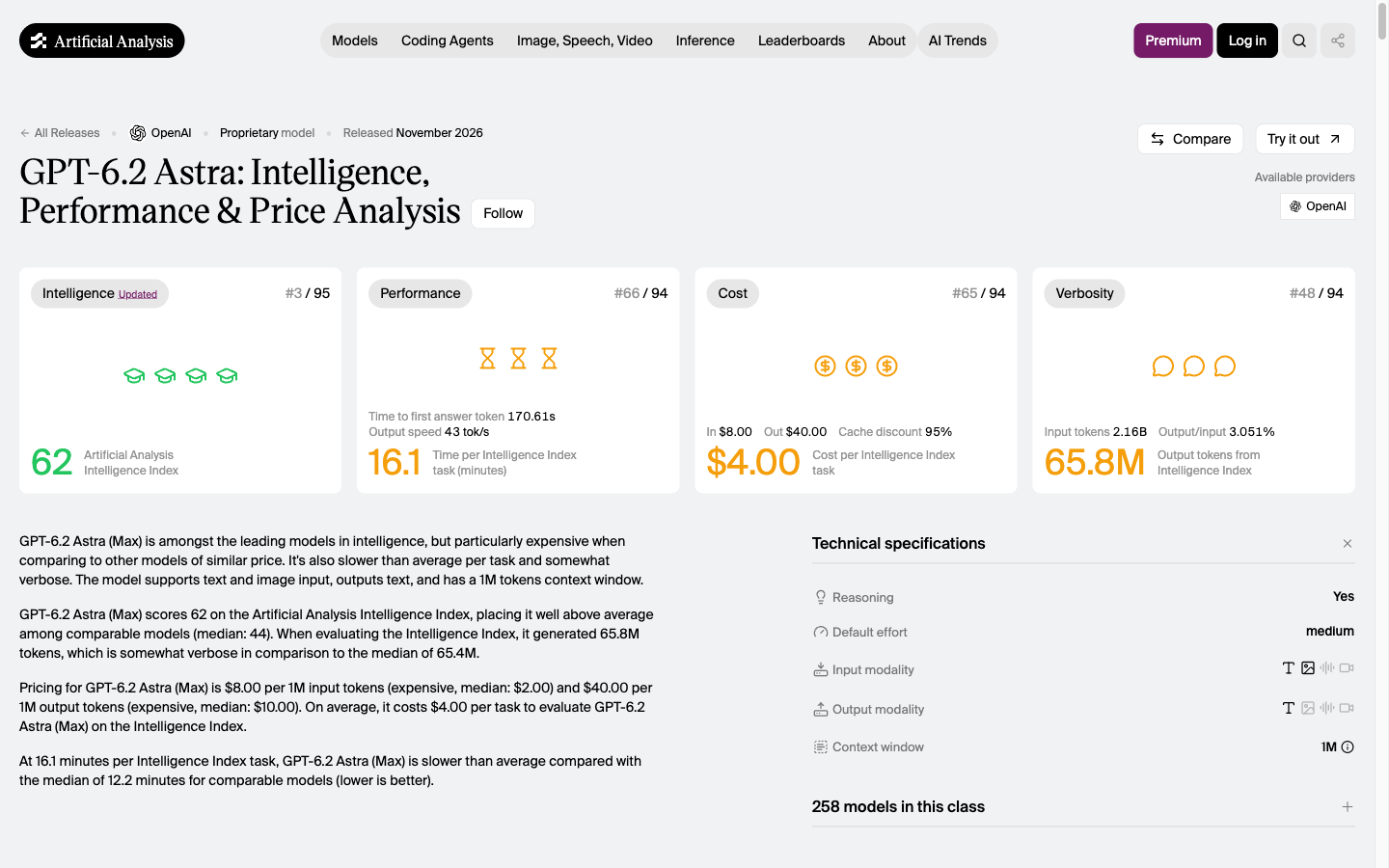
Artificial Analysis’s model summaries, checked November 27, report the following results at max effort. These are its Intelligence Index v5.0.2 figures, not our hands-on scores.
Artificial Analysis measure | GPT-6.2 Astra | GPT-6.2 Sol |
|---|---|---|
Intelligence Index, higher is better | 62 | 57 |
Cost per Index task | $4.00 | $1.01 |
Time per Index task | 16.1 minutes | 11.2 minutes |
Sources: Artificial Analysis: Astra and Artificial Analysis: Sol. The Index combines different evaluations. A five-point gap is not a five-percentage-point improvement in every task, and the reported minutes are evaluation workload averages, not a prediction of how long your next chat will take.
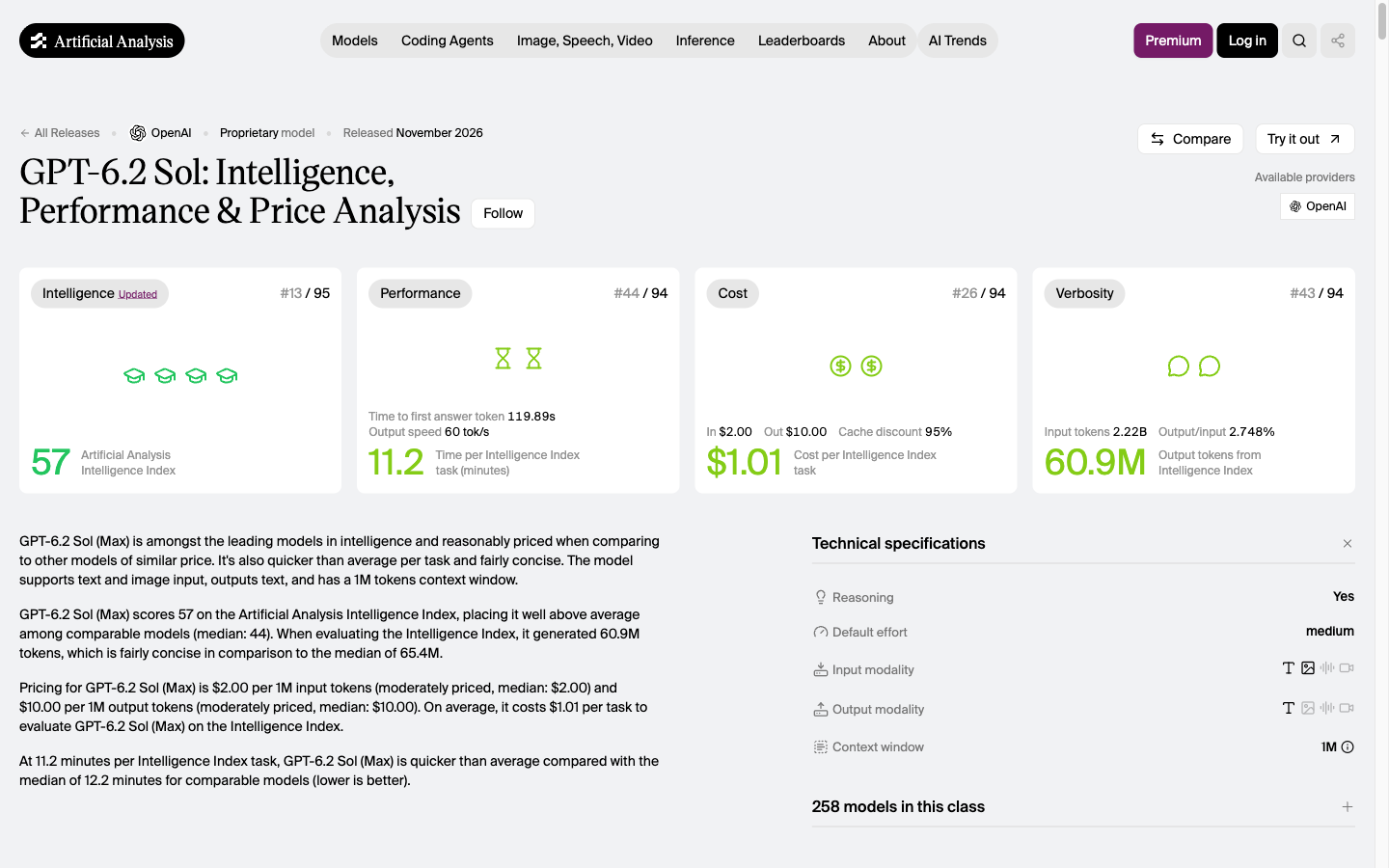
There is also a more specific reason to try Astra for interactive design. Artificial Analysis’s November 17 release analysis gives Astra 1,318 on AA-3D against Sol’s 1,259; people grade the interactive 3D experiences. That supports testing Astra for this kind of deliverable, while leaving ordinary writing and coding decisions open. Source: Artificial Analysis release evaluation.
OpenAI’s own coding result is closer. It reports Sol within 0.5 points of Astra on FrontierCode 2.0 at about one-fifth the cost, with both at max effort. That evaluation asks whether code changes meet maintainers’ merge standards. It is a vendor-reported result for that setup, not proof that the two models are interchangeable across repositories. Source: OpenAI’s GPT-6.2 announcement.
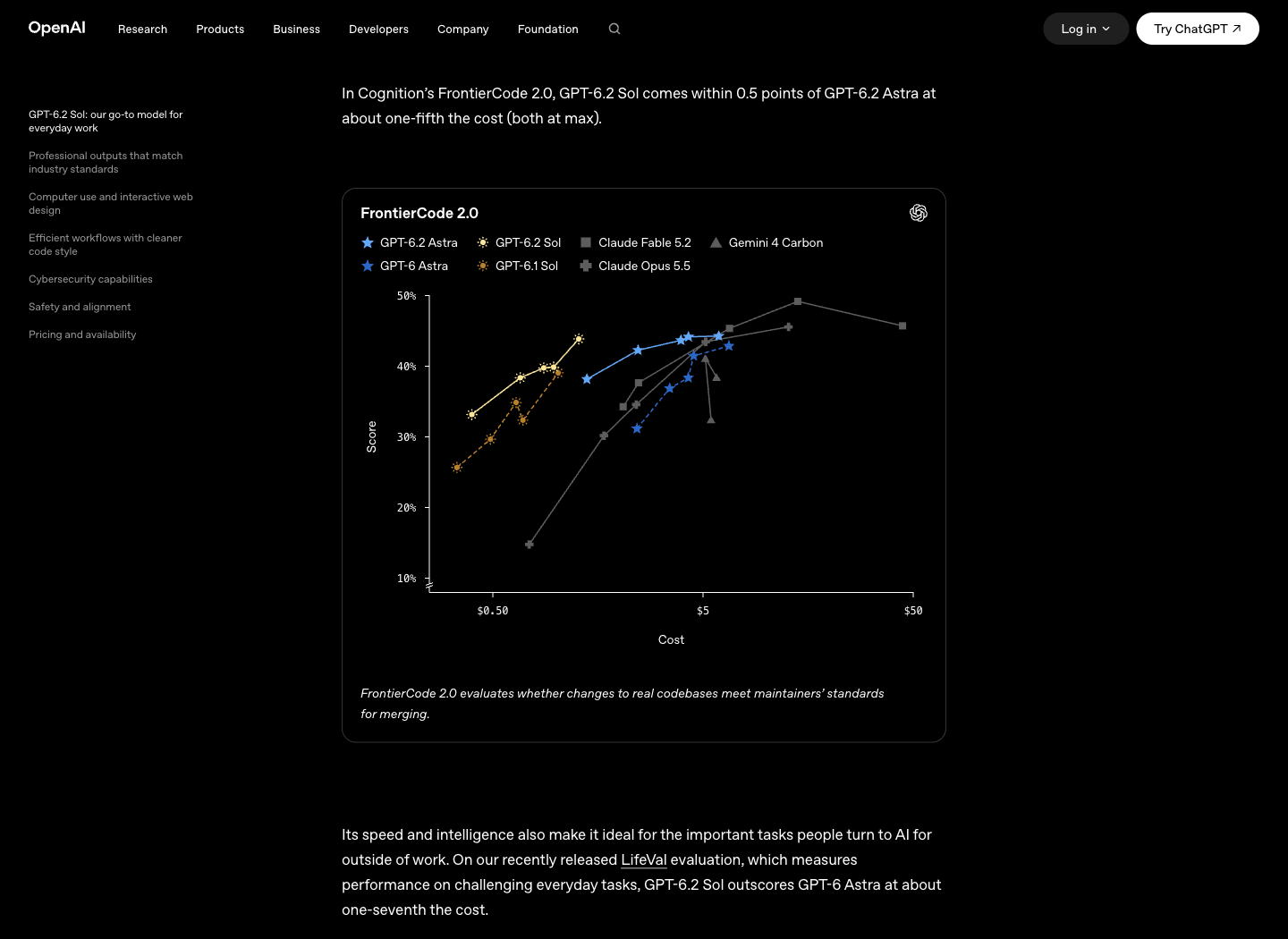
The independent and vendor figures can both be useful because they ask different questions. Broad capability favors trying Astra on difficult work; the close coding result argues for measuring whether Sol already clears your own checks. Neither establishes a universal winner.
Hands-on comparison: which output is ready to use?
GlobalGPT text-task case study · November 27, 2026. We gave both models the same three fictional tasks, requested medium reasoning and an 8,192-token completion ceiling, and assessed the first completed response. Six responses completed without retries or truncation. No browsing or model-side tools were used. We independently checked the submitted code after generation; the models did not execute it.
Result: a tie on the registered task-quality checks. Both models corrected the budget, returned code that passed the predefined checks and preserved the launch dependencies. These examples show why Sol can be sufficient; they do not prove the models have equal capability on harder work.
Times below include service and network variability. Reported completion tokens are provider metadata; detailed reasoning counts were zero, which does not establish the absence of internal reasoning or independently confirm native effort behavior. There were no repeat runs. Token-cost illustrations apply official Standard short-context list rates to reported usage, excluding tools and extra charges; actual platform charges were not exposed.
Budget audit: catch the duplicate and reject a misleading trend
Both returned $6,326.00 after removing duplicate C003, subtracting the $125 refund and excluding the September entries. The required $180 editing package fits; adding the optional $420 upgrade too would exceed the $6,800 cap by $126. Both explained why a partial September extract cannot establish a full-month trend.
First response | Astra | Sol |
|---|---|---|
Task quality | All material checks passed | All material checks passed |
Observed wall time | 8.776 s | 8.765 s |
Reported input tokens | 546 | 546 |
Reported completion tokens | 418 | 408 |
Official-rate cost illustration | $0.021088 | $0.005172 |
Practical verdict: Sol met the same acceptance bar here. Paying for Astra did not buy an observed correctness improvement.
View exact prompt and supplied input
SYSTEM:
Complete the supplied task using only the information provided. Do not browse or claim to have run tools. Give the requested deliverable, not hidden reasoning. Do not invent missing facts.

USER:
You manage the fictional Northline outdoor campaign. Audit this ledger, then give a short decision memo. All amounts are USD. An identical transaction ID repeated with identical values is an accidental duplicate: keep its first occurrence. A refund row contains a positive refund magnitude that must be subtracted from that channel. October is the month being decided; September rows are a partial extract, not a full-month comparator. No other transactions exist in this supplied October ledger.

transaction_id,month,channel,amount,kind
C001,2026-10,Search,1480.50,ordinary
C002,2026-10,Social,965.25,ordinary
C003,2026-10,Creator,2100.00,ordinary
C004,2026-10,Editing,640.80,ordinary
C005,2026-10,Search,319.50,ordinary
C006,2026-10,Social,440.00,ordinary
C007,2026-10,Creator,375.00,ordinary
C008,2026-10,Editing,129.95,ordinary
C009,2026-10,Creator,125.00,refund
C003,2026-10,Creator,2100.00,ordinary
C010,2026-09,Search,1650.00,ordinary
C011,2026-09,Social,1190.00,ordinary

October spending cap: $6,800.00. A necessary additional editing package costs $180.00. An optional social distribution upgrade costs $420.00. Decide which of these two additions can fit together within the cap. Do not infer campaign returns, conversions, or a September growth rate.

Return a JSON object, without markdown fences, with:
- october_net_by_channel: Search, Social, Creator, Editing, each a two-decimal string;
- october_total, remaining_before_additions, total_with_editing, remaining_after_editing, total_with_both, over_cap_with_both: two-decimal strings;
- duplicate_ids: array; excluded_previous_month_ids: array; refund_ids: array;
- approved_additions: array using only "editing" and "social";
- memo: 100–140 English words explaining the correction, the decision and why a September growth comparison is invalid. The required editing package takes priority. Do not present a proposed purchase as an executed one.
View full GPT 6.2 astra output
{
  "october_net_by_channel": {
    "Search": "1800.00",
    "Social": "1405.25",
    "Creator": "2350.00",
    "Editing": "770.75"
  },
  "october_total": "6326.00",
  "remaining_before_additions": "474.00",
  "total_with_editing": "6506.00",
  "remaining_after_editing": "294.00",
  "total_with_both": "6926.00",
  "over_cap_with_both": "126.00",
  "duplicate_ids": ["C003"],
  "excluded_previous_month_ids": ["C010", "C011"],
  "refund_ids": ["C009"],
  "approved_additions": ["editing"],
  "memo": "Approve the required editing package and defer the optional social upgrade. October net spending is $6,326.00 after counting only the first C003 charge and subtracting the $125.00 C009 refund from Creator spending. That leaves $474.00 under the $6,800.00 cap. The $180.00 editing package takes priority and would bring spending to $6,506.00, leaving $294.00. Although the $420.00 social upgrade would fit on its own, it would not fit alongside editing: the two additions would bring spending to $6,926.00, or $126.00 over the cap. C010 and C011 belong to September and are excluded from October. They represent only a partial September extract, so they cannot establish a full-month baseline for a growth comparison."
}
View full GPT 6.2 sol output
{
  "october_net_by_channel": {
    "Search": "1800.00",
    "Social": "1405.25",
    "Creator": "2350.00",
    "Editing": "770.75"
  },
  "october_total": "6326.00",
  "remaining_before_additions": "474.00",
  "total_with_editing": "6506.00",
  "remaining_after_editing": "294.00",
  "total_with_both": "6926.00",
  "over_cap_with_both": "126.00",
  "duplicate_ids": ["C003"],
  "excluded_previous_month_ids": ["C010", "C011"],
  "refund_ids": ["C009"],
  "approved_additions": ["editing"],
  "memo": "October net spending is $6,326.00 after keeping the first C003 entry, removing its identical duplicate, and subtracting the $125.00 C009 refund from Creator spending. The two September entries are excluded from the October audit. Approve the required $180.00 editing package, which would bring October spending to $6,506.00 and leave $294.00 under the cap. Do not approve the optional $420.00 social upgrade: adding it alongside editing would bring spending to $6,926.00, exceeding the cap by $126.00. The upgrade fits on its own, but it cannot displace the required editing package. A September growth comparison is invalid because the September rows are only a partial extract, not a full-month spending baseline."
}
Code repair: correct money rounding and input validation
Both implementations used Decimal and round-half-up, checked numeric spelling and quantity boundaries, and preserved the input data. Each passed all 74 independent cases: six valid and 68 invalid inputs. Astra returned its response in 22.341 seconds with 1,388 completion tokens; Sol took 43.281 seconds with 2,530. Astra adjusted decimal precision while processing lines; Sol validated and collected the items before calculation.
First response | Astra | Sol |
|---|---|---|
Task quality | 74/74 predefined cases passed | 74/74 predefined cases passed |
Observed wall time | 22.341 s | 43.281 s |
Reported input tokens | 510 | 510 |
Reported completion tokens | 1388 | 2530 |
Official-rate cost illustration | $0.059600 | $0.026320 |
Practical verdict: Astra produced a shorter, faster response in this run, while both passed the same checks. Even with fewer tokens, Astra’s list-rate illustration remained higher. This was a function repair, not a repository-level engineering test.
View exact prompt and supplied input
SYSTEM:
Complete the supplied task using only the information provided. Do not browse or claim to have run tools. Give the requested deliverable, not hidden reasoning. Do not invent missing facts.

USER:
Repair this supplied Python function. Return JSON only with keys "code" (a complete Python source string containing calculate_invoice), "tests" (a source string of your suggested tests), and "explanation" (60–100 English words).

Old implementation:
def calculate_invoice(lines, discount_pct="0", shipping="0"):
    subtotal = sum(float(line["unit_price"]) * line["quantity"] for line in lines)
    discount = round(subtotal * float(discount_pct) / 100, 2)
    return {"subtotal": str(round(subtotal, 2)), "discount": str(discount),
            "total": str(round(subtotal - discount + float(shipping), 2))}

The complete required contract:
1. lines must be a nonempty list of dictionaries with exactly unit_price and quantity. No extra/missing keys. A dictionary item cannot be replaced by a list or other type.
2. unit_price, discount_pct, shipping must be strings containing ASCII digits and at most one optional dot followed by 1–4 digits. Leading zeros are allowed; whitespace, sign characters, exponent notation, NaN, Infinity, empty strings, floats, ints and booleans are invalid. Values must be nonnegative. A decimal point requires digits on both sides.
3. quantity must be an int from 1 through 1000 inclusive; bool is invalid. unit_price has no explicit maximum. discount_pct must be between 0 and 25 inclusive; shipping at most 500 inclusive.
4. Use decimal.Decimal, never binary floating point. Round each unit_price times quantity line total to cents with ROUND_HALF_UP, then sum rounded line totals. Apply percentage discount to that subtotal and round the discount to cents with ROUND_HALF_UP. Round shipping separately to cents with ROUND_HALF_UP. total = rounded subtotal - rounded discount + rounded shipping.
5. Return exactly subtotal, discount, shipping and total, all decimal strings with two digits after the decimal point. Raise ValueError for every invalid input rather than leaking a different exception. Do not mutate supplied arguments. Standard-library imports are allowed; no file, network, process, environment or external-package access.

Examples are intentionally not given: implement all rules, not a few demonstration cases. Keep the solution self-contained and avoid unrelated features.
View full GPT 6.2 astra output
{
  "code": "import re\nfrom decimal import Context, Decimal, MAX_EMAX, MIN_EMIN, ROUND_HALF_UP, localcontext\n\n\n_AMOUNT = re.compile(r'[0-9]+(?:\\.[0-9]{1,4})?')\n_CENT = Decimal('0.01')\n\n\ndef _amount(value):\n    if not isinstance(value, str) or _AMOUNT.fullmatch(value) is None:\n        raise ValueError('expected an unsigned decimal string with at most four fractional digits')\n    return Decimal(value)\n\n\ndef calculate_invoice(lines, discount_pct='0', shipping='0'):\n    if not isinstance(lines, list) or not lines:\n        raise ValueError('lines must be a nonempty list')\n    rate = _amount(discount_pct)\n    freight = _amount(shipping)\n    if rate > 25 or freight > 500:\n        raise ValueError('discount or shipping exceeds its limit')\n\n    # Allow for quantity, summation carry, cents, and the six-digit rate coefficient.\n    headroom = len(str(len(lines))) + 16\n    context = Context(prec=headroom, rounding=ROUND_HALF_UP, Emin=MIN_EMIN, Emax=MAX_EMAX, traps=[], clamp=0)\n    with localcontext(context) as ctx:\n        subtotal = Decimal('0.00')\n        for line in lines:\n            if not isinstance(line, dict) or line.keys() != {'unit_price', 'quantity'}:\n                raise ValueError('each line must contain exactly unit_price and quantity')\n            quantity = line['quantity']\n            if isinstance(quantity, bool) or not isinstance(quantity, int) or not 1 <= quantity <= 1000:\n                raise ValueError('quantity must be an integer from 1 to 1000')\n            text = line['unit_price']\n            price = _amount(text)\n            ctx.prec = max(ctx.prec, len(text) + headroom)\n            subtotal += (price * quantity).quantize(_CENT)\n\n        discount = (subtotal * rate / 100).quantize(_CENT)\n        shipping_amount = freight.quantize(_CENT)\n        total = subtotal - discount + shipping_amount\n        return {'subtotal': format(subtotal, 'f'), 'discount': format(discount, 'f'),\n                'shipping': format(shipping_amount, 'f'), 'total': format(total, 'f')}\n",
  "tests": "import unittest\nfrom copy import deepcopy\nfrom decimal import Inexact, localcontext\nfrom invoice import calculate_invoice\n\n\ndef line(price='1', quantity=1):\n    return {'unit_price': price, 'quantity': quantity}\n\n\nclass InvoiceTests(unittest.TestCase):\n    def test_rounding_stages(self):\n        lines = [line('00.0025', 2), line('0.005')]\n        original = deepcopy(lines)\n        self.assertEqual(calculate_invoice(lines, '025.0000', '0.005'),\n                         {'subtotal': '0.02', 'discount': '0.01', 'shipping': '0.01', 'total': '0.02'})\n        self.assertEqual(lines, original)\n\n    def test_precision_and_defaults(self):\n        digits = '9' * 100\n        with localcontext() as ctx:\n            ctx.prec = 2\n            ctx.traps[Inexact] = True\n            self.assertEqual(calculate_invoice([line(digits, 1000)]),\n                             {'subtotal': digits + '000.00', 'discount': '0.00',\n                              'shipping': '0.00', 'total': digits + '000.00'})\n            self.assertEqual(calculate_invoice([line('0')], shipping='0500.0000')['total'], '500.00')\n\n    def test_structure(self):\n        for lines in (None, [], (line(),), [None], [['unit_price', 'quantity']], [{}],\n                      [{'unit_price': '2'}], [{'quantity': 1}], [dict(line(), other=0)]):\n            with self.subTest(lines=lines), self.assertRaises(ValueError):\n                calculate_invoice(lines)\n\n    def test_amount_syntax(self):\n        for bad in ('', ' 1', '1\\n', '+1', '-0', '1e0', 'NaN', 'Infinity', '.5', '5.',\n                    '1.2.3', '1.00000', '1', '1.٢', 1.0, 1, True, None):\n            for args in (([line(bad)],), ([line()], bad), ([line()], '0', bad)):\n                with self.subTest(args=args), self.assertRaises(ValueError):\n                    calculate_invoice(*args)\n\n    def test_bounds(self):\n        for bad in (0, -1, 1001, True, False, '1', 1.0, None):\n            with self.subTest(quantity=bad), self.assertRaises(ValueError):\n                calculate_invoice([line(quantity=bad)])\n        for rate, shipping in [('25.0001', '0'), ('0', '500.0001')]:\n            with self.assertRaises(ValueError):\n                calculate_invoice([line()], rate, shipping)\n",
  "explanation": "The function validates each amount’s spelling before converting it to Decimal, so leading zeros are accepted without admitting signs, whitespace, or non-ASCII digits. It rounds each extended line price before summing, then rounds the discount and shipping independently. A private decimal context keeps caller precision and rounding settings from changing the result, and its precision grows with the price length. The tests assume the implementation is saved as invoice.py and cover rounding ties, large prices, input boundaries, and malformed records."
}
View full GPT 6.2 sol output
{
  "code": "import re\nfrom decimal import (\n    Context, Decimal, DivisionByZero, InvalidOperation, MAX_EMAX,\n    MIN_EMIN, Overflow, ROUND_HALF_UP, localcontext,\n)\n\n_DECIMAL_TEXT = re.compile(r'[0-9]+(?:\\.[0-9]{1,4})?')\n_CENT = Decimal('0.01')\n\n\ndef _parse_decimal(value, field):\n    if not isinstance(value, str) or _DECIMAL_TEXT.fullmatch(value) is None:\n        raise ValueError(f'{field} must be a nonnegative ASCII decimal string')\n    return Decimal(value)\n\n\ndef calculate_invoice(lines, discount_pct='0', shipping='0'):\n    if not isinstance(lines, list) or not lines:\n        raise ValueError('lines must be a nonempty list')\n\n    discount_rate = _parse_decimal(discount_pct, 'discount_pct')\n    shipping_amount = _parse_decimal(shipping, 'shipping')\n    if discount_rate > 25:\n        raise ValueError('discount_pct must not exceed 25')\n    if shipping_amount > 500:\n        raise ValueError('shipping must not exceed 500')\n\n    items = []\n    max_price_width = 0\n    for line in lines:\n        if not isinstance(line, dict) or line.keys() != {'unit_price', 'quantity'}:\n            raise ValueError('each line must be a dictionary with exactly unit_price and quantity')\n        quantity = line['quantity']\n        if isinstance(quantity, bool) or not isinstance(quantity, int) or not 1 <= quantity <= 1000:\n            raise ValueError('quantity must be an integer from 1 through 1000')\n        price_text = line['unit_price']\n        price = _parse_decimal(price_text, 'unit_price')\n        items.append((price, quantity))\n        max_price_width = max(max_price_width, len(price_text))\n\n    # Allow for quantity, accumulation, and the percentage product before rounding.\n    precision = max_price_width + len(str(len(items))) + 16\n    context = Context(prec=precision, rounding=ROUND_HALF_UP, Emin=MIN_EMIN,\n                      Emax=MAX_EMAX, clamp=0,\n                      traps=[InvalidOperation, DivisionByZero, Overflow])\n    with localcontext(context):\n        subtotal = Decimal('0.00')\n        for price, quantity in items:\n            subtotal += (price * quantity).quantize(_CENT)\n        discount = (subtotal * discount_rate / 100).quantize(_CENT)\n        rounded_shipping = shipping_amount.quantize(_CENT)\n        total = subtotal - discount + rounded_shipping\n        return {\n            'subtotal': format(subtotal, '.2f'),\n            'discount': format(discount, '.2f'),\n            'shipping': format(rounded_shipping, '.2f'),\n            'total': format(total, '.2f'),\n        }\n",
  "tests": "import unittest\nfrom decimal import Inexact, ROUND_DOWN, localcontext\n\nfrom invoice import calculate_invoice\n\n\nclass InvoiceTests(unittest.TestCase):\n    def test_line_discount_and_shipping_ties(self):\n        lines = [{'unit_price': '000.0050', 'quantity': 1} for _ in range(2)]\n        self.assertEqual(calculate_invoice(lines, '25.0000', '0.005'), {\n            'subtotal': '0.02', 'discount': '0.01',\n            'shipping': '0.01', 'total': '0.02',\n        })\n        self.assertEqual(lines, [{'unit_price': '000.0050', 'quantity': 1}] * 2)\n\n    def test_multiply_before_rounding_and_inclusive_limits(self):\n        lines = [{'unit_price': '0.0049', 'quantity': 3},\n                 {'unit_price': '0.001', 'quantity': 1000}]\n        self.assertEqual(calculate_invoice(lines, shipping='500.0000'), {\n            'subtotal': '1.01', 'discount': '0.00',\n            'shipping': '500.00', 'total': '501.01',\n        })\n\n    def test_zero_and_defaults(self):\n        self.assertEqual(calculate_invoice([{'unit_price': '000', 'quantity': 1}]), {\n            'subtotal': '0.00', 'discount': '0.00',\n            'shipping': '0.00', 'total': '0.00',\n        })\n\n    def test_large_price_and_caller_context(self):\n        with localcontext() as ctx:\n            ctx.prec = 2\n            ctx.Emax = 9\n            ctx.rounding = ROUND_DOWN\n            ctx.traps[Inexact] = True\n            result = calculate_invoice([{'unit_price': '9' * 80 + '.995', 'quantity': 1}], '25')\n            self.assertEqual(ctx.prec, 2)\n            self.assertFalse(ctx.flags[Inexact])\n        self.assertEqual(result, {\n            'subtotal': '1' + '0' * 80 + '.00',\n            'discount': '25' + '0' * 78 + '.00',\n            'shipping': '0.00',\n            'total': '75' + '0' * 78 + '.00',\n        })\n\n    def test_invalid_line_structures(self):\n        line = {'unit_price': '1', 'quantity': 1}\n        for value in (None, [], line, (line,), [None], [[('unit_price', '1'), ('quantity', 1)]],\n                      [{'quantity': 1}], [{'unit_price': '1'}], [dict(line, extra=0)]):\n            with self.subTest(value=value):\n                with self.assertRaises(ValueError):\n                    calculate_invoice(value)\n\n    def test_invalid_decimal_inputs_in_all_fields(self):\n        line = {'unit_price': '1', 'quantity': 1}\n        for value in ('', ' 1', '1\\n', '+1', '-0', '1e1', 'NaN', 'Infinity',\n                      '.1', '1.', '1.00000', '1.2.3', '١', '1.٢', 1, 1.0, True, None):\n            for field in ('unit_price', 'discount_pct', 'shipping'):\n                with self.subTest(field=field, value=value):\n                    with self.assertRaises(ValueError):\n                        if field == 'unit_price':\n                            calculate_invoice([dict(line, unit_price=value)])\n                        else:\n                            calculate_invoice([line], **{field: value})\n\n    def test_invalid_quantities_and_amount_limits(self):\n        for value in (False, True, 0, -1, 1001, '1', 1.0, None):\n            with self.subTest(quantity=value):\n                with self.assertRaises(ValueError):\n                    calculate_invoice([{'unit_price': '1', 'quantity': value}])\n        for kwargs in ({'discount_pct': '25.0001'}, {'shipping': '500.0001'}):\n            with self.subTest(**kwargs):\n                with self.assertRaises(ValueError):\n                    calculate_invoice([{'unit_price': '1', 'quantity': 1}], **kwargs)\n\n\nif __name__ == '__main__':\n    unittest.main()\n",
  "explanation": "The function validates decimal strings before conversion and checks line structure, quantities, and amount limits explicitly. A private Decimal context sizes precision from the longest price and the number of lines, so large prices do not lose digits before rounding and caller settings do not affect the result. Each line is rounded before summation, then discount and shipping are rounded separately. The tests cover rounding ties, malformed inputs, inclusive limits, and arithmetic under a restrictive caller context."
}
Launch planning: protect the required version when a release is late
Both kept recording blocked on a missing signed performer release and allowed independent script/legal work to proceed. With the release on Day 5, both languages finish on Day 12. With it on Day 7, mandatory English finishes on Day 14 while French can finish on Day 12. Both rejected substituting French for the required English launch and retained legal review and QA.
First response | Astra | Sol |
|---|---|---|
Task quality | All material checks passed | All material checks passed |
Observed wall time | 11.008 s | 11.961 s |
Reported input tokens | 490 | 490 |
Reported completion tokens | 649 | 676 |
Official-rate cost illustration | $0.029880 | $0.007740 |
Practical verdict: Sol preserved the critical dependencies as well as Astra. Neither response invented a signed release or claimed the plan had been executed.
View exact prompt and supplied input
SYSTEM:
Complete the supplied task using only the information provided. Do not browse or claim to have run tools. Give the requested deliverable, not hidden reasoning. Do not invent missing facts.

USER:
Create an executable planning brief for a fictional museum audio-guide launch. Today is Day 0. Days are consecutive working-day units, not calendar dates. A task of duration n starting at day s finishes at s+n; a successor may start immediately at its prerequisite finish. Unlimited parallel staff is available except explicit dependencies. Day 12 is a hard launch deadline. The sponsor wants both the English launch and the optional French version; English is mandatory.

Known tasks:
- S: script revision, duration 2, no prerequisites, can start Day 0.
- L: legal script approval, duration 3, requires S.
- R: English recording, duration 2, requires L and the signed performer release.
- E: English editing, duration 2, requires R.
- Q: English accessibility QA, duration 2, requires E.
- P: publish preparation, duration 1, requires Q.
- F: French translation, duration 3, requires L.
- V: French recording, duration 2, requires F and the signed performer release.
- X: French QA/package, duration 2, requires V.

The performer release is mandatory and is NOT in the supplied materials. Its arrival day is unknown; do not assume it has arrived. Scenario A: the sponsor supplies the signed release at Day 5. Scenario B: it arrives at Day 7. English launch is ready after P; French is ready after X. Publishing cannot happen before all mandatory approvals. Do not fabricate an external action, notification, signed release, or completed task.

Return JSON only:
- blocked_now: boolean;
- missing_input: short string;
- scenarios: keys A and B, each containing release_day, schedule mapping each task ID to [start,finish], english_ready_day, french_ready_day, english_on_time, french_on_time;
- latest_release_day_for_english_deadline: integer;
- recommendation: 100–140 English words distinguishing the actual current blocker from conditional plans, recommending a sensible delivery path without dropping the required release or QA;
- sponsor_message: 60–90 English words requesting the precise missing input and communicating the deadline consequence. Do not say the message was sent.
View full GPT 6.2 astra output
{
  "blocked_now": true,
  "missing_input": "Signed performer release required for English and French recording.",
  "scenarios": {
    "A": {
      "release_day": 5,
      "schedule": {
        "S": [0, 2],
        "L": [2, 5],
        "R": [5, 7],
        "E": [7, 9],
        "Q": [9, 11],
        "P": [11, 12],
        "F": [5, 8],
        "V": [8, 10],
        "X": [10, 12]
      },
      "english_ready_day": 12,
      "french_ready_day": 12,
      "english_on_time": true,
      "french_on_time": true
    },
    "B": {
      "release_day": 7,
      "schedule": {
        "S": [0, 2],
        "L": [2, 5],
        "R": [7, 9],
        "E": [9, 11],
        "Q": [11, 13],
        "P": [13, 14],
        "F": [5, 8],
        "V": [8, 10],
        "X": [10, 12]
      },
      "english_ready_day": 14,
      "french_ready_day": 12,
      "english_on_time": false,
      "french_on_time": true
    }
  },
  "latest_release_day_for_english_deadline": 5,
  "recommendation": "The signed performer release is missing. It blocks recording, not script revision: start revision on Day 0, submit the revised script for legal approval on Day 2, and begin French translation once legal approval is complete. Request the signed release now and target receipt by Day 5. If it arrives on Day 5, start English recording immediately after approval and run the French work in parallel; both versions can be ready on Day 12. If it arrives on Day 7, retain both QA steps and plan for English readiness on Day 14. French can still be ready on Day 12, but it cannot substitute for the mandatory English launch.",
  "sponsor_message": "Please supply the signed performer release required for English and French recording by Day 5. An expected delivery date would help us plan, but recording requires the signed release itself. Day 5 is the latest receipt that keeps the mandatory English launch on schedule for Day 12. If the release arrives on Day 7, French can still be ready on Day 12, but English will not be ready until Day 14."
}
View full GPT 6.2 sol output
{
  "blocked_now": true,
  "missing_input": "Signed performer release",
  "scenarios": {
    "A": {
      "release_day": 5,
      "schedule": {
        "S": [0, 2],
        "L": [2, 5],
        "R": [5, 7],
        "E": [7, 9],
        "Q": [9, 11],
        "P": [11, 12],
        "F": [5, 8],
        "V": [8, 10],
        "X": [10, 12]
      },
      "english_ready_day": 12,
      "french_ready_day": 12,
      "english_on_time": true,
      "french_on_time": true
    },
    "B": {
      "release_day": 7,
      "schedule": {
        "S": [0, 2],
        "L": [2, 5],
        "R": [7, 9],
        "E": [9, 11],
        "Q": [11, 13],
        "P": [13, 14],
        "F": [5, 8],
        "V": [8, 10],
        "X": [10, 12]
      },
      "english_ready_day": 14,
      "french_ready_day": 12,
      "english_on_time": false,
      "french_on_time": true
    }
  },
  "latest_release_day_for_english_deadline": 5,
  "recommendation": "The signed performer release is missing. It blocks recording in both languages, but it does not prevent script revision or legal approval. Start script revision on Day 0, route the revised script to legal on Day 2, and start French translation once legal approval is complete. Request the signed release by Day 5, the last day that preserves the mandatory English deadline. If it arrives on Day 5, proceed with both versions in parallel; both can be ready on Day 12, with no schedule slack. If it arrives on Day 7, flag the missed English deadline: French can still be ready on Day 12, but it cannot replace English, which will be ready on Day 14. Keep all required approvals and QA intact.",
  "sponsor_message": "Please provide the signed performer release by Day 5 so we can start English recording as soon as legal script approval is complete. The release is not in the supplied materials, and neither recording can begin without it. Receipt on Day 5 keeps both versions on track for Day 12. If the release arrives on Day 7, French can still be ready on Day 12, but mandatory English will not be ready until Day 14."
}
These cases did not include a million-token context, visual input, a real codebase, live research or autonomous actions. The code checks cover the registered inputs, not every possible input. To establish a quality premium for your own work, test a case where Sol has a concrete difficulty and retain both the original failure and the Astra result.
GPT-6.2 Astra vs Sol pricing: what does the premium buy?
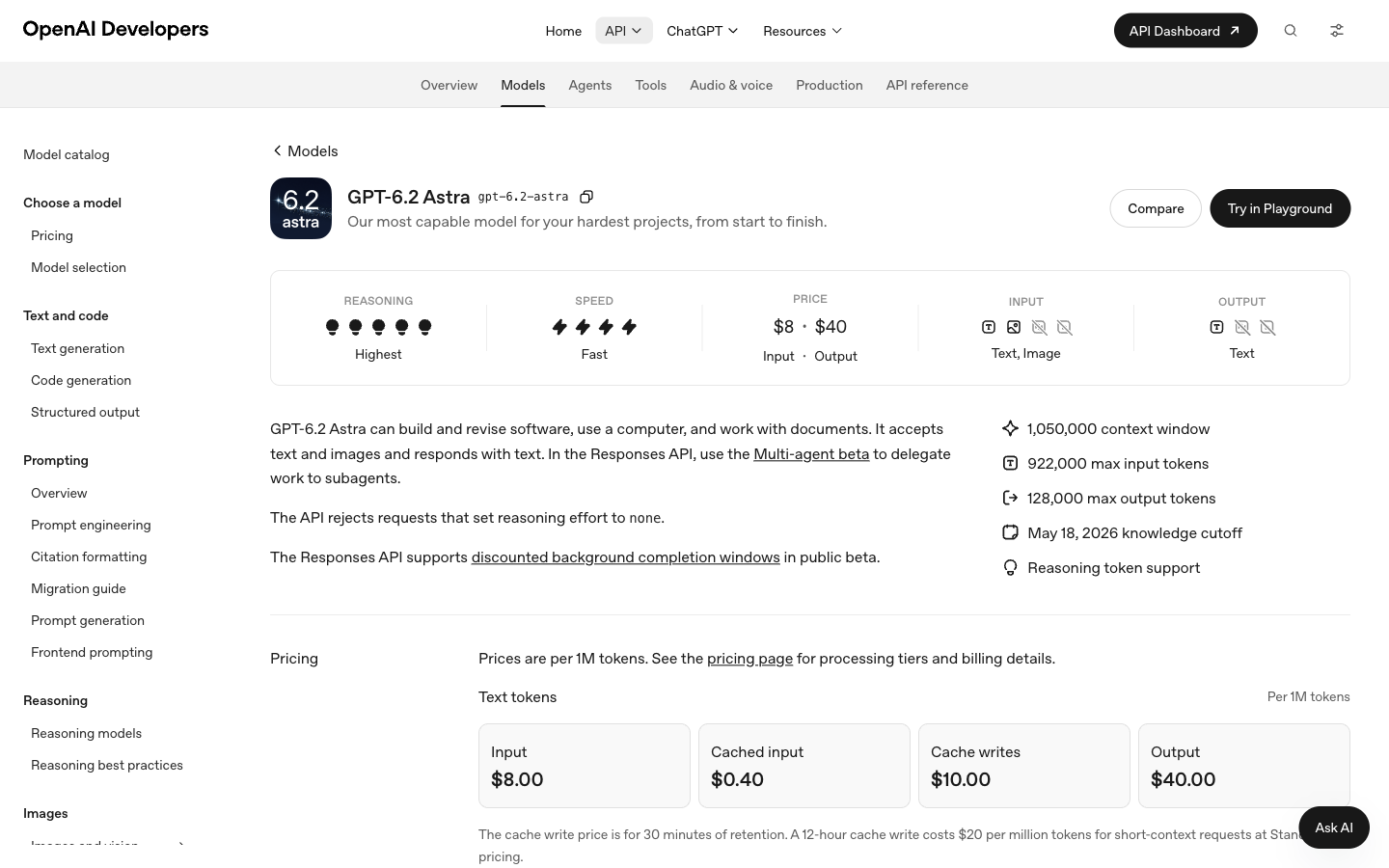
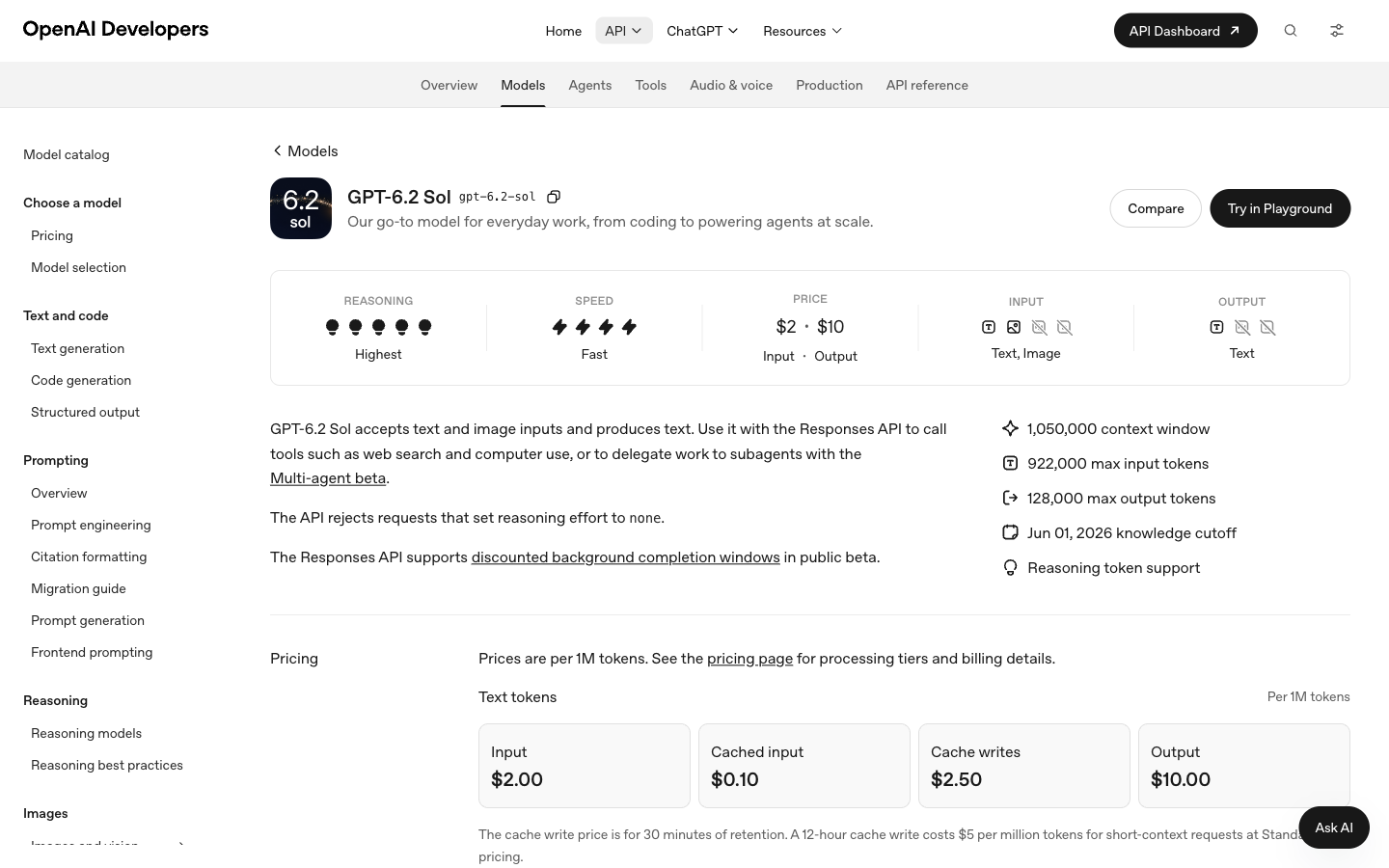
Here are OpenAI’s Standard API prices in US dollars per million tokens, checked November 27, 2026. Cached-input reads and cache writes are different charges. Source: OpenAI API rate card.
Standard API rate | Astra | Sol |
|---|---|---|
Input, short context | $8 | $2 |
Cached input, short context | $0.40 | $0.10 |
Output, short context | $40 | $10 |
Cache write, 30-minute retention | $10 | $2.50 |
Cache write, 12-hour retention | $20 | $5 |
Input above 272K input tokens | $16 | $4 |
Cached input above 272K input tokens | $0.80 | $0.20 |
Output above 272K input tokens | $60 | $15 |
Above 272K input tokens, the full request uses long-context rates from the same official rate card.
Batch costs half Standard and Fast twice Standard. API Ultrafast costs 3× through February 28, 2027, then 6× from March 1 (Pacific time).
A fixed-token example, not an actual task bill
For 10,000 uncached input tokens and 2,000 billed output tokens at Standard short-context rates, the arithmetic is $0.16 for Astra versus $0.04 for Sol. This excludes tools, cache writes and any additional billable reasoning. Multiply by 1,000 identical requests and those illustrative totals become $160 and $40.
Astra’s fourfold token rates do not guarantee a fourfold cost per completed job. Output length, reasoning, retries and caching change the bill. Nor does the price table show how much human review each response needs. Measure both.
A useful budget test is: Does the extra model cost buy a result you would otherwise spend time fixing? In the small example above, the premium is $0.12. At an illustrative review cost of $30 per hour, that equals about 14 seconds of work. This is a break-even calculation, not evidence that Astra saves those seconds. If both outputs pass your checks unchanged, Sol is the economical choice.
GlobalGPT pricing: a subscription for a wider workflow
The API table answers what it costs to call one model in software. A multi-model subscription serves a different need: ongoing access to writing, research, coding and media tools in one place. If those are recurring parts of your day, GlobalGPT is worth comparing alongside a direct API budget.
GlobalGPT plan | Monthly billing | Annual billing, monthly equivalent |
|---|---|---|
Basic | $8.90/month | $5.80/month equivalent |
Pro | $15/month | $10.80/month equivalent |
Unlimited | $37/month | $25/month equivalent |
These Black Friday prices were observed on November 27, 2026. The annual column is a monthly equivalent for annual billing, not a monthly charge. Offers can change; check checkout and renewal terms. Unlimited applies to selected models and conditions. Explore GlobalGPT models and plans.
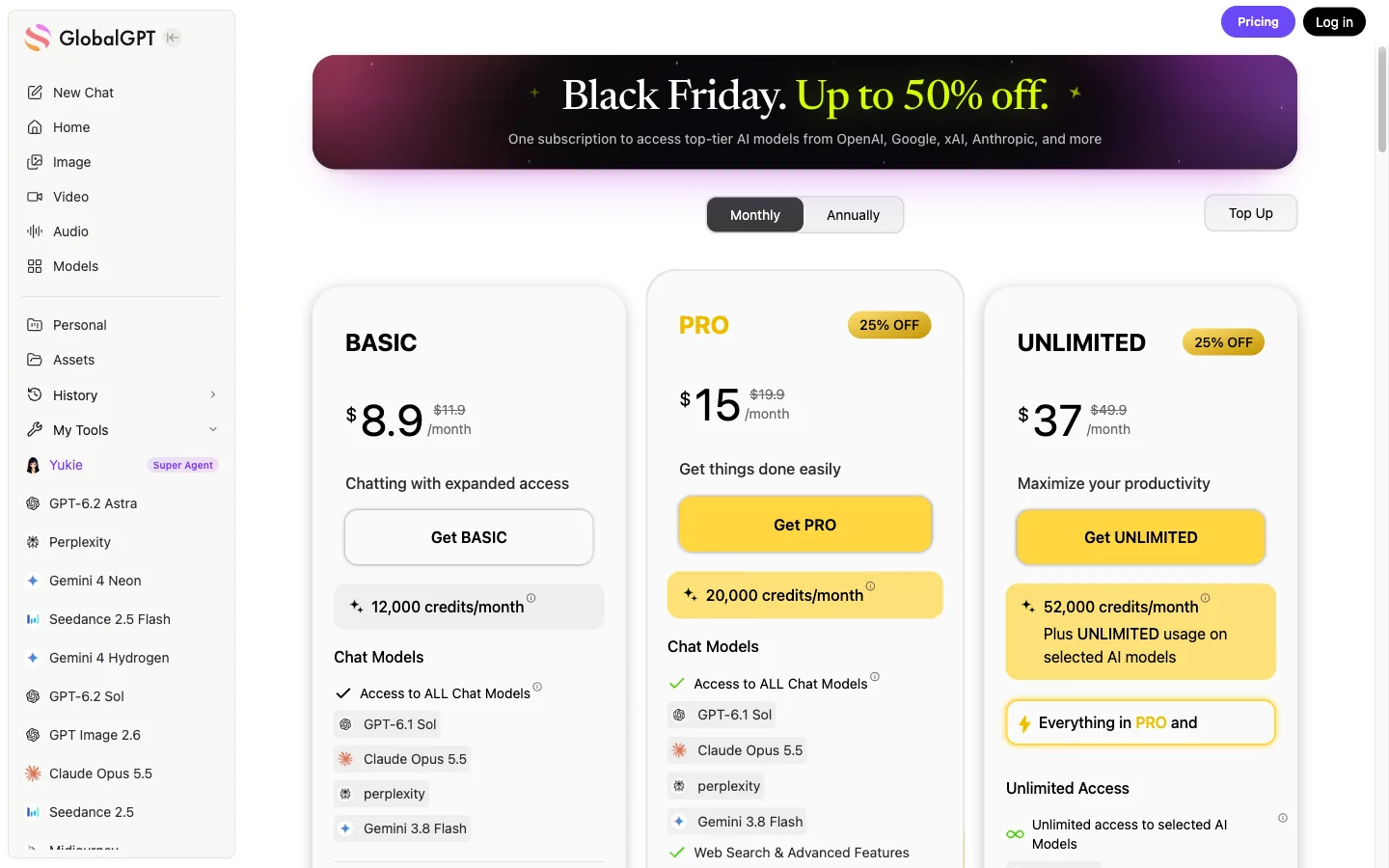
Choose monthly billing when you are still finding your routine. Consider annual billing when the tools already support work you repeat. Compare the plan’s actual model access and usage rules with that workload; a subscription price cannot be converted into an equivalent number of API tokens.
For example, a content project may need a research brief, a draft, a small code fix and an accompanying image. That is where the breadth of one workspace becomes useful. A production application with predictable programmatic calls still needs its own token budget. The two purchase decisions can coexist.
Where can you use the two models officially?
For a named Astra or Sol selection, open ChatGPT Work’s model picker or Codex’s model selector. Access depends on your plan, seat and workspace permissions. Codex CLI needs version 0.166.0 or later for these models. If a model is missing, check the selected experience, workspace permissions and app version first. Source: Work and Codex access help.
Regular Chat has separate choices: GPT-6.2 Instant and Thinking are not a named Astra/Sol selection. The Chat Pro option remains GPT-6 Pro; there is no GPT-6.2 Pro option in that picker.
Subscription prices are separate from API rates
Official plan | Published US price |
|---|---|
Plus | $20/month |
Pro | $100, $200 or $500/month |
Business | $20/user/month billed annually, 2+ users; $25/user/month billed monthly |
Enterprise / Edu | Contact sales |
OpenAI lists both GPT-6.2 models in Work and Codex on Plus, Pro, Business, Enterprise and Edu; Enterprise/Edu administrators must enable them. Its Plus local-message estimates per five hours are 6–50 for Astra and 17–180 for Sol. These are estimates, not fixed allowances; task size and tools change consumption, cloud tasks can use more, and weekly limits may apply. Source: official Codex pricing and usage (checked November 27).
Use the API when you need a programmatic integration and metered token billing. Use Work or Codex when you want their respective task environment. For a multi-model subscription covering more of your research and content workflow, explore GlobalGPT; developers can also read our connect GlobalGPT to your Codex workflow for the terminal workflow.
Before choosing a coding subscription, separate Codex plan costs from API billing. A larger subscription allowance and a higher-priced model answer different budget questions.
Put the comparison to work in GlobalGPT
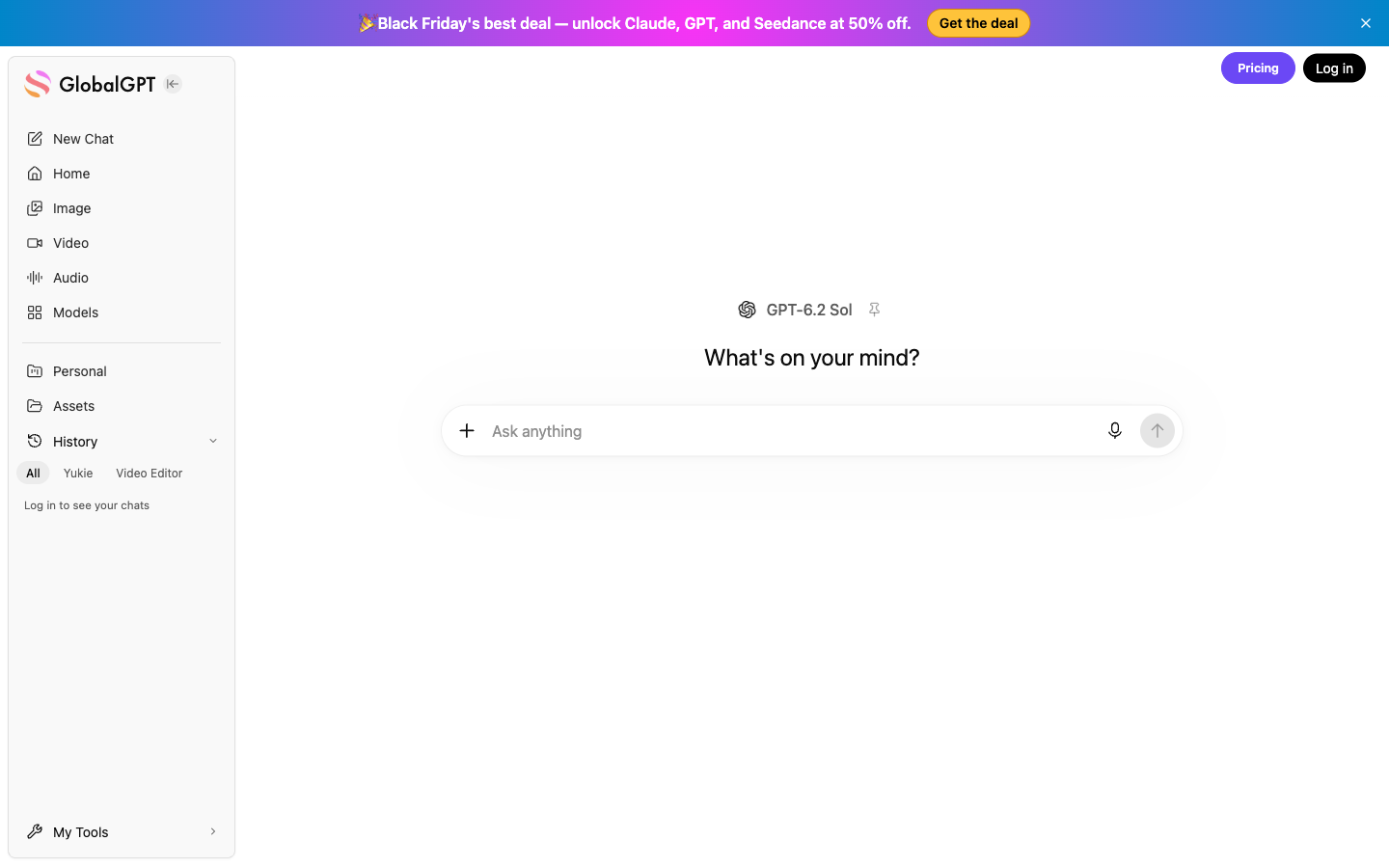
Start from a task you need to finish: a memo, a corrected calculation or a piece of code. Use Models in the sidebar to find your model, then enter your brief in the message box. Add the source material and acceptance checklist. Keep the brief if you try another model, so a change in instructions does not obscure the difference in the answers.
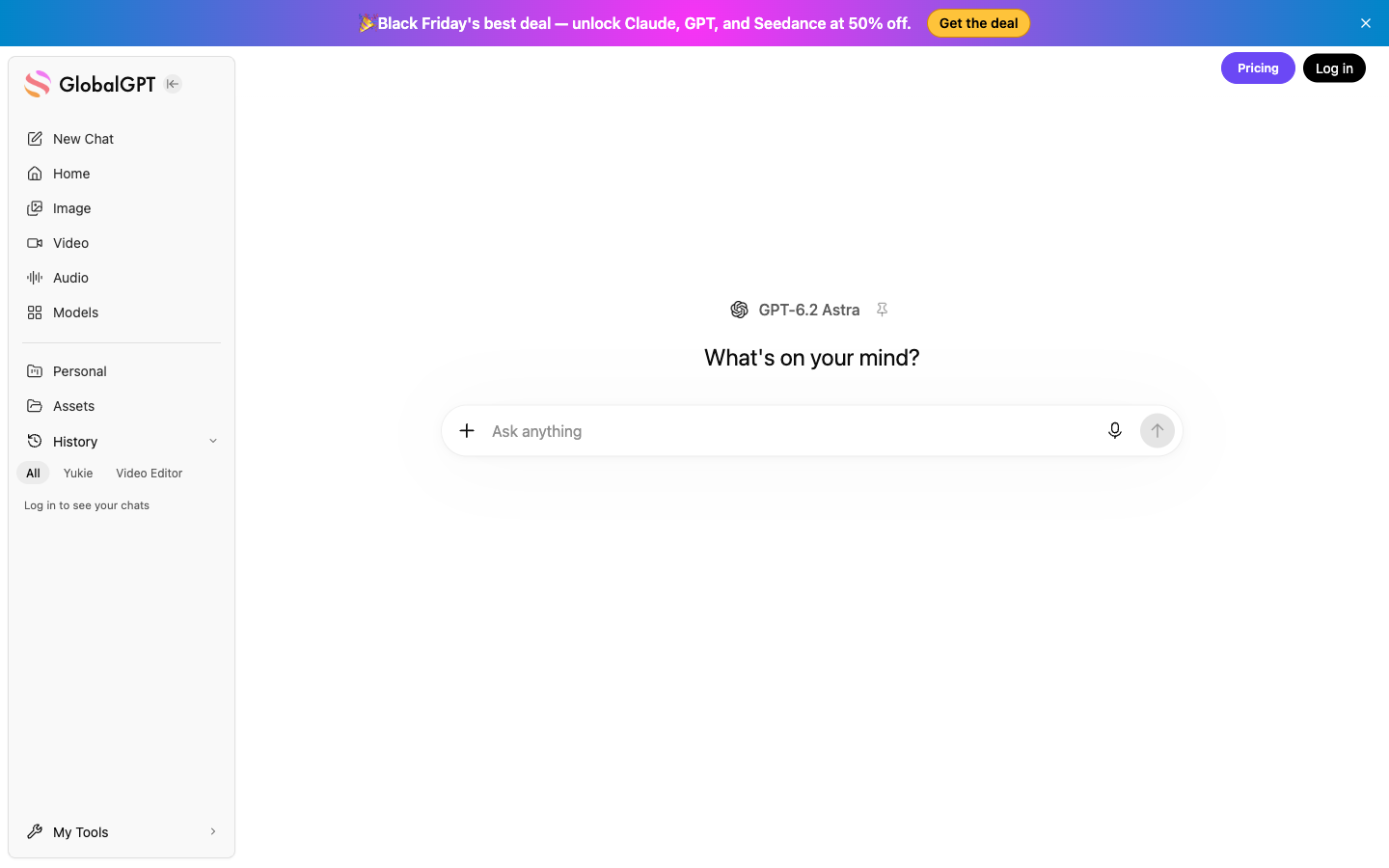
After reviewing the response, continue with the next tool your project needs. A research result can become a writing brief, and the finished copy may need an image or video. This is the practical reason to consider a multi-model workspace: the purchase supports the larger project, while Astra versus Sol remains a task-level choice.
If the next step is a finished brief rather than another model comparison, the Yukie launch-brief and revision example shows how to specify a deliverable and follow up with a focused change.
When is Astra worth choosing over Sol?
For context on the previous generation, see choosing between GPT-6.1 Sol and GPT-6 Astra; its prices and results belong to those older models.
Choose against a written acceptance checklist. Otherwise, the response with more confident wording can look better even when it misses an important condition. Start with the following task-based framework, then adjust it to the work you actually repeat.
Start with Sol: a clear brief, a draft you will review, a bounded bug fix or repeated work with objective checks.
Try Astra early: an ambiguous analysis, a complex design or a deliverable where several requirements must fit together and review is expensive.
Escalate after a specific failure: a missing dependency, incorrect assumption, failed boundary case or unsupported conclusion. Carry the original inputs and failed check into the next request.
Stay with Sol when it passes: a longer answer or more polished wording alone does not justify paying more if it adds no useful work.
A brief you can reuse for either model
Give both models the same source material and the same definition of done. This original template makes the result easier to assess:
Use only the supplied material to produce [deliverable] for [audience].
Requirements: [list every mandatory condition].
Check: [totals, boundaries, dependencies or source support].
If an essential input is missing, state what is missing and explain its effect.
Separate confirmed facts, assumptions and recommendations.
Keep the answer within [format and length].
Finish with a short list of checks I should perform before using it.A model’s own checklist is a useful handoff, but independently check the important items. For a recurring workflow, keep a few previously troublesome examples and run them again whenever you change models or reasoning settings.
Do not ask a stronger model to compensate for missing evidence. Supply the source documents, explain the audience and define what “done” means. For code, run tests; for numbers, check totals independently; for a decision memo, trace each important claim to its input. Those checks remain necessary whichever model you choose.
FAQ
Is GPT-6.2 Astra always better than Sol?
No. Astra has the higher broad independent Intelligence Index result, but that does not establish a win on every task. Start with Sol and compare the outputs against the requirements of your own work.
Is GPT-6.2 Sol four times cheaper?
Its Standard short-context API input and output token rates are one-quarter of Astra’s. End-to-end job costs also depend on token use, reasoning, tools, caching and retries.
Do Astra and Sol have the same API context window?
Yes; API capacity is equal. Interfaces may set other limits.
Where do I select Astra or Sol in ChatGPT?
Choose the named model in ChatGPT Work or Codex. Regular Chat uses different model choices, including GPT-6.2 Instant and Thinking.
Can either model generate audio or video natively?
Both produce text. Native audio/video output is unsupported.
Which should I use for coding?
Sol is a useful default for bounded work with tests. Try Astra for difficult engineering tasks when it improves the result against your acceptance criteria. Published benchmark results depend on the harness and effort setting.
Final verdict: pay for accepted work
The official guidance and published benchmarks support a practical starting point: Sol for the default, Astra for the difficult work that earns its premium. Define the result you need, check the first output, and evaluate the extra cost against the improvement. A higher model bill is worthwhile when it removes a meaningful obstacle to a usable deliverable.
In our three bounded tasks, both met the material requirements. Astra’s code response was shorter and faster in this run, but that did not establish a general quality advantage. For work like these examples, start with Sol; reserve the Astra trial for a task where the extra capability produces a demonstrable improvement.
For work that spans several models and creative functions, GlobalGPT offers a single place to build that workflow. Bring one real task and a clear checklist, then choose the approach that gets it ready to use.