MAGI-2 Pricing: What Does a Finished Video Actually Cost?
A 30-second MAGI-2 generation lists at $2.40. See how retries, trims and platform credits change the cost of a finished video.
 Sally Brooks

Quick Answer: What Does a Finished MAGI-2 Video Cost?
MAGI-2 costs $0.08 per second at 1080p on the Sand.ai API. One 10-second generation lists at $0.80 and one 30-second generation at $2.40. If you pay for three 30-second takes and keep one, your generation budget is $7.20, before editing and other production costs.
The biggest variable is how much generated footage survives the edit. A short product insert can be cheap to replace. A 30-second scene with dialogue, continuity and a specific final frame can require a full rerender when a single beat fails.
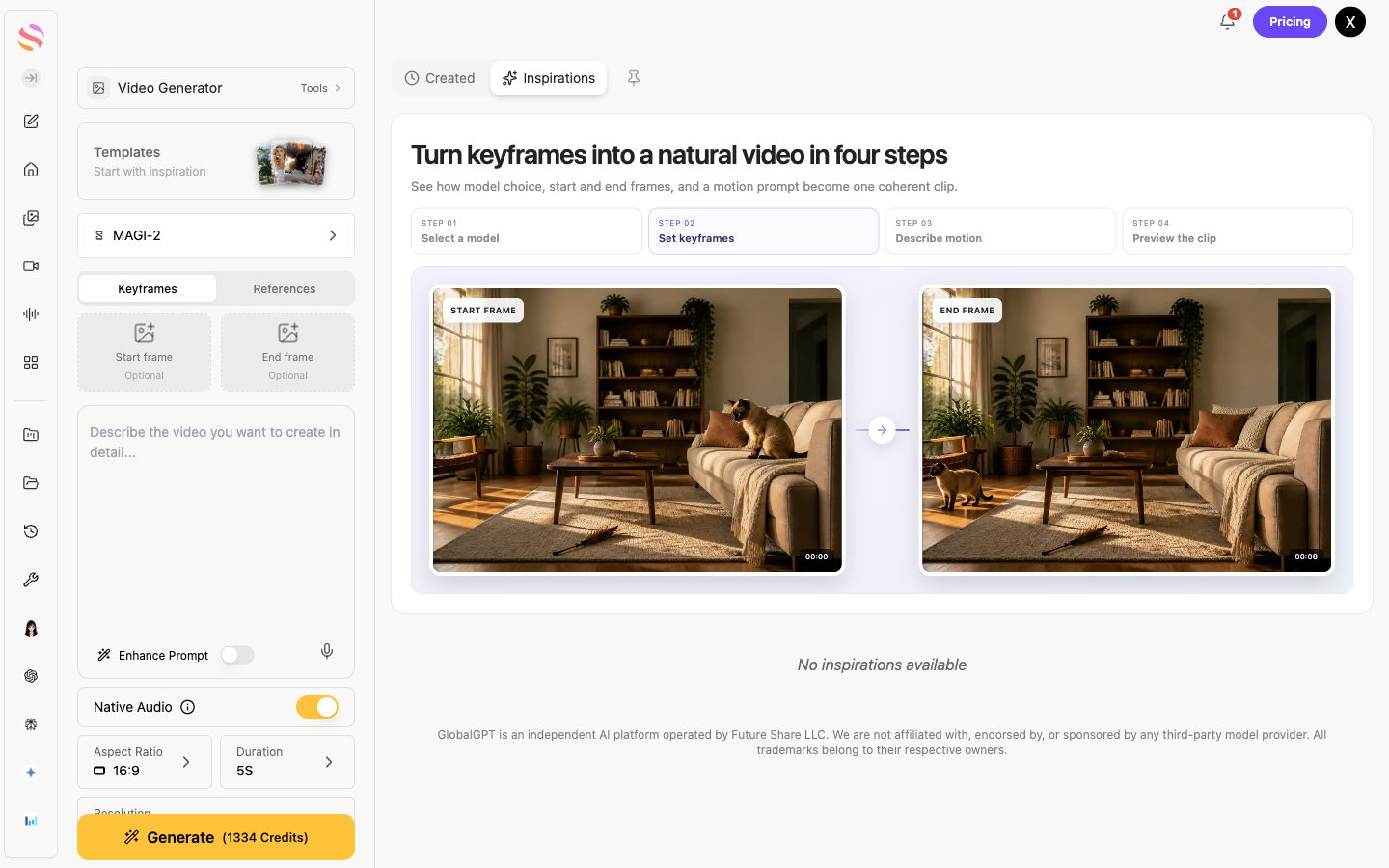
In the GlobalGPT MAGI-2 workspace, you can compare credit quotes before submitting, choose Keyframes or References, and start with the shortest duration that contains your action. The inspected 1080p workspace quoted 1,334 Credits for five seconds and 8,000 for 30 seconds.
What Is MAGI-2, and What Changed?
MAGI-2 is Sand.ai’s flagship video generation model. The full model has 480 billion parameters, with about 28 billion active. The earlier research release, MAGI-2 Preview, had about 114 billion total and 6 billion active parameters. Prices, downloadable weights and performance figures for that preview belong to a different release. Sand.ai announced plans to open-source the flagship. Use the hosted rate for a hosted job and estimate hardware separately if you are evaluating the preview locally. Sand.ai release and technical notes.
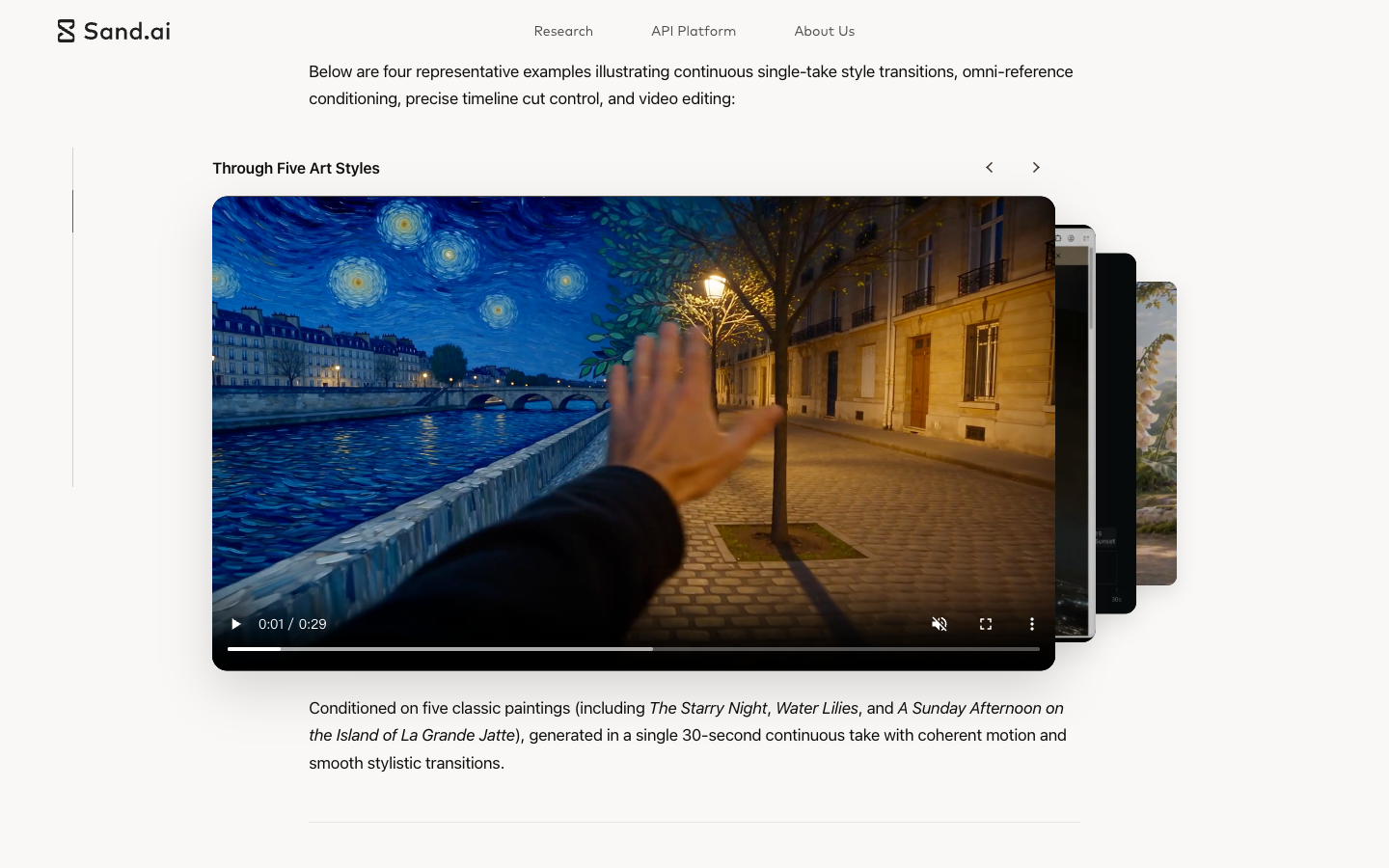
The flagship can generate up to 30 seconds at 1080p and 25 fps with native audio. Text supplies the action and timing. Frame controls can guide the start and end of a shot where the provider exposes them. References can guide a character, motion, setting or sound. Sand.ai’s native API documents up to 10 images, five videos and five audio clips, with separate combined duration limits for video and audio references. Check your provider’s controls before planning around all three media types. Sand AI API reference.
On Artificial Analysis’s text-to-video leaderboard, the flagship scored 1,150 Elo with a 95% interval of 1,137–1,163 in AA-Video-T2V v2.1. The displayed position was seventh, with a ranking range of fourth through twelfth. This is a blind preference result for videos generated from text with audio. It gives you a reason to shortlist the model. For a budget, measure how many takes meet your own brief. Artificial Analysis text-to-video leaderboard.
Sand.ai reports issues with very fast motion, fine movement in some wider 2D shots and layered soundscapes. If your deliverable depends on any of those, test that beat in a short clip while it is still easy to replace. Sand.ai technical notes.
MAGI-2 API Pricing by Clip Length
Sand.ai lists the hosted flagship at $0.08 per second at 1080p. Higgsfield’s API documents the same rate per requested second, with generated audio included. The figures below assume one billed take, with no tax, plan fee or editing cost. Sand.ai’s model pricing page flags top-ups as unavailable, while its billing guide describes the general top-up process. Check your Usage and Billing pages for the balance and funding options available to your account.
Requested Length | One Take at $0.08/s | Three Billed Takes |
|---|---|---|
4 Seconds | $0.32 | $0.96 |
5 Seconds | $0.40 | $1.20 |
10 Seconds | $0.80 | $2.40 |
15 Seconds | $1.20 | $3.60 |
30 Seconds | $2.40 | $7.20 |
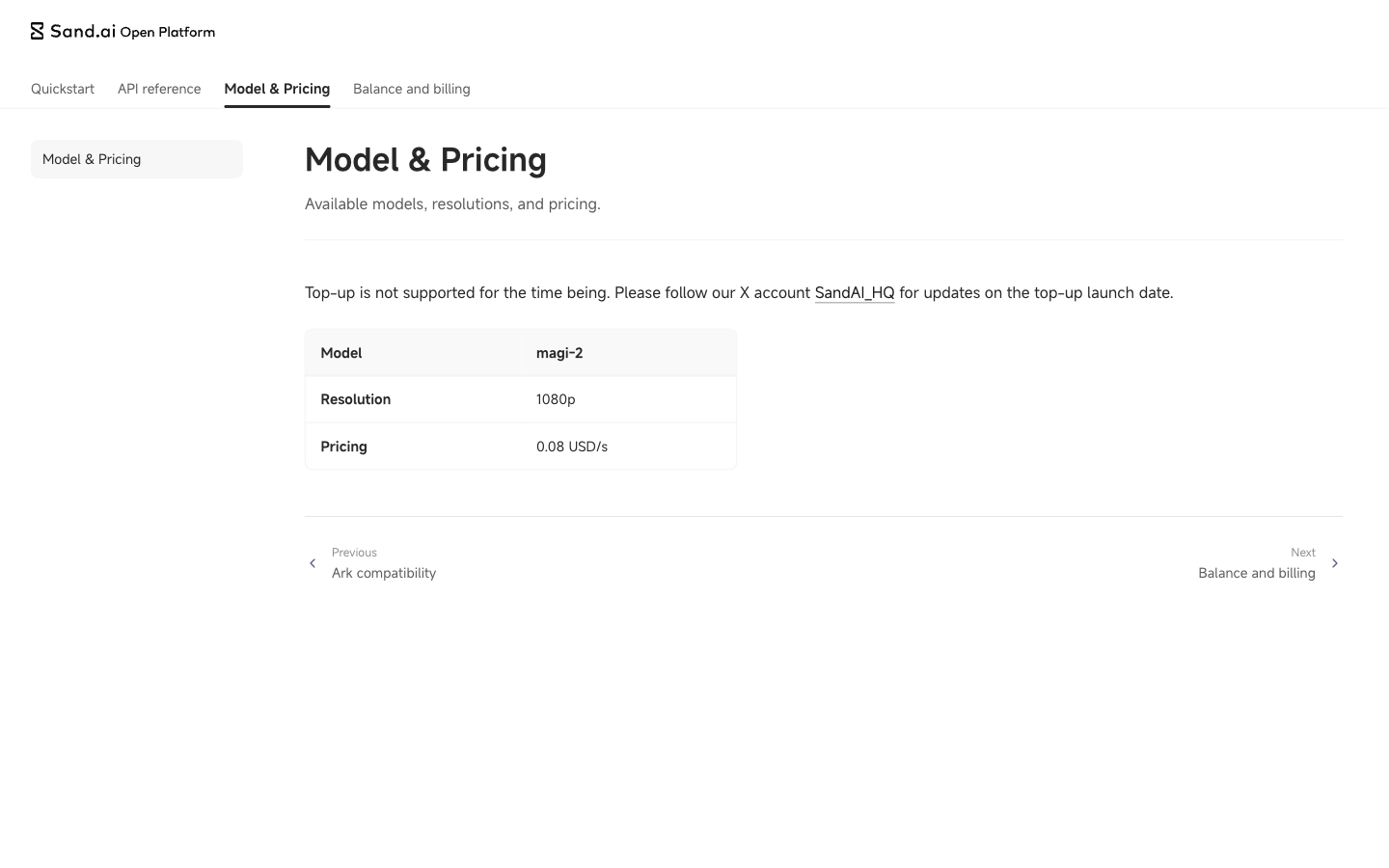
Keep the job ID when you submit through an API. Sand.ai says creation is non-idempotent, so resubmitting after a timeout can create another billable job. Retrieve the original job when you have its ID. Keep completed clips you rejected creatively separate from jobs that errored or were cancelled, and reconcile those job statuses with the provider’s ledger. Sand AI API reference.
How Do MAGI-2 Web Credits Compare?
Credits have different values on different platforms. Each row uses that provider’s own billing unit. For subscriptions, divide the price you actually pay by the credits you actually use to estimate your effective unit cost.
Route | 10 Seconds | 30 Seconds | Billing Basis |
|---|---|---|---|
Sand.ai API | $0.80 | $2.40 | |
Higgsfield API | $0.80 | $2.40 | |
Higgsfield Web | 25 Credits (~$1.23) | 75 Credits (~$3.69) | |
VidMuse | Check App Quote | Check App Quote | |
GlobalGPT | 2,667 Credits | 8,000 Credits |
Under Higgsfield’s published Plus example, 75 credits represent $3.69 of the allowance at full utilization. If you use just 600 of 1,200 credits and the remaining credits go unused, those same 75 credits absorb about $7.38 of the $59 plan. Your card charge is the subscription charge. The per-clip figure is a way to allocate it.
What GlobalGPT Shows Before You Generate
We selected MAGI-2, left both keyframe uploads empty and kept 16:9, 1080p and native audio on. We changed only duration. Generate quoted 1,067 Credits at four seconds, 1,334 at five, 2,667 at ten, 4,000 at fifteen and 8,000 at thirty. Use the live button quote for your selected job. The pricing screen review did not run a retail transaction, so the table records quotes.
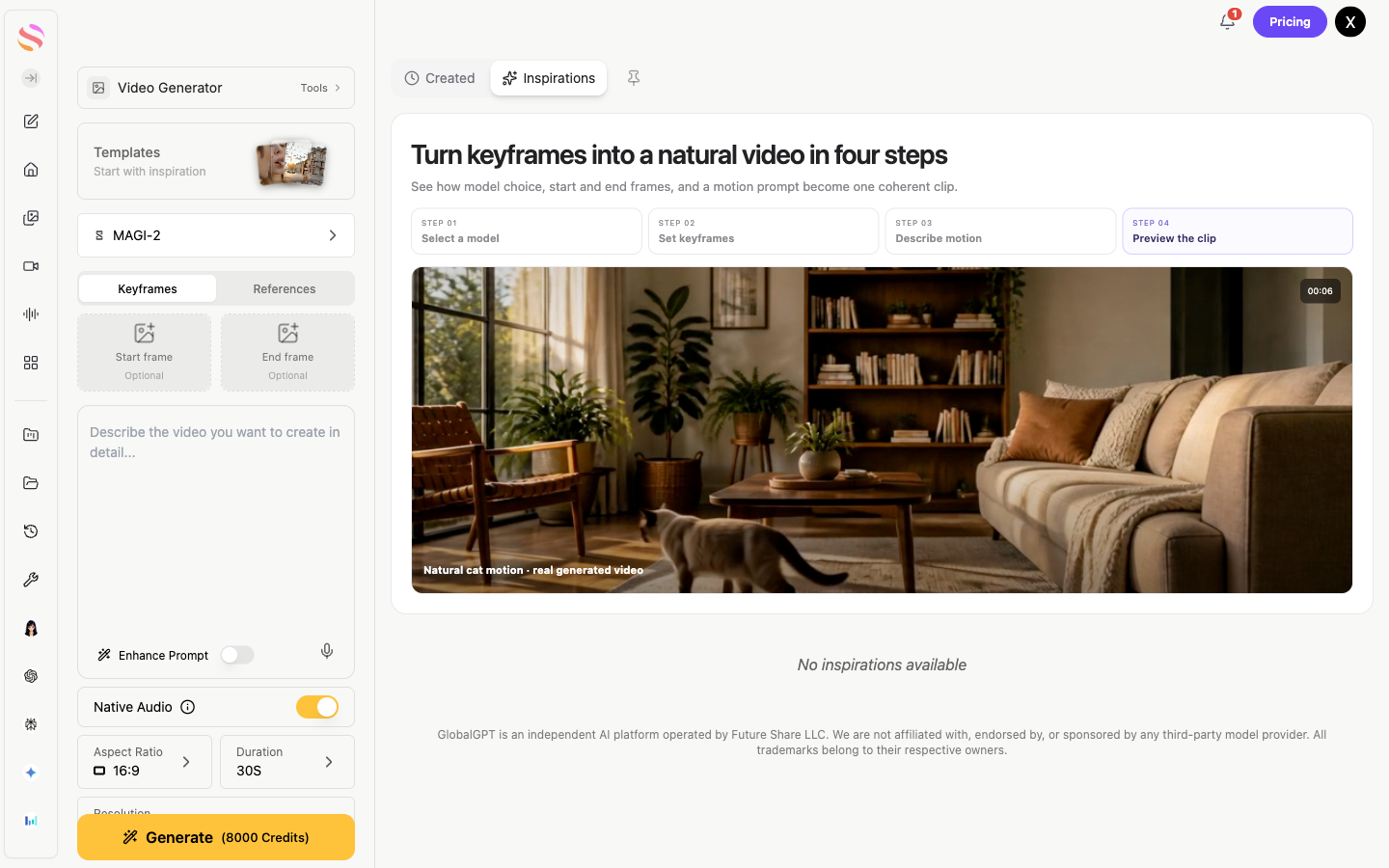
What GlobalGPT Actually Debited for One MAGI-2 Clip
We ran one separate five-second text-only take in the GlobalGPT MAGI-2 workspace using the same teal mug prompt as the API test below. We selected 1080p, 16:9 and native audio, with prompt enhancement off and both keyframe inputs empty. The finished clip played back at 1920×1080 and lasted five seconds.
Billing Check | Credits |
|---|---|
Generate Quote | 1,334 |
Balance Decrease After Completion | 1,334 |
MAGI-2 Entry in My Records | −1,334 |
Actual web debit: 1,334 Credits for one completed five-second take. The balance difference matched the entry in My Records and the quote. While the job was processing, its debit was still absent in this account. Check the record after completion if the balance has not changed yet. The debit is in GlobalGPT Credits. Its dollar value depends on what you paid for the credits you used.


Calculate the Cost of a Finished MAGI-2 Video
List each shot, its requested length and the number of takes you expect to pay for. Multiply requested seconds by billed takes for each shot, add the rows, then multiply by the API rate. Divide that generation spend by final timeline seconds to see what a second of your delivered video costs. If a shot uses references you made with another paid tool, add those costs separately.
30-Second Edit Scenario | Billed Seconds | Sand.ai List-Rate Equivalent |
|---|---|---|
One 30-Second Take, All Used | 30 | $2.40 |
One 30-Second Scene, Three Takes | 90 | $7.20 |
Three 10-Second Shots, Two Extra Takes on One Shot | 50 | $4.00 |
Six 5-Second Shots, One Extra Take on Every Shot | 60 | $4.80 |
Six 6-Second Shots Trimmed to Five Seconds, Two Extra 6-Second Takes | 48 | $3.84 |
For that last edit, 48 billed seconds yield 30 timeline seconds. At $3.84, the generation portion is 12.8 cents per finished second. If you budget four seconds of motion and hold on a still for the end card, count the four-second generation and put the still or motion-graphics work on its own line. The timeline can mix generated motion, stills, existing footage and titles.
A long take makes sense for a shot that needs continuous movement or synchronized performance without a cut. For a typical product ad where cuts are welcome, give the opener, proof shot and packshot separate clip budgets. When a single shot misses, regenerate that row. The Kling 4.0 Flash video tests show how to judge isolated action and timing. See the image-to-video workflow for examples of planning a shot around a reference frame. If you are choosing a second model for comparison, the Seedance 2.0 and Veo 3.1 benchmark offers example criteria for camera control, sound and motion.
MAGI-2 First-Take Video Tests
Both original five-second takes completed. The fox worked as a character shot but missed the two-step brief. The mug was usable as a product shot, with an uninterrupted ending for a title, but its contact sound needs work. Each file was 1920×1080 at 25 fps with stereo AAC audio. We compared the source frames with audio transients to check whether the requested sounds aligned with the visible action.
First Take | What Held Up in the Edit | What Needed Work | Recorded API Service Cost |
|---|---|---|---|
Clockwork Fox | Full fox stayed in frame and stopped facing right. | More than two steps. Audio peaks persisted after the walk ended, so a clean two-step cue was unverified. | $0.40 |
Teal Mug | One set-down. The hand cleared by about three seconds, leaving a stable ending. | No distinct transient matched the visible contact at about 1.4 seconds. | $0.40 |
Cost for the two test takes: The completed API job records reported $0.40 in service cost per take, $0.80 total. That matches the Sand.ai list-rate calculation for ten requested seconds. The GlobalGPT web interface separately quoted 1,334 Credits for the comparable five-second setting. The separate GlobalGPT web run above verified a 1,334-Credit retail debit. That entry belongs to the web generation alone.
We requested 1080p, 16:9 and generated audio, with no reference assets. The jobs took about 21 minutes each from submission to completion in this run. If your timeline is tight, allow for queue and processing time and keep the original task ID.
Clockwork Fox: More Steps Than Requested
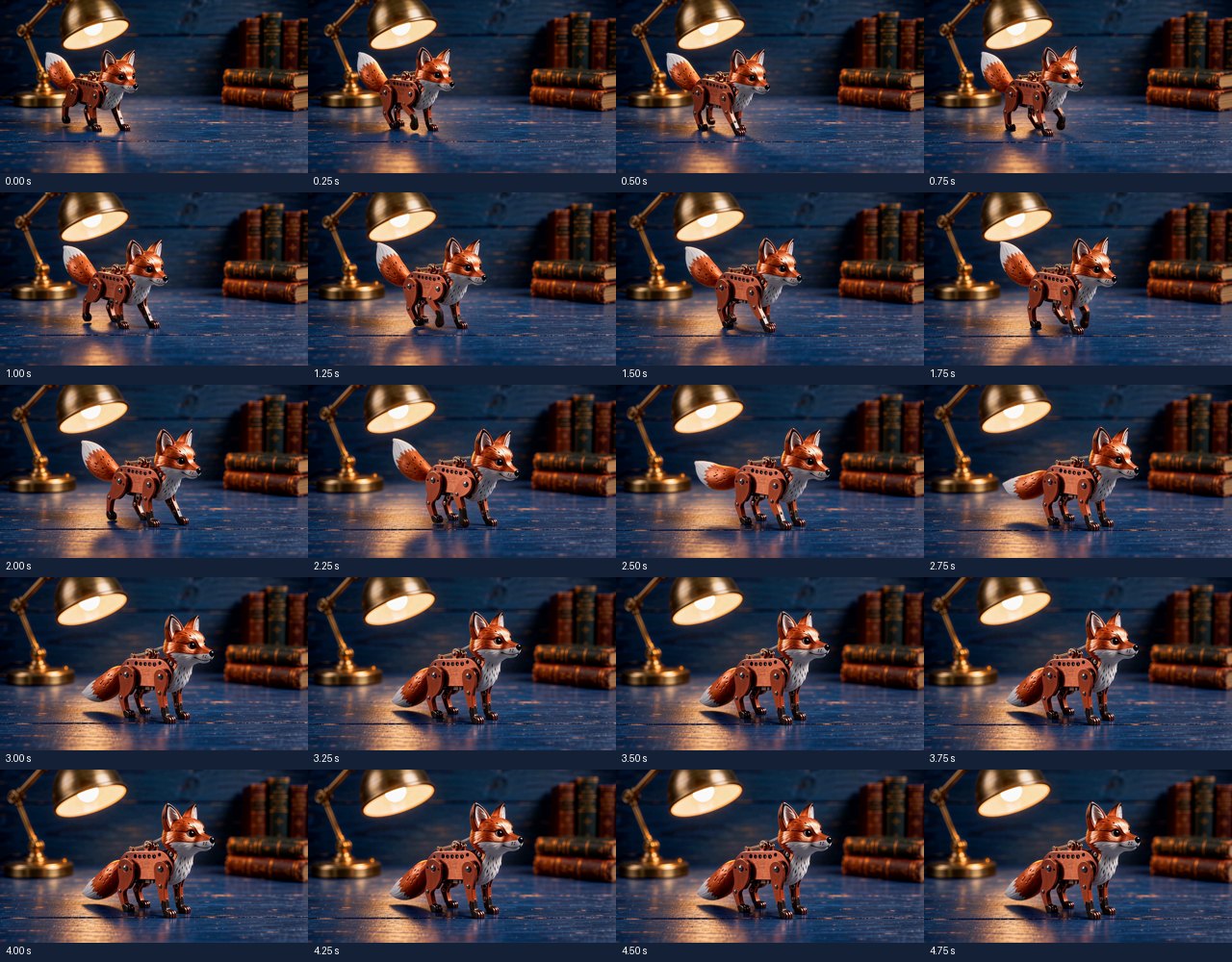
The locked composition and full-body framing worked. The fox walks through several contacts before settling and continues to move slightly in place. The audio still has strong transients around 3.15–3.87 seconds, after the forward walk, so the take misses the brief for two discrete, synchronized step cues. Keep the take if character motion is the goal. For a timed beat, edit the motion or replace the sound against the final cut.
Single locked 16:9 macro shot of a tiny copper wind-up fox on a dark blue wooden desk. The fox takes two steps, then stops facing right, with the entire fox visible throughout. Warm desk lamp, no cuts, no text. Soft clockwork clicks synchronized to the steps, faint room tone, no dialogue or music.Teal Mug: Usable Picture, Unconfirmed Contact Tap
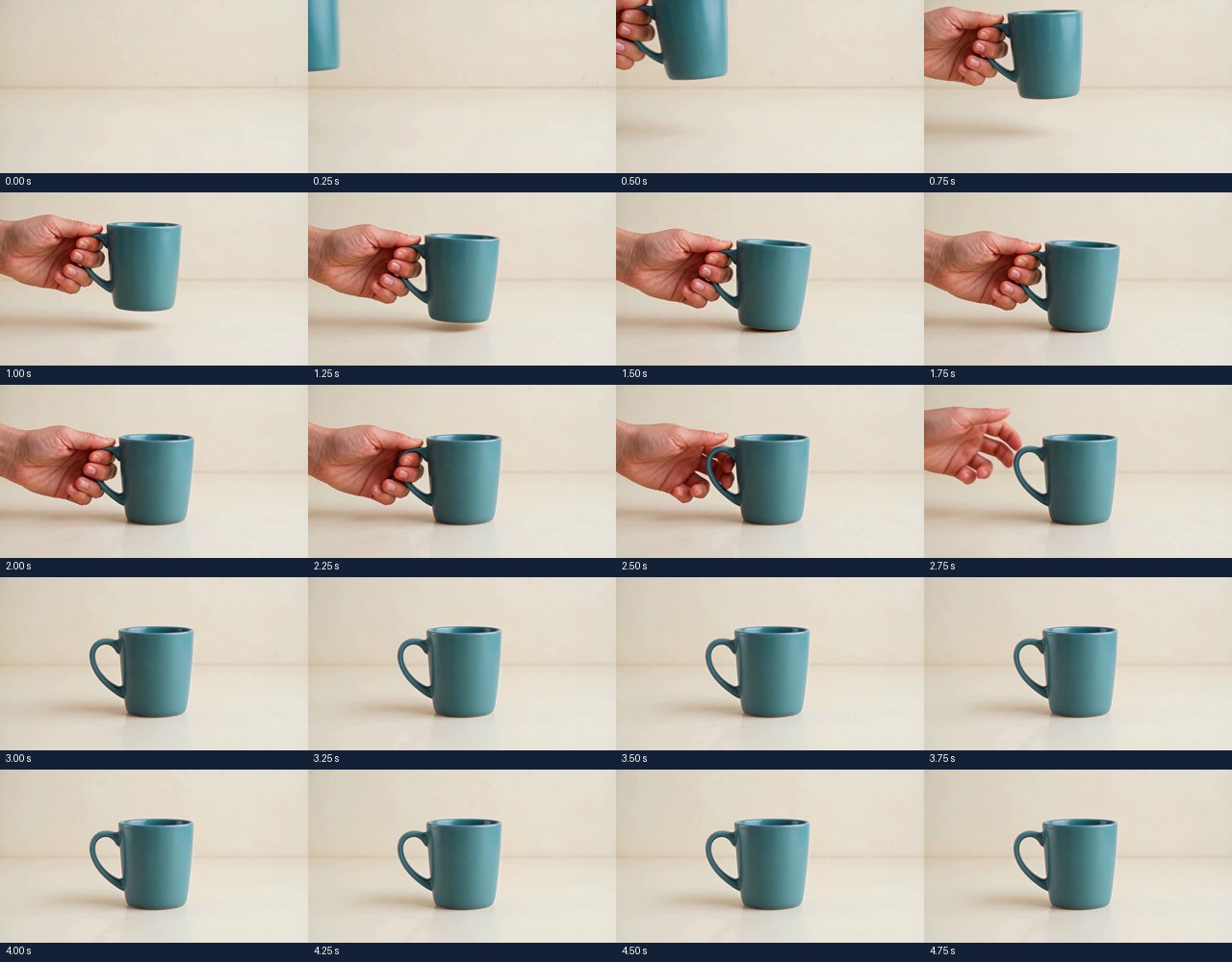
The mug keeps its color and handle shape. Its base settles on the counter around 1.4 seconds, and the stable, hand-free ending gives an editor room for a title. We found no isolated audio transient at the visible contact. With this picture already usable, placing a ceramic tap in the edit is a practical alternative to paying for another generation.
Locked landscape product shot of a matte teal coffee mug centered on an empty cream counter. A hand sets the mug down once by its handle, then exits left. Keep its color, shape and handle consistent. Leave the final second clear for a title to be added in editing. A single soft ceramic tap at contact, no music, no spoken words, no on-screen text.How to Spend Less on MAGI-2 Retakes
Define a keeper before you generate. Write down the object or character that must remain recognizable, the one action that makes the shot usable and the sound you need. This makes it easier to stop after a usable take.
Test the expensive failure point first. For a product ad, check the handoff, product silhouette or end frame with a short test. For dialogue, listen for the exact words and watch the speaker’s mouth. An audio track alone tells you very little about sync.
Keep editable elements in the edit. Save the logo, prices, legal copy or captions for your editor when they need to be exact. Ask the model to leave clean space and a stable final beat.
Record a ceiling in credits or dollars. Track requested seconds, billed attempts and kept seconds per shot. If a shot misses the same requirement twice, simplify the motion or split the shot before paying for a third identical setup.
MAGI-2 Pricing Verdict
Use $0.80 for one 10-second 1080p API generation and $2.40 for one 30-second generation as your starting estimates. For a 30-second deliverable with cuts, a $4.00 scenario gives you three planned 10-second shots and two additional takes on one of them. Budget $7.20 for three full-length attempts when continuity makes a long take worthwhile. In a browser workspace, use its own quoted credits and your real credit utilization to make the same decision.
MAGI-2 Pricing FAQ
How much is a 30-second MAGI-2 video?
One 30-second 1080p generation costs $2.40 at the $0.08/s Sand.ai list rate. Three billed attempts cost $7.20 before editing or other production expenses.
Is audio included in MAGI-2 pricing?
Higgsfield documents generated audio as included in its MAGI-2 API rate. Check the live quote for settings exposed by your web workspace.
Can I save money by generating at 720p?
Sand.ai lists 1080p for the hosted flagship. Use a shorter duration or split the scene if you need to lower the cost of an iteration.
How much does a five-second MAGI-2 clip cost on GlobalGPT?
The inspected 1080p landscape Keyframes setup with native audio enabled quoted 1,334 Credits. Your own Generate button shows the quote for your selected settings.
Do all failed MAGI-2 attempts cost money?
A completed take you discard can still use the full quoted amount. For system errors, cancellations and moderation outcomes, check the provider’s billing ledger or policy before assuming a charge or refund.
Are MAGI-2 and MAGI-2 Preview priced the same?
They are different releases. The $0.08/s figure is the Sand.ai hosted rate for the flagship. Local Preview hardware and deployment costs use a separate calculation.