
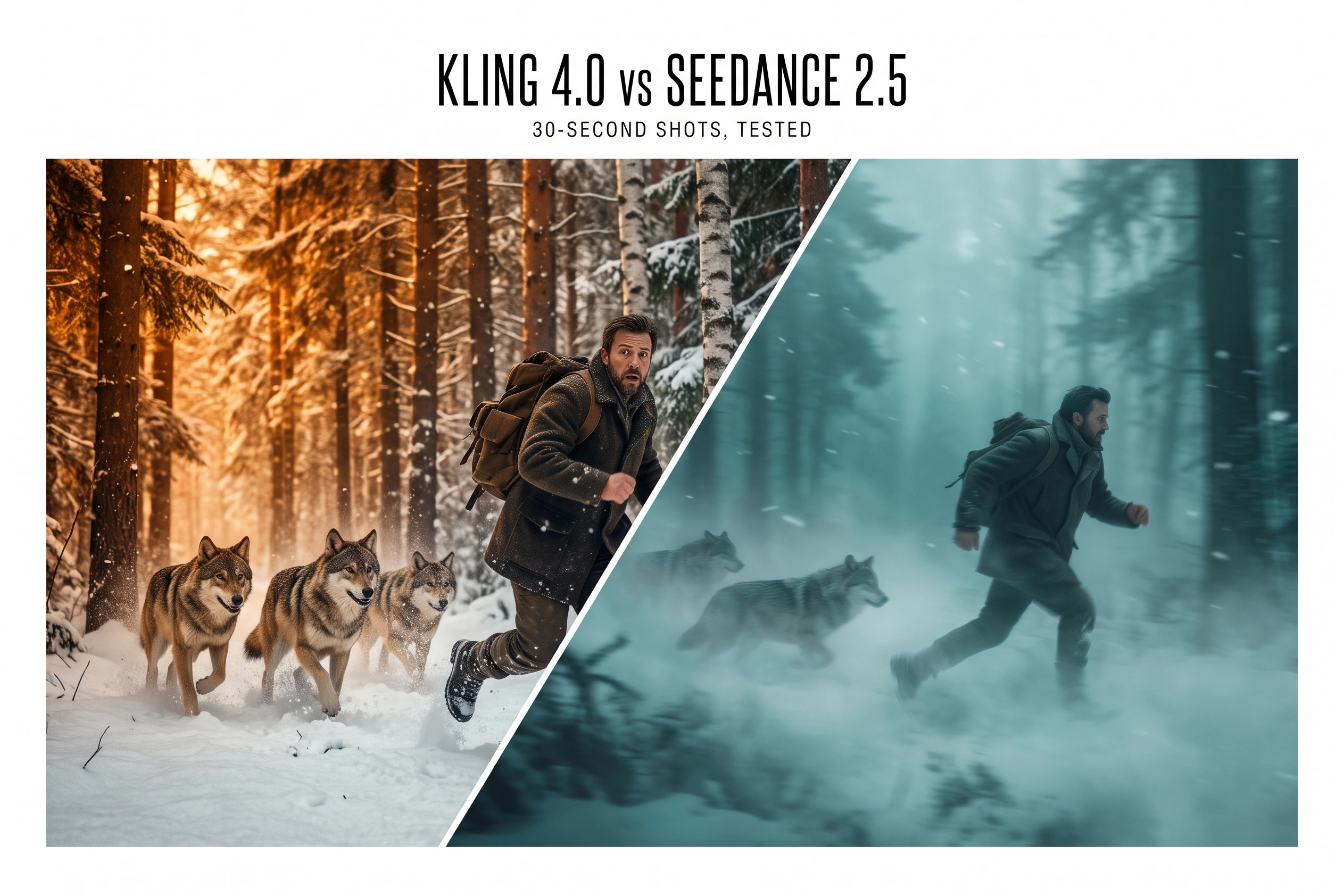
Can Kling 4.0 or Seedance 2.5 deliver a cinematic scene beyond a good-looking opening frame? We compare three short spectacle briefs, looking at camera work, action continuity and a readable payoff. A 30-second wolf-chase film is included as a separate long-form test.
Each model received the same four prompts: three six-second scenes and one 30-second film. Watch the original outputs below, then use the task notes to separate visual impact from missed instructions.
To compare your own scene, GlobalGPT gives you one place to try the named models. Start with a representative shot and check its current quote before committing to a larger project.

Price comparison and production budgets
Kling has the lower published API estimate for this configuration. All prices below are in U.S. dollars for 720p, 16:9 video without video input, checked October 29, 2026.
Kling’s official API table lists Kling 4.0 at $0.157 per output second at 720p, or $0.235 at 1080p, without video input.
BytePlus’s official pricing lists Dreamina Seedance 2.5 at $10.70 per million output tokens for 720p without video input. Its five-second 720p example is $1.156; the formula gives about $0.231 per second at 1280 × 720 and 24 fps.
| Configuration / calculated budget · USD | Kling 4.0 | Seedance 2.5 |
|---|---|---|
| API cost per output second · 720p | $0.157 | $0.231 |
| One 6-second clip | $0.94 | $1.39 |
| One 30-second film | $4.71 | $6.93 |
| Budget example · ten 6-second clips | $9.42 | $13.87 |
| Budget example · ten 30-second films | $47.10 | $69.34 |
- Budget estimates: duration × the published rate or token formula, calculated before rounding. These are not the amounts paid for our test videos.
- Seedance calculation: seconds × 1280 × 720 × 24 ÷ 1024 × $10.70 ÷ 1,000,000. Final billing uses the API’s actual output-token count.
- Scope: official API list prices, not consumer subscriptions. Video references change billing; promotional, negotiated or platform prices may differ.
Calculated from Kling’s official API rate and BytePlus’s Seedance 2.5 token rate and formula. Bars start at zero; lower is cheaper. Estimates are separate from the hands-on test bills.
Calculated from Kling’s official API rate and BytePlus’s Seedance 2.5 token rate and formula. Bars start at zero; lower is cheaper. Estimates are separate from the hands-on test bills.
What the tests show
- Kling 4.0: clearer parallel-rider staging, separate bridge panels and an explicit defeated-pack ending.
- Seedance 2.5: shorter waits in every matched run, rich atmospheric effects and a clearer wolf-trap trigger sequence.
- Both missed instructions: the full bullet-time orbit, the one-rider escape ending and parts of the wolf-trap geometry.
Compare camera work, action and continuity
| Creative dimension | Kling 4.0 | Seedance 2.5 |
|---|---|---|
| Camera staging | Stronger front-wheel-to-side reveal; clearer parallel-rider setup | Wider drift opening; handoff restaged as front-to-back |
| Action and cause | Distinct bridge panels follow the runner; case transfer is easier to read | Magical crossing works; bridge becomes a continuous glowing beam |
| Atmosphere and effects | Sharper separation of bike, rider and bridge panels | Denser spray, luminous skyline and warm glass effects |
| Prop continuity | Case remains visible after the catch, but lands on the rear rack | Case remains visible after the catch, also on the rear rack |
| Ending and instruction fidelity | Rightward drift exit works; second rider incorrectly escapes | Rightward drift exit works; second rider also incorrectly escapes |
| Fear and story setup | Face close-ups, backward glance and timber insert establish the danger and opportunity | Wide-eyed close-ups and an upward eyeline connect fear to the timber trap |
| 30-second action and ending | Defeated wolves are visible; trigger contact and safe escape are unclear | Swing, brace movement and collapse read better; defeated wolves are absent from the ending |
Measured performance: speed and output
Seedance had a 30.2% shorter median wait in this batch. Bars start at zero; lower is faster.
See each short scene’s completion time
Kling’s handoff took 9m 58s; its other shorts finished in under five minutes. This variation is hidden by a single median.
Open the full short-test measurements
| Measured on the three new short tasks | Kling 4.0 | Seedance 2.5 |
|---|---|---|
| Completed outputs | 3 of 3 submitted | 3 of 3 submitted |
| Median completion time | 4m 38s | 3m 14s |
| Completion-time range | 4m 09s–9m 58s | 3m 11s–3m 27s |
| Returned size / frame rate | 1280 × 720 / 24 fps | 1280 × 720 / 24 fps |
| Returned duration | 6.04 seconds each | 6.04 seconds each |
| Audio stream in returned files | Present; not evaluated | Absent; audio disabled |
- Timing: includes queue and processing, excludes downloading, and does not measure raw inference speed.
- Scope: Three tasks per model cannot establish a general reliability rate; audio controls differed.
Three short-video challenges
Each pair uses the same complete prompt, six seconds, 720p and 16:9. Watch both originals to compare the camera move, action and ending; expand a prompt if you want to reuse it.
Bullet-time motorcycle drift
Challenge: Freeze a drift and its spray while the camera moves around the motorcycle.
Read the complete shared prompt
Create a six-second live-action science-fiction action shot, widescreen 16:9. A lone adult female motorcycle courier wears a silver full-face helmet with a narrow amber visor and a cropped crimson rain jacket. Her motorcycle is matte black with one thin amber headlight. It is midnight on a rain-soaked elevated road above a dense city. Cyan architecture and warm amber headlights reflect in the asphalt. One rider, one motorcycle. Premium theatrical cinematography, wet practical surfaces, convincing tire contact, restrained anamorphic flares. 0–1.5 seconds: Begin inches above the wet asphalt, tracking backward ahead of the approaching front wheel. The courier brakes into a controlled sideways drift across the lane. The rear tire throws a curved wall of water toward the lens. Make the skid physically readable: the bike leans, the rider counterbalances, and both wheels remain on the road. 1.5–4.5 seconds: Time abruptly slows almost to a standstill at the most dramatic point of the drift. The rider, wheels, raindrops and curling spray become almost suspended while the camera alone continues moving at normal speed. Move through an open gap in the spray and arc 90 degrees around the motorcycle to a low side view. Nearby droplets sweep past the lens with strong parallax; the distant skyline moves much less. Keep the bike, helmet and red jacket unchanged. The camera never passes through the rider, motorcycle or road. 4.5–6 seconds: Time snaps back to normal. The suspended spray collapses, the rear tire regains traction, and the courier accelerates out of frame to the right, leaving a widening amber reflection on the wet road. End on the falling spray with the city visible beyond it. One continuous shot, no cuts, no duplicate riders, no text, no logos. The image must tell the action without dialogue or music.
Kling 4.0
The tire close-up opens into a clear low side view, with a readable rider silhouette. The camera settles too early to demonstrate the requested orbit through frozen spray.
Seedance 2.5
The water plume and bright skyline make the more atmospheric frame. The held rider pose is visible, but the camera stays near the same three-quarter angle.
Verdict: Kling for the camera reveal; Seedance for atmosphere. Neither establishes the full moving-camera bullet-time trick.
A moving motorcycle handoff
Challenge: Transfer a case between parallel motorcycles, then let only the courier escape beneath the gate.
Read the complete shared prompt
Create a six-second photoreal cinematic stunt shot in a rain-slick industrial tunnel at night, widescreen 16:9. Two motorcycles travel in parallel toward an open security gate. The camera tracks beside them at matching speed in a clear medium-wide side view. The nearer motorcycle is matte black, ridden by an adult courier in a crimson jacket and a silver helmet with an amber visor. The farther motorcycle is dark blue, ridden by an adult in a charcoal riding suit and a black helmet. A single small brushed-metal case has a bright amber strip around its middle. The nearer bike has an empty rigid case cradle immediately in front of its rider. Maintain clear separation between the two riders and bikes. Blue tunnel lights, amber gate warnings, wet concrete, realistic stunt photography. 0–2 seconds: The farther rider tosses the metal case sideways across the narrow gap toward the crimson-jacketed courier. Show one clear shallow airborne arc. The receiving courier keeps her left hand on the handlebar and reaches with her right hand toward the approaching case. Keep both bikes on parallel straight paths. 2–4 seconds: The courier catches the same case with her right hand, brings it down into the cradle and presses it firmly into place. Show the case settle against the rigid mounting surface. She releases it; the case stays secured to the motorcycle. Do not let it disappear into her jacket or fuse with her hand. 4–6 seconds: The courier returns her right hand to the handlebar and accelerates ahead. The steel security gate begins descending. Her motorcycle and its mounted case pass completely under the gate before it reaches the ground; the second rider brakes on the near side. Keep the tracking camera on the courier’s side so the clearance beneath the gate remains visible. End with the courier escaping into warm street light beyond the tunnel. One continuous shot, no hidden cuts, no extra cases, no text or logos. Tell the scene visually without dialogue or music.
Kling 4.0
The two riders stay abreast and the catch is easy to follow. The case goes onto the rear rack, and both riders escape beneath the gate.
Seedance 2.5
The silver case and closing gate read clearly against the blue tunnel. The riders become a front-to-back convoy, the case lands behind the courier, and the second rider also escapes.
Verdict: Kling follows the parallel-rider brief more closely, but both miss the requested case position and escape ending.
A bridge that forms beneath the runner
Challenge: Form separate glass panels ahead of each step, then reveal the city far below.
Read the complete shared prompt
Create a six-second live-action fantasy action shot, widescreen 16:9. A lone adult woman in a fitted black running suit with a short crimson scarf sprints toward the edge of a skyscraper roof at blue hour. Across a deep open gap is a second skyscraper at the same height. The city far below is realistic and immense. The only supernatural element is a bridge made of translucent amber glass panels: each new panel materializes just ahead of her next footfall, extending from the first roof toward the second. Once formed, panels remain solid and stationary. Wind pulls the scarf backward. High-end architectural photography, cool city haze, warm refracted light inside the glass, realistic human proportions. 0–2 seconds: Start in a low lateral tracking close shot of her shoes as she reaches the roof edge. As her leading foot comes down beyond the concrete lip, the first amber glass panel forms beneath it, fully solid before the shoe makes contact. A tight ripple of golden light travels outward from the landing point. Show the foot bearing weight instead of passing through the panel. 2–4 seconds: Track alongside her as the next panels form one after another just ahead of her steps. She keeps running with an ordinary alternating stride; the new bridge supports her. Previously formed panels remain visible behind her. No floating human body, no wings, no leap across the entire gap. 4–6 seconds: The camera sweeps outward and rises into a wide side view, revealing the runner halfway across the chasm on a narrow glowing bridge between the two towers. Fresh panels continue forming in front of her, with the completed span clearly stretching back to the original roof. Finish with the tiny runner silhouetted against the enormous city. One continuous shot, no teleporting, no changing buildings, no text or logos. The action must read without dialogue or music.
Kling 4.0
Separate amber panels form beneath the runner before the view pulls out over the city. This is the clearest delivery of the requested visual effect in the set.
Seedance 2.5
Warm glass, falling particles and the widening city view create a strong fantasy image. The bridge reads as a continuous beam rather than individually forming panels.
Verdict: Kling is our pick for this prompt: its separate panels make the construction effect and the danger easier to read.
The 30-second wolf-chase film
Three wolves chase a hunter who turns a collapsing timber rack into a trap. This is a 30-second edited micro-film, not an unbroken 30-second take.
- Fear: close-ups, breath and backward glances establish the danger.
- Cause and effect: establish the timber, lure the pack, break the support and clear the falling path.
- Payoff: show the shaken survivor and all three defeated wolves.
The Narrow Pass: a 30-second survival film
Challenge: Show fear, establish a timber trap, lure three wolves into it, then show the hunter escape the collapse.
Read the complete shared prompt
Create a complete 30-second cinematic survival thriller, THE NARROW PASS, in photoreal live action, widescreen 16:9. Tell a clear visual story: three wolves hunt a terrified man through a snowy forest; he notices a lethal opportunity in the terrain, deliberately lures them into a narrow passage, and kills the pursuing pack with a collapsing timber stack. The final reversal must be earned through visible setup and physical cause and effect. No supernatural powers, dialogue, captions or on-screen title. CONTINUITY AND LOCATION: One adult male hunter, early thirties, short dark hair, light stubble, a weathered dark-brown winter coat, a torn ochre scarf and a small belt hatchet at his right hip. Exactly three adult gray wolves pursue him: one charcoal-gray lead wolf and two lighter gray wolves. Keep their number and appearances stable. Cold late-afternoon light, dense dark pines, shallow snow, visible breath and an abandoned logging site. The hunter runs toward a narrow passage between a rock wall and an old timber rack. Heavy horizontal logs are stacked above the passage on a visibly failing wooden rack, held by one cracked diagonal support at its outer corner. A small side opening beyond that support gives the man a clear escape route away from the falling logs. Establish this geometry before the trap is triggered. The wolves approach from behind him through the same entrance. The timber must fall into the passage, away from his side escape. SHOT 1 — 0–6 SECONDS: Start in the middle of the chase, close to boots pounding through snow. Track backward rapidly and rise into a tight chest-height view of the man running toward the camera. Tree trunks sweep past close to the lens, while the three wolves remain visible farther behind him in the same corridor of forest, gaining ground. He stumbles once, catches his balance and looks back over his shoulder. Briefly frame his frightened face in sharp focus with the nearest wolf approaching behind him. His fear is involuntary: raised brows, eyes searching, mouth open for breath, tense shoulders. Use urgent but readable handheld movement and strong foreground parallax, not chaotic shaking. Keep the wolves running on the ground with ordinary canine strides. SHOT 2 — 6–11 SECONDS: Cut to an intimate close-up as he reaches the abandoned logging passage and presses against the rock wall. He is almost out of breath; white vapor escapes his mouth, his lower lip trembles, and his eyes flick back toward the approaching wolves. Then his gaze snaps upward to something nearby. Follow with a brief eyeline insert: the heavy logs above the narrow passage, then a small downward tilt to their cracked wooden support within hatchet reach. His right hand closes around the hatchet handle at his hip. Return briefly to his eyes: fear remains, but his searching gaze becomes focused. Do not make him smile or become suddenly fearless. SHOT 3 — 11–18 SECONDS: Cut to a clear lateral medium-wide composition that establishes the entire trap: the man at the far end of the passage beside the cracked support, the stacked logs above, the wolves approaching from the entrance, and the side escape beside the man. He takes the hatchet into his right hand, backs up two short steps and deliberately stops fleeing. He keeps his left hand against the rock for balance. The three wolves advance into the passage below the timber. The lead wolf lowers its head and prepares to spring. Preserve their approach direction and leave the escape opening visible. Do not cut away to unrelated forest imagery. SHOT 4 — 18–25 SECONDS: Stay on the same side of the action and push slightly closer, retaining the support and the wolves in the frame. Once all three wolves are beneath the timber rack, the man delivers one forceful hatchet blow to the already cracked support. Show contact, then the support breaking. He immediately dives sideways through the escape opening, out of the falling path. The rack tilts and several heavy logs tumble down into the narrow passage, engulfing the wolves in a dense burst of powdery snow and wood dust. Show the beginning of the collapse and his completed escape in the same shot. The impact is obscured naturally by falling timber and airborne snow: no blood spray, open wounds or graphic injury. No explosion. The logs must fall from the established stack, not materialize overhead. SHOT 5 — 25–30 SECONDS: Cut to a low, quiet aftermath shot on the safe side of the passage. Begin near the man’s trembling right hand still holding the hatchet. Pull back slowly to reveal him sitting in the snow, breathing hard, looking toward the collapsed stack. Behind him, all three wolves are partly visible beneath the fallen logs, motionless; the charcoal lead wolf and the two lighter wolves remain distinguishable without exposing injuries. No wolf escapes or gets up. Hold the final composition for two seconds: one shaken survivor in the foreground, the collapsed timber and defeated pack behind him. His hand is still shaking. End on exhausted survival rather than a triumphant pose. VISUAL DIRECTION: Grounded theatrical action cinematography, cold blue-gray snow and pine shadows, natural skin texture, restrained film grain, crisp moving foregrounds and deep spatial composition. Use proximity, eye movement, breath and approaching danger to express terror. Give the chase kinetic speed, the decision a brief stillness, the collapse a forceful burst, and the aftermath a deliberate slowdown. Maintain one man, one hatchet and exactly three wolves. Avoid duplicated animals, changing costumes, morphing bodies, floating feet and instant changes of location. Keep the story fully understandable with audio muted.
Kling 4.0
Fear close-ups, the timber setup and three prone wolves make the reversal readable. The support-breaking contact and separate escape route are unclear, and the hunter lunges toward the pack as the roof falls.
Seedance 2.5
The hatchet swing, shifting brace and falling timber form a clearer action sequence. The hunter’s exit is not established as a safe side opening, and the ending shows no defeated wolves.
Verdict: Kling for an explicit reversal ending; Seedance for the clearer trap-trigger sequence. Neither fully delivers the required escape geometry, and Seedance leaves the pack’s fate off-screen.
Seedance finished this task 1m 52s sooner. Bars start at zero; lower is faster. One run does not establish typical performance.
Open the full wolf-film measurements
| 30-second film · one run per model | Kling 4.0 | Seedance 2.5 |
|---|---|---|
| Completion time | 8m 39s | 6m 47s |
| Returned video | 1280 × 720 / 24 fps / 30.04s | 1280 × 720 / 24 fps / 30.04s |
Each long-film result is one sample. These timings are separate from the three-short medians above.
How we tested
No exact-version Kling 4.0 public score was verified in the checked sources; quality and timing findings here come from our own outputs.
- Runs: shorts generated October 28, 2026; wolf films October 29. One output per prompt and model; no visual references.
- Settings: 720p and 16:9 per pair. Audio controls differed; visuals were assessed muted. Other material defaults were not verified as identical.
- Review: original files fully decoded; matching timestamps plus denser critical-action samples inspected. This does not certify flawless motion, uninterrupted takes or audio quality.
- Evidence: frame samples and detailed notes remain in the editor workbench.
Try the scene that matches your intended work with Kling 4.0 or Seedance 2.5. For shot planning, the camera movement guide explains how to replace a broad “cinematic” request with a specific move.
Frequently asked questions
What does this comparison test?
Three six-second spectacle scenes and a 30-second wolf-chase micro-film, with the same complete prompt per matched pair. The review separates visual impact, action or story delivery, and execution misses.
Is the 30-second film a single continuous shot?
No. The wolf-chase brief uses multiple shots to establish the pursuit, fear, the timber trap, the reversal and the aftermath. The three short briefs separately request continuous shots.
Which model is better for cinematic video?
For these four briefs, start with Kling 4.0 for clearer staging and explicit payoff. Seedance 2.5 completed every matched run sooner and made the wolf trap’s action sequence clearer. Neither fully delivered every instruction, so the better choice depends on the scene’s hardest requirement.
Were the settings identical?
Each pair shared the complete prompt, requested duration, 720p resolution, 16:9 framing and no reference image. Audio controls differed, and other material defaults were not independently verified as identical. The review compares visual outputs only.
Do sampled frames prove smooth motion?
No. Matching timestamp samples show visible subjects, layouts and action stages. Smoothness, brief cuts and temporal artifacts require continuous playback review.
Can I reuse these prompts?
Yes. Keep the camera move, action order and ending explicit, and adapt the character or setting to your needs. Check the current model settings and price before generating.
Our verdict: which model should you choose?
Across these four briefs, we recommend Kling 4.0 overall. Seedance 2.5 is the better fit for faster iteration; choose by your scene’s hardest requirement.
- Choose Kling: precise staging, distinct construction effects and an explicit ending.
- Choose Seedance: quicker iterations, dense atmosphere and the clearer trigger sequence in this wolf-film pair.
- Plan to revise: complex physical interactions and escape geometry in either model.
For your first action scene, try Kling 4.0. If iteration speed matters more, compare the same brief in Seedance 2.5 before committing to a longer film.