
Introduction
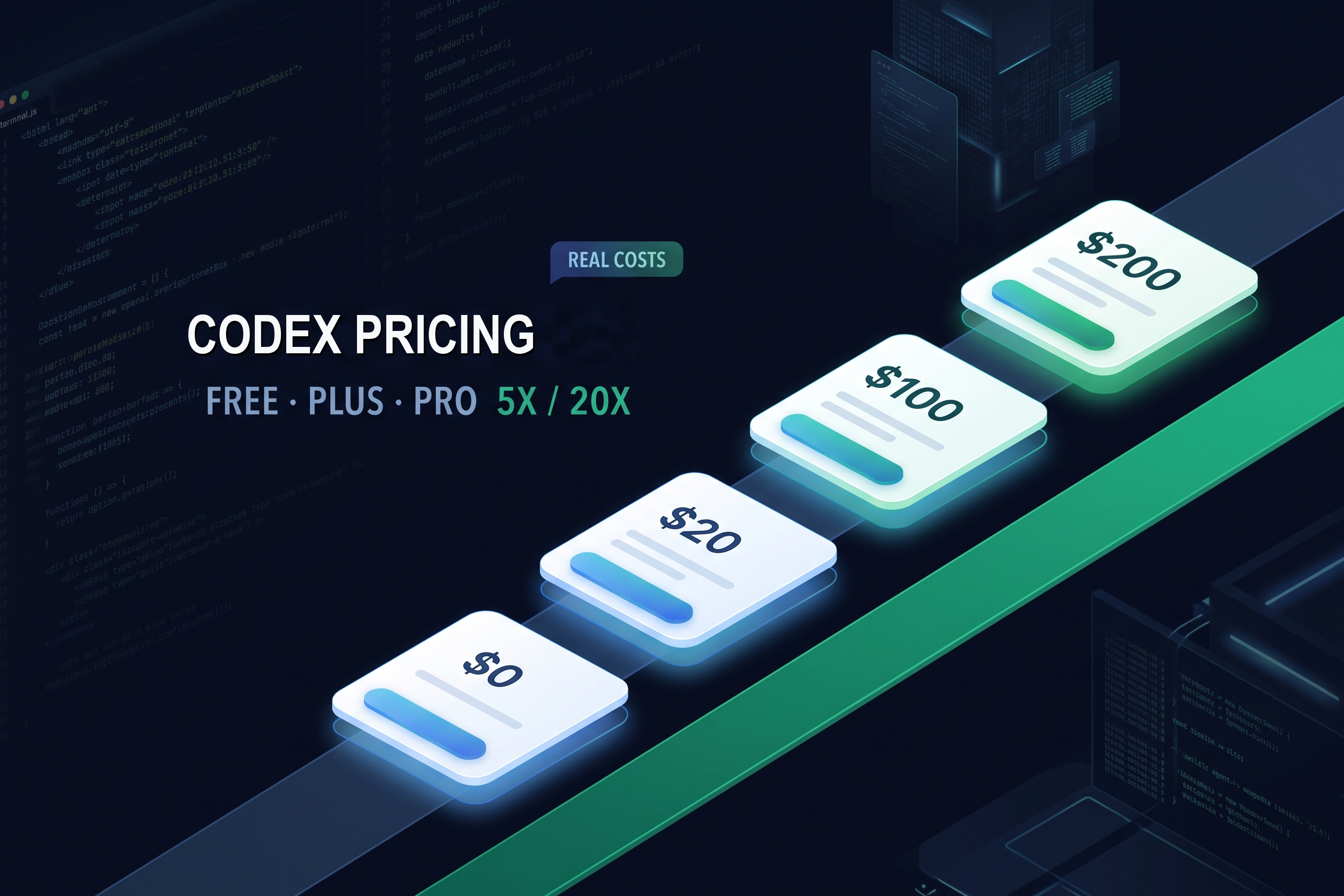
OpenAI Codex pricing currently runs from Free at $0/month to Pro 20x at $200/month, with Pro usage options described as 5x or 20x relative to Plus.Go is $8/month and Plus is $20/month. The price is easy to scan; the useful question is what each tier includes and how its shared usage window affects real coding work.
Free and Go are listed with GPT-6 Luna at Standard speed, while Plus includes GPT-6 Sol and GPT-6 Luna. Pro provides more usage; the 5x and 20x labels describe capacity, not better code. The July benchmark below uses GPT-5.6 Sol and shows how token usage adds up on one coding task. It is a historical example, not a test of the current models.
Some of the work around a coding project happens outside the repository: researching an idea, drafting a document, or preparing slides. GlobalGPT’s browser-based agent, Yukie, brings those tasks into one workspace. If that is where much of your time goes, consider those needs alongside coding usage when choosing where to spend your AI budget.

OpenAI Codex Pricing at a Glance
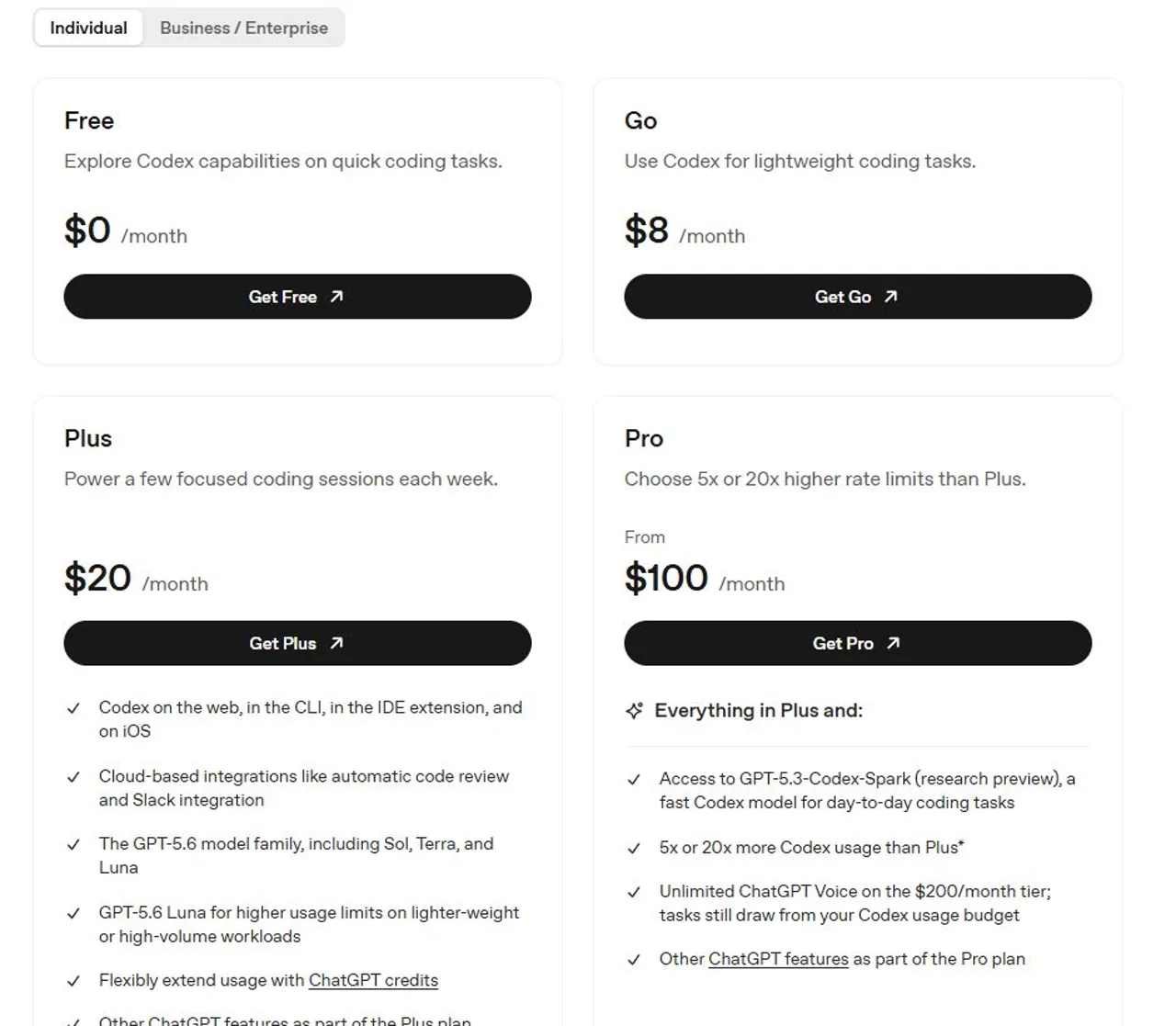
OpenAI’s official Codex pricing documentation is the source of truth for current prices, model access and usage estimates. If you are choosing by model quality as well as price, compare the best AI models for coding separately; a larger allowance does not automatically solve a model-fit problem.
What Do You Get With Each Codex Plan?
Free is for evaluation, Go is the economical entry tier, and Plus is the first tier whose pricing page explicitly lists the complete cross-device Codex experience. Choose based on how often your work reaches a limit, not on the plan name alone.
Codex Free — Best for Trying It
Codex Free costs $0 per month and is the simplest way to test whether an AI coding agent fits your work.
- Price: $0/month.
- Best for: explaining a small function, reviewing a short patch or proposing a unit test.
- Model note: Free access is described around GPT-6 Luna Standard speed, subject to rollout and availability.
- Expectation: treat Free as an evaluation tier rather than guaranteed daily development capacity.
Codex Go — The $8 Lightweight Option
Codex Go costs $8 per month and fills the gap between occasional Free use and the $20 Plus plan.
- Price: $8/month.
- Best for: learners, side projects and short coding sessions.
- Model access: Go is listed with GPT-6 Luna at Standard speed. If you need GPT-6 Sol, compare the plans that include it.
- Limit: the lower price does not guarantee enough capacity for large repositories or long autonomous sessions.
For a broader budget-tier comparison, see our ChatGPT Go review. It covers the $8 plan’s practical trade-offs without treating a temporary promotion as a permanent feature.
Codex Plus — The $20 Starting Point
Codex Plus costs $20 per month and is the first tier with an explicitly documented cross-device Codex experience.
- Price: $20/month.
- Included surfaces: web, CLI, IDE extension and iOS.
- Current model family: GPT-6 Sol and GPT-6 Luna are listed for Plus; the exact model and rollout can depend on the surface.
- Best for: individual developers running a few focused sessions each week.
- Capacity: model choice, context, reasoning, tools and caching affect how quickly the allowance is used.
Upgrade for capacity only after measuring interruptions. Our ChatGPT Plus limits guide gives useful context for that decision.
Codex Pro Pricing: 5x vs 20x
The Pro decision is mainly about how much uninterrupted capacity you need. Both tiers include the Plus experience, but their usage multiples and monthly prices are very different.
Pro 5x Costs $100 per Month
Codex Pro 5x costs $100 per month and provides five times the Codex usage available on Plus.
- Five times the Codex usage available on Plus, according to OpenAI’s plan description.
- A reasonable fit when Plus limits interrupt frequent work but a $200 plan is difficult to justify.
- Still bounded by windows and limits; it is not a guarantee of uninterrupted access.
Pro 20x Costs $200 per Month
Codex Pro 20x costs $200 per month and provides twenty times the Codex usage available on Plus.
- Twenty times the Codex usage available on Plus.
- Best suited to sustained implementation, repository analysis and parallel tasks.
- Still not unlimited: local messages and cloud chats share usage windows, and additional weekly limits may apply.
Is Pro 20x Worth Twice the Price?
Pro 20x doubles the Pro 5x bill but raises the stated Plus-relative usage from 5x to 20x. The value depends on whether you regularly use that extra capacity.
Only if the extra capacity prevents enough paid-work interruption to cover the additional $100/month. If waiting for a reset rarely costs you time, Plus or Pro 5x is usually easier to defend.
Codex Limits and Hidden Costs
Codex plans are limited by more than a monthly price. Shared usage windows, possible weekly caps, task complexity, Fast mode, image generation, retries, and separate API billing can all determine how quickly your allowance disappears—and what continued work costs after that.
Shared Windows and Weekly Limits
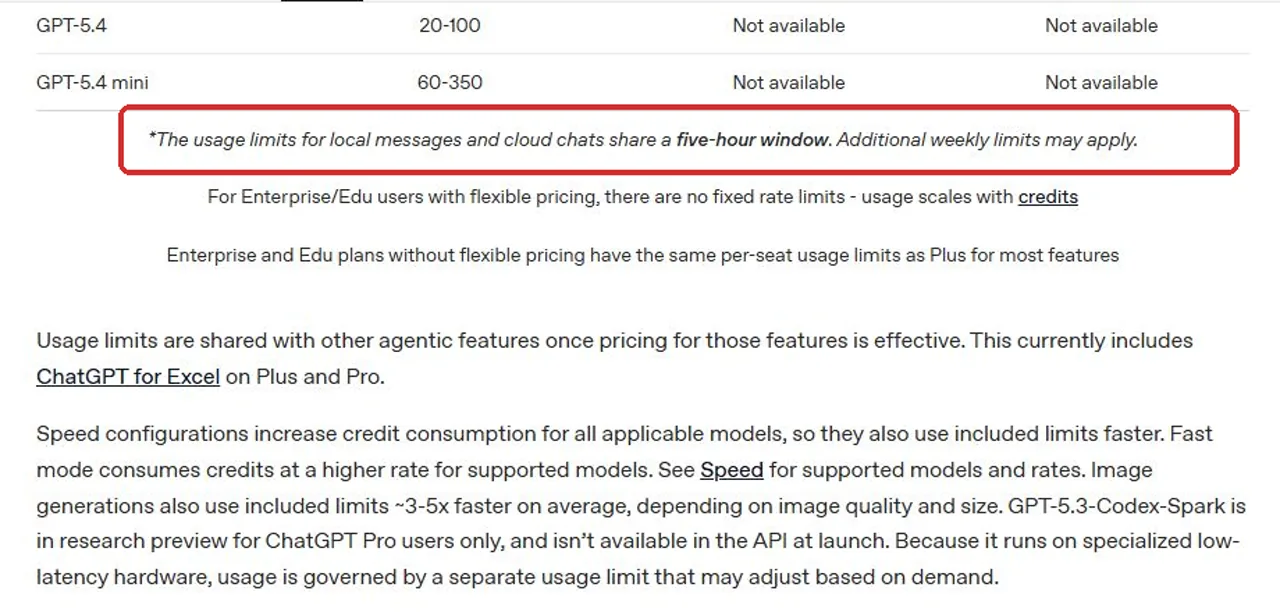
A subscription prepays for an allowance, not unlimited work. OpenAI says local messages and cloud chats share a five-hour usage window and that additional weekly limits may apply. Large repositories, repeated tool calls, retries, reasoning and image generation can consume the allowance faster than a short text request.
- No line-item charge does not mean no cost: each task consumes prepaid capacity.
- Reset waits cost time: interruptions matter when Codex is part of paid work.
- Continued use may cost more: extra Credits or a higher plan can become necessary.
These figures are personal cost allocations, not OpenAI’s per-task prices. They also assume every counted task produced an accepted result. A failed run that needs extensive human correction increases the true cost even if it used fewer tokens.
Complex Tasks Consume Limits Faster
Codex does not consume the same allowance for every request. Renaming one variable may need little context; tracing a production bug can require repository search, file reads, reasoning, tool calls, test output, and retries. Prompt length alone is therefore a poor guide to limit consumption.
- Model choice: different models have different subscription consumption and API rates.
- Context size: more files and longer conversations require more input processing.
- Reasoning: harder tasks may consume more compute or credits.
- Tool use and retrieval: searches, commands, test output, and external retrieval add context.
- Caching: reusable context can be priced or counted differently from fresh input.
- Retries: a cheap failed attempt can cost more overall than a slightly heavier first-run success.
Fast Mode and Images Use More Allowance
Fast mode and image generation exchange more allowance for speed or richer output.
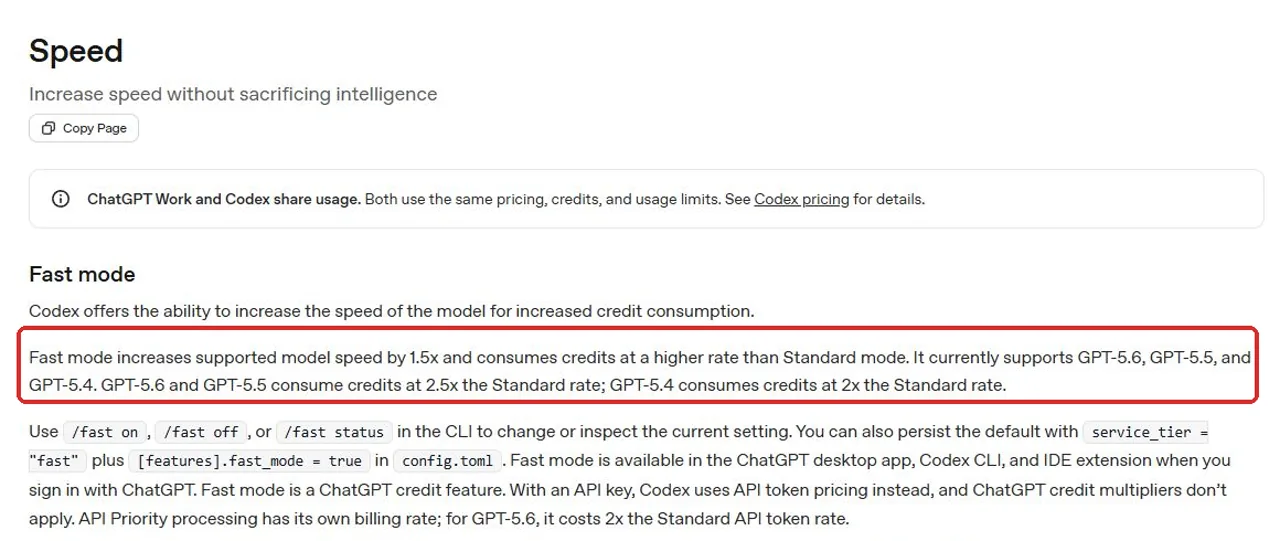
- Fast mode is about 1.5x faster on supported models but consumes credits at a higher rate.
- The credit multiplier depends on the model and mode; use the rate listed for your selected model.
- Image generation also uses your allowance. Include image-heavy tasks when judging whether a plan leaves enough capacity for coding.
Extra Credits and API Billing Are Separate
Included usage, ChatGPT Credits, and API billing are three separate cost buckets.
- Lowest-cost option: wait for the included limit to reset.
- Continue with Credits: Plus and Pro users may use available ChatGPT Credits, which are additional to the included allowance.
- Check before large tasks: use
/statusin the CLI or the Codex usage dashboard. - API billing is separate: API-key use is charged by model Tokens and does not include Codex cloud features such as GitHub review or Slack integrations.
How Much Does a Real Codex Task Cost?
Testing status: We completed one controlled Codex CLI run on July 28, 2026. Codex passed all seven public and hidden acceptance checks on its first implementation. The result below measures Codex only; the current GlobalGPT CLI does not expose Yukie as a testable model or Agent command.
This case study records one completed task, its token usage and its test results. The $0.32 figure below is a list-rate estimate calculated from the measured tokens, not an observed charge or a subscription cost per task.
The Test Task
How Many Tokens Did Codex Use?
What Did the Codex Task Really Cost?
Did Codex Complete the Task?
A Cheaper Codex Alternative: When Yukie Makes More Sense
Codex is built for coding and developer tools. Yukie is a web-first alternative for people who want finished research, content, media, document, or presentation outputs without managing a local coding environment.
What Is Yukie?
Yukie is an independent web-based Agent inside GlobalGPT. It can help produce images, videos, documents, research, tables, websites, and slides from one browser workspace. It is not a Codex CLI plugin and does not need Codex to run.
GlobalGPT is a multi-model AI platform that brings chat, image, video, and Agent tools into one subscription. Its public annual-plan prices currently show monthly equivalents of $5.80 for Basic, $10.80 for Pro, and $25 for Unlimited. These are GlobalGPT platform prices; Yukie’s exact plan eligibility and task limits are not publicly stated.
- Independent Agent: Yukie works directly in the browser rather than inside the Codex CLI.
- Lower platform price: GlobalGPT’s annual-plan monthly equivalents start well below Codex Pro, although Yukie-specific limits still need confirmation.
- Less setup: non-developers can work without configuring a repository, terminal, or IDE. See our AI assistant comparison for more browser-first options.
- Not a full Codex replacement: choose Codex for direct repository editing, terminal commands, automated tests, IDE integration, GitHub review, and other developer workflows. Our all-in-one AI platform comparison covers more outcome-focused alternatives.
Codex vs Yukie: What Is the Difference?
Choose Codex for direct codebase control; choose Yukie when a browser Agent can deliver the finished outcome. The better value depends on acceptable quality and total cost, not which product is universally “better.”
Final Verdict — Do You Really Need Codex Pro?
- Start with Plus: it is the logical first paid tier for the complete web, CLI, IDE, and iOS experience.
- Choose Pro 5x: when Plus limits repeatedly interrupt frequent work.
- Choose Pro 20x: only when heavy daily use makes reset waits a measurable business cost.
- Use API billing: for programmatic or variable usage, but track it separately from the subscription.
- Consider Yukie: when research, media, documents, websites, slides, or other browser-first outputs matter more than repository control.
- Compare accepted results: include correction time and do not present GlobalGPT’s lower plan prices as a measured Yukie coding-task cost.
Frequently Asked Questions
These answers cover the pricing, limits, billing routes, and Yukie distinction that matter most before choosing a plan.
Is OpenAI Codex free?
Yes. OpenAI currently lists Codex Free at $0 per month for exploring quick coding tasks. Its capacity is lower than paid plans, and the current price card does not promise the same complete surface coverage as Plus.
How much does Codex Plus cost?
Codex Plus costs $20 per month. OpenAI says it includes Codex on the web, in the CLI, in the IDE extension, and on iOS.
How much does Codex Go cost?
Codex Go costs $8 per month and is positioned for lightweight coding tasks. It sits between the $0 Free plan and $20 Plus plan.
What is Codex Pro 5x?
Codex Pro 5x is a $100-per-month plan that provides five times the Codex usage available on Plus. The 5x label refers to usage capacity, not five times better model quality.
What is Codex Pro 20x?
Codex Pro 20x costs $200 per month and provides twenty times the Codex usage available on Plus. It is designed for heavy individual use but is not unlimited.
Is Pro 20x twice as good as Pro 5x?
No. Pro 20x doubles the monthly price and offers a larger usage allowance, but it does not make the model twice as capable. Quality still depends on the model, task, context, and instructions.
Is Codex Pro unlimited?
No. Local messages and cloud chats share a five-hour usage window, and additional weekly limits may apply. Resource-intensive tasks can consume the allowance faster.
Does a Codex subscription include API usage?
No. API-key access is billed separately by token at the selected model’s API rates. It works in the CLI, SDK, and IDE extension but does not include Codex cloud features.
How can I check my Codex usage?
Run /status in an active Codex CLI session to see remaining limits, or open the Codex usage dashboard outside the session.
What happens when I reach a Codex limit?
You can wait for the allowance to reset. Plus and Pro users may also continue with available ChatGPT credits, which are separate from included usage.
Does Codex Fast mode cost more?
Yes. Fast mode uses credits at a higher rate in exchange for faster responses on supported models. The multiplier depends on the model, so check its current rate before a long session.
Is Yukie cheaper than Codex?
GlobalGPT lists annual-plan monthly equivalents of $5.80, $10.80 and $25, all below Codex Pro at $100 or $200 per month. That does not make every GlobalGPT plan cheaper than Go at $8 or Plus at $20. Yukie’s plan eligibility and limits still need checking before making a direct cost comparison.
Does Yukie run inside the Codex CLI?
No. Yukie is an independent web-based agent workspace within GlobalGPT. It is an alternative for some outcomes, not a Codex CLI plugin or an agent that must be connected to Codex.