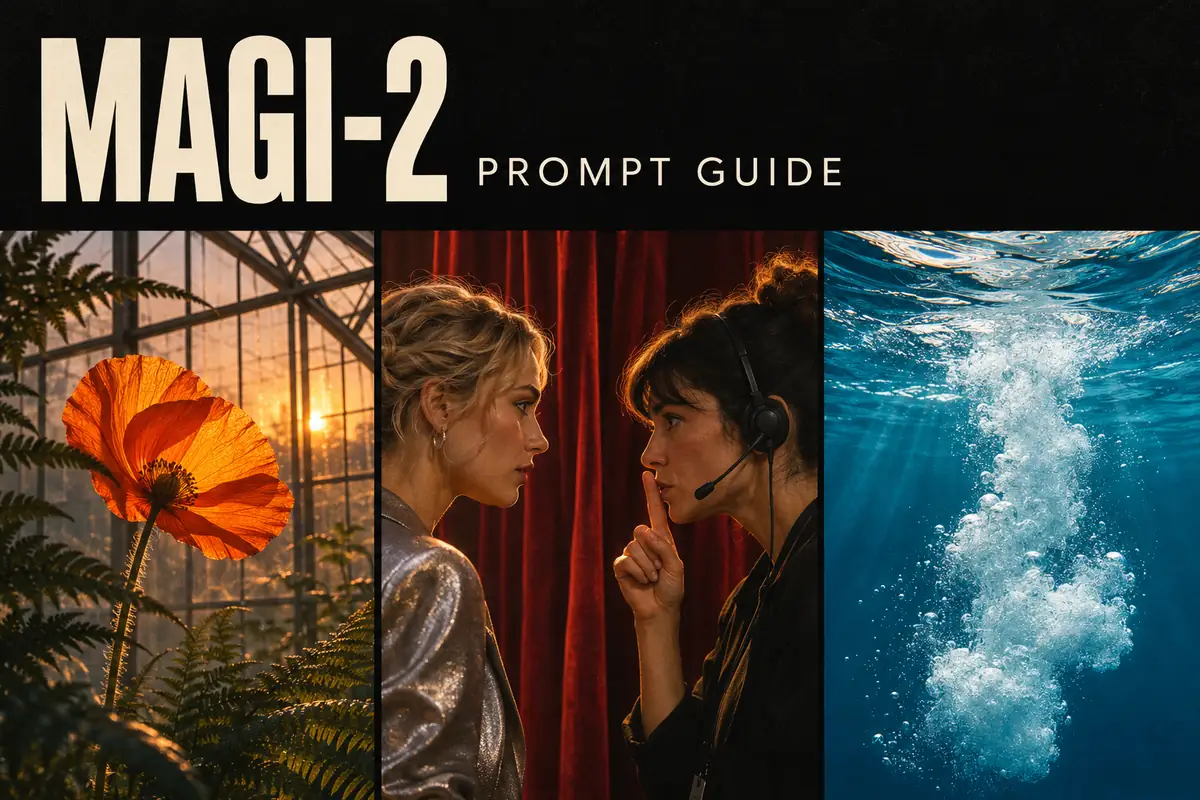
MAGI-2 vs Seedance 2.5: Which Fits Your Video Workflow?
Four paired video tests reveal which model follows an orbit, holds a character through a wipe, and pulls back for a wide shot. Compare observed turnaround, output specs and matched 1080p quotes.
 Chloe Murphy
Choose MAGI-2 for affordable 1080p variations. Choose Seedance 2.5 for a 4K master or to extend an approved shot. For camera work, the choice depends on the brief. Watch what happens to the dancers’ jackets when the gold scarf clears the lens.
MAGI-2 vs Seedance 2.5 Specs
Feature | MAGI-2 | Seedance 2.5 |
|---|---|---|
Release | Sand.ai · November 24, 2026 | ByteDance · July 31, 2026 |
Output | 1080p at 25 fps; up to 30 seconds | 480p to 4K on BytePlus; up to 30 seconds per generation |
Reference inputs | 10 images, 5 videos, 5 audio clips | 30 images, 10 videos, 10 audio clips on BytePlus |
Sound and editing | Native audio, timed cuts and targeted edits | Native audio, timestamp edits and scene extensions |
If the brief calls for 4K, the Seedance output options on BytePlus let you select it before generating. For a scene built from a storyboard, its reference guide shows how to combine images, video and audio. If the action needs to run past the initial take, ByteDance also documents scene extensions on supported workflows.
Why MAGI-2 drew attention
ByteDance released Seedance 2.5 on July 31. Sand.ai followed a different timetable: its August MAGI-2 Preview had 114 billion parameters, and the November flagship brought that to 480 billion. For an editor pitching three camera moves, the practical change was being able to afford another take when the first missed the shot.
Editing limits
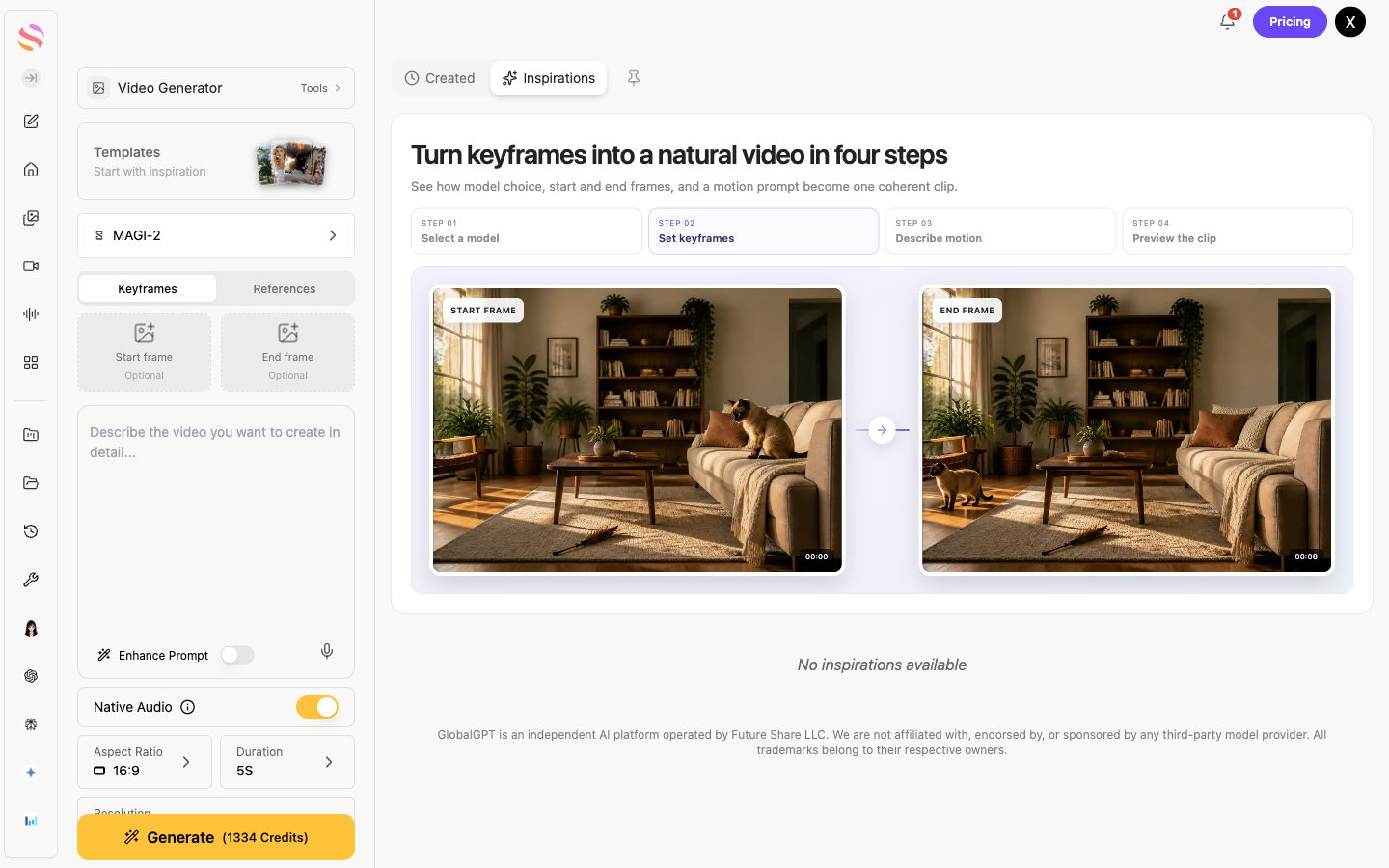
On GlobalGPT, MAGI-2 accepts a start frame and an optional end frame. Upload the opening image first and the intended closing image second. The MAGI-2 output specification lists 1080p as the only resolution.
If a motorcycle slide is the shot you need, scrub through the moment the rear wheel regains traction. Sand.ai flags fast motion and complex soundscapes as difficult cases. Our silent clips let us inspect the rider’s path, but they tell us nothing about how either model would mix the engine with the rain.
MAGI-2 vs Seedance 2.5 Pricing
At 1080p on GlobalGPT, a 10-second MAGI-2 clip uses about 82% fewer credits than Seedance 2.5. The video pricing guide lists MAGI-2 at 2,667 credits. The live Seedance estimator quoted 14,800 credits for 1080p. Its public table lists prices through 720p.
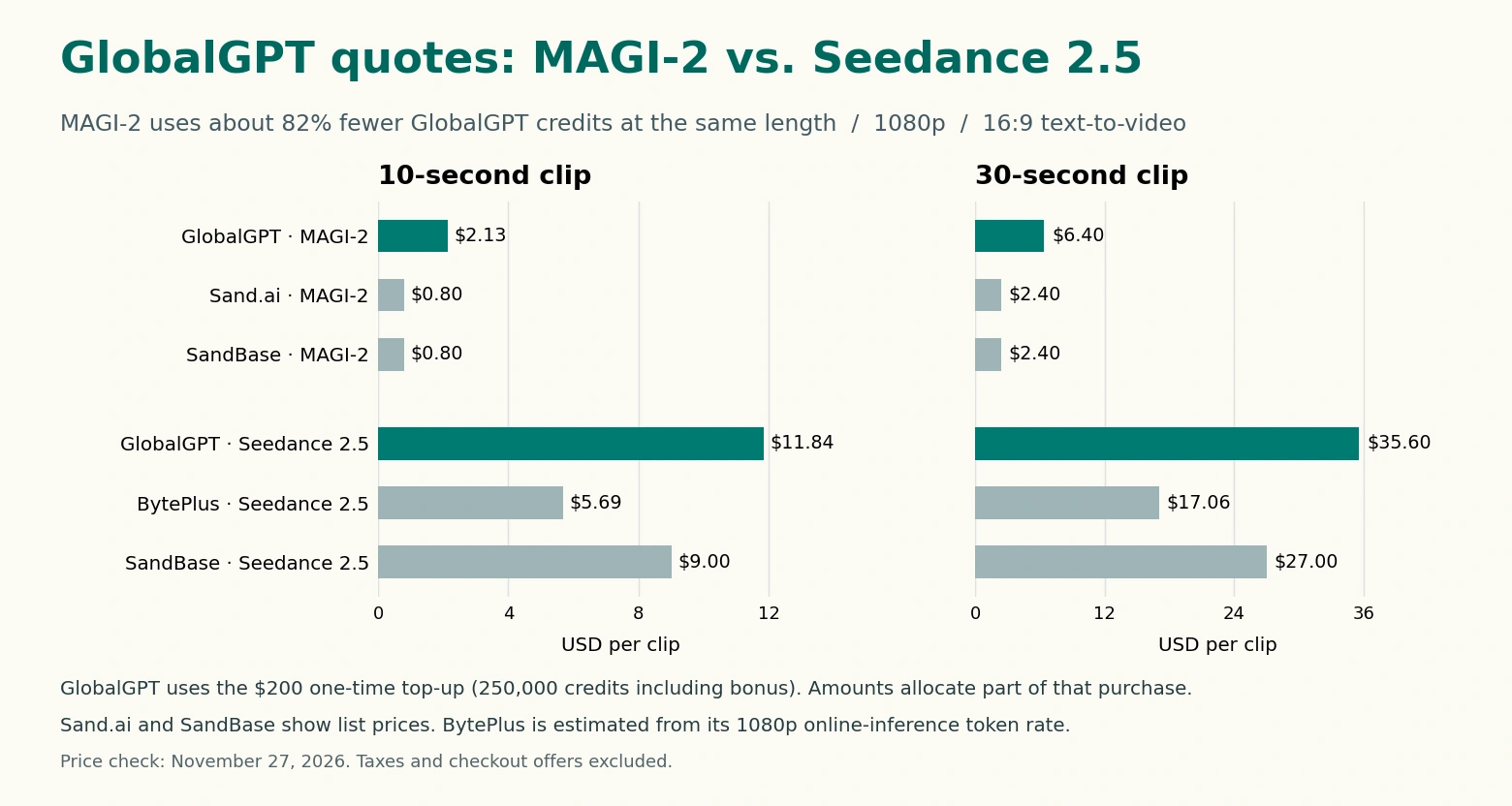
The green bars assume a $200 purchase. With the smaller $20 GlobalGPT credit pack, the same ten seconds use about $2.67 of credit for MAGI-2 or $14.80 for Seedance.
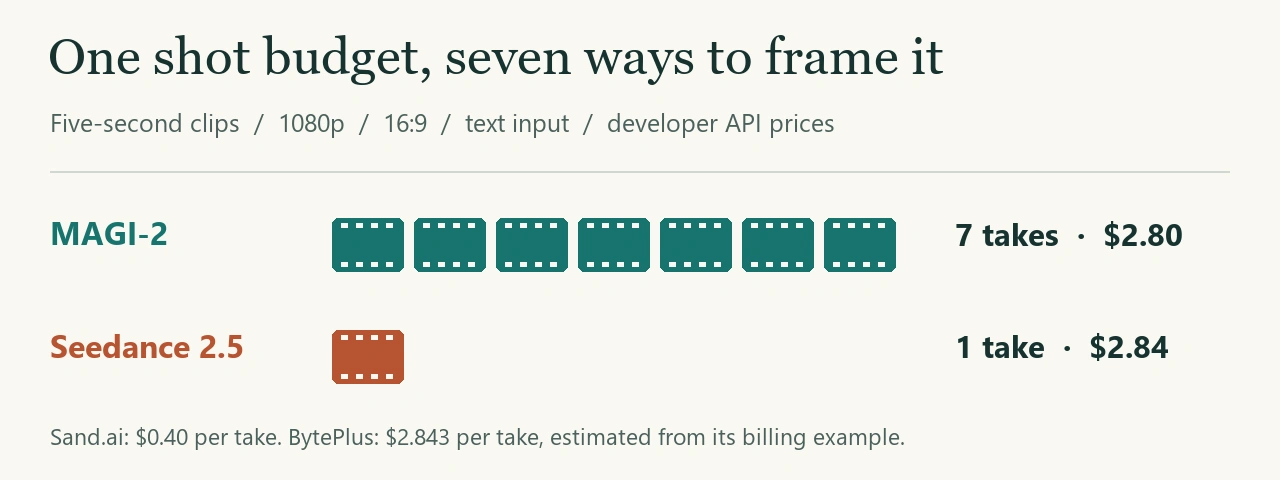
For five seconds at 1080p, Sand.ai’s posted rate works out to $0.40, while the BytePlus example for Seedance without video input comes to about $2.84. Sand.ai listed self-service top-ups as unavailable on November 27. The hosted rates on SandBase provide another way to budget the same shot.
If a client buys thirty seconds of finished footage, billable seconds can be higher. In our MAGI-2 budget for a finished 30-second edit, the selected clips took 48 generated seconds. At the direct list rate that meant $3.84 in generation costs.
MAGI-2 vs Seedance 2.5 Benchmarks
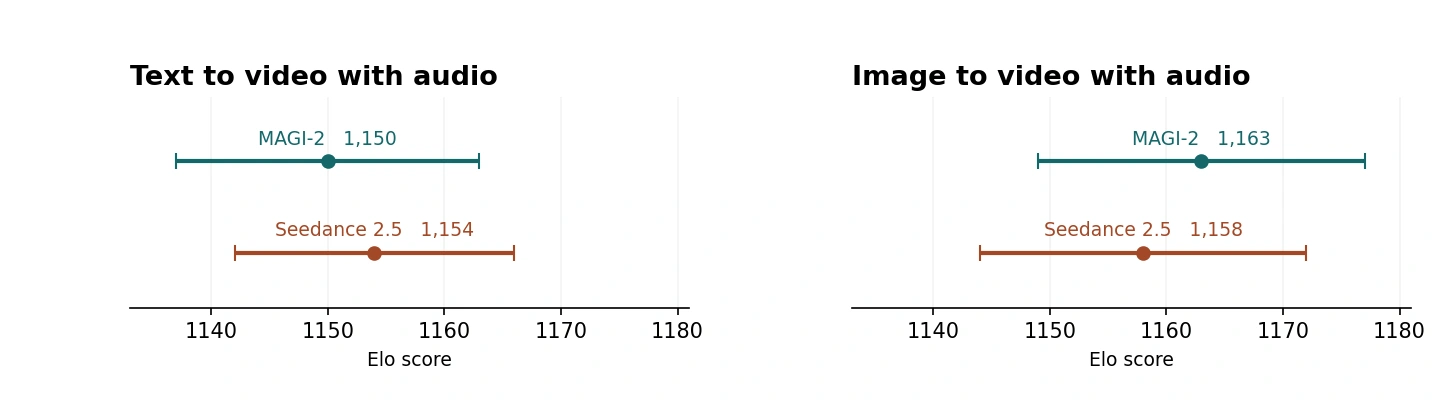
The text-to-video votes put the two models close together. MAGI-2 led on the image-to-video board with audio, but the 95% intervals overlap there too. For a shot that depends on a flag crossing the lens at just the right moment, we would choose from the actual takes.
When Higgsfield put MAGI-2 directly against Seedance 2.5 in its November 24 blind comparison, viewers chose Seedance in 61% of votes. That head-to-head measures preference for whole clips, so the result can differ from the broader arena ranking.
See exact benchmark scores, ranks and intervals
| Video evaluation | MAGI-2 | Seedance 2.5 |
|---|---|---|
| Artificial Analysis · text to video with audio | 1,150 Elo (1,137–1,163), rank 7 | 1,154 Elo (1,142–1,166), rank 5 |
| Artificial Analysis · image to video with audio | 1,163 Elo (1,149–1,177), rank 1 | 1,158 Elo (1,144–1,172), rank 2 |
| Higgsfield · direct blind matchups between these two models | 39% of votes | 61% of votes |
MAGI-2 vs Seedance 2.5 Official Demos
In Sand.ai’s giant-flower sequence, a hand brushes past a fern at three seconds. One second later the camera is far enough back to fit both the woman and an enormous pink rose in the frame. The fern gives the viewer a sense of her size before the wide shot changes it.
Four seconds into ByteDance’s Peking Opera sequence, the first performer’s back flags sweep across the lens. When the fabric clears, a second performer is in view. The moving costume gives the change of subject a physical cue. Both studios supplied references for their selected demos.
MAGI-2 vs Seedance 2.5 Video Tests
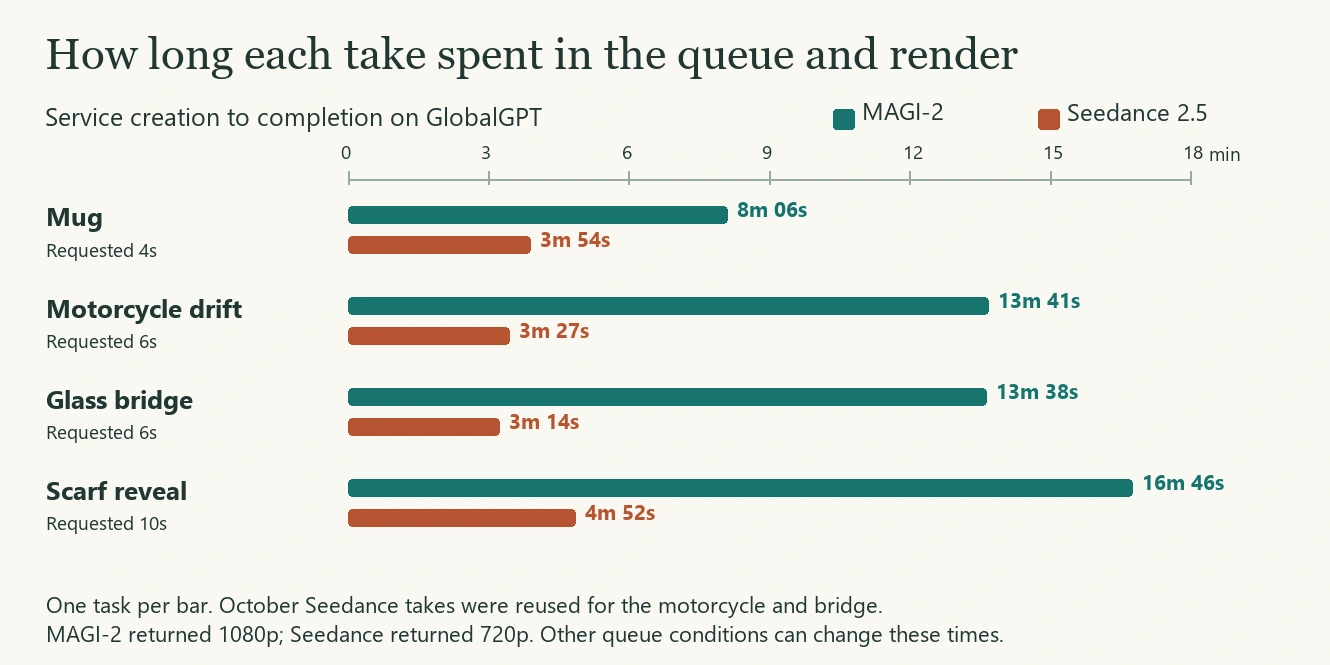
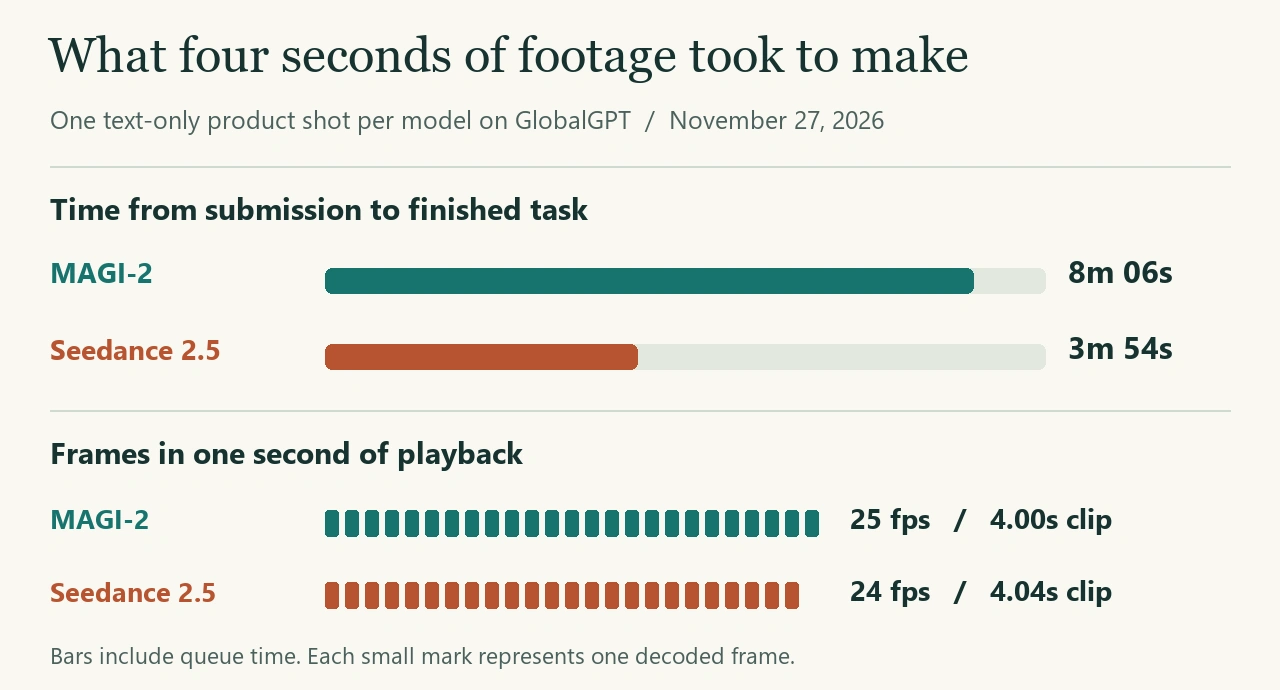
Four text-only briefs on GlobalGPT. Each pair used the same prompt, requested duration, 16:9 framing and audio off. MAGI-2 exported at 1080p/25 fps; Seedance at 720p/24 fps. The motorcycle and bridge reuse October 28 Seedance takes. All other paired outputs were generated November 27, 2026.
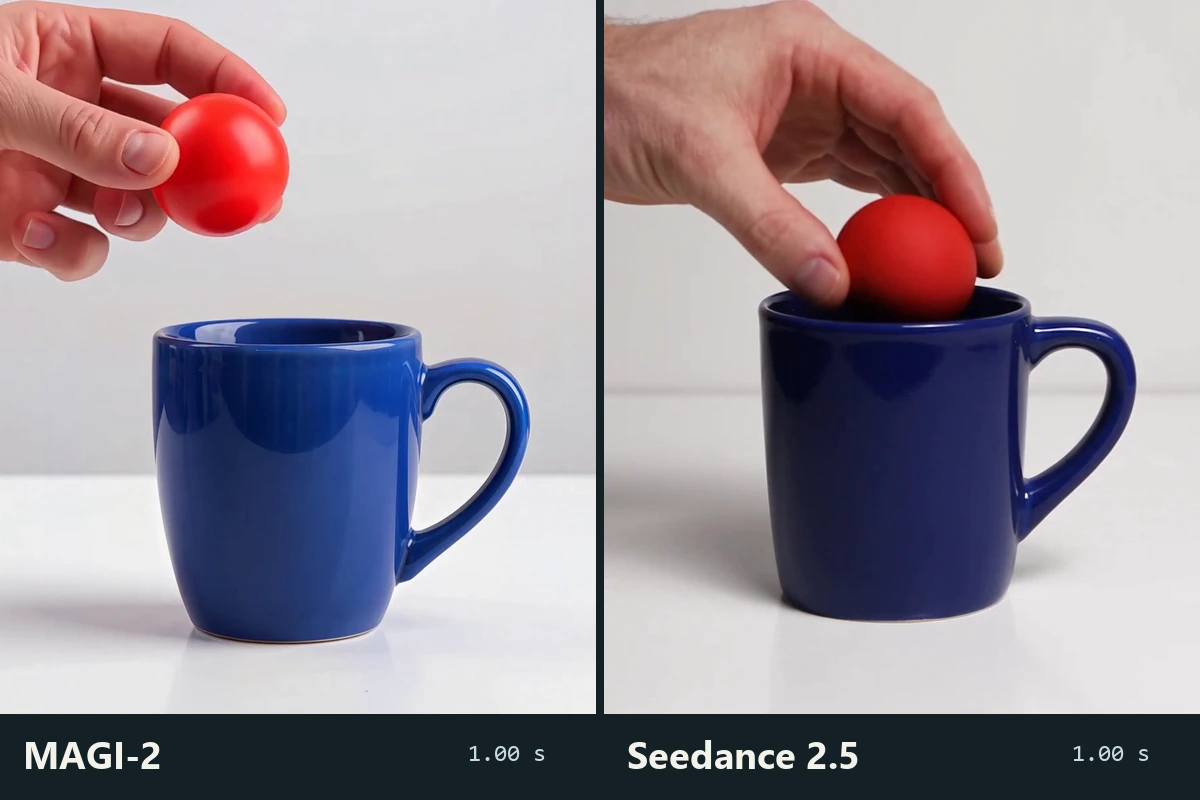
Product demo · 4 seconds
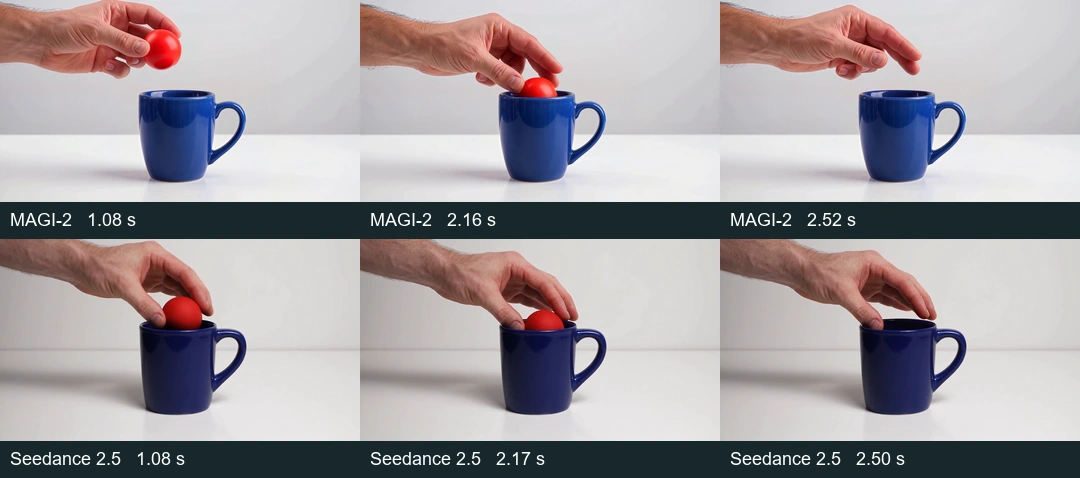
Use MAGI-2 for the approach; use Seedance if the viewer needs more time to see where the ball goes. Both end on a clean shot of the mug.
Read the shared prompt
A single locked-off tabletop product shot. One upright cobalt-blue ceramic mug sits on a plain white table, its handle pointing right. A human hand enters from the left holding one small red ball between thumb and forefinger, lowers the ball into the mug, opens the fingers to release it, then withdraws empty to the left. End on the same stationary mug. Neutral studio light, no text, no cuts.
Motorcycle drift · 6 seconds
Freeze the spray while the camera swings 90 degrees around the rider.
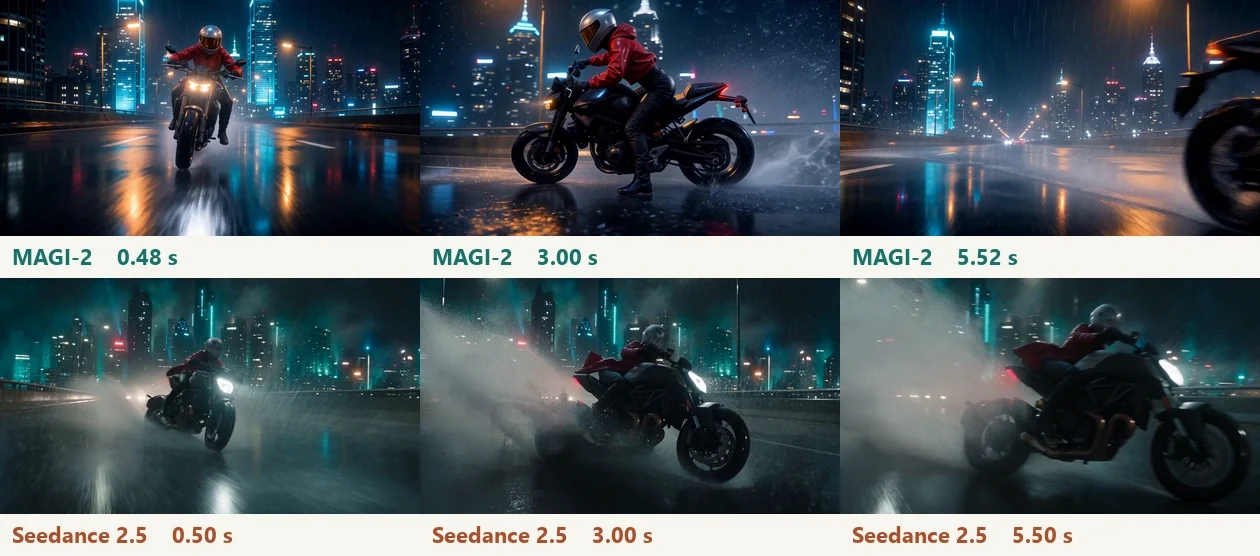
MAGI-2 gives the editor a stronger change of angle. The bike also turns, so the camera’s exact arc is hard to isolate. Seedance gives the suspended splash a longer hold.
Read the full shared prompt
Create a six-second live-action science-fiction action shot, widescreen 16:9. A lone adult female motorcycle courier wears a silver full-face helmet with a narrow amber visor and a cropped crimson rain jacket. Her motorcycle is matte black with one thin amber headlight. It is midnight on a rain-soaked elevated road above a dense city. Cyan architecture and warm amber headlights reflect in the asphalt. One rider, one motorcycle. Premium theatrical cinematography, wet practical surfaces, convincing tire contact, restrained anamorphic flares.
0–1.5 seconds: Begin inches above the wet asphalt, tracking backward ahead of the approaching front wheel. The courier brakes into a controlled sideways drift across the lane. The rear tire throws a curved wall of water toward the lens. Make the skid physically readable: the bike leans, the rider counterbalances, and both wheels remain on the road.
1.5–4.5 seconds: Time abruptly slows almost to a standstill at the most dramatic point of the drift. The rider, wheels, raindrops and curling spray become almost suspended while the camera alone continues moving at normal speed. Move through an open gap in the spray and arc 90 degrees around the motorcycle to a low side view. Nearby droplets sweep past the lens with strong parallax; the distant skyline moves much less. Keep the bike, helmet and red jacket unchanged. The camera never passes through the rider, motorcycle or road.
4.5–6 seconds: Time snaps back to normal. The suspended spray collapses, the rear tire regains traction, and the courier accelerates out of frame to the right, leaving a widening amber reflection on the wet road. End on the falling spray with the city visible beyond it. One continuous shot, no cuts, no duplicate riders, no text, no logos. The image must tell the action without dialogue or music.
Glass bridge · 6 seconds
Track the runner’s feet as the bridge forms, then pull back to reveal the gap.
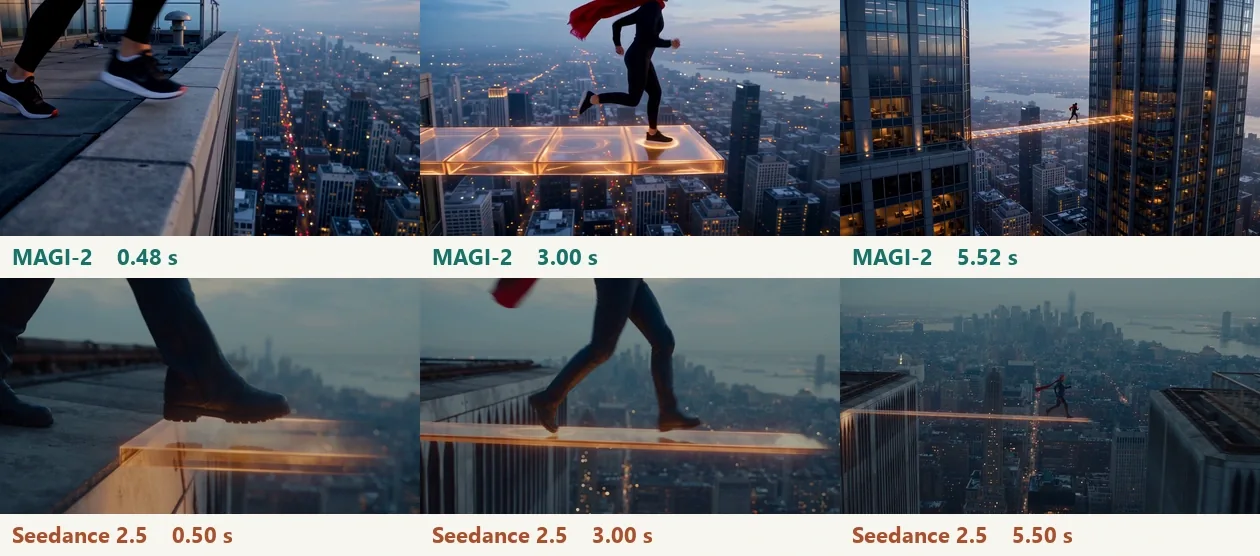
Pick MAGI-2 if the audience must understand how the bridge forms. The seams and the ripple under each landing make individual steps easier to read.
Read the full shared prompt
Create a six-second live-action fantasy action shot, widescreen 16:9. A lone adult woman in a fitted black running suit with a short crimson scarf sprints toward the edge of a skyscraper roof at blue hour. Across a deep open gap is a second skyscraper at the same height. The city far below is realistic and immense. The only supernatural element is a bridge made of translucent amber glass panels: each new panel materializes just ahead of her next footfall, extending from the first roof toward the second. Once formed, panels remain solid and stationary. Wind pulls the scarf backward. High-end architectural photography, cool city haze, warm refracted light inside the glass, realistic human proportions.
0–2 seconds: Start in a low lateral tracking close shot of her shoes as she reaches the roof edge. As her leading foot comes down beyond the concrete lip, the first amber glass panel forms beneath it, fully solid before the shoe makes contact. A tight ripple of golden light travels outward from the landing point. Show the foot bearing weight instead of passing through the panel.
2–4 seconds: Track alongside her as the next panels form one after another just ahead of her steps. She keeps running with an ordinary alternating stride; the new bridge supports her. Previously formed panels remain visible behind her. No floating human body, no wings, no leap across the entire gap.
4–6 seconds: The camera sweeps outward and rises into a wide side view, revealing the runner halfway across the chasm on a narrow glowing bridge between the two towers. Fresh panels continue forming in front of her, with the completed span clearly stretching back to the original roof. Finish with the tiny runner silhouetted against the enormous city. One continuous shot, no teleporting, no changing buildings, no text or logos. The action must read without dialogue or music.
Scarf reveal · 10 seconds
Hide the lens with a scarf, change subjects, then crane up with both dancers still in frame.
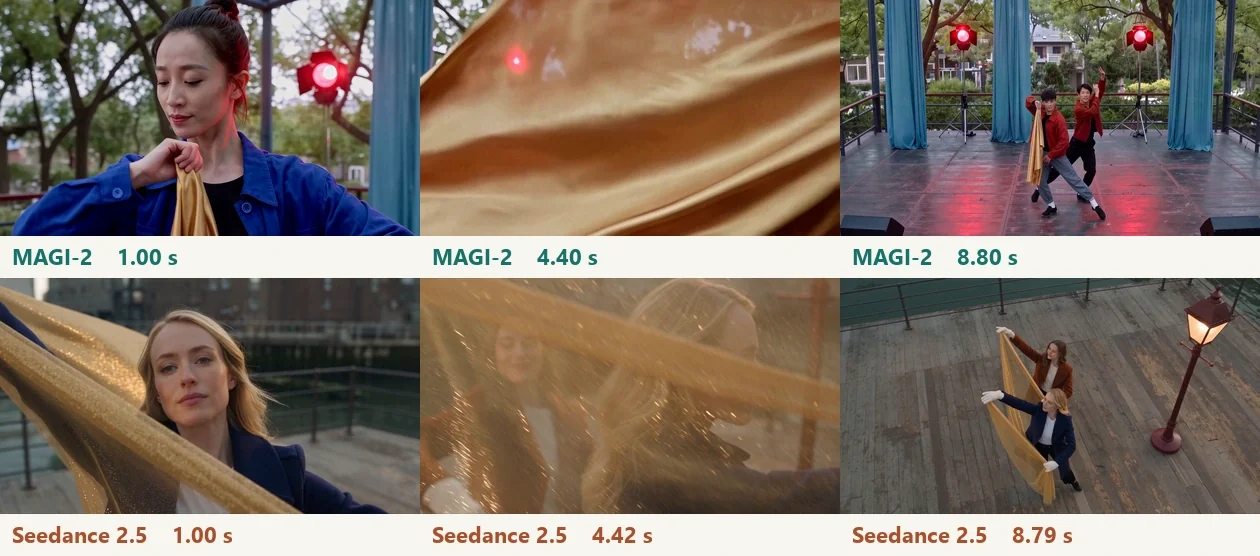
MAGI-2 makes the cleaner wipe but loses the blue jacket. Seedance keeps the costumes distinct through its overhead finish. We would use Seedance for this continuity brief.
Read the full shared prompt
One continuous ten-second shot on a small open-air stage in daylight. Start close on a dancer in a cobalt jacket holding a long gold scarf. From 0–3s, orbit from her front toward her right shoulder; a stationary red stage lamp shifts across the background. From 3–5s she sweeps the gold cloth across the lens until it fills the frame. As the cloth clears, pick up a second dancer in a rust-red jacket behind her. From 5–10s crane up and pull back to a high wide shot showing both dancers and the same red lamp. No hard cuts, no text.
Bonus clip · Seedance character continuity

The watchmaker keeps his glasses and waistcoat as he moves. The final instruction in the watchmaker prompt we used across models was for him to look into the camera. He never does. An editor could keep the movement and still need another take for the last beat.
Render time and frame rate
MAGI-2 vs Seedance 2.5 Verdict
Start with MAGI-2 for multiple 1080p concepts, a pronounced camera move or a process the viewer needs to follow step by step. The glass bridge is the clearest example.
Start with Seedance 2.5 for a 4K delivery, a scene extension, or a reveal where the same performers must remain recognizable. Our scarf test favored Seedance for that last requirement.
MAGI-2 vs Seedance 2.5 FAQ
Is MAGI-2 cheaper than Seedance 2.5 for a 1080p clip?
Sand.ai lists $0.40 for five seconds at 1080p. BytePlus estimates $2.843 for the equivalent Seedance clip with no video input.
Which model wins on image-to-video benchmarks?
MAGI-2 led the November 27 image-to-video board with audio. The two models’ 95% intervals overlapped.
Can I use MAGI-2 for a 4K delivery?
MAGI-2 outputs 1080p, so a 4K master requires upscaling. Standard Seedance 2.5 offers 4K through BytePlus.
Can both models make a 30-second video?
Yes. Both support up to 30 seconds per generation. Seedance also offers extensions on supported interfaces.
Which model should I try for a reference-heavy product shoot?
Seedance 2.5 accepts up to 50 references on BytePlus. MAGI-2 takes up to 20.
How can I run my own comparison?
Use one action, identical inputs and the first result from each model. Compare the moment your edit depends on.