MAGI-2 Review: Real Tests, Failed Shots and Limitations
See MAGI-2’s original first takes, what failed in motion and sound, and how to decide which footage is worth keeping.
 Sally Brooks
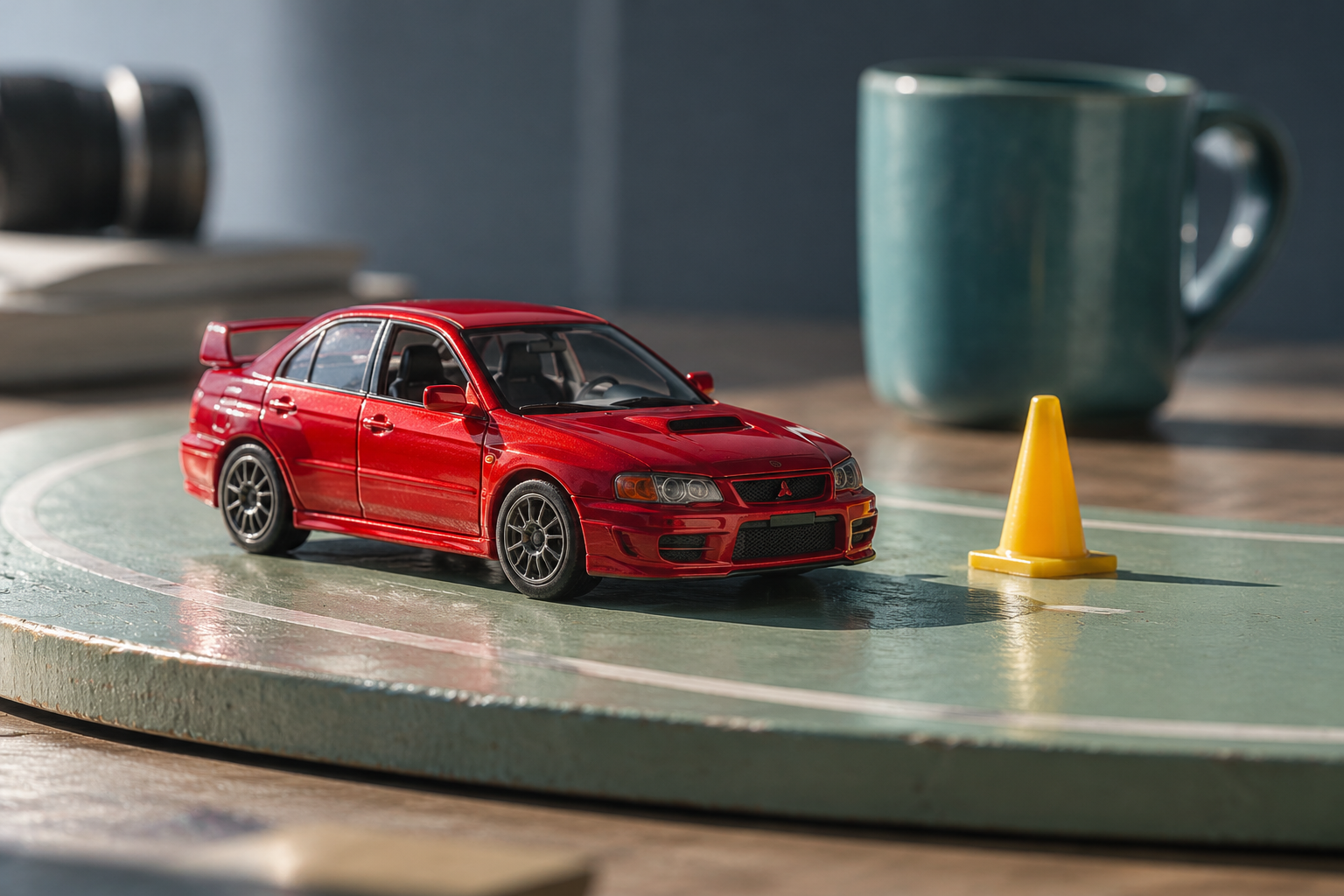
Quick Answer: Is MAGI-2 Worth Using?
MAGI-2 is worth trying for short shots you can judge and edit individually. In our original five-second clips, the teal mug retained its shape and gave us a clean ending for a title. The clockwork fox looked convincing in frame and stopped facing the right way, but took extra steps. Both examples show why you should approve the picture and the sound separately.
Its 30-second ceiling and native audio are useful for scenes that need continuity. Exact choreography, required words and an effect that must hit on a particular frame raise the bar. This review includes first takes, the decisions we made about each shot, and the specific misses we would fix before delivery.
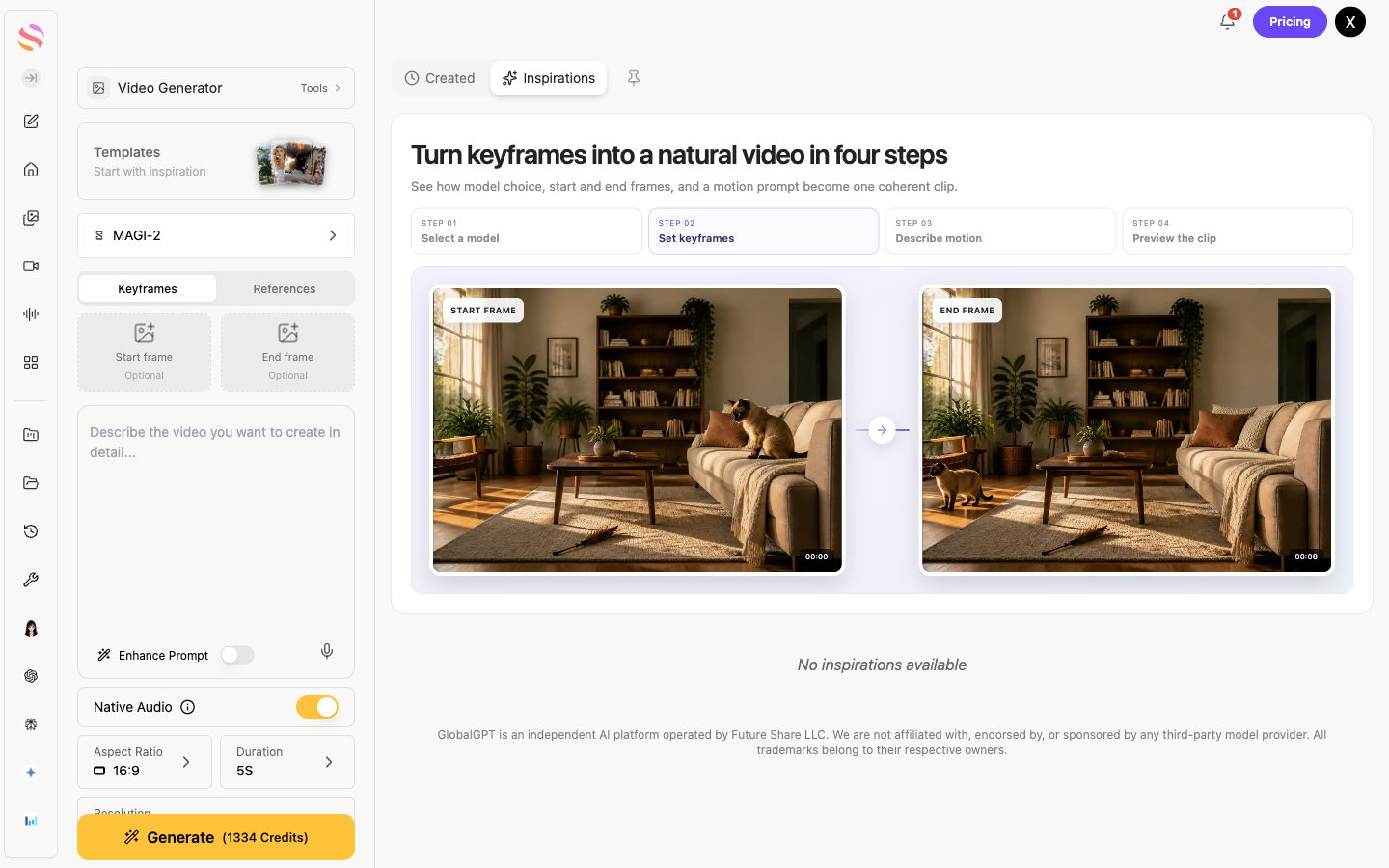
In the GlobalGPT MAGI-2 workspace, you can try text alone or bring a starting frame, choose your aspect ratio, and see the credit quote before generating. We used it to run an independent version of the mug shot and verified the completed job in My Records.
What Changed From MAGI-2 Preview?
Sand.ai’s full MAGI-2 is a 480B mixture-of-experts video model with about 28B active parameters. The 114B Preview had about 6B active. The flagship also scales the training corpus and adds targeted post-training and a 1080p output pipeline. The Preview and flagship are separate releases when you compare access, weights or quality.
Capability | Why It Matters in an Edit |
|---|---|
Up to 30 Seconds at 1080p, 25 fps | Give a continuous interaction room to play, or generate shorter clips when you can cut between actions. |
Native Audio With Dialogue and Effects | Get an audio track alongside the picture. Check line wording, speaker and contact timing before committing to it. |
Image, Video and Audio References | The native API supports up to 10 images, five videos and five audio clips. Input limits and controls vary by interface. |
Timeline and Editing Controls | Sand.ai shows examples of scheduled cuts and video edits. Check how your selected endpoint exposes these controls. |
For a first generation, choose the control that addresses your biggest uncertainty. Use a starting frame if the opening composition is approved. Use a reference when the subject or setting should carry across shots. Use a text-only prompt when the action is more important than an exact visual match. The four short runs below were text-only. The separate 30-second test examines one attached identity reference across three shots.
What the Official MAGI-2 Showcase Demonstrates
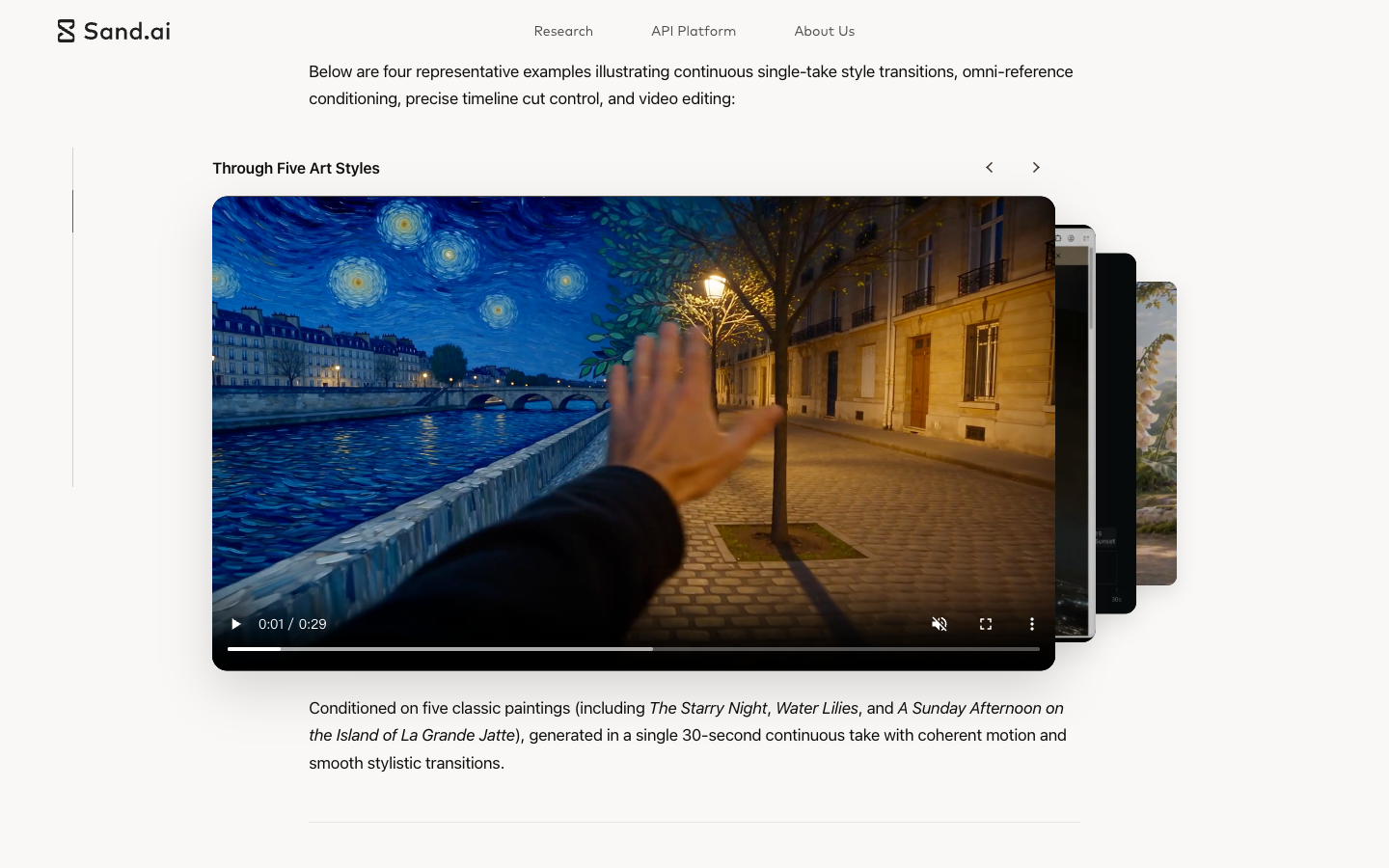
We replayed Sand.ai’s Through Five Art Styles example on its release page. The published file lasted about 29.8 seconds at 1920×1080. The sequence changes visual style while retaining the forward movement of the scene, an example of why a longer continuous take can be valuable. Sand.ai supplies the references and selects what appears in the showcase. The release page does not show how often an ordinary first attempt reaches that quality.
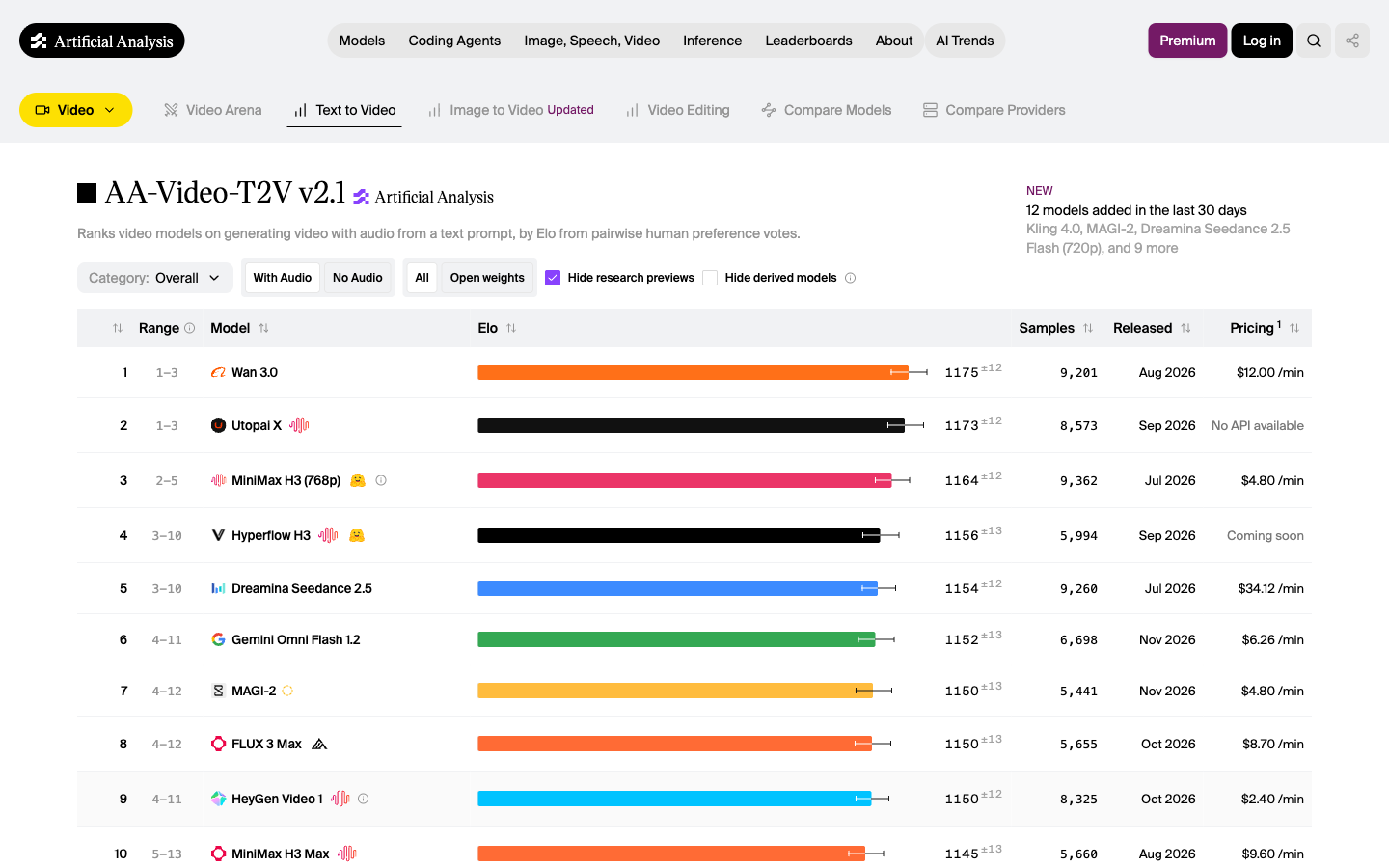
Artificial Analysis scored the flagship at 1,150 Elo on its AA-Video-T2V v2.1 with-audio ranking, with a 95% interval of 1,137–1,163 across the published 5,441 samples. The Preview row scored 1,040 on the same table. Seedance 2.5 scored 1,154 and Kling 4.0 scored 1,144, with intervals that overlap MAGI-2’s. Consider them shortlist candidates when you can test the same brief. Blind preference scores do not establish the likelihood of reproducing a precise action or matching an approved script.
MAGI-2 First-Take Results and Failed Checks
We used four independent prompt briefs with no reference assets. We retained the first output for each one and inspected movement, audio and what an editor would have to change. The first two videos are original takes from our earlier pricing test. The dialogue and rally shots are additional runs. Each row describes one clip, so the results should travel with the input and the evidence shown here.
Shot | Usable Result | Failed or Unverified Check |
|---|---|---|
Clockwork Fox · 5s | Full body in a locked shot. Stops facing right. | Extra steps. Transients continue after the walk. |
Teal Mug · 5s | One set-down and a clean title hold. | No isolated transient at visible contact. |
Train Station Dialogue · 8s | Both requested lines recovered by ASR in order. The two speech windows broadly track different faces. | Reply starts around 5.5s by audio energy. Phoneme-level sync unverified. |
Rally Car · 10s | Recognizable car, clear turn, ramp and stop. | Late turn, moving camera, staggered landing and ambiguous sound cue. |
Clockwork Fox: A Good Character Shot With the Wrong Step Count
Clockwork fox. Original first take, with generated sound.
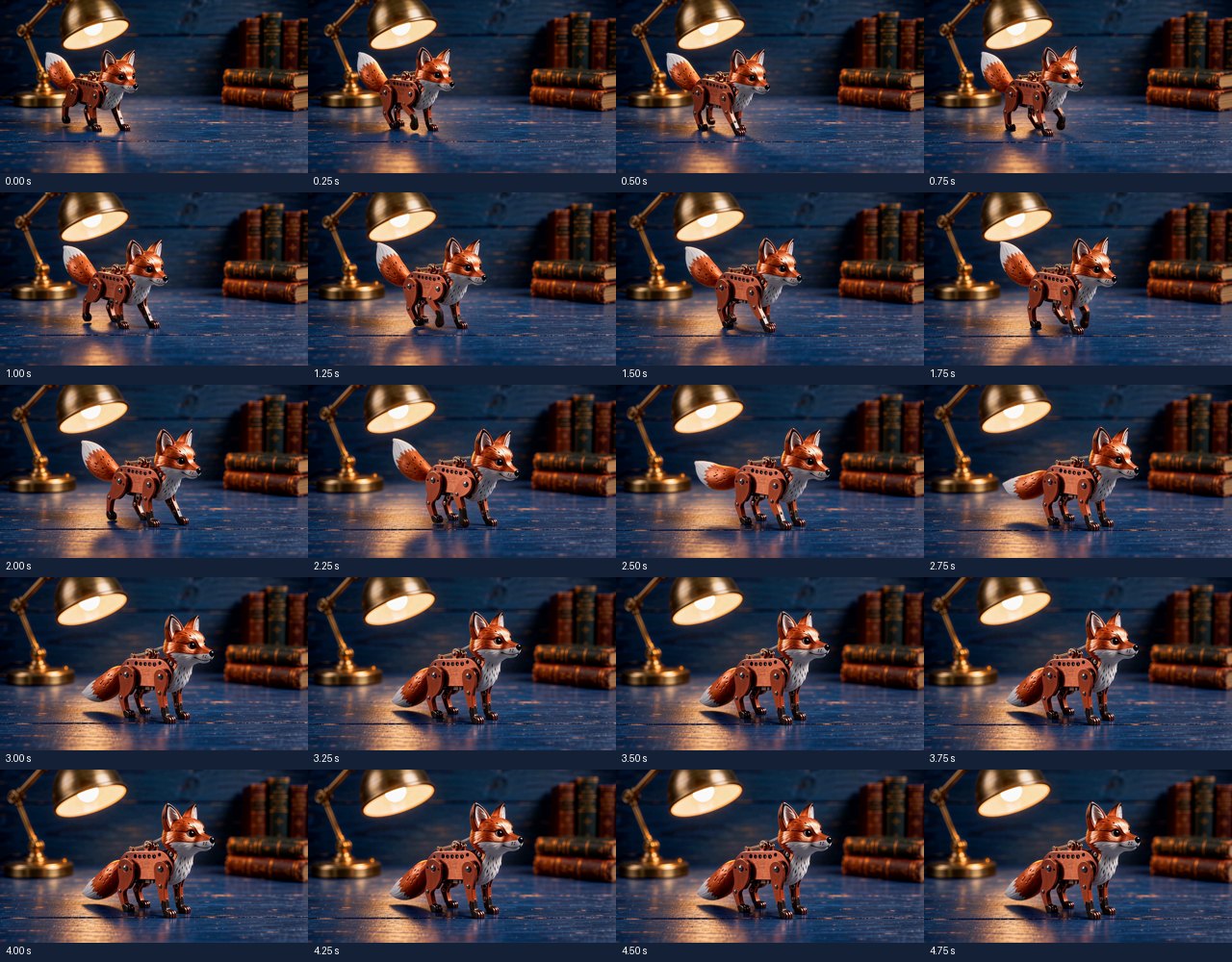
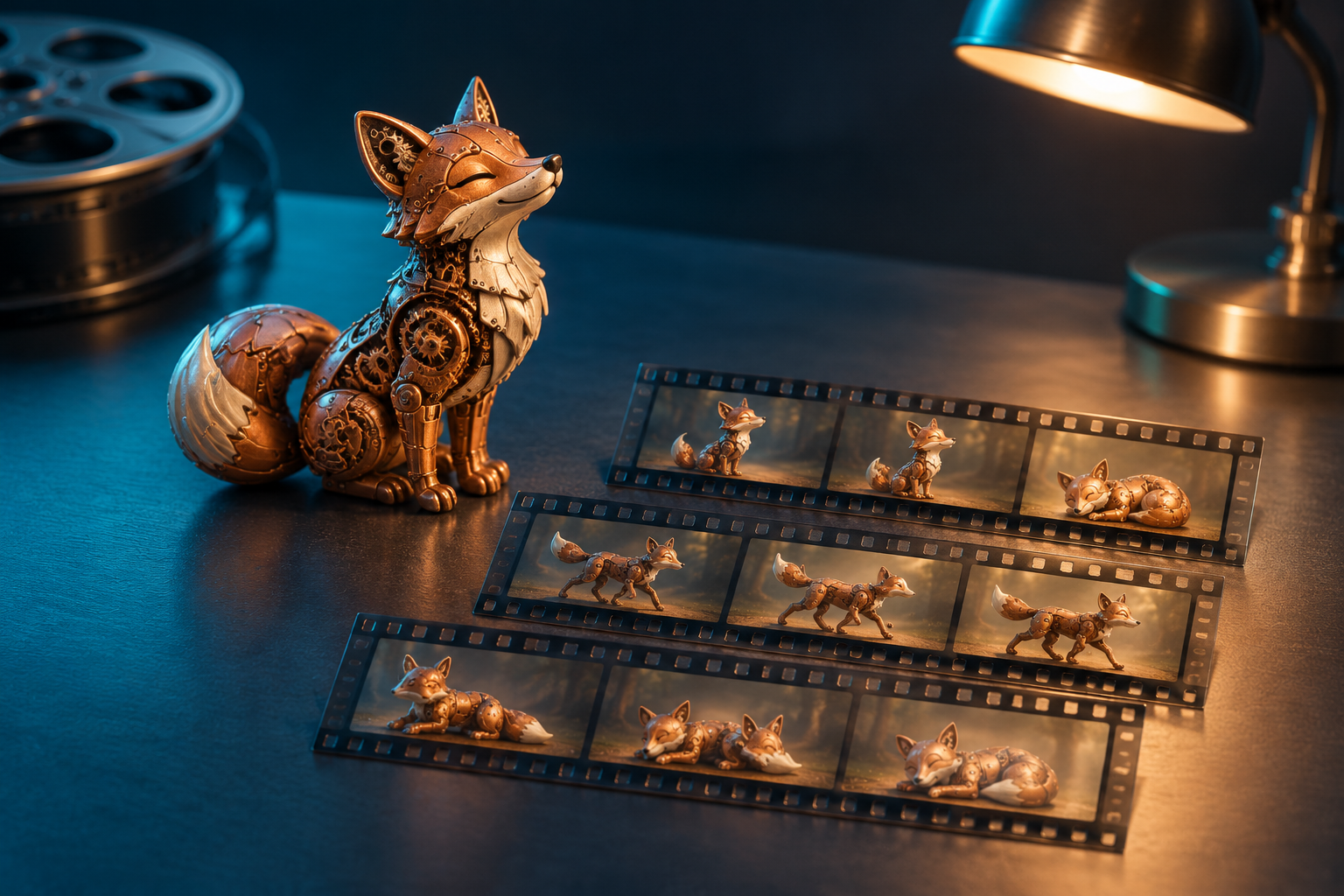
The fox stays in frame, walks right and settles around 2.75–3 seconds. The feet make more than the requested two contacts. We also found strong audio transients after the walk, around 3.15–3.87 seconds. The picture can work as a character insert. For a two-beat cue, both the movement and the sound need to be timed again.
Single locked 16:9 macro shot of a tiny copper wind-up fox on a dark blue wooden desk. The fox takes two steps, then stops facing right, with the entire fox visible throughout. Warm desk lamp, no cuts, no text. Soft clockwork clicks synchronized to the steps, faint room tone, no dialogue or music.Teal Mug: Keep the Picture, Replace the Tap
Teal mug. Original first take, with generated sound.
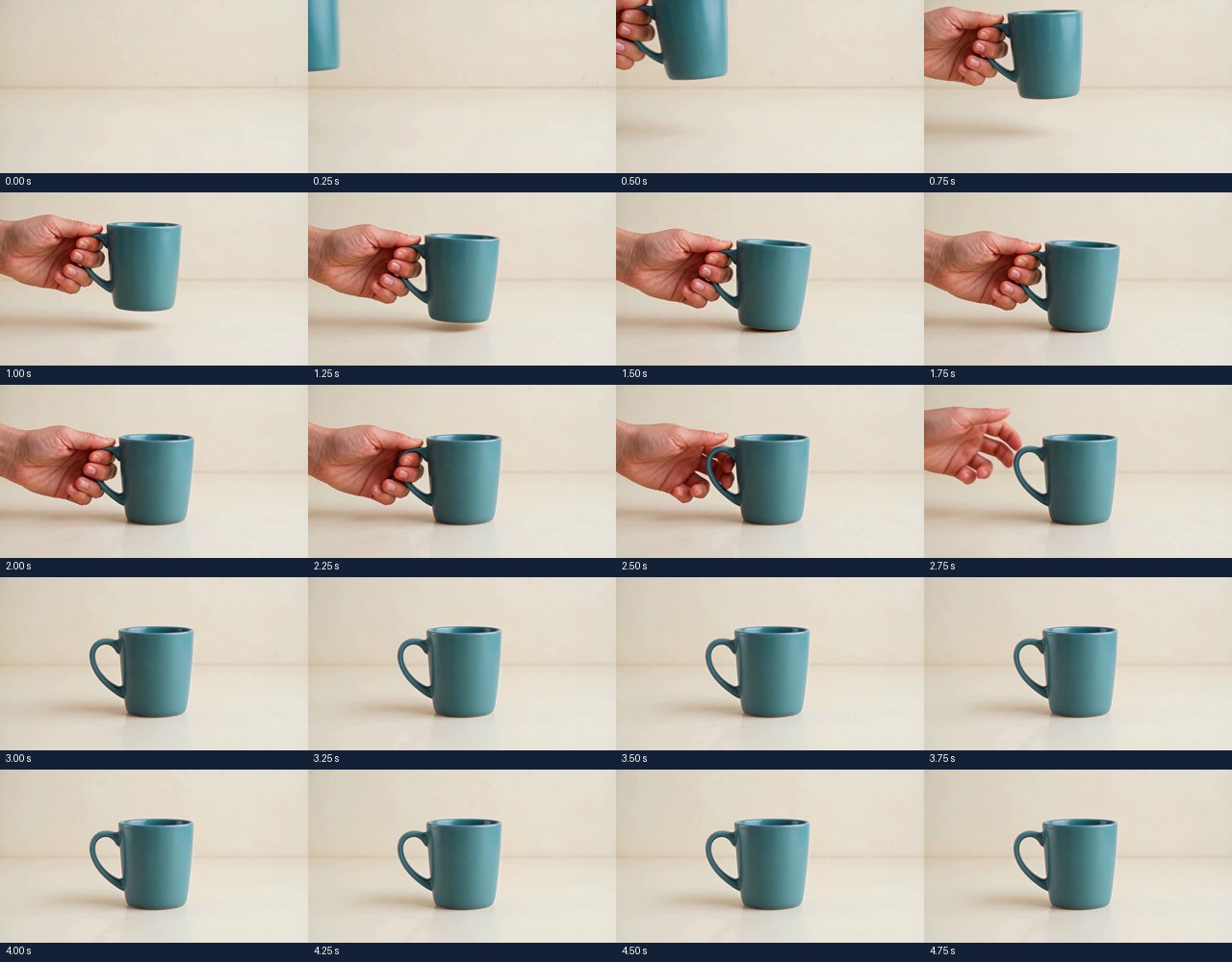
The mug holds its color and silhouette through one set-down, and the hand has cleared by about three seconds. The last second is steady enough for a title. At roughly 1.4 seconds, the source frames show the base reaching the counter. Near that moment, the audio has no clear, isolated transient that we could attribute to the ceramic contact. We would keep the picture and add one tap in the edit.
Locked landscape product shot of a matte teal coffee mug centered on an empty cream counter. A hand sets the mug down once by its handle, then exits left. Keep its color, shape and handle consistent. Leave the final second clear for a title to be added in editing. A single soft ceramic tap at contact, no music, no spoken words, no on-screen text.Train Station: Correct Words, Approximate Timing
Two-speaker train-station dialogue. Original first take, with generated sound.
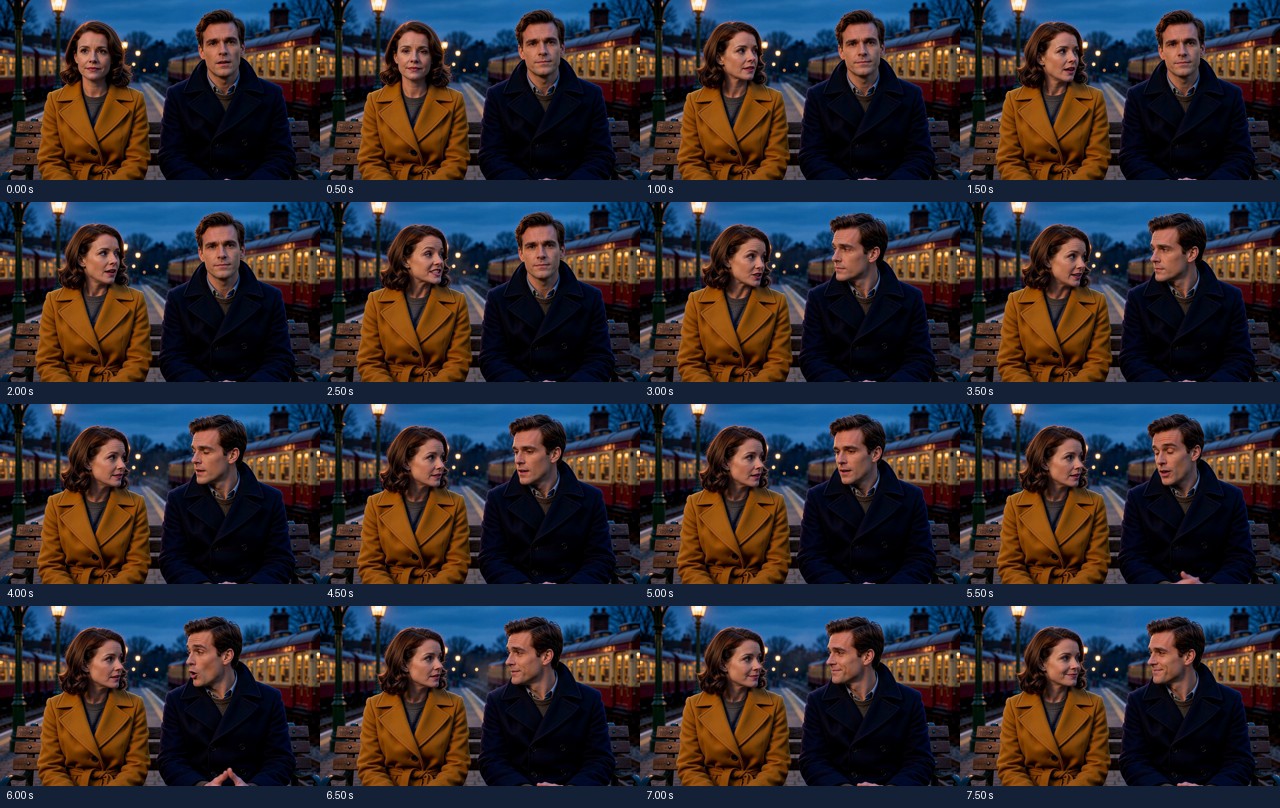
Local speech recognition recovered the requested words in order: “We missed the last train” and “Then we walk home.” The source has two strong speech-energy windows, roughly 2.25–3.75 seconds and 5.50–6.75 seconds. The sampled faces support the intended speaker sequence. The reply is later than the requested five-second cue, and frame sampling and ASR cannot verify every mouth shape. We would keep this take for a flexible storyboard, with a closer sound-and-picture review before approving a timed dialogue scene. The eight-second API job reported $0.64 in service cost.
Eight-second uninterrupted medium two-shot in a quiet miniature train station at blue hour. Two adult friends with visually distinct outfits sit on a bench, both faces unobstructed: the woman in a mustard coat on the left, the man in a navy coat on the right. At about two seconds the woman says exactly, 'We missed the last train.' The man listens silently, then at about five seconds he says exactly, 'Then we walk home.' She remains silent while he speaks. Natural conversational English, no extra words or voices, no music, faint evening ambience. Locked camera, no cuts, no subtitles.Rally Car: Coherent Route, Missed Camera and Landing Cues
Rally car first take. The Hub playback file uses the same footage and original audio, with video compression for the media upload.
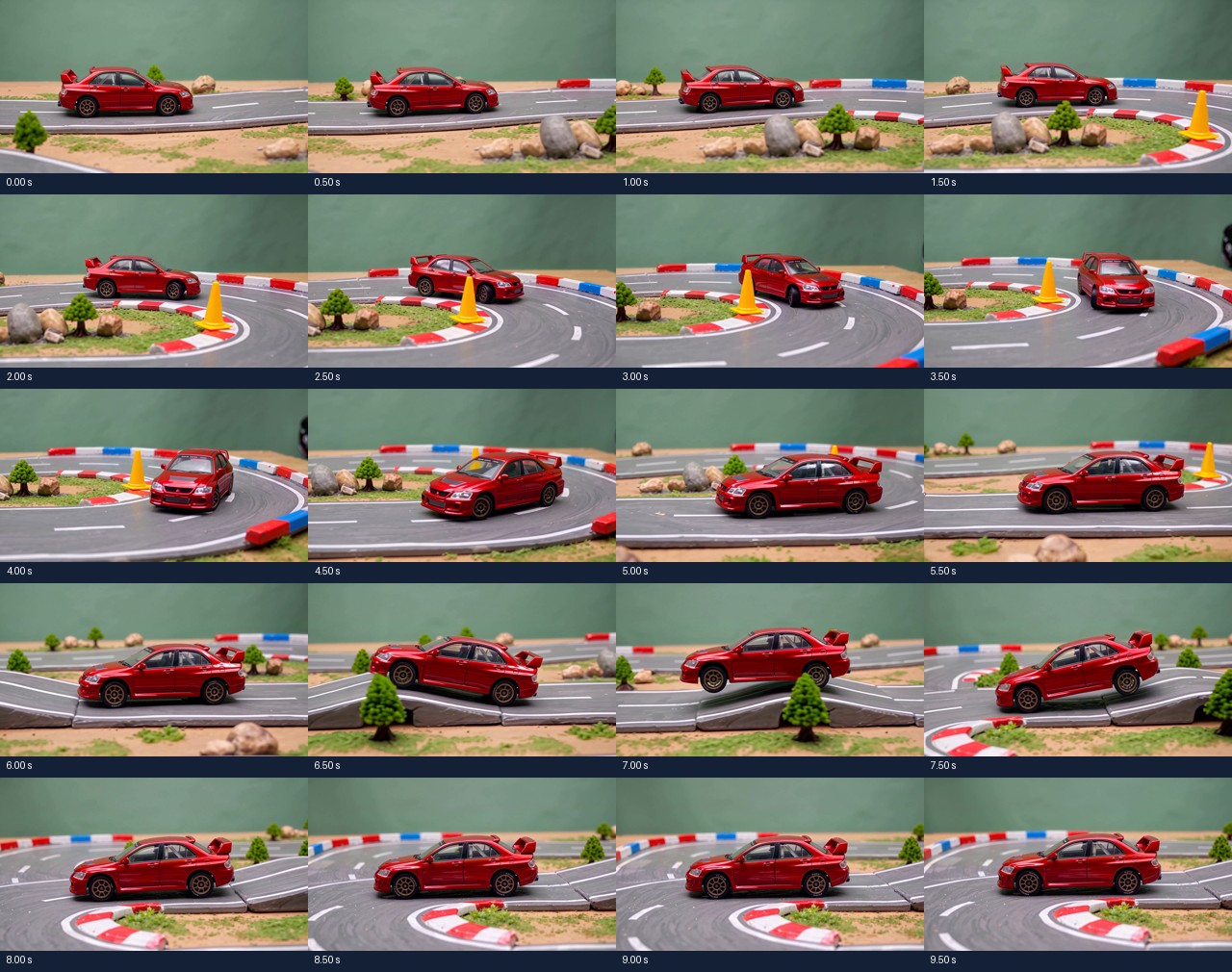
The red car remains recognizable in one continuous shot. The cone stays upright and there is no visible hit. At three seconds the car is still turning, and it points back along the leftward leg only around 4.5 seconds. The track and background shift horizontally as the camera follows, contrary to the locked-camera instruction.
Near the ramp, the front arrives lower than the rear. Sampled frames do not show a clean four-wheel landing, and the two strongest local high-frequency transients are around 7.30 and 7.66 seconds. The sound is lively, but we could not attribute one isolated clack to a single landing frame. The car settles for a sufficiently clear final hold. We would use this as a miniature action insert or rebuild it as two shots if timing and camera lock are contractual. The 10-second API job reported $0.80 in service cost.
One continuous locked landscape shot of a jewel-red miniature rally car on a tabletop ceramic track, against a sage-green backdrop. Keep the car fully visible. In the opening three seconds it rolls from left to right and takes a tight hairpin around a single yellow cone without touching it. It then accelerates back toward the left, clears one tiny ramp, lands on all four wheels, and comes to a complete stop before the end. Same red body and four black wheels throughout. No cuts or text. A soft electric motor whine grows as the car accelerates; one brief clack at the landing, no music, no speech.MAGI-2 30-Second Reference Test: Three Shots in One Take
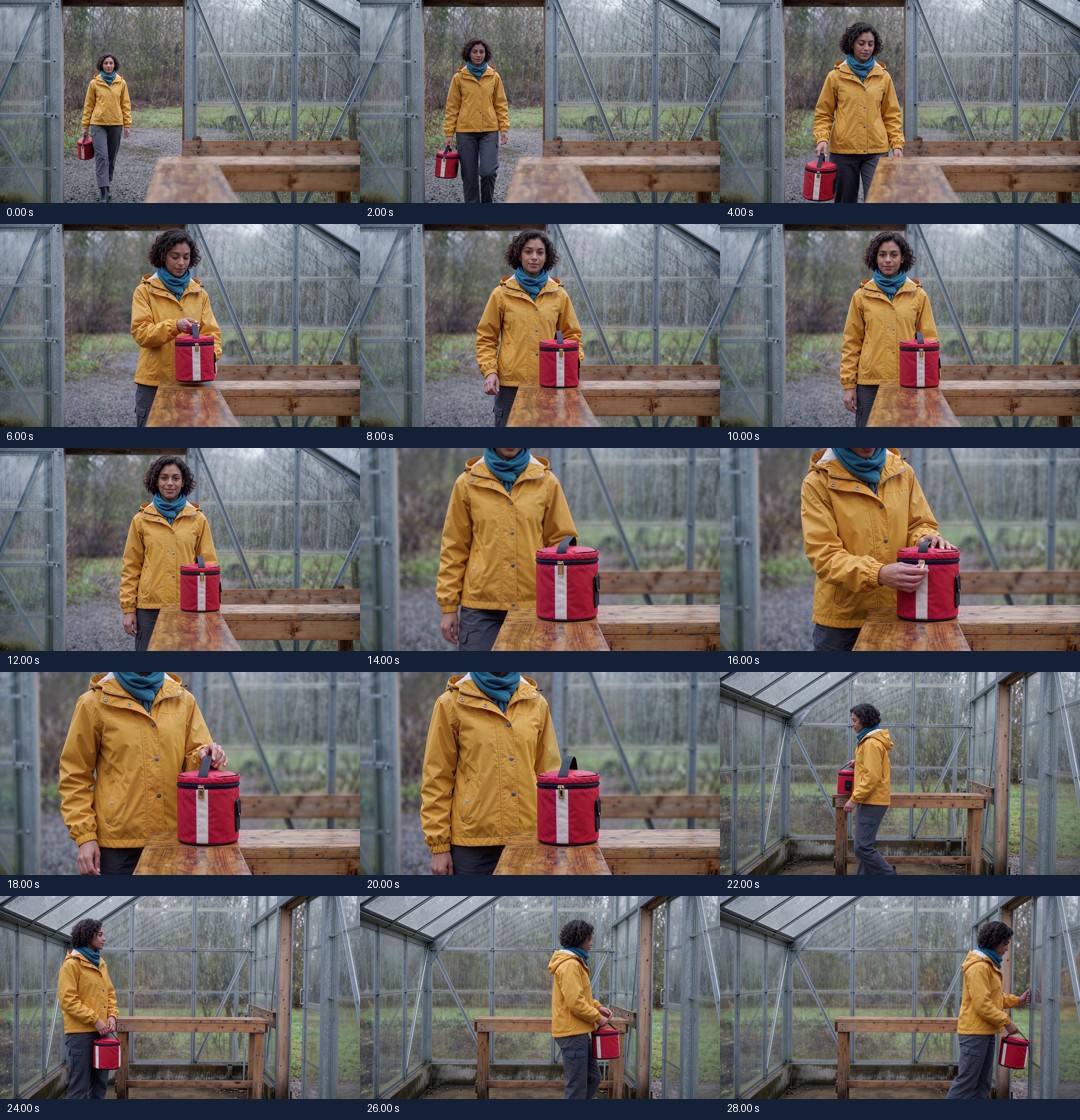
MAGI-2 delivered three recognizable shots in one 30-second output. Both cuts missed our timing tolerance, and the middle shot cropped the face we asked it to keep visible. The mustard raincoat, blue-green scarf and striped red case carried through the sequence. The sound added texture, but the take would need timing and foley work before delivery.
The first and only result. The Hub player uses a compressed video copy with the original audio.
The Reference and the Three-Shot Brief
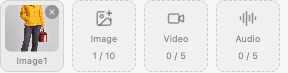
We generated an original portrait for the test and attached it as @Image1 in GlobalGPT MAGI-2 References mode. Settings were 30 seconds, 1080p, 16:9, native audio on, prompt enhancement off. We asked for a case set-down at six seconds, a latch closure at 15 and a door closure at 26, with hard cuts at 10 and 20. Before generating, we set a ±0.50-second cut tolerance and a ±0.20-second sound-to-action tolerance where the visual contact and matching audio event could both be identified.

Cut Timing and Character Continuity
Cut | Requested | First Frame of New Shot | Deviation |
|---|---|---|---|
Wide Entry to Bench View | 10.00 s | 12.92 s | +2.92 s |
Bench View to Exit Profile | 20.00 s | 20.52 s | +0.52 s |
Adjacent source frames confirmed two hard cuts at 25 fps. The second missed our tolerance by 0.02 seconds. In shot one, the courier’s curls, jacket, scarf and case are easy to read. In shot two, the clothing and case persist but the camera cuts closer than asked, hiding most of the face. Shot three restores a wider profile and keeps the same wardrobe and striped case. These are strong continuity cues for the edit. The missing frontal view prevents a reliable face match across all three shots.

Did the Sound Land on the Action?
Prompted Beat | Visible Action and Audio | First-Take Decision |
|---|---|---|
Case Set-Down · 6 s | The case settles around 6.0 s. The strongest nearby short transient is at 6.36 s. | Candidate knock trails the visible set-down by roughly a third of a second. Replace or move it in the edit. |
Latch Closure · 15 s | The hand manipulates the case hardware around 17 s. Sharp peaks at 16.85 and 17.11 s bracket the action. | No distinct closure frame or unique matching click. A precise sync offset is unverified. |
Door Closure · 26 s | The courier reaches and presses the door area near 28 s. Audio peaks near 27.73 and 28.07 s. | The fully closed state is unclear in frame. An isolated closing cue could not be matched to a precise contact. |
We measured transients in the original stereo AAC output after a mono analysis decode and compared them with the source frames. Nearby peaks help find a cue. They do not identify the sound source. For an edit with fixed cut points and reliable contact sounds, we would keep the usable coverage, trim the cuts ourselves and place isolated foley.
The Settled 30-Second Charge
One completed web take debited 8,000 GlobalGPT Credits. The balance dropped by 8,000 and My Records showed a matching MAGI-2 debit. The amount matched the pre-submit quote. This was a separate web transaction from the short API takes.


Exact 30-Second Test Prompt
@Image1
Create one 30-second landscape film with exactly three shots and two hard cuts. Use the attached image as the identity and wardrobe reference for the same adult courier in every shot. Keep her face, short dark curly bob, mustard-yellow rain jacket, teal scarf, slate trousers and black boots consistent. Keep the same small cherry-red cylindrical delivery case with a cream stripe. No dialogue, music, subtitles or text.

SHOT 1, 00:00–00:10. Locked eye-level medium-wide view in a rainy greenhouse entry. The courier walks toward a waist-high wooden bench holding the red case. At 00:06 she places it upright on the bench once. One isolated wooden knock exactly as the case touches the bench. She continues to face the camera.

HARD CUT at 00:10. SHOT 2, 00:10–00:20. Locked three-quarter medium shot facing the same courier across the bench. Her face and scarf stay visible. The same red case remains upright with the cream stripe toward camera. At 00:15 she presses its brass latch shut once. One isolated mechanical click at the visible latch closure.

HARD CUT at 00:20. SHOT 3, 00:20–00:30. Locked wide profile shot of the same courier beside the greenhouse exit. She lifts the same case, walks to the door, and closes it gently at 00:26. One isolated soft door clack at visible closure. End with the courier still in frame and no further cuts. Keep soft rain ambience low enough to distinguish all three contact sounds.Where MAGI-2 Limitations Affect Production
Sand.ai flags possible motion or continuity artifacts in extreme high-speed shots, overly smooth local motion in some wider 2D shots, and limits in the depth and physical realism of complex soundscapes. Those are developer-disclosed boundaries. We used the rally brief as a practical motion check and the mug and dialogue clips to inspect simpler audio constraints.
Failure You Can See or Hear | What to Change Next |
|---|---|
A repeated or skipped beat | Remove actions that are optional. Give each remaining beat its own line and make the final state visible. |
A correct motion with the wrong hit sound | Approve the picture, then edit an isolated effect onto the contact frame. |
A fast trajectory changes direction unexpectedly | Split the turning shot and the landing shot. Cut on a frame where the object’s orientation is easy to read. |
Speech is audible but the wrong mouth moves | Test each speaker in a separate shot, or plan a cutaway during the off-screen line. Review exact words against the script. |
Trying MAGI-2 on GlobalGPT and Checking the Cost
Open the exact MAGI-2 model, choose Keyframes or References, and set duration and output framing. We selected Keyframes with both slots empty, 5 seconds, 16:9, 1080p and native audio on. We left prompt enhancement off and submitted the same teal mug prompt. The separate web job completed, and the 1,334-Credit quote matched the balance decrease and the settled MAGI-2 entry.
We also switched to References in the English workspace and saw separate counters for up to 10 images, five videos and five audio files. The screenshot verifies the available controls. Our text-only runs leave reference fidelity open.


Sand.ai lists 1080p generation at $0.08 per second, or $0.40 for five seconds. Our original five-second API jobs each reported $0.40 in service cost. GlobalGPT Credits are a separate billing unit. For an actual project, budget by requested seconds and paid takes, then compare that total with the footage you will keep.
Before a longer take, build one decisive failure check into the prompt. Name the speaker for each line, the object that must remain visible, or the required final frame.
MAGI-2 Review Verdict
Use MAGI-2 when a polished short insert or a continuous visual idea is worth testing. Review the shot with a clear acceptance decision for framing, continuity and sound. If the same failure would force you to rerender a long scene, put the hardest action into a short test first. The mug shows when it makes sense to keep the picture and repair sound. The fox and rally car show why a pleasing shot still needs to pass the choreography brief. Our train-station take is the best fit for a storyboard where dialogue matters and the cue can move by half a second. The 30-second courier take shows the value of carrying wardrobe and a prop through a sequence, with enough time in post to reset cuts and sound.
MAGI-2 Review FAQ
Can MAGI-2 make 30-second clips?
Sand.ai documents up to 30 seconds at 1080p and 25 fps. We also ran a 30-second three-shot reference take in GlobalGPT, and separately verified playback of the developer’s near-30-second example.
Does MAGI-2 generate dialogue and sound effects?
Yes. Native audio can include dialogue, effects, ambience and music. Check exact words, speaker identity, mouth motion and the timing of each effect independently.
What failed in the first takes?
The fox took extra steps and the mug’s audio lacked a clear transient at counter contact. Different prompts can fail in different ways, so the article shows the original outputs beside their checks.
How much did the GlobalGPT mug clip cost?
The completed five-second web generation debited 1,334 Credits. The Generate quote, balance change and My Records entry matched.
Which MAGI-2 version did you review?
The hosted flagship MAGI-2. The 114B research Preview is a different release.