MAGI-2 提示指南:摄像机、对话和时间轴示例
学习如何组织 MAGI-2 提示,用于摄像机移动、对话和定时剪辑。五个原创片段展示了哪些指令有效以及需要修改什么。
 Olivia Carter
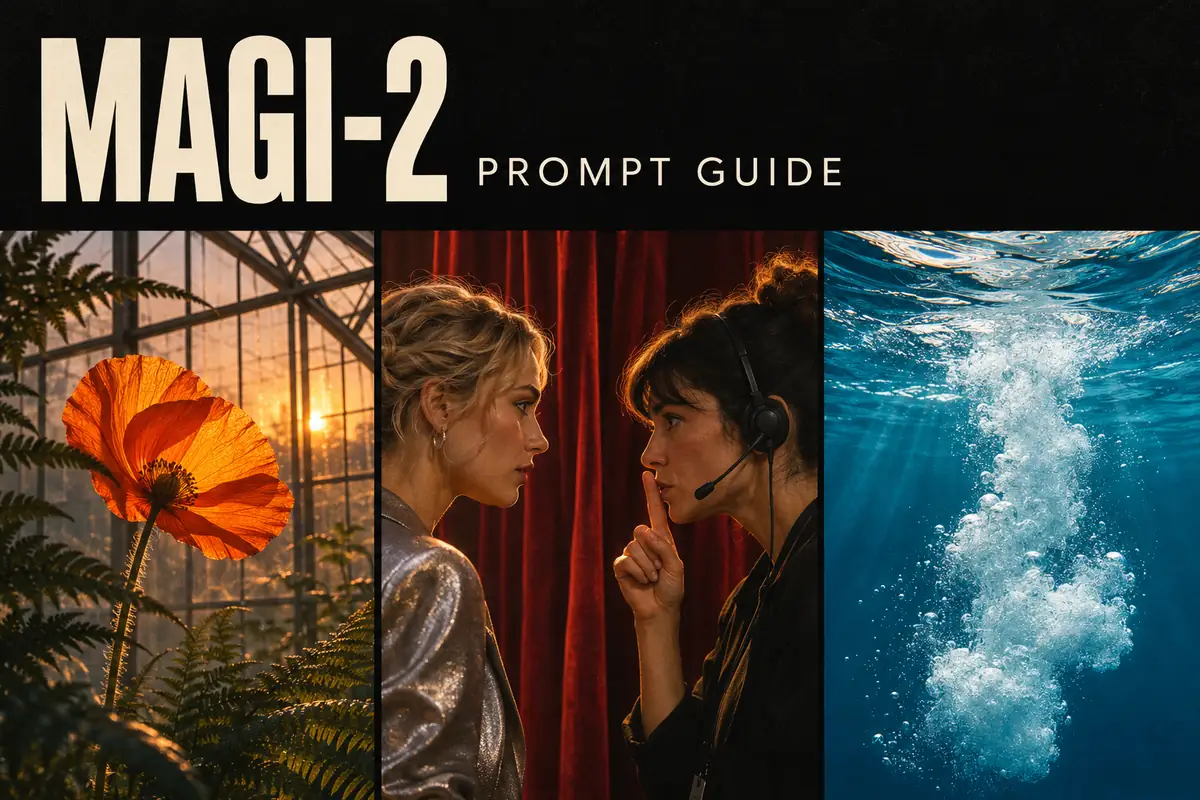
将 MAGI-2 提示词写成简短的分镜列表。先设定一次场景,然后给每个镜头一个开场画面和一个动作。通过画面中变化的内容来描述摄影机运动,将说话者放在确切台词旁边,并告诉下一个镜头动作从哪里接续。细微的措辞很重要。在我们的五秒日食测试中,要求两个物体之间有一条蓝色带,结果在其中一个物体上产生了蓝色光晕。
MAGI-2 提示词公式
先设定一次场景。然后给每个镜头一个时间范围、一个开场画面和一个动作。在需要的地方添加摄影机运动或一句台词。每次切换时,描述观众应该看到的第一个画面。
提示词元素 | 写什么 | 片段中发生了什么 |
|---|---|---|
相机 | 说出移动方式和两个地标。在长椅高度缓慢向右跟踪拍摄。 | 近处的蕨类植物扫过远处的窗框。不断变化的间隙让横向移动清晰可见。 |
对话 | 给说话者台词,给听者一个动作。艾达看着本,问道:“哪把钥匙?”本保持沉默。 | 两个按键计数器都将问题保留在艾达这边,将回答保留在本这边。 |
时间线 | 给剪辑一个时间和一个首帧画面。首帧:黑鲸已经印好,印章在画面外。 | 这个4秒的剪辑出现在3.88秒处。新镜头打开时,印章仍然盖着印刷品。 |
[Place and light]. [Who is present and where they stand].
[Start–end] Open on [framing and subject]. [Camera move or locked view]. [What happens on screen].
[Speaker] says, “[exact words].” [What the listener does].
[Next start–end] Hard cut to [new framing]. In the first frame, [state of the subject or object].将重要的声音放在引发它的动作旁边。在跳板提示中,“入水时响起一声水花”给了你一个可以聆听的接触点。环境声,比如泳池通风系统的嗡嗡声,可以贯穿多个镜头。VidMuse 的 MAGI-2 提示技巧 解释了如何将音效放置在镜头动作旁边。
对于单个连续动作,使用一条镜头线。对于无声序列,省略对话线。当观众需要新角度时,添加另一个时间范围。
测试条件。 我们在 GlobalGPT 中使用 MAGI-2 将每个版本生成一次,分辨率为 1080p,宽高比为 16:9,开启原生音频,关闭提示增强,且不使用参考。日食片段时长为 5 秒,拟音和版画片段时长为 6 秒,前五个示例时长为 10 秒。每对新片段共享一个设置,并更改摄像机、对话或时间指令。我们比较了原始 25 fps 帧,转录了对话,并检查了音轨电平与可见动作的对应关系。这些比较描述了这些镜头。没有共享种子。要为同一场景的两次拍摄做预算,请查看 MAGI-2 按片段时长定价。
摄像机提示:写出从第一帧到最后一帧的移动
五秒钟的日食揭示在发条模型上
想象为天文馆展品拍摄一次微小的日食。黑色月亮应遮住金色圆盘,然后随着摄像机向右移动而滑开。模型后面的蓝色星图为您提供了一个固定地标。比较A的最后两句和B的最后四句。
A. 说出这个动作及其目的
In a dark planetarium workshop a stationary brass orrery sits under a narrow warm light. A small black moon on a thin post completely eclipses a larger gold sun disk behind it. A fixed cobalt-blue star chart fills the far wall. Everything in the model stays still. One level, unbroken macro shot. No dialogue or music. Truck slowly to camera-right to reveal the gold disk. Hold the final view for the last second.月亮在圆盘上向左移动,并在一个连续镜头中露出更多金色。在开口处暂停:宽阔的金色边缘已经环绕着月亮。最后两个形状仍然重叠,构图在要求的保持期间继续滑动。
B. 描述相对运动和停止帧
In a dark planetarium workshop a stationary brass orrery sits under a narrow warm light. A small black moon on a thin post completely eclipses a larger gold sun disk behind it. A fixed cobalt-blue star chart fills the far wall. Everything in the model stays still. One level, unbroken macro shot. No dialogue or music. Truck slowly to camera-right to reveal the gold disk. As the lens travels, the near black moon slips left across the gold disk while the distant blue chart shifts much less. Stop when a strip of blue separates the two circles. Hold that view for the last second.近处的月亮确实比金色圆盘向左移动得更快。添加的颜色提示是有代价的。比较4.00秒和4.96秒:相机仍在移动,金色圆盘左边缘上方出现一个鲜艳的蓝色新月。在两个不同边缘之间没有清晰的图表视图。开头也显示金色。
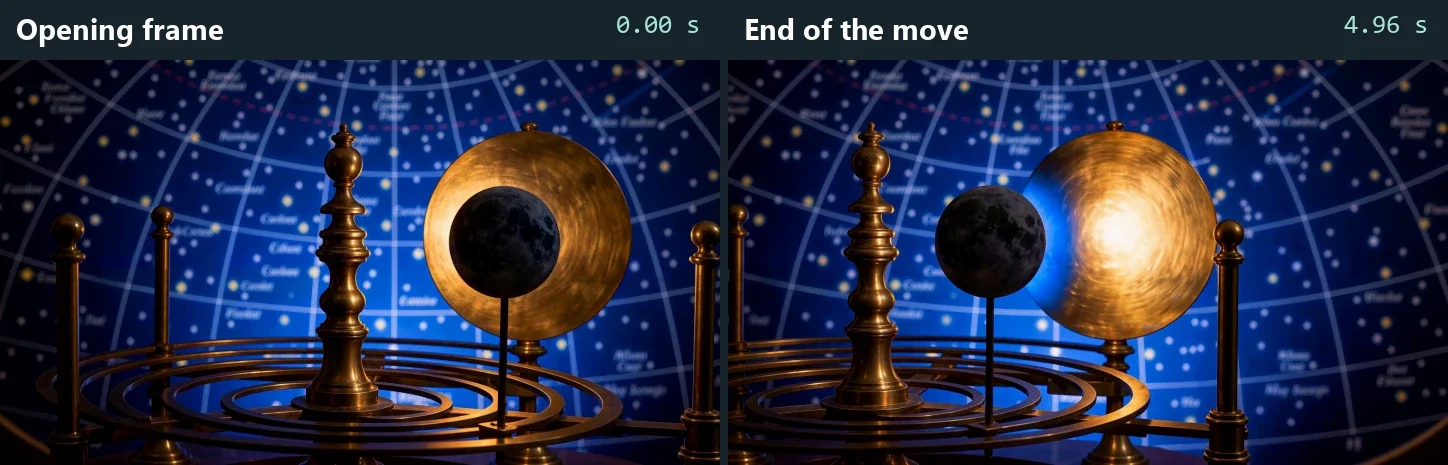
如何使用这个。 A 给出了更清晰的局部显露。两次拍摄都没有呈现出全食后完全分离、稳定的结束画面。保留表示移动的方向性动词。如果物理间隙很重要,尝试命名一个必须在那里可见的可识别背景部分,例如图表上的一颗白色星星。该修订仍需要测试。
选择 镜头的摄像机运动首先,然后描述开场画面以及移动应在何处结束。在我们的测试中,眼平中景双人镜头 指定了在关键柜台处的开场构图。 以长凳高度缓慢向右跟踪拍摄 指定了穿过温室的路径。 保持静止两秒钟 为那个移动提供了一个我们可以检查的终点。一个锁定的特写镜头需要取景和主体,但你可以完全省略移动指令。
示例:移动经过蕨类植物以显露花朵
One unbroken 10-second live-action shot inside a glass greenhouse at sunset. Begin inches behind a dark fern, its leaves filling the left half of the frame. Track slowly to camera-right at bench height. As the nearest leaves slide left out of view, reveal a single translucent orange poppy glowing in the backlight. The distant white window mullions drift only slightly. End with the whole flower visible against the glass and hold still for two seconds. A light breeze stirs the petals. Quiet greenhouse ambience. No dialogue, music, zoom or cuts.分三段阅读温室提示词。“从一株深色蕨类植物后方几英寸处开始”将前景物体放在靠近镜头的位置。“缓慢向右跟拍”移动视点。“远处白色窗棂仅轻微漂移”给了你第二个可观察的物体。回放时,蕨类植物向左扫过的速度比窗框更快。大约三秒时,整个橙色花朵已进入画面。即使关闭声音,你也能看到视点的变化。
措辞不足之处。“填满画面左半部分”告诉模型把蕨类植物放在哪里。它让右半部分空着,第一帧那里可见一抹橙色。最后的停顿也轻微漂移。修改揭示镜头时,如果惊喜被剧透,就更改关于第一帧的从句。如果最终构图持续滑动,就更改停止指令。这是两种不同的失败,可以分别检查。“填充画面左半部分”告诉模型把蕨类植物放在哪里。它让右半部分保持开放,在第一帧那里可以看到一丝橙色。最终的保持也略有漂移。在修改揭示时,如果惊喜被剧透了,就更改关于第一帧的从句。如果最终构图持续滑动,就更改停止指令。这是两个可以分别检查的不同失败。
示例:在摄像机开始移动之前框住两个人
下面的关键计数器提示要求横向滑动,并说“让两张脸都保持可见”。在早期剪辑的镜头中,本一开始部分在右边缘之外,并在滑动过程中完全进入视野。双人镜头最终可以包含两个人,但仍然可能错过你预期的开场。在决定一个镜头是否满足双人镜头要求之前,先在第一帧暂停。
对话提示:分配一个声音、一个听众和一个话轮
两位演员和一个手工雷声提示
一个六秒的广播室场景需要三个节拍:玛拉询问雷声,索尔揭示技巧,然后他演示。A 分配两句台词。B 添加一个聆听动作和一个停顿。两者都要求在回答后弯曲金属片。
A. 给每位说话者确切的台词
A late-night radio drama is being recorded. One locked, waist-up two-shot. On the left Mara wears headphones. On the right Sol holds a thin sheet of metal below chin height. Both faces and the sheet are visible. Red tally light, quiet booth, no music, captions or other voices. Mara asks, “Real thunder?” Sol replies, “Tin sheet.” After the reply Sol flexes the sheet once. A short thunder roll sounds as it bends.两句台词都按顺序恢复了。玛拉在提问时转向索尔,索尔明显地给出了回答。在 4.64 秒时,金属片几乎侧对着镜头。在 4.80 秒时,它的宽面可见并弯曲,同时音轨急剧上升。这个道具让笑点即使在静音状态下也能被读懂。
B. 在台词之间引导听众
A late-night radio drama is being recorded. One locked, waist-up two-shot. On the left Mara wears headphones. On the right Sol holds a thin sheet of metal below chin height. Both faces and the sheet are visible. Red tally light, quiet booth, no music, captions or other voices. Mara asks, “Real thunder?” Sol listens with his lips closed and the sheet still. A brief silence. Sol replies, “Tin sheet.” Mara listens with her lips closed. After the reply Sol flexes the sheet once. A short thunder roll sounds as it bends.同样的台词和说话顺序保留了下来。索尔仍然拿着那张纸等待着,然后明显地做出了回答。在他回答的过程中,玛拉的嘴唇在几个画面中仍然微微张开,尽管有闭嘴的指示。后来索尔抿起嘴唇,而那张纸几乎保持侧立。接近结尾时配乐变得更响,但物理声源更难看到。
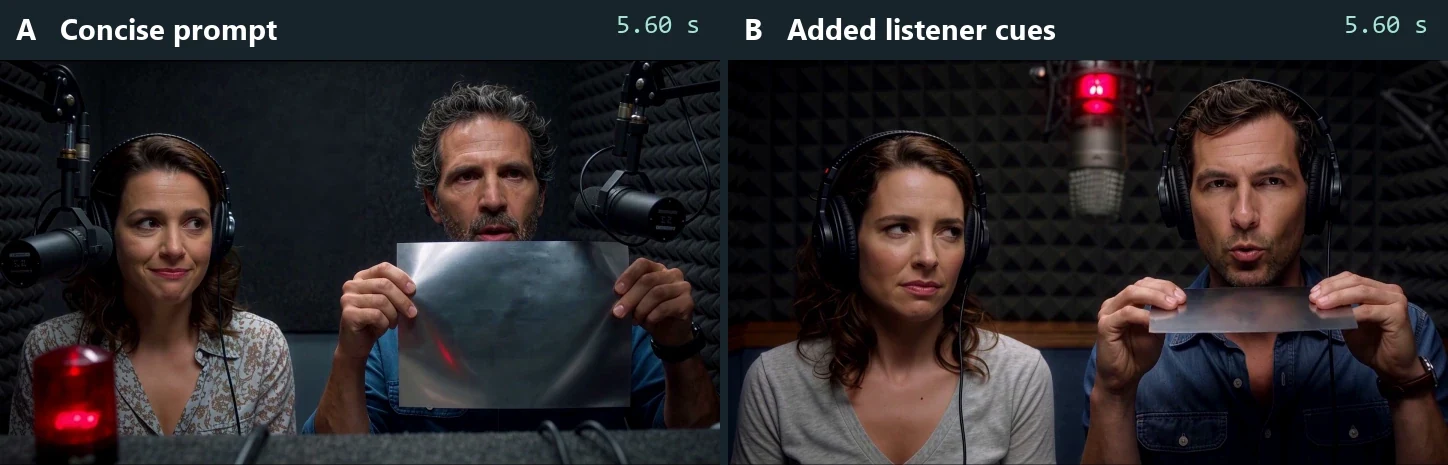
如何使用这个。 对于说出的台词,两个镜头打成平手。对于完整的笑料,A 效果更好。从具名说话者和引用的台词开始。当反应具有意义时,添加聆听提示。如果笑点取决于道具,请将其动作单独成句,并在静音状态下检查。
每句话写一个回合。后台提示使用 在左边,黑色耳机,低语,先举起一根手指然后然后轻声回答。前两个确定人物。动词指定表达方式,“先”和“然后”建立可检查的顺序。将说的话放在引号内,舞台指示放在引号外。
示例:两位说话者同框的安静交流
Ten seconds backstage at a small theater, filmed in one steady medium two-shot. Keep both faces in the frame. A singer in a silver jacket stands under a warm work light on the left. On the right, a stage manager wearing a black headset watches a narrow gap in the red velvet curtain. The singer whispers, “Can they hear us?” The stage manager first raises one finger for silence, then replies quietly, “Only if you sing.” The singer relaxes into a smile. Keep the room quiet enough to hear every word. The curtain stays closed. No other voices, subtitles or music.穿银色衣服的歌手问:“他们能听到我们吗?”戴耳机的人在约3.6秒时把手指放到唇边,并说出“只有你唱歌才行。”到约7.6秒时,歌手在微笑。音轨转录按顺序恢复了这两句台词,可见的口型与预期的说话者相符。停顿有其作用:观众在听到回答之前先看到要求安静的手势。
措辞不足之处。“让两张脸都留在画面里”这个开头与一个要求注视窗帘缝隙的指令并列。两位表演者都看向那条缝隙,而经理一开始转过身去。画面包含两个人,但观众无法同时看清两人的表情。如果开场对话很重要,请同时指定他们脸部的朝向和屏幕位置。要评估修改版,请检查第一帧、问题和回答的第一个词。
示例:给回答一个独立特写
在关键计数器处,我们采用了不同的安排。艾达在双人镜头中问“哪把钥匙?”。下一个镜头将本单独置于正面特写中,说出“蓝色的那把。”指令明确要求每一轮中另一个角色保持沉默。两个原始音轨都恢复了相同的词语。当听者的反应承载信息时,选择双人镜头。当看到说话者传递回复更重要时,选择特写。
时间线提示:写下剪切点和动作状态
用三个镜头印制鲸鱼
一个六秒的版画制作序列有一个简单的连续性测试。纸张开始时是空白的,印章接触一次,完成的鲸鱼在角度变化后仍然存在。简报要求在2秒和4秒处进行硬切。
A. 将动作放在剪切时间旁边
A printmaker in a cobalt apron makes one small relief print on an ochre workbench. Use a red-handled rubber stamp carved with a single whale silhouette, black ink and one square of ivory paper. Three shots at normal speed. Just workshop room tone, no dialogue or music. 0–2s: overhead close-up of the inked stamp hovering above the blank paper. At 2s hard cut to a bench-level side view of the stamp pressing down once and lifting. At 4s hard cut to a tight overhead shot of the finished black whale on the paper.侧视图在1.96秒时到达,提前了一帧。印章已经出现在纸上。到3.60秒时,手已经将其提起,鲸鱼可见。俯视揭示从4.12秒开始,延迟了三帧。在第一个俯视帧中,印章的一角仍然可见。印记留在纸上,动作不会重播。
B. 指定每次剪辑后的第一帧
A printmaker in a cobalt apron makes one small relief print on an ochre workbench. Use a red-handled rubber stamp carved with a single whale silhouette, black ink and one square of ivory paper. Three shots at normal speed. Just workshop room tone, no dialogue or music. 0–2s: overhead close-up of the inked stamp hovering above the blank paper. At 2s hard cut to the bench-level side view. First frame: a gap still separates stamp and paper. Press once and lift until the stamp clears the paper. At 4s hard cut to the tight overhead shot. First frame: the black whale is already printed and the stamp is out of frame. Hold on that single print.侧视图从1.92秒开始,提前了两帧。要求的印章与纸张之间的间隙缺失。到3.60秒时,印章被抬起,整个印记可见。俯视图从3.88秒开始,提前了三帧。印章重新出现在鲸鱼上方并再次移开。到4.76秒时,印记已完全脱离印章。
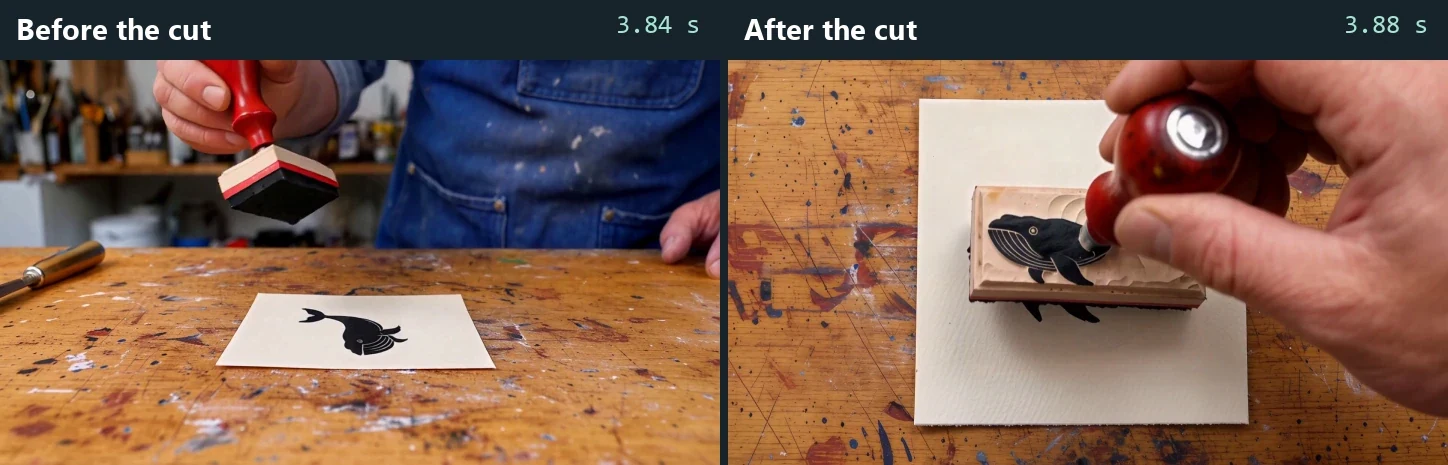
如何使用这个。两个版本都错过了4秒目标,相差三帧。A晚了,B早了。A的揭示更干净,因为鲸鱼在剪辑中保持可见。在B中,即使是明确的第一帧指令也未能通过该检查。在编辑自己的序列时,比较剪辑前的最后一帧和剪辑后的第一帧。寻找一个已经完成又重新开始的动作。
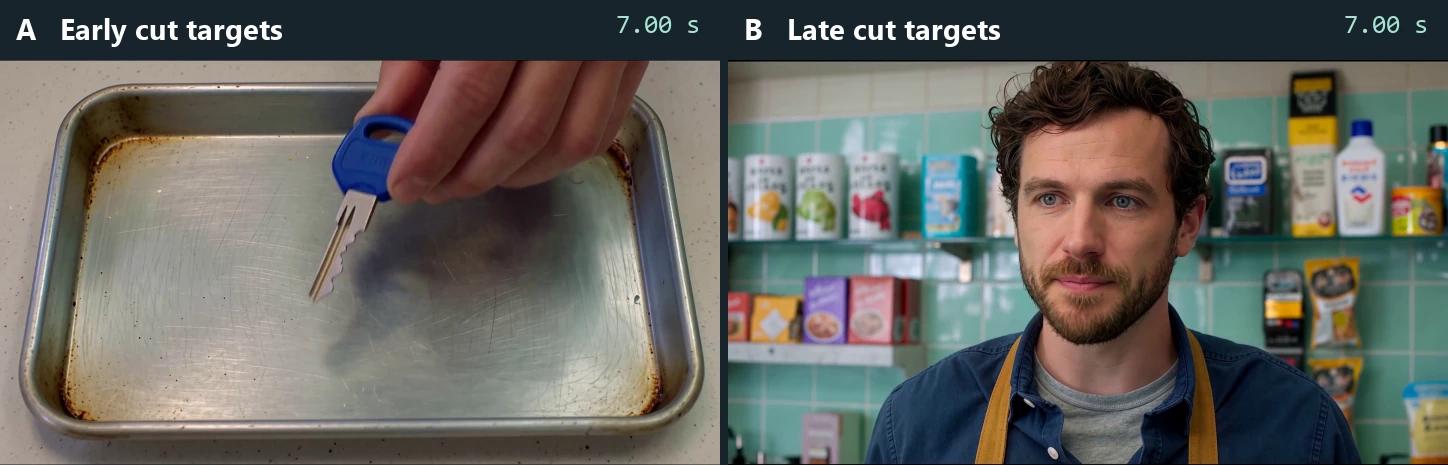
使用从剪辑开始测量的秒数。在这些测试中,硬切标志着突然的变化,锁定俯视特写使新视图可识别,并且保持要求相机停留在结果上。选择您要计时的帧。托盘镜头的第一帧、钥匙的首次出现以及它接触金属的瞬间都可能发生在不同的时间。
示例:仅更改关键计数器上的时间戳
Create a 10-second live-action scene at a brightly lit key-cutting counter. Use a mint tile wall and a clean pale counter. Ada wears a plum jacket and stands on frame left. Ben wears a mustard apron and stands on frame right. Keep their wardrobe and positions consistent. The blue key has a large cobalt plastic head.

Shot 1 [00:00–00:02] — Eye-level medium two-shot. The camera slides sideways to camera-right, with a red key tag close to the lens in the lower-left corner and the mint tile wall farther away. Let both faces stay visible. Ada looks at Ben and asks, "Which key?" Ben stays silent.
Shot 2 [00:02–00:05] — Hard cut to a locked frontal close-up of Ben, with his mustard apron visible below his face. Ben says, "The blue one." Ada stays silent.
Shot 3 [00:05–00:10] — Hard cut to a locked, directly overhead close-up of a pale metal tray. Ben sets the cobalt-blue key down once in the center. Let its single click occur at contact. Hold the overhead view. No one speaks.

Keep the shop quiet. Use two distinct voices, natural English dialogue, and one clear metal click. No music, voice-over, subtitles, zoom, or dissolves.这就是完整的早期剪辑提示。对于后期版本,我们将三个范围替换为 [00:00–00:04]、[00:04–00:08] 和 [00:08–00:10]。其他所有词保持不变。
版本 | 切换到 Ben,目标 → 实际 | 切换到托盘,目标 → 实际 |
|---|---|---|
早期剪辑 | 2.00 → 4.40 秒(延迟 2.40 秒) | 5.00 → 6.52 秒(延迟 1.52 秒) |
后期剪辑 | 4.00 → 5.52 秒(延迟 1.52 秒) | 8.00 → 8.20 秒(延迟 0.20 秒) |
将目标分别延后 2 秒和 3 秒,实际剪辑分别延后了 1.12 秒和 1.68 秒。将两个片段都拖动到 7 秒处:早期版本已经显示手和托盘,而后期版本仍显示 Ben。所有四次剪辑都晚于请求时间。每个时间表只生成一次,没有共享种子控制,因此测量差异仅适用于这些镜头。
反面示例:详细的时间线重复了跳水动作
A ten-second live-action sports film in a bright indoor pool, with three distinct shots. [00:00–00:03] Locked low close-up of a diver’s bare feet on the edge of a blue springboard. The board flexes once. [00:03–00:07] Hard cut to a wide side view showing the whole board and the water. The diver springs forward, straightens and enters the pool hands first. A single splash sounds at entry. [00:07–00:10] Hard cut underwater. A column of silver bubbles streams downward past the lens and begins to thin. Switch to muffled underwater sound. No speech, music, slow motion or dissolves.第一个剪切点落在 3.04 秒,晚了一帧。第二个落在 6.80 秒,早了五帧。在广角镜头中,跳水者大约在 5.1 秒时手先入水,然后消失在水面下。水下镜头随后从空无一物的水面开始,再次显示跳水者入水。“硬切到水下”这个措辞定义了一个视角,“一串银色气泡”定义了一个主体。两句话都没有告诉我们跳水者是否已经经过镜头。
需要修改的地方。在保持连续性的同时,保持 3 秒和 7 秒的目标。在广角镜头结束时指定完成的进入,并在紧接着的下一帧指定水下仍然可见的内容。然后一起检查这两帧。改善剪辑时机的更改仍可能留下重复动作,因此要独立判断时机和连续性。
MAGI-2 提示常见问题
如何描述横向的摄像机移动?
给摄像机一个方向,并将一个物体放在靠近镜头的位置,另一个物体放在较远的位置。在温室提示中,摄像机在长凳高度向右跟踪。附近的蕨类植物在远处的窗框前向左扫过。为了获得揭示效果,还要说明开始时被摄体有多少被隐藏。我们的提示让罂粟花部分可见。
如何清楚地表明每句台词是谁说的?
把角色的名字紧接在引语之前。在钥匙柜台场景中,艾达问“哪把钥匙?”,而本保持沉默。切到本的脸部,由他回答:“蓝色的那把。”两个镜头都保留了这个交流。当听者的表情很重要时,在回答过程中保持两人的脸都可见。
MAGI-2 会在我提示词中的确切秒数处剪切吗?
把时间戳当作目标。在钥匙柜台,请求在 5 秒处切镜头,结果在 6.52 秒处到达。把目标移到 8 秒,切点就移到了 8.20 秒。如果剪切必须落在某个节拍上,请对照该节拍检查生成的片段,并在需要时调整剪辑。
什么时候值得添加更多细节?
当细节能解决观众需要看到或听到的问题时,就添加细节。两个拟音提示都给出了“真的雷声?”和“锡片”。较短的版本还清楚地展示了金属弯曲。较长的版本增加了关于听者的指示,而锡片几乎保持侧向。对于那个场景,锡片的角度比听者的嘴更值得关注。
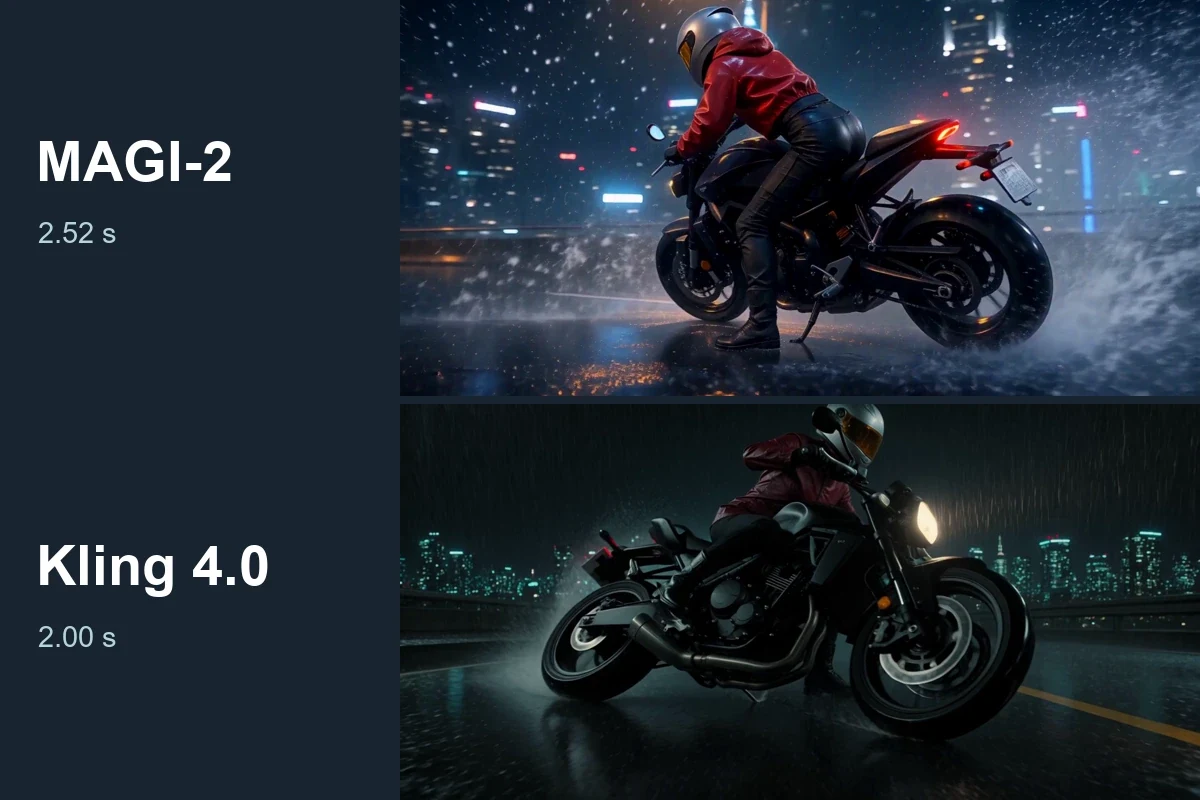
如果您为同一镜头列表选择模型,请参阅 MAGI-2 vs. Kling 4.0 或 MAGI-2 vs. Seedance 2.5。在比较您自己的镜头时,请保持构图、对话和剪辑目标不变。
结论
MAGI-2 的镜头清单可以很短。场景只需设定一次。给镜头移动一个可见的目的地,把每句台词分配给指定的说话者,并描述剪辑后观众应立即看到的内容。回放时,找到结果与你所写镜头偏离的第一个地方。如果台词到位但道具难以看清,保留对话并修改取景。这样下一次拍摄就有一个明确的任务。