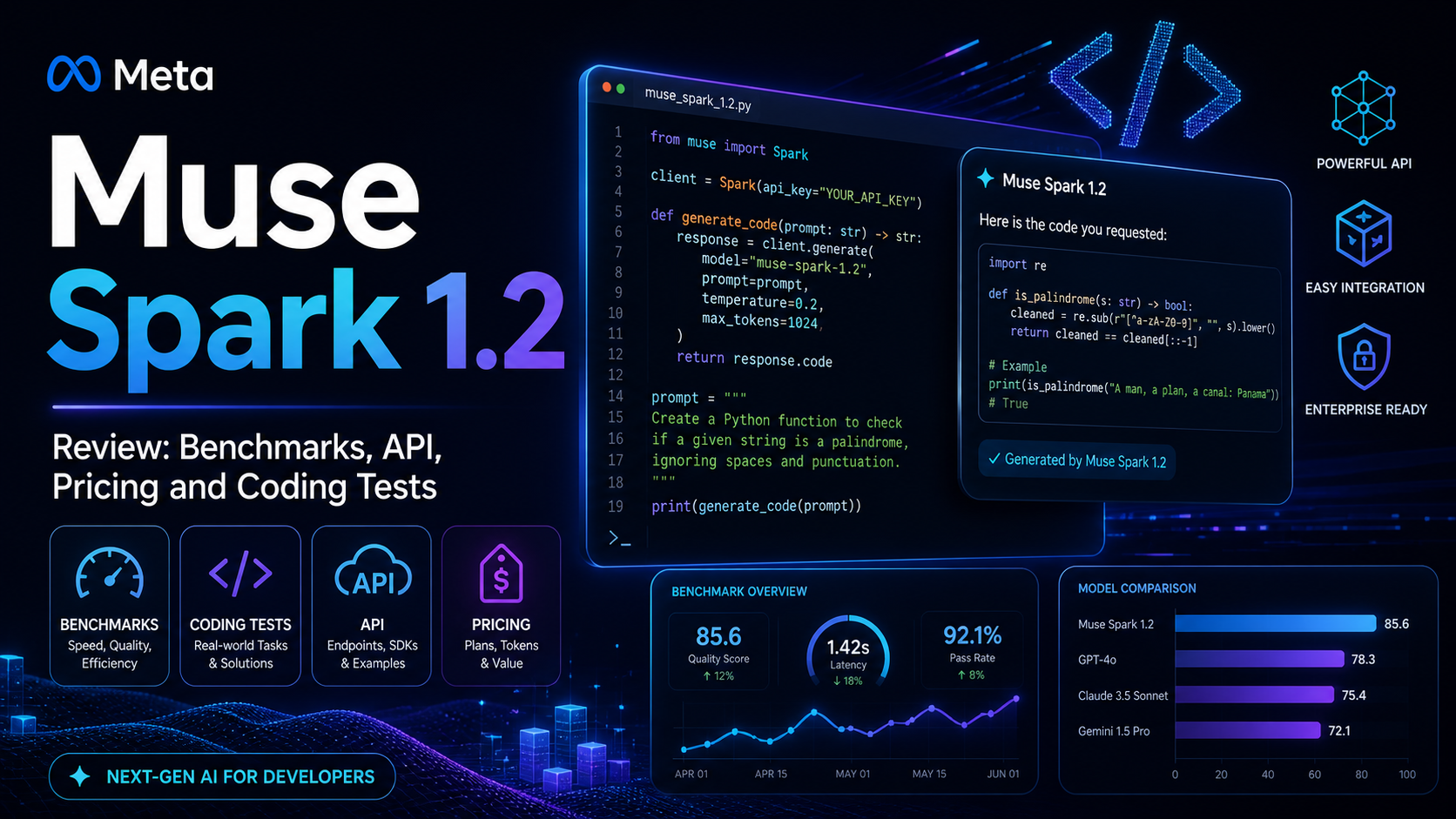
Muse Spark 1.2 レビュー:ベンチマーク、API、価格、コーディングテスト

Muse Spark 1.2 レビュー

Muse Spark 1.2 combines unusually low token pricing with a 1M-token context window, and it passed all three base-model coding tasks in our first-attempt API suite. Meta launched the model on August 5, 2026, with a 1 million tokens context window, two API pricing tiers, and a separate terminal agent called Muse Code. Meta’s benchmark results are promising; independent public coding leaderboards have not yet verified the same model-and-agent combinations.

This review separates the model from the agent, official scores from independent evidence, and standard pricing from the Contributor tier’s data-use trade-off. In our tests, the model completed a Python idempotency fix, a compatibility-preserving TypeScript refactor, and a repository-wide JSONL feature with no retries. Muse Code agent execution was not tested, and tool-call reliability was not tested. If you are comparing the wider field first, our guide to the コーディングに最適なAIモデル gives the broader competitive context.

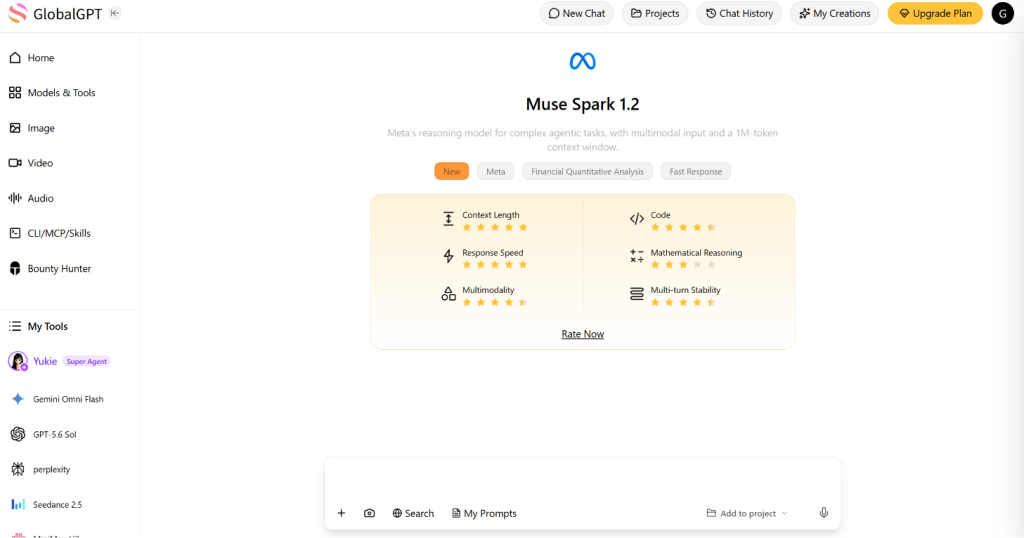
Muse spark on GlobalGPT

Muse Spark 1.2 Review: Quick Answer

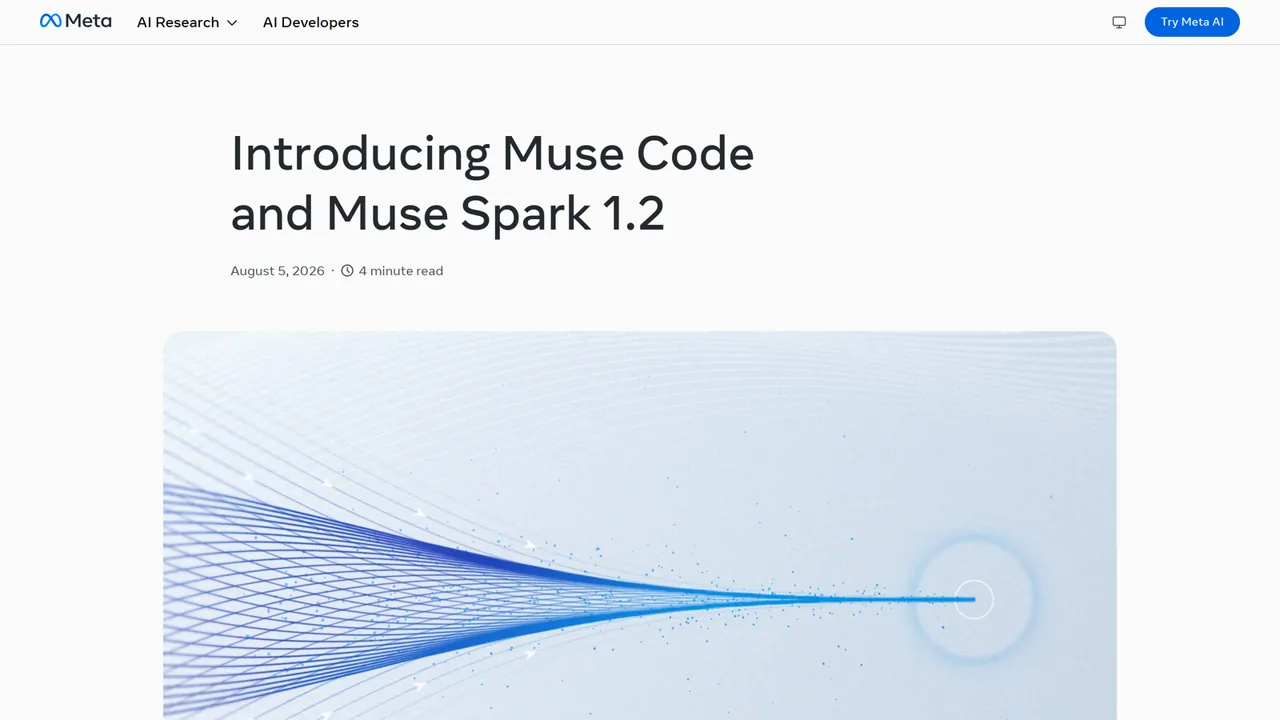
Meta Research announcement titled Introducing Muse Code and Muse Spark 1.2, dated August 5, 2026
Official launch. Meta announced Muse Code and Muse Spark 1.2 on August 5, 2026. Source: Meta Research.

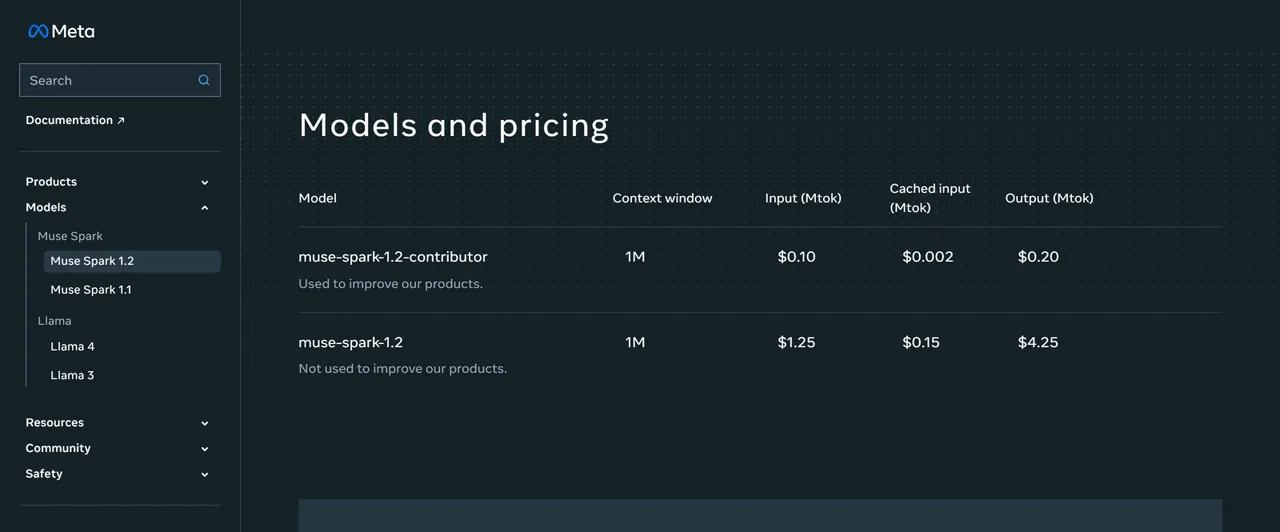
The short version: Muse Spark 1.2 is a coding-focused Meta model with a 1M-token window, OpenAI SDK-compatible API access, and an attention-grabbing Contributor tier. Its strongest public story is value: $0.10 input and $0.20 output per million tokens on the Contributor model. That tier may be used to improve Meta products, while the more expensive standard model is not used for that purpose.

The performance story needs more restraint. Meta reports 82.9% on Terminal-Bench 2.1 for Muse Spark 1.2 with Muse Code and 59.3% on DeepSWE. Those are Meta-run results. The public Terminal-Bench and DeepSWE boards did not list Muse Spark 1.2 when checked on August 7, 2026. Artificial Analysis offers a useful independent cross-check, where the current Intelligence Index is 57 and the model ranks #12 of 185.

  • Best reason to try it now: low Contributor pricing, large context, and an API that follows the familiar OpenAI client pattern.
  • Best reason to stay cautious: three controlled base-model tasks do not establish Muse Code agent reliability, tool-call quality, or performance across a large production repository.
  • Important privacy choice: use the standard model for code or prompts you do not want used to improve Meta products.

Muse Spark 1.2 at a Glance

Verified specifications

開発者メタLaunched August 5, 2026
文脈1M100万トークン
主な焦点Coding + toolsRepository work and debugging
Hands-on status3/3 tasks passedOne attempt per task
muse-spark-1.2 muse-spark-1.2-contributor Muse Code Meta Model API オープンルーター OpenAI SDK-compatible Text + image input; text output

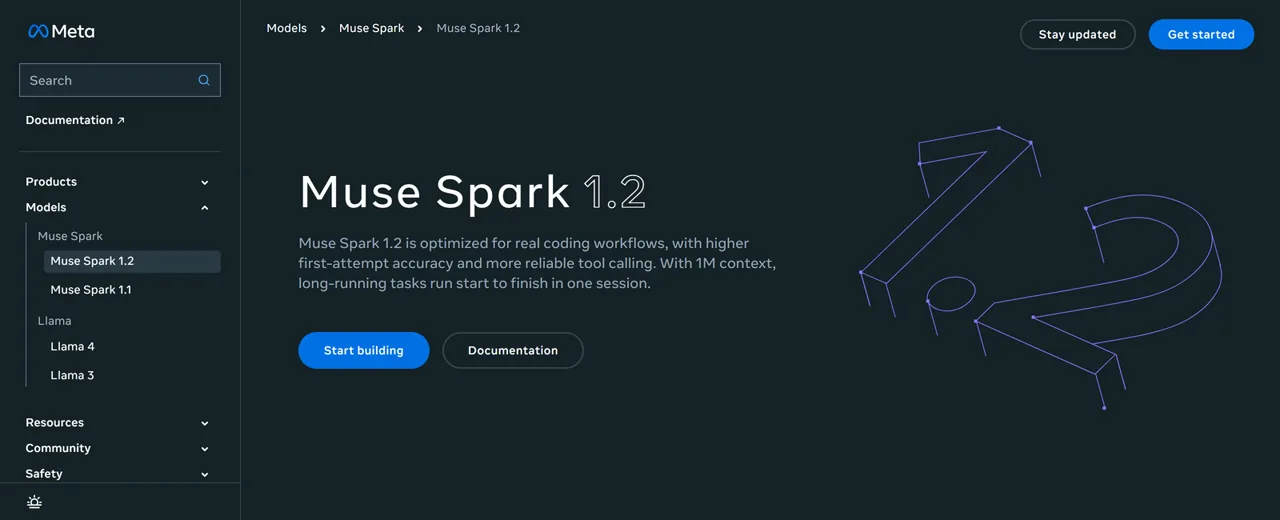
Meta describes Muse Spark 1.2 as a model with higher first-attempt coding accuracy and more reliable tool calling than Muse Spark 1.1. Those are provider claims from the official Muse Spark model page, not conclusions from our own coding session.

Muse Spark 1.2 vs Muse Code

Muse Spark 1.2 is the model. Muse Code is a separate beta terminal agent powered by that model. This distinction matters because an agent can add planning, tool orchestration, repository navigation, worktree isolation, logging, and retry behavior around the underlying model.

Keep the layers separate

モデル

Muse Spark 1.2

Context, reasoning, API behavior, token billing, outputs, and tool-call decisions.

Model IDs1M コンテキストAPI価格

The beta agent

Muse Code

Terminal UX, subagents, git worktrees, event log, resume flow, bundled skills, and orchestration.

Agent workflowMeta-run system results

Meta Muse Spark 1.2 model page showing its coding focus and one-million-token context window
Official model overview. Meta positions Muse Spark 1.2 for coding workflows, a 1M-token context window, and more reliable tool calling. Source: Meta model page.

について official Muse Code page calls the product a beta coding agent. That makes comparisons with products such as Claude Code and Codex more useful than pretending every observed workflow difference comes from a bare model call. Our Codex と Claude のコード比較 explains why the surrounding agent can change the developer experience as much as the model.

Muse Spark 1.2 Benchmarks: What the Scores Really Show

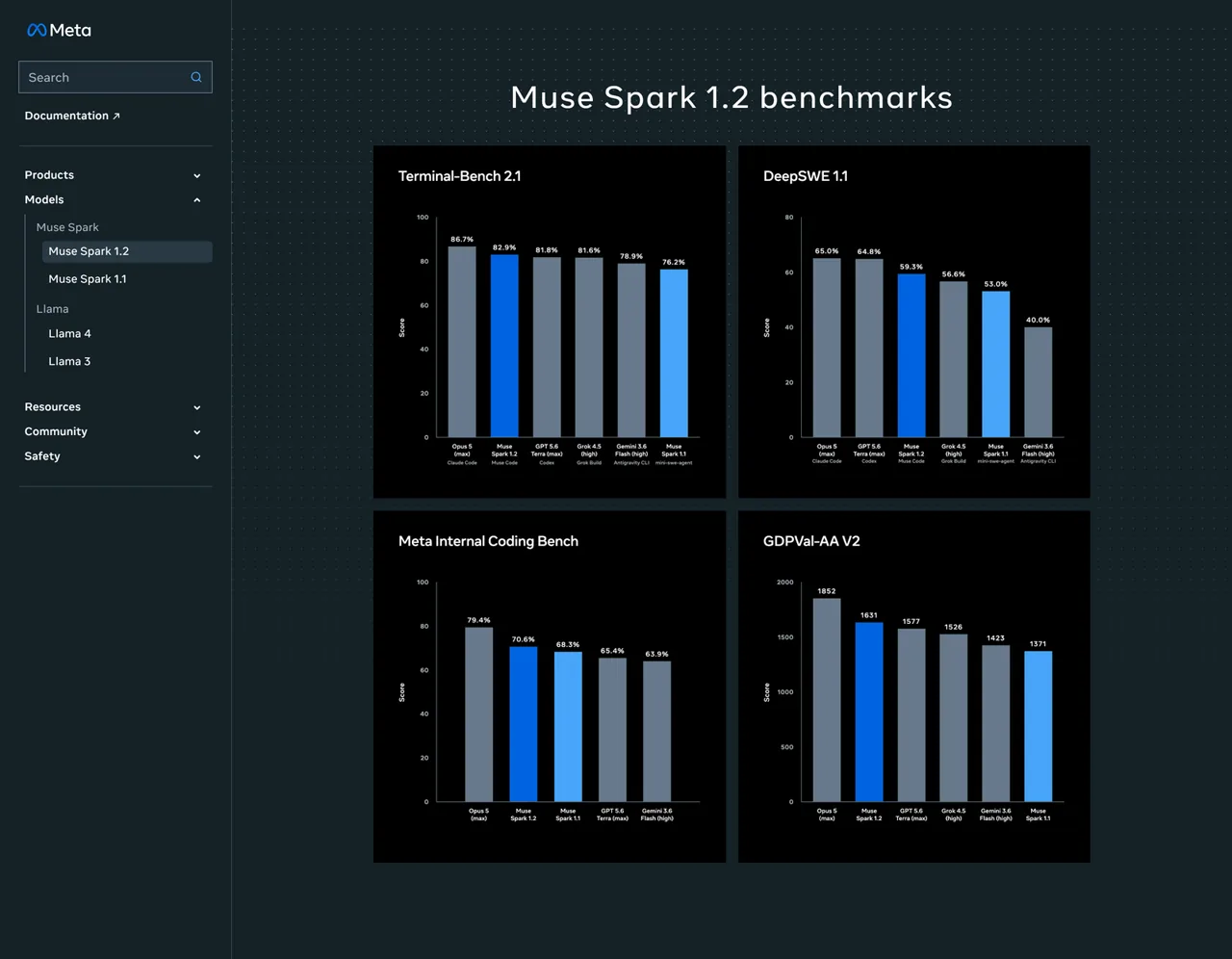
Meta benchmark charts for Muse Spark 1.2 across Terminal-Bench, DeepSWE, internal coding, and GDPVal-AA version two
Provider-run benchmark evidence. Meta published four Muse Spark 1.2 benchmark panels; the harness and agent pairing still need to be read with each score. Source: Meta model page.

Meta’s benchmark chart puts Muse Spark 1.2 near the top of several coding evaluations. The numbers are worth examining, but they are not a single clean ranking of raw model quality. The model, agent, harness, reasoning strength, and task protocol can all change together.

Meta-reported Terminal-Bench 2.1

Meta benchmark panel

ターミナル・ベンチ 2.1

All 89 tasks · pass@1 over five attempts · selected model-and-agent combinations

Meta-run Muse Code result not a verified public leaderboard entry
Opus 5 max + Claude Code86.7%
Muse Spark 1.2 + Muse Code82.9%
GPT-5.6 Terra max + Codex81.8%
Grok 4.5 high + Grok Build81.6%
Gemini 3.6 Flash high + Antigravity CLI78.9%
Muse Spark 1.1 + mini-swe-agent76.2%
Source: Meta’s Muse Spark 1.2 model page and evaluation methodology. These are provider-run model-and-agent combinations.

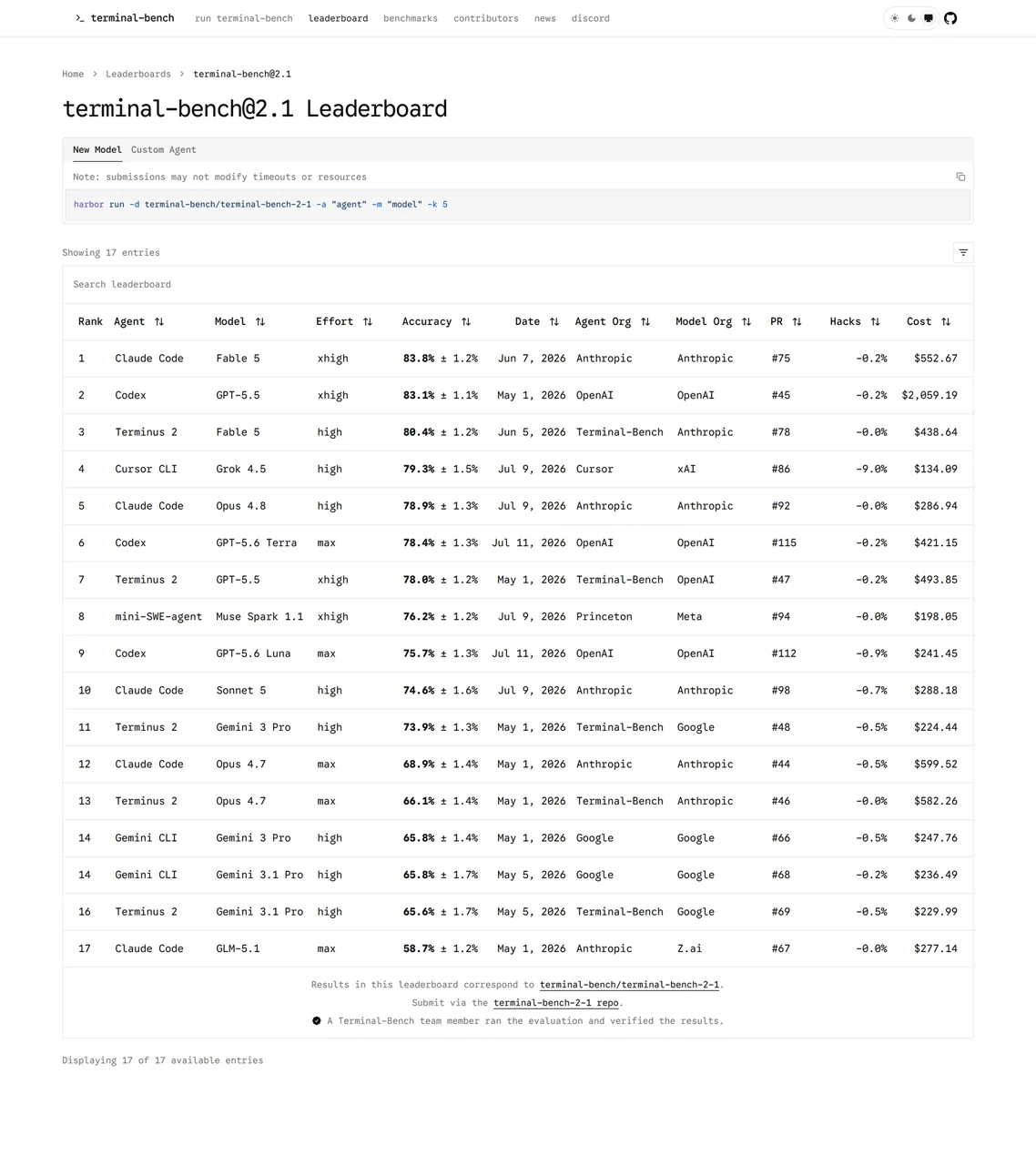
The 82.9% figure is a Meta-run Muse Code result. . public Terminal-Bench 2.1 leaderboard did not list Muse Spark 1.2 on August 7, 2026, so it is not a verified public leaderboard entry. The public board did list Muse Spark 1.1 with mini-SWE-agent at 76.2% ±1.2%.

Complete Terminal-Bench 2.1 public leaderboard checked August 7, 2026, with all seventeen visible entries
Independent cross-check. The complete public Terminal-Bench 2.1 board did not list Muse Spark 1.2 when checked on August 7, 2026. Source: Terminal-Bench.

Meta-reported DeepSWE 1.1

Meta benchmark panel

DeepSWE 1.1

113 tasks · 91 repositories · five languages · pass@1 over five attempts

作品第5番65.0%
GPT-5.6 Terra64.8%
Muse Spark 1.259.3%Meta-reported
Grok 4.556.6%
Muse Spark 1.153.0%
Gemini 3.6 フラッシュ40.0%

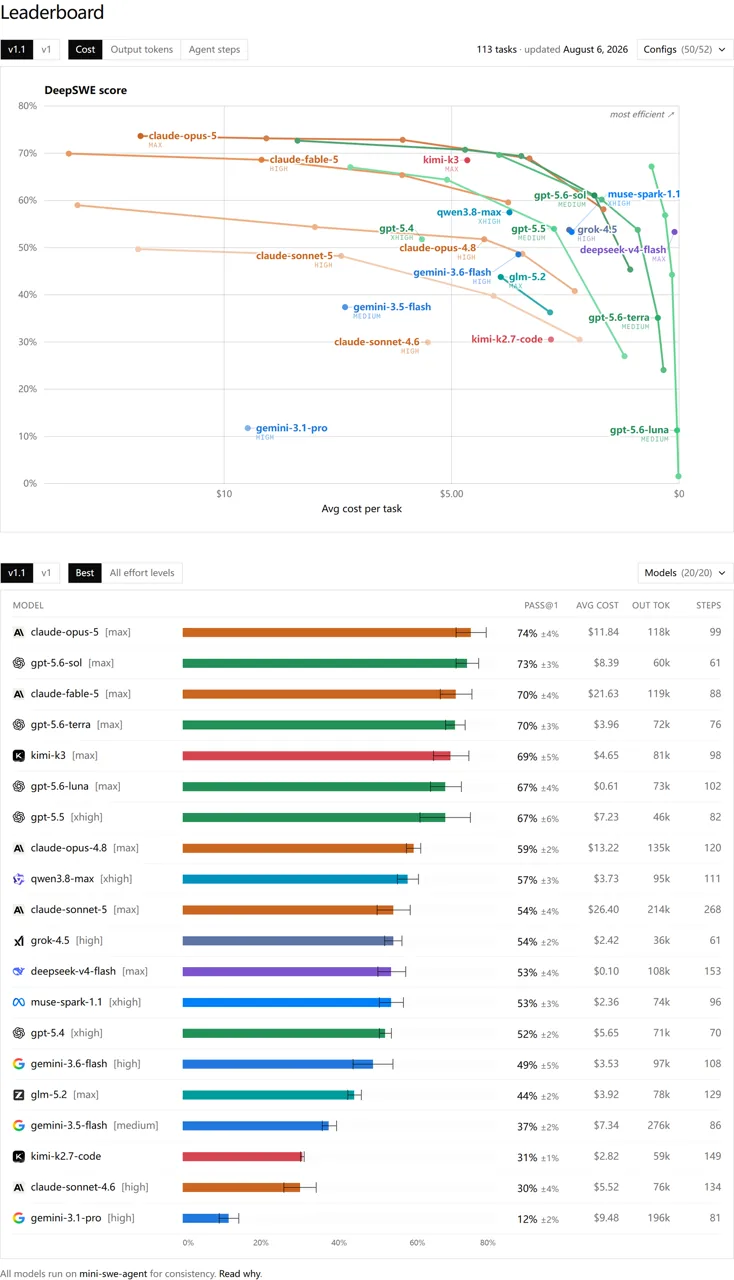
について public DeepSWE v1.1 leaderboard uses mini-swe-agent across its listed models for consistency. It had not added Muse Spark 1.2 when checked; Muse Spark 1.1 was listed at 53%. Meta’s 59.3% result uses Muse Code, so the two numbers are not harness-identical.

Complete DeepSWE version 1.1 public leaderboard updated August 6, 2026, including chart, table, and consistency note
Independent cross-check. DeepSWE used mini-swe-agent for all listed models and did not yet include Muse Spark 1.2. Source: DeepSWE v1.1.

Meta’s internal and general-agent evaluations

Two different evaluation scales

Meta Internal Coding Bench

440 internal tasks · two attempts per task

モデルスコア
作品第5番79.4%
Muse Spark 1.270.6%
GPT-5.6 Terra65.4%
Gemini 3.6 フラッシュ63.9%
Grok 4.5Not shown

GDPVal-AA v2

General agentic task evaluation · Elo-style values

モデルスコア
作品第5番1852
Muse Spark 1.21631
GPT-5.6 Terra1577
Grok 4.51526
Gemini 3.6 フラッシュ1423

Meta’s evaluation methodology says Terminal-Bench uses all 89 tasks and pass@1 over five attempts. DeepSWE covers 113 tasks across 91 repositories and five languages, also with pass@1 over five attempts. Meta also notes that its setup may not be optimally tuned for third-party models. For a current competitor comparison built around real product decisions, see Claude Opus 5 対 GPT-5.6.

Methodology changes the meaning

Meta Terminal-Bench

Model + selected agent

89 tasks, five attempts, maximum reasoning settings differ, and Meta’s harness may not be tuned equally for third-party systems.

Public Terminal-Bench

Verified entries

Muse Spark 1.2 was absent when checked. The board’s configurations and verification status must be read separately from Meta’s chart.

Public DeepSWE

Common mini-swe-agent

113 tasks across 91 repositories and five languages. Muse Spark 1.2 was absent; Muse Spark 1.1 was listed at 53%.

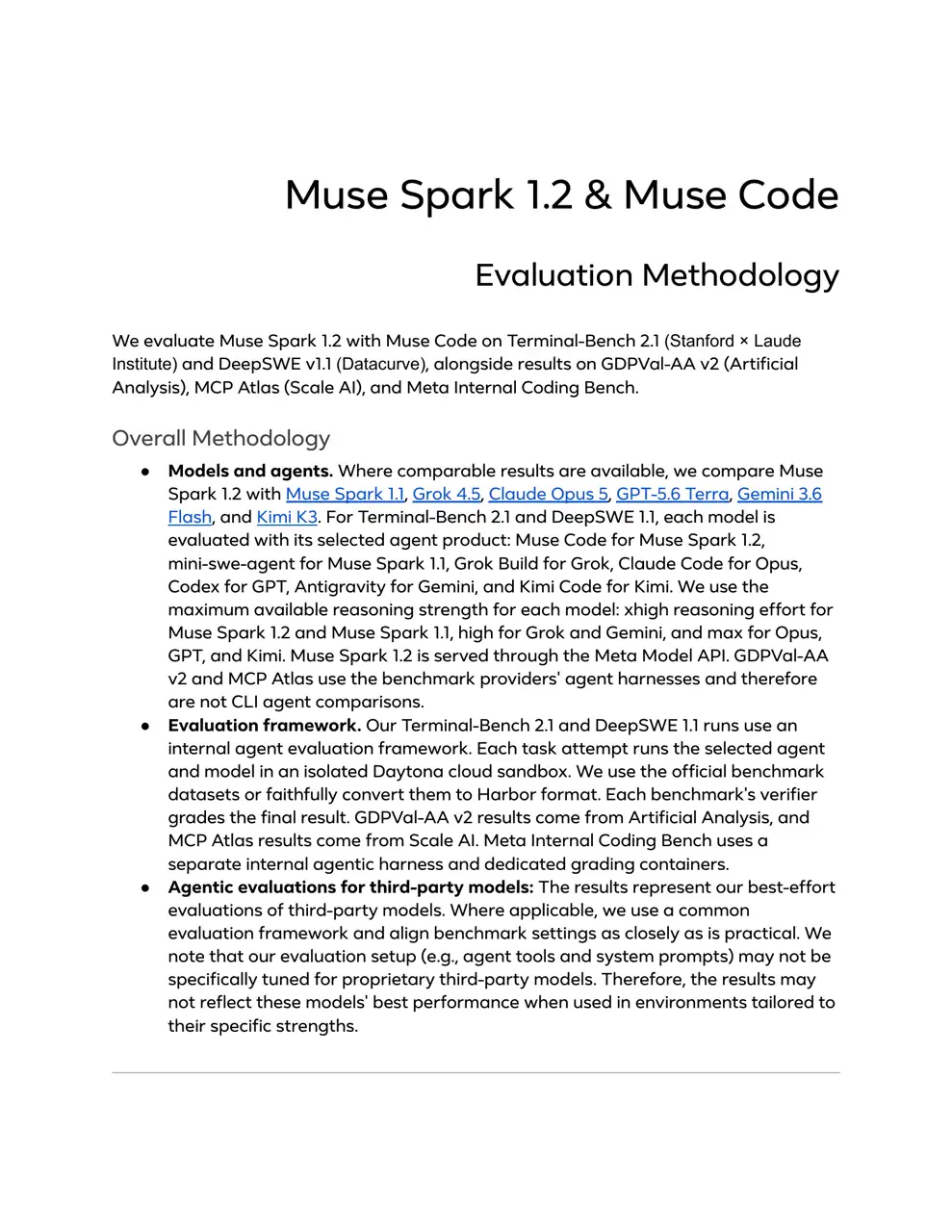
Page one of Meta Muse Spark 1.2 and Muse Code evaluation methodology with agent pairings and reasoning settings
Methodology evidence. Meta pairs different models with different agents and reasoning settings, so the provider chart is not a raw model-only ranking. Source: Meta methodology PDF.

Artificial Analysis: useful independent context

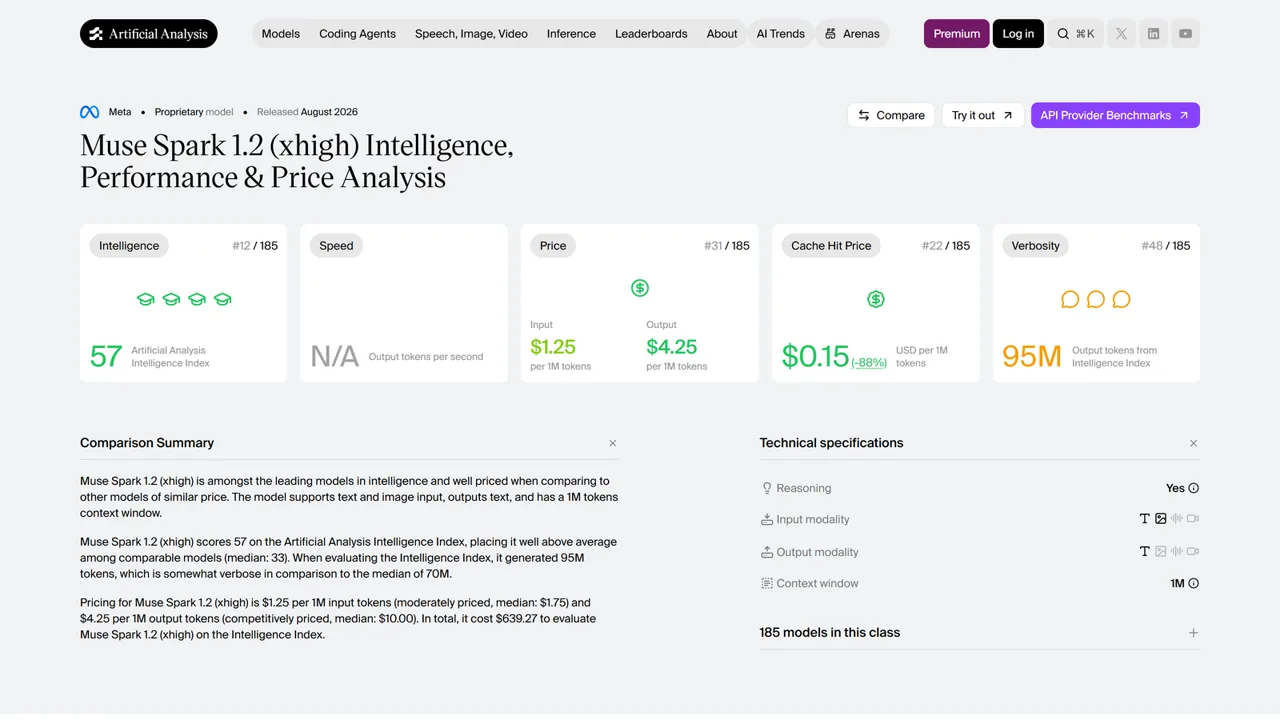
現在の Artificial Analysis model page gives Muse Spark 1.2 an Intelligence Index of 57, ranking it #12 of 185. Its harness reports 80% on Terminal-Bench v2.1, 57% normalized on GDPVal-AA v2, 56% on SciCode, and 83% on the AA-LCR long-context evaluation.

Artificial Analysis version drift

知能指数54 → 57Evaluation version/result changed
GDPVal Elo1371 → 1631Higher current value
Terminal-Bench78% → 80%Higher current AA-harness result
タスクあたりのコスト$0.29 → $0.40More token use raised cost
Hallucination rate38% → 28%Lower, alongside more abstention
Attempt rate82% → 67%The model attempted fewer questions
Source: Artificial Analysis model page and launch analysis. Launch and current values should not be mixed as if they came from one unchanged evaluation.

The practical lesson is simple: Muse Spark 1.2 looks competitive, but no single score isolates the model. Treat Meta’s chart as evidence for the Muse Code system, public leaderboards as a separate cross-check, and Artificial Analysis as an independent but differently configured evaluation.

Artificial Analysis Muse Spark 1.2 summary showing Intelligence Index 57, rank, prices, evaluation cost, and one-million-token context
Independent model evaluation. Artificial Analysis reports an Intelligence Index of 57 and provides a separate check on price, context, modalities, and evaluation cost. Source: Artificial Analysis.

Muse Spark 1.2 Pricing and Privacy Trade-offs

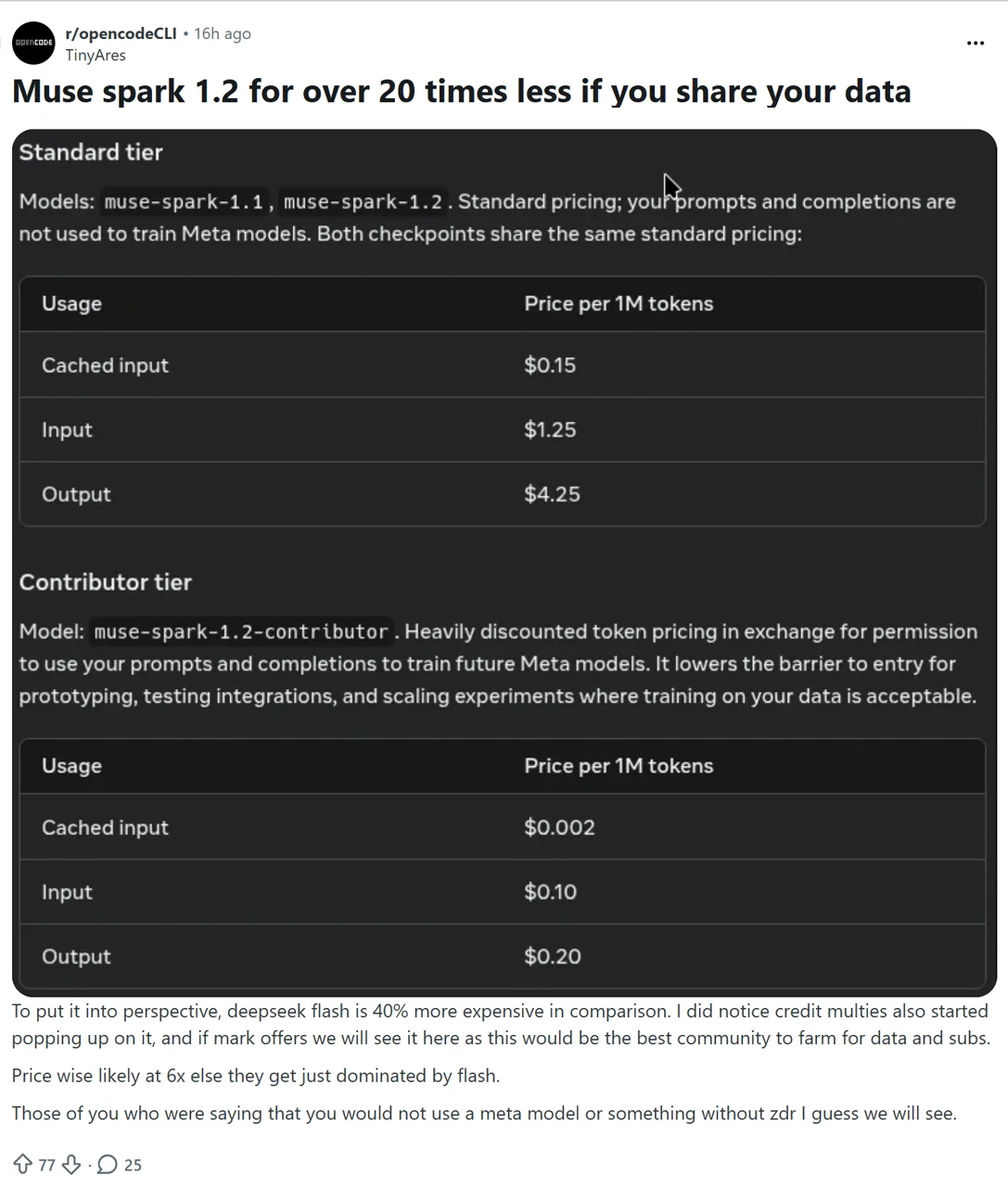
Meta offers two API model IDs with dramatically different prices. The cheaper option is not merely a discount: it changes how submitted data may be used.

USD per one million tokens · 1M context

Standard · muse-spark-1.2

Not used for product improvement

Not used to improve Meta products

インプット$1.25
キャッシュ$0.15
出力$4.25
Contributor · muse-spark-1.2-contributor

Cheaper, with a data-use trade-off

データ may be used to improve Meta products

インプット$0.10
キャッシュ$0.002
出力$0.20
Official Meta pricing checked August 7, 2026. The privacy condition changes with the tier.
Meta Muse Spark 1.2 standard and contributor API pricing table with model identifiers and data-use terms
Official pricing. Meta lists separate standard and Contributor model IDs, token prices, and data-use conditions. Source: Meta model page, checked August 7, 2026.

Contributor pricing is 12.5× cheaper for input, 75× cheaper for cached input, and 21.25× cheaper for output than the standard tier. There is no honest single discount percentage that describes every token type.

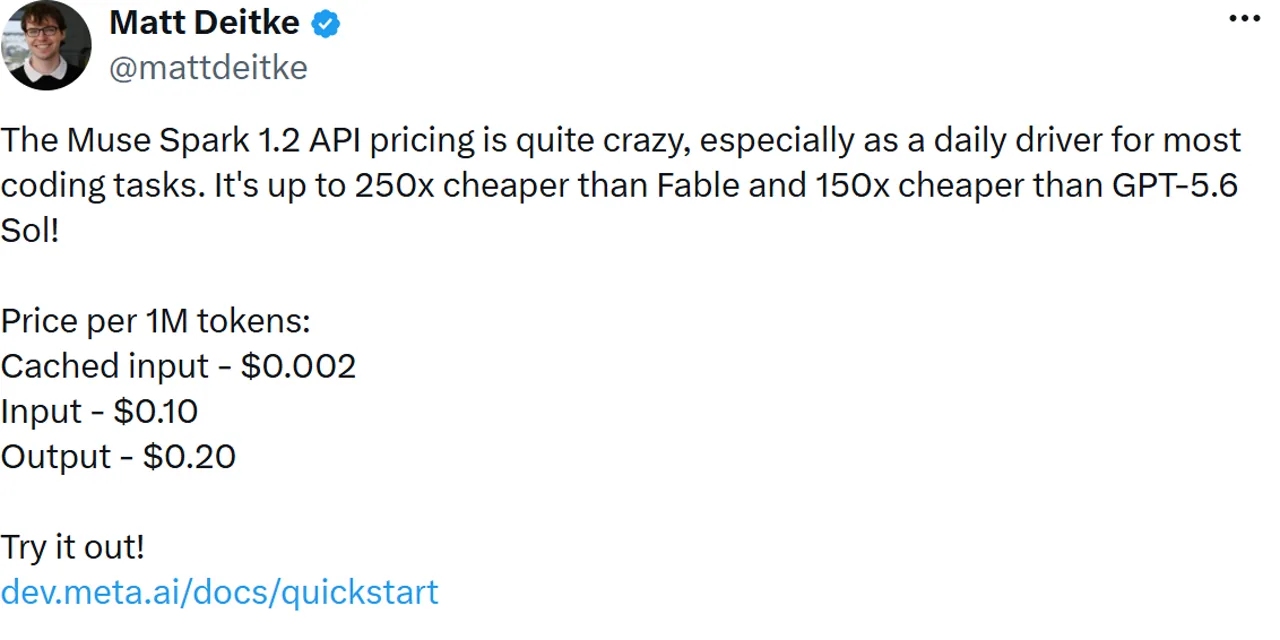
A Meta researcher promoted the Contributor tier as “up to 250× cheaper” than Fable and “150× cheaper” than GPT-5.6 Sol. That social comparison uses the Contributor prices, not the standard model, and should always carry the data-use qualification. Readers comparing current competitor costs can use our separate GPT-5.6 価格ガイド そして Claude Code pricing breakdown.

Matt Deitke social post promoting Muse Spark 1.2 Contributor-tier input, cached-input, and output token prices
Launch pricing context. A Meta researcher promoted the Contributor price comparison; the post does not show the higher standard-tier prices and must be read with the data-use trade-off. Source: Matt Deitke on X.

For public repositories, synthetic tasks, or disposable evaluation fixtures, the Contributor tier may be appealing. For private code, customer data, credentials, or proprietary architecture, the standard tier is the safer default. Meta also says it is beginning to accept zero-data-retention requests through sales, which is a separate access path rather than the default self-serve setting.

Muse Spark 1.2 API Access and Example

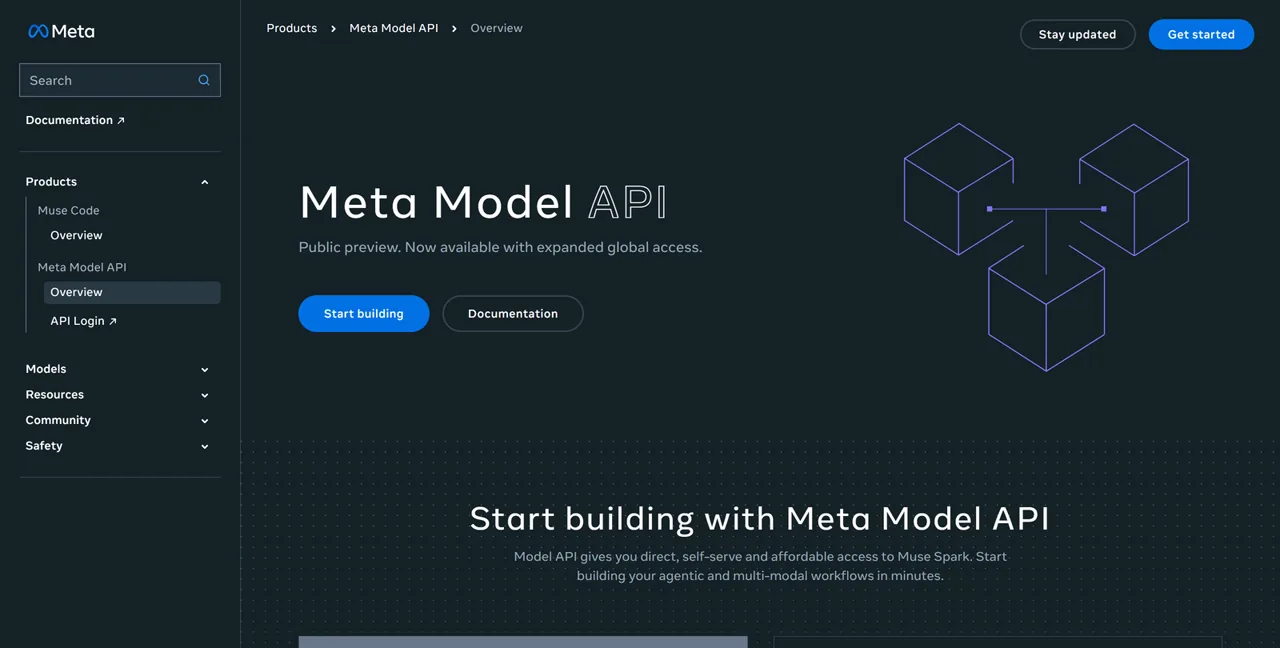
Meta Model API page describing direct self-serve access to Muse Spark in public preview
Official API access. Meta describes direct self-serve Muse Spark access through the Meta Model API in public preview. Source: Meta Model API.

Three official access routes

Terminal agentMuse Code beta
Direct APIMeta Model API
Aggregatorオープンルーター

Official cookbook base URL: https://api.meta.ai/v1 · 1.2 request in this review: not executed

について Meta Model API supports an OpenAI SDK-compatible workflow. Meta’s official cookbook uses the base URL https://api.meta.ai/v1 and reads the key from MODEL_API_KEY. The product page also describes search grounding, while the cookbook covers chat completions, streaming, tool calling, structured output, prompt caching, reasoning controls, vision, long context, retries, and search recipes.

Official cookbook example — captured version: について official GitHub cookbook still uses muse-spark-1.1. This proves the client structure and base URL, not that the example has been refreshed for 1.2.

import os

from openai import OpenAI

client = OpenAI(
    base_url="https://api.meta.ai/v1",
    api_key=os.environ["MODEL_API_KEY"],
)

response = client.chat.completions.create(
    model="muse-spark-1.1",
    messages=[{"role": "user", "content": "Hello, world!"}],
)

print(response.choices[0].message.content)
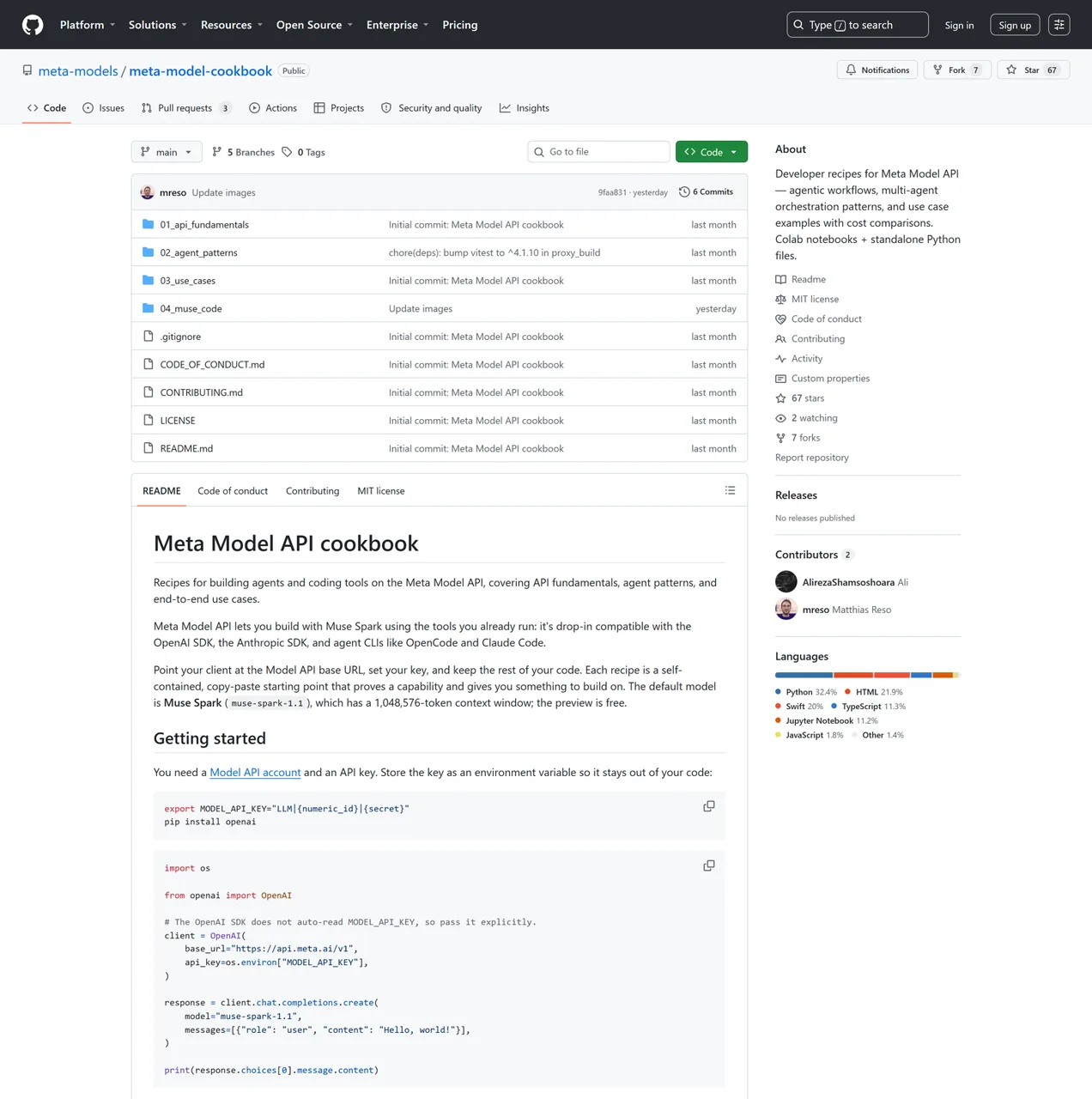
Meta Model API GitHub cookbook showing the OpenAI SDK base URL, environment key, and complete chat-completions example
Official cookbook. The captured README shows the OpenAI SDK pattern and base URL, but its example still used Muse Spark 1.1 when checked. Source: Meta Model API cookbook.

Documented adaptation — not executed: Meta separately lists muse-spark-1.2 as the standard 1.2 model ID. The minimal substitution below combines two official facts, but no paid request was sent during this review.

response = client.chat.completions.create(
    model="muse-spark-1.2",
    messages=[{"role": "user", "content": "Hello, world!"}],
)

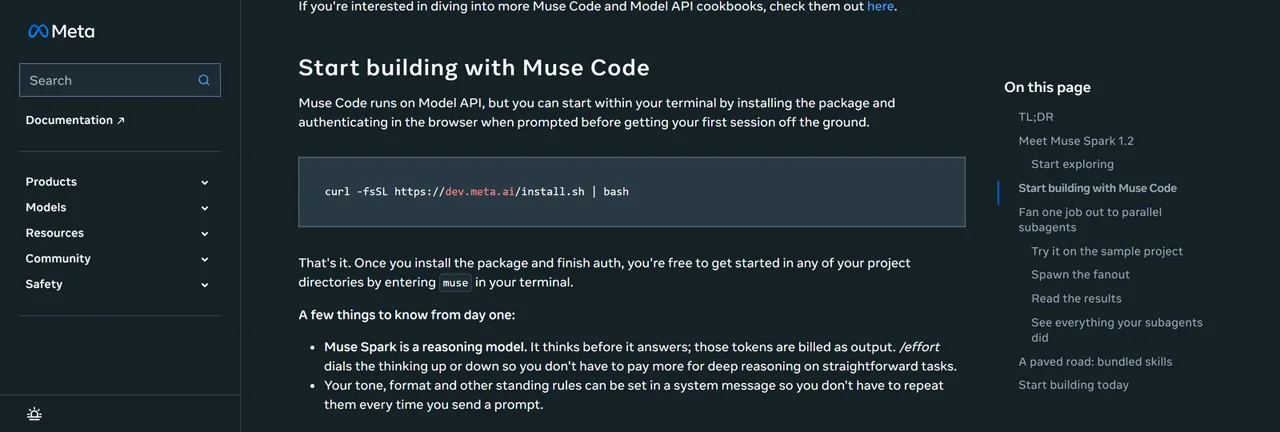
Muse Spark is a reasoning model, and reasoning tokens are billed as output. That makes the $4.25 standard output rate more important than it first appears: an apparently short answer can still carry material hidden reasoning usage. Real latency, time to first token, retry rate, and per-task cost remain unmeasured here.

Meta developer guide explaining Muse Spark reasoning-token billing and the Muse Code effort control
Billing behavior. Meta says Muse Spark reasoning tokens are billed as output, while the Muse Code /努力 command changes reasoning depth. Source: Meta developer guide.

What Muse Code Adds

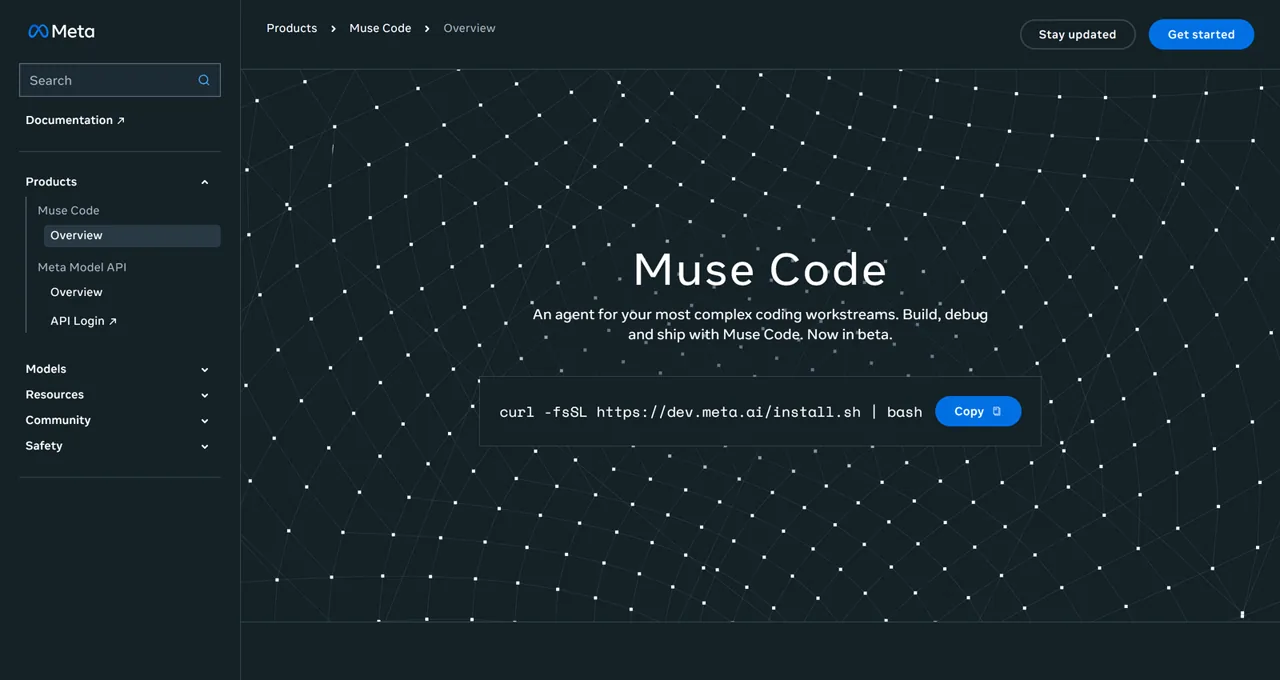
Official Muse Code beta page showing the terminal coding agent and its one-command installer
Muse Code beta. Meta presents Muse Code as a terminal agent for complex coding workflows and provides a one-command installer. Source: official Muse Code page.

Muse Code is installed from the terminal and wraps Muse Spark 1.2 in an agent workflow. Meta’s developer deep dive describes several behaviors that do not belong to a bare API call:

  • Parallel agents: tasks can run in isolated git worktrees.
  • Append-only event log: sessions and actions are written to local JSONL for audit and replay.
  • Resume flow: muse resume can continue interrupted sessions.
  • Reasoning control: the /努力 command adjusts reasoning strength.
  • Explicit skills: Meta names /taste, /grilling, /grill-with-docs, そして /plan.

Agent product features

Parallelism

Subagents

Independent tasks can fan out.

Isolation

Worktrees

Branches stay separated during parallel work.

Audit

JSONL log

Append-only local events support replay.

Recovery

Resume

muse resume continues interrupted sessions.

Explicit tools

スキル

/taste, /grilling, /grill-with-docs, /plan.

That feature set makes Muse Code relevant to the broader coding-agent market, where planning, isolation, replay, and tool discipline matter alongside model intelligence. The OpenClaw vs Claude Code vs OpenCode guide is useful context for those product-level differences.

Launch Claims and Early Community Signals

Reaction is not validation

Official launch framing

Training + long horizon

More coding compute, environment diversity, co-training, and a 1,000-plus-tool-call stress test.

One positive anecdote

Price and OpenCode

A single Reddit user praised an early coding experience and value.

Open questions

Privacy + reliability

Other users raised data-use, standard price, availability, and early reliability concerns.

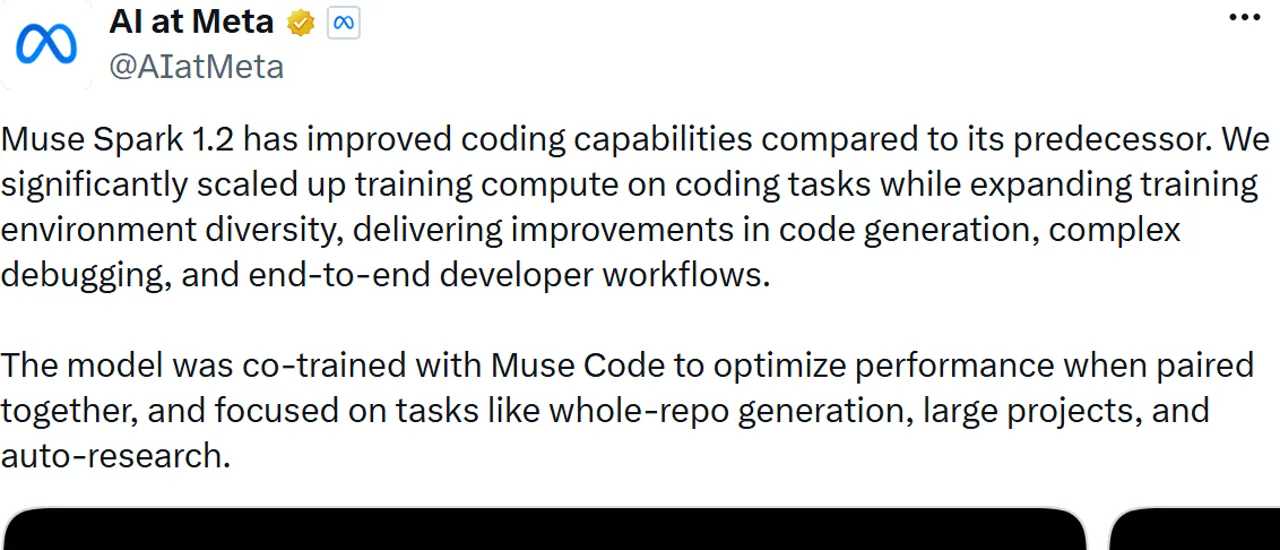
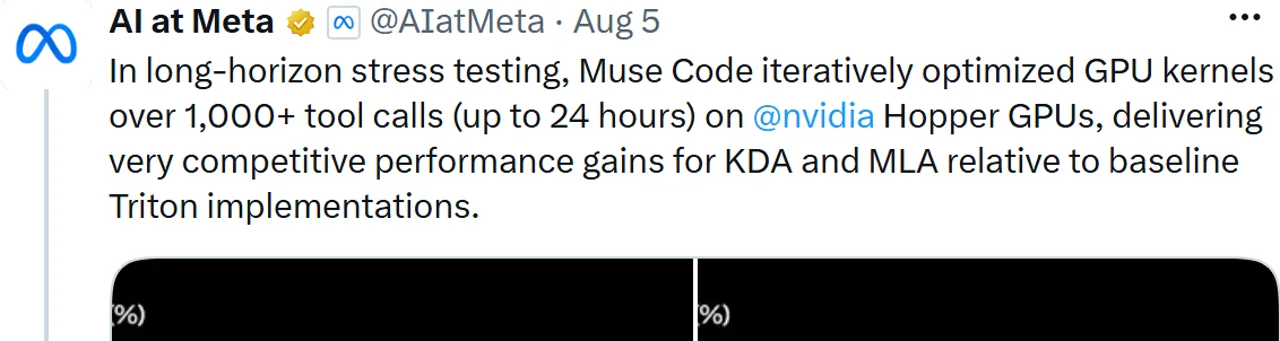
AI at Meta says Muse Spark 1.2 received more coding-training compute, more varied environments, greater emphasis on whole-repository generation and debugging, and co-training with Muse Code. A separate launch thread describes a stress test lasting up to 24 hours with more than 1,000 tool calls on NVIDIA Hopper GPUs.

AI at Meta post describing Muse Spark 1.2 coding training, debugging, whole-repository generation, and co-training with Muse Code
Official launch framing. AI at Meta says the model received more coding-task compute, broader environments, and co-training with Muse Code. Source: AI at Meta on X.
AI at Meta post describing a Muse Code stress test with more than one thousand tool calls over as long as twenty-four hours
Long-horizon demonstration. Meta showcased one GPU-kernel stress test with 1,000-plus tool calls; this is not a general tool-reliability rate. Source: AI at Meta on X.

That is an impressive demonstration, but it is not a measured general success rate. It does not tell us how often the agent chose the right tool, recovered from errors, avoided duplicate calls, or finished a normal repository task without steering.

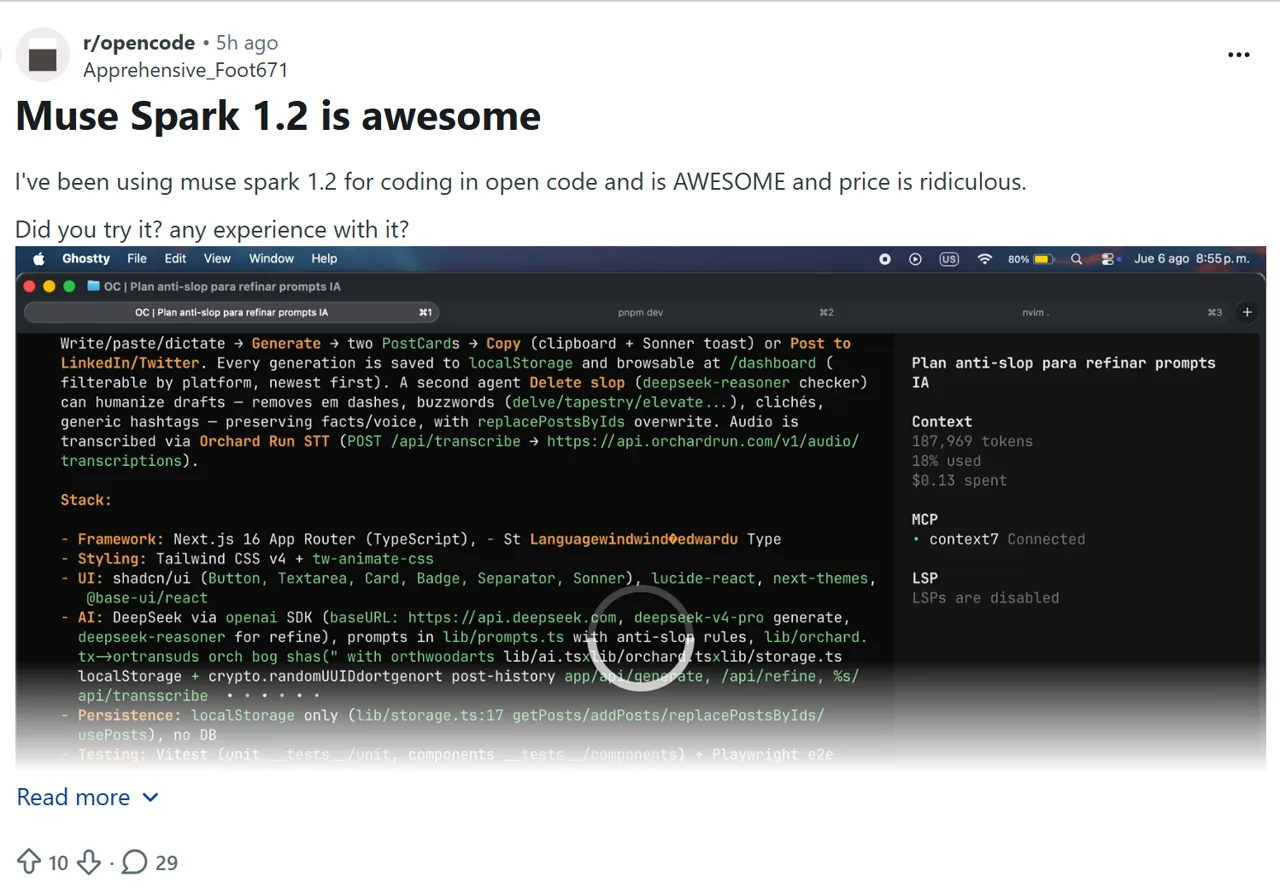
Early Reddit posts are similarly mixed. One r/opencode user reported a positive OpenCode experience and praised the price. A separate Contributor-pricing discussion raised data-use, standard-tier cost, availability, and reliability questions. These are individual reactions, not community consensus.

Reddit user describing an early positive Muse Spark 1.2 coding experience and low price in OpenCode
One early user report. A Reddit user praised the coding experience and price in OpenCode; this is an anecdote, not a broad consensus. Source: r/opencode.
Reddit discussion comparing Muse Spark 1.2 standard and Contributor pricing while raising data-sharing concerns
Privacy and value reaction. This community discussion pairs interest in the Contributor price with concerns about data use, availability, and standard-tier cost. Source: r/opencodeCLI.

Muse Spark 1.2 Coding Tests: 3/3 Tasks Passed

In our tests, the base Muse Spark 1.2 model completed three controlled coding tasks through an OpenAI-compatible chat-completions API. Each task received one attempt, with zero retries and no human steering. We evaluated the returned files in disposable repositories against public and hidden checks. Muse Code agent execution was not tested, and tool-call reliability was not tested, so these results should not be read as an agent benchmark.

Single-attempt result

タスク3/33/3 coding tasks passed
Average latency12.98s12.98 seconds per task
使用方法12,10012,100 tokens total
Reported cost$0.045362Three model calls

The responses used 6,618 reasoning tokens. All three finish reasons were stop, and the provider field reported Meta.

Test 1: Python idempotency bug fix — Pass

タスク

Stop duplicate transfers without changing the public API

The model identified the missing request-ID guard, added the smallest safe fix, and supplied a regression test while preserving atomic balance updates.

PASS · 6 tests
レイテンシー12.064s
Tokens2,867
推論1,621
コスト$0.01072675

The original hidden evaluator incorrectly required a duplicate call to return False, even though the task only required that it not charge the sender twice. After correcting that invented return-value requirement, the unchanged first response passed all six tests. We did not retry or edit the model output.

Test 2: TypeScript multi-file refactor — Pass

タスク

Separate validation, persistence, and audit logging

The returned files kept the public route contract, strict TypeScript, and the single transaction covering both order and audit writes. It also added focused validation tests without a runtime dependency.

検証PASSType-check, public contract, hidden transaction check, and added validation tests
13.909s5,011 tokens2,770 reasoning$0.01833275

The first evaluator compared objects with raw JSON.stringify, so equivalent objects with different key insertion order looked unequal; its Windows npx launch also failed before type-checking. With an order-insensitive comparator and a Windows-safe command invocation, the original response passed every check. Again, there was no model retry.

Test 3: JSONL repository feature — Pass

Repository-wide instruction following

Add JSONL without breaking CSV

The model implemented extension detection, one-based malformed-line errors, atomic output, dry-run safety, focused tests, help text, and a README example.

結果9/9tests passed
レイテンシー12.976sfirst attempt
4,222 tokens2,227 reasoning$0.0163025

What the tests show: Muse Spark 1.2 can return usable multi-file patches, respect compatibility constraints, add tests, and handle a modest repository-wide feature in one attempt. The average reported cost was about $0.0151 per task, but these fixtures were small and should not be used to forecast a large codebase bill.

Who Should Use Muse Spark 1.2?

意思決定ガイド

Try now

Controlled evaluation

Public or synthetic code, measurable tasks, large-context needs, and a promising 3/3 base-model result.

ちょっと待って

Agent proof required

Muse Code behavior, stable rate limits, repeated tool calls, or broad repository benchmarks are decision gates.

Compare first

Sensitive code or high output

Use the standard tier or compare alternatives when privacy and reasoning-token cost dominate.

Try it now

Muse Spark 1.2 is worth a controlled evaluation if you work with public or synthetic code, need a 1M-token context window, already use the OpenAI client pattern, and can verify returned patches locally. Its 3/3 result here strengthens the case for a trial, while the Contributor tier remains especially compelling for disposable benchmarks where its data-use terms are acceptable.

Wait for more evidence

Wait if your decision depends on Muse Code agent behavior, stable rate limits, repeated tool-call accuracy, or broad independent repository benchmarks. Three small first-attempt passes answer more than a launch chart, but they do not establish production reliability.

Use the standard tier or compare alternatives

Use the standard model for sensitive code unless your organization has separately approved the Contributor terms. If the standard output price changes the value calculation, compare it with current Codex pricing, Claude Code, and other coding-agent costs before committing to a workflow.

Muse Spark 1.2 Review Verdict

Muse Spark 1.2 earns a place on the evaluation shortlist, not an automatic production recommendation. The 1M-token context, familiar API shape, low Contributor pricing, three first-attempt coding passes, and strong Meta-run Muse Code scores make it hard to ignore. Meta has also done a better job than many launches at publishing methodology details.

The caveats are equally concrete. Contributor pricing comes with a data-use trade-off. Standard output and reasoning tokens can raise the real cost. Meta’s top coding numbers have not been reproduced as matching entries on the public Terminal-Bench or DeepSWE boards, and our hands-on sample covers three base-model tasks rather than Muse Code agent execution.

The sensible move is a controlled trial on non-sensitive code with raw usage and local verification saved. Treat the measured cost and latency as a small-task sample, then test your own repository size, failure recovery, and agent workflow before choosing it for production.

Muse Spark 1.2 FAQ

What is Muse Spark 1.2?

Muse Spark 1.2 is Meta’s coding-focused model, launched on August 5, 2026, with a 1M-token context window and access through Muse Code, the Meta Model API, and OpenRouter.

Is Muse Spark 1.2 the same as Muse Code?

No. Muse Spark 1.2 is the model; Muse Code is a separate beta terminal agent powered by it. Muse Code adds product features such as subagents, isolated git worktrees, event logging, resume, and bundled skills.

How much does the Muse Spark 1.2 API cost?

The standard model costs $1.25 input, $0.15 cached input, and $4.25 output per million tokens. The Contributor model costs $0.10 input, $0.002 cached input, and $0.20 output.

Does Meta use Muse Spark API data for training?

Meta says standard-tier data is not used to improve Meta products. Contributor-tier data may be used to improve Meta products, so private or proprietary code should use the standard route unless an organization approves otherwise.

Is Muse Spark 1.2 on the public Terminal-Bench or DeepSWE leaderboards?

It was not listed on either public board when checked on August 7, 2026. Meta reports 82.9% on Terminal-Bench 2.1 with Muse Code and 59.3% on DeepSWE, but those are Meta-run results.

Has Muse Spark 1.2 been tested hands-on in this review?

Yes. In three single-attempt base-model tests, Muse Spark 1.2 passed a Python bug fix, a TypeScript refactor, and a JSONL repository feature. Average latency was 12.98 seconds and total reported cost was $0.045362. Muse Code agent and tool-call reliability were not tested.

How can developers access Muse Spark 1.2?

Meta lists three routes: the Muse Code beta terminal agent, the Meta Model API, and OpenRouter. The official cookbook uses an OpenAI SDK-compatible client with the base URL https://api.meta.ai/v1.

記事を共有する

関連記事