Snel antwoord: Kosten van de GPT-6 Astra $10 per 1 miljoen invoertokens, $1 per 1 miljoen in de cache opgeslagen invoertokens, $12,50 per 1 miljoen cache-schrijftokens, en $50 per 1 miljoen uitgegeven tokens tegen standaardtarieven, zolang een verzoek 272K invoertokens of minder omvat. Boven 272K wordt het volledige verzoek onderworpen aan de tarieven voor lange context: $20 invoer, $2 cache-invoer, $25 cache-schrijfbewerkingen en $75 uitvoer per 1 miljoen tokens. OpenAI beschrijft een contextvenster van 1,05 miljoen tokens en een maximale output van 128K.
Die cijfers maken Astra krachtig, maar ook zo duur dat een goede planning vereist is. Een herhaalde aanvraag kan aanzienlijk goedkoper uitvallen als caching goed werkt, terwijl een verzoek dat de grens van 272K invoertokens net overschrijdt, aanzienlijk duurder kan worden. In deze gids worden de officiële prijzen onderscheiden van berekende voorbeelden en van onze praktische API-waarnemingen van 5 september 2026.
Prijzen voor de GPT-6 Astra API
OpenAI maakt bij de standaardprijzen een onderscheid tussen korte en lange termijn. De drempel is gebaseerd op invoertekens, niet de som van de invoer en de uitvoer. De korte context geldt voor prompts met maximaal 272.000 invoertokens; de lange context is van toepassing vanaf dat punt.
Kosten per 1 miljoen tokens
De hogere tariefklasse geldt voor het gehele verzoek. De weergegeven prijzen zijn per 1 miljoen tokens.
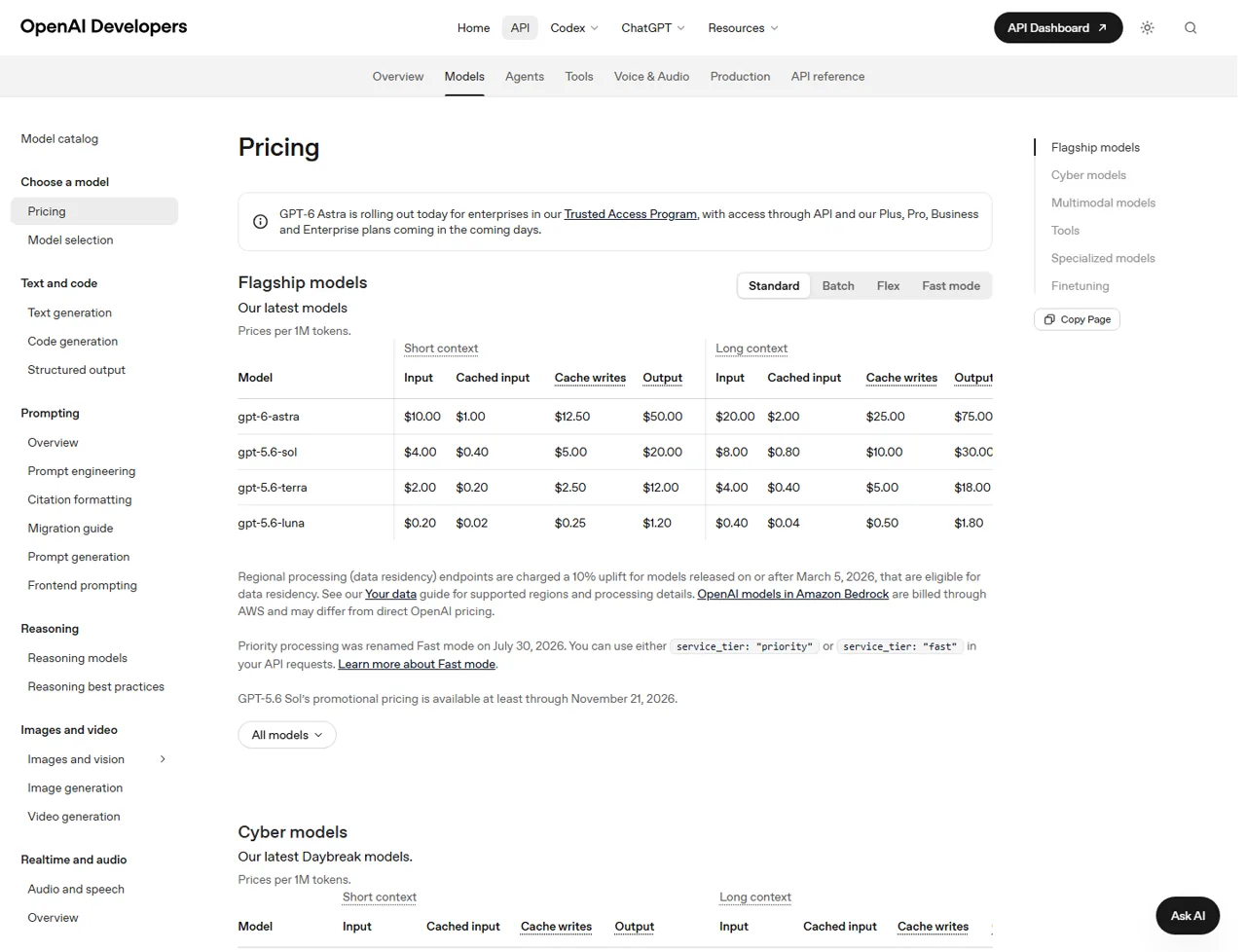
Het belangrijkste punt is dat het overschrijden van 272K niet leidt tot een factuur met gemengde tarieven. Volgens De documentatie over de API-tarieven van OpenAI, gelden de hogere tarieven voor de gehele aanvraag zodra de input de drempel overschrijdt. Teams die Astra vergelijken met een eerder vlaggenschipmodel, moeten daarom verder kijken dan alleen de prijs per input; onze Prijsgids GPT-5.6 biedt nuttige achtergrondinformatie voor die begrotingsbespreking.
Het snel in de cache opslaan kan de kosten voor herhaalde invoer aanzienlijk verlagen, maar het aanmaken van een cache is niet gratis. Het schrijven naar de cache kost 1,25 keer het geldende tarief voor invoer zonder cache. Batch- en Flex-verwerking kosten 50% aan Standard, terwijl Fast twee keer het geldende tarief kost. In aanmerking komende regionale verwerking voegt 10% toe, en Fast is niet beschikbaar voor Astra met gegevensopslag in de EU.
Hoeveel kost een GPT-6 Astra API-aanroep?
Bij een standaardverzoek bereken je elke categorie van gefactureerde tokens afzonderlijk en tel je vervolgens de resultaten bij elkaar op:
Totale kosten = kosten van niet-gecachete invoer + kosten van gecachete invoer + kosten van het schrijven naar de cache + kosten van uitvoer.
(0,0125 × $10) + (0,002 × $50)$0.225(0,1 × $10) + (0,005 × $50)$1.25(0,1 × $1) + (0,005 × $50)$0.35(0,3 × $20) + (0,01 × $75)$6.75Bij de schattingen op basis van het standaardtarief zijn gereedschap, regionale toeslagen en andere afzonderlijk gefactureerde diensten niet inbegrepen.
De 100.000 voorbeelden laten zien waarom herbruikbare voorvoegsels belangrijk zijn: de schatting van het aantal model-tokens daalt van $1,25 naar $0,35 wanneer alle invoer in de cache wordt opgeslagen. Dit is een illustratie van de prijsstelling, geen garantie dat elke herhaalde prompt een cachehit oplevert. Voor een bredere budgettering van meerdere modellen kunt u de aannames voor de workflow in onze Handleiding voor alles-in-één AI-modellen.
GPT-6 Astra-tokens, contextvenster en uitvoerlimieten
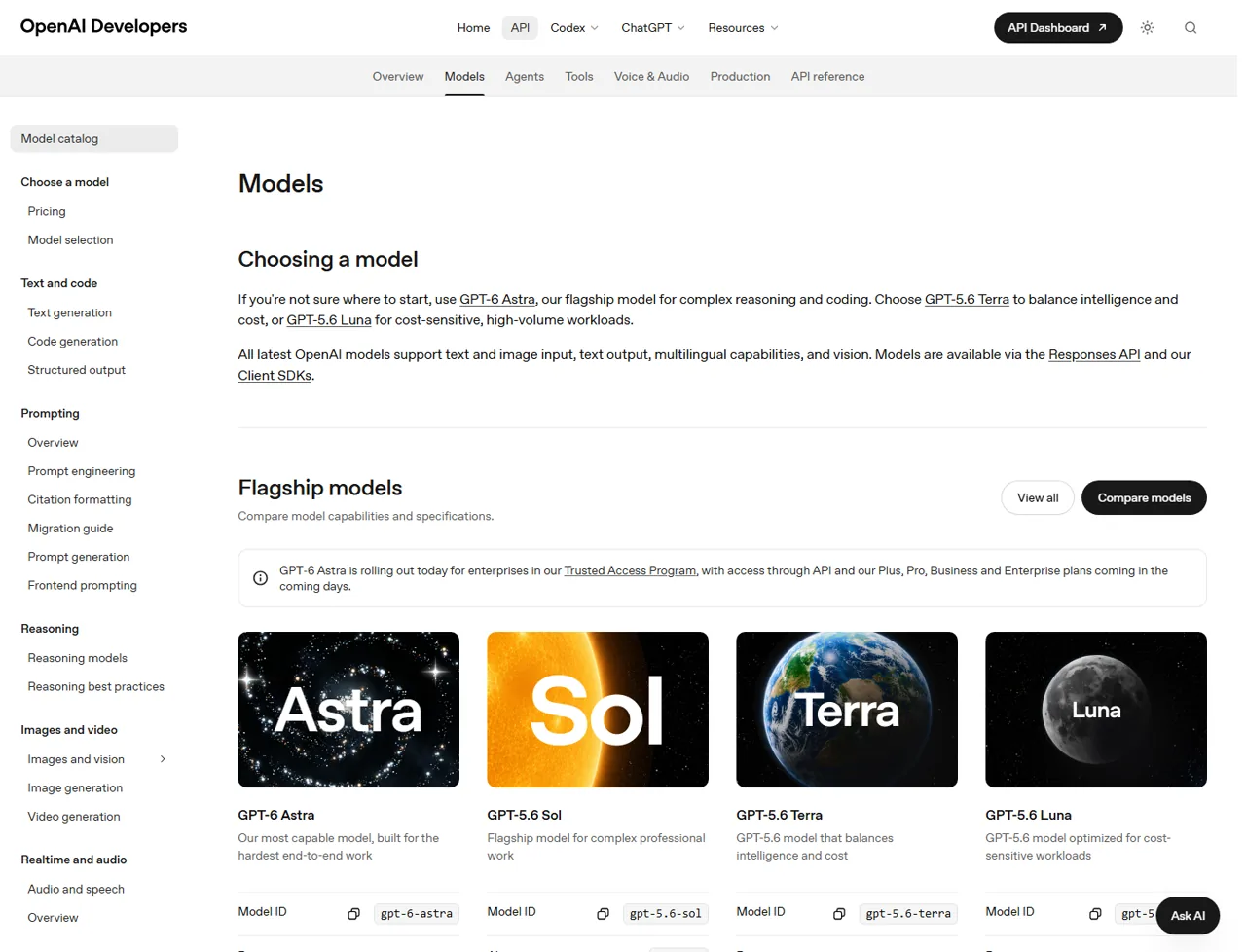
De officiële GPT-6 Astra-modelpagina documenteert a 1.050.000-token contextvenster en een Maximale output van 128.000 tokens. De kennisgrens ligt op 30 april 2026. Het accepteert tekst- en afbeeldingsinvoer, geeft tekst als uitvoer en ondersteunt de instellingen voor de mate van redenering laag, gemiddeld, hoog, xhoog, en max.
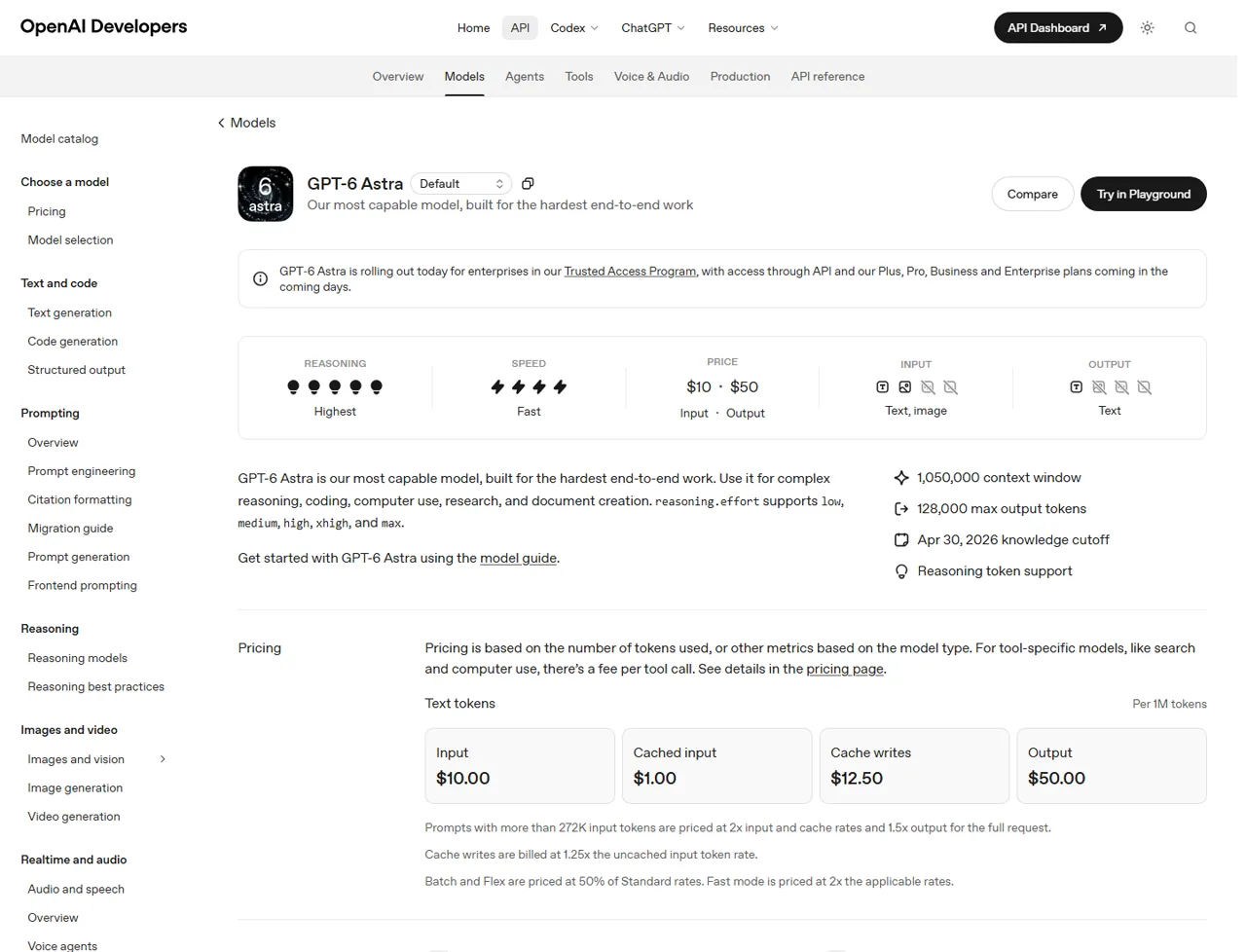
Een groot contextvenster is een capaciteit, geen aanbeveling om elk verzoek te vervullen. Door het ophalen van informatie, de selectie van documenten, het samenvatten en de structuur van de prompt kan de invoer onder de grens van 272K worden gehouden. Ook de keuze van het model is van belang: ontwikkelaars die zich richten op programmeren kunnen de afwegingen vergelijken in onze beste AI-model voor codering analyse, in plaats van ervan uit te gaan dat het model met het grootste venster automatisch het best past.
Zes praktische testopdrachten voor de GPT-6 Astra API
Teststatus: GPT-6 Astra is sinds 5 september 2026 beschikbaar via de Broly Anywhere-compatibiliteits-API. We hebben de zes hieronder genoemde taken uitgevoerd. Vijf daarvan leverden bruikbare HTTP 200-resultaten op; het verzoek met de limiet van 272K eindigde met een transportfout en is nog steeds niet geverifieerd.
Aanwijzingen en waargenomen resultaten
Model-ID gpt-6-astra. Elk resultaat betreft één uitgevoerde test, geen officiële benchmark. De kloktijd omvat de vertraging bij de gateway en de upstream-vertraging.
Basisprincipes van de tokenboekhouding
Het model leverde het verwachte theoretische resultaat op. Het daadwerkelijke API-gebruik bedroeg 54 invoer- en 26 uitvoertokens.
Prompt cachen
Beide zoekopdrachten waren correct, maar bij het herhaalde voorvoegsel werden in beide reacties nul tokens in de cache en nul cache-schrijftoken geregistreerd.
Prijsgrens van 272K
Het omvangrijke synthetische verzoek werd beëindigd voordat er een HTTP-antwoord binnenkwam. Er werd geen gebruiksobject geretourneerd, waardoor de bandbreedte en het factureringsgedrag niet zijn gemeten.
Redenering op basis van minimum- versus maximumwaarden
Bij beide runs werd $265,20 berekend. Max deed er langer over en leverde 88 redeneringstokens op; bij deze ene rekenopgave was er geen verbetering in de kwaliteit van de antwoorden waarneembaar.
128K-uitgangsparameter
Het compatibiliteits-eindpunt gaf de status „OK“ terug in plaats van één token boven het officiële maximum af te wijzen. Dit is het gedrag van de gateway en geen aanwijzing dat er een groter ondersteund uitvoervenster is.
Tarieven en serviceniveaus
Normale reacties bevatten geen headers met de naam „remaining-request“ of „remaining-token“. Zowel de Flex- als de priority-probes waren succesvol, maar gaven „service_tier: default“ terug.
GPT-6 Astra API-limieten
GPT-6 Astra wordt niet ondersteund in het gratis abonnement. De limieten voor gepubliceerde gegevens stijgen naarmate het gebruiksniveau toeneemt, maar de headers van live projecten blijven de meest praktische bron voor informatie over de resterende capaciteit en het tijdstip van het resetten.
De capaciteit stijgt sterk in niveau 5
De barhoogte dient ter illustratie. De exacte waarden voor RPM, TPM en de batchwachtrij hierboven zijn bepalend.
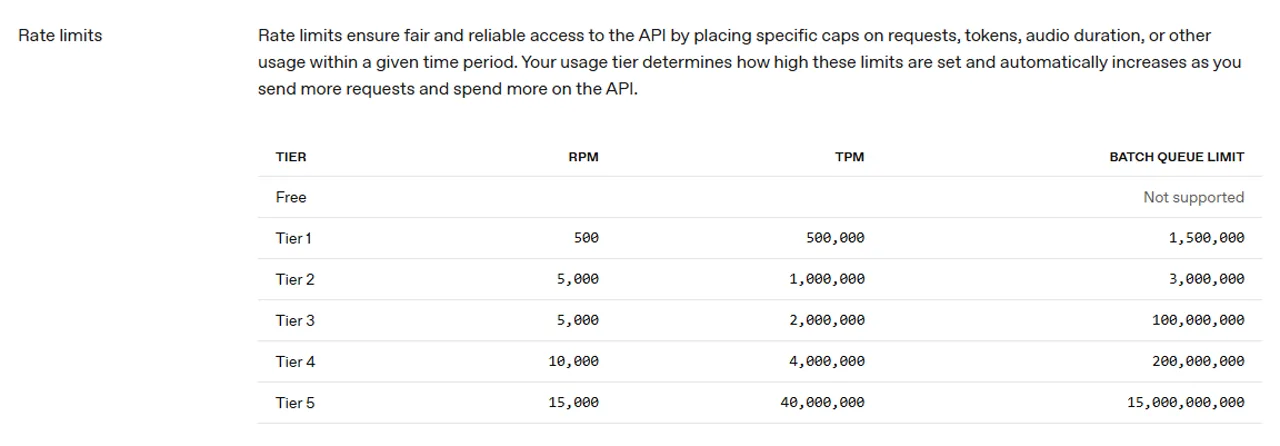
Met ‘Batch’ of ‘Flex’ kunnen de tarieven per modeltoken worden gehalveerd wanneer onmiddellijke reacties niet nodig zijn. ‘Fast’ is wellicht geschikt voor taken waarbij de latentie van belang is, maar verdubbelt de geldende prijs en is niet beschikbaar in combinatie met gegevensopslag binnen de EU voor Astra. Vergelijk, voordat je een productiewerkbelasting vastlegt, de modelkosten met de bijbehorende platformkosten; onze Codex-prijsgids laat zien waarom productabonnementen en API-facturering niet met elkaar mogen worden vermengd.
Wat de eerste recensenten laten zien
De onafhankelijke maker Matt Wolfe heeft een eerste video gepubliceerd met een voorproefje van demonstraties op het gebied van programmeren, computergebruik, Blender en Unreal Engine. Deze voorbeelden zijn nuttig om inzicht te krijgen in de soorten workflows die recensenten onderzoeken, maar het gaat hier niet om gecontroleerde benchmarkgegevens en ze vormen geen vervanging voor de hierboven genoemde API-tests. Bredere vergelijkingen, zoals ChatGPT versus Claude versus Gemini moet eveneens worden gezien als werkbelastingsspecifieke richtlijn, en niet als een algemeen klassement.
Voor wie is GPT-6 Astra bedoeld?
Astra is een geschikte keuze voor complexe programmeeropdrachten, agentgebaseerde workflows, de analyse van omvangrijke documenten en multimodale taken waarbij een sterkere redeneringscapaciteit of een zeer groot contextvenster de hogere kosten per token kunnen compenseren. Teams zouden het moeten testen aan de hand van een afgebakende, meetbare taak en de kwaliteit per dollar moeten vergelijken, niet alleen de kwaliteit van de output. Onze overzicht van de beste AI-modellen biedt een breder keuzekader.
- Gebruik Astra wanneer: de taak is complex, fouten zijn kostbaar, er is een lange context nodig, of het model kan meerdere zwakkere doorlopen vervangen.
- Gebruik een goedkoper model wanneer: het gaat om routinematige classificatie, extractie, herschrijving of het genereren van grote hoeveelheden tekst met eenvoudige kwaliteitseisen.
- Optimaliseer eerst wanneer: het aantal verzoeken overschrijdt herhaaldelijk de 272K, grote statische voorvoegsels kunnen in de cache worden opgeslagen, of de latentie vereist geen Standard- of Fast-verwerking.
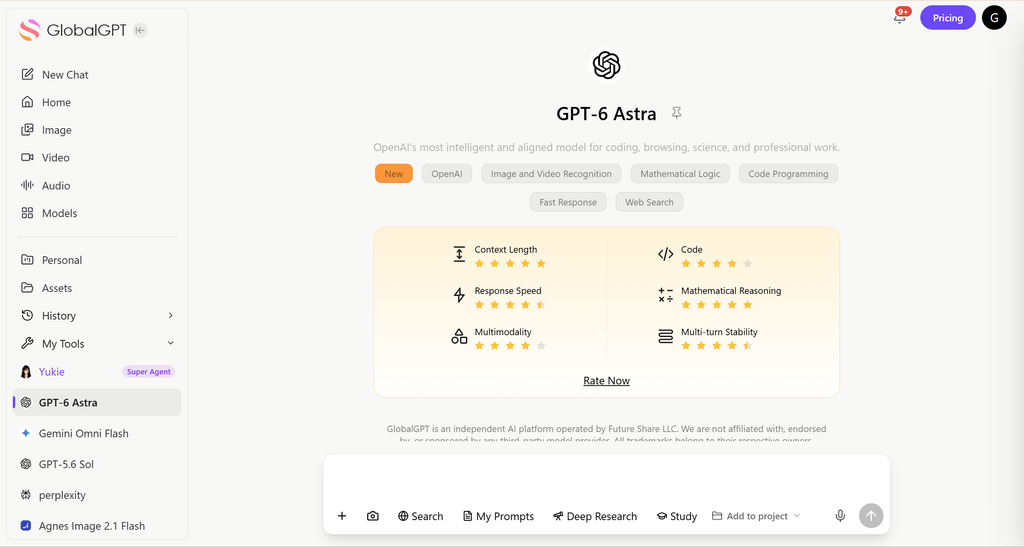
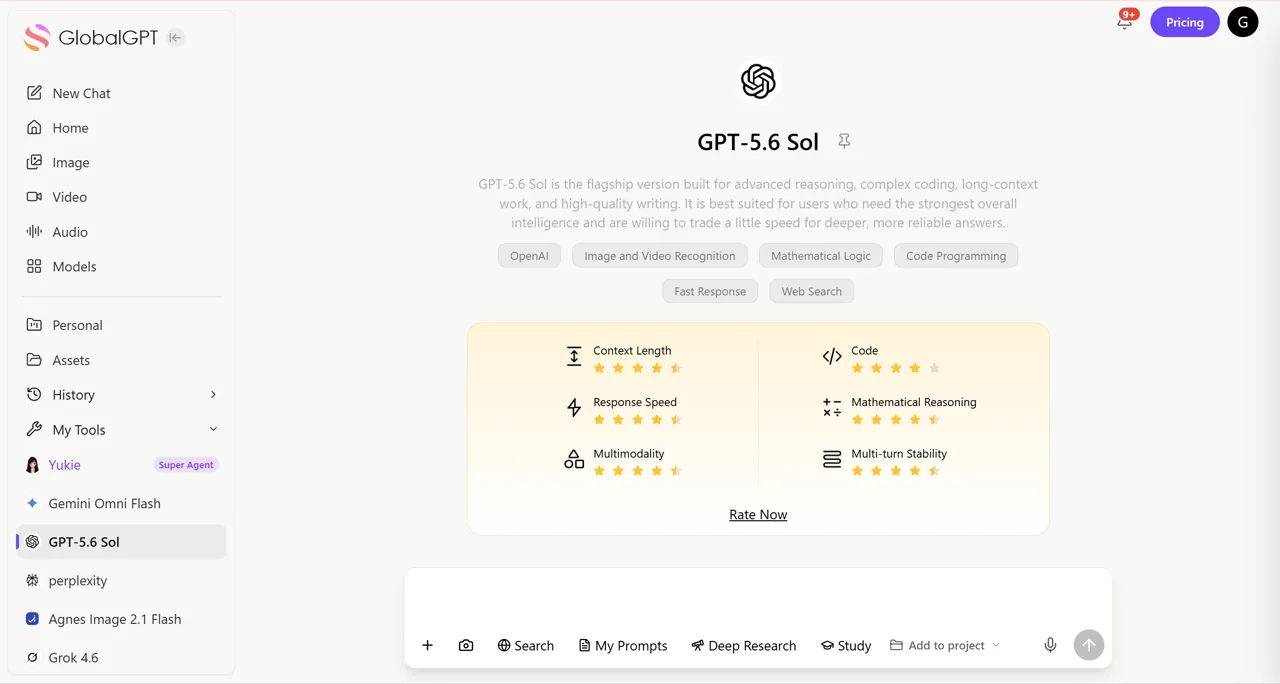
Voor lezers die vergelijkbare premiumopties met elkaar vergelijken, is de Vergelijking tussen GPT-5.6, Fable 5 en GPT-5.5 biedt een ander perspectief op kosten, mogelijkheden en de aansluiting op de werklast. GlobalGPT beschikt over een speciale GPT-6 Astra-landingspagina. Onze API-waarnemingen zijn afzonderlijk vastgelegd via het compatibiliteitseindpunt van Broly Anywhere.
Veelgestelde vragen
Wat is de prijs van de GPT-6 Astra API?
De standaardprijs voor korte contexten bedraagt $10/M invoer, $1/M ingelezen invoer, $12,50/M cache-schrijfbewerkingen en $50/M uitvoer. Boven 272K invoertokens gebruikt het volledige verzoek $20/M invoer, $2/M cache-invoer, $25/M cache-schrijfbewerkingen en $75/M uitvoer.
Wat gebeurt er als een prompt meer dan 272K invoertokens bevat?
OpenAI verplaatst het volledige verzoek naar de band met lange context. Het is geen gemengd pakket waarbij alleen de tokens boven de 272K meer kosten.
Wat is het contextvenster van GPT-6 Astra?
OpenAI heeft een contextvenster van 1.050.000 tokens, een maximale invoer van 922.000 tokens en een maximale uitvoer van 128.000 tokens. Redeneringstokens nemen ook plaats in de context en worden als uitvoer in rekening gebracht.
Ondersteunt GPT-6 Astra het invoeren van afbeeldingen?
Ja. In de documentatie van het model worden tekst- en afbeeldingsinvoer met tekstuitvoer vermeld. Audio en video worden niet genoemd als invoermodaliteiten voor dit model.
Zijn deze kostenvoorbeelden officiële facturen?
Nee. Het zijn rekenvoorbeelden op basis van de vastgelegde tarieven. Op uw factuur kunnen ook kosten voor cached-token-afrekening, de verwerkingsmodus, regionale verwerking en andere afzonderlijk gefactureerde diensten worden vermeld.
Welke verwerkingsmodi zijn er beschikbaar?
Voor de tariefniveaus Standard, Batch, Flex, Fast en Ultrafast zijn de Astra-prijzen vastgelegd. Batch en Flex kosten de helft van Standard, Fast kost het dubbele van Standard en Ultrafast kost zes keer zoveel als Standard binnen dezelfde contextband. In aanmerking komende regionale verwerking kost 10% extra; de beschikbaarheid hangt af van de modus en het eindpunt.
Hoe wordt GPT-6 Astra via GlobalGPT gefactureerd?
In de API van GlobalGPT staan voor GPT-6 Astra 23 credits per 1.000 invoertokens en 117 credits per 1.000 uitvoertokens vermeld. Redeneringstokens worden als uitvoer in rekening gebracht. Dit zijn de credittarieven van GlobalGPT; voor het gebruik van de OpenAI-API gelden aparte tarieven in USD.
Eindoordeel
GPT-6 Astra combineert een contextvenster van 1,05 miljoen tokens en een maximale output van 128.000 met een premium prijs. Het standaardtarief voor korte context begint bij $10 per 1 miljoen invoertokens en $50 per 1 miljoen uitvoertokens, maar de limiet van 272.000, redeneringstokens, cache-schrijfbewerkingen, de verwerkingsmodus en regionale toeslagen kunnen de kosten aanzienlijk beïnvloeden. Maak een schatting van het aantal tokens voordat u grote prompts verstuurt, controleer de caching aan de hand van gebruiksgegevens en beoordeel Astra op de waarde van de voltooide taak in plaats van alleen op de officiële prijs.