There is no single winner for every job. ChatGPT is the broadest standalone assistant, Claude is especially strong with long documents and careful coding work, and Gemini makes the most sense when Google products or multimodal files are already part of the workflow.
The practical choice depends on where the work starts and what must happen after the answer. ChatGPT keeps research, files, voice, images, and coding tools together; Claude is well suited to source-heavy analysis and large codebases; Gemini connects naturally with Gmail, Docs, Drive, Sheets, Search, and NotebookLM.
If your work regularly uses more than one model family, GlobalGPT brings supported GPT, Claude, and Gemini models into one all-in-one workspace. One account keeps those workflows in the same place, so you do not need separate subscriptions or repeated jumps between provider URLs whenever the task changes.

ChatGPT vs Claude vs Gemini: Quick Comparison
ChatGPT is the broadest standalone assistant, Claude is built around careful document and coding work, and Gemini is the most deeply connected to Google products. The main difference is not whether they can answer the same prompt. It is how much useful work each product can complete before you have to move the result somewhere else.
| Category | ChatGPT | Claude | Gemini |
|---|---|---|---|
| Best default use | General writing, coding, file work, analysis, research, voice, and image workflows in one standalone product. | Long documents, source-bound synthesis, careful editing, Artifacts, and repository work through Claude Code. | Tasks that begin or end in Gmail, Docs, Drive, Sheets, Search, Android, NotebookLM, or Google Cloud. |
| Writing and synthesis | Flexible output style and a familiar choice for reports, drafts, analysis, and mixed file work. | Especially strong at making contradictions, dependencies, and source relationships easy to inspect. | Clear and structured, with a strong advantage when source material already lives in Google products. |
| Coding | Strong general-purpose coding, debugging, explanation, and code generation across many languages; particularly useful when coding is mixed with analysis, files, or other tasks. | Excels at understanding large codebases, tracing dependencies, explaining complex logic, and producing careful fixes with detailed reasoning. | Strong at code generation, complex reasoning, and long-context coding tasks, with particular strengths in multimodal inputs and Google technology stacks. |
| Research and search | Strong all-round research synthesis that combines web sources, uploaded files, and connected apps into structured, cited reports. | Particularly good at reading long source sets, comparing claims, preserving nuance, and turning research into clear, source-grounded analysis. | Strongest when current web information, Google Search, and material from Gmail, Drive, Docs, or NotebookLM need to be brought together. |
| Multimodal workflow | Text, files, images, voice, and generation tools in the ChatGPT product family. | Multimodal understanding with an interface centered on conversation, documents, and Artifacts. | Text, image, audio, and video capabilities across Gemini and Google’s media products. |
| Native ecosystem | ChatGPT, Projects, connectors, Codex, and OpenAI creative tools. | Claude apps, Projects, Artifacts, integrations, and Claude Code. | Gmail, Docs, Drive, Sheets, Meet, Search, Android, NotebookLM, AI Studio, and Vertex AI. |
What Are the Latest ChatGPT, Claude, and Gemini Models?
The model routes compared here are GPT-5.6 Sol (the GlobalGPT GPT route used for this test), Claude Opus 5 for Claude, and Gemini 3.1 Pro Preview for Gemini.
| Product | Latest model in this comparison | Current status | What it is designed to handle |
|---|---|---|---|
| ChatGPT | GPT-5.6 Sol | Current GPT route used for this comparison | General reasoning, coding, research, files, and multi-tool work. |
| Claude | Claude Opus 5 | Introduced July 24, 2026 | Coding, professional knowledge work, search, computer use, and multi-step agent tasks. |
| Gemini | Gemini 3.1 Pro Preview | Preview; introduced February 19, 2026 | Complex reasoning and multimodal work connected to Google’s product ecosystem. |
Model generations move quickly, so the latest name is only the starting point. The broader best AI models comparison shows where other current models fit when speed, cost, or a specialist workflow matters more than flagship quality.
Gemini also has faster workflow-focused variants. The Gemini 3.5 Flash review is the better next step when responsiveness and repeated Google-connected tasks matter more than the Pro model’s hardest reasoning work.
The choice can still change by task: compare finished outputs, native tools, and plan limits rather than treating one model name as a permanent winner. For a wider product-level view, see the current AI assistant comparison and ranking.
Benchmark Results: What Do They Actually Tell You?
Benchmarks should not replace hands-on testing, but they show which kinds of difficult work each model handles best. The most useful current evidence comes from Anthropic’s official Claude Opus 5 table—which includes GPT-5.6 Sol in the same comparison—and Google’s official Gemini 3.1 Pro results.
Overall benchmark picture
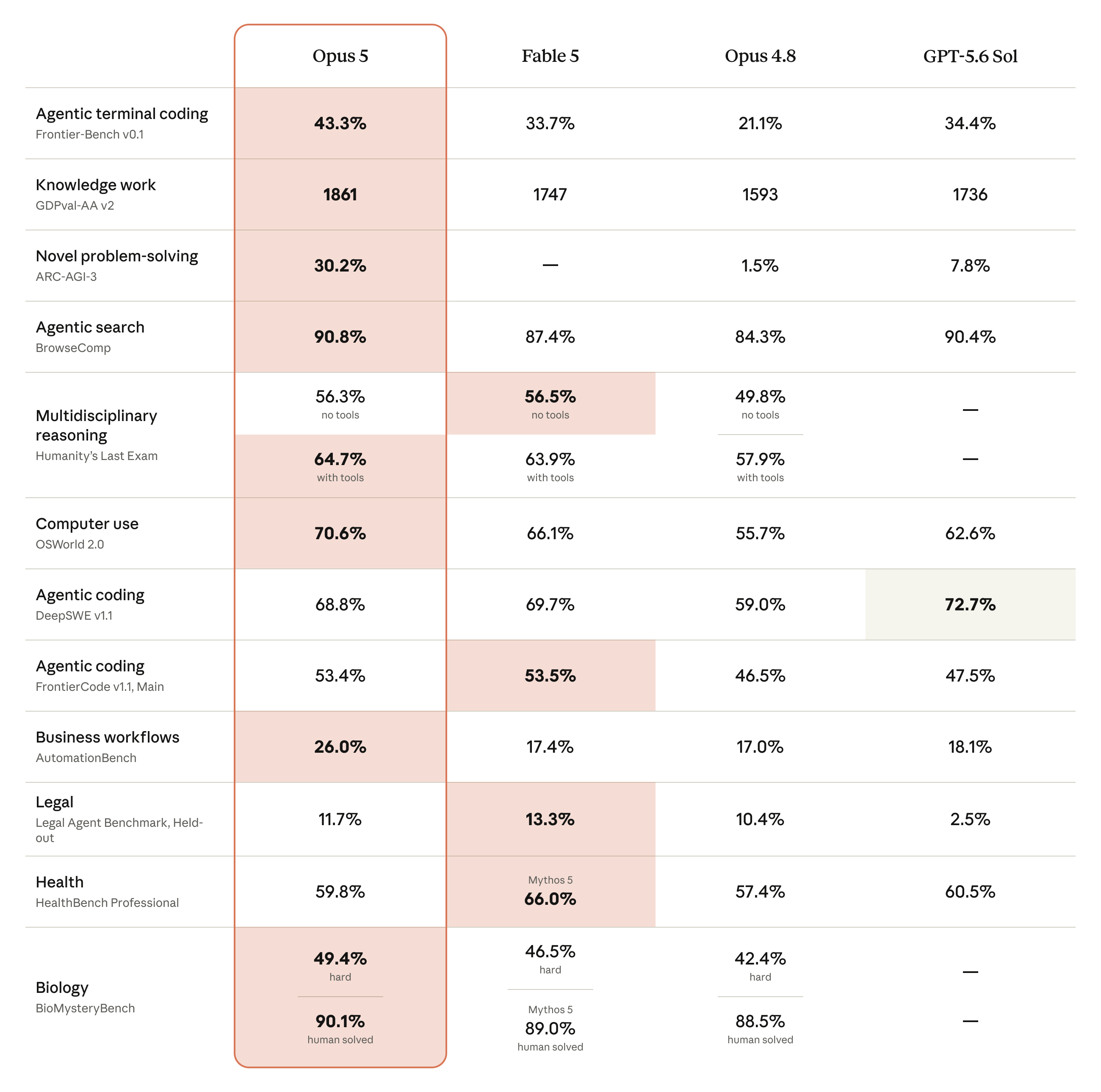
Claude Opus 5 has the stronger all-round benchmark case in the evidence used for this comparison. It leads across more of Anthropic’s published evaluations for professional knowledge work, web research, computer use, automation, and multi-step agent tasks. GPT-5.6 Sol has a narrower but important advantage: it leads the software-engineering row. Gemini 3.1 Pro is documented separately by Google and makes its strongest case on unfamiliar visual and logical reasoning.
Claude Opus 5 has the broadest benchmark advantage
Claude Opus 5 records 43.3% on Frontier-Bench for agentic terminal work, 1,861 on GDPval-AA for professional knowledge work, 90.8% on BrowseComp for difficult web research, 70.6% on OSWorld for computer use, and 26.0% on AutomationBench. It also leads the table’s ARC-AGI-3 reasoning row at 30.2%.
For buyers, these are not six versions of the same intelligence test. Together they represent a model finding information, working through professional material, operating software, and completing dependent steps. Claude’s advantage is therefore most relevant when one assignment combines several of those demands.
GPT-5.6 Sol leads the software-engineering result
GPT-5.6 Sol reaches 72.7% on DeepSWE v1.1, the strongest result in the table’s software-engineering row. It also scores 90.4% on BrowseComp, only 0.4 points behind Claude Opus 5 on that research benchmark.
For buyers, this makes GPT more than the broader-toolkit option. Its clearest benchmark advantage appears in the evaluation closest to completing real software-engineering work, while its web-research result remains competitive. If coding is the main reason for paying, that row deserves more weight than Claude’s larger number of wins elsewhere.
The closer Claude Opus 5 vs GPT-5.6 comparison separates those two models without the additional Gemini ecosystem question.
Gemini 3.1 Pro is not only a Google Workspace model
Google reports a verified 77.1% result for Gemini 3.1 Pro on ARC-AGI-2, more than double the result Google reported for Gemini 3 Pro. The evaluation focuses on unfamiliar problems that cannot be solved by simply recalling known answer patterns.
That makes Gemini 3.1 Pro a serious reasoning model rather than only an ecosystem add-on. For buyers, the important point is that choosing Gemini for Gmail, Docs, Drive, or NotebookLM does not mean giving up a flagship reasoning model—although Google’s separate result cannot be treated as a direct head-to-head score against the Anthropic table.
What the benchmark section means for your choice
If your work combines research, computer use, professional analysis, and multi-step execution, Claude has the strongest benchmark case. If software engineering is the priority, GPT has the most relevant row win and remains close to Claude on difficult web research. If your work is Google-centered but still requires difficult reasoning, Gemini should not be dismissed as merely an integration layer. Use these results to build a shortlist, then use the hands-on tests below to compare the finished work.
Real Tests: Coding, Writing, and Research
To move beyond feature lists and benchmark claims, GPT-5.6 Sol, Claude Opus 5, and Gemini 3.1 Pro Preview received the same coding, long-form writing, and evidence-research questions. The comparison below shows the returned work directly, then explains the differences that would affect a real task.
The results were not converted into a score or an overall winner. Coding was checked by running the submitted functions. Writing was compared against the same length, structure, and evidence rules. Research was checked against the same nine-source packet, including conflicting sales, contract, reliability, incident, pricing, and audit evidence.
Coding test: which answer is easiest to trust and reuse?
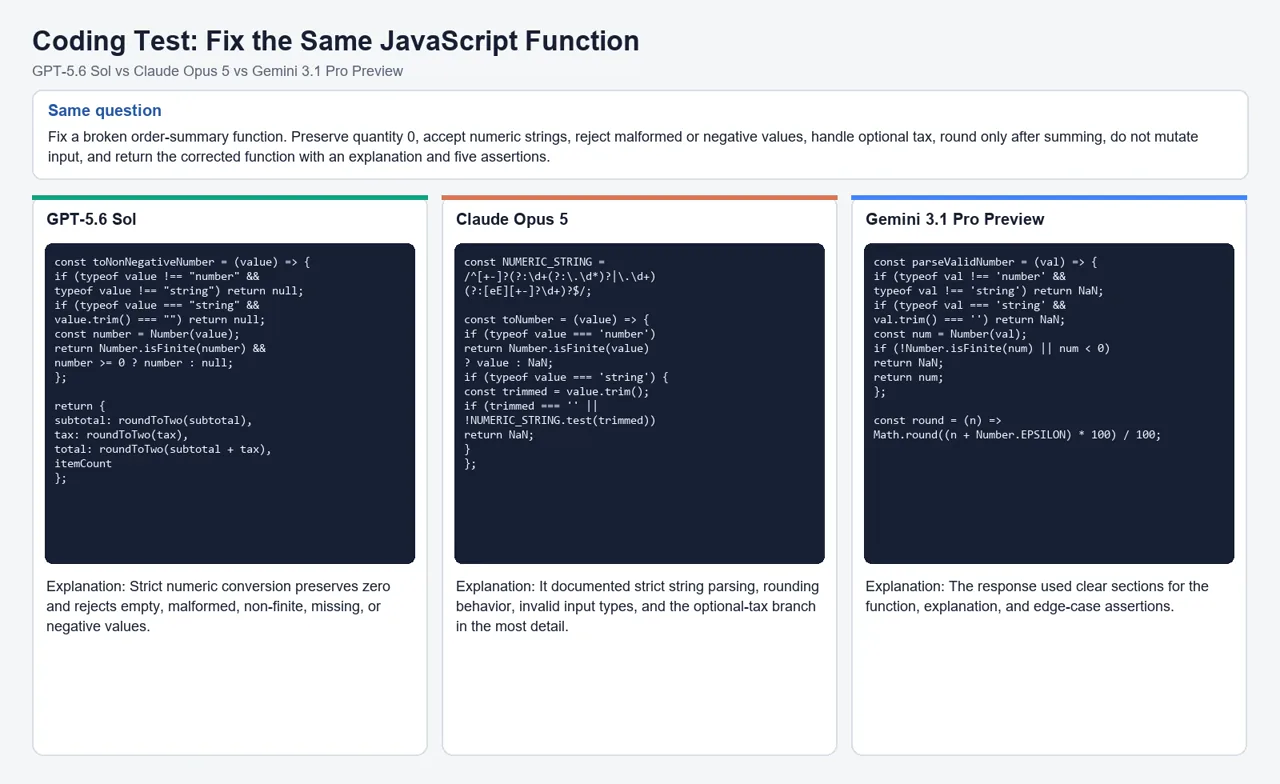
The question: Repair the same JavaScript order-summary function and prove that the edge cases work.
function summarizeOrders(orders, taxRate) {
  // Preserve zero quantities and accept valid numeric strings.
  // Reject malformed, negative, and non-finite values.
  // Handle optional tax, sum before rounding, and do not mutate input.
  // Return the fix with at least five edge-case assertions.
}
| Model | Objective result | What stood out | Best fit from this test |
|---|---|---|---|
| GPT-5.6 Sol | Passed all 8 checks | Most compact complete fix; validation helper was easy to reuse. | Fast copy-and-apply debugging. |
| Claude Opus 5 | Passed all 8 checks | Most detailed treatment of string validation, invalid types, and rounding. | Fixes that must survive careful review. |
| Gemini 3.1 Pro Preview | Passed all 8 checks | Clearest separation of function, explanation, and tests. | Scanning or copying the answer in parts. |
Choose by workflow: GPT for the quickest reusable fix, Claude for the fullest review trail, or Gemini for the clearest section structure.
For work that extends beyond one function, the Codex vs Claude Code comparison examines repository-level tools that can inspect files, run commands, and iterate across a codebase.
Writing test: which model produces the most publishable long-form draft?
The question: Using only a synthetic source pack, write a 1,800–2,200-word decision article for ecommerce operations leaders. Preserve conflicting evidence, distinguish correlation from causation, follow seven fixed headings, include a specified decision summary and framework table, and do not invent missing facts or thresholds.
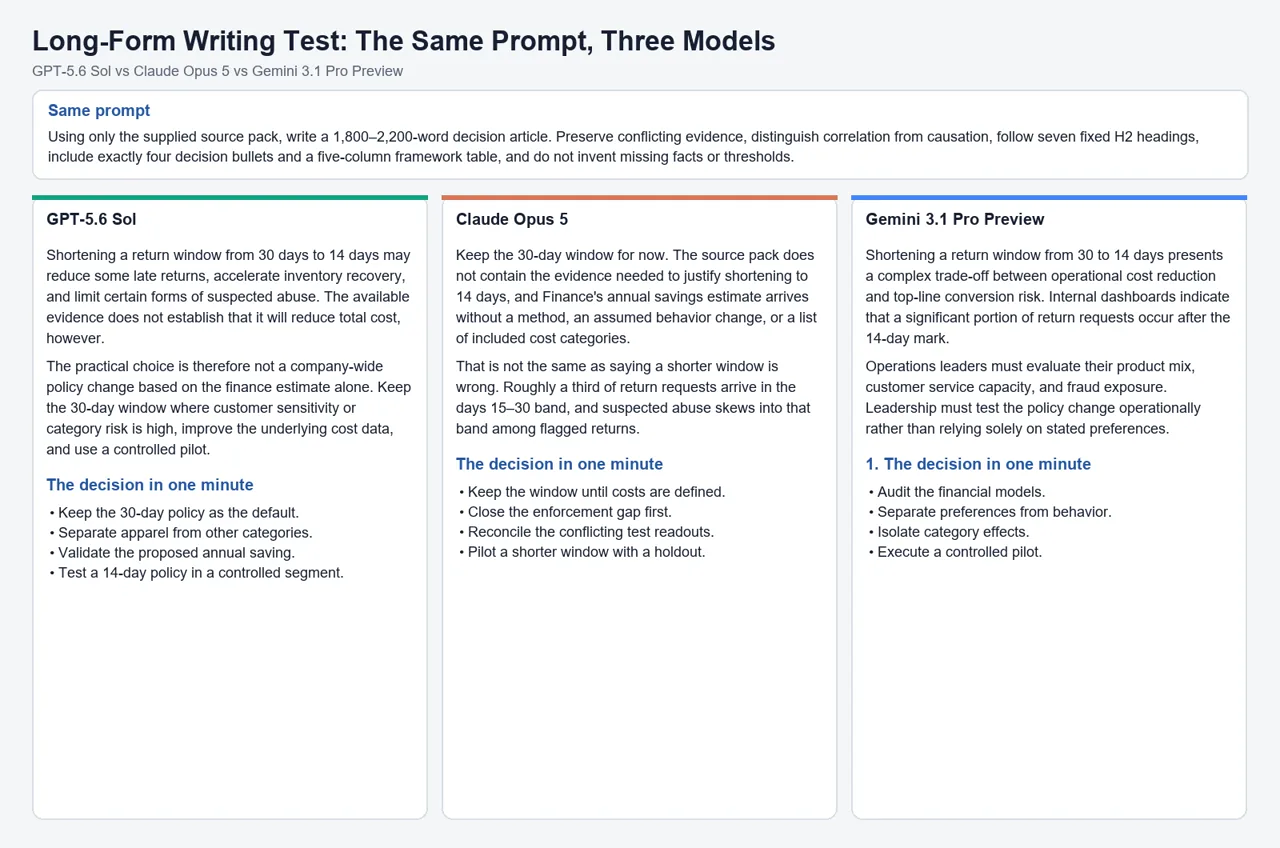
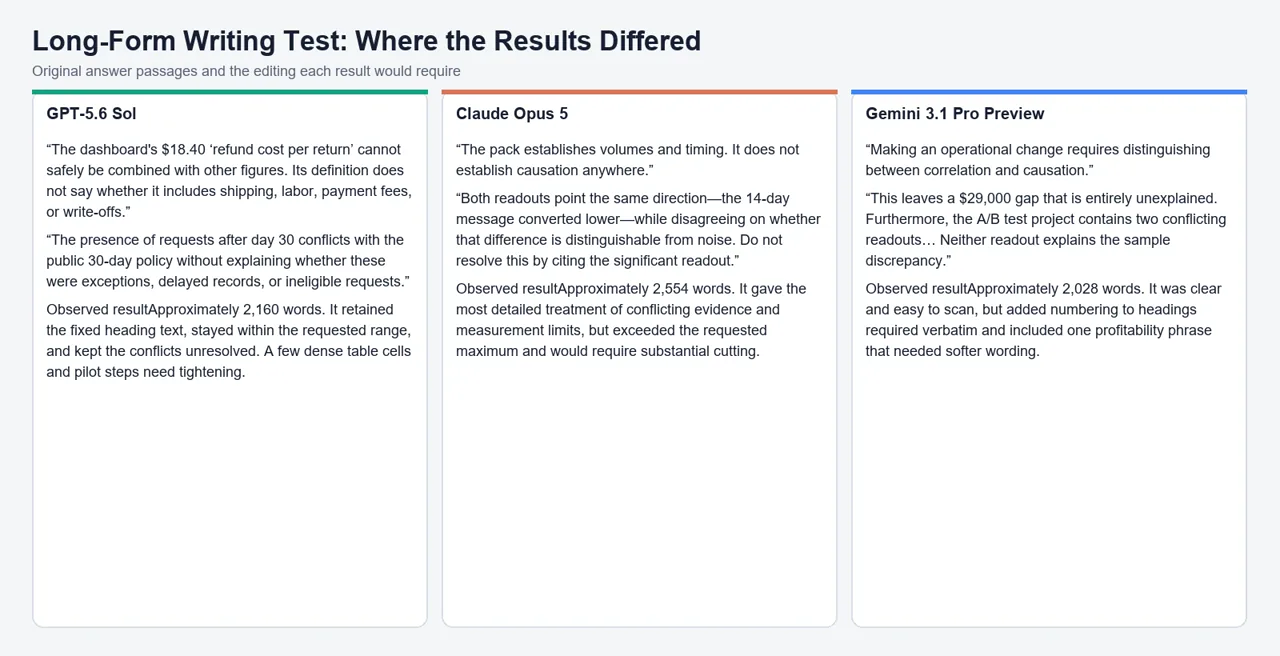
| Model | Length result | Evidence and structure | Main edit needed |
|---|---|---|---|
| GPT-5.6 Sol | About 2,160 words; inside the 1,800–2,200 range | Kept the fixed headings and preserved incompatible evidence. | Reduce sentence and table density. |
| Claude Opus 5 | About 2,554 words; over the limit | Deepest explanation of conflicting figures and measurement periods. | Substantial cutting before publication. |
| Gemini 3.1 Pro Preview | About 2,028 words; inside the range | Clear decision framework, but changed fixed heading text and strengthened one claim beyond the source. | Restore headings and soften the unsupported phrase. |
Choose by editing cost: GPT when the brief must be followed closely, Claude when evidence depth is worth additional cutting, or Gemini when a clear draft can receive a final instruction check.
Research test: which model handles conflicting evidence most carefully?
The question: Decide whether a 45-person software company should buy a team product using a frozen nine-source packet. Check seven claims about model training, data deletion, uptime, security incidents, US-only storage, first-year cost, and SOC 2 coverage. Mark each claim supported, contradicted, or unresolved; identify source conflicts, show the price calculation, state what cannot be concluded, and do not invent missing facts.
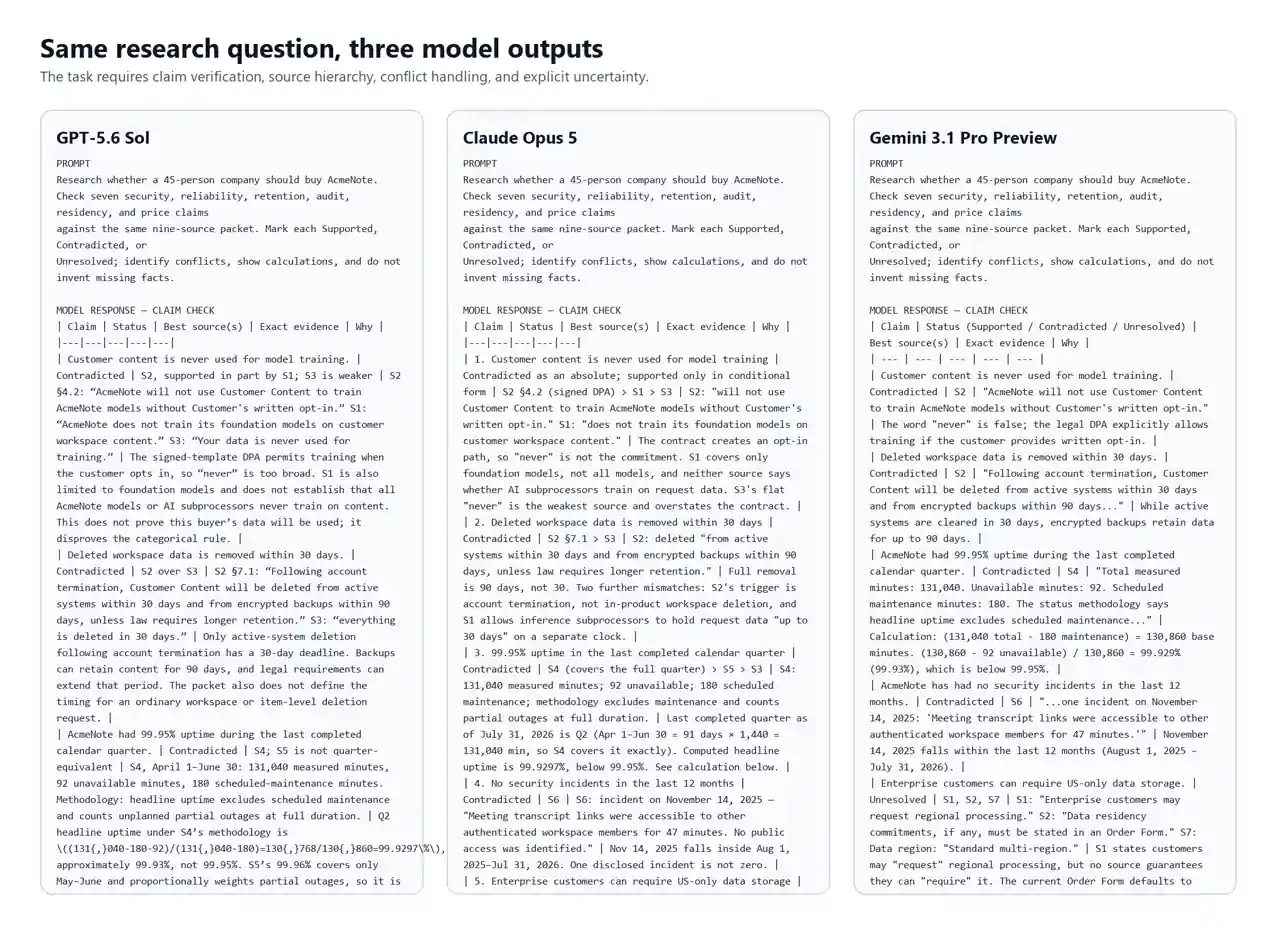
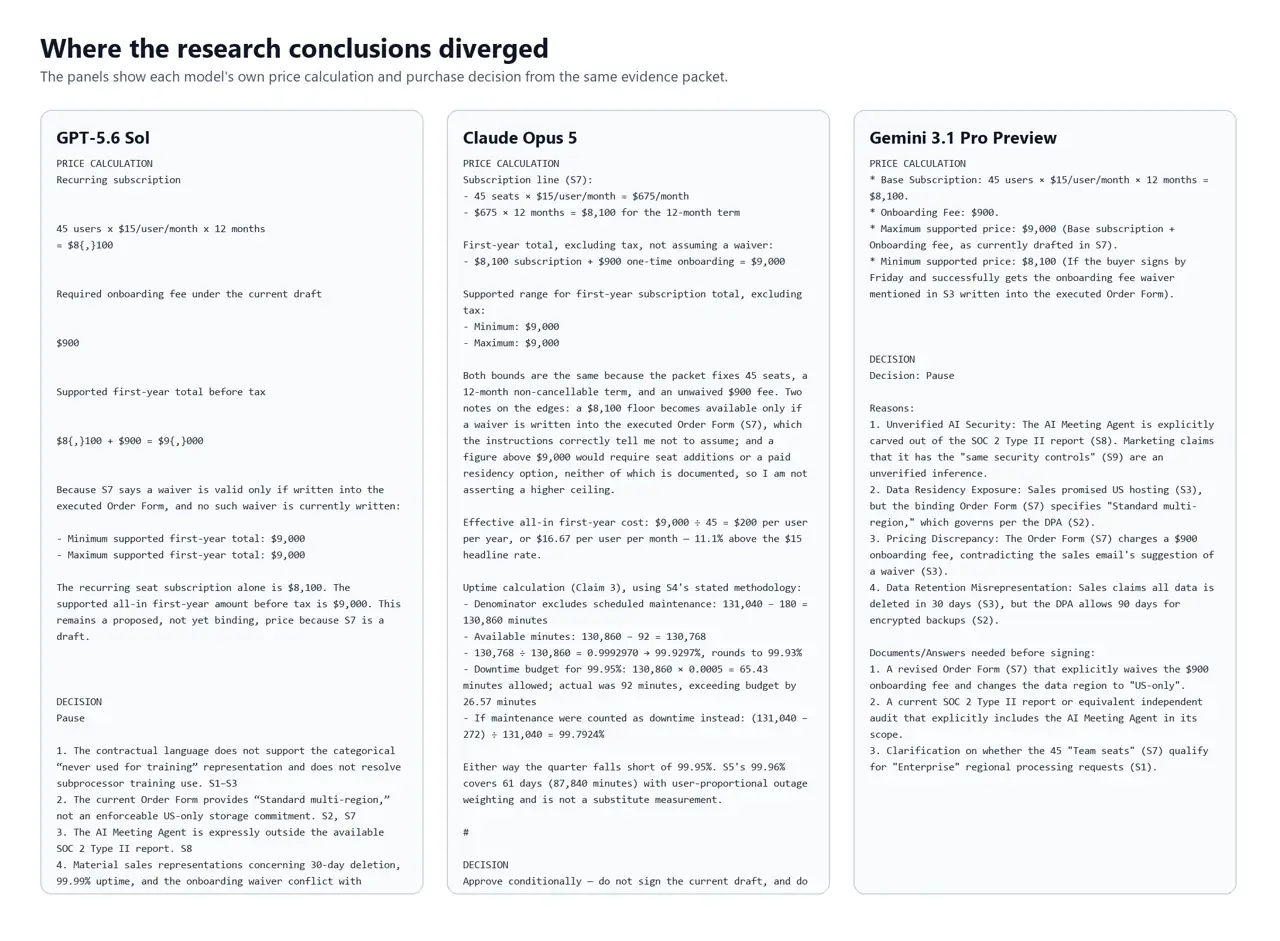
| Model | Shared evidence findings | Price result | Decision |
|---|---|---|---|
| GPT-5.6 Sol | Found the training, deletion, uptime, incident, residency, price, and audit problems. | $9,000 supported first-year total | Pause; direct calculation and verification list. |
| Claude Opus 5 | Found the same issues and added the most definition mismatches and unresolved questions. | $9,000–$9,000 under the no-waiver rule | Approve conditionally; do not sign the current draft. |
| Gemini 3.1 Pro Preview | Found the main conflicts in the shortest response. | $8,100–$9,000; incorrectly allowed a future waiver in the minimum | Pause; fewer follow-up questions. |
Choose by research style: Claude for the most exhaustive source audit, GPT for a direct evidence-to-decision path, or Gemini for a concise first pass that receives a careful calculation check.
Pricing: ChatGPT vs Claude vs Gemini vs GlobalGPT
Pricing depends on what you are actually buying. An official subscription pays for one provider’s app and native ecosystem. API billing pays for usage inside a product you build. GlobalGPT combines supported GPT, Claude, and Gemini access in one workspace, which is the simpler route when you want one account instead of separate provider subscriptions and model URLs.
| Option | Published consumer pricing checked July 31, 2026 | What the plan is best for |
|---|---|---|
| ChatGPT | Free: $0. Plus: $20/month. Features and model access vary by region and rollout; confirm whether GPT-5.6 access, Deep Research, Projects, scheduled tasks, custom GPTs, and Codex usage are included in your account before paying. Pro availability and checkout pricing should also be confirmed live. | The broadest standalone toolkit for people who want research, files, voice, images, Projects, connectors, and coding workflows in one product. |
| Claude | Free: $0. Pro: $17/month when paid annually. Max: from $100/month. | Claude’s native document, Artifact, project, and Claude Code workflows. |
| Gemini | Plus: $4.99/month. Pro: $19.99/month. Ultra: from $99.99/month. | Gemini together with plan-dependent Google storage and Workspace benefits. |
| GlobalGPT | Annual-plan equivalents shown at capture: Basic $5.80/month, Pro $10.80/month, Unlimited $25/month. | Using supported model families from one account without maintaining three separate AI subscriptions. |
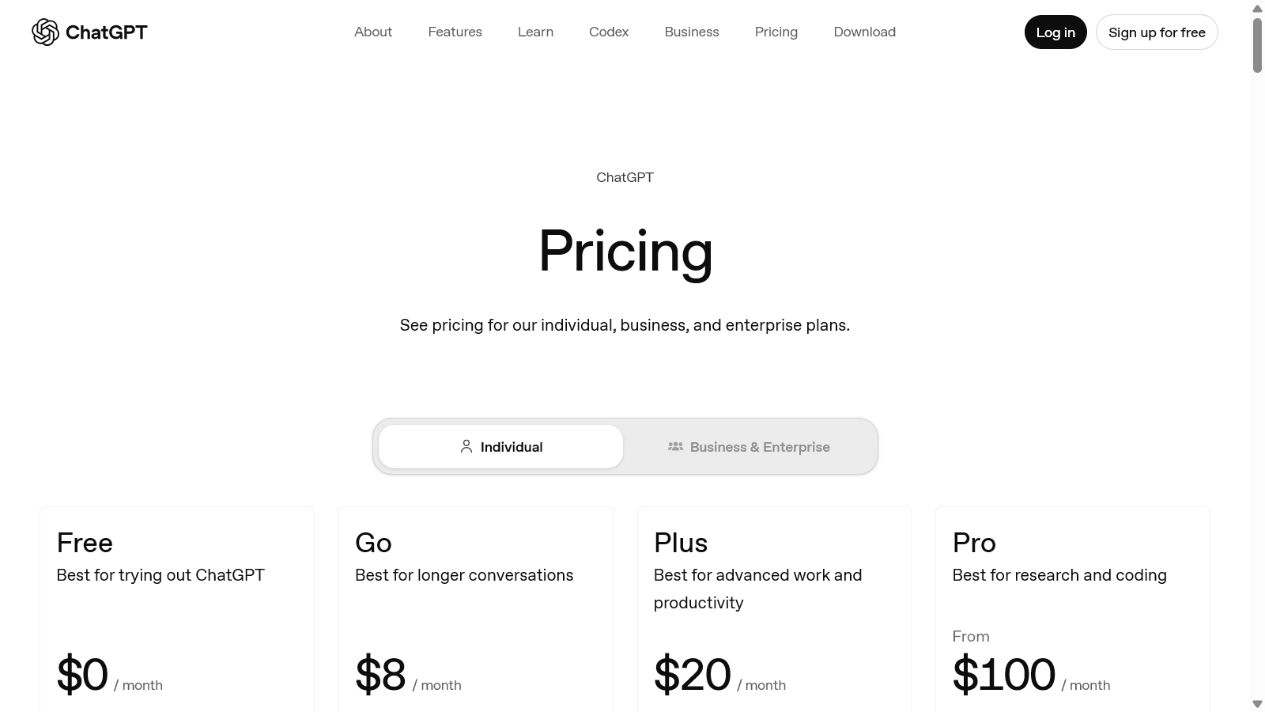
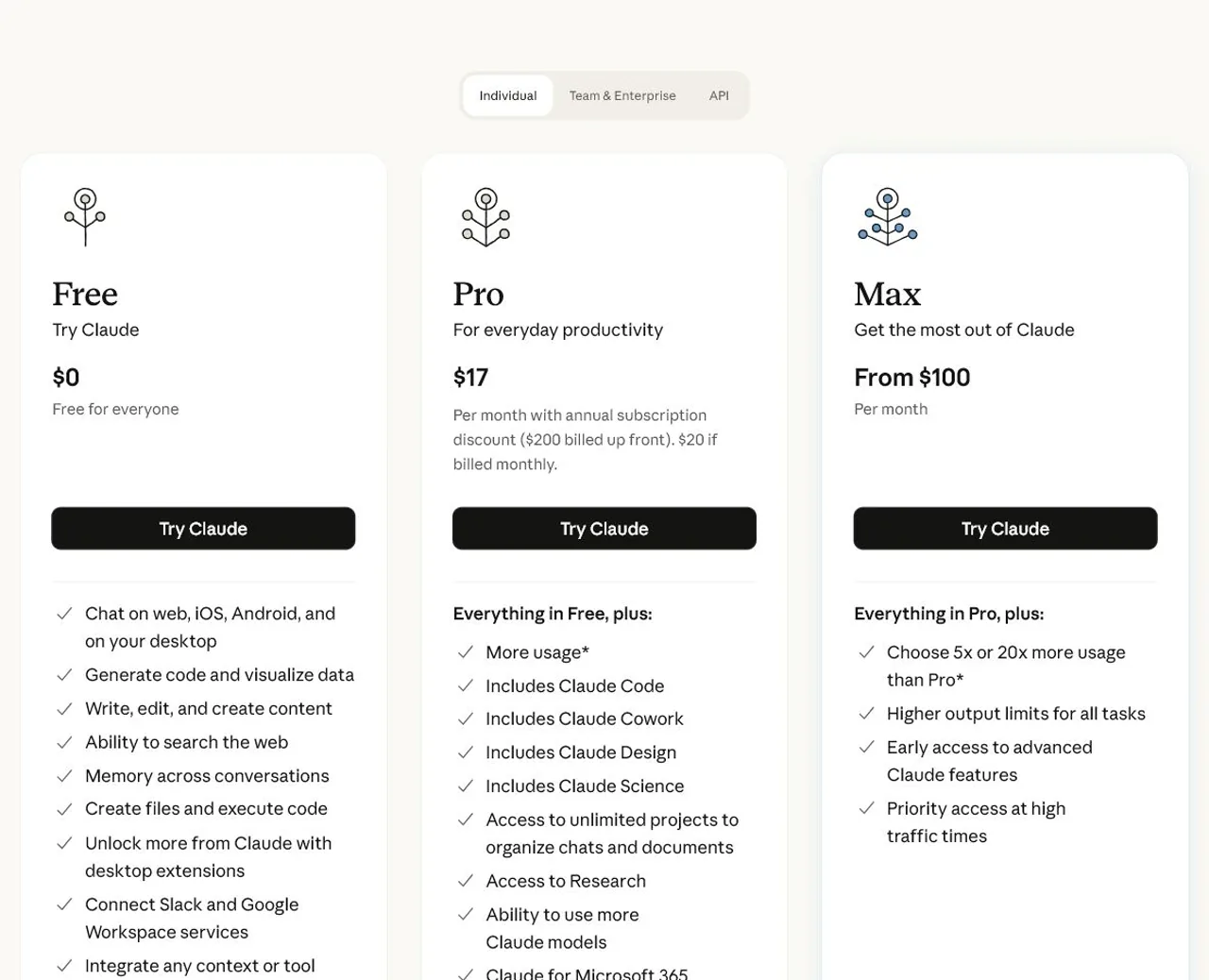
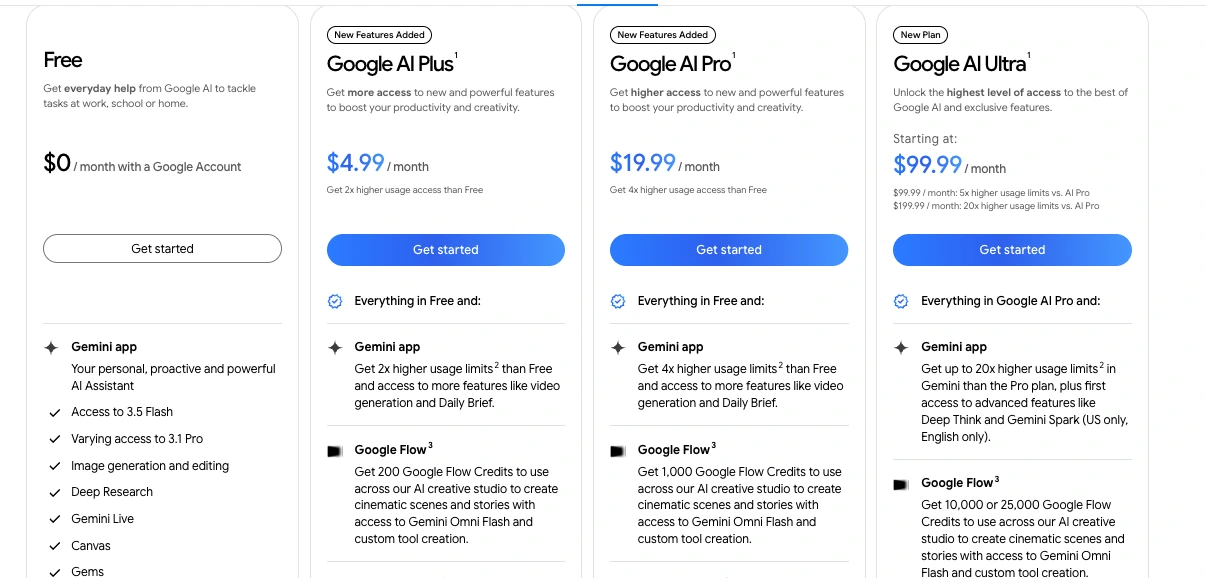
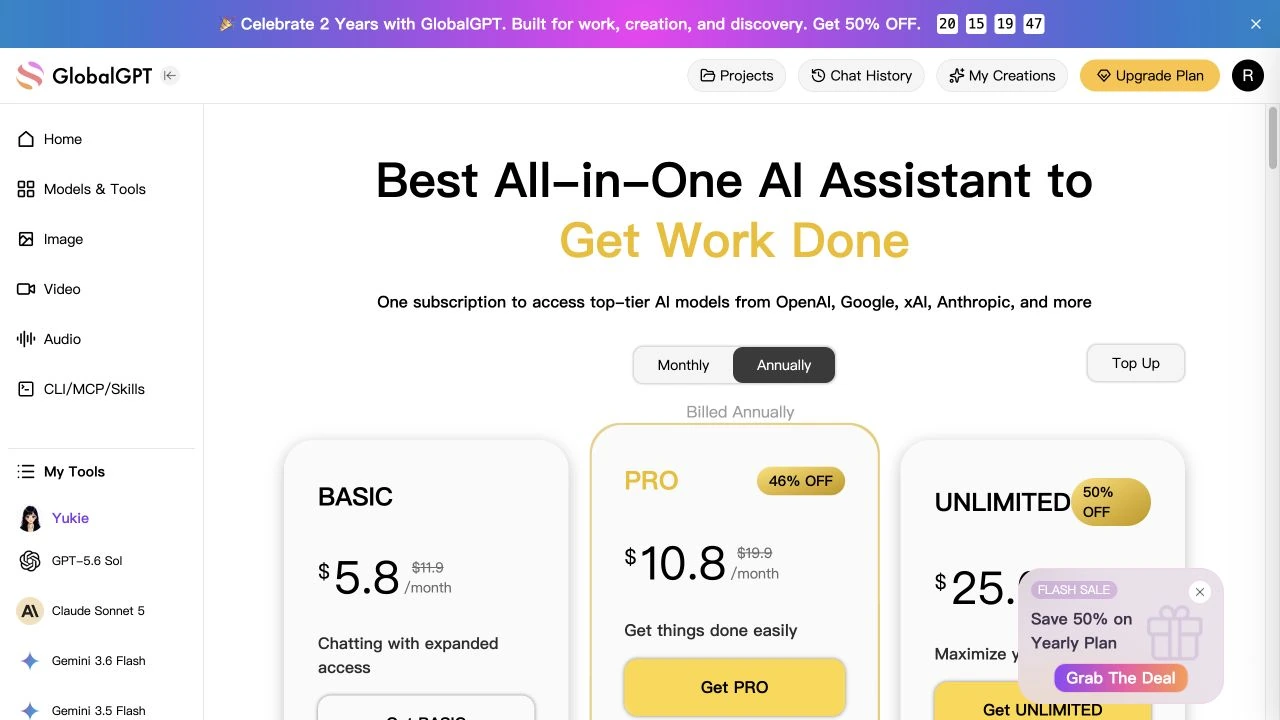
Choose an official plan when a native feature is central to the work: ChatGPT’s full product toolkit, Claude Code, or Gemini inside Google Workspace. Choose GlobalGPT when all-in-one access, one account, and fewer separate subscriptions or provider URLs matter more than a single provider’s native ecosystem. API prices are separate from every consumer subscription and should be compared only for application or automation workloads; see the official ChatGPT pricing page for the current consumer plan cards.
For a closer breakdown, compare the current GPT-5.6 pricing options and Claude AI plans. Context-window claims also belong to the exact model and interface: an API context limit is not the same as a consumer app’s file allowance.
ChatGPT vs Claude vs Gemini for Different Users
Start with the description closest to the work you already do. The surrounding files, tools, colleagues, and delivery format usually matter more than a generic model ranking.
| User | Best starting point | Why |
|---|---|---|
| Students and educators | ChatGPT or Gemini | ChatGPT is a flexible general study partner; Gemini fits courses built around Docs, Drive, Gmail, and NotebookLM |
| Developers | ChatGPT or Claude | ChatGPT handles broad coding help; Claude is attractive when detailed reasoning across a larger code context matters |
| Writers and marketers | ChatGPT or Claude | Choose between format control and deeper treatment of source relationships |
| Analysts and consultants | Claude or ChatGPT | Claude suits source-heavy review; ChatGPT suits concise, mixed-format deliverables |
| Google Workspace teams | Gemini | The path from Gmail and Drive to Docs, Sheets, Search, and Meet is the deciding advantage |
| People who switch by task | A multi-model workflow | The best result may change between coding, writing, research, and planning |
Students and educators
Students who need explanations, essay outlines, document summaries, and coding help will usually find ChatGPT the easiest general study partner. Gemini is appealing when classes already depend on Google Docs, Drive, Gmail, or NotebookLM. Claude is worth comparing when long readings need to become a careful outline without losing relationships between sources.
Developers
Developers who want compact fixes and concise debugging explanations can start with ChatGPT. Claude is a strong fit when edge cases and reasoning must be documented in detail. Gemini is useful when clearly separated code, explanation, and tests—or Google’s development stack—matter. The best AI model for coding comparison covers a wider set of programming decisions.
Writers and marketers
Writers who need a draft to follow a detailed structure with less repair should start with ChatGPT. Claude is useful when evidence depth matters more than strict length, while Gemini works well for a clearly organized first draft that can be checked against the brief afterward.
Analysts and consultants
Analysts working through conflicting evidence may prefer Claude’s detailed treatment of assumptions and measurement limits. Consultants producing a client-ready deliverable on a fixed brief may prefer GPT’s tighter compliance. Gemini is useful when the decision framework needs to be especially easy to scan.
Google Workspace teams
Teams whose work begins in Gmail or Drive and ends in Docs, Sheets, or Meet should start with Gemini. Google’s Workspace AI overview shows the native integration that a text-only model test cannot measure, while the ChatGPT vs Gemini comparison examines the choice without Claude in the middle.
People who switch models by task
People whose preferred model changes between coding, writing, and analysis can run the same material through GPT, Claude, and Gemini in GlobalGPT. The most useful answer is the one that is correct, follows the brief, and requires the least correction for that task.
No model name guarantees privacy or factual accuracy. Data use depends on the product and account type; sensitive company or client work belongs in a plan whose retention, training, access, and administrator controls your organization has reviewed. Accuracy should be checked at the claim level. In these tests, that meant running the code and checking every writing or research claim against the supplied evidence.
Final Verdict: ChatGPT, Claude, or Gemini?
The practical verdict
Choose the product that shortens the whole workflow, not the one that wins the most unrelated claims. Start with ChatGPT for breadth, Claude for careful long-form reasoning, Gemini for Google-centered work, or a multi-model workspace when no single answer stays best across tasks.
- Choose ChatGPT when you want the broadest standalone assistant and a familiar path across writing, files, research, voice, images, and coding help.
- Choose Claude when the central challenge is long, detailed, or conflicting source material and the reasoning must stay easy to inspect.
- Choose Gemini when Gmail, Docs, Drive, Sheets, Search, Android, or NotebookLM already defines the team’s workflow.
- Choose a multi-model workflow when the best answer predictably changes by task and the cost of switching tools is becoming its own problem.
FAQ: ChatGPT vs Claude vs Gemini
Which is better overall: ChatGPT, Claude, or Gemini?
There is no universal winner. ChatGPT is the broadest standalone choice, Claude is especially useful for long and conflicting source material, and Gemini is the natural fit for Google-centered work. Choose by the full workflow around the answer.
Which is best for coding?
Start with ChatGPT for broad, compact coding help and Claude when detailed reasoning across a larger context matters. Gemini is worth considering when multimodal inputs or Google development tools are central. Always run the code and tests instead of trusting the model name.
Which is best for long-form writing?
ChatGPT is a strong default when format and brief compliance matter, while Claude is attractive when source relationships and nuance deserve more space. Gemini fits writing that begins in Google files or needs a clear framework for a Workspace-based team.
Which is best for research synthesis?
Claude is a strong starting point for careful treatment of contradictions, ChatGPT for a direct mixed-source brief, and Gemini for workflows tied to Search, Drive, Docs, or NotebookLM. Verify important claims against the underlying sources.
How much do ChatGPT, Claude, and Gemini cost?
Prices, plan names, included models, billing periods, regions, trials, and usage limits change. Compare the live consumer checkout for each provider on the same date, and keep API pricing separate from consumer subscriptions.
Can I use ChatGPT, Claude, and Gemini in GlobalGPT?
GlobalGPT displayed routes for GPT-5.6 Sol, Claude Opus 5, and Gemini 3.1 Pro during the August 28, 2026 check. Model availability and plan consumption can change, so confirm the live workspace and plan before relying on a specific route.
Should I use more than one AI model?
Use more than one model when the best fit changes by task or when a second answer helps expose omissions. Keep the workflow disciplined: use the same source material, verify claims, and choose the result that needs the least correction.