 Chloe Murphy
Hydrogen
Observed time55.21 sInput tokens4,273Output tokens8,243
Output evaluation
Correct: A+C+D, cost 16, value 31. Also identified A+C+E as the only other feasible portfolio with value at least 30.
We compare Google’s published benchmarks and API prices, then test all three models on identical tasks with verified results, prompts, time and token usage.
Hydrogen has the lowest official token price; Carbon targets the deepest reasoning; Argon balances frontier reasoning and efficiency. All three passed our four completed tasks. The hardest code test exposed formatting and explanation differences rather than a correctness winner.
Google now has three Gemini 4 models with names that tell you very little about which one to choose. Should you start with Hydrogen, use Argon for demanding work, or pay for Carbon's deeper reasoning?
The useful comparison is capability per task: what each model can solve, how much reasoning it uses, and what a completed answer costs. Official benchmark scores give us a starting point; difficult same-prompt tasks are needed to see where those differences matter.
We tested all three models on the same tasks through GlobalGPT. If you want to compare your own workload, start with GlobalGPT and check your account’s current model options and usage terms.
Built for fast everyday coding and agentic execution.
Can run standalone or handle execution alongside deeper reasoning models.
Google-reported index: 51 at high thinking, 54 at xhigh.
Source: Google's Hydrogen announcement.
Google’s highest-capability Gemini 4 reasoning model.
Intended for difficult debugging, scientific research and extended verification.
May use more reasoning tokens than Argon despite equal per-token rates.
Source: Google's Carbon availability announcement.
Efficient frontier reasoning for demanding coding, math and science.
Google positions it as faster and less token-intensive than Carbon.
Its role is a balance between reasoning depth and task cost.
Source: Google's model and pricing documentation.
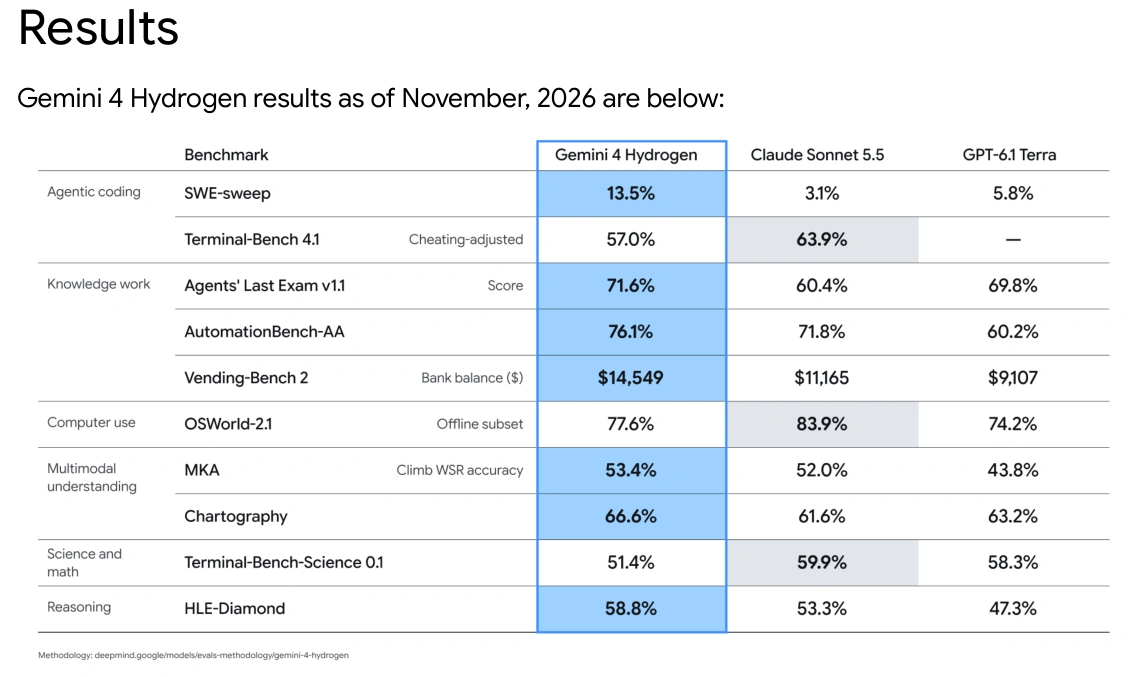
PUBLISHED BENCHMARK · HIGHER IS BETTER
A quick view of the scores Google reported.
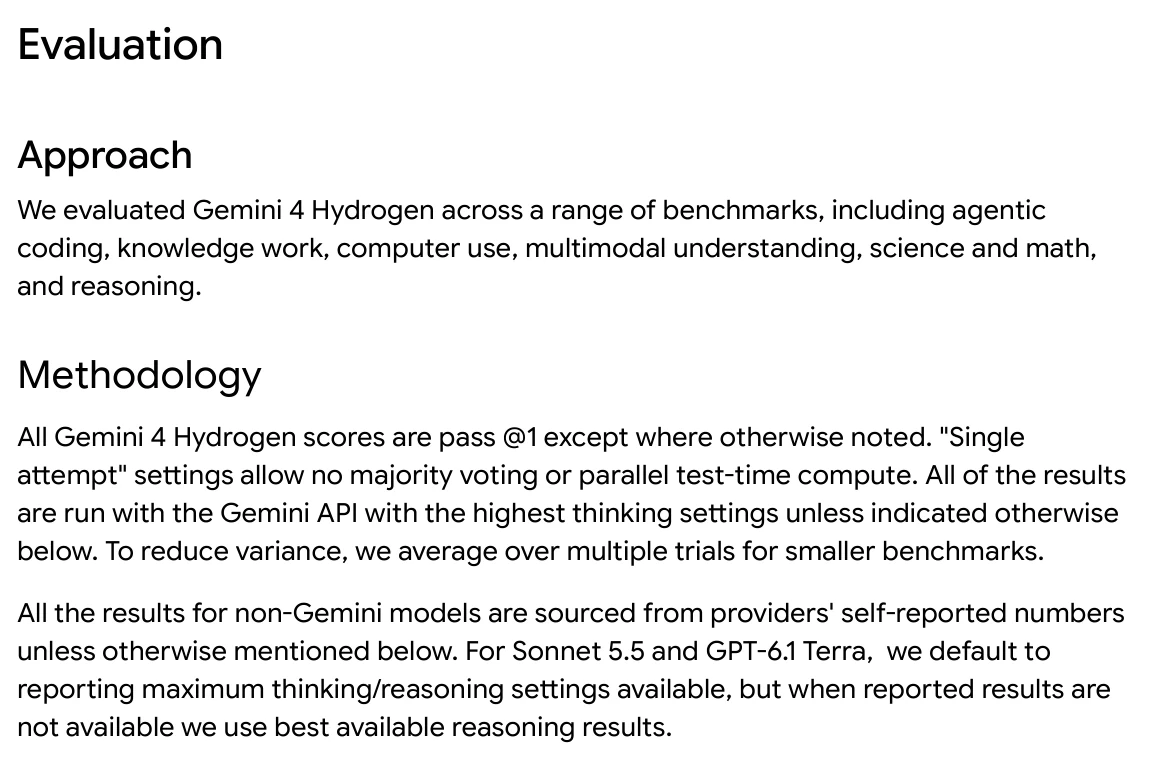
These are Google-reported published results, checked November 15, 2026. They are not scores from our own tests. Carbon's figure comes from its announcement; Hydrogen and Argon figures come from the Hydrogen announcement above. This is a source comparison across announcements, rather than a fresh three-model leaderboard run with independently verified identical settings.
Do not put Terminal-Bench 4.0 and 4.1 figures in one ranked column. A changed evaluation version can change task difficulty, so the percentages would not support a fair head-to-head conclusion.
Standard Gemini API prices in USD per one million tokens, checked November 15, 2026:
STANDARD GEMINI API · USD PER 1M TOKENS
INPUT
OUTPUT · INCLUDING THINKING
INPUT
OUTPUT · INCLUDING THINKING
INPUT
OUTPUT · INCLUDING THINKING
*Hydrogen's current published rates have no December increase specified; this is not a guarantee against future changes. Output billing includes thinking tokens. Search and other tool charges are separate. These are Google's API rates, not GlobalGPT subscription prices or credit conversions.
At fixed token counts, Hydrogen costs 25% less than Carbon or Argon at their introductory rates. Against the announced December rates, that difference becomes 62.5%. Actual task cost also depends on reasoning tokens, retries, and tool use.
For example, 100,000 input tokens and 20,000 billable output tokens cost $0.30 on Hydrogen, $0.40 on Carbon or Argon through November 30, and $0.80 on Carbon or Argon from December 1. This arithmetic excludes tools, caching, batch discounts, and retries; it does not predict how many tokens each model needs.
Hydrogen has a rate-limited free API tier. Carbon and Argon do not. Consumer subscriptions are a separate purchase with their own access rules.
Source: Google API pricing.
We tested Hydrogen, Carbon and Argon on four identical tasks. The first three checked core accuracy; the final task required a complete exact-search program that we ran and checked against an independently calculated answer.
Same input and system instruction for each task.
Fresh requests, with project context disabled and no model tool use.
Correctness, output format, time and token use evaluated separately.
TEST 1 · ACCURACY BASELINE
Select the optimal portfolio and identify every qualifying alternative.
Solve exactly, showing verifiable arithmetic and a proof of optimality. Six indivisible projects have (cost, value): A(7,13), B(6,12), C(5,10), D(4,8), E(3,7), F(2,4). Budget=16. C requires A. D and E cannot both be selected. B requires at least one of D or F. Select projects maximizing total value; break ties by lower cost then alphabetically sorted project-list. Give chosen list, cost, value and enumerate all feasible candidates with value at least 30. No external tools or web.
Correct: A+C+D, cost 16, value 31. Also identified A+C+E as the only other feasible portfolio with value at least 30.
Correct: A+C+D, cost 16, value 31. Also identified A+C+E as the only other feasible portfolio with value at least 30.
Correct: A+C+D, cost 16, value 31. Also identified A+C+E as the only other feasible portfolio with value at least 30.
Task verdict: All three passed the core answer checks.
TEST 2 · ACCURACY BASELINE
Separate aggregate conversion from device-level effects and standardized lift.
Analyze a randomized experiment using only these counts. Variant A: mobile 90 purchases/900 visitors; desktop 80/100. Variant B: mobile 20/100; desktop 630/900. Show overall and device-specific conversion rates, absolute lifts B-A, and a standardized B-A lift using 50% mobile/50% desktop. Explain the reversal, distinguish observational aggregate from randomized causal interpretation, and state exactly what randomization details are missing. May we claim B wins overall and in both devices? Do not invent significance or revenue. No external tools or web.
Correct: B leads by 48 percentage points overall, but loses 10 points on desktop. A common 50/50 device mix gives zero lift. Rejected a win in both segments.
Correct: B leads by 48 percentage points overall, but loses 10 points on desktop. A common 50/50 device mix gives zero lift. Rejected a win in both segments.
Correct: B leads by 48 percentage points overall, but loses 10 points on desktop. A common 50/50 device mix gives zero lift. Rejected a win in both segments.
Task verdict: All three passed the core answer checks.
TEST 3 · ACCURACY BASELINE
Apply revisions, voids and refunds correctly, then return strict JSON.
Return valid JSON only, no Markdown. Reconcile event ledger by event_id: retain highest revision, then exclude void=true. Amounts are integer cents; refund amounts subtract from captured revenue even when received before capture; group by order_id; ignore pending. Ledger: [e1,r1,o1,capture,1000,false];[e1,r2,o1,capture,1200,false];[e2,r1,o1,refund,200,false];[e3,r1,o2,refund,300,false];[e4,r1,o2,capture,2000,false];[e5,r1,o3,capture,500,false];[e5,r2,o3,capture,500,true];[e6,r1,o3,pending,900,false];[e7,r1,o4,capture,700,false];[e8,r1,o4,refund,800,false];[e8,r2,o4,refund,600,false];[e9,r1,o2,refund,100,false]. Output keys orders (array sorted by order_id with order_id,net_cents,retained_event_ids sorted lexically), total_net_cents, excluded_event_ids (superseded event versions written as event_id:rN plus void and pending versions). Include o3 with zero net. No external tools or web.
Correct: order totals of 1,000, 1,600, 0 and 100 cents; total 2,700 cents. Raw output parsed as JSON with no cleanup.
Correct: order totals of 1,000, 1,600, 0 and 100 cents; total 2,700 cents. Raw output parsed as JSON with no cleanup.
Correct: order totals of 1,000, 1,600, 0 and 100 cents; total 2,700 cents. Raw output parsed as JSON with no cleanup.
Task verdict: All three passed the core answer checks.
TEST 4 · HARD CODING TASK
Generate executable Python for a constrained search; we ran every program against an independent exhaustive reference.
Find the EXACT top 5 feasible portfolios, ranked by highest total value, then lowest total cost, then lexicographic sorted ID string. Items (ID,cost,value): [('A', 9, 19), ('B', 7, 16), ('C', 11, 25), ('D', 6, 13), ('E', 8, 18), ('F', 5, 12), ('G', 10, 23), ('H', 4, 9), ('I', 12, 29), ('J', 3, 8), ('K', 7, 17), ('L', 6, 15), ('M', 9, 22), ('N', 5, 11), ('O', 8, 20), ('P', 4, 10), ('Q', 11, 27), ('R', 2, 5)]. Budget 55; choose between 6 and 9 items inclusive. Dependencies: C requires A; G requires B and D; I requires E; M requires F and H; Q requires J and K. Mutually exclusive pairs: (A,B),(E,F),(L,N),(O,Q). At least 2 of C,G,I,M,Q. Exactly 2 of D,H,L,P. At least one of B,F,J,N,R. If O is selected then P is selected and K is absent. If R is selected then exactly one of A,E is selected. Return ONLY executable Python 3 code, at most 120 lines. Implement an exact exhaustive search, print JSON with keys feasible_count and top5 (each row [sorted_ID_string,cost,value]). Do NOT manually calculate or hardcode the answer. State complexity in a code comment. Use only itertools and json; no filesystem, network, subprocess or other imports. The code will be executed and checked against an independent exhaustive reference.Passed: executable code returned 121 feasible portfolios and the correct top five. Included the correct combination count and a fuller complexity explanation.
Passed: executable code returned 121 feasible portfolios and the correct top five. Combination count was correct; the complexity note omitted the final sorting term.
Passed after removing a Markdown fence: code returned 121 feasible portfolios and the correct top five. The comment claimed 115,379 combinations instead of 142,766, and omitted sorting in its complexity note.
Task verdict: Functional correctness tied. Hydrogen gave the cleanest combination of executable formatting and explanation in this run.
Times are single-run end-to-end observations including network and queue time, with requests run concurrently. Tokens are reported input/output usage and may include reasoning or request-wrapper tokens; they are not dollar charges. A separate direct-answer attempt hit rate limits or a local timeout and was excluded from quality scoring. The coding task above used a new matched prompt.
Start with Hydrogen when its lower official token rates fit your workload. Keep Argon in your comparison if you value efficient frontier reasoning: it solved our exact-search coding task correctly after formatting cleanup. Evaluate Carbon on work that needs deeper exploration; this test set did not demonstrate a correctness advantage that would justify choosing it by default. Check the displayed platform charge separately from Google API rates.
Hydrogen has the lowest listed standard API rates: $1.50 per million input tokens and $7.50 per million output tokens, checked November 15, 2026.
Their listed standard token rates are equal. Carbon can still cost more per task if it uses more reasoning tokens or verification steps.
No. Check the benchmark version and thinking setting, then test the model on representative tasks with independently verifiable answers.
We ran each generated Python solver and compared its feasible count and top five portfolios against an independent exhaustive-search reference.
Our Argon access guide explains the differences between platform access, Google subscriptions, AI Studio and API billing.
For access details, read how to use Gemini 4 Argon. To compare models in one account, start with GlobalGPT and check the selected model and displayed usage terms.