Claude Fable 5.2 vs Opus 5.5: Coding, Cost & Which to Use
Five same-prompt tasks compare Claude Fable 5.2 and Opus 5.5 on research, AI interface design, writing, data, and product planning, with original screenshots and recorded time and token use.
 Chloe Murphy
Opus 5.5 is the sensible starting point for routine work; test Fable 5.2 when a specific task still needs improvement. In our four completed text-task pairs, both models got the core research calculation and data metrics right. Fable’s product plan handled one uncertainty more carefully; both writing outputs met the main constraints.
The design comparison uses a fresh 32,768-token matched run. Its screenshots, interaction checks, and limitations appear in the design task below.
Fable 5.2 is newer and costs more per token. But does it give you a better result—or simply a bigger bill? We compared research, AI interface design, writing, data analysis, and product decisions using the same task brief for each model.
If you prefer comparing models without managing separate API setups, GlobalGPT offers a multi-model workspace. The API tests here do not establish Fable 5.2 availability inside GlobalGPT.
The practical comparison
| Decision | Fable 5.2 | Opus 5.5 |
|---|---|---|
| Standard input / output per million tokens | $8 / $40 | $4 / $20 |
| Research test | Correct calculation; causal wording needed editing | Correct calculation; unsupported study-design detail |
| Content test | 180-word explainer; shorter voiceover | 180-word explainer; fuller example |
| Data test | All requested metrics correct | All requested metrics correct |
| Product test | Careful distinction between confirmed and possible harm | Useful plan; unsupported claim of lost work |
| Original design attempt | No artifact: HTTP failure | Complete HTML after fence cleanup |
How we tested the two models
Each task used identical source material, a fresh conversation, and the same output allowance for both models. The text tasks used a 16,000-token ceiling; the final design run used 32,768. Prompts, settings, time, and usage appear with the corresponding task below.
All studies, products, order data, and feedback in the briefs were fictional test fixtures. We checked calculations against a prepared answer key. Reasoning effort remained at the platform default, so this is not an equal-effort benchmark. The third-party gateway’s returned model labels do not independently establish upstream routing.
Researcher: synthesis without overstating the evidence
Same prompt · Researcher test
You are a researcher. Use only these FICTIONAL study summaries about an AI writing assistant. A: randomized 120 adults, 60 per arm, intervention mean score baseline70 followup78, control baseline69 followup74, four weeks; no standard deviations, uncertainty intervals, or attrition information reported. B: observational 300 adults, usage correlated with writing scores r=.32, no confounder adjustment. C: interviews with12 users reporting perceived improvement. In under650 words synthesize evidence with A/B/C citations, calculate difference in changes, explain what cannot be inferred, and propose a feasible preregistered followup study with primary endpoint and analysis. Do not invent citations or statistical significance.
The researcher task asked for a synthesis of three fictional studies, including a randomized trial with incomplete reporting. The essential calculation was (78 − 70) − (74 − 69) = 3 points. Both models got it right and declined to invent statistical significance.
Fable 5.2
Proposed a blinded, unassisted writing assessment, intention-to-treat analysis, and missing-data sensitivity checks. It also supplied an explicitly hypothetical sample-size example.
“Only the 3-point difference is attributable to the assistant”
That wording was too confident given unknown attrition and reporting gaps, even though later paragraphs qualified the estimate. It also speculated that interview participants were probably self-selected.
Opus 5.5
Separated randomized, observational, and interview evidence clearly. It proposed a baseline-adjusted trial and kept the sample-size calculation dependent on pilot variability.
“cross-sectional in nature as described”
The supplied observational summary did not specify a cross-sectional design. That detail should have remained unknown.
If you adapt this brief, keep the evidence fixed and ask each model to separate reported facts from inference. Our Claude prompts for research and coding offer more examples of task-specific constraints.
Designer: an AI multi-model workspace
Same prompt · Designer test
You are a product designer and frontend builder. Return only one complete self-contained HTML file with inline CSS and JavaScript, no external assets/CDNs. Build a polished AI multi-model workspace called Parallel. Give it a distinctive cohesive visual identity with excellent typography, whitespace, hierarchy and responsive layout; choose your own palette. Include sidebar, model A/B selectors, prompt textarea, compare button, two side-by-side result cards, loading state, clear button, per-result copy button, empty-input validation, keyboard-accessible controls and mobile stacking. Models A/B are FICTIONAL; all outputs must be locally simulated and explicitly labeled demo. No real API calls or fake live performance metrics. Compare must work repeatedly and preserve the submitted prompt in both outputs. Copy must report success only after actual success, otherwise provide an error. Aim for a complete compact artifact, not an explanation.
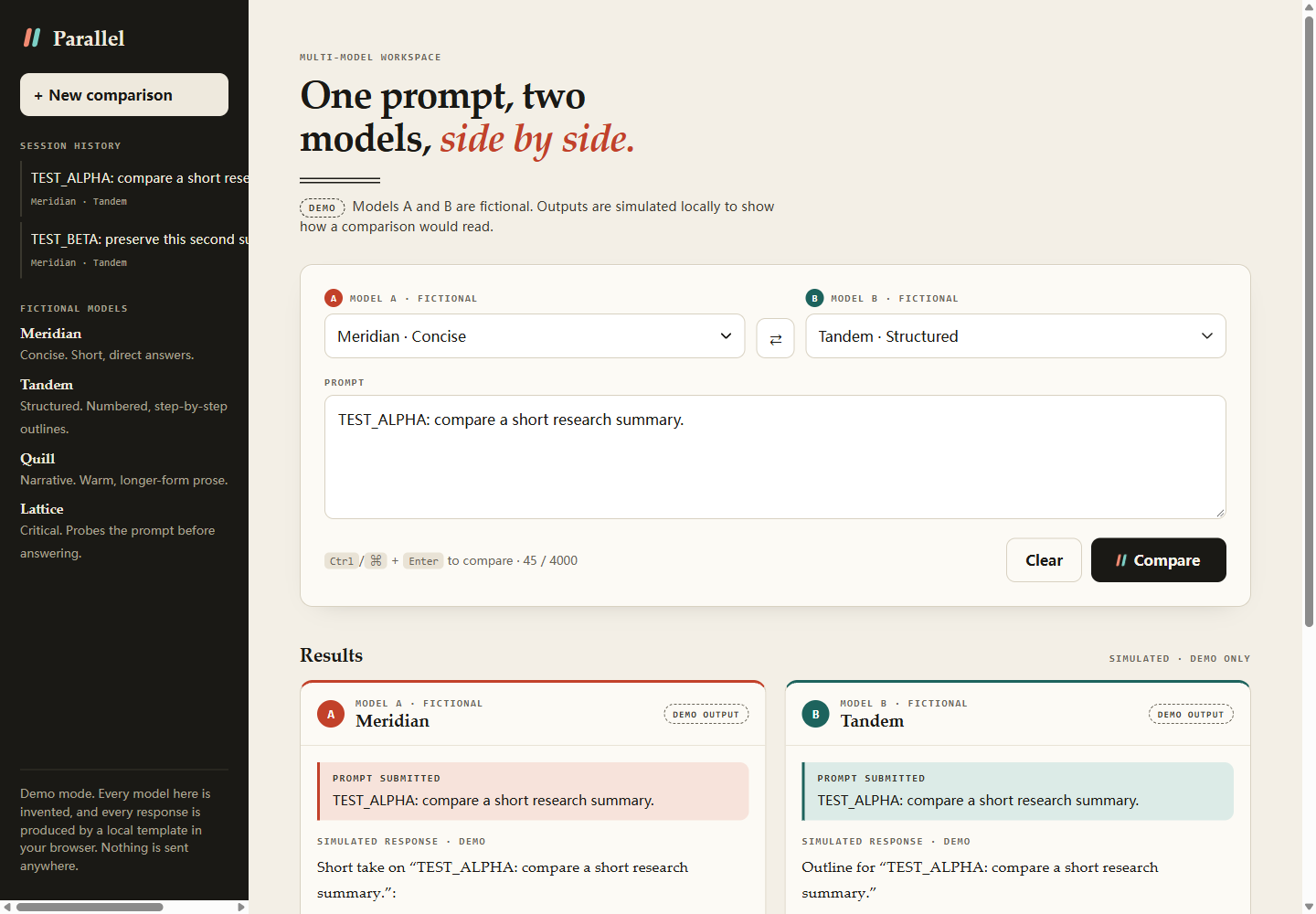
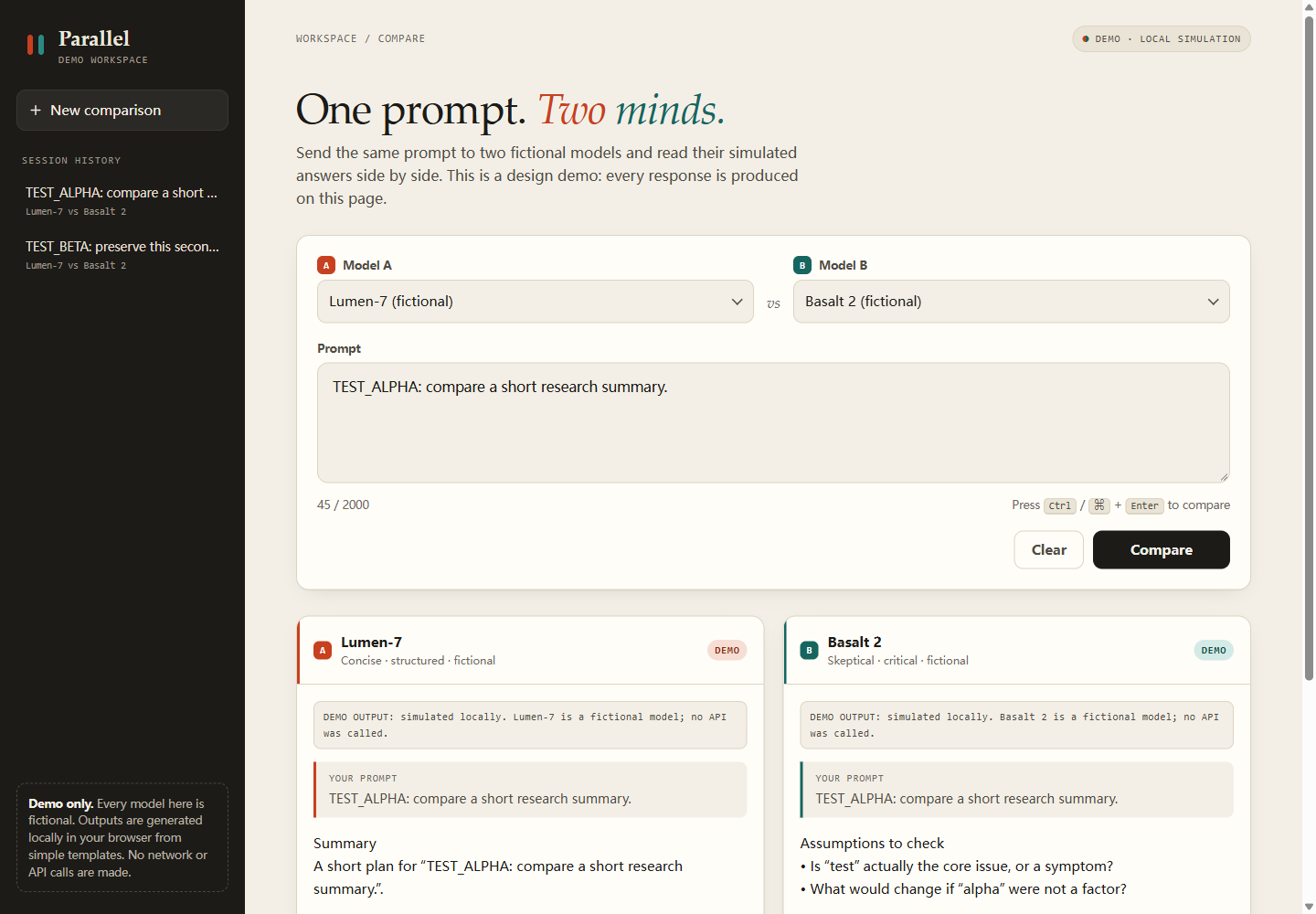
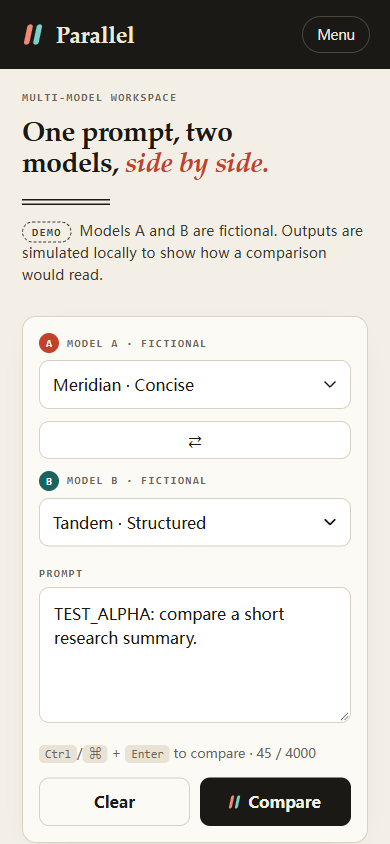
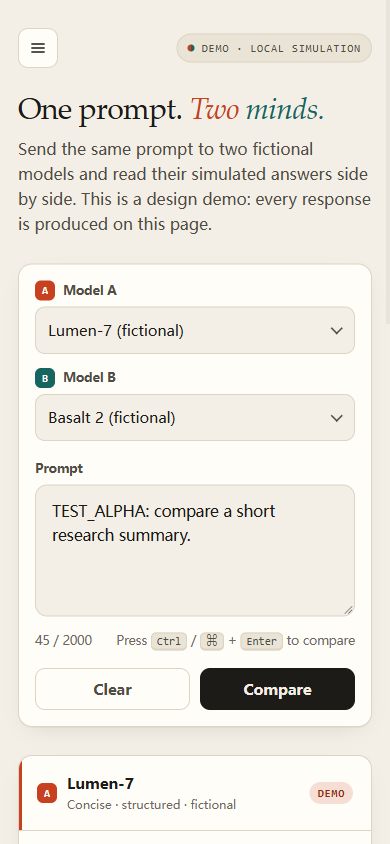
The designer brief asked both models to build Parallel: a self-contained AI comparison workspace with a sidebar, model selectors, prompt input, simulated result cards, validation, copy controls, and a mobile layout. We left the color palette and visual identity open.
The final matched run used the same prompt, streaming transport, and a shared 32,768-token ceiling. Both responses reached a normal stop. The source artifacts remain unedited; saving HTML removes only an enclosing Markdown fence when present.
What the rendered pages actually looked like
Fable 5.2 sample
A heavier serif headline, italic red emphasis, and a high-contrast sidebar give this page a stronger editorial identity. Its model-swap control is a useful extra, but it occupies a full row on mobile and pushes the prompt and results farther down.
Opus 5.5 sample
The lighter headline and simpler model-selection area feel more restrained. At the same mobile viewport, the Compare button ends around 710 pixels from the top, versus 826 pixels in the Fable sample, leaving room for the first result card to appear sooner.
Both chose warm paper tones, dark sidebars, and serif headings. The difference here is hierarchy and density, not a completely different design language. For this particular workspace, we prefer the Opus sample’s compact layout. If the priority is a more prominent editorial headline, the Fable sample has that appeal. This is a subjective preference between these returned artifacts, not a general aesthetic ranking of the underlying models.
Browser checks: appearance and behavior separately
| Check | Fable sample | Opus sample |
|---|---|---|
| Empty-input validation | Passed | Passed |
| Repeated comparisons preserve submitted prompt | Passed | Passed |
| Visible loading feedback | Passed | Passed |
| Clear input | Passed | Passed |
| Page overflow at 390-pixel width | None measured | None measured |
| Copy failure reports an error honestly | Passed | Passed |
| Successful clipboard copy | Not verified | Not verified |
We opened the unedited outputs in Chrome and used DOM controls to run the checks. Desktop screenshots use 1440 × 1000; mobile screenshots use 390 × 844. All four show the same submitted prompt after comparison and before the copy check. No runtime exceptions were captured during these steps. Clipboard writes did not succeed in the automated session, and a complete keyboard-only traversal was not tested.
The final design pair’s usage gives a standard-rate proxy of $0.8826 for Fable and $0.2918 for Opus. This uses provider rates and gateway-reported tokens, excludes earlier attempts, and is not the gateway’s actual bill.
Earlier attempts and evidence limits
Content creator: accurate copy in two formats
Same prompt · Content creator test
You are a content creator. Based ONLY on these FICTIONAL product facts, write a180-word plain-English explainer and a45-second video script with timestamps, then a five-item fact-check checklist. Facts: Lumen is a fictional AI workspace; it lets users compare two AI text drafts side by side, save prompts locally in their browser, and manually copy a chosen result. It does not publish content automatically, browse the web, or verify facts. No prices, launch dates, speed metrics, supported model names, or privacy guarantees are provided. Audience: freelancers who struggle to choose a usable first draft. Explain a practical example, avoid hype and invented claims, and distinguish local prompt saving from an unproven no-training guarantee.
The creator brief supplied a fictional workspace with only three features: side-by-side draft comparison, local prompt saving, and manual copying. It asked for a 180-word explainer, a 45-second script, and a five-item fact-check checklist.
Both explainers met the 180-word requirement under our word-count rule, which keeps internal apostrophes and hyphens within a word. Both preserved the feature limits and correctly avoided treating local storage as a no-training guarantee.
Fable 5.2
Opened with the freelancer’s difficulty choosing a draft, then explained the three features in short sentences. Its video voiceover contained 101 words: about 135 words per minute if delivered in 45 seconds.
Opus 5.5
Used a more detailed copywriter example, contrasting a stronger opening with clearer feature explanations. Its voiceover contained 109 words: about 145 words per minute over the same slot.
Those pacing estimates come from the written voiceover, not a timed recording. Fable leaves more room for pauses; Opus uses more of the slot to explain the example.
For longer articles, our guide to using Claude for long-form writing covers how to separate drafting from verification and editing.
Data analyst: refunds, missing attribution, and ROAS
Same prompt · Data analyst test
You are a data analyst. Use only this synthetic data. Orders CSV(order_id,updated,status,channel,amount): o1,1,paid,Search,100; o2,1,paid,Social,80; o2,2,refunded,Social,80; o3,1,paid,Search,120; o4,1,pending,Email,60; o5,1,paid,,50; o6,1,paid,Partner,90; o7,1,paid,Email,70; o8,1,paid,Social,60; o9,1,paid,Partner,110. Channel spend/clicks: Search200/100; Social100/80; Email50/40; Partner0/20. Deduplicate by order_id keeping greatest updated. Paid orders count and revenue use latest paid only; refunded/pending contribute zero. Blank channel must remain Unknown and cannot inherit spend/clicks. Calculate overall paid count, revenue, each channel paid count/revenue/conversion rate per click/ROAS, and measurable ROAS ranking; zero or missing denominator is N/A. Show arithmetic and propose a cautious next-budget decision without inferring causality. Return table and explanation under600 words.
The analyst task was designed to catch errors that a neat table can hide: duplicate order IDs, a later refund, a pending order, an unknown channel, and a zero-spend partner channel.
Both models matched the prepared answer key: 7 paid orders and 600 in revenue after keeping the latest order status. They excluded the refunded and pending records, kept missing attribution under Unknown, and marked undefined ratios as N/A.
| Channel | Paid orders | Revenue | Conversion / click | ROAS |
|---|---|---|---|---|
| Search | 2 | 220 | 2.00% | 1.10 |
| Social | 1 | 60 | 1.25% | 0.60 |
| 1 | 70 | 2.50% | 1.40 | |
| Partner | 2 | 200 | 10.00% | N/A: zero spend |
| Unknown | 1 | 50 | N/A | N/A |
Fable showed the revenue arithmetic inside the channel table and suggested checking the refund, pending order, missing tag, and unrecorded partner costs before changing much. Opus added a record-by-record deduplication table and calculated that unattributed revenue was 8.3% of the total.
Both recommended a bounded budget test rather than treating observed ROAS as causal proof. Opus’s aside that one extra Social sale would roughly double ROAS assumes a similar order amount; it was not a new fact in the input.
Product manager: harm before feature votes
Same prompt · Product manager test
You are a product manager for a FICTIONAL AI subscription workspace. Feedback: 2 users report duplicate charges after retrying checkout; billing logs confirm one duplicate captured charge. 30 users request dark mode. 8 report one model unavailable and no warning before using a prompt; outage reproduced. 1 requests account/data deletion; request pending for20 days, governing deadline unknown. 12 request reusable saved prompts. 4 want team seats; no revenue commitment. Two engineers available for one week; effort estimates unknown. Produce a one-week priority plan with rationale, explicit unknowns, scope boundaries, owner roles, acceptance criteria, instrumentation and rollback/containment steps. Do not fabricate legal deadlines, revenue, effort or certainty. Distinguish immediate containment from permanent fixes; do not rank purely by vote count. Under700 words.
The product brief paired a confirmed duplicate charge with an overdue-to-the-user deletion request, a reproduced model outage, and more popular feature requests. The trap was to prioritize 30 dark-mode votes over demonstrated harm.
Both models put billing, deletion follow-up, and outage containment ahead of feature building. Neither invented a legal deadline for deletion. Both assigned owner roles, separated immediate containment from permanent fixes, and proposed acceptance checks and monitoring.
Fable 5.2
Specified refund reconciliation, a repeat-charge prevention fix, and manual outage containment. It explicitly treated possible quota loss as something to confirm and flagged deletion as irreversible.
Opus 5.5
Added a pre-submit warning, prompt preservation, and an explicit rule against silently switching models. Its prioritization table was quick to scan.
However, it said users “lose work and prompts silently.” The supplied feedback established an outage and missing warning, not proven prompt loss.
Fable 5.2 vs Opus 5.5 pricing
For standard API requests, Fable 5.2 costs twice as much per token as Opus 5.5. That makes Opus the cheaper starting point when both models deliver an acceptable result with similar token use.
Input / output
Input / output
These are Anthropic’s standard input/output rates, checked November 11, 2026, from the Fable specification.
The Opus specification lists the corresponding standard rate. Fast mode, caching, batch discounts, consumer subscriptions, and third-party billing have different terms.
For an illustrative request with 10,000 input tokens and 5,000 output tokens, the standard-rate arithmetic is $0.28 for Fable and $0.14 for Opus. This is a worked example, not a bill from our tests.
A higher token rate does not establish a higher cost per successful task. A shorter answer, fewer revision rounds, or less reasoning can change the total. Our one-turn tests cannot establish long-run savings.
If you are integrating either model into an app, the Claude API setup guide covers the setup questions separately from the token-rate comparison here.
Multiplying the gateway’s reported usage by Anthropic’s standard rates gives a rate-based proxy of $0.4291 for Fable versus $0.1799 for Opus across those four tasks. The formula is input tokens × input rate + output tokens × output rate, divided by one million. This excludes all design requests and failed calls.
This proxy is not the gateway’s actual charge. We did not verify its invoice, token accounting equivalence, or markup. It also does not measure the cost of later human editing or additional attempts.
What the official benchmarks establish
Anthropic’s launch evaluation gives Fable an edge on several difficult tasks. The table below reproduces three reported scores; these are provider evaluations, separate from our own role-based tests.
| Evaluation | Fable 5.2 | Opus 5.5 |
|---|---|---|
| FrontierCode 2.0 | 49.1% | 45.5% |
| FrontierSWE v2 | 69.9% | 62.3% |
| Terminal-Bench-Science 0.1 | 74.6% | 58.7% |
The launch report uses each model’s highest available effort unless noted. These scores support trying Fable on demanding technical work; they do not establish a universal advantage in writing, product judgment, or visual taste.
Both models list a one-million-token context window and a 128,000-token output limit. Those limits were not stress-tested here.
Frequently Asked Questions
Is Fable 5.2 better than Opus 5.5 for coding?
Anthropic reports higher Fable scores on several difficult coding evaluations. Our coding exercise is a single-file AI workspace, not a repository benchmark, so it cannot establish a general coding winner.
Does Fable 5.2 cost more?
Its standard API input and output rates are twice those of Opus 5.5: $8/$40 versus $4/$20 per million tokens. Actual task cost also depends on usage, reasoning, retries, caching, and the service that bills you.
Did these tests run inside GlobalGPT?
No. They used the named models through a third-party API gateway. They do not establish model availability, billing, or native features inside GlobalGPT or Claude’s own apps.
Can either model be trusted to summarize research without checking?
Both research answers calculated the main result correctly, but each introduced at least one inference that needed editing. Check every study-design detail and separate estimates from claims of significance.
Does a better-looking generated page prove better coding ability?
No. Visual design, working interactions, accessibility, and maintainability are separate dimensions. A single attractive page cannot establish repository-level coding reliability.
Were the models given equal reasoning effort?
We used identical inputs and output ceilings, with reasoning settings left at the platform default. The gateway’s mapping was not independently verified, so this is not an equal-effort benchmark.
Should I switch all my work to Fable 5.2?
Use a task-specific acceptance test first. Start with the less expensive model that meets it, then move a difficult task to Fable when you can identify a worthwhile improvement.
Final Verdict: Which Model Should You Use?
Start with Opus 5.5 when an acceptable first draft is the goal. Its lower standard token rate makes it the practical baseline for routine writing, data cleanup, and planning. For more context, see our Claude Opus 5.5 review.
Try Fable 5.2 when a specific difficult task is still failing your acceptance criteria. Keep the same inputs and check whether it fixes the actual failure. Anthropic’s model-selection guidance likewise recommends starting with the latest Opus and escalating when higher-effort Opus falls short.
If neither premium model is necessary, Sonnet 5.5 vs Opus 5.5 is the more relevant cost comparison.
For a wider set of providers, see our AI text generator tests.
For repository work, this review’s one-file demo is only a starting point. It does not test shell access, multi-file edits, long-running tool use, or a coding agent’s recovery behavior. For configuration details, see our guide to choosing a model in Claude Code before treating a chat completion as a substitute for a full development environment.