Evidence guide · Updated September 2026
Perplexity AI can help you find sources and build a first-pass answer, but its citations do not guarantee that the answer is correct. Accuracy depends on the question, search mode, and quality of the sources. It is a useful starting point for research; important claims still need to be checked against the original page.
A numbered citation may lead to a real, relevant page without supporting the exact statistic, date, quote, or conclusion beside it. Perplexity citation accuracy is therefore about more than whether a link works: the source must support the claim in the same context.
Before you publish a statistic, cite a paper, or use an answer to make a decision, open the attached source, find the relevant passage, and compare its wording, date, and scope with the answer. If the evidence is missing or says something different, treat the claim as unverified.
What does Perplexity accuracy actually mean?
Perplexity accuracy has at least two layers: whether the answer is correct and whether its sources support the answer. One percentage usually hides several different tests. A link can open successfully and still fail the most important test: whether the page supports the claim attached to it.
| Dimensi | Pertanyaan | Common failure |
|---|---|---|
| Citation resolution | Does the URL open and point to the intended page? | Broken, redirected, or fabricated URL |
| Source relevance | Is the page actually about the topic? | Live page that only mentions the topic |
| Claim support | Does it support the exact sentence, number, or date? | Citation overreach or phantom statistic |
| Quality and freshness | Is it original, authoritative, and current? | Stale page or syndicated copy |
For publishers and brands, citation presence is separate. A tool can tell you that Perplexity mentioned your company, but not whether the answer described it correctly. Presence measures visibility; accuracy measures whether the source and claim agree.
Kami beginner’s guide to using Perplexity AI explains the basic workflow. This article focuses on what happens after the answer appears: checking the evidence.
What did the best-known Perplexity citation study actually test?
The Tow Center and CJR methodology
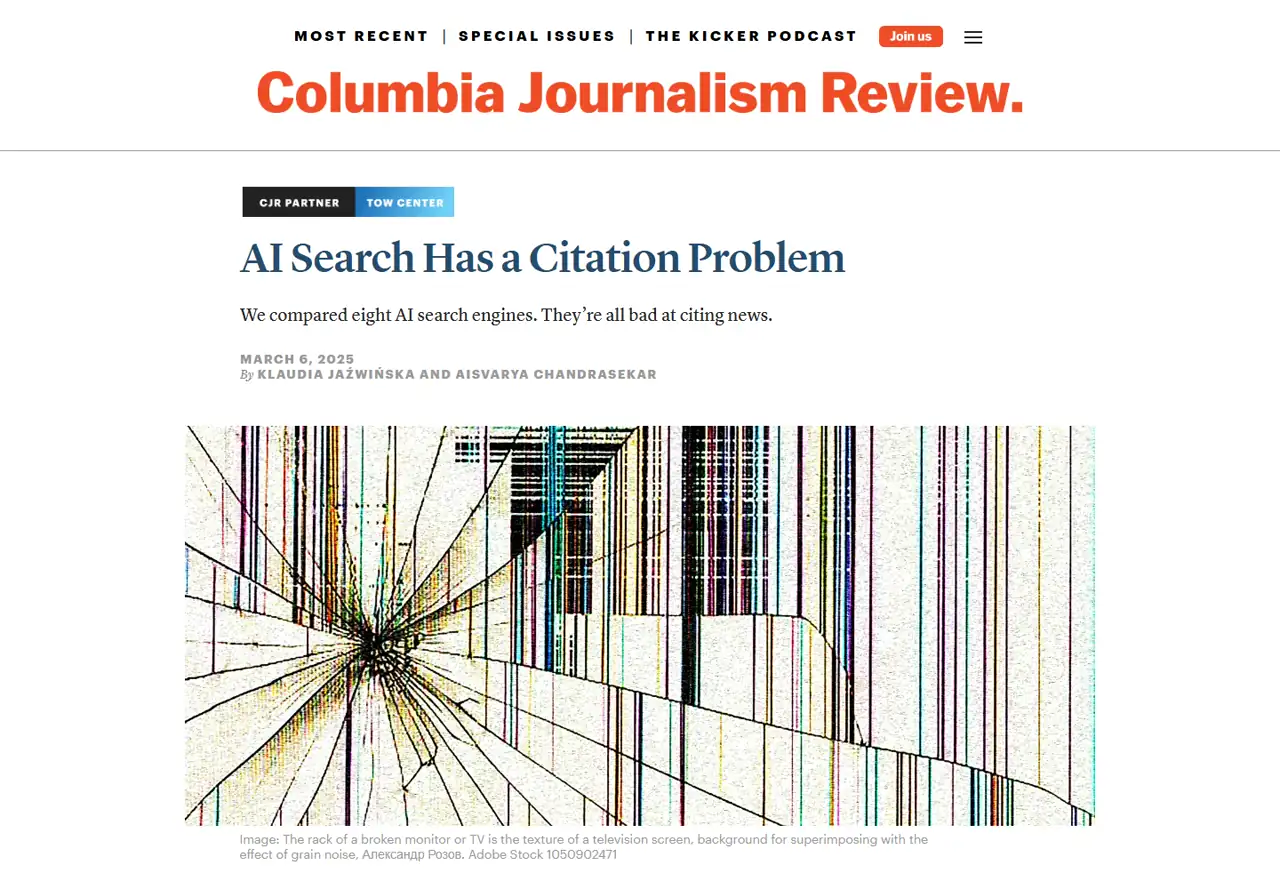
The most useful public benchmark is the Tow Center for Digital Journalism study published by Columbia Journalism Review on March 6, 2025. Researchers selected 20 news publishers, took 10 articles from each, and gave excerpts to eight AI search engines. Each system had to identify the article’s headline, publisher, publication date, and URL.
That produced 1,600 queries: 20 publishers multiplied by 10 articles and 8 tools. It is useful because the researchers had a known source article and could compare each answer against it. It is narrow because it tests source identification for news excerpts, not every research, shopping, academic, coding, or synthesis question.
What the study found for Perplexity
| Alat | Result in the tested task | Cara membacanya |
|---|---|---|
| Kebingungan | 37% incorrect | Specific news-source identification task |
| Pencarian ChatGPT | 67% incorrect | Same task and comparison frame |
| Grok 3 | 94% incorrect | Same task and comparison frame |
Primary source: AI Search Has a Citation Problem, Tow Center / Columbia Journalism Review, published March 6, 2025.
What the study did not prove
- It did not test every question or Perplexity mode.
- It did not create a permanent score for future versions.
- It did not prove that every Perplexity citation is wrong.
- It did not prove a global winner for every topic.
- It should not be rewritten as “63% overall citation accuracy.”
Prompt Architects’ analysis makes the same useful point: a number is meaningful only when readers can see the sample, scoring rule, task definition, and date behind it.
Why can a Perplexity citation look right and still be wrong?
A citation mismatch is harder to notice than a broken link. The page loads, the headline sounds relevant, and the answer may be confident. The problem appears when you compare the claim with the wording and context on the source page.
| Failure mode | What it looks like | Periksa |
|---|---|---|
| Claim-source mismatch | Real source does not support the claim as written. | Find the exact sentence or number. |
| Citation overreach | Source makes a modest point; answer makes a stronger one. | Compare wording strength and direction. |
| Topic drift | Link works but article is about a different subject. | Read title and opening section. |
| Phantom statistic | Number appears in answer but not on page. | Search for the number and unit. |
| Syndication confusion | Repost cited instead of original publisher. | Find first-party version and date. |
| Stale or broken source | Page changed, disappeared, or errors. | Open in a fresh session. |
Kebingungan source-label guidance also sets a useful expectation: a label describes a website as a whole, not the truth of every individual article or claim.
Circle the number, date, name, quote, or recommendation.
Click the source attached to that sentence.
Search for the phrase, number, or evidence.
Check context, scope, date, and provenance.
How to verify a Perplexity citation in two minutes
Start with the claim that would cause the most damage if it were wrong: a price, percentage, date, quote, legal condition, medical statement, or competitor comparison.
- Choose the claim. Copy the exact sentence or number.
- Open the attached citation. Use the source connected to that sentence.
- Search the page. Use find for the number, phrase, or named study.
- Read the paragraph. Check subject, date, scope, unit, and direction.
- Check provenance. Prefer the original and current version. Mark a failed match unverified.
Reusable verification prompt: Open the source you cited for “[claim].” Quote the exact sentence that supports it. If the source does not contain a sentence that supports the claim as stated, say so directly and do not restate it.
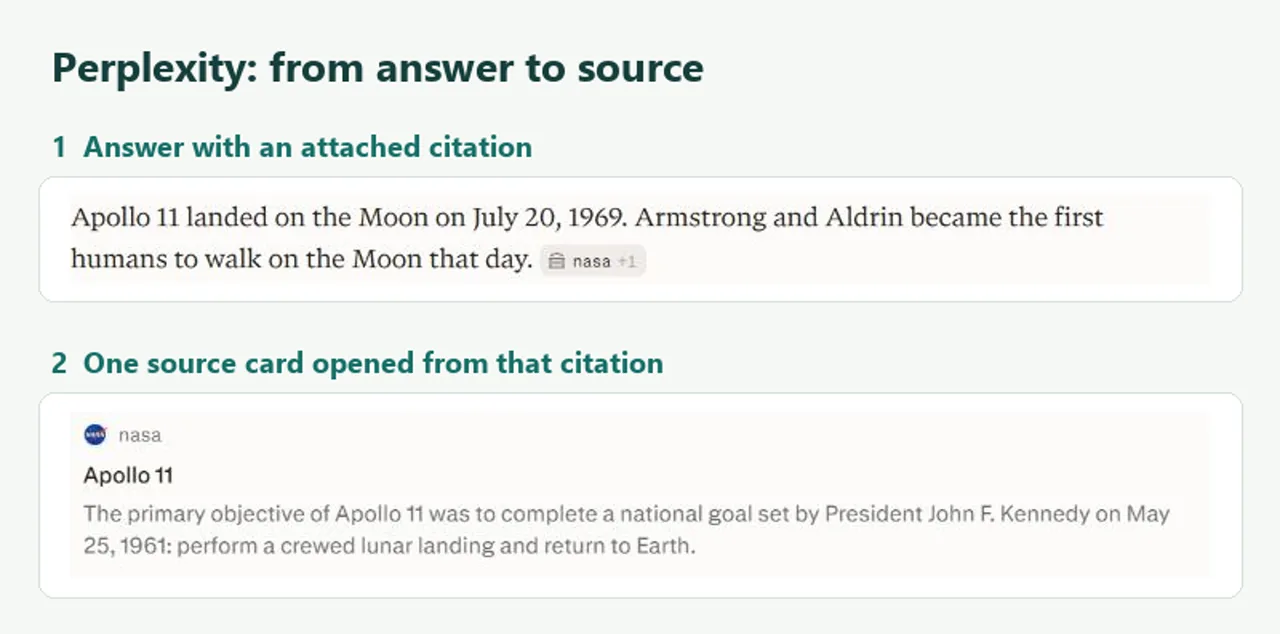
This prompt does not make the original retrieval more accurate. It forces the model to show its work. You still need to read the source when the answer will be published or used for a high-stakes decision.
Is Perplexity Deep Research more accurate than standard search?
A longer report with more sources can be more useful, but length is not a verification score. Deep Research has more opportunities to retrieve, combine, and misassign information. Public examples can show that citation problems occur; they do not establish a stable accuracy percentage for every session.
Match review effort to consequence. Spot-check a low-stakes overview. For a literature review, due-diligence memo, or report with hard statistics, check each number and read the source. Our models and modes guide explains workflow differences; it cannot replace verification.
Is Perplexity more accurate than ChatGPT for citations?
On the Tow Center’s specific news-source identification task, Perplexity produced fewer incorrect answers than ChatGPT Search. That is a fair same-task comparison, not a global verdict about every model, query, date, or mode.
A fair comparison needs the same prompts, source set, time window, scoring rule, and treatment of abstentions. For broader workflow context, see our Uji perbandingan Perplexity vs ChatGPT.
When is it safe to use Perplexity citations?
| Kasus penggunaan | How to handle the citation |
|---|---|
| Topic and source discovery | Good starting point; open sources. |
| Current-news orientation | Verify dates, originals, and updates. |
| Low-stakes summary | Spot-check the claims carrying the conclusion. |
| Academic literature review | Read and cite the original paper. |
| Medical, legal, financial, or safety decisions | Treat output as a lead only. |
| Brand and AEO monitoring | Track presence and accuracy separately. |
Before uploading internal documents or personal data for an AI research task, check the relevant policy and workspace controls. Our guide to AI data privacy across model policies is a useful starting point.
How can you check claims about a brand?
“We were cited” is only the first line of an audit. Record the query, answer claim, citation URL, source type, and whether the page supports the claim. Add mode and test date because the web and retrieval system change.
| Audit field | Apa yang harus direkam |
|---|---|
| Pertanyaan | Exact prompt and market or language |
| Claim | Sentence, number, or description to check |
| Citation | URL, title, publisher, and access date |
| Support status | Supported, partial, contradicted, or not found |
| Asal-usul | Original, syndicated, official, secondary, or community |
| Kontekstual | Mode, model, date, and change notes |
If you are checking an answer about your company or a competitor, compare each price, feature, and limitation with the original product page. For example, a citation to a pricing page does not support a claim that a feature is included unless that page lists it under the same plan. Record any mismatch before reusing the answer in a report or recommendation.
For adjacent product decisions, see our Alternatif kebingungan, the guide to how Perplexity works compared with Google and ChatGPT, and the overview of Perplexity’s research and citation features.
Pertanyaan yang Sering Diajukan
Does Perplexity give accurate information?
Perplexity can provide useful and current information, especially for discovering sources. Accuracy depends on the query, source set, mode, and claim. Treat important numbers, dates, quotes, and recommendations as unverified until the cited page supports them.
Are Perplexity sources reliable?
Some are authoritative and some are not. A source label can help you judge the website, but it cannot prove that an article supports a particular sentence. Check its date, provenance, and context.
What is the accuracy of Perplexity AI?
There is no single current percentage covering every query and mode. The best-known public benchmark found a 37% error rate on one news-source identification task. Report it with its sample and task, not as a universal score.
Does a Perplexity citation mean the claim is verified?
No. A citation means a source was attached. Verification requires checking whether the source contains evidence for the exact claim in the same context and scope.
Is Perplexity good for academic writing?
It can help discover papers and build a reading list. Open the original paper, verify the quotation or result, and cite the paper itself.
Apakah Perplexity lebih akurat daripada ChatGPT?
Perplexity performed better than ChatGPT Search in the Tow Center’s specific news-source identification test. That does not establish a winner for every topic or mode.
How do I check whether a Perplexity citation is correct?
Open the exact citation, search for the key phrase or number, read the surrounding paragraph, and compare the subject, scope, date, and direction. Mark a failed match unverified.
Can Perplexity cite the wrong source even when the link works?
Yes. The page can be live and related while still failing to support the exact claim. Claim-source matching is more useful than checking only whether the URL resolves.
Want a cited research workspace? Explore Perplexity through GlobalGPT when you want a direct route to the research experience and a single place to compare AI workflows.
Open Perplexity on GlobalGPTConclusion: treat citations as leads, then verify the claim
Perplexity’s citations make research faster because they give you a path back to the web. They do not remove the need to read the source. The Tow Center/CJR result is useful evidence, but its 37% figure belongs to one defined news-source task. It is not a permanent, universal Perplexity citation score.
When a claim matters, identify the claim, open the citation, find the evidence, and compare the context. That habit catches errors a polished interface can hide and gives you a defensible record when you need to explain where an answer came from.