
Gemini 3.6 Flash did not land quietly. Google released it as a faster, more efficient Flash model, but a lot of people had the same reaction: wait, where is the Pro upgrade?
That makes the comparison more interesting than a normal spec sheet. Gemini 3.6 Flash is supposed to be cheaper, faster, and stronger for coding, agents, and everyday multimodal work. Gemini 3.1 Pro, meanwhile, still carries the “Pro” label and is positioned around deeper reasoning and harder tasks.
So we tested them the only way that actually matters: same task, same prompt, same input, same scoring rules.
In this review, we compare Gemini 3.6 Flash and Gemini 3.1 Pro across real tasks: research synthesis, coding repair, long-context summarization, data reasoning, screenshot analysis, and SEO writing. For each round, the main question is simple: which output would be easier to trust, edit, and reuse?
If you want to compare models without opening a pile of separate tabs, start from the GLBGPT model hub and run the same prompt across multiple AI models before trusting any launch claim. That matters for this kind of review, because the only honest way to compare models is to run the same work through them and look at the outputs.
Gemini 3.6 Flash is listed as Stable; Gemini 3.1 Pro uses the Preview API label.
Per 1M output tokens on standard paid API pricing, before long-prompt Pro tiers.
Flash won four task-level editorial calls; Pro won research synthesis and screenshot analysis.
Gemini 3.6 Flash vs Gemini 3.1 Pro Quick Answer
In our same-prompt API test, Gemini 3.6 Flash was the stronger overall practical model: it won four of the six task-level editorial calls and produced cleaner first drafts in several practical tasks.
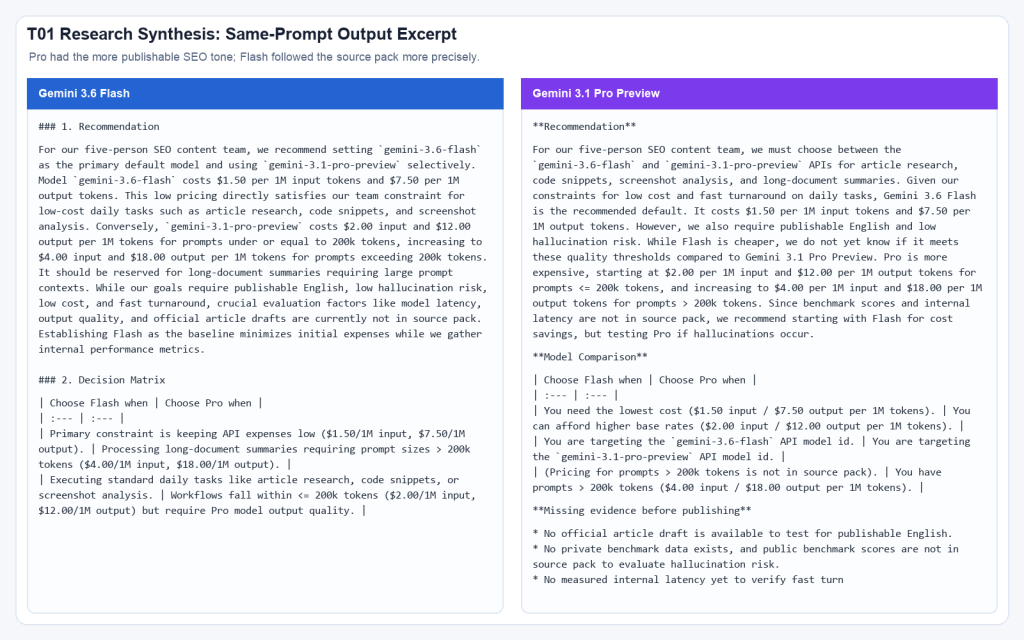
Gemini 3.1 Pro Preview produced the more publishable SEO-style research recommendation and the richer screenshot audit. Flash answered the coding, long-context, data-reasoning, and SEO-editing tasks more effectively.
Flash had stronger results in coding, long-context summary, data reasoning, and SEO editing, while keeping the first draft easier to reuse.
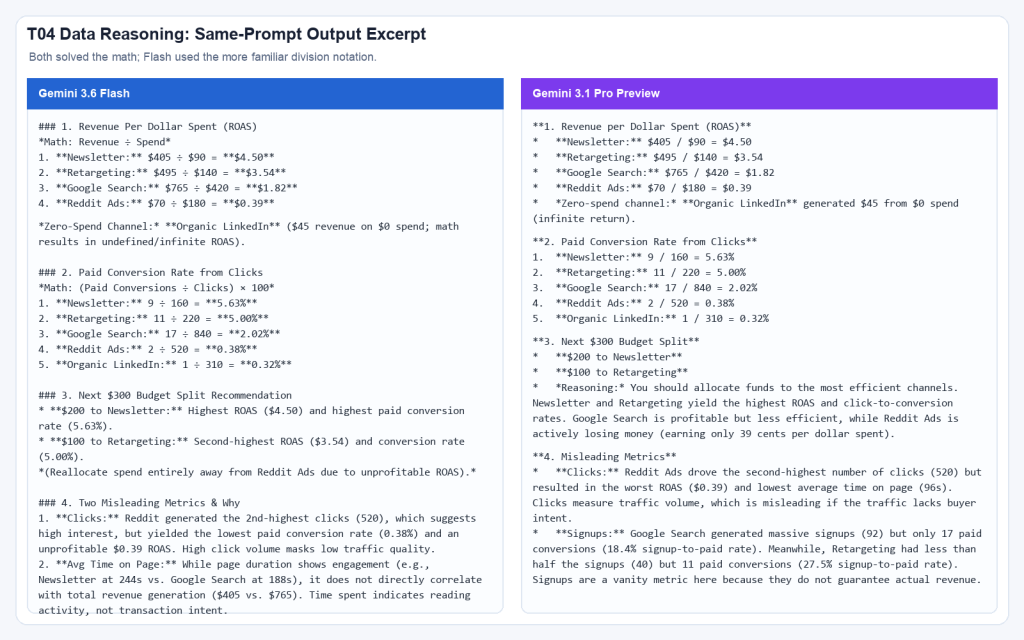
Pro gave the cleaner data-reasoning response and the more detailed screenshot audit, especially when the answer needed richer critique.
This run used six controlled API tasks. It does not prove every production workload, provider route, or long-context tier behaves the same way.
Gemini 3.6 Flash vs Gemini 3.1 Pro Official Specs
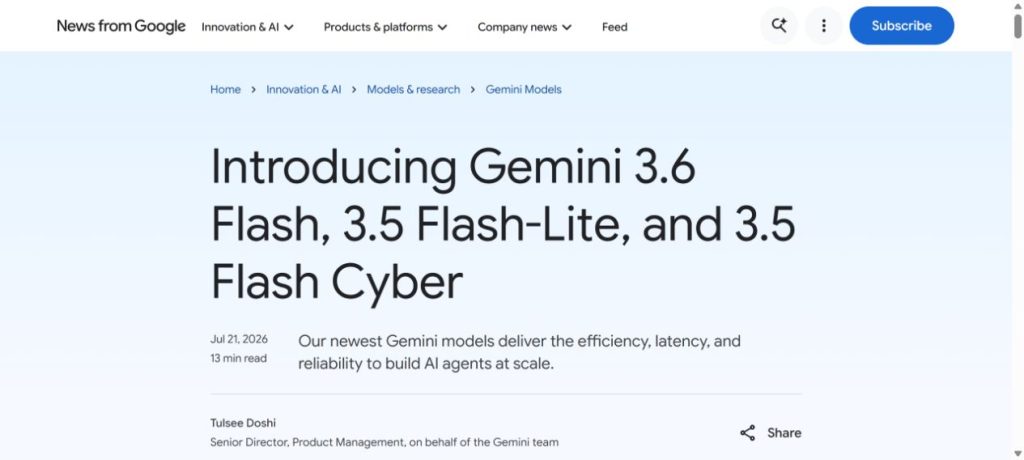
Google announced Gemini 3.6 Flash on July 21, 2026, alongside Gemini 3.5 Flash-Lite and Gemini 3.5 Flash Cyber. In that launch post, Google frames 3.6 Flash as a more efficient Flash model for coding, knowledge work, multimodal performance, and agentic workflows.
The official Gemini API model page lists the model code as gemini-3.6-flash. It is marked Stable, supports text, image, video, audio, and PDF input, and returns text output. The listed token limits are 1,048,576 input tokens and 65,536 output tokens.
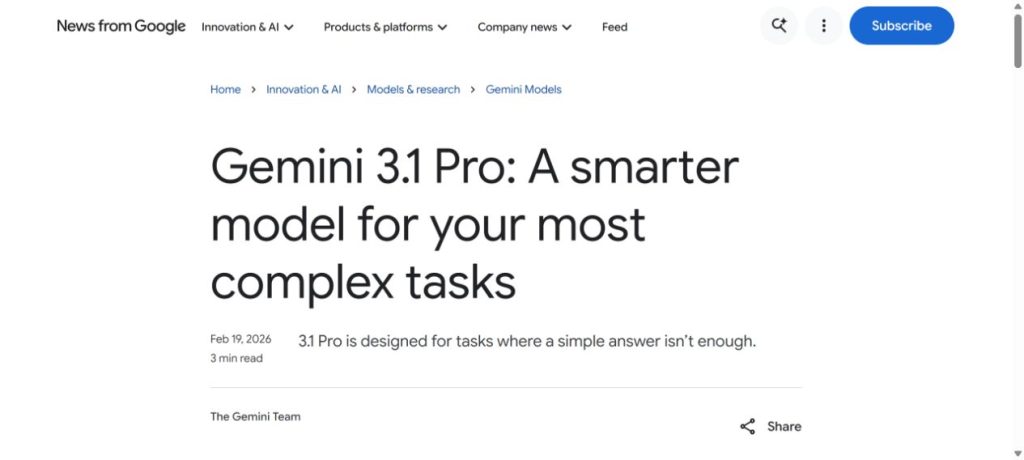
Gemini 3.1 Pro is a different kind of model. Google announced Gemini 3.1 Pro on February 19, 2026, positioning it around complex tasks and advanced reasoning. Google said the model was rolling out in preview to validate updates before general availability.
For API comparisons, the precise label matters. The official model page uses gemini-3.1-pro-preview, not a stable Pro label. It has the same listed input and output token limits as Gemini 3.6 Flash: 1,048,576 input tokens and 65,536 output tokens. To try the Pro side after reading the specs, open the Gemini 3.1 Pro model page and run one of the same prompts from this article.
If you need a setup walkthrough instead of raw model-code notes, the Gemini 3.1 Pro usage guide is the cleaner next step before you start testing prompts.
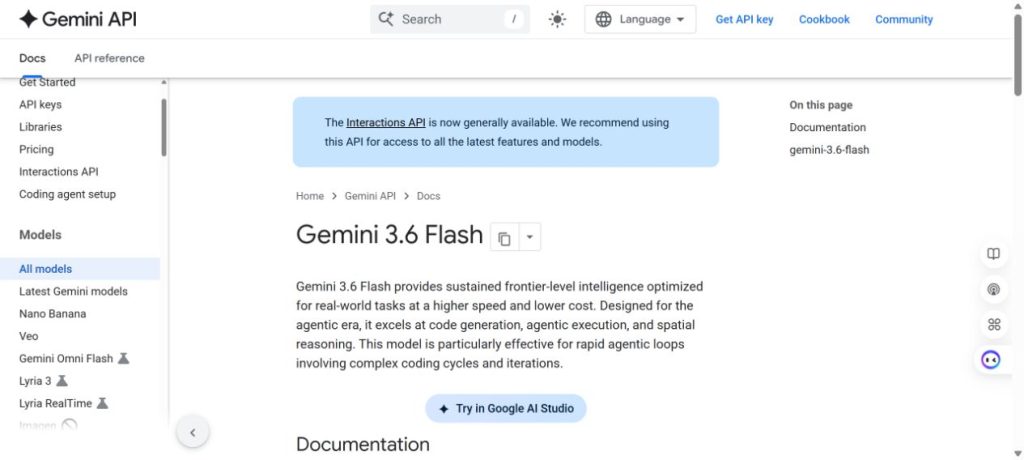
gemini-3.6-flash is listed as Stable with a 1M-token input window.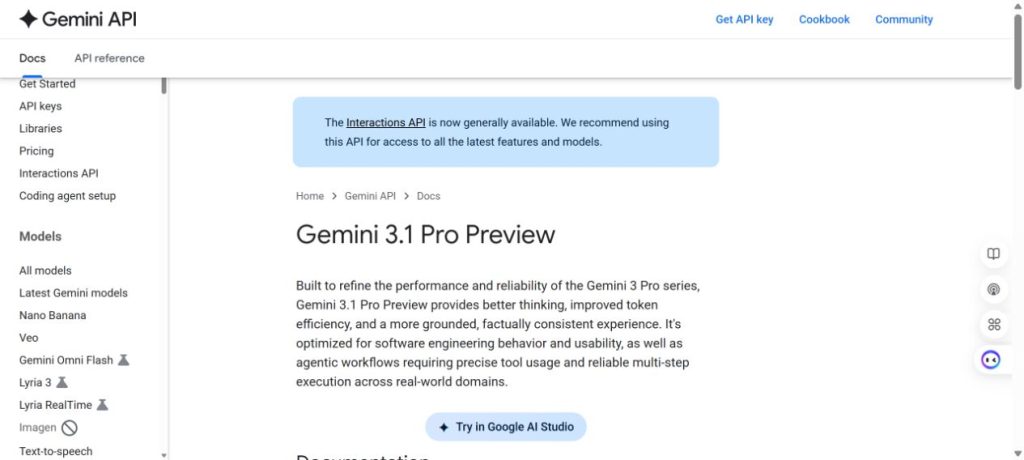
gemini-3.1-pro-preview is listed as Preview with the same input/output limits.Gemini 3.6 Flash vs Gemini 3.1 Pro Price Comparison
For standard paid Gemini API usage, Gemini 3.6 Flash is cheaper than Gemini 3.1 Pro Preview. The Gemini API pricing page lists Gemini 3.6 Flash at $1.50 per 1M input tokens and $7.50 per 1M output tokens.
Gemini 3.1 Pro Preview has two standard pricing tiers. For prompts up to 200K tokens, it is listed at $2.00 per 1M input tokens and $12.00 per 1M output tokens. For prompts above 200K tokens, it rises to $4.00 input and $18.00 output per 1M tokens. For a Pro-specific cost breakdown, keep the Gemini 3.1 Pro cost guide open beside the table.
| Модель | Стандартная цена производства | Стандартная цена выпуска | Important note |
|---|---|---|---|
| Gemini 3.6 Flash | $1.50 / 1M tokens | $7.50 / 1M tokens | Stable model; output price includes thinking tokens |
| Gemini 3.1 Pro Preview | $2.00 / 1M tokens under 200K prompt tokens | $12.00 / 1M tokens under 200K prompt tokens | Preview model; higher tier applies above 200K prompt tokens |
| Gemini 3.1 Pro Preview, long prompt | $4.00 / 1M tokens above 200K prompt tokens | $18.00 / 1M tokens above 200K prompt tokens | Important for long-context testing |
Price alone does not decide model quality. A cheaper model that needs more retries can become expensive in practice. A slower model can still be worth it if it avoids a bad answer on a high-value task. If your prompts often push long context or quotas, check the Gemini 3.1 Pro limits guide before treating price as the whole decision. That is why our test records both cost and result quality for every prompt.
Gemini 3.6 Flash vs Gemini 3.1 Pro Benchmarks
Google's Gemini 3.6 Flash launch post gives the model a strong efficiency story. Google says 3.6 Flash uses 17% fewer output tokens than 3.5 Flash on the Artificial Analysis Index, improves on DeepSWE, improves on MLE Bench, and raises OSWorld-Verified performance compared with 3.5 Flash.
That is a good sign, but it does not answer the question we care about here. The real question is not only how 3.6 Flash compares with the earlier Gemini 3.5 Flash review; it is whether 3.6 Flash can now challenge Gemini 3.1 Pro in practical same-prompt work.
Gemini 3.1 Pro has a different official benchmark story. In the Gemini 3.1 Pro launch post, Google highlighted its advanced reasoning and said 3.1 Pro reached a verified ARC-AGI-2 score of 77.1%. That makes it easy to assume Pro should win the harder reasoning tests. But assumptions are exactly what this article is trying to avoid.
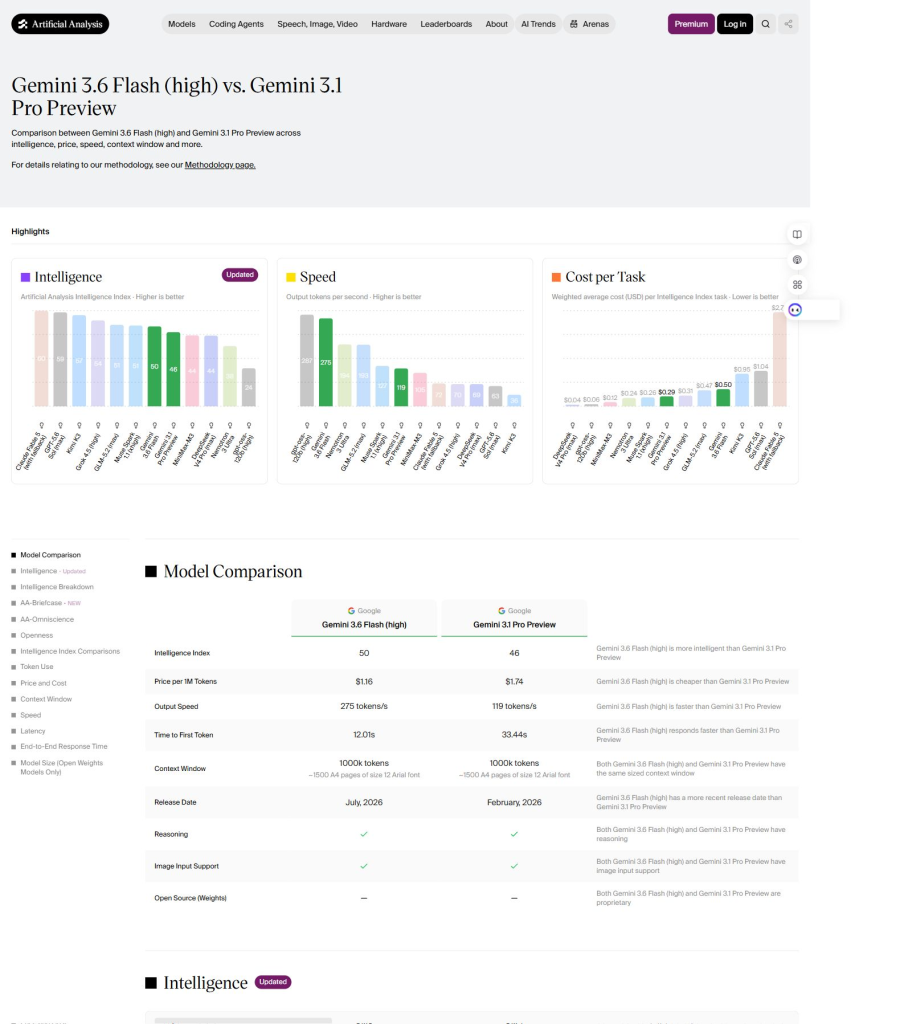
The third-party Artificial Analysis comparison we captured shows a much sharper contrast: Gemini 3.6 Flash appears faster, cheaper, and higher on its Intelligence Index than Gemini 3.1 Pro Preview. That is useful context, but it is not a Google official result, and it still does not replace same-prompt testing.
| Источник | Метрическая система | Gemini 3.6 Flash | Gemini 3.1 Pro Preview | How to use it |
|---|---|---|---|---|
| Google official | DeepSWE | 49% | Not a direct 3.1 Pro comparison in the 3.6 Flash launch post | Official claim mainly compares 3.6 Flash with 3.5 Flash |
| Google official | MLE Bench | 63.9% | Not a direct 3.1 Pro comparison in the 3.6 Flash launch post | Useful for coding/agentic expectations, not final proof |
| Google official | OSWorld-Verified | 83.0% | Not a direct 3.1 Pro comparison in the 3.6 Flash launch post | Useful for computer-use context |
| Искусственный анализ | Intelligence Index | 50 | 46 | Third-party benchmark context |
| Искусственный анализ | Скорость выхода | 280 tokens/s | 119 tokens/s | Third-party speed context |
| Искусственный анализ | Time to first token | 11.71s | 33.44s | Third-party latency context |
| Искусственный анализ | Blended price | $1.16 / 1M tokens | $1.74 / 1M tokens | Use separately from official API pricing |
Data Figure: Artificial Analysis Snapshot
Third-party comparison captured July 22, 2026. Use this as benchmark context, not as a Google official claim.
How We Tested Gemini 3.6 Flash vs Gemini 3.1 Pro
Each test uses the same prompt, the same input, and the same scoring categories for both models. We do not treat one good answer as proof that a model is globally better. The goal is narrower and more useful: show how each model behaves across specific tasks.
We scored each output across these categories:
| Категория | What we looked for |
|---|---|
| Result quality | Is the answer actually usable? |
| Instruction following | Did the model obey format, limits, and constraints? |
| Точность | Did it avoid invented facts, prices, links, or claims? |
| Глубина рассуждений | Did it catch tradeoffs and hidden constraints? |
| Структура | Is the output easy to scan and reuse? |
| Скорость | End-to-end response time in seconds |
| Стоимость | Estimated from official API input/output token pricing |
The test was run through the same API route using the exact requested model IDs: gemini-3.6-flash и gemini-3.1-pro-preview. The raw outputs, token usage, latency, and official API cost estimates were logged for every task.
If coding is the main reason you are comparing these two models, pair this result with the Лучшая модель искусственного интеллекта для кодирования guide instead of judging by one bug-fix prompt alone.
If you are still choosing a default model for broader work, the best AI models guide is a better next step than reading this Gemini pair in isolation.
And if your real decision is Google versus OpenAI rather than Flash versus Pro, the GPT-5 vs Gemini 2.5 Pro comparison is a better next step than another Gemini-only benchmark table.
Pro’s recommendation read more like polished SEO-team copy, although one matrix note misstated the source pack.
ПроBoth solved it, but Flash had more robust decimal assertions in the tests.
ВспышкаPro was richer, but Flash was cleaner and safer on preview-status wording.
Flash, slightBoth did correct math; Flash used the more familiar division notation and a cleaner scan-friendly structure.
ВспышкаFlash was accurate; Pro gave richer trust, typography, and mobile-risk detail.
Pro, slightFlash sounded more natural and clean; Pro was safe but too dramatic in tone.
ВспышкаGemini 3.6 Flash vs Gemini 3.1 Pro Same-Prompt Results
Instead of hiding the test data in one combined scorecard, this section shows each prompt as its own Gemini 3.6 Flash vs Gemini 3.1 Pro comparison card. Each card includes same-prompt API run data plus short excerpts from the actual raw outputs, so the comparison is not just a score table.
Gemini 3.6 Flash vs Gemini 3.1 Pro: Final Verdict
Gemini 3.6 Flash finishes ahead in this comparison, winning four of the six same-prompt tasks. Its strongest results came from coding, long-context summarization, data reasoning, and SEO editing. Gemini 3.1 Pro Preview still produced the better research synthesis and the more detailed screenshot audit, showing that the Pro model can deliver a more polished or observant answer when the task rewards depth.
Flash was also faster and cheaper across this controlled API run. That combination made it the stronger overall result here, but not a universal replacement for Pro: the actual outputs show that model quality still changes with the task, even when the prompt stays exactly the same.
For your own Gemini 3.6 Flash против Gemini 3.1 Pro comparison, run the same real prompt through both models in GLBGPT and judge the finished work side by side.
Gemini 3.6 Flash vs Gemini 3.1 Pro FAQ
When was Gemini 3.6 Flash released?
Google announced Gemini 3.6 Flash on July 21, 2026. The official Gemini API model page lists gemini-3.6-flash as a stable model.
Is Gemini 3.1 Pro the same as Gemini 3.1 Pro Preview?
For API pricing and technical comparison, use the official label gemini-3.1-pro-preview. Google’s February 2026 launch post says Gemini 3.1 Pro was released in preview to validate updates before general availability.
When will Gemini 3.5 Pro or Gemini 3.6 Pro be released?
As of July 22, 2026, Google has made an official statement about Gemini 3.5 Pro, but not a dated launch promise. In the Gemini 3.6 Flash announcement, Google says Gemini 3.5 Pro is currently testing with partners and that it plans to make the model broadly available “as soon as it’s ready.” I did not find an official Google release date or official announcement for Gemini 3.6 Pro.
Does Gemini 3.6 Flash replace Gemini 3.1 Pro?
Not officially. Gemini 3.6 Flash is a stable Flash model focused on speed, cost, coding, multimodal work, and agentic execution. Gemini 3.1 Pro Preview is positioned around more advanced reasoning and complex tasks. The same-prompt tests in this article are designed to show where the practical gap is now.
Can public benchmarks decide the winner?
No. Benchmarks help set expectations, but they do not replace controlled same-prompt testing. This article separates official benchmark claims, third-party benchmark data, and our own task-level test results.
Why does this article use Gemini 3.1 Pro Preview instead of just Gemini 3.1 Pro?
The article can use “Gemini 3.1 Pro” in reader-facing prose, but the technical tables should use gemini-3.1-pro-preview. That is the official API label used in the Gemini model and pricing pages.
Is Gemini 3.6 Flash cheaper than Gemini 3.1 Pro Preview?
Yes, under standard paid Gemini API pricing. Gemini 3.6 Flash is listed at $1.50 per 1M input tokens and $7.50 per 1M output tokens. Gemini 3.1 Pro Preview starts at $2.00 input and $12.00 output per 1M tokens, with a higher tier for prompts above 200K tokens.
Do both models support a 1M-token context window?
The official Gemini API model pages list 1,048,576 input tokens for both gemini-3.6-flash и gemini-3.1-pro-preview. In practice, the long-context test still matters because a large window does not guarantee perfect recall.
Should the article include official screenshots?
Yes, but screenshots should support the claims rather than carry the whole article. The main comparison should be shown with readable tables, data cards, price bars, benchmark summaries, and same-prompt result tables.
What tasks were included in the same-prompt test?
The API run included six tasks: research synthesis, coding bug fix, long-context summary, data reasoning, screenshot analysis, and SEO writing/editing. Each run recorded latency, input tokens, output tokens, estimated cost, and a judge note.
Can this article say Gemini 3.6 Flash is better than Gemini 3.1 Pro?
It can say Gemini 3.6 Flash was better overall in this specific same-prompt API test. It should not claim that Flash is globally better for every workload, because Pro produced stronger results in research synthesis and screenshot analysis.
Where were the same-prompt tests run?
The tests were run through the same API route using the exact model IDs gemini-3.6-flash и gemini-3.1-pro-preview. This is not a GLBGPT UI test, and the local timing should be read as end-to-end request time rather than provider-side latency.
Why did Gemini 3.6 Flash win overall if Pro won some quality categories?
Flash won because it produced the stronger reusable answer in more tasks. Pro’s research synthesis and screenshot analysis were stronger, but Flash’s wins covered coding, long-context summary, data reasoning, and SEO editing.
Why mention GLBGPT in the comparison?
Model comparisons are easier when readers can test multiple models in one place. GLBGPT is relevant here because the reader’s next action is not just reading specs; it is running the same prompt across models and comparing the outputs.