
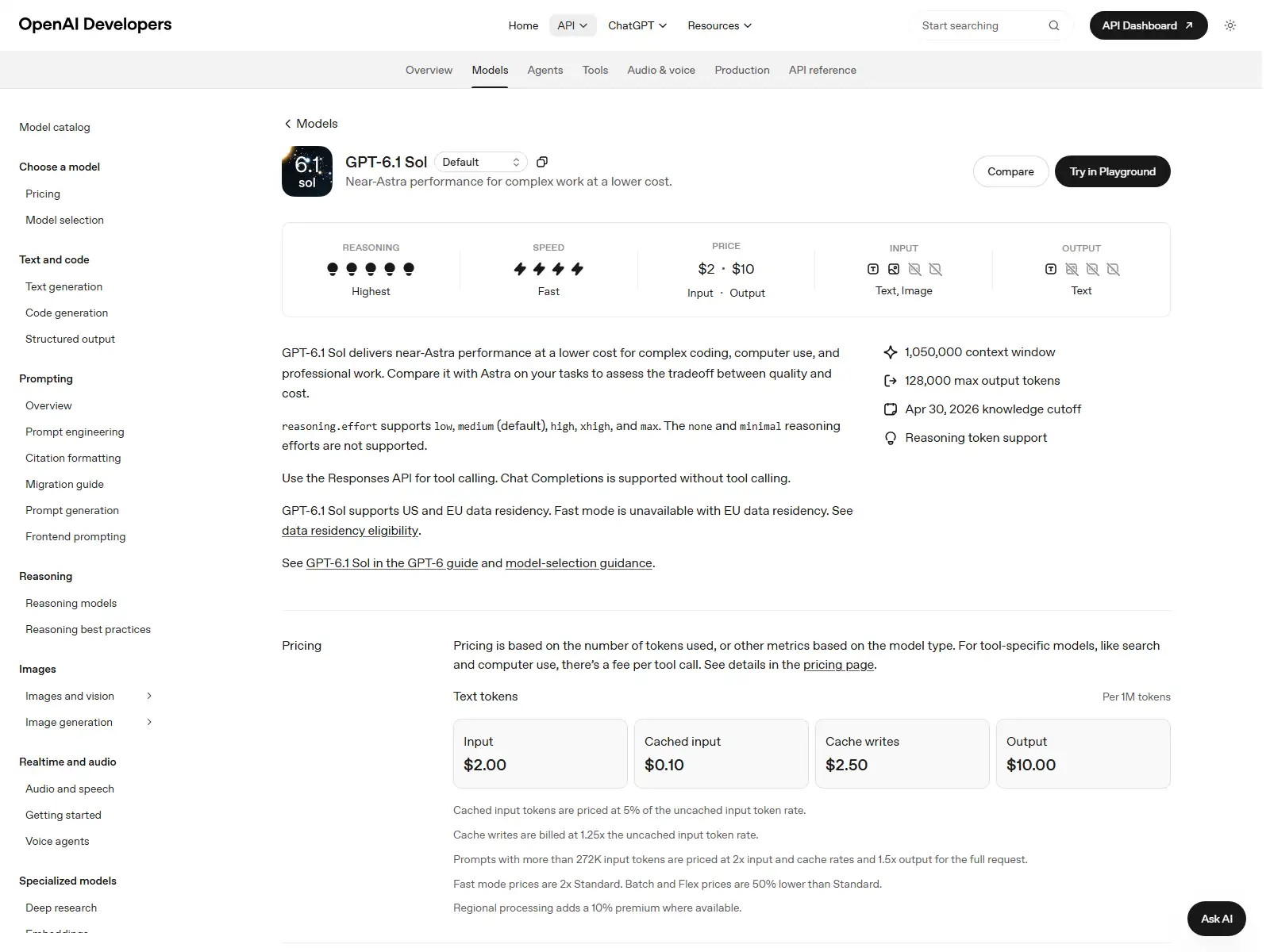
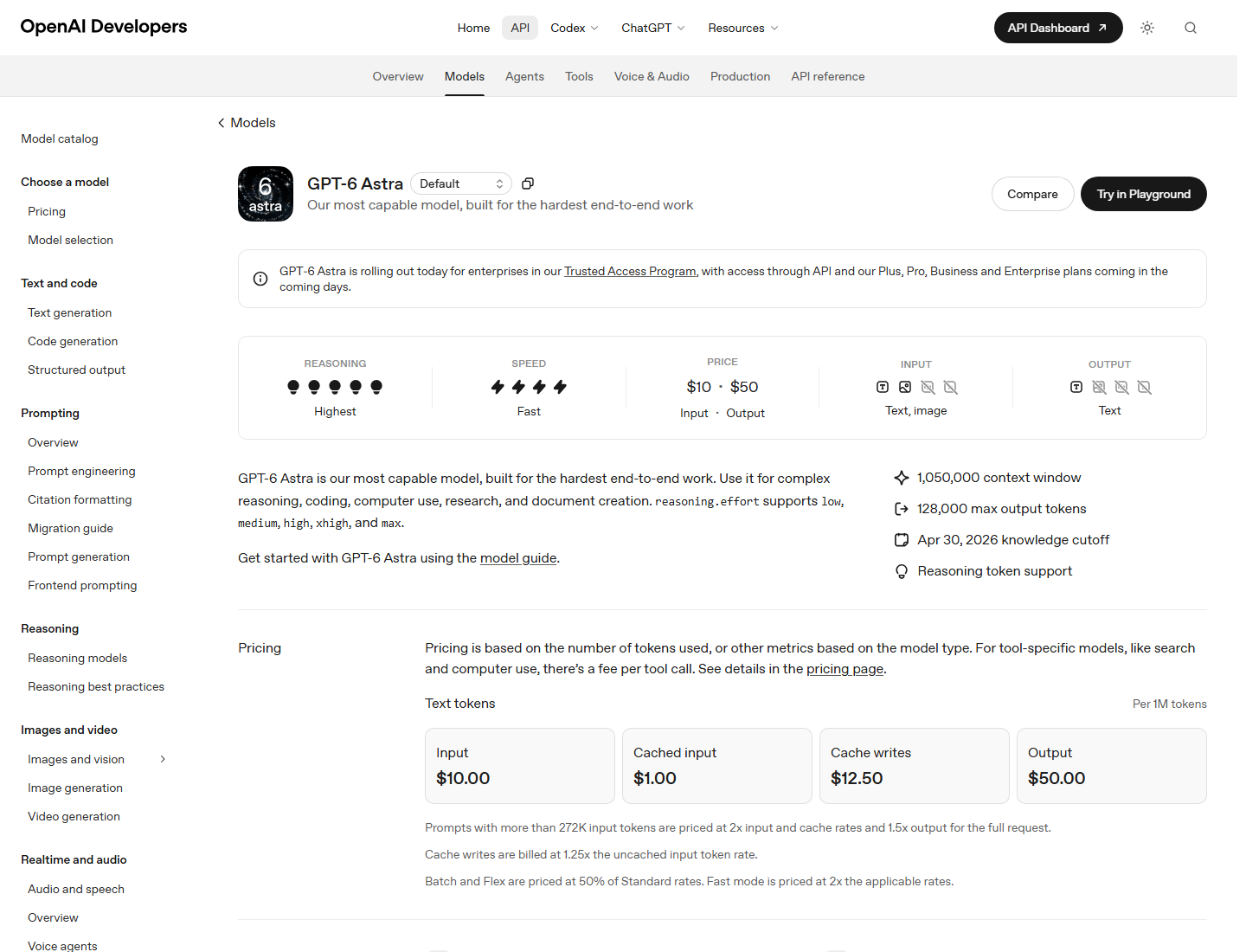
GPT-6.1 Sol is the value default; GPT-6 Astra is the quality ceiling. Both expose the same 1,050,000-token context window, 128,000-token output limit, multimodal input, and broad tool set. The decisive difference is positioning and price: Sol costs $2 per million input tokens and $10 per million output tokens, while Astra costs $10 and $50. In other words, Astra must create enough extra value to justify a five-times-higher Standard token bill.
That does not make Sol “the same model for less.” OpenAI calls Astra its most capable model for the hardest end-to-end work and describes Sol as near-Astra performance for complex work at lower cost. The right decision is therefore an evaluation problem, not a brand-ranking exercise. This comparison uses current GPT-6.1 Sol documentation, die GPT-6 Astra model page, and identical cost scenarios checked on October 9, 2026.
GPT-6.1 Sol vs GPT-6 Astra: Quick Comparison
The table makes the first decision easy: if you do not yet have task-specific evidence, Sol deserves the first trial because it preserves the major interface and capacity features while sharply reducing token cost. Astra becomes the rational choice when the work is unusually hard, the downside of a wrong answer is large, or its stronger result avoids several rounds of human or model revision.
This is different from comparing Sol with a small, fast model. OpenAI’s current family guidance puts Sol near the top, not at the budget floor. Readers deciding across the whole lineup can also use our Leitfaden zu den besten KI-Modellen und die GPT-6 Luna review to see when a lighter model is enough.
What GPT-6.1 Sol and GPT-6 Astra Share
The two official model pages list the same context window, maximum input, maximum output, and knowledge cutoff. Both accept text and images and produce text. Neither lists audio or video as native model input or output. They also share low, medium, high, xhigh, and max reasoning efforts, with medium as the default. That symmetry simplifies A/B testing because an application can hold most request parameters constant while switching only the model ID.
Both models support structured outputs, function calling, web search, file search, image generation, code interpreter, hosted shell, apply patch, computer use, MCP, skills, and tool search. OpenAI lists tool calling through the Responses API; Chat Completions is available when tools are not involved. Fine-tuning is not supported on either model page. These are capability declarations, not promises that the two models will choose tools with identical accuracy.
A million-token context window is capacity, not permission to ignore retrieval design. Very long requests are more expensive, harder to debug, and subject to the pricing step above 272K input tokens. Chunking, retrieval, summaries, and prompt caching remain important. The same warning applies to the 128K output ceiling: smaller verifiable artifacts are usually safer than one massive response.
Pricing: The Five-Times Gap
At Standard rates, GPT-6.1 Sol costs $2 per million uncached input tokens, $0.10 for cached input, $2.50 for cache writes, and $10 for output. GPT-6 Astra costs $10, $1, $12.50, and $50 respectively. Sol is five times cheaper for uncached input, cache writes, and output; cached input is ten times cheaper. The current figures come directly from OpenAI’s model pages and Dokumentation zur Preisgestaltung der API.
The headline ratio is not the whole bill. Once a request exceeds 272K input tokens, OpenAI applies twice the normal input and cache rates and 1.5 times the normal output rate to the full request. Batch and Flex are priced at 50% of Standard, while Fast is twice the applicable rate. Astra also offers an Ultrafast tier. Compare like with like: a Sol Batch request and an Astra Fast request do not reveal the underlying model-price ratio.
For a broader breakdown of the flagship tier, see our GPT-6 Astra pricing guide. The earlier GPT-6 Sol pricing analysis is useful when planning a migration from the prior Sol generation, but production estimates should use the exact current model ID and current rates.
Long-Context Design: Same Capacity, Different Economics
The identical 1,050,000-token context window can make Sol and Astra look interchangeable for document-heavy work, but capacity is only the first constraint. A request near the limit must still locate the right evidence, distinguish instructions from quoted material, preserve relationships across many files, and return a result that a person or program can verify. The model with the larger name does not remove the need for information architecture. Organize sources, label boundaries, and ask for citations back to stable document identifiers.
Sol’s lower rate changes which long-context experiments are economically practical. A team can test several chunking strategies, retrieval thresholds, and summary formats for the cost of one Astra run. That wider search can improve the system even if Astra wins a single prompt. Astra is more attractive after the workflow is stable and the unresolved errors are genuinely model-limited. In early development, spending the full budget on a few flagship calls may produce less learning than running a disciplined Sol evaluation across many representative cases.
The 272K threshold deserves explicit monitoring. A request with 271K input tokens and one with 273K are close in size, but the second moves the full request into the higher band. Build a preflight token estimate and record which band each job used. If an input is just over the boundary, removing duplicated boilerplate, stale conversation history, or low-value retrieved passages may materially reduce cost without harming quality. This optimization applies to both models, though Astra’s higher base rates make mistakes more expensive.
Prompt caching is most useful when a large prefix stays stable across calls. Examples include policy manuals, coding standards, a product catalog, or a tool schema shared by many tasks. Put stable content first and variable instructions later when the API’s caching behavior supports that layout. Then measure cache hits rather than assuming them. Sol’s cached-input advantage is especially large, but a constantly changing prefix can erase it. Cache design belongs in the benchmark report alongside accuracy and latency.
For research and document analysis, use a staged workflow: retrieve likely evidence, ask the model for a structured evidence map, validate the citations, and only then request synthesis. Use Astra when the synthesis remains weak after the evidence pipeline is sound, or when the source set contains unusually subtle contradictions. This separates retrieval failures from reasoning failures. Without that separation, teams often pay for a more capable model to compensate for an avoidable context-construction problem.
Coding and Tool Use
For coding, the useful question is not “which model can write code?” Both can. The question is where the extra capability of Astra changes the outcome. Sol is attractive for common repository work: implementing scoped features, diagnosing reproducible bugs, reviewing pull requests, writing tests, transforming data, and running iterative tool loops. Its lower rate allows more attempts, more verification, and larger evaluation sets for the same budget.
Astra is better reserved for tasks where ambiguity and coordination dominate: an unfamiliar monorepo migration, a security-sensitive architecture review, long-horizon computer use, a difficult cross-language port, or a production incident with incomplete evidence. The most capable model can be worth its premium when one correct plan prevents hours of rework. Our Das beste KI-Modell zum Vergleich von Programmiercodes explains why repository tests matter more than generic coding impressions.
- Scoped features with clear acceptance tests
- Routine debugging and code review
- High-volume agent loops
- Draft migrations and refactors
- Test generation and documentation
- Hard failures after a Sol attempt
- High-risk security or data changes
- Ambiguous cross-system architecture
- Long autonomous computer-use tasks
- Final review when mistakes are expensive
Do not judge either model from code that merely looks plausible. Give both the same repository snapshot, instructions, tools, time budget, and tests. Record pass rate, human corrections, tool-call failures, tokens, latency, and cost. A model that costs five times more but halves the number of failed attempts may be justified; a model that improves style without improving acceptance is not.
Performance Evidence: What We Can and Cannot Conclude
OpenAI’s positioning supplies the strongest defensible summary: Astra is the most capable model for the hardest end-to-end work, while GPT-6.1 Sol aims for near-Astra performance on complex work at lower cost. Those statements support a selection hypothesis, not a universal percentage gap. No single public benchmark can predict performance on your proprietary documents, tools, policies, or codebase.
Launch videos are valuable for understanding how a company frames a product, but they are not independent evaluations. Likewise, creator reviews show real interfaces and useful examples, yet each review reflects a particular prompt set, tool configuration, and publication deadline. Treat a favorable thumbnail or first-look verdict as a lead for your own test plan, not proof that Astra or Sol wins every category.
The official OpenAI video above documents Astra’s launch framing. The independent Matt Wolfe page below shows that third-party attention quickly focused on the size of the release. Neither screenshot is used here as a numerical benchmark. The article intentionally avoids converting enthusiasm, views, or a creator’s title into an unsupported performance score.
A sound comparison uses a private evaluation set that resembles production. Include easy tasks, typical tasks, and expensive failure cases. Blind the outputs when human preference matters. For agents, test completion and recovery rather than the first response. OpenAI’s Leitfaden zur Modellauswahl similarly recommends comparing models on identical tasks and keeping the lightest model and reasoning effort that clears the quality bar.
How to Run a Fair Sol vs Astra Evaluation
Begin by defining the decision the evaluation will make. “Which model is smarter?” is too vague. A useful question is “Which model should handle pull-request reviews for this repository at medium reasoning?” or “Should final contract synthesis escalate from Sol to Astra?” Fix the task family, service tier, reasoning effort, tools, time limit, and acceptance criteria before generating outputs. Otherwise, a favorable result can be explained by configuration rather than the model.
Build a set large enough to contain ordinary cases and meaningful edge cases. Twenty carefully selected examples can reveal obvious failures, but a production routing policy usually needs more. Sample from recent real work after removing sensitive data, then tag each case by difficulty and risk. Keep a locked holdout set so prompt tuning does not gradually overfit the examples everyone has already seen. Version the dataset and evaluator just as you version application code.
Prefer deterministic checks whenever the task permits them. Compile code, run tests, validate JSON against a schema, compare extracted fields with labels, and verify cited passages. Human graders should focus on qualities that automation cannot capture well, such as clarity, judgment, and whether a recommendation respects the business context. Blind model identity and randomize output order. If graders know which answer came from Astra, price and reputation can influence the score without anyone intending bias.
Track severity, not only averages. Ten minor style advantages should not outweigh one critical data-loss recommendation. Define hard vetoes such as fabricated citations, unsafe commands, missing required fields, or failure to follow a legal constraint. Report the distribution by difficulty and risk category. Sol may tie Astra on normal work and fall behind only on the hardest five percent; that result strongly supports a router instead of an all-or-nothing migration.
Finally, calculate uncertainty and rerun unstable cases. Model outputs can vary, so a one-shot comparison exaggerates luck. Repeat a subset, investigate disagreements between evaluators, and preserve raw outputs for audit. The final recommendation should state the tested date, model IDs, settings, dataset version, prices used, and known gaps. Revisit it after a model update, a prompt change, or a meaningful shift in workload. A model choice is a maintained production decision, not a permanent trophy.
Do not let the evaluator become the hidden deciding model. If an automated judge strongly prefers one output, sample those decisions for expert review and compare the judge with hard acceptance results. Separate presentation quality from task correctness: a polished explanation can conceal a failed requirement, while a terse answer may pass every test. Also report abstentions and ties instead of forcing a winner. Those details make the result less dramatic, but far more useful for budgeting and routing. The goal is a repeatable operating rule that another team member can inspect and reproduce. Record rejected outputs too; failure examples often explain the routing boundary more clearly than a table of average scores.
Beispiele für tatsächliche Kosten
Consider a coding-agent run with 200,000 uncached input tokens and 20,000 output tokens. Sol costs about $0.60: $0.40 for input and $0.20 for output. Astra costs about $3.00: $2.00 plus $1.00. Across 10,000 runs, the difference is roughly $24,000 before tool fees, caching, regional uplifts, or service-tier adjustments.
Now consider a long-context request with 300,000 input tokens and 30,000 output tokens. Because input exceeds 272K, the higher rates apply to the entire request. Sol’s effective input rate becomes $4 per million and output becomes $15, producing about $1.65. Astra becomes $20 input and $75 output, producing about $8.25. The five-times relationship remains, but the absolute spread grows.
Caching can shift the calculation further toward Sol because its cached-input rate is one tenth of Astra’s. That matters for stable system instructions, large repeated references, and agent scaffolding. However, cache writes still have a price, and changing the prefix can reduce reuse. Estimate from actual usage logs rather than assuming every token will receive the cached rate.
How to Compare the Models in the API
Use the Responses API for tool-using applications and keep the comparison configuration identical. The simplest useful harness sends the same input to both model IDs, records response metadata, and runs the same evaluator. Do not expose API keys in source code; use an environment variable and your normal secret manager.
The sample is deliberately small. A production harness should save request IDs, evaluator versions, repository commits, tool traces, retry counts, and acceptance outcomes. It should also calculate price from the service tier and long-context band actually used. Avoid letting one model see feedback that the other did not receive unless you are explicitly testing a routing sequence.
A Practical Sol-to-Astra Routing Strategy
A two-stage router captures the strongest economic argument for Sol without pretending that every prompt is equal. Send normal traffic to Sol at medium reasoning. Escalate when deterministic tests fail, the model reports low confidence, the task matches a high-risk category, or a human explicitly requests flagship review. Keep escalation rules observable so that cost does not silently drift.
Use the same prompt, tools, and acceptance tests.
Tests, confidence, risk class, and human review.
Send failures or high-risk work to Astra.
Track acceptance, rework, latency, and total cost.
Routing also gives teams a controlled way to update defaults. If Sol’s acceptance rate improves on a task family, broaden its share. If Astra repeatedly prevents expensive defects, route that category directly. The comparison becomes an operating policy backed by data instead of a one-time model debate. For an earlier-generation reference, see GPT-6 Astra vs. GPT-5.6 Sol.
Latency and reliability belong in the same routing policy. A model can produce a stronger answer yet still be the wrong default if its response time breaks an interactive workflow or its longer reasoning causes job timeouts. Measure first-token latency, total duration, tool-call recovery, and successful completion under realistic concurrency. Then define a service objective for each task class. Sol can own time-sensitive production traffic while Astra handles asynchronous review, or the reverse can be justified if a difficult task routinely fails before escalation. The model decision is operational, not merely editorial.
Who Should Choose Sol, and Who Should Choose Astra?
Choose GPT-6.1 Sol for cost-aware production
Sol fits product teams, agencies, researchers, and developers who run substantial volumes of difficult work but still have measurable acceptance criteria. It is especially compelling when iteration is part of the process: code-test-fix loops, document revision, extraction with validation, research synthesis, and multi-step internal agents. Its lower price buys more evaluation coverage and more retry budget.
Choose GPT-6 Astra for the hardest quality-sensitive work
Astra fits teams whose hardest tasks have high error costs or weak automated checks. A difficult architecture decision, final security review, novel scientific reasoning task, or long computer-use sequence can justify paying for the flagship. It is also the cleaner default during early discovery when the team does not yet know what a smaller model misses and cost is not the immediate constraint.
Use both when task difficulty varies
Most mature systems should not force one model onto every request. Use Sol for the broad middle and Astra as an escalation layer. Add Luna or another smaller model for predictable classification and transformation. This tiered design reflects actual workload diversity and is usually more economical than debating a single permanent winner. Our model testing methodology offers a useful framework for separating repeatable evidence from impressions.
How to Use GPT-6.1 Sol and GPT-6 Astra on GlobalGPT
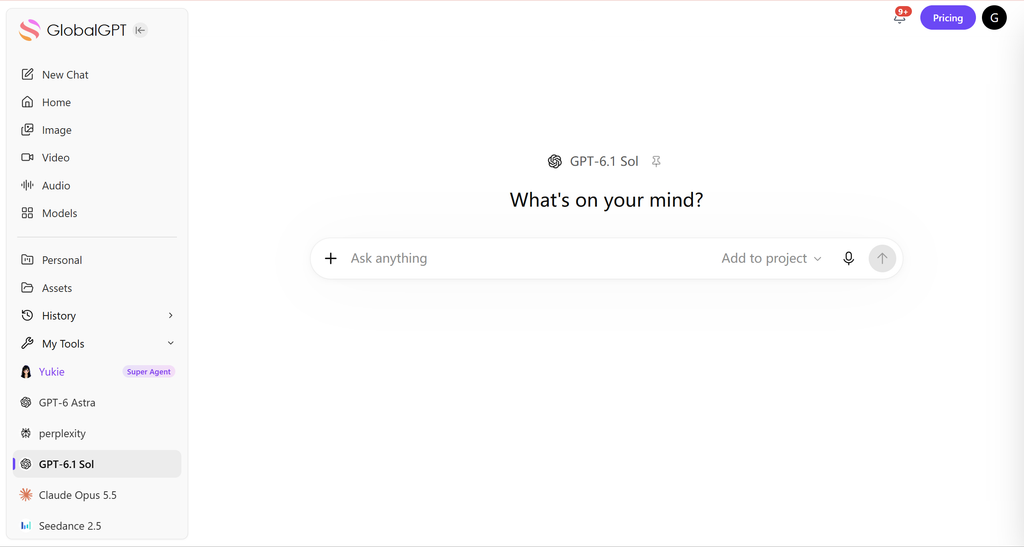
GlobalGPT provides live product routes for both models inside one multi-model workspace. Open the workspace, start a fresh conversation, and check the current model picker for GPT-6.1 Sol or GPT-6 Astra. Keeping both models in one interface is useful for side-by-side exploratory work, while API evaluation remains the better route for automated scoring, exact usage capture, and deployment controls.
Start with Sol for the first pass, then rerun the hardest prompt with Astra and compare what materially changed.
Geöffnet GlobalGPTFor deeper model-specific background, read our GPT-6.1 Sol explained guide und Testbericht zum GPT-6 Astra. Those pages cover each model individually; this page focuses on the purchase and routing decision between them.
Häufig gestellte Fragen
Is GPT-6.1 Sol better than GPT-6 Astra?
Not in absolute terms. OpenAI positions GPT-6 Astra as its most capable model and GPT-6.1 Sol as a lower-cost model with near-Astra performance for complex work. Sol is the better value when it clears your quality bar; Astra is the safer quality-first choice for the hardest tasks.
How much cheaper is GPT-6.1 Sol than GPT-6 Astra?
At Standard rates, Sol costs $2 per million input tokens and $10 per million output tokens, versus Astra at $10 and $50. Sol is therefore five times cheaper for uncached input and output. Its $0.10 cached-input price is one tenth of Astra’s $1 rate.
Do GPT-6.1 Sol and GPT-6 Astra have the same context window?
Yes. OpenAI lists a 1,050,000-token context window, 922,000 maximum input, and 128,000 maximum output for both models. Requests above 272K input tokens move the full request to higher long-context rates.
Welches Modell eignet sich besser zum Programmieren?
Astra is the quality-first choice for unusually difficult, ambiguous, or high-risk repository work. Sol is the practical default for routine feature work, debugging, reviews, and agent loops because its lower cost supports more iterations. Run both against the same repository tests before standardizing.
Do both models support tools and image input?
Yes. Their official model pages list text and image input, text output, structured outputs, function calling, web search, file search, code interpreter, hosted shell, apply patch, computer use, MCP, skills, and tool search. Tool calling should use the Responses API.
When should I pay for GPT-6 Astra?
Use Astra when an error is expensive, the task is genuinely frontier-level, or a matched evaluation shows that its extra quality reduces rework enough to justify five times the token price. Examples include critical migrations, difficult autonomous computer use, and final review of high-stakes deliverables.
Which reasoning effort should I choose?
Start at medium, the documented default for both models. Move down for straightforward transformations and up only when task difficulty or error cost requires it. The efficient setting is the lowest effort that consistently passes your acceptance tests.
Can I use GPT-6.1 Sol and GPT-6 Astra on GlobalGPT?
GlobalGPT has live routes for both GPT-6.1 Sol and GPT-6 Astra in its multi-model workspace. Availability can vary by account and interface, so open the workspace and check the current model picker before beginning a production workflow.
Should I route every prompt to one model?
Usually not. A simple router can send normal work to Sol and escalate low-confidence, failed-test, or high-risk cases to Astra. This captures most of Sol’s cost advantage while reserving Astra for prompts where marginal capability has measurable value.
Endgültiges Urteil
GPT-6.1 Sol should be the first model most cost-conscious teams evaluate; GPT-6 Astra should remain the escalation target for the hardest work. Their shared context, output limit, modalities, reasoning controls, and tool catalog make the comparison unusually clean. Sol delivers the economic advantage. Astra carries the official capability advantage.
The deciding metric is not token price or model prestige alone. Measure cost per accepted result under real operational constraints and budgets. If Sol passes at a similar rate, its five-times-lower uncached input and output rates are difficult to ignore. If Astra prevents failures, reduces expert review, or solves tasks Sol cannot, the premium can be rational. Start with identical tasks, keep the evaluation blind where possible, and promote only the model and reasoning effort that earns its place.