Kurze Antwort: Kling 4.0’s published API rates start at $0.157/s for 720p und $0.235/s for 1080p with no video input. That puts a 30-second attempt at $4.71 or $7.05 before retries. Consumer subscriptions use separate prices and credits; these API figures are not monthly plan prices.
Are you paying for a six-second visual effect or a 30-second mini-movie? The difference goes beyond runtime. A longer scene has more chances for a camera move, handoff or ending to miss the brief—and each new attempt can add to your budget.
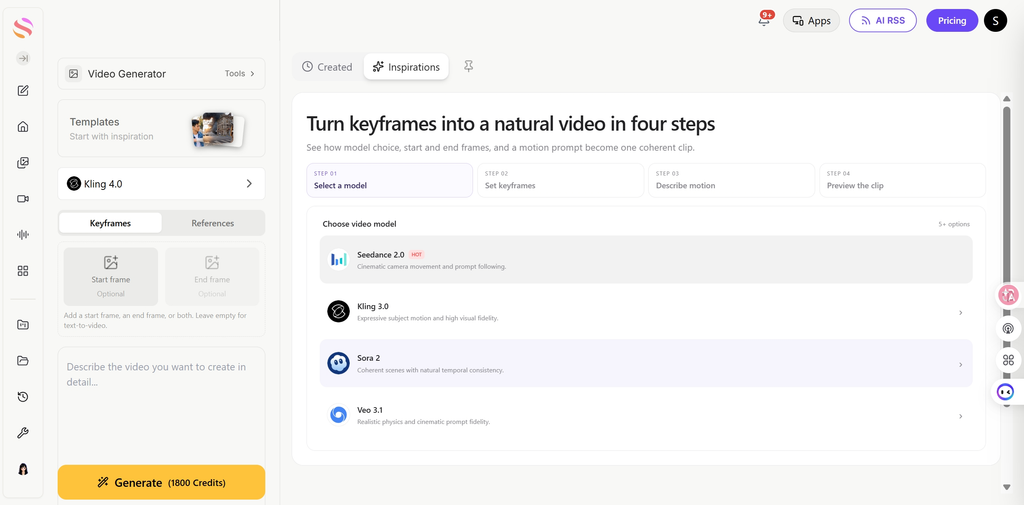
To help you decide what to spend, this guide pairs official pricing and credit rules with two real Kling 4.0 outputs: a short light-bridge shot and a wolf-chase film. You can also open Kling 4.0 on GlobalGPT to test a scene alongside other video models before choosing a longer-term workflow.
- API users: compare resolution and reference-video costs.
- Subscribers: check the exact 4.0 quote, included credits and expiry.
- Creators: allow for revisions, not just the finished runtime.
Auf dieser Seite
- Kling 4.0 API pricing: the official rate table
- Reference videos: why the lower rate can cost more
- Consumer plans: what to check before subscribing
- Kling credits: expiry, top-ups and cancellation
- Real clips: budget for the shot you can use
- API status: published pricing versus verified access
- Kling 4.0 pricing FAQ
- Is Kling 4.0 worth paying for?
Kling 4.0 API pricing: the official rate table
Die Kling 4.0 developer price table distinguishes three cases. The lower rate shown for video-input jobs applies to a larger billable duration, so it does not automatically mean a cheaper output.
| Input configuration | Billable seconds | 720p / billable second | 1080p / billable second |
|---|---|---|---|
| No input video | Ausgabedauer | $0.157 | $0.235 |
| Input video ≤ output duration | Output duration × 2 | $0.094 | $0.141 |
| Input video > output duration | Input duration + output duration | $0.094 | $0.141 |
- Video inputs include reference videos and video character elements; an image alone is not a video input.
- The 4.0 table lists no 4K API rate. Consumer 4K benefits do not establish 4.0 API support.
How much does a 6-, 30- or 60-second output cost?
| Ausgabenbudget | 720p, no input video | 1080p, no input video |
|---|---|---|
| 6 Sekunden | $0.94 | $1.41 |
| 30 Sekunden | $4.71 | $7.05 |
| 60 seconds total | $9.42 | $14.10 |
| 5 minutes total | $47.10 | $70.50 |
- Berechnung: output seconds × the published USD rate, rounded to cents.
- Umfang: no video input; excludes taxes, editing and repeat generations. Check resource-package purchase terms separately.
- Longer budgets: 60 seconds and five minutes are aggregate totals, not single-request duration limits.
One 30-second output • no input video • published API list rates
1080p is about 50% more expensive at these published rates. This is a price comparison, not a measured quality gain. Official tariff.
Reference videos: why the lower rate can cost more
A reference video lowers the listed rate but increases the number of seconds billed. Here is how that changes the budget for the same 30-second 720p output:
30-second 720p output • reference durations are billing examples
Berechnet auf der Grundlage von Kling’s input-duration billing rules. Examples illustrate the tariff; input-length acceptance must be checked against the endpoint and account you use.
- 10s reference: 30 × 2 × $0.094 = $5.64.
- 40s reference: (40 + 30) × $0.094 = $6.58. This illustrates billing, not an endpoint’s accepted input length.
- Trim references to the scene you need, then compare the final quote.
Consumer plans: what to check before subscribing
Die official membership FAQ names Standard, Pro, Premier and Ultra+. It says Ultra is closed to new subscriptions, while existing subscribers retain their benefits. Current monthly/annual dollar prices and exact 4.0 tier access are not verified here, so there is no defensible “cheapest plan” ranking.
- Zugriff auf das Modell: confirm Kling 4.0 is included, not just the Kling brand.
- Zahlung: compare today’s charge, annual commitment and renewal total; check tax, currency and promotion eligibility.
- Credits: compare the usable allowance with the exact 4.0 generation quote and expiry.
- Merkmale: verify resolution, watermark options, queue and concurrency terms.
- Premier tiers: the FAQ mentions 8K/18K/28K/38K credits in its switching rules; that alone does not verify current offers or prices.
Kling credits: expiry, top-ups and cancellation
Die Häufig gestellte Fragen zur Mitgliedschaft gives different expiry rules for monthly allowances, purchased credits and bonuses. Buying more credits does not itself unlock subscription benefits such as watermark removal or 4K generation.
| Consumer credit type | Published validity |
|---|---|
| Monthly subscription credits | 31 days from issue; unused monthly credits expire when the subscription ends |
| Separately purchased credits | 2 years from purchase |
| 7-day trial credits | 7 days from issue |
| Subscriber daily bonus credits | Expire at 24:00 local time the same day; trial/pass exclusions apply |
| Non-subscriber monthly free credits | Claim on login each month; valid for 31 days |
- Credits with the nearest expiry are spent first; promotion-specific credits follow the promotion’s terms.
- Free monthly credits do not establish free Kling 4.0 access or a fixed allowance.
- Credits cannot be redeemed for cash.
Can you turn a credit allowance into a clip count?
- Attempt count: divide usable credits by the exact generation quote and round down. Revisions reduce the number of finished clips.
- Quote factors: output count, model, duration and resolution. An official consumer 4.0 credit tariff is not verified here.
- Keep balances separate: consumer credits, developer units and third-party platform credits have no assumed shared dollar conversion.
What happens if you cancel?
- Web: Profile → Manage Plan → Cancel Subscription. Apple/Google Play purchases are managed in their store settings.
- At expiry: subscription benefits and unused monthly credits end. Other credits keep their own expiry dates.
- Check the renewal deadline; cancellation does not establish refund eligibility.
Real clips: budget for the shot you can use
- Ausgabe: both test clips returned 720p video at 24 fps.
- Budget basis: no-video-input API rates, not actual sample bills. These clips do not establish direct official API execution.
6-second test: a light bridge forms beneath a runner
- Haushalt: $0.94 per six-second attempt at the published 720p no-video-input API rate.
- Beobachtetes Ergebnis: separate amber panels form beneath the runner, making the central action readable.
- Verwendung: validate one visual mechanism before expanding it into a longer sequence.
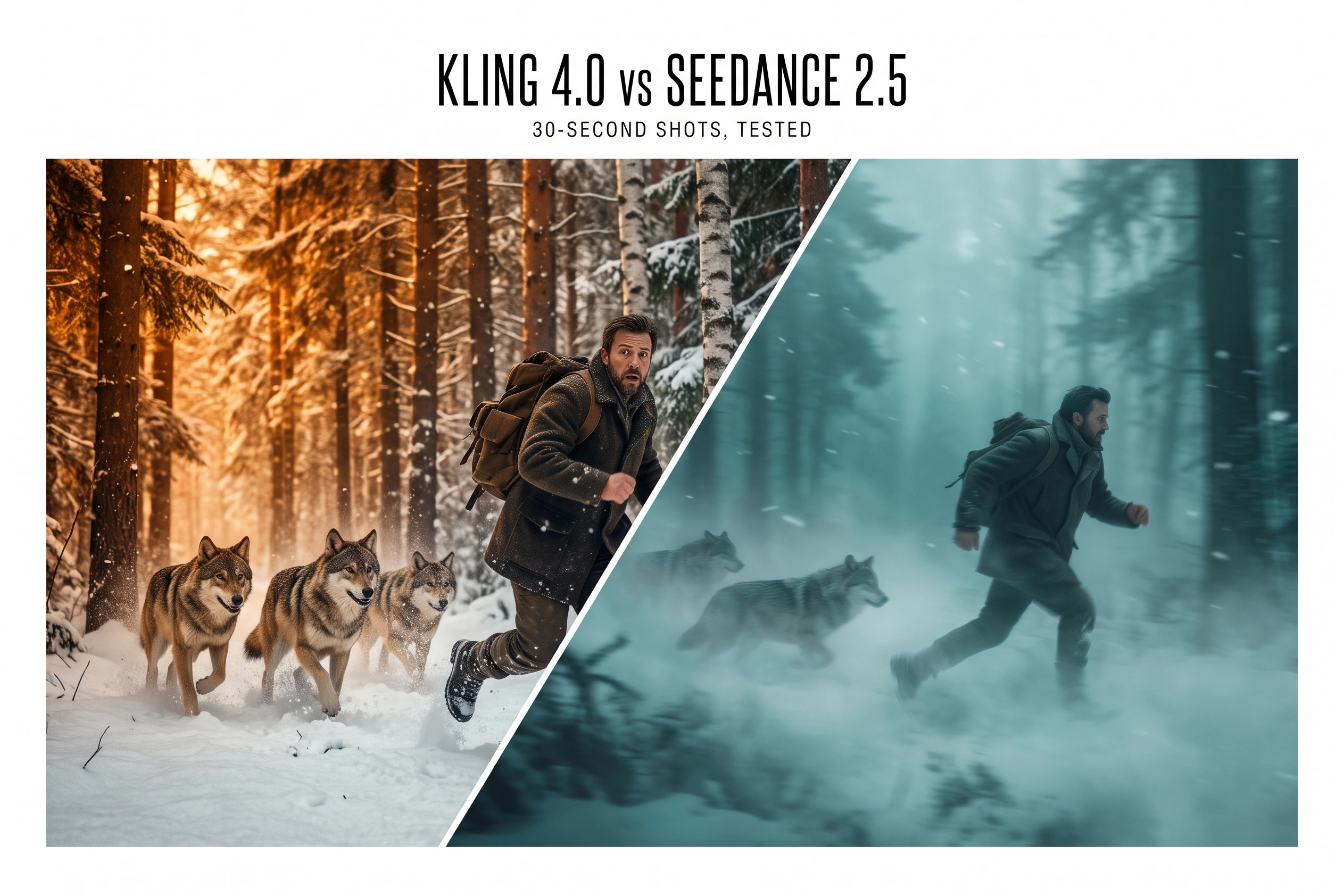
30-second test: a wolf chase turns into a counterattack
- Haushalt: $4.71 per 30-second attempt at the same published API rate.
- Beobachtetes Ergebnis: the fearful protagonist, wood-stack setup and three prone wolves make the ending readable. Trigger contact and escape geometry remain unclear.
- Revision priority: clarify the trap’s cause and effect before paying for a higher-resolution version.
Observations cover sampled frames and critical actions, not an exhaustive review. These examples support a revision budget, not a typical success-rate claim.
30-second 720p scene • no video input • independent scenario assumptions
Each attempt is assumed to generate the full 30 seconds at $0.157/s. These are planning scenarios, not measured retry rates or claims about failed-job billing.
For difficult shots, define the camera move and physical interaction before scaling the duration. Our guide to Kling camera movements can help turn a vague cinematic instruction into a more specific shot brief.
API status: published pricing versus verified access
Kling 4.0 has an official developer pricing entry. Published rates and account-level API access are different checks:
| Frage | Evidence from this check |
|---|---|
| Is an exact Kling 4.0 API price published? | Yes: 720p/1080p, with and without input video. |
| Did we verify exact endpoint parameters and account entitlement? | No. Confirm the exact model identifier, accepted durations and account access in the developer console before integrating. |
| Did we complete a direct official API generation for this article? | No. Existing video tests are output examples, not an official API access test. |
Verwenden Sie Kling’s developer documentation and your console to confirm the model identifier, authentication, resource-package requirements and limits before a small trial request.
- Consumer membership: choose it if you want the native creation interface and can verify the plan’s 4.0 access and quote.
- Entwickler-API: consider it for repeatable workflows after confirming endpoint access and purchase requirements.
- Multi-model platform: consider it when you want to test several models in one place. Compare its own quote and included features rather than applying Kling’s API tariff to it.
Kling 4.0 pricing FAQ
- How much does Kling 4.0 cost?
The published no-video-input API rates are $0.157/s at 720p and $0.235/s at 1080p. Consumer subscription prices and credits are separate; a current dollar plan comparison is not verified here. - How much is a 30-second Kling 4.0 video?
The no-video-input API budget is $4.71 at 720p or $7.05 at 1080p before retries and additional costs. These calculations are not the bills for our sample clips. - Is Kling 4.0 free?
Kling’s FAQ describes monthly free credits, but does not establish free 4.0 access or a fixed allowance. Check the exact model and generation quote in your account. - Do Kling credits expire?
Yes: monthly credits last 31 days, purchased credits two years, and daily subscriber bonuses until local midnight. Unused monthly credits also expire when the subscription ends. - Does buying credits include membership benefits?
No. Owning credits does not grant subscription benefits. Watermark removal and 4K generation require an active subscription and applicable feature access. - Does Kling 4.0 have an API?
An official developer pricing entry exists. Exact endpoint parameters, account entitlement and a completed direct official API request are not verified here; confirm them before integrating.
Is Kling 4.0 worth paying for?
- Test the hardest action first: a six-second 720p attempt has a $0.94 no-video-input API budget.
- Scale after the action works: one 30-second attempt is $4.71; three are $14.13 at the same rate.
- Choose a subscription for usable output: confirm exact 4.0 access, the generation quote, expiry and renewal total—not just the headline price.
For subscriptions, buy only after confirming exact 4.0 access, the generation quote, credit expiry and renewal total. If you are still choosing a model, try a short Kling 4.0 scene on GlobalGPT and review the output before committing to a longer production.