

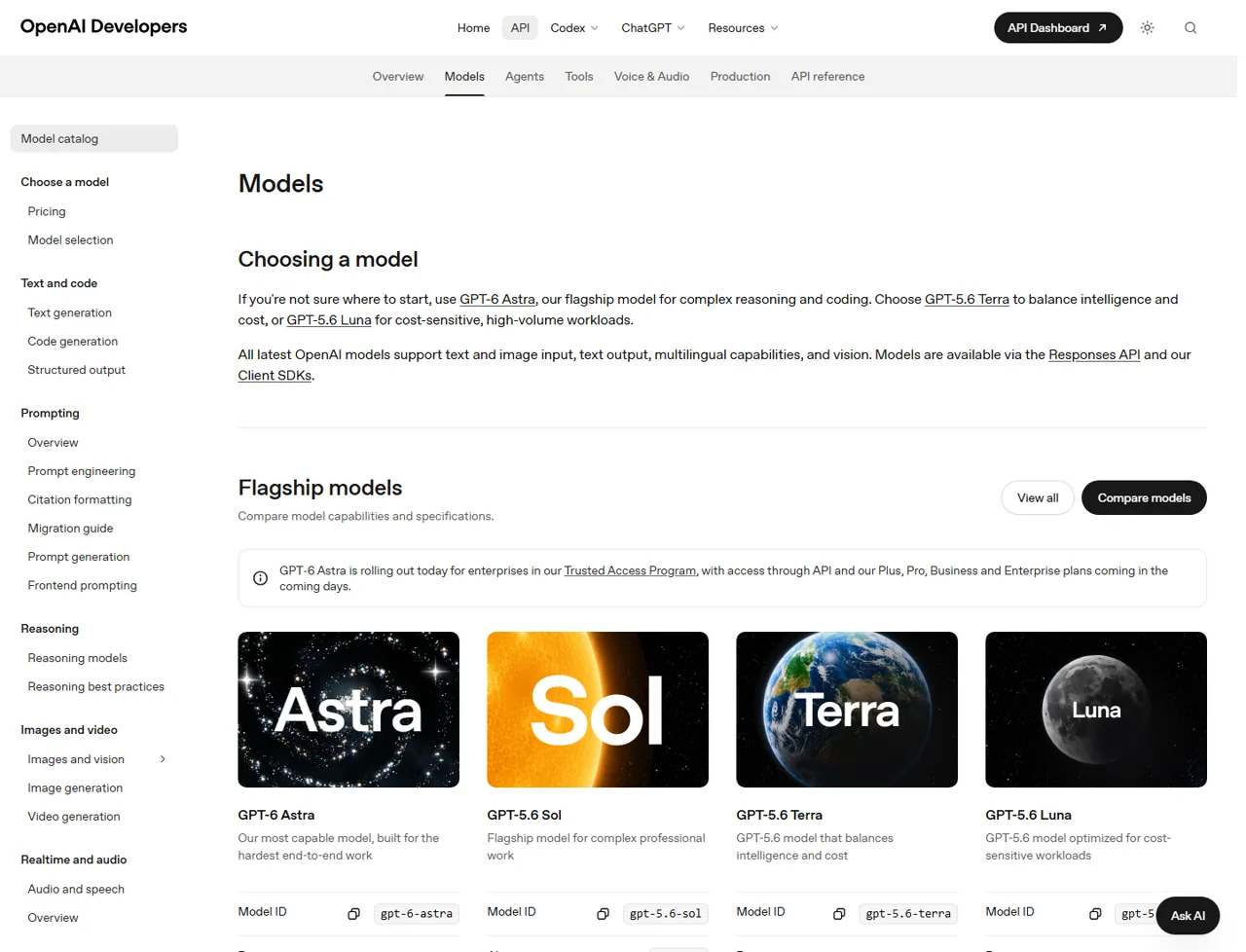
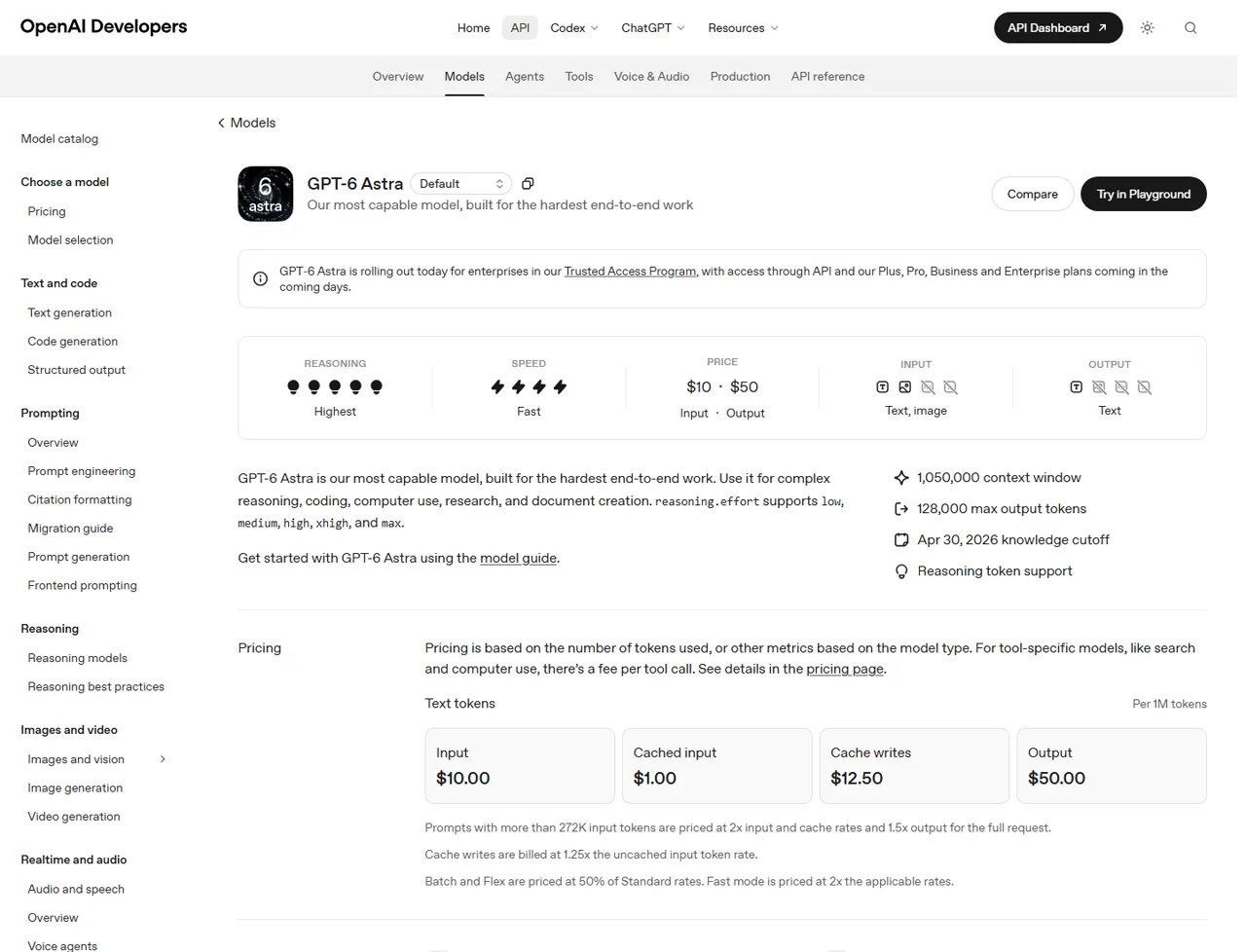
Quick answer: GPT-6 Astra costs $10 per 1M input tokens, $1 per 1M cached input tokens, $12.50 per 1M cache-write tokens, and $50 per 1M output tokens at Standard rates while a prompt stays at or below 272K input tokens. Above 272K, the full request moves to long-context pricing: $20 input, $2 cached input, $25 cache writes, and $75 output per 1M tokens. OpenAI documents a 1.05M-token context window and a 128K maximum output.
Those numbers make Astra powerful but expensive enough to require planning. A repeated prompt can become much cheaper when caching works, while a request that barely crosses 272K input tokens can become sharply more expensive. This guide separates official prices from calculated examples and from our September 5, 2026 hands-on API observations.
GPT-6 Astra API Pricing
OpenAI divides Standard pricing into short and long context. The threshold is based on input tokens, not total input plus output. Short context covers prompts up to 272K input tokens; long context applies above that point.
Cost per 1M tokens
The higher band applies to the entire request. Prices shown are per 1M tokens.
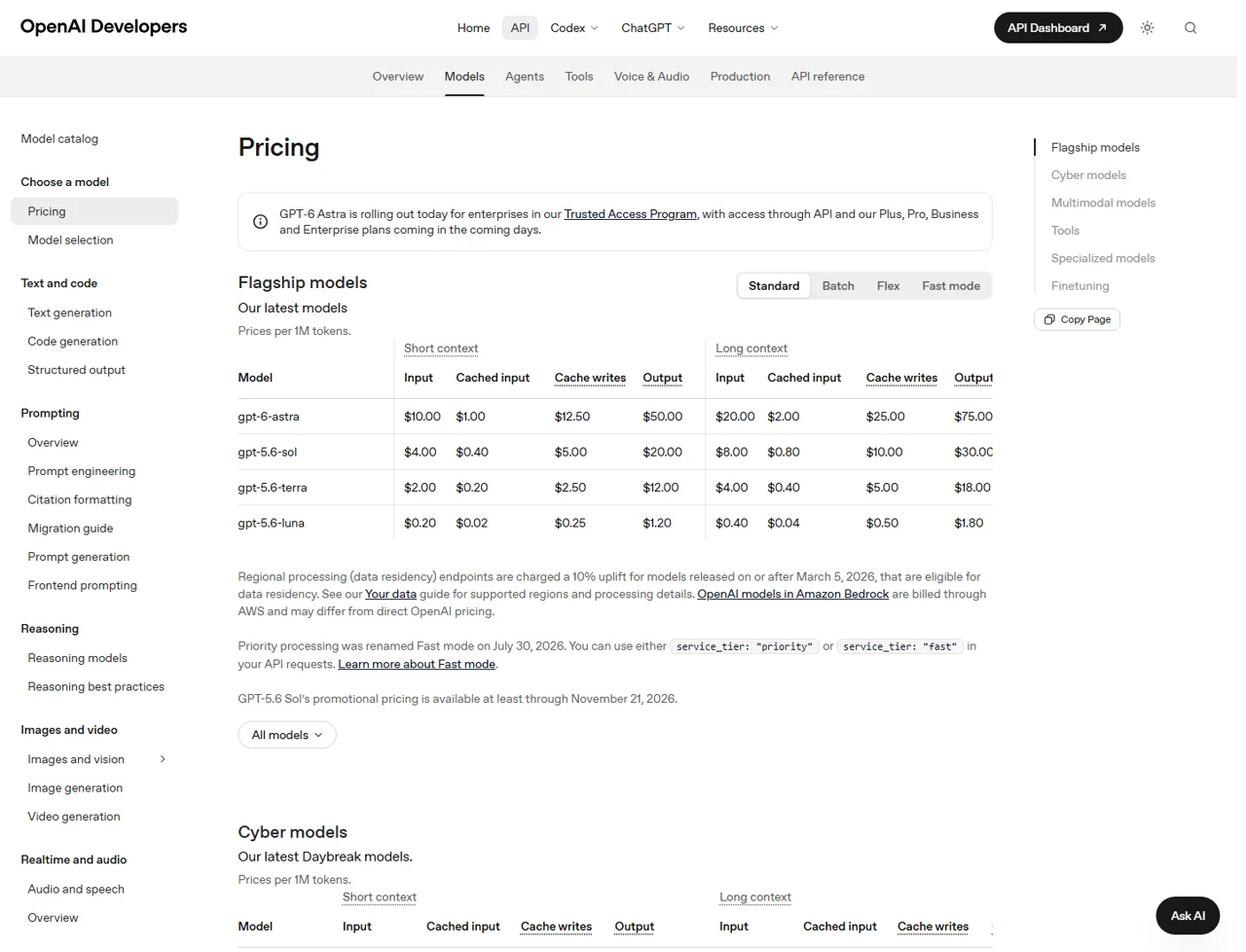
The most important detail is that crossing 272K does not create a mixed-rate bill. According to OpenAI’s API pricing documentation, the higher rates apply to the entire request when input exceeds the threshold. Teams comparing Astra with an earlier flagship should therefore look beyond the headline input price; our GPT-5.6 pricing guide provides useful context for that budget discussion.
Prompt caching can substantially reduce repeat-input costs, but cache creation is not free. A cache write costs 1.25 times the applicable uncached input rate. Batch and Flex processing cost 50% of Standard, while Fast costs twice the applicable rate. Eligible regional processing adds 10%, and Fast is unavailable for Astra with EU data residency.
How Much Does a GPT-6 Astra API Call Cost?
For a Standard request, calculate each billed token category separately, then add the results:
Total cost = uncached input cost + cached input cost + cache-write cost + output cost.
(0.0125 x $10) + (0.002 x $50)$0.225(0.1 x $10) + (0.005 x $50)$1.25(0.1 x $1) + (0.005 x $50)$0.35(0.3 x $20) + (0.01 x $75)$6.75Standard-rate estimates exclude tools, regional uplifts, and other separately billed services.
The 100K examples show why reusable prefixes matter: the model-token estimate falls from $1.25 to $0.35 when all input qualifies as cached. That is a pricing illustration, not a promise that every repeated prompt will produce a cache hit. For broader multi-model budgeting, compare the workflow assumptions in our all-in-one AI models guide.
GPT-6 Astra Tokens, Context Window, and Output Limits
The official GPT-6 Astra model page documents a 1,050,000-token context window and a 128,000-token maximum output. Its knowledge cutoff is April 30, 2026. It accepts text and image inputs, returns text, and supports the reasoning-effort settings low, medium, high, xhigh, and max.
A large context window is capacity, not a recommendation to fill every request. Retrieval, document selection, summarization, and prompt structure can keep the input below the 272K price boundary. Model choice matters too: developers focused on programming can compare the tradeoffs in our best AI model for coding analysis rather than assuming the model with the largest window is automatically the best fit.
Six Practical GPT-6 Astra API Test Tasks
Testing status: GPT-6 Astra became available through the Broly Anywhere compatibility API on September 5, 2026. We ran the six disclosed tasks below. Five produced usable HTTP 200 observations; the 272K boundary request ended with a transport failure and remains unverified.
Prompts and observed results
Model ID gpt-6-astra. Each result is one observed run, not an official benchmark. Wall-clock time includes gateway and upstream delay.
Basic token accounting
The model returned the expected theoretical calculation. Actual API usage was 54 input and 26 output tokens.
Prompt caching
Both lookups were correct, but the repeated prefix registered zero cached and zero cache-write tokens in both responses.
272K pricing boundary
The large synthetic request ended before an HTTP response arrived. No usage object was returned, so the rate band and billing behavior remain unmeasured.
Low vs max reasoning
Both runs calculated $265.20. Max took longer and returned 88 reasoning tokens; this single arithmetic task showed no answer-quality gain.
128K output parameter
The compatibility endpoint returned OK instead of rejecting one token above the official maximum. This is gateway behavior, not evidence of a larger supported output window.
Rate headers and service tiers
Normal responses contained no remaining-request or remaining-token headers. Flex and priority probes both succeeded but returned service_tier: default.
GPT-6 Astra API Rate Limits
GPT-6 Astra is not supported on the Free tier. Published limits rise by usage tier, but the live project headers remain the practical source for remaining capacity and reset timing.
Capacity rises sharply at Tier 5
Bar height is illustrative. The exact RPM, TPM, and batch-queue values above control.
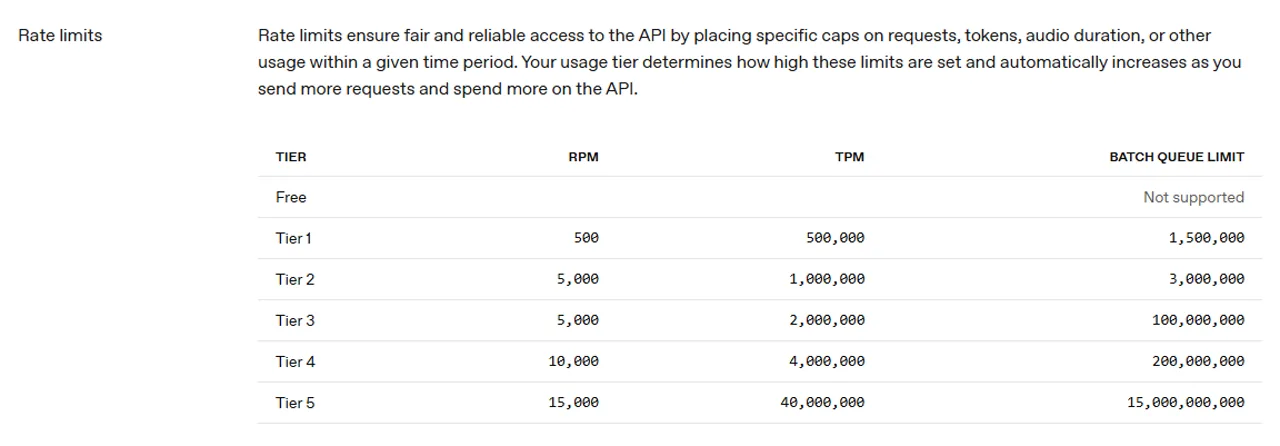
Batch or Flex can halve model-token rates when immediate responses are unnecessary. Fast may suit latency-sensitive work but doubles the applicable price and is not available with EU data residency for Astra. Before committing a production workload, compare model cost with surrounding platform expenses; our Codex pricing guide illustrates why product subscriptions and API billing should not be mixed together.
What Early Reviewers Are Showing
Independent creator Matt Wolfe published an early first-look video covering coding, computer use, Blender, and Unreal Engine demonstrations. These examples are useful for understanding the kinds of workflows reviewers are exploring, but they are not controlled benchmark evidence and do not replace the API tests above. Broader comparisons such as ChatGPT vs Claude vs Gemini should likewise be read as workload-specific guidance, not a universal leaderboard.
Who Should Use GPT-6 Astra?
Astra is a plausible fit for difficult coding, agentic workflows, large-document analysis, and multimodal jobs where stronger reasoning or a very large context window can offset a premium token bill. Teams should pilot it on a narrow, measurable task and compare quality per dollar, not simply output quality. Our best AI models overview offers a wider selection framework.
- Use Astra when: the task is complex, errors are expensive, long context is necessary, or the model can replace several weaker passes.
- Use a cheaper model when: the work is routine classification, extraction, rewriting, or high-volume generation with straightforward quality requirements.
- Optimize first when: prompts repeatedly cross 272K, large static prefixes can be cached, or latency does not require Standard or Fast processing.
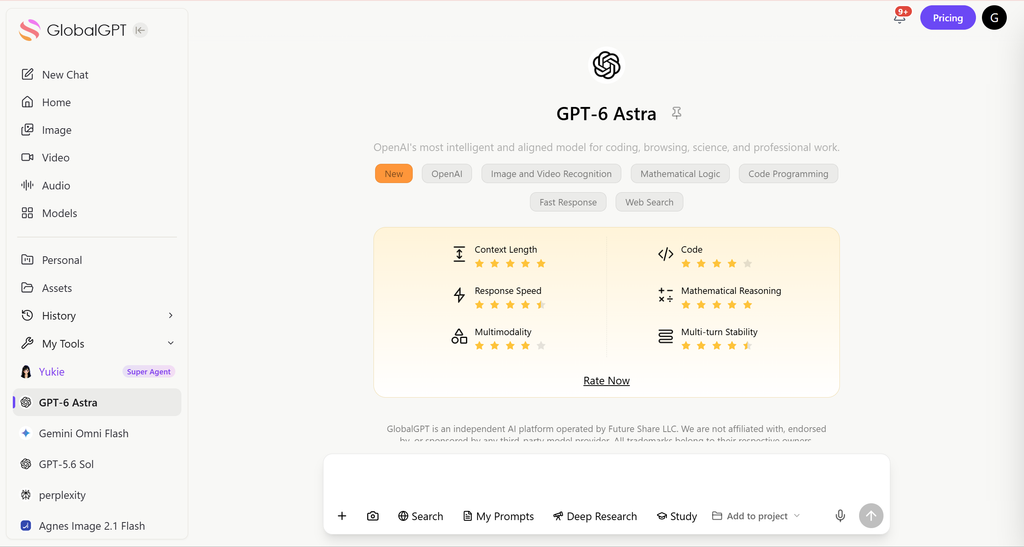
For readers comparing adjacent premium options, the GPT-5.6 vs Fable 5 vs GPT-5.5 comparison provides another view of cost, capability, and workload fit. GlobalGPT has a dedicated GPT-6 Astra landing page. Our API observations were recorded separately through the Broly Anywhere compatibility endpoint.
Frequently Asked Questions
What is the GPT-6 Astra API price?
Standard short-context pricing is $10/M input, $1/M cached input, $12.50/M cache writes and $50/M output. Above 272K input tokens, the full request uses $20/M input, $2/M cached input, $25/M cache writes and $75/M output.
What happens when a prompt exceeds 272K input tokens?
OpenAI moves the entire request to the long-context band. It is not a mixed bill where only the tokens above 272K cost more.
What is GPT-6 Astra’s context window?
OpenAI lists a 1,050,000-token context window, a 922,000-token maximum input, and a 128,000-token maximum output. Reasoning tokens also occupy context and are billed as output.
Does GPT-6 Astra support image input?
Yes. The model documentation lists text and image input with text output. Audio and video are not listed as input modalities for this model.
Are these cost examples official invoices?
No. They are arithmetic examples using the documented rates. Your bill can also reflect cached-token accounting, processing mode, regional processing and other separately billed services.
Which processing modes are available?
Standard, Batch, Flex, Fast and Ultrafast have documented Astra prices. Batch and Flex cost half of Standard, Fast costs twice Standard, and Ultrafast costs six times Standard in the same context band. Eligible regional processing adds 10%; availability depends on the mode and endpoint.
How is GPT-6 Astra billed through GlobalGPT?
GlobalGPT’s API lists 23 credits per 1K input tokens and 117 credits per 1K output tokens for GPT-6 Astra. Reasoning tokens are billed as output. Those are GlobalGPT credit rates; OpenAI API usage follows its own USD pricing.
Final Verdict
GPT-6 Astra combines a 1.05M-token context window and 128K maximum output with premium pricing. Its short-context Standard rate starts at $10 per 1M input tokens and $50 per 1M output tokens, but the 272K boundary, reasoning tokens, cache writes, processing mode, and regional uplift can materially change the bill. Estimate tokens before sending large prompts, verify caching from usage data, and judge Astra on the value of the completed task rather than the headline price alone.