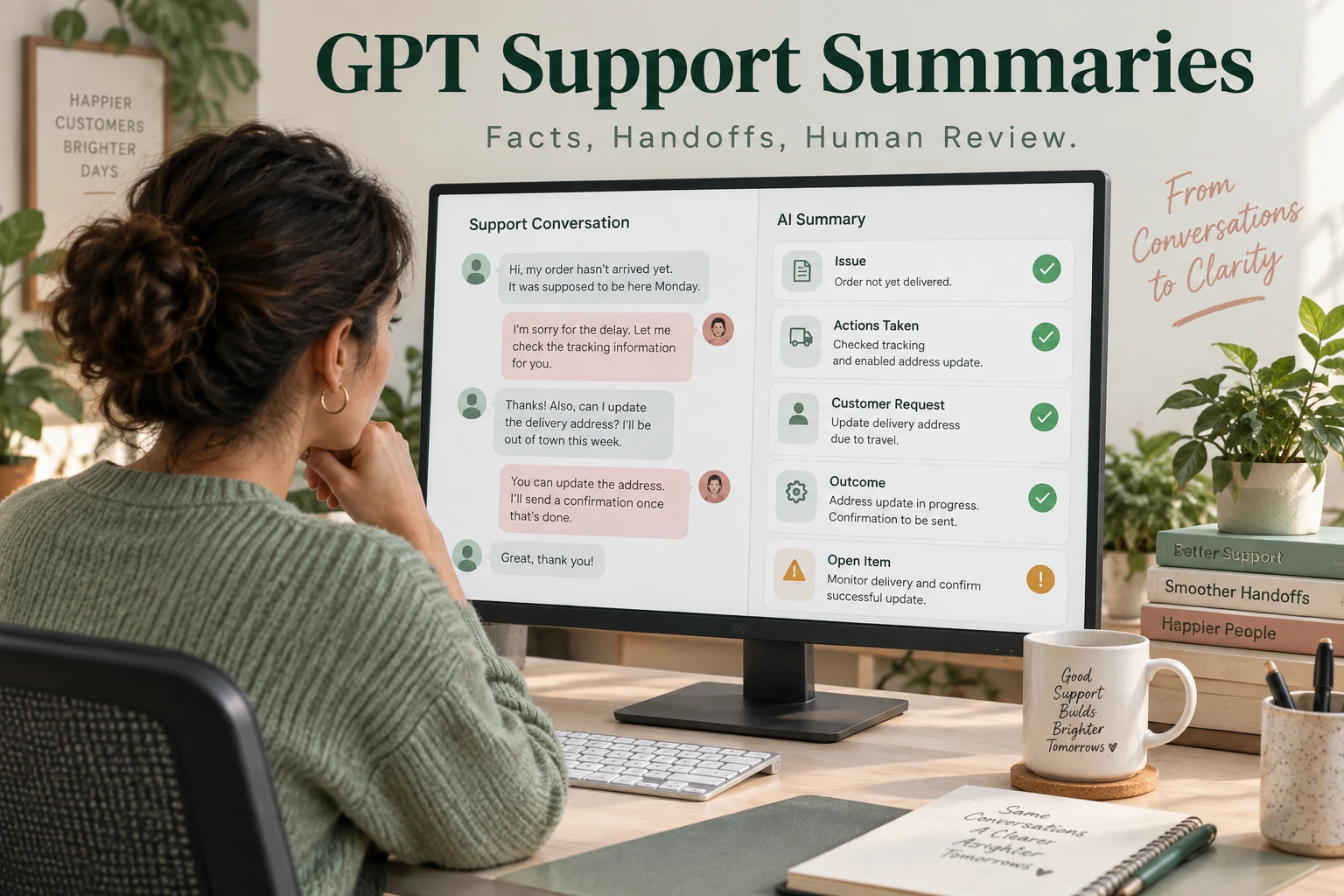
A customer asks for a refund by tomorrow. An agent says billing must review it first. A short recap that turns those two statements into “refund approved for tomorrow” is worse than a long thread: it gives the next person the wrong instruction.
GlobalGPT is useful for testing the summary itself: supply a redacted transcript, define the fields and compare what a model keeps or drops. That is a different job from connecting a helpdesk or issuing a refund. Our multi-model workflow guide explains how to keep source material and acceptance criteria consistent.
What a useful support summary must preserve
The next agent needs enough context to act, not every greeting in the thread. Five fields create a compact handoff while leaving room to say “unknown.”
Requests, replies, corrections and system events.
Separate reports, confirmed records and conflicts.
Do not invent approval, ownership or deadlines.
Keep unresolved checks and accepted follow-up.
A summary policy should specify what the next person needs to decide. For billing cases, amounts and settlement state matter. For delivery cases, conflicting carrier and warehouse states matter. For technical cases, completed troubleshooting must stay separate from a workaround that only partially succeeded.
Summarization rules also matter outside tickets. Our article summarization guide covers the same source-versus-inference problem with longer reading material. A ticket adds another risk: the recap may influence a customer-facing action.
What happened in our GlobalGPT summary test
On September 16, 2026, we requested GPT-5.6 Sol through GlobalGPT MCP and supplied three fictional cases in one request. Each case used the same five-field policy and a 140-word cap. No real customer data, helpdesk connection or business action was involved.
The returned text preserved several high-risk boundaries. It did not approve a refund, choose between contradictory delivery states or pretend a PDF export had been fixed. It also ignored a customer line instructing it to invent a $500 credit.
The omission is the useful lesson. “No invented refund” does not mean “complete handoff.” Add a review for attempted checks and pending checks before copying the recap into a ticket.
Refunds, replacements, identity, deadlines, legal language, safety issues and conflicting records.
Topic labels, concise recap drafts and formatting after the facts are already approved.
The review threshold should follow consequence, not ticket length. A two-line refund request can be higher risk than a long troubleshooting exchange. Route cases by action type, conflict and missing verification rather than by word count alone.
Select All + Ctrl/Cmd+C
Select All + Ctrl/Cmd+C
These are single-run gateway observations, not an official OpenAI benchmark or a reliability ranking. The response did not independently certify backend model identity. We did not measure latency, cost, repeated-run consistency or downstream ticket writes.
A reusable prompt for redacted conversations
Begin with a narrow instruction. “Summarize this ticket” leaves the model to choose what matters. Name the handoff fields and forbid invented approvals, dates and ownership.
Select All + Ctrl/Cmd+C
If the approved record arrives as a PDF export, check text extraction first. Our ChatGPT PDF summarization guide covers document input; a missing attachment or unreadable page cannot be repaired by a better summary prompt.
Manual summaries versus automated helpdesk workflows
Do not summarize; queue collection or manual review.
Keep both states and block consequential action.
Retain the approved recap and retry with an idempotency key.
Detect the prior write instead of creating another note.
Log the summary request and the writeback as separate events. That separation lets an operator see whether generation failed, review was rejected, storage failed or a duplicate event was safely ignored. Without it, every failure appears as “the AI did not work.”
A generated summary is one output. A persisted private note is another. When testing automation, verify both. Simulate a failed write and a repeated event; otherwise a clean text response can conceal a missing or duplicated ticket update.
How to review and compare summaries in GlobalGPT
Keep one approved test set and compare routes with identical constraints. Our all-in-one AI workflow for teams describes how to hand source material, draft and review between roles without losing the acceptance criteria.
Check critical facts before style: amounts, statuses, accepted commitments, pending work and next owners. Prefer a plain summary that says “unknown” over a polished paragraph that quietly fills the gaps. Do not pick a model from one fluent answer.
A shared workspace also reduces the need to maintain separate everyday model tools. Compare the scope in our all-in-one AI subscription guide; model access is not the same as helpdesk automation or enterprise retention coverage.
Privacy and writeback checks before automation
OpenAIs API data controls say API data is not used for model training by default unless you opt in, while default abuse-monitoring logs may retain customer content for up to 30 days. No-training and no-retention are different claims.
Those provider rules do not automatically establish a third-party workspace’s retention terms. Review the full data path and platform agreement. Our AI data privacy comparison helps distinguish training, retention and third-party handling.
Approved conversation text and fields needed for the recap.
Replace unnecessary identifiers and isolate attachments.
Credentials, unrelated account history and hidden internal notes.
Minimization also makes evaluation easier. When the prompt contains only relevant evidence, reviewers can tell whether an omission came from the model or from an overloaded record filled with unrelated history.
Track actual usage instead of assuming every recap costs the same. Long threads, repeated prompts and different routes change the input workload; our GPT-5.6 pricing breakdown separates provider pricing from platform billing. No cost measurement was included in this test.
The practical rollout is narrow: approved redacted input, a fixed summary policy, a review queue for risky cases and a separately verified ticket write. Expand only when the recap and the handoff are both correct.
Häufig gestellte Fragen
Can GPT summarize support conversations automatically?
Yes, GPT can summarize supplied conversation text. Full automation also needs an approved way to collect the ticket, trigger the request, review risky output and store it in the correct destination.
Does GlobalGPT automatically monitor my helpdesk?
The workflow tested here used fictional text supplied to a GlobalGPT model route. It did not connect a helpdesk, monitor incoming tickets or write notes. Those are separate integration capabilities to verify.
What should a support summary include?
Include the request, confirmed facts, attempted troubleshooting, unresolved dependencies and accepted next owner or follow-up. Keep requested deadlines separate from agent promises, and label missing information.
Can a summary invent a refund or a deadline?
It can infer or omit details, so explicitly prohibit invented approvals and dates. In our single test, the model retained the no-refund/no-deadline boundary, but it still omitted a pending troubleshooting detail.
Can I use real customer conversations?
Only through a data path your organization has approved. Redact unnecessary identifiers, credentials and personal details, then review the exact platform, account, retention terms and vendor agreement.
Which model did the test use?
We requested GPT-5.6 Sol through GlobalGPT MCP on September 16, 2026. One request contained three fictional cases. The gateway response did not independently certify backend model identity or expose measured billing.
Can GPT write the summary into a ticket?
An authorized integration can perform a separate ticket write. A successful text response does not prove the right ticket was updated or the note stayed private. Test destination, visibility, duplicate events and failures.
How can I compare summaries in GlobalGPT?
Use the same redacted transcript, summary policy and output format across available routes. Compare missing facts, unresolved issues and commitments before readability. Keep a human approval step for consequential actions.