
บทสรุปสั้นๆ
The tested Anywhere meshy-v7 route is a useful rapid-prototyping tool, not a reliable shortcut to production-ready geometry. Four of five frozen slots returned valid GLBs. The mug and bicycle preserved strong coarse silhouettes, but hidden-surface projection, thin-part fusion, one-mesh construction, and missing PBR detail maps created real cleanup work. In the matched robot pair, hosted Smart Topology did not honor the 15k target, did not return quads, showed no clear joint-loop advantage, and produced more boundary and non-manifold edges than Standard. Route reliability was also mixed: one slot failed twice before task creation and another required its only operational retry.
Meshy 7 arrived in August 2026 with a strong claim: closer geometric alignment between a reference image and the generated 3D asset. But a useful review has to look past the supplied front view. Handles, spokes, small controls, hidden backs, texture projection, and the mesh itself are where a convincing preview can turn into a cleanup project.
There is also a version caveat. Meshy 7.1 began rolling out on September 10, 2026. The hands-on tests in this article use the separately identified Anywhere route ID meshy-v7. That label does not prove whether every request used Meshy 7, Meshy 7.1, or Meshy’s separate T2 topology system, so the official product facts and hosted-route results are kept separate.
For creators building a complete image-to-3D workflow, GlobalGPT offers an affordable way to use multiple AI models and functions in one dashboard. You can prepare or refine a reference image, generate the 3D asset, then continue with prompt work, research, writing, or development without moving the project across a separate service for every step.
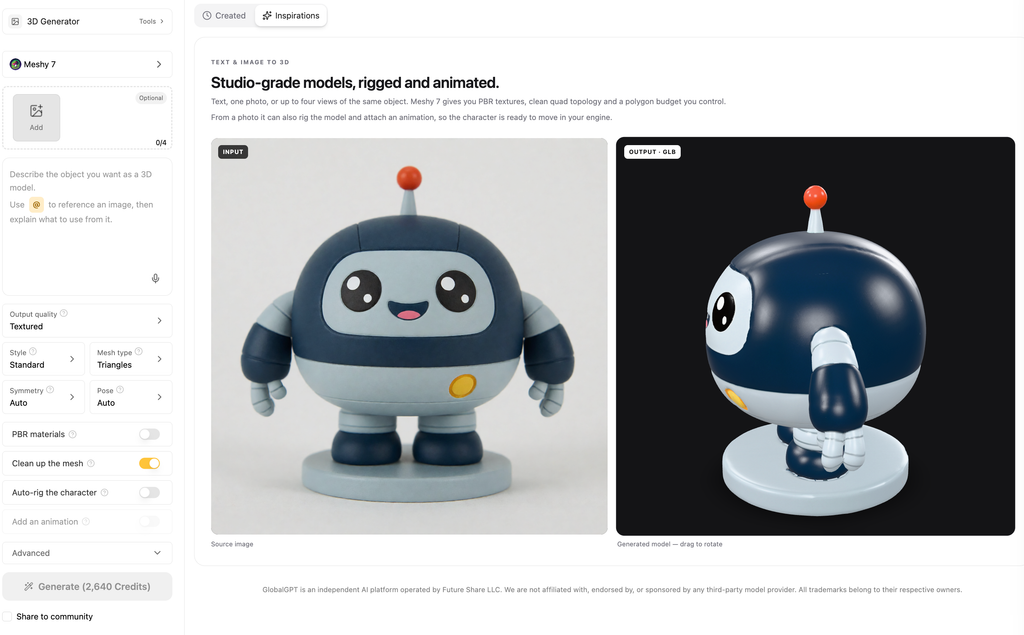
What Meshy 7 Is, and What Changed with Meshy 7.1
Meshy describes Meshy 7 as an image-to-3D foundation model built to align generated geometry more closely with a reference image. The company announced the model in August 2026 and reported stronger results for overall proportion, spatial distribution, and surface detail. Those numbers are vendor benchmarks, not scores from this review.
Meshy 7.1 began rolling out on September 10, 2026, adding an Ultra 4K geometry mode in Meshy’s own product. That timing matters: an unversioned hosted label such as meshy-v7 should not be called the latest Meshy model, and a hosted result should not be described as 7.1 unless the response identifies it that way.
Release facts and review scope
| Name | Verified context | What this review can claim |
|---|---|---|
| Meshy 7 | Image-to-3D release announced in August 2026 | Official positioning and vendor-reported benchmarks, clearly attributed |
| Meshy 7.1 | Rollout began September 10, 2026 | Freshness warning; not silently assigned to hosted results |
ที่ไหนก็ได้ meshy-v7 | Hosted route tested through /v1/tasks | Only the observed request, response, file, timing, and cost evidence |
Three Meshy Contracts You Should Not Treat as the Same Model
The most important terminology problem is not cosmetic. Meshy’s native API documentation identifies Smart Topology as a separate meshy-t2 model. The current Anywhere interface instead exposes a Smart Topology label under its hosted meshy-v7 route and limits that option to text input. A successful hosted request would prove that the hosted contract works; it would not prove that T2 is part of V7.
Native documentation vs hosted route
| สัญญา | โหมดการป้อนข้อมูล | Topology behavior | ขอบเขตของหลักฐาน |
|---|---|---|---|
| Official Meshy 7/7.1 product | Image-to-3D positioning | Version-specific product claims | Official release material, not the hosted response |
Native API meshy-t2 | Documented for single Image-to-3D | Documented triangle output; ignores ordinary topology and remesh fields | Native API contract only |
ที่ไหนก็ได้ meshy-v7 Smart Topology label | Text-only in the captured hosted interface | Hosted request accepts a topology field; delivered file must be inspected | Current hosted contract only |
A request containing topology=quad is not evidence that the returned GLB contains editable quad topology.
How We Tested the Anywhere-Hosted meshy-v7 เส้นทาง
The frozen batch uses five first-valid output slots. Three single-image tests target different failure modes: a white mug for hidden surfaces and texture projection, a vintage camera for mixed materials and small parts, and a road bicycle for thin structures and open gaps. A separate robot prompt compares the hosted Standard and Smart Topology labels at the same requested 15,000-polygon budget.
- Every slot keeps the first valid output, even when the result is visibly weak.
- Each operational failure gets at most one retry; a poor but valid asset does not.
- The batch excludes multiview, Ultra, Low-poly, rigging, animation, stability runs, quality rerolls, and named-competitor head-to-head tests.
- Each valid GLB is checked for vertices, stored triangles, open and non-manifold edges, components, UVs, materials, textures, and browser import.
- Displayed estimates are kept separate from response-side billing fields. Quota and margin are never converted into a claimed charge.
First-valid test status
All five frozen slots have terminal handling; operational failures remain separate from output-quality judgments.
| Slot | Terminal state | What can be evaluated |
|---|---|---|
| T01 · mug | Success | First-valid GLB downloaded, inspected, rendered, and scored. |
| T02 · camera | No valid output | Initial submit and the one allowed operational retry both returned HTTP 530 before a task ID. No quality score is assigned. |
| T03 · bicycle | Success after operational retry | The first submit returned HTTP 502 before task creation; the pre-registered retry produced a valid GLB that was inspected, rendered, and scored. |
| T04A · Standard | Success | First-valid GLB inspected under the matched 15k request. |
| T04B · hosted Smart | Success | First-valid GLB inspected against the Standard control. |
Image-to-3D Test 1: Hidden Surfaces on a White Mug
A simple mug can expose surprisingly difficult reconstruction problems. The handle must remain open and attach cleanly at both ends, the rim needs a real cavity, and the unseen rear and underside must form a coherent object. The source also places one cobalt stripe only on the visible front, making unwanted texture projection around the back easy to spot.
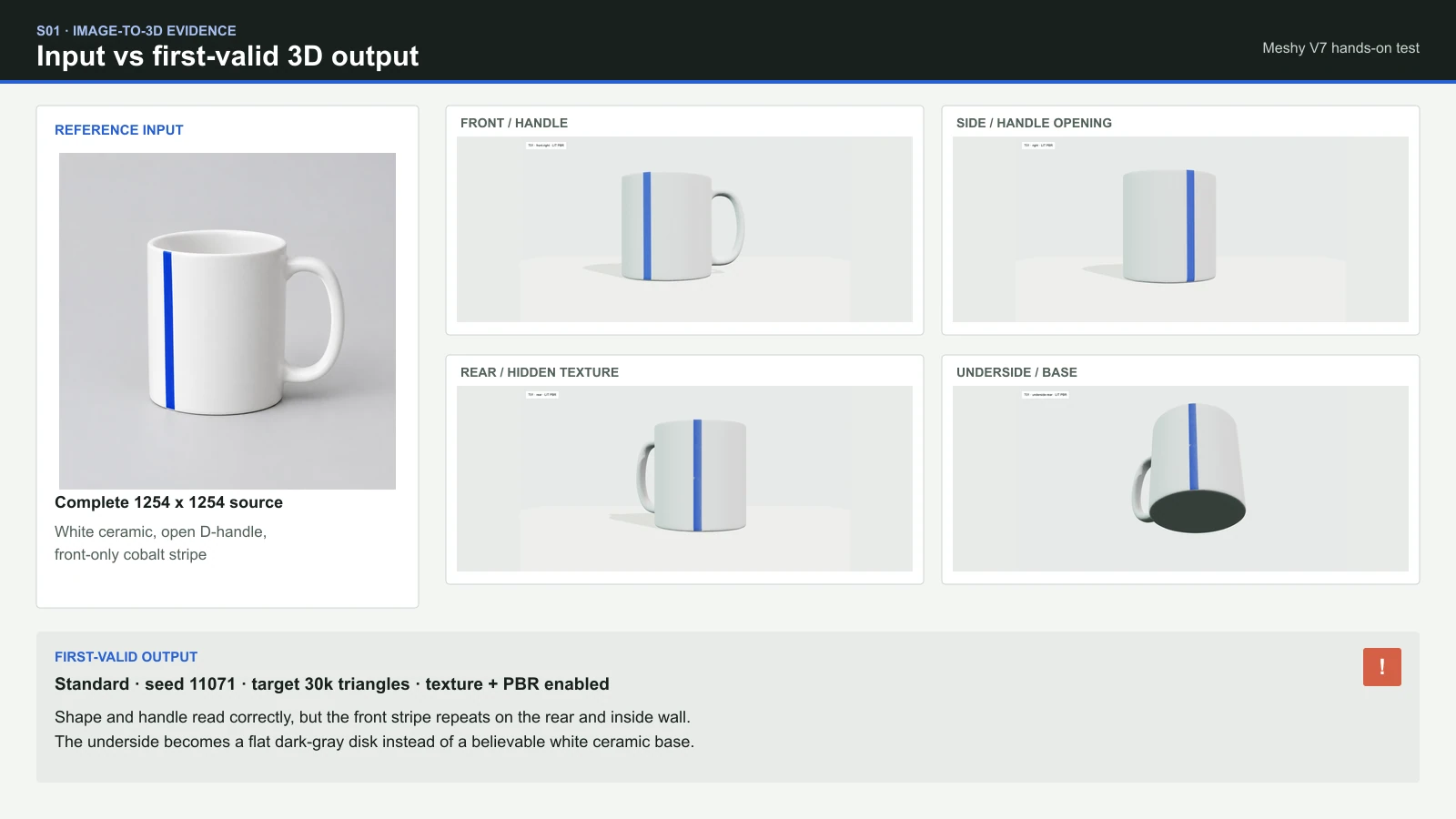
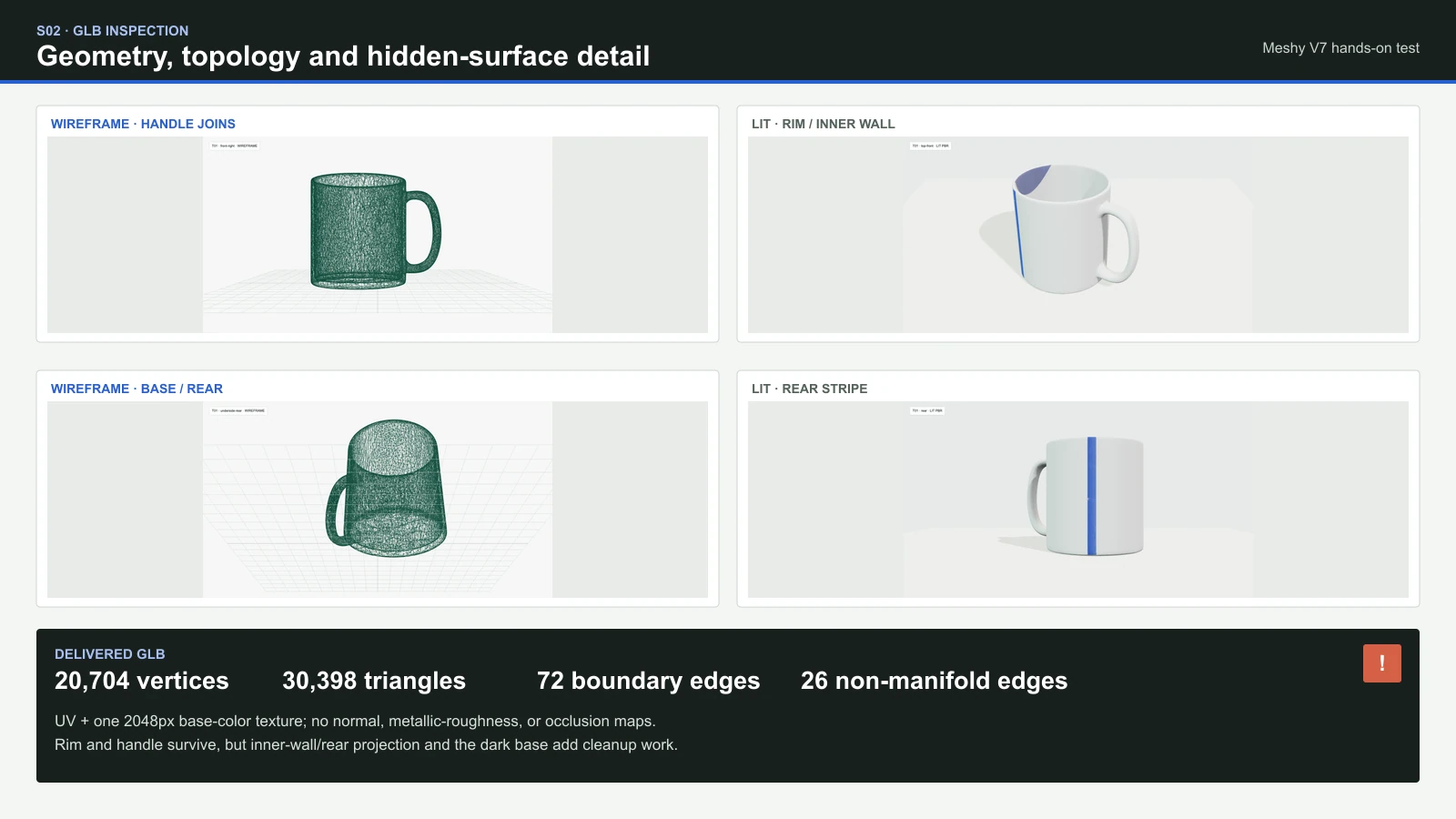
The first-valid result kept the mug’s straight-sided silhouette, open handle, and visible cavity. The result becomes much weaker when rotated. The front-only blue stripe reappears on the rear and continues into the inner wall, while the underside is capped by a flat dark-gray disk instead of a believable white ceramic foot. In other words, the model reconstructed the category and major shape more successfully than it inferred unseen surface appearance.
T01 result: recognizable shape, unreliable hidden surfaces
Ratings use the frozen 0-5 cleanup scale. There is no decorative overall score.
| มิติ | การจัดอันดับ | Observed first-valid result |
|---|---|---|
| Silhouette and proportion | 4/5 | The mug remains clearly recognizable with useful overall proportions. |
| Handle opening and joins | 3/5 | The opening and both joins survive, but the handle surface and attachments need cleanup. |
| Rim, cavity, rear, and underside | 2/5 | The cavity exists, but the underside becomes a flat dark disk. |
| Front-only stripe projection | 1/5 | The stripe is incorrectly projected onto the rear and inner wall. |
| UV, materials, and cleanup | 2/5 | UVs and a base-color texture are present, but missing PBR maps and topology defects increase cleanup. |
Image-to-3D Test 2: Materials and Small Parts on a Vintage Camera
The camera combines a circular glass lens, brushed metal, dark leather, two top dials, and two strap loops. The test asks whether those material zones and small components survive as usable structure rather than being painted onto a soft block.
No camera asset was produced. The first submission and the one authorized operational retry both returned HTTP 530 before Anywhere created a task ID. That result belongs in the reliability record, not the image-to-3D quality score: there is no generated lens, dial, strap loop, material, or mesh to judge.
T02 status: operational failure, no quality score
Two HTTP 530 responses, zero task IDs, and zero valid outputs. The slot is closed under the pre-registered retry policy and will not be submitted again.
Image-to-3D Test 3: Thin Geometry and Open Gaps on a Bicycle
A bicycle is a harsher geometry test. Circular wheels, spokes, narrow tubes, the fork, chain, crank, and two pedals all compete for limited geometry, while the open frame triangles must stay open instead of fusing into a slab.
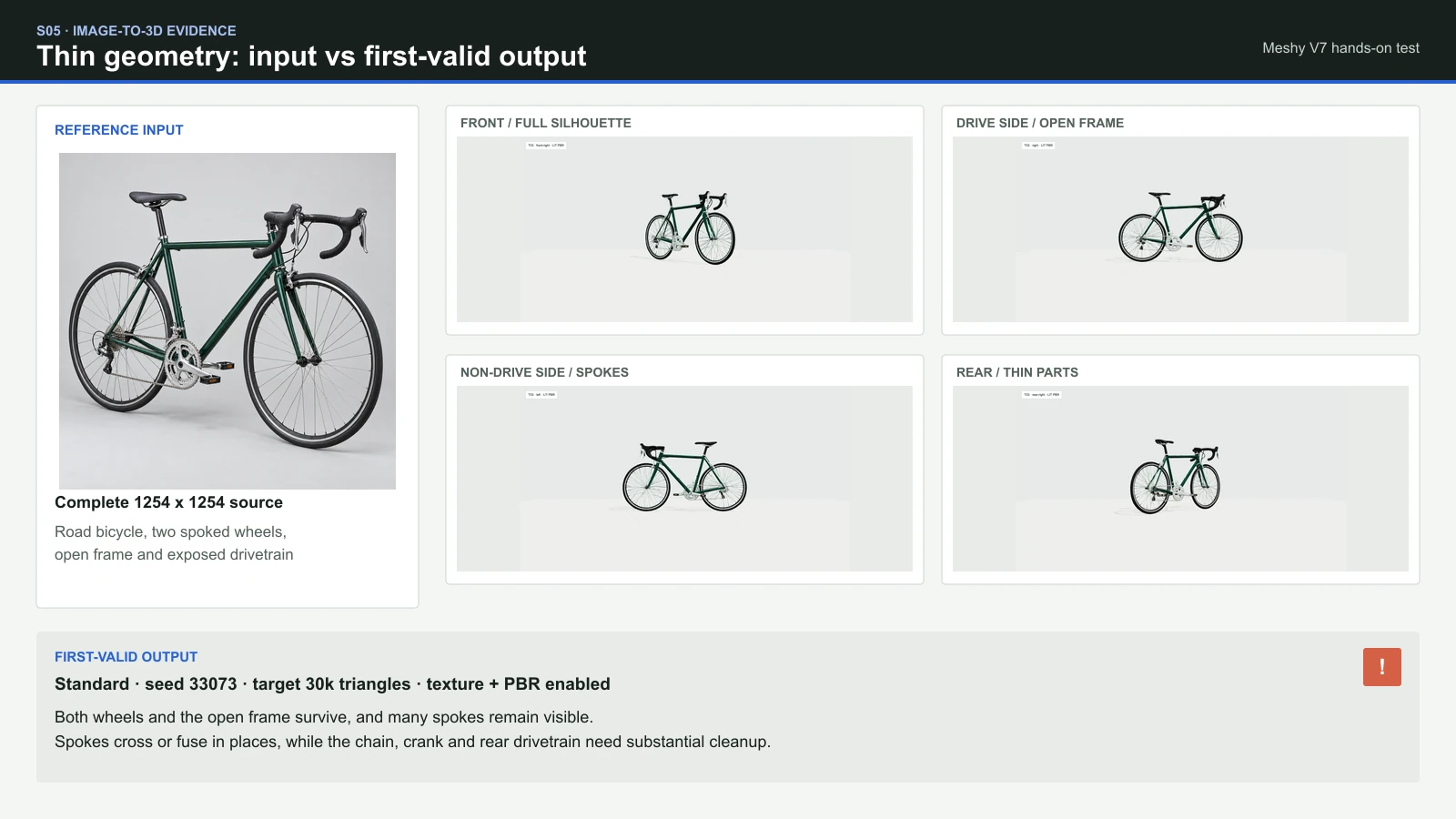
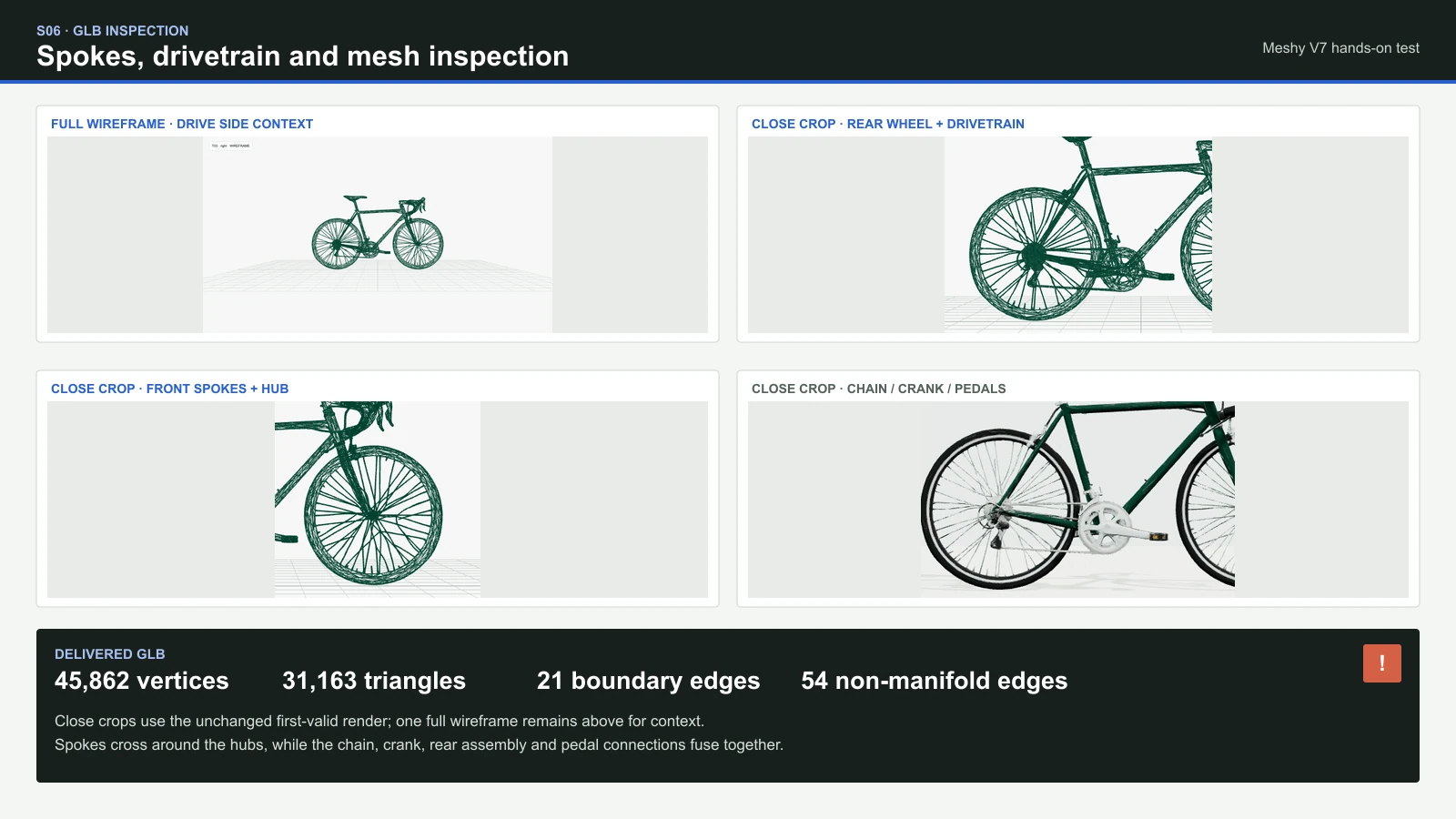
The first-valid bicycle looks convincing from ordinary viewing distance. Both wheels stay broadly round, the main frame silhouette remains recognizable, and the large front and rear frame openings do not fill in. The weakness appears when the mesh is inspected more closely: several spokes bend, double, cross, or fuse around the hubs, while the chain, crank, chainrings, derailleur, and rear hub merge into a mechanical approximation rather than separate editable parts.
T03 result: strong bicycle silhouette, fragile mechanical detail
Ratings use the same frozen 0-5 cleanup scale as the mug test. There is no decorative overall score.
| มิติ | การจัดอันดับ | Observed first-valid result |
|---|---|---|
| Wheel roundness and frame silhouette | 4/5 | Both wheels and the road-bike silhouette survive with only localized shape variation. |
| Spoke survival | 3/5 | Many spokes remain visible, but several bend, double, cross, or fuse around the hubs. |
| Open frame triangles and gaps | 4/5 | The major frame openings remain clear from both sides; smaller cable and component gaps are less reliable. |
| Fork, chain, crank, and pedals | 2/5 | The fork and both pedals are present, but the drivetrain is a fused approximation rather than a coherent assembly. |
| Thin-part cleanup burden | 2/5 | Crossed spokes, fused mechanical parts, 21 boundary edges, and 54 non-manifold edges require substantial cleanup. |
Does the Hosted Smart Topology Option Improve a Matched 15K Asset?
The control uses one text prompt for a stylized robot courier, the same seed, A-pose, requested 15,000-polygon budget, texture-off setting, and all other hosted controls. Only modelType changes from มาตรฐาน ถึง smart-topology.
This is a test of the Anywhere contract, not a validation of native Meshy T2. The comparison checks delivered primitive modes, actual triangle count, part completeness, density around the face, hands, and joints, broad-panel sparsity, open and non-manifold edges, and practical cleanup. A smoother render or smaller file is not enough to declare better topology.
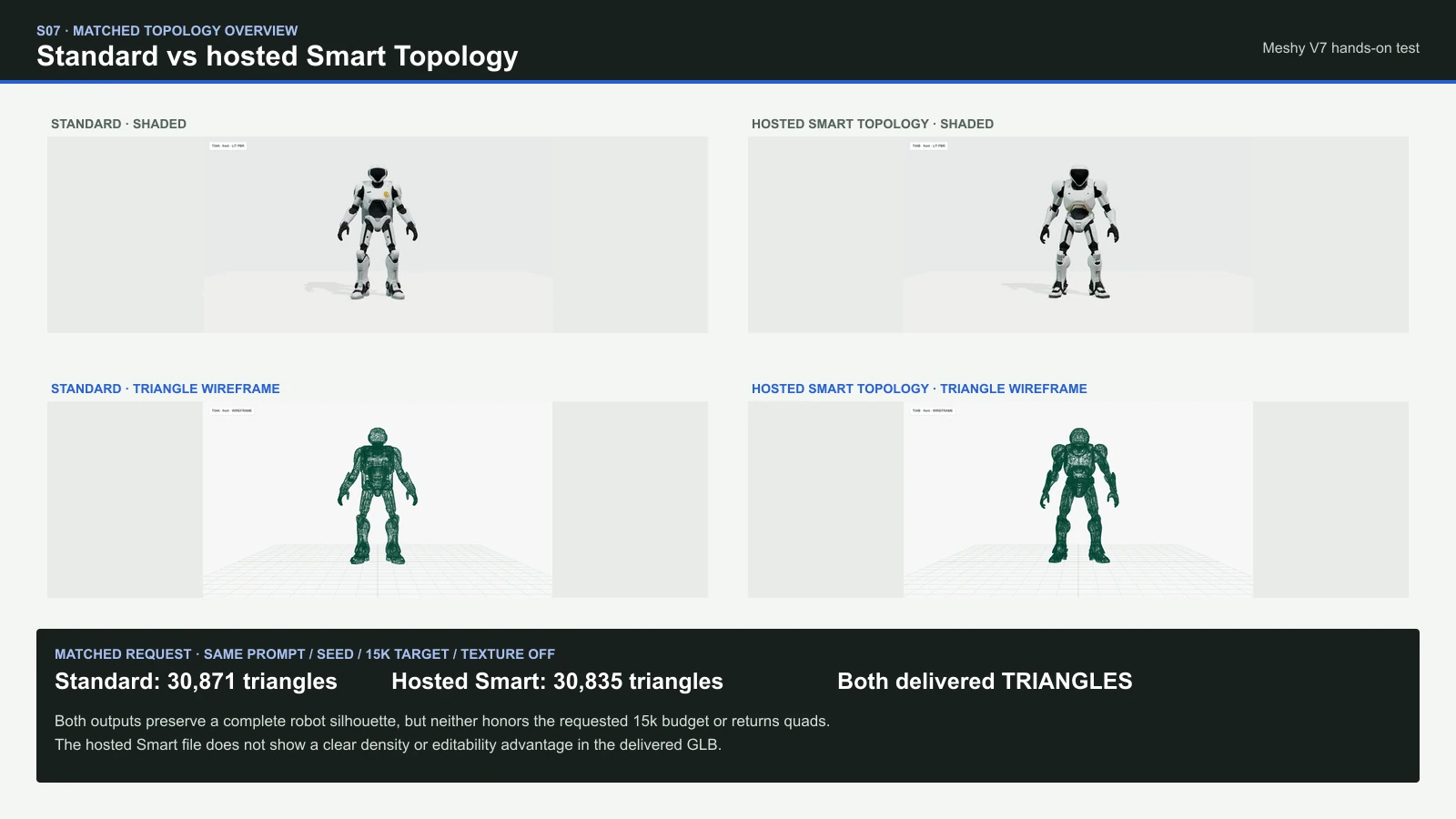
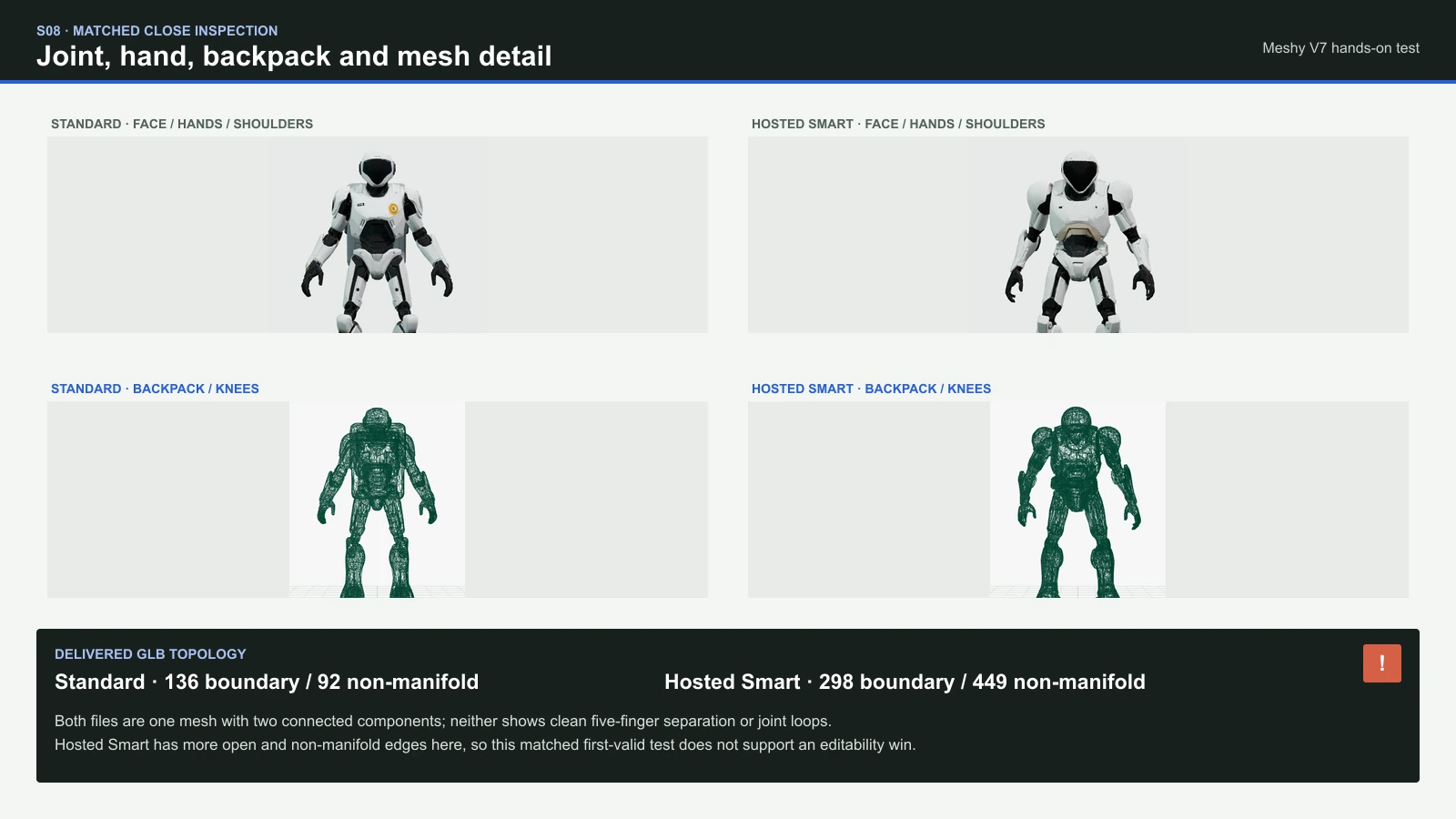
Both first-valid outputs preserve a complete robot silhouette, but neither delivers the requested topology contract. Standard contains 30,871 stored triangles and hosted Smart contains 30,835, roughly 2.06 times the requested 15,000 in both cases. Both GLBs store TRIANGLES, so the matched topology=quad request did not produce a quad asset.
Matched first-valid topology comparison
Same prompt, seed, A-pose, 15k target, texture-off request, and camera. Only the hosted modelType changed.
| Delivered evidence | มาตรฐาน | Hosted Smart Topology |
|---|---|---|
| Stored triangles | 30,871 | 30,835 |
| Primitive mode | TRIANGLES | TRIANGLES |
| Source vertices | 39,336 | 48,043 |
| Boundary / non-manifold edges | 136 / 92 | 298 / 449 |
| Mesh organization | One mesh, two connected components, no skin | One mesh, two connected components, no skin |
| Observed shape | Complete robot; clearer hard-shell backpack; fingers not cleanly separated | Complete robot; backpack blends more into torso; fingers not cleanly separated |
| Editing evidence | No clear joint loops; substantial separation and repair remain | No clear joint loops and more edge defects; no demonstrated Smart advantage |
Practical finding: Standard is the cleaner delivered GLB in this one matched pair. That does not prove Standard is universally better, but it does mean this test cannot support an editability win for the hosted Smart label.
PBR, Returned Formats, and Downstream Mesh Usability
Meshy’s native documentation lists several export targets, but a hosted route can expose a narrower result. This review lists only the files Anywhere actually returned, then separately reports whether the GLB parsed, rendered, included UVs, and carried decodable material maps.
Files and material data actually observed
| Slot | Returned file | UV / texture inventory | Mesh condition |
|---|---|---|---|
| T01 · mug | One valid glTF 2.0 GLB | UVs plus one decodable 2048 x 2048 base-color JPEG; no normal, metallic-roughness, or occlusion map | 30,398 stored triangles; 72 boundary and 26 non-manifold edges; browser render passed |
| T02 · camera | No output | Not evaluable | HTTP 530 before task creation on both allowed submissions |
| T03 · bicycle | One valid glTF 2.0 GLB | UVs plus one decodable 2048 x 2048 base-color JPEG; no normal, metallic-roughness, or occlusion map | 31,163 stored triangles; 21 boundary and 54 non-manifold edges; browser render passed |
| T04A · Standard | One valid glTF 2.0 GLB | UVs plus one decodable 2048 x 2048 base-color JPEG despite the texture-off request; no PBR detail maps | 30,871 triangles; 136 boundary and 92 non-manifold edges; two components |
| T04B · hosted Smart | One valid glTF 2.0 GLB | UVs plus one decodable 2048 x 2048 base-color JPEG despite the texture-off request; no PBR detail maps | 30,835 triangles; 298 boundary and 449 non-manifold edges; two components |
Opening successfully is only the first gate. Open edges, non-manifold connections, fused parts, detached fragments, texture seams, and awkward density can still make an asset expensive to edit. None of the checks in this review establishes rigging, animation, deformation, or production readiness.
Hosted-Route Speed, Reliability, and Observed Cost
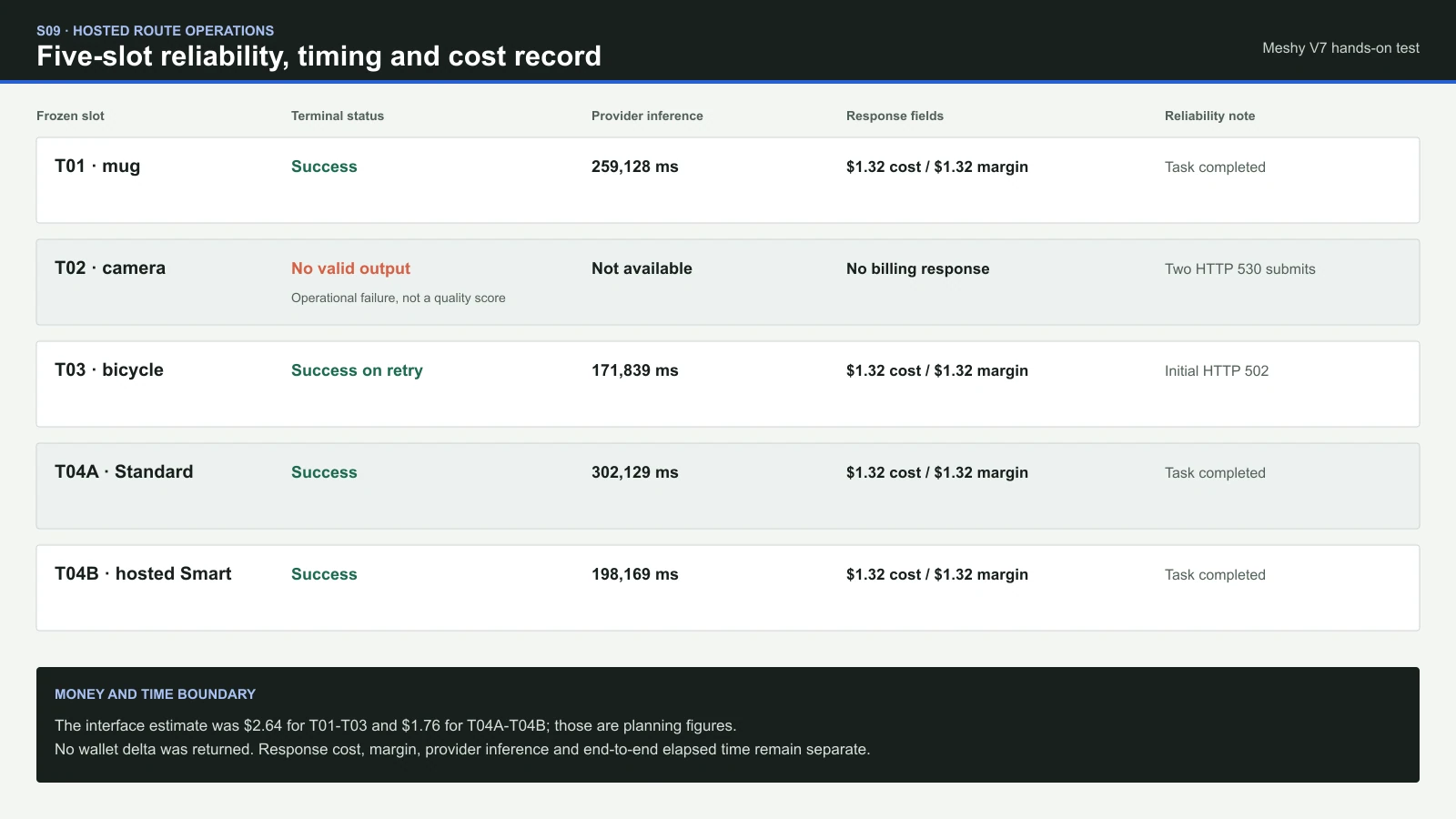
Turnaround is measured from submission to task ID, terminal response, download, and local import. Service errors and queue delays are reported separately from model quality. The hosted interface displayed a planning ceiling of $11.44 for the five frozen outputs, but that is not an observed charge.
Observed hosted-route timing and money fields
Only returned evidence is shown. A displayed estimate, response cost, response margin, and wallet deduction are different fields.
| หลักฐาน | T01 · mug | T02 · camera | T03 · bicycle | T04A · Standard | T04B · hosted Smart |
|---|---|---|---|---|---|
| Submit result | Task ID received about 4 seconds after submission | HTTP 530 before task creation on both allowed attempts | Initial submit returned HTTP 502; the allowed retry received a task ID about 5 seconds after submission | Task ID received about 5 seconds after submission | Task ID received about 4 seconds after submission |
| Provider inference | 259,128 ms, about 4 min 19 sec | ไม่มีให้บริการ | 171,839 ms, about 2 min 52 sec | 302,129 ms, about 5 min 2 sec | 198,169 ms, about 3 min 18 sec |
| End-to-end service observation | Terminal response arrived about 46 min 25 sec after submission timestamps; repeated polling errors mean this is not pure generation time | No task lifecycle to time | The retry process took about 8 min 17 sec through download; this includes polling and transfer overhead | About 8 min 49 sec through download | About 9 min 54 sec through download |
| Interface estimate | $2.64 | $2.64 planning estimate; no task or billing response | $2.64 | $1.76 | $1.76 |
Response cost_usd | $1.32 | ไม่มีให้บริการ | $1.32 | $1.32 | $1.32 |
Response margin_usd | $1.32 | ไม่มีให้บริการ | $1.32 | $1.32 | $1.32 |
| Wallet before / after | ไม่มีให้บริการ | ไม่มีให้บริการ | ไม่มีให้บริการ | ไม่มีให้บริการ | ไม่มีให้บริการ |
ขอบเขตการเรียกเก็บเงิน: without a wallet delta, this review does not label $2.64, $1.32, or the margin field as the final amount actually deducted.
Meshy Pricing and Commercial Use Without Mixing Billing Systems
There are three different money systems to keep apart: Meshy web subscriptions, native Meshy API credits, and the USD estimate or charge shown by a hosted provider. They are not interchangeable.
- Meshy subscriptions: the current official page lists Free, Pro, Studio, and Enterprise. Exact monthly prices and included credits were not reliably exposed during research, so stale third-party figures are omitted.
- Native API credits: Meshy’s documentation lists operation-level credit costs. These are native API terms and are not treated as hosted-route prices or confirmed V7/7.1 pricing.
- Anywhere hosted route: the captured interface displayed $2.64 for each textured test and $1.76 for each geometry-only test. Final reporting uses returned billing evidence where available.
Commercial rights also depend on plan and inputs. Meshy’s current help material says paid-plan users own generated assets subject to the Terms and rights in the supplied content. Free-plan assets use CC BY 4.0, which allows commercial use with attribution. Neither rule overrides someone else’s intellectual-property rights.
How Meshy Fits Beside Tripo, Rodin, Hunyuan 3D, and TRELLIS
No universal winner is claimed here because this frozen batch does not rerun equivalent inputs across every model. The useful comparison is workflow fit. For a separate geometry-mode test, see our Tripo H3.1 review. For another fast hosted image-to-3D route, see the Hunyuan3D 3.1 Rapid review.
Choose by workflow, not a universal leaderboard
| เส้นทาง | Useful when | ขอบเขตของหลักฐาน |
|---|---|---|
ที่ไหนก็ได้ meshy-v7 | You want a quick recognizable prototype and can inspect or repair the GLB afterward. | This review tests first-valid output, hidden surfaces, thin parts, and one hosted topology pair. |
| Tripo H3.1 | You want a separate hands-on view of another current image-to-3D and geometry-mode workflow. | Read its own test; it was not rerun with the Meshy inputs here. |
| Hunyuan3D 3.1 Rapid | You want to examine another fast hosted image-to-3D route. | Read its own test; no matched winner is claimed in this article. |
| Rodin or TRELLIS | Their available export, editing, or local-workflow options better fit your project. | Context only. No current matched head-to-head was run here. |
A One-Dashboard Image-to-3D Workflow with GlobalGPT
- Start with a clean, complete reference whose silhouette and openings are easy to read.
- When one photo is not enough for planning, generate consistent multi-angle reference images before deciding which 3D route to use. This review itself does not test multiview reconstruction.
- Run the chosen 3D model with frozen settings and keep the first valid output.
- Inspect the back, underside, wireframe, UVs, material maps, and small parts before building downstream work around the asset.
- Continue prompt refinement, reference work, research, writing, or development in the same GlobalGPT dashboard. Its affordable multi-model, multifunction setup means you do not need to open and pay for a separate service for every model or stage of the workflow.
Who This Tested Route Is Best For
เหมาะที่สุดสำหรับ: concept artists, product ideation, previsualization, rough game or scene blocking, and creators who value a fast recognizable starting point more than clean mechanical detail. The route is especially practical when you already expect to inspect the back, underside, topology, and materials before using the asset downstream.
Not a good fit without cleanup: users who need exact hidden-surface appearance, clean spokes or drivetrain parts, a strict polygon budget, editable quads, deformation-ready joint loops, separate production parts, watertight geometry, or a complete PBR map set. Route reliability also matters when one failed slot or an operational retry would disrupt a deadline.
คำถามที่พบบ่อย
Is Meshy 7 still the latest Meshy release?
No. Meshy 7.1 began rolling out on September 10, 2026. The hosted route tested here is labeled meshy-v7, and the review does not silently relabel its outputs as 7.1.
Is Meshy Smart Topology part of Meshy V7?
That is not established by the current first-party API documentation. Meshy identifies native Smart Topology as the separate meshy-t2 model. Anywhere exposes a hosted Smart Topology option under meshy-v7, but a hosted interface label does not prove backend equivalence.
Does Smart Topology produce quads?
Meshy’s native T2 documentation says triangle output and says ordinary topology controls are ignored. For the hosted test, the request includes topology=quad because that is what the captured interface exposes; the article reports the file actually delivered rather than assuming the request was honored.
How much does Meshy cost?
Meshy subscriptions, native API credits, and hosted-provider charges are separate. This article reports each system in its own context and does not use a displayed estimate as proof of the final charge.
Can Meshy outputs be used commercially?
Meshy’s current help material says paid-plan users own generated assets subject to its Terms and the rights in their inputs. Free-plan assets use CC BY 4.0 and require attribution. Check the current terms for your exact use case.
Is Meshy better than Tripo or Rodin?
This test cannot support an overall winner because it does not run a matched multi-model comparison. The better choice depends on reference fidelity, thin-part survival, topology needs, cleanup tolerance, speed, and the route you can actually access.
Final Verdict: Fast Prototypes, Real Cleanup
In this frozen first-output test, the Anywhere meshy-v7 route was good at turning a readable reference into a recognizable 3D starting point. It was much less dependable when the job required accurate unseen surfaces, delicate mechanical parts, a strict polygon target, editable quads, or clean downstream topology. Standard was also the better delivered file in the one matched hosted topology pair. The sensible workflow is to use Meshy for speed, then inspect the complete GLB before committing production work.
If that tradeoff fits your project, try the image-to-3D workflow in GlobalGPT. Its affordable multi-model workspace keeps reference preparation, 3D generation, prompt refinement, research, writing, and development in one dashboard, while leaving the final mesh decision grounded in the file you actually receive.