Will an AI provider use your client document, product photo, voice recording, or 3D design to train its models? The answer depends on the service agreement and data settings attached to the request. Paying for access does not, by itself, settle that question.
Быстрый ответ: several official APIs and enterprise services promise not to train on customer content, sometimes with consent or feedback exceptions. Other services permit training, offer an opt-out, or leave parts of their policy unclear. A no-training promise does not automatically mean zero storage, no human review, or private output.
This comparison covers 121 model and version entries from GlobalGPT’s model directory and home page: 64 text and multimodal, 21 image, 24 video, seven audio and music, and five 3D entries. Models sharing a policy are grouped in the tables; use the search card to look up any individual version. The names reflect the platform’s catalog; they are not independent verification of every upstream model identity or contract.
If you use an комплексная подписка на ИИ, the platform’s own policy is another part of the decision. GlobalGPT brings these categories into one account. The provider policies below remain tied to their named services; they are not a claim that every GlobalGPT model has the same enterprise protection.
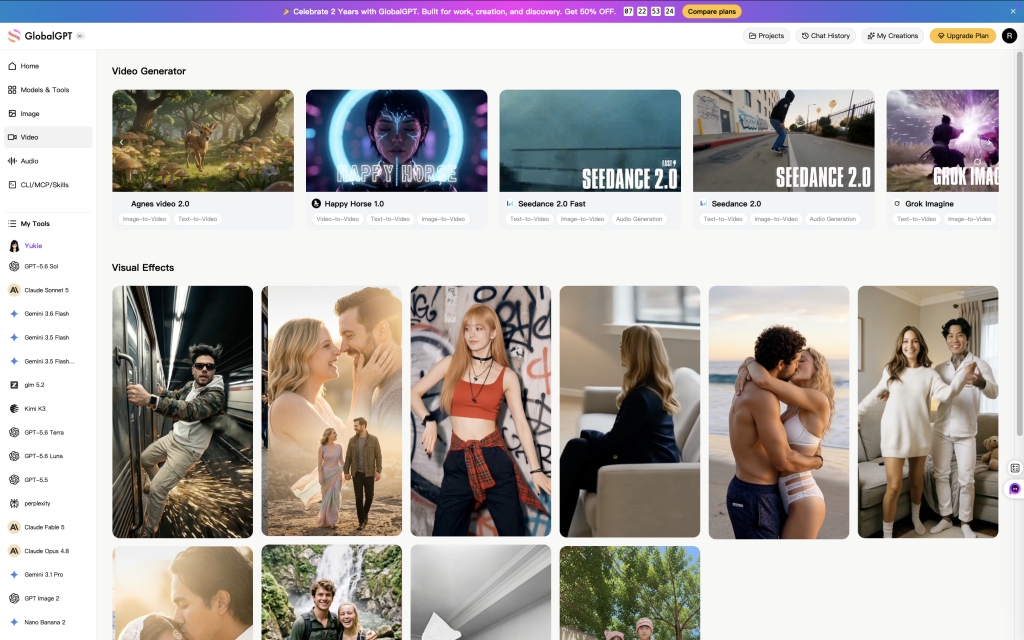
Policy review and catalog snapshot: September 11, 2026. This is a comparison of published terms, not an audit of backend behavior. The actual upstream service, contract, and settings for each GlobalGPT entry have not been verified. “All models” means all entries in this catalog snapshot, not every AI model worldwide.
All 121 Models: Privacy Comparison
Read the training result together with its service scope. No training by default can include opt-in or feedback exceptions. Training permitted describes permission, not proof that your particular file was used. Unknown means the applicable evidence is missing or incomplete. Where ordinary and enterprise services differ, both are identified instead of assigning the model a single unconditional verdict.
The tables group versions within each category when they share the same policy evidence. Expand a family to see every catalog name, or search for an individual model above the tables. No row confirms that GlobalGPT has signed the named enterprise agreement.
Check a model’s privacy policy
Search all 121 catalog entries. Try Claude, DeepSeek, Seedance, or Meshy.
Enter a name to find its policy. No query is sent to a server.
| Model family / versions | Published training position | Service scope — GlobalGPT applicability unverified |
|---|---|---|
| OpenAI GPT & reasoning | No training by default | Official OpenAI API; consumer ChatGPT and other hosting services have separate policies. |
| Клод | No training by default | Anthropic commercial products and API; personal Claude services are outside this comparison. |
| Близнецы | Depends on Google service | Gemini API Paid or Unpaid Services, and separately Google Cloud Vertex AI; consumer Gemini is not covered. |
| Grok | No training without permission | Official xAI API, including documented media controls; consumer Grok has separate policies. |
| DeepSeek | Training permitted; refusal right | DeepSeek official-service privacy policy; downstream developer applications and their contracts are separate. |
| GLM / Z.ai | API excludes improvement by default | Z.ai enterprise/developer API and, separately, Z.ai personal services; other GLM hosts are outside these terms. |
| Kimi / Moonshot | Training permitted unless agreed otherwise | Kimi OpenPlatform ordinary API terms; separate enterprise or written agreements can restrict use. |
| Qwen | Depends on service and plan | Mainland Alibaba Cloud Bailian terms; international Model Studio and third-party API services require separate assessment. |
Muse Spark2 models | Unknown | Muse Spark platform listings; the exact provider mapping and hosted-service agreement are not established. |
| Model family / versions | Published training position | Service scope — GlobalGPT applicability unverified |
|---|---|---|
Изображение GPT2 models | No training by default | Official OpenAI image API; exact model and endpoint matter |
| Нано-банан | Conditional no-training protection | Gemini image models and Nano Banana labels; paid Gemini API or Vertex AI coverage requires confirmation. |
| Seedream | Default restriction on foundation-model training | BytePlus AI and Model Services; mainland Ark and Seed Audio routing are not established by these terms. |
| Идеограмма | Plan-dependent protection | Ordinary Ideogram services and Enterprise; API contract coverage can differ |
| FLUX images | Training allowed; controls vary | BFL ordinary services, official FLUX API and Enterprise arrangements |
Agnes1 модель | Unknown | Agnes platform label; upstream service identity and applicable agreement are unconfirmed. |
| Середина путешествия | No-training commitment unclear | Midjourney Terms of Service; third-party access arrangements require separate confirmation |
| Model family / versions | Published training position | Service scope — GlobalGPT applicability unverified |
|---|---|---|
Сора1 модель | API no-training default | OpenAI /v1/videos data policy; this entry makes no claim about current service availability. |
| Veo | Conditional no-training protection | Veo through an identified Google service; consumer and third-party access require separate assessment. |
| Танцы на семенах | Default restriction on foundation-model training | BytePlus AI and Model Services; mainland Ark and Seed Audio routing are not established by these terms. |
| Клинг | Training permitted; revocation available | Kling ordinary-service terms; enterprise and platform API coverage require separate confirmation. |
| Ван | Depends on service and plan | Mainland Alibaba Cloud Bailian terms; international Model Studio and third-party API services require separate assessment. |
Подиум1 модель | Contract-dependent | Runway ordinary services compared with Runway Enterprise Services. |
Luma1 модель | API/Enterprise no training | Ordinary Luma web services versus API and Enterprise agreements |
MiniMax1 модель | Training scope not established | MiniMax API platform terms; Hailuo consumer-service treatment is not established here. |
Grok Imagine2 models | No training without permission | Official xAI API, including documented media controls; consumer Grok has separate policies. |
Happy Horse1 модель | Unknown | Happy Horse platform entry; upstream identity and applicable data-processing terms are unconfirmed. |
Видео «FLUX 3»1 модель | Unknown | FLUX 3 Video platform entry; supplier and service mapping remain unconfirmed. |
| Agnes | Unknown | Agnes platform label; upstream service identity and applicable agreement are unconfirmed. |
| Model family / versions | Published training position | Service scope — GlobalGPT applicability unverified |
|---|---|---|
Qwen1 модель | Depends on service and plan | Mainland Alibaba Cloud Bailian terms; international Model Studio and third-party API services require separate assessment. |
Seed Audio1 модель | Default restriction on foundation-model training | BytePlus AI and Model Services; mainland Ark and Seed Audio routing are not established by these terms. |
| ElevenLabs | Training permitted; opt-out available | Standard ElevenLabs services; enterprise/business processing is governed separately. |
Мурека1 модель | Unknown under current applicable terms | Mureka v9 platform entry; current controlling service terms and API agreement are unconfirmed. |
Лирия1 модель | Paid-service protection with safety exception | Lyria through Gemini API; the platform's Lyria 3 label requires exact model and service mapping. |
| Model family / versions | Published training position | Service scope — GlobalGPT applicability unverified |
|---|---|---|
Hunyuan3D1 модель | Input protection; output unclear | Tencent Cloud Hunyuan3D API and its incorporated large-model terms |
Меши1 модель | Non-Enterprise training allowed | Meshy ordinary, API and Enterprise services; order-specific exceptions |
Трипо1 модель | Paid-service no training | Tripo Paid Users section; free services and access settings differ |
Роден1 модель | Private-output protection; gaps remain | Hyper3D terms, privacy policy and API-generated asset storage |
TRELLIS1 модель | Hosting policy unknown | TRELLIS model project versus the service that runs it |
Text and Multimodal AI Model Privacy Policies
For chat and reasoning models, check the full conversation and attachments, not only the last prompt. A document uploaded for summarization can contain customer names, contracts, code, or financial records. Feedback permissions may cover a conversation even where ordinary API requests are excluded from training.
OpenAI text models: the API default excludes training
Catalog entries: GPT-6 Astra; GPT-5.6 Sol; GPT-5.6 Terra; GPT-5.6 Luna; GPT-5.5; GPT-5.4; GPT-5.4 mini; GPT-5.4 nano; GPT-5.3; GPT-5.2; GPT-5.1; GPT-5; GPT-5 mini; GPT-5 nano; GPT-4o; o1; o1 mini; o3; o3 mini; o3 Mini High; o4 mini; o4 Mini High.
Область применения: Official OpenAI API; consumer ChatGPT and other hosting services have separate policies.
Training: Official OpenAI API inputs and outputs are not used to train or improve OpenAI models unless the customer explicitly chooses to share them.
For text models accessed through the official OpenAI API, customer inputs and outputs are excluded from model training by default. Explicitly opting in to data sharing creates an exception. This is an API service policy, rather than proof that every customer has negotiated an Enterprise agreement, according to OpenAI’s data controls documentation.
The policy evidence reviewed on September 11, 2026 distinguishes training from storage. Abuse-monitoring logs generally remain for up to 30 days, subject to documented exceptions. Conversation state, uploaded objects and some caching features can follow different retention rules. A no-training setting therefore does not establish that every request disappears immediately.
Safety and legal processing can still apply. Zero Data Retention and Modified Abuse Monitoring have eligibility requirements and endpoint limitations; they are not universal promises that nobody can access submitted content. These controls should be assessed against the exact feature handling the prompt or file.
Information sent to external tools or remote MCP services also falls under those recipients’ policies. OpenAI’s API commitment does not determine GlobalGPT’s own storage, public links or third-party sharing. GlobalGPT’s specific supplier contracts and routing have not been verified here, and this policy comparison makes no claim about current model availability.
Control to check: Check data-sharing permissions and the actual endpoint. Modified Abuse Monitoring and Zero Data Retention require eligibility and approval; neither applies automatically to every feature.
Claude: commercial training protection has permission exceptions
Catalog entries: Claude Fable 5.1; Claude Fable 5; Claude Opus 5; Claude Opus 4.8; Claude Opus 4.7; Claude Opus 4.6; Claude Opus 4.5; Claude Sonnet 5; Claude Sonnet 4.6; Claude Sonnet 4.5; Claude Sonnet 4; Claude Haiku 4.5.
Область применения: Anthropic commercial products and API; personal Claude services are outside this comparison.
Training: Anthropic does not train on commercial-product inputs or outputs by default. Explicit permission or submitted feedback can create exceptions under the applicable policy.
Anthropic’s commercial-product policy says that inputs and outputs are not used to train its models by default. This applies to the commercial services covered by the policy, including API use. The commitment is described in Anthropic’s model-training FAQ and should not be generalized to every personal Claude account.
Permission matters. Customers can authorize additional use, and explicitly submitted feedback can include a related conversation. A business evaluating Claude should therefore consider both the underlying commercial terms and any feedback or sharing choices that can change how a particular interaction is handled.
A fixed retention period, deletion timetable and detailed human-review conditions are not established in the policies reviewed for this entry. Those questions require the applicable data-handling terms. The training exclusion, on its own, does not mean that content is never stored, inspected for safety or retained for another permitted purpose.
Public visibility and onward sharing are separate questions as well. The cited training FAQ does not establish whether another platform stores a conversation, exposes an uploaded file through a link or sends material to a separate tool. For GlobalGPT, commercial protection depends on the actual supplier agreement and service used; a Claude model name alone does not confirm them.
Control to check: Confirm commercial-service coverage and any feedback or data-sharing permissions. Consumer Claude settings do not establish the controls applied to a developer’s API account.
Gemini: paid API, unpaid API and Vertex AI differ
Catalog entries: Gemini 3.8 Flash; Gemini 3.7 Flash; Gemini 3.6 Flash; Gemini 3.5 Flash; Gemini 3.5 Flash Lite; Gemini 3.1 Pro; Gemini 3.1 Flash Lite; Gemini 3 Pro; Gemini 3 Flash; Gemini 2.5 Pro; Gemini 2.5 Flash; Gemini Omni Flash.
Область применения: Gemini API Paid or Unpaid Services, and separately Google Cloud Vertex AI; consumer Gemini is not covered.
Training: Paid Gemini API excludes prompts and responses from product improvement; unpaid rules differ. Vertex AI requires prior permission or instruction for model training or fine-tuning.
Google’s privacy classification depends on the service. Under Gemini API terms, Paid Services exclude prompts and responses from product improvement. Unpaid Services generally permit improvement use and human review, with specific regional provisions for the EEA, Switzerland and the UK. Paid status follows Google’s service and billing definitions.
Vertex AI data governance separately states that Google will not train or fine-tune AI or machine-learning models using customer data without prior permission or instruction. This is a Google Cloud commitment. It should not be silently substituted for unpaid developer services or the consumer Gemini app.
Сайт Gemini API abuse-monitoring policy specifies 55 days for prompts, context and outputs. Authorized employees may review flagged content or suspicious projects. Abuse logs are excluded from general AI training, with an exception for models specifically used for policy enforcement. The 55-day period belongs to Gemini API, not Vertex AI.
None of these statements establishes a platform’s public-link settings, file storage or onward sharing. A GlobalGPT subscription also does not identify Google’s underlying paid project or contract. For each Gemini entry, the relevant questions are which Google service processes it, whether the paid-service definition applies and which additional retention features are used.
Control to check: Verify the Google service, project billing status and regional exceptions. Abuse-monitoring data can support policy-enforcement models; a paid subscription does not establish universal zero retention.
Grok API: no training by default, with separate retention controls
Catalog entries: Grok 4.6; Grok 4.3.
Область применения: Official xAI API, including documented media controls; consumer Grok has separate policies.
Training: xAI states that it never trains on API inputs or outputs without explicit permission. This API commitment does not establish ordinary consumer Grok’s policy.
Что касается официального API, xAI’s security FAQ states that it never trains on customer inputs or outputs without explicit permission. This establishes a no-training default for that service. It does not establish the rules for a personal Grok conversation or an independently hosted model.
By default, requests and responses are encrypted at rest and stored for 30 days to support auditing of suspected abuse or misuse, then automatically deleted. Negotiated enterprise agreements may specify different retention. The policy does not provide a universal promise that no human can ever access API content.
Teams can enable Zero Data Retention, which prevents request inputs and outputs from being persisted to disk. Feature restrictions matter: images must use base64 output, while video delivery requires the customer’s upload destination instead of xAI-hosted output storage. The documented response header can confirm whether ZDR is active for a particular team.
Zero retention at xAI does not determine storage or link visibility at a separate platform, an external upload destination or a customer’s own systems. GlobalGPT’s xAI route and team settings have not been verified. Each Grok or Imagine listing therefore needs the applicable API agreement and actual controls before it can carry a stronger privacy guarantee.
Control to check: Teams can enable Zero Data Retention, subject to feature restrictions. Verify the actual team setting; image and video storage controls require particular output methods.
DeepSeek: training permission does not mean there is no refusal right
Catalog entries: DeepSeek V4.1 Flash; DeepSeek V4 Pro; DeepSeek V4 Flash.
Область применения: DeepSeek official-service privacy policy; downstream developer applications and their contracts are separate.
Training: DeepSeek’s official-service policy permits training and improvement while recognizing a right to refuse personal-data use for model training or technical optimization within its scope.
Сайт DeepSeek official-service privacy policy permits training and improvement uses, while recognizing a right to refuse the use of personal data for model training or technical optimization. That distinction matters: permission to use data and a user’s ability to object are separate parts of the policy.
The identified refusal right concerns personal data. It should not be expanded into an unconditional guarantee covering every uploaded document, generated response or non-personal input. A dedicated product switch, the technical implementation of a request and its effect on data already used for training are not established in the policies reviewed.
A fixed retention period, detailed deletion schedule and specific human-review conditions are also not established for this entry. Refusing training does not necessarily remove records needed to operate a service, handle security issues or comply with applicable obligations. Deleting a conversation is not evidence that an already trained model has been changed.
This evidence concerns DeepSeek’s official policy scope, which excludes downstream developer applications. It does not establish GlobalGPT’s DeepSeek contract, public-sharing settings or storage practices. The appropriate comparison is therefore training permitted with a documented personal-data refusal right, while the applicable third-party service agreement and remaining data-handling details still require confirmation.
Control to check: A personal-data refusal right is documented. A dedicated switch, its technical implementation and its effect on earlier training are not established in the policies reviewed.
GLM through Z.ai: API content protection differs from personal services
Catalog entries: GLM-5.3; GLM-5.3 Flash; GLM-5.2; GLM-5.1.
Область применения: Z.ai enterprise/developer API and, separately, Z.ai personal services; other GLM hosts are outside these terms.
Training: Z.ai API prompts and outputs are excluded from service development or improvement unless explicitly agreed. Personal-service terms permit broader content use for improvement.
Z.ai’s terms define User Content as prompts and outputs. For enterprises and developers using its API, section IV.7 excludes that content from developing or improving services unless the customer explicitly agrees. Personal-service provisions instead permit improvement use, including non-personal content for machine-learning and AI development.
The API data processing agreement, section 4(b), says supplied and generated content is processed in real time and not saved on servers. Section 4(c) treats other customer data separately: it may be stored for service or legal purposes and deleted after termination, subject to legal requirements.
This content-storage promise does not mean that account details, payment information or technical records are never collected. Detailed human-review conditions are not established in the policies reviewed. The DPA describes processing generally in Singapore; that statement concerns the covered service rather than every GLM deployment worldwide.
Control to check: Confirm API-specific terms and the DPA apply. Personal-data objection or withdrawal rights do not establish a dedicated consumer training switch or another host’s protection.
Kimi OpenPlatform: ordinary API access allows training use
Catalog entries: Kimi K3; Kimi K2.6; Kimi K2.5; Moonshot v1.
Область применения: Kimi OpenPlatform ordinary API terms; separate enterprise or written agreements can restrict use.
Training: Kimi OpenPlatform allows Customer Content to be used for training or improving Moonshot AI models unless a separate written agreement expressly provides otherwise.
Kimi illustrates why API access is not a universal privacy category. Its OpenPlatform terms, dated July 30, 2026, allow Customer Content to support service development and improvement. They explicitly direct customers seeking restrictions on model training or improvement to discuss enterprise arrangements or a separate written agreement.
Unless otherwise expressly agreed in writing, the terms permit the stated uses. This establishes contractual permission, not proof that a particular prompt has actually entered a training dataset. A standard API account should therefore not be classified as protected from training merely because a developer pays for requests.
Сайт OpenPlatform privacy policy, dated April 30, 2025, says account, input and payment information is retained while the account remains active. It allows specific employees to access relevant information when necessary for business purposes. A uniform deletion deadline and a no-human-access guarantee are not established in these provisions.
A dedicated ordinary-account training switch is not established in the policies reviewed; the documented route is a contractual discussion. Public visibility and a third-party platform’s onward sharing require separate assessment. GlobalGPT’s supplier agreement may differ, but its coverage has not been verified here, so the ordinary OpenPlatform rule cannot establish an enterprise exemption.
Control to check: Customers seeking training restrictions can contact Moonshot about enterprise arrangements or a separate written agreement. Ordinary API access does not automatically supply a no-training exemption.
Qwen and Wan: mainland Bailian has important plan exceptions
Catalog entries: Qwen3.8 Max; Qwen3.8 Flash; Qwen3-30B-A3B.
Область применения: Mainland Alibaba Cloud Bailian terms; international Model Studio and third-party API services require separate assessment.
Training: Mainland Bailian excludes conversation training without authorization, but Token Plan personal and Coding Plan explicitly authorize input/output use for service improvement and model optimization.
Mainland Bailian’s privacy documentation describes protection against training use. Its linked service agreement provides the essential detail: section 6.2.5 excludes conversation data from model training without customer authorization. This evidence concerns mainland Bailian, not automatically international Alibaba Cloud Model Studio.
Section 5.2.2 creates an important exception. Token Plan personal and Coding Plan authorize storage and use of inputs and outputs for service improvement and model optimization. Token Plan team is excluded from that sentence. Stopping the covered service ends future authorization, but does not withdraw authorization for content already covered.
Training protection is not zero retention. Model and application call data can be stored, with conversation retention limited to the shortest period necessary under applicable obligations. No universal number of days is established. Section 4.3.1 also permits technical or human review of submitted content and generated results.
Third-party APIs have another boundary: section 6.2.9 places storage, deletion and content filtering under the third-party service agreement. These clauses do not establish public-link settings or GlobalGPT’s actual Qwen, Wan or audio hosting route. The specific service, subscription and supplier contract must be identified before assigning the corresponding model a definitive no-training status.
Control to check: For the plan exception, stopping use ends future authorization, not earlier authorized data use. Third-party API handling follows its own agreement; international terms remain separate.
Muse Spark: the applicable hosted-service policy remains unknown
Catalog entries: Muse Spark 1.3; Muse Spark 1.2.
Область применения: Muse Spark platform listings; the exact provider mapping and hosted-service agreement are not established.
Training: An applicable training rule for the listed Muse Spark hosted service is not established in the policies reviewed; this does not show that training occurs.
For the Muse Spark entries in this comparison, the exact provider mapping and applicable hosted-service agreement are not established. The training classification is therefore unknown. That is a statement about the available policy evidence, rather than an allegation that the model trains on submitted prompts or generated responses.
A retention period, deletion timetable and detailed human-review policy are also not established in the policies reviewed for this hosted service. The model name alone cannot resolve whether prompts, uploaded files, outputs and technical logs receive different treatment, or whether exceptions apply to security investigations and legal obligations.
The same uncertainty applies to public visibility and onward sharing. A platform listing does not establish whether files are private, whether output links are accessible to others or which processing partners receive submitted material. Those details belong in the applicable hosting agreement and service documentation, rather than being inferred from the brand.
Open-weight licensing, where relevant to another model, governs use of software or weights; it does not establish how a hosting company handles customer data. For these Muse Spark listings, neither an enterprise no-training commitment nor a dedicated opt-out is established in the policies reviewed. Unknown remains the appropriate classification until the specific hosted service and its terms are identified.
Control to check: Training opt-out, enterprise coverage and public-sharing controls are not established in the policies reviewed. An open-weight license cannot establish a hosting provider’s data protection.
Before choosing a ChatGPT Бизнес-план for a team, evaluate the applicable business agreement and administrative controls alongside the subscription features. Those controls do not automatically transfer to an account on another platform.
AI Image Generator Privacy Policies
Image privacy includes your prompt, uploaded reference photos, source files used for editing, and generated pictures. A private gallery setting can prevent other users from seeing an image without stopping the provider from using it for training.
OpenAI Image Models: No Training by Default Through the API
Catalog entries: GPT Image 2.5; GPT Image 2.
Область применения: Official OpenAI image API; exact model and endpoint matter
Training: OpenAI does not use official API prompts, reference images or generated outputs for model training unless the customer explicitly chooses to share data.
OpenAI’s image API follows its API-wide default: customer data is not used to train or improve OpenAI models unless the customer explicitly opts in. That distinction matters when uploading reference photographs, product designs or images for editing. The protection comes from the applicable API data policy, rather than the image model’s display name.
Not training on an image does not mean immediately deleting it. The same documentation lists 30-day abuse-monitoring retention for image endpoints and no application state, subject to the listed exceptions. A third-party platform can also retain its own uploads, generated images or delivery copies on a separate schedule.
Image and file inputs undergo safety screening. Potential child sexual abuse material can be retained for review under the documented exception, including when Zero Data Retention is enabled. Consequently, a no-training promise is not a promise that no person can ever review submitted material.
Zero Data Retention is a separate, approval-based control with model-specific eligibility. For an image model offered through GlobalGPT, the exact upstream model, endpoint and applicable account controls determine whether that option applies. The name alone cannot establish approval, disabled data sharing or the lifetime of platform-hosted image files.
Control to check: Zero Data Retention requires approval and compatible models. Check the exact image endpoint, sharing permissions and platform storage before treating an image workflow as zero retention.
Google image models: the service determines the protection
Catalog entries: Nano Banana; Nano Banana 2; Nano Banana Pro.
Область применения: Gemini image models and Nano Banana labels; paid Gemini API or Vertex AI coverage requires confirmation.
Training: Paid Gemini API excludes prompts and responses from product improvement; Vertex AI restricts training without permission. Unpaid services and consumer products follow different rules.
A reference photo, an editing instruction and a generated image can fall under the same service’s content rules, but the image model’s name does not identify those rules. Nano Banana labels first need to be matched to an exact model and Google service. A subscription to another platform does not itself establish which Google agreement covers the request.
Для paid Gemini API services, Google says it does not use prompts or responses to improve its products. The terms include submitted files such as images. Unpaid services generally permit improvement use and human review, with regional exceptions. Separately, Vertex AI data governance restricts training or fine-tuning without prior permission or instruction.
These protections do not establish that images disappear immediately, that nobody can review flagged content, or that generated links are private. Check uploaded-file storage, safety processing and the platform’s own image copies separately. GlobalGPT’s exact image route and contractual coverage have not been confirmed here, so the protection remains conditional rather than a model-wide guarantee.
Control to check: Confirm the exact image model, Google service and billing scope. A Nano Banana name or a paid GlobalGPT subscription alone does not establish applicable protection.
Seedream and Seedance: BytePlus protection is service-specific
Catalog entries: Seedream 5.0 Pro; Seedream 5.0 Lite; Seedream 4.5.
Область применения: BytePlus AI and Model Services; mainland Ark and Seed Audio routing are not established by these terms.
Training: BytePlus excludes Customer Data from underlying foundation-model training, except voluntary improvement feedback or separate consent or written agreement. This is not automatically an Ark policy.
Сайт BytePlus General Terms for AI Services contain a concrete foundation-model training restriction. Section 3.3 excludes Customer Data from that training unless the customer voluntarily supplies improvement feedback or separately consents or agrees in writing. This is a qualified commitment, not a promise covering every possible use forever.
Section 3.1 treats inputs to BytePlus Model Services as Confidential Information under the agreement. Section 3.2 nevertheless allows necessary service and security retention without a universal number of days. Section 3.4 permits automated systems and other reasonable measures to detect and review abuse; it does not promise that human access is impossible.
For Seedream and Seedance, the relevant question is whether the generation actually uses covered BytePlus services. These terms cannot automatically be transferred to mainland Volcengine Ark. Seed Audio’s specific service mapping also remains unconfirmed. Section 4 additionally recognizes separate terms for third-party components. GlobalGPT’s route, feedback permissions and contractual coverage need confirmation before this supplier policy becomes a statement about an individual platform model.
Control to check: Confirm BytePlus coverage, feedback permissions and any third-party terms. Seed Audio’s service mapping remains unconfirmed; do not transfer this protection to mainland Ark by brand association.
Ideogram: Ordinary Service Training and Enterprise Input Protection
Catalog entries: Ideogram 4.0; Ideogram 4.0 Turbo; Ideogram 4.0 Quality; Ideogram 3.0; Ideogram 3.0 Turbo; Ideogram 3.0 Quality.
Область применения: Ordinary Ideogram services and Enterprise; API contract coverage can differ
Training: Ideogram’s ordinary policy permits model training. Its Enterprise page excludes enterprise inputs from shared-model training, while custom training requires an opt-in; outputs need separate confirmation.
Ideogram’s ordinary privacy policy includes prompts, uploaded images and interactions among the information it collects. It permits using information to train the models powering its services. A paid account or private image setting therefore does not, by itself, establish that submitted content is excluded from training.
Сайт Enterprise offering provides a more specific statement: enterprise inputs are not used to train Ideogram’s shared models, and custom training on customer data is opt-in. This wording expressly names inputs. It is not an equally explicit promise covering every generated output or every API account.
For ordinary services, retention lasts as long as reasonably necessary for the policy’s purposes. Enterprise customers can configure retention down to 30 minutes, according to the enterprise page. That describes an available configuration, rather than automatic deletion after 30 minutes for every customer, dataset or account.
Visibility is another setting. The terms distinguish private content from content available to other users for remixing. Private visibility does not establish a training exclusion or prohibit all provider access. For use through GlobalGPT, the relevant upstream agreement and actual configuration determine which enterprise protections apply.
Control to check: Private content settings control visibility to other users. Enterprise training and retention protections depend on the applicable arrangement; an ordinary-service training opt-out is not established here.
FLUX by Black Forest Labs: Training Permission and Contract-Specific Controls
Catalog entries: FLUX; FLUX 1.1 Pro; FLUX 1.1 Ultra; FLUX 1 Kontext; FLUX 2 Pro.
Область применения: BFL ordinary services, official FLUX API and Enterprise arrangements
Training: Both ordinary BFL terms and FLUX API terms permit input/output training. Enterprise options differ, and the ordinary-service opt-out cannot automatically be assumed to govern API contracts.
Black Forest Labs does not offer a blanket no-training default across its services. Its ordinary terms permit training and improvement using inputs, outputs and tasks. The separate FLUX API terms also expressly permit using inputs and outputs to train and improve AI models.
Ordinary terms allow customers to email legal@blackforestlabs.ai to opt out of future FLUX training. The privacy policy additionally lists privacy@blackforestlabs.ai with the subject Training Opt Out. API customers should obtain confirmation of how this control interacts with their API terms and order; beta or special-program conditions can differ.
The opt-out operates prospectively. It does not reverse previous training, and the terms preserve exceptions involving safety, legal compliance and feedback. Retention otherwise follows necessary service and legitimate business purposes, rather than one fixed deletion period. A file retrieval deadline is not a deadline for deleting every associated data copy.
BFL’s enterprise offering advertises zero data retention and dedicated deployment options. Those options require an applicable arrangement; they do not establish the configuration of an ordinary API account. Similarly, neither a FLUX label in GlobalGPT nor a private deployment marketing claim identifies the agreement governing a particular request.
Control to check: Ordinary terms offer prospective FLUX training opt-out by email. Confirm its coverage under API-specific terms, beta conditions and orders before relying on it for API traffic.
Agnes: an identifiable policy is still needed
Catalog entries: Agnes Image 2.1 Flash.
Область применения: Agnes platform label; upstream service identity and applicable agreement are unconfirmed.
Training: No applicable model-specific data-processing policy has been established for Agnes. This is an evidence gap, not proof that training occurs or that content is protected.
Agnes is a platform model label, but an applicable model-specific data-processing policy has not been established. A name alone does not identify the upstream legal entity, hosting arrangement or agreement governing uploaded content.
Training permission, opt-out controls, retention and human-review conditions therefore remain unknown. This does not mean training occurs or that opting out is impossible. Before submitting confidential material, the missing evidence is the actual service identity and its applicable policy, rather than a privacy promise borrowed from a similarly named model or presumed supplier.
Control to check: Confirm the upstream legal identity, service agreement and any training settings. Do not attribute another provider’s opt-out, enterprise protection or retention controls to Agnes.
Midjourney: Public Visibility and Stealth Are Separate from Training
Catalog entries: Midjourney (version not specified).
Область применения: Midjourney Terms of Service; third-party access arrangements require separate confirmation
Training: Midjourney’s terms grant a broad continuing content license but do not establish an explicit no-training promise here. That license alone does not prove actual training use.
Midjourney’s clearest privacy distinction concerns publication. Its Условия предоставления услуг state that content is publicly viewable and remixable by default. This matters for unreleased product designs, customer photographs and brand assets, even before considering whether any content can be used to train models.
The terms grant Midjourney a broad, continuing license over submitted content and generated assets. They do not establish an explicit no-training commitment in this comparison. Equally, a broad content license is not evidence that a particular image has actually been included in training. The training status therefore needs more specific assurance.
Pro and Mega customers can use Stealth, under which Midjourney promises best efforts not to publish assets created with that feature engaged. Stealth does not make a shared Discord room private: people in that room can still view the content. Publication controls and training controls answer different questions.
The cited terms do not establish a single retention deadline, and the content license survives termination. Deleting an account should not be treated as automatically withdrawing every granted right. For a Midjourney workflow offered through another platform, its access arrangement, publication behavior and storage policy require separate attention before submitting confidential material.
Control to check: Pro and Mega Stealth provide best-efforts non-publication, not a training opt-out. Content created in shared Discord spaces remains visible to people with access to those spaces.
A Seedream prompt using product references can work with a public product photo or a confidential prelaunch design. The generation technique may be identical, but the permission to upload those files is not.
AI Video Generator Privacy Policies
Video requests can include first and last frames, face images, reference footage, speech, and other audio. A retention statement about the finished clip may not cover those inputs, safety logs, or copies stored elsewhere.
Sora API: no-training does not mean zero retention
Catalog entries: Сора 2.
Область применения: OpenAI /v1/videos data policy; this entry makes no claim about current service availability.
Training: The official video API data-controls table excludes training, subject to the general API exception for explicit data-sharing opt-in. Consumer Sora requires a separate policy assessment.
OpenAI's API data-controls documentation lists the video endpoint as not used for training, subject to the general exception for customers who explicitly opt into data sharing. This is an API policy finding, not a statement about consumer Sora or confirmation that any service is currently available.
The same documentation distinguishes video storage from training. Its video workflow describes a 48-hour period for downloading the produced video, followed by 30 days of abuse-monitoring retention. It also identifies the video endpoint as ineligible for Zero Data Retention and blocked for Modified Abuse Monitoring or Zero Data Retention requests. Controls available for text endpoints cannot simply be assumed for video.
A Sora label on another platform does not reveal the endpoint, account or agreement used. It also says nothing about that platform’s own uploaded reference files, video copies or download links. GlobalGPT’s route remains unconfirmed, so the practical classification is conditional API no-training protection with documented retention, rather than a universal promise that video data is never stored or reviewed.
Control to check: The documented video endpoint is not eligible for Zero Data Retention and is blocked for MAM/ZDR requests. Confirm the actual route rather than inheriting text-API controls.
Veo: distinguish Vertex AI from other access routes
Catalog entries: Veo 3; Veo 3.1.
Область применения: Veo through an identified Google service; consumer and third-party access require separate assessment.
Training: Vertex AI restricts training and fine-tuning without prior permission or instruction. That promise cannot automatically cover every Veo consumer product or third-party access route.
A Veo generation may contain more than a text prompt: reference images, people appearing in those images and generated video files all matter to a privacy assessment. The practical question is which service processes them and which agreement covers that processing. A Veo version label cannot answer that question on its own.
Google's Vertex AI data-governance documentation says customer data will not be used to train or fine-tune AI/ML models without prior permission or instruction. This supports a conditional no-training classification for covered access. It does not establish identical treatment in a consumer video product, an unrelated host or a platform using an unconfirmed upstream route.
Video storage needs its own check even when training is restricted. A generated clip’s download window, uploaded reference-media lifetime and safety records may describe different data. None establishes how long GlobalGPT keeps its own copies. Before treating a Veo workflow as suitable for confidential footage, confirm the service, agreement and relevant video controls; no universal zero-retention or no-human-review claim is established here.
Control to check: Identify the exact service, account and agreement before relying on Vertex AI protection. Confirm video-specific retention controls rather than borrowing settings from a text model.
Seedance 1.0 Pro, Seedance 2.0, Seedance 2.0 Fast, Seedance 2.5
For these entries, the relevant public commitment is still the BytePlus foundation-model clause. Uploaded frames, reference audio and generated media need their own storage assessment. Seed Audio’s service mapping is unconfirmed; BytePlus coverage must not be assumed from the Seed name.
См. Seedream and Seedance: BytePlus protection is service-specific for the applicable published terms and unresolved fields.
Kling: training permission with a revocation route
Catalog entries: Kling 2.6; Kling 3.0; Kling O1.
Область применения: Kling ordinary-service terms; enterprise and platform API coverage require separate confirmation.
Training: Kling’s ordinary terms permit covered content use to create, test, improve and train AI/ML models. Permission does not prove that any particular clip was used.
Kling belongs in a category that acknowledges both training permission and a way to withdraw authorization. Section 4.7.3 of its ordinary-service terms permits covered material to support creating, testing, improving and training AI/ML models. This describes contractual permission; it does not establish that a particular uploaded image or generated clip entered training.
Section 4.7.4 says users who do not want continued use of all or part of their Content may revoke authorization by emailing support@kling.ai. Calling Kling impossible to opt out of would therefore omit a documented route. The clause does not establish a one-click account control, a guaranteed processing time or reversal of earlier model training.
Revocation and deletion should remain separate questions. These clauses do not establish a common retention period or guarantee removal of every stored copy. Enterprise services may have additional rules, and GlobalGPT’s actual access agreement is unconfirmed. Apply the ordinary-service finding only where those terms govern the generation, rather than assigning one privacy verdict to every Kling model version.
Control to check: Section 4.7.4 allows authorization revocation by emailing support@kling.ai. This is not a verified one-click switch, and enterprise terms require separate confirmation for the actual service.
Wan 2.6, Wan 2.7, Wan 3.0, Wan 3.0 Prime
For these media entries, first confirm whether the request uses the covered Bailian service, a separate API contract or another host. The catalog label does not establish contractual coverage. Reference media, scripts and generated files also need storage and access controls beyond the general conversation-data clause.
См. Qwen and Wan: mainland Bailian has important plan exceptions for the applicable published terms and unresolved fields.
Runway: ordinary and Enterprise terms reach different results
Catalog entries: Runway Gen-4 Turbo.
Область применения: Runway ordinary services compared with Runway Enterprise Services.
Training: Ordinary Runway terms permit input/output training and improvement. Enterprise terms expressly prohibit using Customer Content as training data for the Services when that agreement applies.
Runway illustrates why a single model-level yes or no can mislead. Its ordinary terms allow Inputs and Outputs to be used to train and improve AI models and related technology. Paying for access does not, by itself, replace that agreement with Enterprise protection.
Отдельный Enterprise Services Terms state: “Runway may not use Customer Content as training data for the Services.” This is an explicit contractual restriction with a defined content category and service scope. A model name such as Gen-4 Turbo does not establish whether the request is covered by it.
Training restrictions also leave other privacy questions open. The cited clauses do not establish a universal content-retention period, guarantee no safety review or determine how another platform stores generated videos. A standard-service training opt-out has not been established here. For GlobalGPT, the decisive missing detail is the actual contracted Runway service and its coverage, followed by the applicable storage and deletion settings.
Control to check: Verify that the Enterprise agreement actually covers the request. Ordinary paid access is not equivalent, and a standard-service training opt-out has not been established here.
Luma: API and Enterprise No-Training Commitments
Catalog entries: Luma Ray 2 Flash.
Область применения: Ordinary Luma web services versus API and Enterprise agreements
Training: Luma’s ordinary free and paid web terms allow training. Its API terms exclude API input/output training, while Enterprise provides a separate No Train Guarantee.
Luma draws a substantial distinction between ordinary web use and protected API or Enterprise access. Its ordinary terms grant training rights over inputs and outputs from both free and paid web use. Purchasing an ordinary subscription therefore does not create the same privacy terms as an enterprise agreement.
Section 10 of the API terms excludes API inputs and outputs from training, fine-tuning or otherwise developing Luma’s models. That commitment applies specifically to API access governed by those terms. The Enterprise agreement separately includes a No Train Guarantee for inputs and outputs.
Neither commitment means all content disappears immediately. The post-termination 30-day input-export window is not an automatic deletion deadline. Enterprise customers can request content deletion in writing, while standard backup copies may remain subject to confidentiality obligations. The privacy policy also describes legal and other retention exceptions.
Ordinary free-use terms include broader public-display and distribution rights. Deleting an ordinary account does not undo licenses for material already incorporated into models, systems or aggregated data. A Ray model name alone cannot identify the applicable contract or establish how a separate platform, including GlobalGPT, stores submitted media and generated clips.
Control to check: Confirm API or Enterprise coverage for no-training protection. Ordinary account deletion does not reverse rights over content already incorporated into models, systems or aggregated data.
MiniMax API: service improvement is explicit, training scope is unresolved
Catalog entries: MiniMax-H3.
Область применения: MiniMax API platform terms; Hailuo consumer-service treatment is not established here.
Training: MiniMax API terms allow input and generated content for service development and improvement. They do not establish a blanket training prohibition or a precise training scope here.
Сайт MiniMax API terms allow input and generated content to provide, maintain, develop and improve services, alongside safety and legal purposes. That is an explicit improvement permission. It is not sufficient evidence to say every request trains a model, and it is not a blanket no-training promise.
Сайт API privacy policy limits using personal data for training to profile or target consumers. The purpose limitation matters: shortening it to “MiniMax does not train on personal data” would change its meaning. The same policy uses necessary-purpose and legal retention criteria rather than one fixed input/output lifetime.
A dedicated training opt-out, universal no-human-review commitment and separate commercial no-training arrangement have not been established here. Personal-data deletion or consent withdrawal should not be substituted for a training control. These findings concern the API platform, not the Hailuo consumer service. GlobalGPT’s MiniMax audio or video labels still need an exact route and agreement before a stronger privacy classification is justified.
Control to check: A dedicated training opt-out has not been established. Personal-data deletion or withdrawal rights are different controls, and any separate commercial restrictions require confirmation for this account.
Grok Imagine, Grok Imagine 1.5
For Grok Imagine, the official xAI API commitment depends on API coverage. Media delivery and zero-retention restrictions require particular attention: generated image or video links can have a different lifetime from request logs.
См. Grok API: no training by default, with separate retention controls for the applicable published terms and unresolved fields.
Happy Horse: the access agreement is unconfirmed
Catalog entries: Happy Horse 1.0.
Область применения: Happy Horse platform entry; upstream identity and applicable data-processing terms are unconfirmed.
Training: An applicable model-specific training policy has not been established for Happy Horse. Do not infer either permission or prohibition from the model label alone.
Happy Horse remains an unknown-policy entry because its applicable model-specific data-processing terms have not been established. The platform name is not enough to identify the responsible supplier or determine the agreement covering a video request.
That leaves reference-media handling, training permission, opt-out availability, retention and review conditions unresolved. A generated clip being downloadable says nothing about whether other copies or logs remain. The correct next evidence is the actual upstream service and agreement; neither a no-training guarantee nor a claim of unavoidable training is justified by the current information.
Control to check: The actual provider agreement, training controls and enterprise exceptions need confirmation. Do not assign a supplier identity or inherit another model’s privacy controls without evidence.
FLUX 3 Video: do not inherit image-model terms
Catalog entries: FLUX 3 Video.
Область применения: FLUX 3 Video platform entry; supplier and service mapping remain unconfirmed.
Training: No applicable model-specific training policy is established for FLUX 3 Video. Similar branding does not justify applying Black Forest Labs image-service terms to this entry.
FLUX 3 Video needs its own service identification and applicable data-processing policy. A shared word in the name does not prove that the entry is supplied by Black Forest Labs or governed by its FLUX image terms.
Training permission, opt-out controls, retention and human review remain unconfirmed for this video route. None should be borrowed from an image endpoint or inferred from model branding. The evidence gap supports an unknown classification, not a claim that content must be used for training or that the service provides enterprise no-training protection.
Control to check: Identify the actual supplier and video agreement before assigning training opt-out or enterprise coverage. A shared brand word is insufficient evidence of contractual protection.
Agnes Video 2.0, Agnes Video 2.5, Agnes Video 2.5 Flash
The video entries share the unresolved service-identity question described for Agnes Image. No model-specific training permission, retention timetable or opt-out has been established for these video versions.
См. Agnes: an identifiable policy is still needed for the applicable published terms and unresolved fields.
When you reuse reference material for consistent AI video characters, the same identifiable face or product may be sent in multiple requests. Check the policy for every service involved, including separate voice or lip-sync tools.
AI Audio, Music, and Speech Privacy Policies
Audio privacy covers more than the final MP3. Lyrics, scripts, reference recordings, voice samples, and transcripts can have different uses and retention periods. Consent to clone someone’s voice is also separate from permission to use that recording for model training.
Qwen Audio 3.0
For these media entries, first confirm whether the request uses the covered Bailian service, a separate API contract or another host. The catalog label does not establish contractual coverage. Reference media, scripts and generated files also need storage and access controls beyond the general conversation-data clause.
См. Qwen and Wan: mainland Bailian has important plan exceptions for the applicable published terms and unresolved fields.
Seed Audio 1.0
For these entries, the relevant public commitment is still the BytePlus foundation-model clause. Uploaded frames, reference audio and generated media need their own storage assessment. Seed Audio’s service mapping is unconfirmed; BytePlus coverage must not be assumed from the Seed name.
См. Seedream and Seedance: BytePlus protection is service-specific for the applicable published terms and unresolved fields.
ElevenLabs: a prospective training opt-out
Catalog entries: Eleven Music; Eleven Multilingual v2; Eleven v3.
Область применения: Standard ElevenLabs services; enterprise/business processing is governed separately.
Training: Standard ElevenLabs terms permit training-related content use and provide an opt-out. Enterprise or business-customer processing depends on the applicable agreement and Data Processing Addendum.
ElevenLabs provides a documented choice rather than an unconditional no-training default for its standard services. Its terms allow users to opt out of content use for training through the Data use menu under Terms and Privacy. The change does not undo earlier uses or materials resulting from those uses.
Сайт privacy policy separately explains that personal-data processing on behalf of enterprise or business customers is governed by their agreement and Data Processing Addendum. Consequently, a standard account, an enterprise arrangement and an API integration should not be treated as interchangeable merely because they use the same voice or music model.
For Eleven Music, Eleven Multilingual or Eleven v3 entries, check the actual upstream product, account and training choice. GlobalGPT’s configuration has not been confirmed here. An opt-out does not establish zero retention, private output links or the absence of safety review. Permission to clone or reproduce someone’s voice is also separate from whether the provider can use submitted content to improve its models.
Control to check: The account’s Terms and Privacy > Data use menu offers training opt-out. Verify its effective setting and coverage; voice-cloning consent is a separate requirement.
Mureka: current controlling terms still need confirmation
Catalog entries: Mureka v9.
Область применения: Mureka v9 platform entry; current controlling service terms and API agreement are unconfirmed.
Training: The current controlling terms have not been verified for this model and service. Neither a no-training guarantee nor unavoidable training should be asserted from incomplete evidence.
Mureka v9 should remain unclassified for training until the current controlling agreement is confirmed. Mureka publishes service terms и privacy policy, but the evidence available for this comparison does not establish which current version governs this model’s actual access route. Older policy wording should not be presented as a current promise or permission.
This uncertainty affects more than a yes-or-no training answer. The treatment of submitted lyrics, reference audio, generated songs and account information may differ, as may ordinary-service and API contracts. A general right to revoke content use is not automatically a dedicated training opt-out, and a deletion request does not establish that every class of data follows the same timeline.
For now, the useful conclusion is specific: current training permission, training controls, retention periods and commercial exceptions remain unconfirmed. That does not prove that Mureka trains on customer material, nor that it guarantees non-training. GlobalGPT’s exact model mapping and applicable agreement are needed before either claim can be made about its Mureka entry.
Control to check: A dedicated training opt-out and any API or enterprise exception remain unconfirmed. A general revocable content license does not establish a working training control.
Lyria: product improvement and safety-model training differ
Catalog entries: Google Lyria 3 (home entry).
Область применения: Lyria through Gemini API; the platform's Lyria 3 label requires exact model and service mapping.
Training: Paid Gemini API excludes product-improvement use of prompts and responses. Abuse-monitoring data has an exception for training models specifically used for policy enforcement.
Документы Google Lyria 3 Pro preview within Gemini API. That establishes an official service context, but does not prove that a platform label called Lyria 3 uses that exact model or account. The applicable paid or unpaid service category still matters.
Под paid-service terms, Google does not use prompts or responses to improve its products. Unpaid services generally permit improvement use and human review, subject to regional exceptions. These categories should not be merged with the consumer Gemini app or other Google Cloud services.
Сайт abuse-monitoring policy specifies 55 days of retention for prompts, context and output, and allows authorized personnel to review flagged content. Logged data is not used for AI/ML training except for models specifically used for policy enforcement. Therefore, a promise that no AI model ever learns from the data would be too broad. Lyria-specific zero-retention eligibility and GlobalGPT’s upstream settings remain unconfirmed.
Control to check: Confirm paid-project status and the exact Lyria service. Do not describe the policy as banning all AI training, because policy-enforcement models are expressly excepted.
The inputs in music generation with ElevenLabs differ from the narration scripts used in Qwen text-to-speech. Consider the lyrics, confidential script, or recognizable voice you are submitting before choosing either service.
AI 3D Model Privacy Policies
A 3D request can expose a product from multiple angles and generate reusable geometry, textures, and materials. Input-photo privacy, model-training permissions, asset-gallery visibility, and mesh retention are separate questions.
Hunyuan3D: Tencent Cloud Protects Inputs from Unconsented Model Improvement
Catalog entries: Hunyuan 3D 3.1.
Область применения: Tencent Cloud Hunyuan3D API and its incorporated large-model terms
Training: Tencent Cloud excludes input content from algorithm or model development and improvement without separate consent. The cited clause does not expressly provide the same prohibition for outputs.
Tencent Cloud’s Hunyuan3D product terms explicitly incorporate its large-model service terms. Clause 4.2 of those service terms says input content will not be used to develop or improve service algorithms or models without separate authorization. This is a specific protection for the cloud service’s inputs.
The wording matters for image-to-3D workflows: a submitted reference image is different from the resulting mesh or texture. The clause expressly covers inputs. It does not supply an equally explicit output-training prohibition, so customers needing protection for every generated asset should obtain confirmation covering that category too.
Clause 2.13 describes processing in mainland China and retention for the period necessary to provide the service. After processing ends, data use stops or data is returned or deleted following instructions, subject to legal and technical exceptions. There is no single fixed number of retention days in this provision.
Clause 2.9 permits security review of inputs and generated results. The input-use restriction therefore does not mean content avoids screening or all provider access. These Tencent Cloud commitments also cannot automatically cover the Hunyuan consumer website, a self-hosted model or another provider’s deployment. A GlobalGPT model label does not identify which arrangement applies.
Control to check: Separate authorization is the stated input-use exception. Confirm Tencent Cloud contract coverage; Hunyuan’s consumer website, open models and other hosts do not automatically share these terms.
Meshy: Training Rights and Separate 3D Asset Retention Rules
Catalog entries: Meshy 7.
Область применения: Meshy ordinary, API and Enterprise services; order-specific exceptions
Training: Meshy permits non-Enterprise inputs and outputs to train, validate, test or improve services unless the order says otherwise. Enterprise exclusion requires checking the actual contractual protection.
Meshy’s terms permit using non-Enterprise customer inputs and outputs to train, validate, test or improve its services unless the order provides otherwise. For 3D generation, that can cover submitted reference material and generated assets. Ordinary paid customers are not automatically excluded from this permission.
The training-permission sentence excludes Enterprise customers. That is meaningful, but the exclusion alone is not a standalone promise that every enterprise data category will never be used for any training. An Enterprise order should establish the specific restriction, its coverage and any separately agreed processing conditions.
Retention has unusually concrete asset rules: non-Enterprise API outputs are deleted three days after generation. Enterprise outputs are retained indefinitely by default, with configurable automatic deletion from one to 30 days or a different order arrangement. These rules concern output objects; they do not establish matching deletion of inputs, logs or training copies.
Ordinary paid users can keep content private without cancelling the training permission. Webapp storage limits and inactive-account cleanup are separate again. The terms also exclude customer inputs and outputs from Aggregated Statistics. For confidential projects, assess training authorization, output visibility and each storage category independently rather than treating a disappearing download as complete data erasure.
Control to check: A paid private-content option does not cancel training permission. Check Enterprise or order-specific restrictions and output retention settings separately from visibility and general account deletion.
Tripo: Paid-User Inputs and Outputs Have an Explicit Training Restriction
Catalog entries: Tripo h3.1.
Область применения: Tripo Paid Users section; free services and access settings differ
Training: Tripo’s paid-user terms explicitly exclude inputs and outputs from training, validation, testing or improvement of AI technology. That protection should not automatically be extended to free users.
Tripo’s paid-user terms expressly state that inputs and outputs will not be used as training data to train, validate, test or improve AI technology. This is a more specific assurance than simply saying users own their generated models, because it directly addresses the provider’s permitted use.
The statement appears in the paid-user section. Free users have separate, broader content-rights provisions, so a free account should not inherit that paid-service conclusion. Likewise, paying GlobalGPT does not by itself establish which Tripo account, API arrangement or downstream contract governs a particular model request.
Storage and publication remain separate concerns. Tripo does not promise to preserve inputs and outputs for a common fixed period. Termination can remove account content, but material previously placed in public areas may be retained permanently. The privacy policy also provides a route to request account deletion.
Users are responsible for selecting an appropriate content-access level, and the terms warn that an unselected level may default to the most permissive setting. A paid no-training commitment therefore does not automatically make a reference image or 3D asset private. Customers needing confidentiality should confirm both contractual coverage and the actual access settings.
Control to check: Confirm that the relevant paid-service terms cover the account and API route. Select content access settings separately; paid no-training protection does not automatically make assets private.
Rodin and Hyper3D: Private Output Protection Has a Defined Scope
Catalog entries: Rodin Gen-2.
Область применения: Hyper3D terms, privacy policy and API-generated asset storage
Training: Hyper3D restricts private Rodin outputs to account display under its terms. That narrow protection does not establish a comprehensive training prohibition covering prompts, ordinary outputs and API use.
Hyper3D’s terms offer a specific protection for Rodin output marked private: other users cannot access it unless shared, and Hyper3D says it will not use that output apart from displaying it in the account. This statement names private outputs, rather than every piece of submitted content.
Consequently, the private-output clause does not establish a comprehensive no-training agreement covering prompts, uploaded references, ordinary outputs or every API workflow. A customer protecting an unreleased product should seek an answer for the reference images as well as the generated mesh. The status of one category does not settle the other.
Сайт privacy policy connects retention of inputs, feedback and reactions to withdrawal, deletion or account deactivation, followed by deletion or anonymization subject to exceptions. Separately, the API offering advertises indefinite retention of API-generated assets. These statements describe different data categories and should be read together.
Content moderation provisions still allow access to prompts and outputs, so private visibility is not a promise of no review. For a Rodin model accessed through GlobalGPT, the applicable API agreement, private-output settings and platform storage practices need their own confirmation before treating the complete workflow as protected from training.
Control to check: Marking Rodin output private restricts other users’ access and specified output use. Confirm prompt handling, API training terms and any Enterprise protection separately before submitting confidential references.
TRELLIS: The Hosting Provider Determines Data Handling
Catalog entries: TRELLIS 3D.
Область применения: TRELLIS model project versus the service that runs it
Training: The TRELLIS project does not establish a shared no-training policy for every hosted deployment. Training permission depends on the service processing reference images and generated assets.
TRELLIS is a model project, not one universally governed hosting service. The official Microsoft project page links to code and a demonstration. Those resources explain the technology and how to access it, but they do not create a common privacy contract for every company that runs the model.
In a hosted image-to-3D workflow, the relevant data can include reference images, generated geometry, textures and request metadata. Whether the provider uses those materials for training depends on its own service terms and any customer agreement. Open-source licensing controls software or model use; it does not answer that data-handling question.
There is consequently no universal TRELLIS retention period or deletion control. The host may apply different rules to uploaded images, finished assets, logs and delivery copies. A removed download link does not establish that every associated record has been erased, and ownership of the resulting mesh does not establish confidentiality.
For TRELLIS through GlobalGPT or another platform, the useful assurance is an applicable provider policy covering training, storage, access and deletion. Self-hosting also requires understanding the deployment’s logging and external connections. Until those details are established, the hosted workflow’s privacy status remains unknown; that uncertainty is not evidence that training actually occurs.
Control to check: Identify the hosting provider and applicable agreement, then confirm training use, deletion and access controls. Open-source availability alone provides no assurance about a hosted service’s privacy.
Для image-to-3D generation with Hunyuan3D, start by checking who hosts the model and what happens to the uploaded photo. Access to a downloadable mesh does not establish that the source image has been deleted.
What GlobalGPT’s Privacy Policy Covers
GlobalGPT's privacy policy states: We do not use user content to train AI models unless explicitly disclosed and permitted.
That is a qualified statement about the platform’s own use of content, not an unconditional promise that no data will ever be retained or reviewed.
The same policy describes sharing with service providers and retaining personal information for the purposes for which it was collected and for applicable legal requirements. Its AI-related section permits human review where required for security, abuse prevention, or legal compliance.
The public notice does not provide a model-by-model list of signed upstream enterprise agreements, retention settings, or training permissions. For that reason, this article does not mark any individual model as confirmed to have a particular enterprise contract on GlobalGPT. Provider protections described above apply only when the relevant service and agreement govern the request.
For confidential work, request confirmation of the specific model’s provider or host, the no-training clause that applies, any feedback exceptions, retention periods for inputs and outputs, and the deletion process. Account history, generated assets, and upstream audit logs may be handled separately.
Tools can involve additional data processors
AI Note Taker, ChatPDF, research assistants, video translation, lip-sync, and image-editing tools can involve more than one model or service. For meeting notes, for example, one service may transcribe audio and another may summarize the transcript. Both need an applicable data policy.
The 121-entry comparison covers the named models in the catalog snapshot, rather than counting these tools as additional foundation models. A tool-specific list of processors and retention rules was not established in this review.
How to Manage Your AI Data Privacy
Generative AI data privacy involves training permission, retention, access and sharing across the whole workflow. Use the following checks when choosing a service or reviewing an existing account.
Check training permission separately from storage
Look for a clause covering both inputs and outputs. Record whether it excludes foundation-model training, all model training, or only a narrower purpose. A safety-classifier exception is different from permission to train a general-purpose model.
Use the documented opt-out before submitting new work
Where the service provides a data-use setting, disable the relevant permission and check when it takes effect. Where the terms require an email or contract, use that mechanism. A marketing unsubscribe or browser Do Not Track setting is not a model-training opt-out.
Set output visibility independently
Check galleries, sharing links, public workspaces, and collaboration rooms. Private or Stealth settings concern visibility; they do not automatically change the provider’s training license or moderation access.
Delete the right data objects
A chat, uploaded file, generated asset, voice profile, and account can have different deletion controls. Ask what remains in backups, audit records, and third-party systems. An expired download link does not establish that all copies have been erased.
Reduce the sensitivity of what you upload
Use a redacted contract, a public product photograph, a fictional client example, or an authorized sample recording when that is enough for the task. Remove unnecessary names, account numbers, hidden metadata, and confidential design details before submission.
AI Data Privacy FAQ
Which AI models do not train on your data?
Several official APIs and enterprise services provide no-training protections, including OpenAI’s API and Anthropic’s commercial products, with stated exceptions. The applicable service, agreement, and settings determine the protection; the model name alone does not.
Does paying for AI automatically stop training on my data?
No. Some ordinary paid services still permit training. Other providers distinguish paid, API, and enterprise access. Check the training clause attached to the service you use rather than treating any subscription as an enterprise agreement.
Does DeepSeek train on my data, and can I opt out?
The reviewed DeepSeek privacy policy permits training or improvement and recognizes a right to refuse use of personal data for model training or technical optimization. That does not establish a one-click switch or the terms of a separate downstream application.
Are all AI APIs private by default?
No. Kimi OpenPlatform’s ordinary terms permit customer content to be used for training unless agreed otherwise in writing. Other APIs provide no-training defaults. Storage, human access, and third-party processing need separate checks in either case.
Does no training mean zero data retention?
No. A service can exclude content from training while keeping it for generation, account history, security, or legal requirements. Zero-retention controls may require approval and can exclude particular models, endpoints, or features.
Does private image or video generation prevent training?
Not necessarily. A private setting can limit what other users see while leaving training permissions unchanged. Check output visibility and model-training terms separately, including any limits on Stealth or shared workspaces.
Can voice and music services use my recordings for training?
That depends on the service. ElevenLabs provides a training opt-out under its standard terms, while other services may use different agreements. Check scripts, reference recordings, voice samples, and outputs separately; voice-owner consent remains a separate requirement.
Can AI 3D generators train on my product designs?
Some terms permit this use. Meshy’s non-Enterprise training clause covers inputs and outputs unless the Order says otherwise. Tripo’s paid-user terms contain an explicit no-training provision. Neither statement establishes GlobalGPT’s specific contract coverage.
Does deleting my chat remove data already used for training?
Deleting a visible chat does not, by itself, establish removal from earlier training, backups, or safety logs. Several opt-outs are prospective. Read the provider’s deletion and consent provisions for the particular data and service involved.
Do all models on GlobalGPT have the same privacy protections?
GlobalGPT publishes its own privacy policy, but its public notice does not establish a single upstream enterprise agreement for every model. Confirm the specific provider, contract, training permissions, and retention settings for the model you intend to use.
What does an unknown privacy status mean?
It means the applicable terms, model-to-service mapping, or specific policy field were not established in this review. It does not prove the provider trains on your content, and it is not a no-training guarantee. Treat the unanswered field as an open decision point.