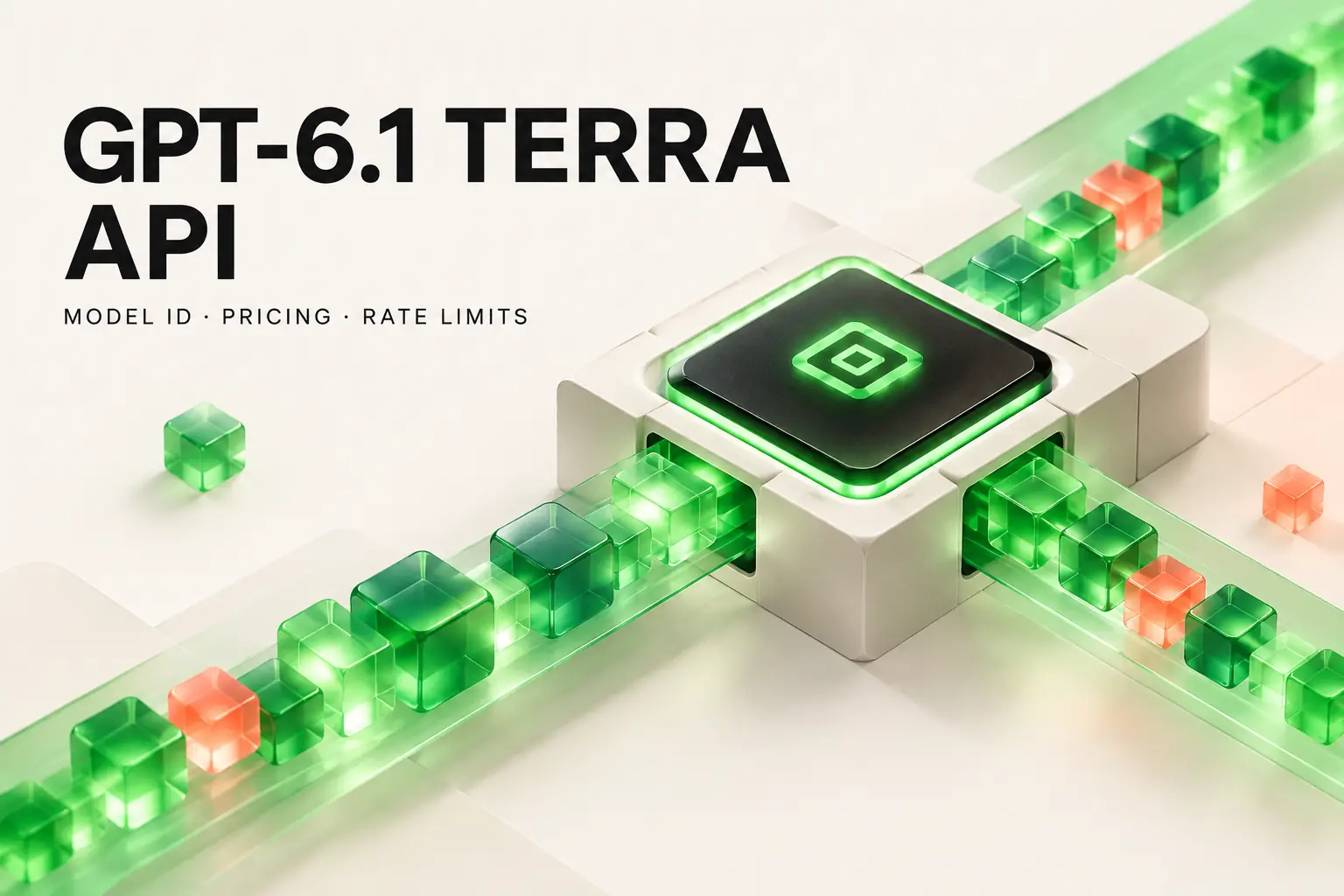
The GPT-6.1 Terra API model ID is gpt-6.1-terra. At Standard rates, OpenAI lists $1 per million input tokens, $0.05 for cached input, $1.25 for a 30-minute cache write, $2.50 for a 12-hour cache write, and $5 for output. The model accepts text and images, returns text, exposes a 1,050,000-token context window, and supports tool calling through the Responses API.
The price looks simple until caching, service tiers, regional processing, and the more-than-272K long-context rule are involved. This guide turns the official rates into reproducible formulas, shows the documented Build and Launch limits, and separates official OpenAI API billing from a GlobalGPT workspace route. Facts were checked against the official GPT-6.1 Terra model page 그리고 OpenAI API 가격 on October 27, 2026.
GPT-6.1 Terra API Quick Answer
GPT-6.1 Terra API Model ID and Endpoints
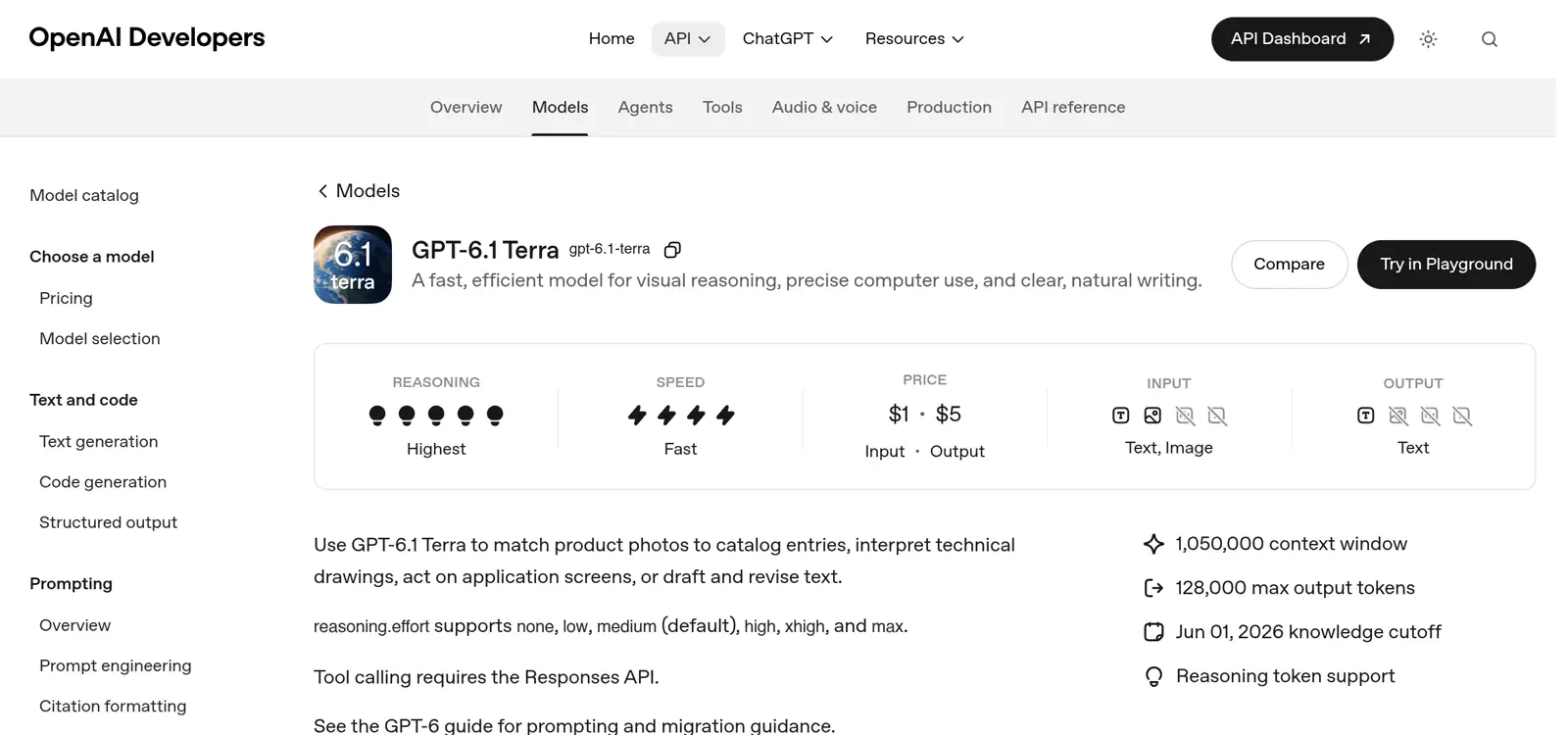
Use the exact model string in every request. Similar family names are not aliases: gpt-6.1-sol is a different product with different positioning and prices. OpenAI’s developer changelog records Terra’s October 26 release, while the model page describes it as a fast, efficient option for visual reasoning, precise computer use, and clear natural writing.
If one application will route between Terra and Sol, define which requests actually need Sol’s deeper reasoning and coding focus before implementation instead of sending every task to the more expensive model.
For new tool-using applications, the Responses API is the practical default. The official model page lists Responses with tool calling and Chat Completions without tool calling. That distinction matters for agents that call functions, search files, inspect the web, run code, use a hosted shell, apply patches, invoke skills, or interact with computer-use tools. A plain text generation workload can still use Chat Completions, but mixing the two routes without logging the endpoint makes evaluations harder to reproduce.
Terra supports reasoning efforts from 없음 통해 max, 와 함께 중간 documented as the default. Do not assume a gateway or multi-model workspace preserved your requested setting unless the response or route metadata proves it. In our alternate GlobalGPT test route, the interface reported that deep thinking was disabled but did not expose a separate reasoning-effort field, so the exact effort remained unverified.
GPT-6.1 Terra Standard Pricing
Each meter is independent. A request can include uncached input, cached input, a cache write, and output at the same time. Multiply each token count by its own per-million rate, then add the components. Tool-specific charges, storage, network, and any product-level subscription are separate from this token formula. The official rates are API prices, not a promise about the debit shown by a third-party workspace.
Terra’s Standard rates are half of GPT-6.1 Sol’s $2 input and $10 output prices. That is useful context for teams choosing a default, but model quality still changes total cost per accepted result. Use the same prompts and acceptance criteria to test where Terra saves money and where Sol earns its premium instead of choosing on token price alone.
Standard vs Batch, Flex, and Fast
Batch and Flex cut eligible token rates in half; Fast doubles them. Apply the tier multiplier consistently to every token component before adding optional regional processing. A $0.10 Standard job becomes about $0.05 in Batch or Flex and $0.20 in Fast, assuming the same token mix and no long-context or regional adjustment. Eligibility, queueing behavior, and latency characteristics still belong to the chosen route.
Do not mix service-tier arithmetic with model quality claims. Faster processing does not mean a different model is smarter, and a lower Batch price does not guarantee the job will finish within an interactive deadline. Log the actual service tier returned by the API. Our GlobalGPT test route did not expose one, so its reported platform charge cannot be translated into an official Standard-rate debit.
Before moving every low-priority request to Batch, test whether GPT-6 Luna already clears the acceptance criteria for short, well-scoped tasks where Terra may still be more model than you need.
Prompt Caching: Reads, Writes, and Retention
Cached input at $0.05 per million tokens is only 5% of ordinary input, but creating the reusable entry costs more: $1.25 per million tokens for 30 minutes or $2.50 for 12 hours. A stable prefix must be reused enough times to repay that write. The short-retention write breaks even after roughly 1.26 avoided ordinary reads; the 12-hour write takes roughly 2.63. Real requests include uncached suffixes and output, so measure complete calls rather than quoting the prefix alone.
Design a cacheable prompt by placing large stable material first: policies, schemas, coding standards, product catalogs, or a shared reference corpus. Put request-specific instructions later. Keep the prefix byte-stable, record a hash, and inspect returned cached-token usage. If your application continually changes the prefix, a cache-write meter can raise rather than lower effective cost.
The More-Than-272K Long-Context Rule
Terra’s headline context window is 1.05 million tokens, but pricing changes before the limit. When input is more than 272,000 tokens, OpenAI applies 2× input and cache rates and 1.5× output rates to the full request. A 273K-token request is therefore not billed at the ordinary rate for the first 272K and a premium only on the final thousand. The whole call moves to the higher band.
This step makes retrieval and compaction financial controls. Remove duplicated boilerplate, stale conversation history, and low-value retrieved passages before sending. If a request sits near the boundary, calculate both bands and decide whether the extra context improves acceptance enough to justify the jump. A large context window is capacity, not a recommendation to fill it.
For a long-context task that still fails after retrieval cleanup and better prompting, use the exact failure to check whether GPT-6 Astra closes the quality gap before paying for a permanent model upgrade. The question is whether the stronger model fixes the measured error, not whether it ranks higher in the family.
Regional Processing and Data Scope
OpenAI documents a 10% regional-processing uplift where that option is available. Apply it after the model, context, and service-tier rates are determined. A Standard job calculated at $0.20 becomes $0.22 with the uplift; a Batch job calculated at $0.10 becomes $0.11. The official data-controls guide is the correct place to verify residency availability and scope for your organization.
Regional processing is not a general tax on every Terra request. It applies only when the eligible regional route is selected. Keep it visible as a separate line item so procurement can distinguish data-location requirements from model cost. The same separation should be used for tool charges and GlobalGPT access, which are not part of the official Terra token table.
GPT-6.1 Terra Rate Limits
The checked model page also lists batch queues of 3,000,000 tokens for Build and 200,000,000 tokens for Launch. Those numbers describe documented account tiers, not guaranteed throughput for every organization. Limits can be enforced across projects or organizations, and a request may hit RPM, TPM, or queue capacity first depending on its shape.
Design for all three constraints. Small chat turns can exhaust requests per minute while using little token capacity. Large document jobs can exhaust tokens per minute with relatively few calls. Batch workloads can fill the queue even when no interactive request is being sent. Add exponential backoff for transient rate errors, honor server retry guidance, and cap retries so a failing workflow cannot create an accidental cost loop.
What Our API Usage Test Actually Showed
A prepared OpenAI-compatible request was rejected before inference with HTTP 402 pre_consume_token_quota_failed. It reported $0.006048 remaining quota against a $0.012676 pre-consumption requirement. Because the call never ran, that event is not a Terra capability result and the requirement is not an independently verified debit. We then used an authenticated GlobalGPT route configured for gpt-6.1-terra to preserve usable test evidence.
All three route calls completed, but the response did not attest an upstream response.model or service tier. The route reported a combined settled charge of 0.016076 in its own platform billing field. We do not map that value to official API dollars. The useful result is narrower: raw usage contained prompt, completion, total, and cached-prompt fields, and the model-generated arithmetic matched the supplied official rates.
GPT-6.1 Terra Cost Examples
The long-document example applies 2× to all 300K input tokens and 1.5× to all 10K output tokens: 300,000 / 1,000,000 × $2 equals $0.60, and 10,000 / 1,000,000 × $7.50 equals $0.075. Tool calls and regional processing are excluded. If the same job can run in Batch, the eligible token total falls to roughly $0.3375.
For a cached workflow, add cache-write cost during the call that creates the entry, then use the cached-input price only for tokens the API actually reports as cached. Teams migrating from older models should rebuild the cost model from the GPT-5.6 baseline rather than transfer old multipliers or model IDs into a Terra estimate.
When procurement also needs a flagship budget ceiling, price the same representative workload at GPT-6 Astra’s API rates. Keeping one workload and one acceptance test makes that premium comparison more useful than placing unrelated list prices side by side.
Copyable GPT-6.1 Terra Cost Calculator
This calculator treats the documented more-than-272K rule as a full-request multiplier and keeps the regional uplift explicit. It does not include web-search, storage, code-interpreter, or other tool charges. For production billing, reconcile estimates with returned usage and the authoritative account invoice rather than using model-generated arithmetic as a ledger.
GPT-6.1 Terra API FAQ
What is the GPT-6.1 Terra API model ID?
Use gpt-6.1-terra. Keep that exact string in requests, logs, evaluations, and billing exports so results are not mixed with GPT-6.1 Sol or an older Terra model.
How much does GPT-6.1 Terra cost?
At Standard rates, input is $1, cached input is $0.05, a 30-minute cache write is $1.25, a 12-hour cache write is $2.50, and output is $5 per one million tokens.
Does GPT-6.1 Terra support the Responses API?
Yes. OpenAI documents Responses API support with tool calling. Chat Completions is also supported, but without tool calling for this model.
What is the GPT-6.1 Terra context window?
OpenAI lists a 1,050,000-token context window and up to 128,000 output tokens. A separate maximum-input value was not documented in the checked source.
입력 토큰 수가 272K를 초과하면 어떻게 되나요?
When input exceeds 272,000 tokens, the full request uses twice the input and cache rates and 1.5 times the output rate. The multiplier is not limited to tokens above the threshold.
What are the GPT-6.1 Terra rate limits?
The checked model page documents Build at 5,000 RPM, 1,000,000 TPM, and a 3,000,000-token batch queue; Launch is 10,000 RPM, 4,000,000 TPM, and a 200,000,000-token batch queue.
Does prompt caching always lower the bill?
No. You need a reusable prefix and actual cached-token usage. A cache write costs more than ordinary input, so short-lived or constantly changing prefixes may not repay the write cost.
Can I use GPT-6.1 Terra on GlobalGPT?
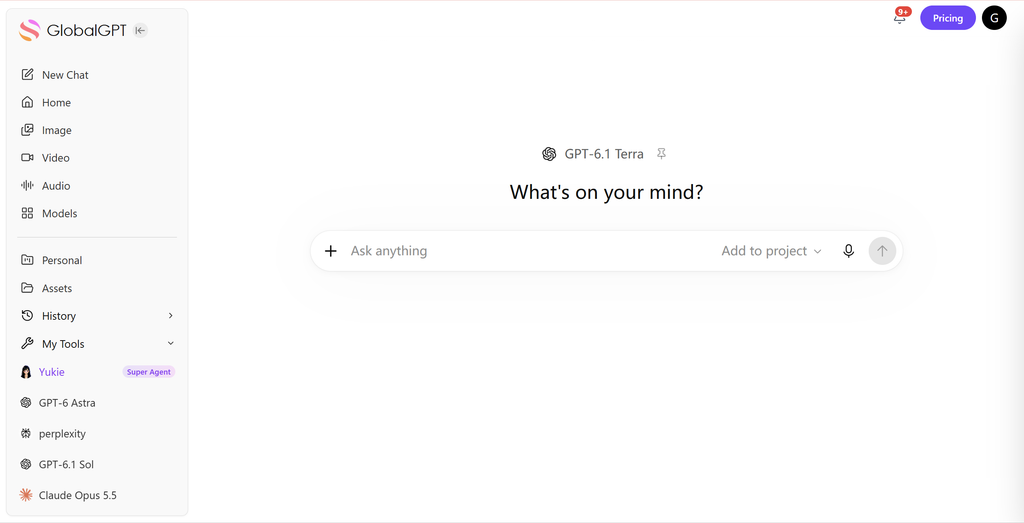
A live GlobalGPT route exists for GPT-6.1 Terra. GlobalGPT access is a separate platform route and should not be treated as official OpenAI API billing or rate-limit evidence.
Is GPT-6.1 Terra good for images?
It accepts text and image input and returns text, which suits screenshot analysis, visual reasoning, and interface planning. It does not natively output audio or video.
최종 평결
GPT-6.1 Terra is a cost-efficient API choice when visual reasoning, interface understanding, natural writing, and tool-enabled work matter more than maximum reasoning depth. The exact model ID is straightforward, but production cost control depends on separating five token meters, checking cache behavior, applying the full-request long-context rule, and monitoring RPM, TPM, and batch queues independently.
Start with Standard and medium reasoning, measure the smallest representative workload, and add service-tier or regional multipliers only when the route actually uses them. Count tokens before any request near 272K. When the workload needs deeper reasoning or harder coding, compare the same task with Sol instead of guessing from model names.
For teams comparing OpenAI with other providers, run the same task across other leading model families rather than stretching Terra-versus-Sol conclusions across unrelated systems.