Muse Wonder is worth trying for code repair and source-based analysis. The examples below passed 29 independent checks: 13 for the code-repair follow-up and eight each for source reconciliation and recovery planning. With explicit identity requirements, the returned code preserved distinct Symbols and object references while keeping the requested order and format.
Meta introduced Muse Wonder on October 12 as a frontier model for personal and professional agents. The bigger promises involve long tasks, memory and computer use. Our text tests give an early view of how it handles constraints; they do not settle those bigger claims.
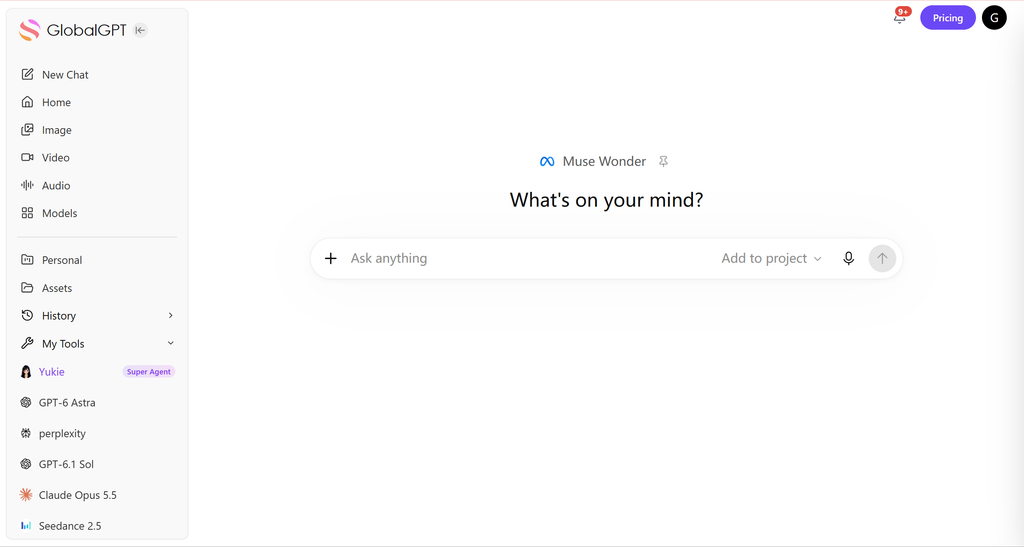
You can repeat the tasks through Muse Wonder su GlobalGPT before changing your workflow. This review is published by GlobalGPT, and the platform entry is also where we ran the tests.
What is Muse Wonder?
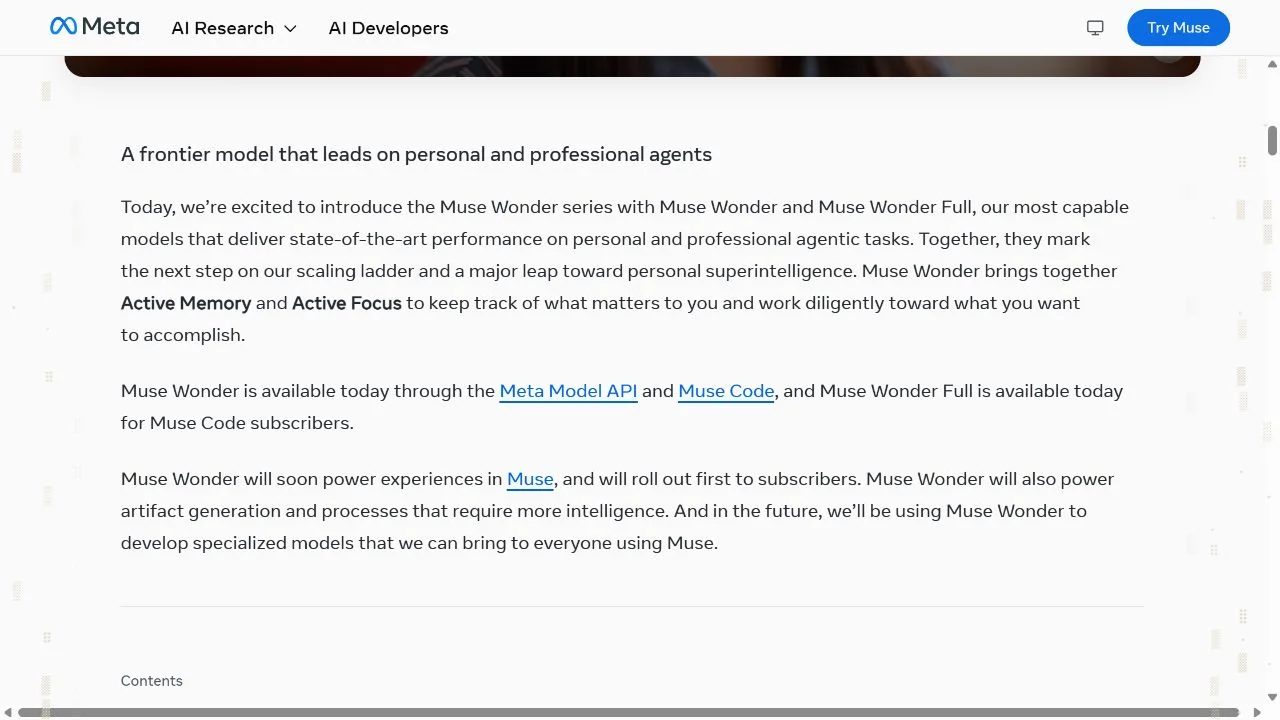
Il official Meta launch announcement introduces two variants: Muse Wonder and Muse Wonder Full. It says Wonder is available through Meta Model API and Muse Code, while Full is available to Muse Code subscribers. It separately says Wonder will soon power the consumer Muse product, starting with subscribers. Those are three access surfaces with different scopes.
Quelli di Meta documentazione del modello identifies the standard preview model as muse-wonder-1.0. It accepts text, images, video, audio and PDFs, and returns text. Multimodal understanding can help a model explain a file or reason about a screen; it does not by itself give that model an image- or video-generation endpoint.
Choose an evaluation around what you actually need: correct code, a cited answer, a usable plan or a finished tool task. Our Guida ai migliori modelli di IA helps separate those workloads before you turn a model name into a buying decision.
What Meta promises: memory, focus and context
Il documented context window is 1,048,576 tokens. Meta also describes tool calling and structured outputs. A large window is useful when a task has many files, but the specification alone says little about retrieval errors, conflicting instructions or what survives a long interaction.
Contesto
1,048,576Tokens documented by Meta; not stress-tested here.
Ingresso
MultimodaleText, images, video, audio and PDFs.
Uscita
TestoPlans, analysis and code; our runs used text only.
Accesso
Two variantsStandard Wonder and Muse Code’s Wonder Full.
In Meta’s Active Memory and Active Focus launch post, Memory is about carrying relevant context across conversations; Focus is about staying with a goal when a task becomes difficult. These are attractive ideas for a working agent. Testing them needs repeated conversations and actual tool execution, not a short prompt that merely asks the model to explain the features.
That distinction shapes our test set. We tested a coding constraint, an evidence conflict and a recovery plan. The source packet fits comfortably into an ordinary chat. We did not attach images or PDFs, fill the context window, or measure persistent memory between chats.
Three real Muse Wonder tests and results
We tested three task types in GlobalGPT’s production Muse Wonder interface on October 14, 2026, using its default settings. The code example below is a follow-up with explicit identity requirements; the source and planning examples retain their original outputs. The published entry maps to agent 6256 and label muse-wonder. No reasoning-effort control was exposed, and the provider backend version was not independently attested; these are not Wonder Full or max-effort API benchmark results.
Code basics
8 / 8Order, types, missing IDs and input preservation passed.
Evidence JSON
8 / 8Format, source choice and missing facts passed.
Recovery plan
8 / 8Six steps, 126 words and a bounded retry.
ID identity
5 / 5Symbols, references and BigInt passed in the follow-up.
Test 1: fix a real JavaScript deduplication bug
The original function used record.id || '', which collapses numeric zero, false and absent IDs into the same value. We tested stable order, case-insensitive strings, separate missing-ID records and no mutation, then followed up with explicit Symbol, object-reference and BigInt requirements. The complete prompt and returned code below are from that follow-up.
Dati esatti
Test di verifica della correzione del codice per lo stesso task 'uniqueById'. Restituisci una funzione JavaScript eseguibile corretta, una breve spiegazione ed esattamente cinque test in stile 'assert'. Non dichiarare di aver eseguito i test.

Requisiti di accettazione:
- Mantieni l'ordine degli input e restituisci il primo record per ogni ID duplicato. Non modificare mai l'array o i record.
- I record il cui ID è assente, nullo o non definito vengono sempre mantenuti.
- Confrontare gli ID stringa senza distinzione tra maiuscole e minuscole. Mantenere distinti il numero 0, il valore booleano false e la stringa '0'.
- Mantieni l’identità degli ID in JavaScript: due valori distinti di Symbol('x') devono rimanere separati, la ripetizione dello stesso identico Symbol deve essere deduplicata e i valori ripetuti di Symbol.for('shared') devono essere deduplicati.
- Oggetti o funzioni diversi utilizzati come ID rimangono distinti; i riferimenti ripetuti vengono deduplicati. BigInt 1n e il numero 1 rimangono distinti.
- Utilizzare l’esempio originale [{id:0},{id:false},{id:'A'},{id:'a'},{name:'one'},{name:'two'}], mantenendo 0, false, la prima A ed entrambi i record privi di ID.

I cinque test forniti dovrebbero coprire l’esempio standard, gli ID mancanti/nulli, l’identità dei simboli, l’identità dei riferimenti agli oggetti e il confronto tra BigInt e numero. Utilizzare un’implementazione che preservi i valori anziché ridurre le identità distinte a chiavi testuali.
Se la copia automatica è disabilitata, seleziona il testo e premi Ctrl/Cmd+C.Risultati del modello
function uniqueById(records) {
  const seen = new Set();

  return records.filter((record) => {
    // Absent, null, and undefined IDs are always kept.
    if (record == null || record.id == null) {
      return true;
    }

    const id = record.id;

    // Normalize only strings for case-insensitive comparison.
    // All other values are stored as-is, preserving their identity.
    const key = typeof id === "string" ? id.toLowerCase() : id;

    if (seen.has(key)) {
      return false;
    }

    seen.add(key);
    return true;
  });
}
Se la copia automatica è disabilitata, seleziona il testo e premi Ctrl/Cmd+C.Muse Wonder lowercased only string IDs and stored other IDs directly in a Imposta. Records with absent, null o undefined IDs always pass through. The eight ordinary checks covered the sample, empty input, case handling, distinct types, missing IDs, immutability, order and returned-record identity. All eight passed.
Risultati del modello
const assert = require("node:assert/strict");

// Test 1: Ordinary sample — string case, distinct primitive types, id-less records.
assert.deepStrictEqual(
  uniqueById([
    { id: 0 },
    { id: false },
    { id: "A" },
    { id: "a" },
    { name: "one" },
    { name: "two" },
  ]),
  [
    { id: 0 },
    { id: false },
    { id: "A" },
    { name: "one" },
    { name: "two" },
  ]
);

// Test 2: Missing, null, and undefined IDs are always kept.
assert.deepStrictEqual(
  uniqueById([
    { name: "one" },
    { id: null },
    { id: undefined },
    { name: "two" },
    { id: null },
  ]),
  [
    { name: "one" },
    { id: null },
    { id: undefined },
    { name: "two" },
    { id: null },
  ]
);

// Test 3: Symbol identity and registered symbols.
const symbolA = Symbol("x");
const symbolB = Symbol("x");
assert.deepStrictEqual(
  uniqueById([
    { id: symbolA },
    { id: symbolB },
    { id: symbolA },
    { id: Symbol.for("shared") },
    { id: Symbol.for("shared") },
  ]),
  [{ id: symbolA }, { id: symbolB }, { id: Symbol.for("shared") }]
);

// Test 4: Object and function reference identity.
const objectA = {};
const objectB = {};
function functionA() {}
function functionB() {}
assert.deepStrictEqual(
  uniqueById([
    { id: objectA },
    { id: objectB },
    { id: objectA },
    { id: functionA },
    { id: functionB },
    { id: functionA },
  ]),
  [
    { id: objectA },
    { id: objectB },
    { id: functionA },
    { id: functionB },
  ]
);

// Test 5: BigInt, number, and string IDs remain distinct.
assert.deepStrictEqual(
  uniqueById([
    { id: 1n },
    { id: 1 },
    { id: "1" },
    { id: 1n },
    { id: 1 },
    { id: "1" },
  ]),
  [{ id: 1n }, { id: 1 }, { id: "1" }]
);
We executed the model’s five assert-style tests and all passed. We also ran our own checks separately. Execution happened in our verification environment after receiving the answer; the model did not operate a repository or independently attest a test run.
Five additional identity checks passed: distinct same-description Symbols remain separate; repeated identical Symbols deduplicate; registered Symbols deduplicate; objects and functions preserve reference identity; and 1n remains distinct from 1. That makes 13 independent checks for this follow-up version, in addition to the five model-supplied assertions.
If code quality is your main reason to switch, use the Il miglior modello di IA per il confronto dei codici to choose a second model and run the same input. We did not run a matched competitor test here, so this result does not establish a ranking.
Test 2: reconcile conflicting evidence into valid JSON
The second task used a fictional Orion Agent packet. An older announcement said $19/month and EU availability; newer official sources said $24/month and a paused EU rollout. An unsupported community claim said $12. The missing output price and restart date were deliberate traps for invented certainty. None of these fictional prices are Muse Wonder pricing.
Dati esatti
Test di revisione di Muse Wonder 2: riconciliazione delle prove.
Utilizza esclusivamente questo pacchetto di fonti fittizio. Restituisci SOLO un JSON valido contenente le chiavi launch_date, plan_monthly_usd, api_input_per_million_usd, region_status, unresolved, citations. Ogni valore fattuale deve riportare i relativi ID di fonte in citations. Non calcolare silenziosamente la media delle contraddizioni né inventare fatti mancanti.

[S1] Annuncio del prodotto, datato 12-10-2026: Orion Agent lanciato il 12 ottobre. Piano Pro $19/mese. Disponibile negli Stati Uniti e nell’Unione Europea.
[S2] Pagina ufficiale dei prezzi, aggiornata il 14/10/2026: piano Pro $24/mese, fatturato mensilmente. Input API $4 per milione di token. L’output API non è indicato.
[S3] Pagina ufficiale di stato, aggiornata il 14-10-2026: accesso negli Stati Uniti operativo. Lancio nell’UE sospeso; nessuna data di ripresa fornita.
[S4] Post della community, datato 14/10/2026: Qualcuno afferma che il piano è di $12 e che l’UE funziona; nessun screenshot o link.

Preferire prove ufficiali più recenti per lo stesso campo. Elencare esplicitamente eventuali informazioni non risolte.
Se la copia automatica è disabilitata, seleziona il testo e premi Ctrl/Cmd+C.
Risultati del modello
{"data_di_lancio": "2026-10-12", "canone_mensile_in_USD": 24, "input_API_per_milione_di_USD": 4, "stato_regione": {"USA": "operativo", "UE": "sospeso"}, "irrisolti": ["Il prezzo di uscita dell’API non è riportato nelle fonti.", "La data di ripresa del lancio nell’UE non è stata fornita.", "Le affermazioni contrastanti non sono state utilizzate come base per i valori selezionati: S1 indicava il piano Pro a $19/mese e l’UE come disponibile, mentre la fonte non ufficiale e non supportata S4 sosteneva $12/mese e che l’UE funzionasse; si è preferito invece utilizzare le più recenti fonti ufficiali S2 e S3."], "citazioni": {"data_lancio": ["S1"], "piano_mensile_usd": ["S2"], "api_input_per_million_usd": ["S2"], "region_status": ["S3"]}}The output parsed as JSON and contained the six requested keys. It chose 24 from S2, chose “paused” from S3, retained S1 for the launch date and kept the missing output price and EU restart date unresolved. It did not cite S4 as the basis for a selected fact. All eight checks passed.
This is the most useful result for everyday research work: the model preferred newer official evidence for the same field without erasing what it still could not know. It is a small source-reconciliation test, not a web-search accuracy score or a million-token retrieval result.
Use a redacted packet when reproducing the task with business material. Our Guida alla protezione dei dati nell'ambito dell'intelligenza artificiale covers questions to ask about the platform and provider; accurate source handling alone does not establish privacy terms.
Test 3: plan recovery after an official page fails
The third prompt simulated a browser agent facing HTTP 500, conflicting price claims and no authorized API key. It asked for exactly six steps, no more than 140 words and a concrete stopping condition. It explicitly requested planning rather than real tool execution.
Dati esatti
Test di valutazione di Muse Wonder n. 3: pianificazione del recupero, non esecuzione effettiva dello strumento.
Un agente browser deve raccogliere i prezzi pubblici dei prodotti e preparare una bozza di confronto. La pagina ufficiale dei prezzi restituisce un codice di errore HTTP 500. Un marketplace riporta come dato di input $4/M e come dato di output $20/M. Uno snippet di ricerca su Reddit riporta $1/M. L’utente desidera uno screenshot a conferma e un risultato pratico. Non è disponibile alcuna chiave API autorizzata.
Scrivi esattamente sei passaggi numerati, per un totale massimo di 140 parole. Includi un numero limitato di tentativi, conserva la registrazione della pagina con errore, attribuisci i prezzi al marketplace, non considerare verificato lo snippet di Reddit e distingue chiaramente la fase di preparazione dal test completo del modello. Non aggirare la procedura di accesso né falsificare screenshot o risultati. Concludi il passaggio 6 con una condizione di interruzione concreta.
Se la copia automatica è disabilitata, seleziona il testo e premi Ctrl/Cmd+C.
Risultati del modello
1. Riprovare ad accedere alla pagina ufficiale dei prezzi fino a tre volte, con brevi intervalli; conservare il timestamp, l’URL, lo stato HTTP 500 ed eventuali screenshot autentici della pagina di errore come documentazione del malfunzionamento.
2. Registrare l’inserzione sul marketplace come prezzo attribuito al marketplace: inserire $4/M ed estrarre $20/M, con URL di origine e data; non presentarlo come prezzo ufficiale.
3. Registrare la segnalazione su Reddit relativa a $1/M solo come indizio non verificato; escluderla dal confronto verificato fino a quando non sarà confermata da una fonte ufficiale o attendibile.
4. Redigere una tabella di confronto che separi le voci verificate, attribuite e non verificate, segnalando la mancanza di conferma ufficiale.
5. Preparare — senza eseguirli — il piano di test del modello, i prompt e la scheda di valutazione; in assenza di una chiave API autorizzata, non aggirare la procedura di accesso né falsificare screenshot o risultati; contrassegnare lo stato come “non testato”.
6. Segnalare la bozza come semplice preparazione, non come test del modello completato, e interrompere l’operazione quando tre tentativi falliscono e non perviene alcuna chiave autorizzata entro la scadenza concordata.
Muse Wonder produced six steps totaling 126 words, excluding step numbers. It bounded retries at three, retained the failed-page evidence, attributed marketplace prices, treated the Reddit snippet as unverified and kept preparation separate from a completed model test. All eight checks passed.
The plan’s final deadline was not given a timestamp, so a real operator would still have to set it. More fundamentally, a good plan does not prove the agent can execute clicks, recover a tool connection or finish a long workflow. That is also why our Classifica degli assistenti AI testati distinguishes different assistant tasks rather than treating every fluent answer as automation.
What these runs did not measure
These examples cover three task types with no competing model. Code repair includes an explicit-requirements follow-up. The selected code, JSON and plan displayed “Took 18s,” “Took 10s” and “Took 11s”; those are platform labels, not independent latency measurements. We did not audit task-specific credit debits, provider token usage, persistent Active Memory, long context, multimodal files or live computer use.
The complete code, JSON and planning text is retained in the panels above. Use the exact inputs and verify the returned text when reproducing these examples; the accepted code is the follow-up version, and its result does not imply universal correctness for every application.
X benchmarks and Reddit reactions
Il AI at Meta launch thread on X frames Wonder and Full around personal and professional agent work. That is the model maker’s intended positioning. Our tests support some basic instruction-following observations, while the memory and execution claims remain separate.
Nel suo valutazione X originale, Artificial Analysis reports Intelligence Index v4.3 scores of 52 for Muse Wonder and 56 for Wonder Full at maximum reasoning effort, versus 48 for Muse Spark 1.3. The organization also distinguishes standard API access from Full in Muse Code. We read the original report; we did not reproduce its evaluations.
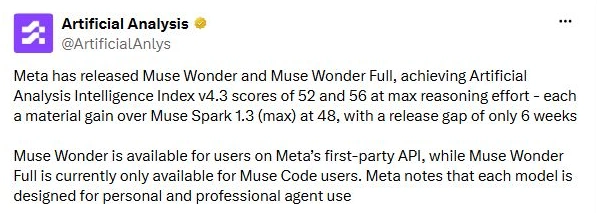
Reported scores · maximum reasoning effort · not our benchmark
Bars use a display range of 0–60, not a percentage scale. Source: Artificial Analysis original post.
The same report is positive about gains in agent tasks, but flags premium standard-model pricing and knowledge as a relative weakness. That combination is more informative than “new frontier model”: a model can improve at agent work while still being the wrong economic choice for a frequent task. Its reported benchmark cost per task should not be reused as the price of our chat runs.
On Reddit, the original LocalLLaMA post has been removed by moderators, but comments remain readable. u/noobiethe13 ha scritto: “wonder’s on the API, full is only through Muse Code subs for now. reviews should say which one they actually tried”. The practical point matches Meta’s access distinction: an unspecified “Wonder review” can mix two different routes.

Another commenter, u/ComplexType568, wrote: “Hope they release a new open weights model and also an MoE model…” That is an openness preference, not a measured quality result.
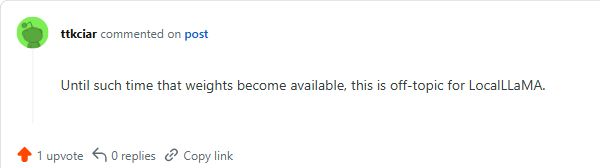
Moderator u/ttkciar explained the removal: “Until such time that weights become available, this is off-topic for LocalLLaMA.” These comments were posted October 13 and read on October 14. They explain this thread’s concerns; they do not establish a Reddit-wide consensus or a reliability score.
Muse Wonder pricing: tokens versus subscriptions
Il Scheda prodotto OpenRouter Muse Wonder checked October 14 quotes $4 per million input tokens, $0.20 per million cached input tokens and $20 per million output tokens. These are marketplace-listed API rates, attributed to OpenRouter rather than presented as a verified Meta invoice or checkout total.
API input
$4 / MOpenRouter listing; uncached input tokens.
Input memorizzato nella cache
$0.20 / MListing rate; eligibility for caching matters.
API output
$20 / MListing rate; separate from subscription fees.
At those listed rates, an illustrative request with 10,000 uncached input tokens and 2,000 output tokens would cost $0.08: (10,000 ÷ 1,000,000 × $4) + (2,000 ÷ 1,000,000 × $20). This is arithmetic from displayed rates, excluding any other applicable charges. It is not the audited price of a completed review task.
Muse Code subscription access, standard API token billing and GlobalGPT credits are different units. Full’s Muse Code access does not establish a per-token price for Full, and setting standard Wonder to high reasoning effort does not select Full. We did not verify a current Muse Code checkout total or a per-task GlobalGPT debit.
If you run the same workflow daily, compare accepted output and retry cost as well as the headline rate. Our per quale IA vale la pena pagare is useful for that broader subscription decision; a cheaper token rate can still be poor value if the task needs more attempts.
How to use Muse Wonder on GlobalGPT
Il Muse Wonder production entry on GlobalGPT was published and enabled when checked. The original tasks and the code-repair follow-up completed there. Open it, confirm the Muse Wonder label and paste a complete prompt above. Judge the response against the stated checks before applying it to your own files.
For code repair, spell out the allowed ID types and the expected equality rules. Start with a small sample, then check case handling, missing values, identity and input preservation. A specific acceptance list makes the returned function easier to verify and adapt.
For direct API work, Meta’s Model API overview documenti https://api.meta.ai/v1, the standard model ID and a bearer key requirement. Our browser runs used the existing platform access; they do not establish that an arbitrary Meta API key or another gateway can call the same backend.
GlobalGPT is convenient when you want to repeat a prompt and compare other models in one workspace. The flusso di lavoro con modelli di IA "tutto in uno" describes that workflow. It does not make the chat interface equivalent to Muse Code’s terminal agent or guarantee that every native memory/tool feature is exposed.
Who should use it? Our verdict
Try Muse Wonder for bounded coding, evidence cleanup and planning tasks. Our code run met the ordinary-ID requirements, the source run retained uncertainties and the planning run obeyed the recovery constraints. Those are concrete reasons to try it with a task you can verify.
Good first task
Code repairA small function with explicit accepted inputs and checks.
Useful research task
Source cleanupDated evidence, named sources and required unresolved fields.
Needs a deeper test
Agent executionMemory, browser recovery and long workflows remain untested.
Keep human review for production changes and define the accepted inputs before using generated code. Our follow-up checks support this specific implementation. If you need Wonder Full, evaluate the actual Muse Code route. For persistent memory or live computer use, run a separate end-to-end task and save its tool trace.
For audio workflows, do not infer speech-generation quality from these text runs. A AI voice agents for customer support workflow also needs speech recognition, a voice output route and its own latency checks; Wonder’s documented audio input alone does not prove the whole stack.
Our early verdict is positive but specific: Muse Wonder handled the tested tasks well enough to earn a place in a practical trial. The next meaningful step is your own verified task, not a universal “best model” claim from these examples.
Muse Wonder review FAQ
What is Muse Wonder?
Muse Wonder is Meta’s frontier agent model, launched October 12, 2026. Meta documents text, image, video, audio and PDF inputs, text output, and a 1,048,576-token context window.
Is Muse Wonder good for coding?
The code-repair follow-up passed 13 independent checks, including Symbol identity, object references, BigInt, order and input preservation. We made the identity requirements explicit and also executed all five supplied assertions successfully.
Did this review actually test Muse Wonder?
Yes. We tested code repair, conflicting-source JSON and recovery planning in GlobalGPT’s production interface. The examples shown passed 29 independent checks. The code example is a follow-up with explicit identity requirements.
Can I use Muse Wonder on GlobalGPT?
Yes. We verified the published Muse Wonder entry and completed the original tasks and a code-repair follow-up there on October 14, 2026. The interface labels the model Muse Wonder; its exact provider backend version was not independently attested.
What is the difference between Muse Wonder and Wonder Full?
Meta offers standard Wonder through Model API and Muse Code. The launch announcement limits Wonder Full to Muse Code subscribers. Our GlobalGPT runs do not establish that we tested Full.
How much does Muse Wonder cost?
The OpenRouter listing checked October 14, 2026 quotes $4/M input, $0.20/M cached input and $20/M output tokens. Those marketplace rates are separate from Muse Code subscriptions and GlobalGPT credits.
Does Muse Wonder generate images or video?
Meta’s model documentation specifies multimodal inputs and text output. Understanding an image or video is different from generating one; this review tested text tasks only.
Did the tests prove Active Memory or computer use?
No. The source packet was short, and the recovery task requested a plan only. We did not test cross-chat memory, a million-token input, multimodal files or live computer-use execution.