Muse Spark 1.3 adalah versi Muse Spark terkuat dari Meta hingga saat ini: model xhigh yang tersedia untuk umum mencapai skor 61 pada Indeks Kecerdasan Analisis Buatan, mempertahankan jendela konteks sebesar 1 juta token, dan berhasil menyelesaikan ketiga tugas pemrograman tingkat kesulitan sedang dalam uji API respons pertama kami. Hal penting yang perlu diperhatikan adalah bahwa grafik tolok ukur utama Meta menggunakan fitur "max reasoning", padahal pada saat ulasan ini disusun, fitur "max" masih menunggu peluncuran secara luas setelah menjalani pengujian keamanan tambahan.

Ulasan Muse Spark 1.3: Kesimpulan Singkat
Kesimpulan kami
Muse Spark 1.3 layak dicoba untuk agen pemrograman, pekerjaan dengan konteks panjang, dan otomatisasi yang sensitif terhadap biaya. Hasil xhigh publiknya sudah setara dengan yang terbaik di bidangnya, namun jangan mengutip skor maksimum Meta seolah-olah setiap pengguna API dapat mencapainya saat ini.
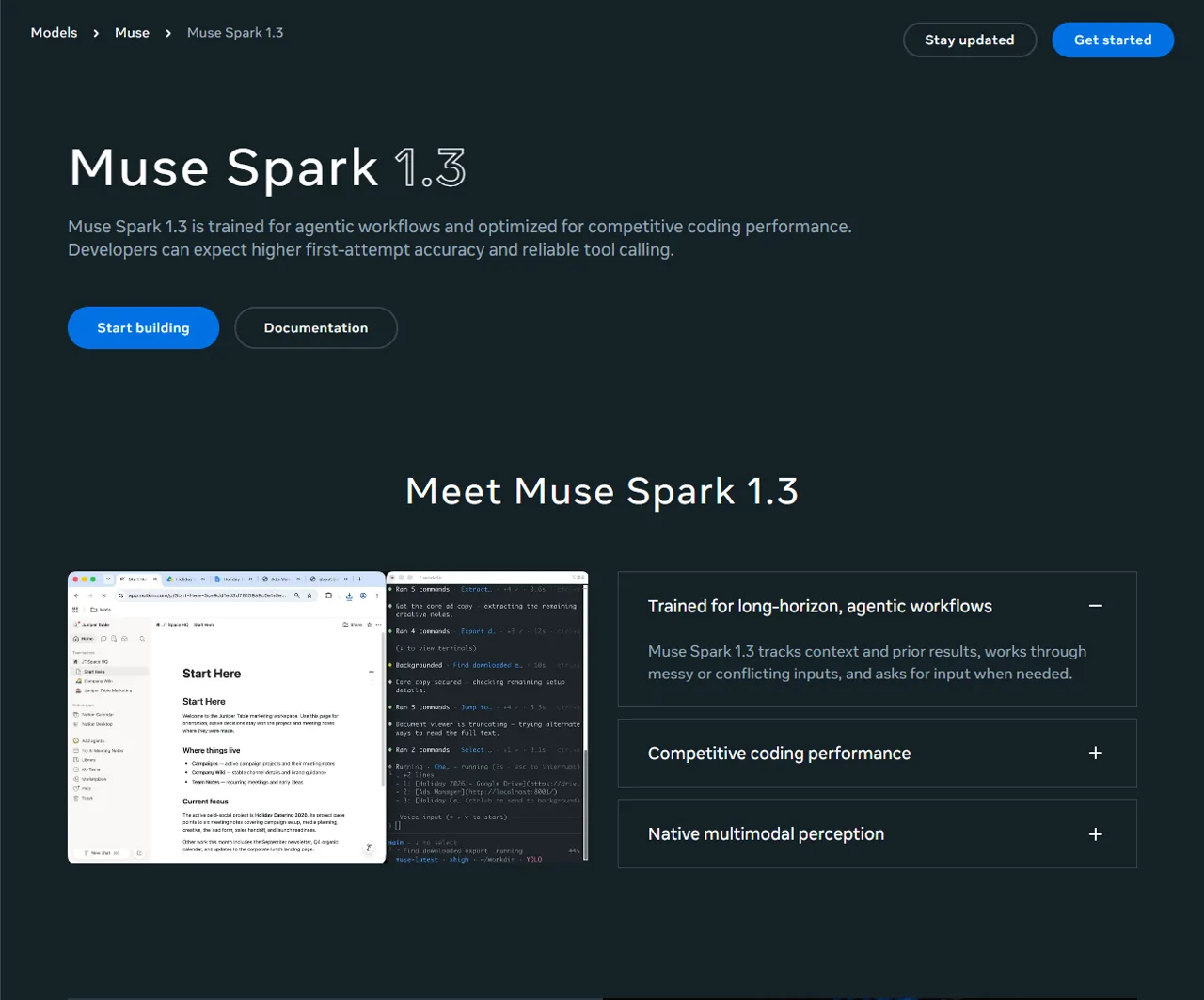
Meta merilis Muse Spark 1.3 pada 2 September 2026, sehingga memungkinkannya digunakan untuk alur kerja berbasis agen dengan cakrawala jangka panjang, hasil kode yang lebih rapi, dan kolaborasi yang lebih andal. Hal ini melanjutkan pergeseran menuju Agen AI yang dikembangkan berdasarkan model penggunaan alat. Meta menyatakan bahwa sistemnya mengajukan pertanyaan klarifikasi ketika persyaratan tidak jelas, memberikan peringatan saat mengalami kebuntuan, dan melakukan konfirmasi sebelum mengambil tindakan yang berdampak signifikan. Dalam perbandingan internal dengan versi 1.2, para insinyur Meta mencatat penurunan sekitar 20% pada jumlah panggilan alat dan 25% pada jumlah token. Angka-angka tersebut merupakan klaim dari penyedia, bukan hasil dari pengujian kami.
Apa saja yang berubah dari Muse Spark 1.2?
Analisis Buatan: 57 hingga 61 di xhigh.
Meta melaporkan skor 75,4 versus 55,0 pada DeepSWE, namun membandingkan nilai maksimum 1,3 dengan nilai xhigh sebesar 1,2.
Jendela 1M masih berlaku; skor MRCR pada rentang tinggi melonjak tajam dalam grafik Meta.
Tingkat token tetap stabil, sementara AA mencatat nilai $0,55 dibandingkan dengan $0,40 per tugas yang dievaluasi.
Uji Kinerja Muse Spark 1.3: Max dan Xhigh Tidaklah Sama
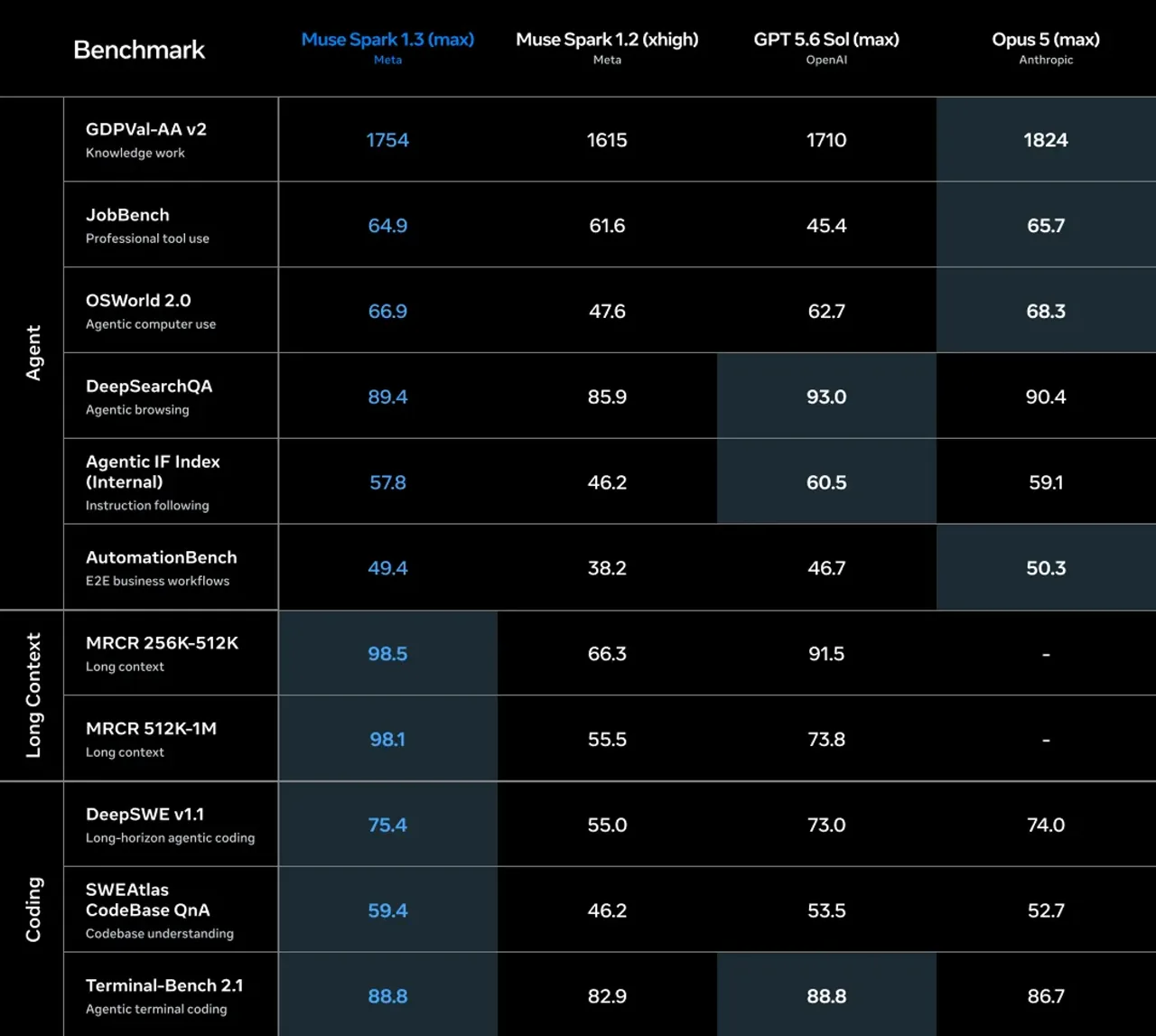
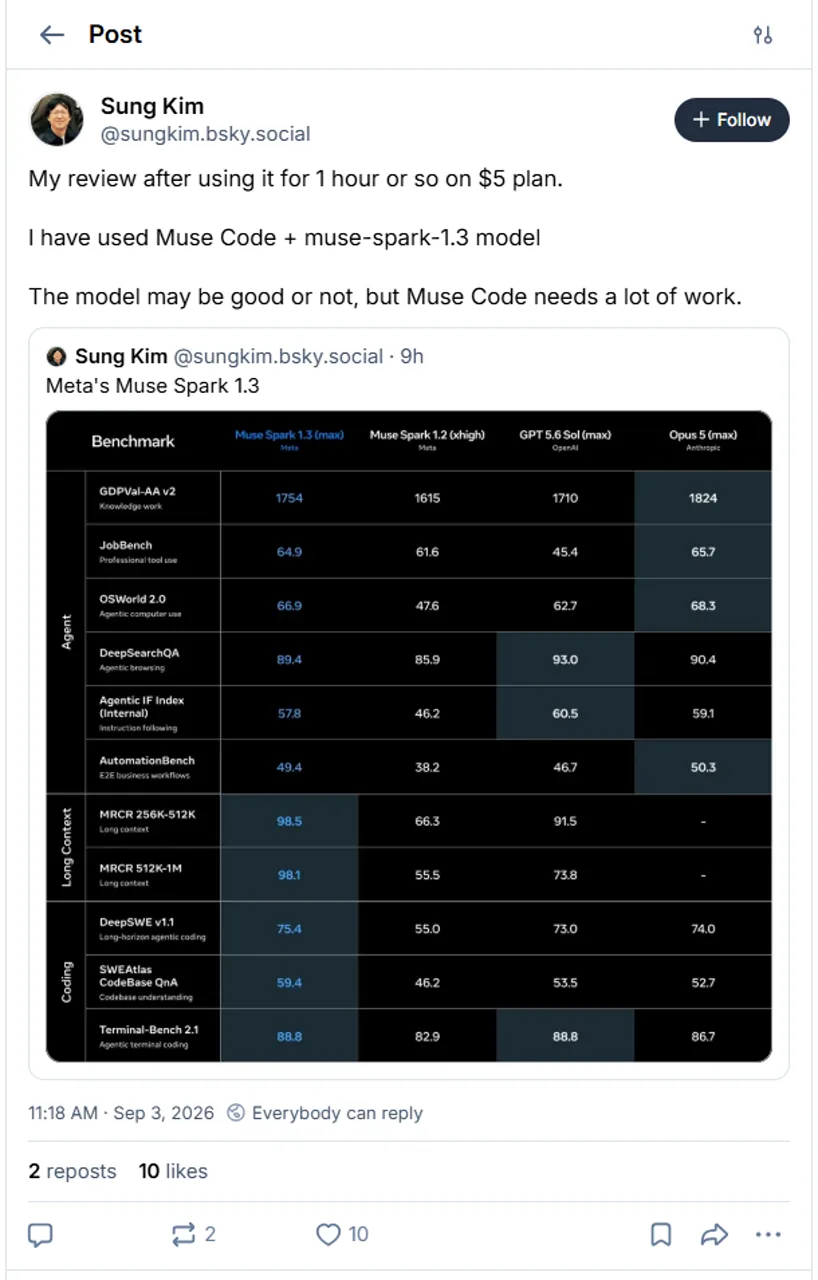
Grafik resmi Meta Hasilnya sangat mengesankan. Muse Spark 1.3 meraih skor tertinggi 88,8 pada Terminal-Bench 2.1, 75,4 pada DeepSWE v1.1, 98,1 pada MRCR 512K-1M, dan 66,9 pada OSWorld 2.0. Model ini menyamai skor maksimum GPT-5.6 Sol pada Terminal-Bench dan unggul dibandingkan para pesaing yang ditampilkan pada dua rentang konteks panjang MRCR. Pengembang yang membandingkan pasar yang lebih luas dapat menggunakan Gambaran Umum Coding-Agent sebagai konteks tambahan.
LAPORAN METADATA, PENALARAN MAKSIMAL
| Patokan | 1,3 (maks.) | 1,2 x tinggi | GPT-5.6 Sol max | Opus 5 max |
|---|---|---|---|---|
| Terminal-Bangku 2.1 | 88.8 | 82.9 | 88.8 | 86.7 |
| DeepSWE v1.1 | 75.4 | 55.0 | 73.0 | 74.0 |
| OSWorld 2.0 | 66.9 | 47.6 | 62.7 | 68.3 |
| MRCR 512K-1M | 98.1 | 55.5 | 73.8 | Tidak tersedia |
Perbedaan pengaturan upaya, sistem pengukuran agen, dan versi OSWorld membatasi kemampuan untuk membandingkan secara langsung. Meta juga menggambarkan Agentic IF Index sebagai indeks gabungan internal.
Cara membaca grafik
1.3, GPT-5.6 Sol, dan Opus 5 menggunakan max; 1.2 menggunakan xhigh.
Agen yang disebutkan dan rangkaian kabel tetap bervariasi tergantung pada evaluasi.
Runtun 1.3 dan 1.2 menggunakan versi lingkungan yang berbeda.
Indeks Agentic IF adalah indeks gabungan yang dikembangkan oleh Meta, bukan satu-satunya tolok ukur publik.
Analisis Buatan memberikan gambaran yang lebih jelas dari apa yang dapat diakses pengguna saat ini. Muse Spark 1.3 mencetak skor xhigh 61, naik dari 57 pada versi 1.2. Hasil Terminal-Bench-nya adalah 85%, GDPval-AA v2 sebesar 1709 Elo, dan Tau3-Bench Banking sebesar 47%. Varian max dalam pratinjau terbatas mencapai skor keseluruhan 62. Ada juga penurunan performa: AA-LCR turun dari 83% menjadi 79%, sementara AA-Omniscience Accuracy turun dari 45% menjadi 42% pada xhigh.
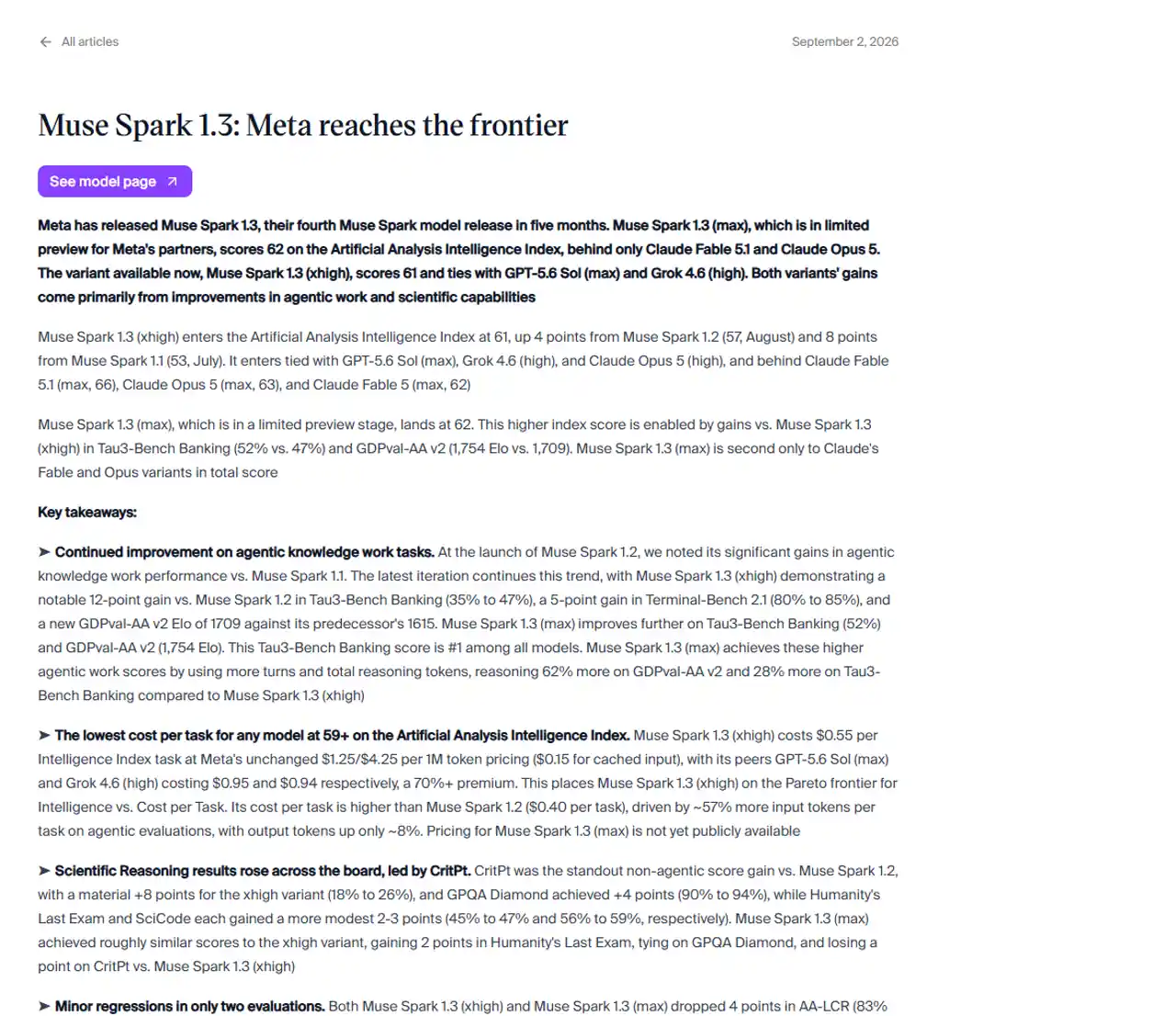
Harga Muse Spark 1.3
Kontributor
muse-spark-1.3-kontributor
$0.10 masukan / $0.002 disimpan dalam cache / $0.20 keluaran per juta token.
Prompt dapat digunakan untuk meningkatkan kualitas produk Meta.
Standar
muse-spark-1.3
$1.25 masukan / $0.15 disimpan dalam cache / $4.25 keluaran per juta token.
Meta menyatakan bahwa tingkatan ini tidak digunakan untuk meningkatkan kualitas produknya.
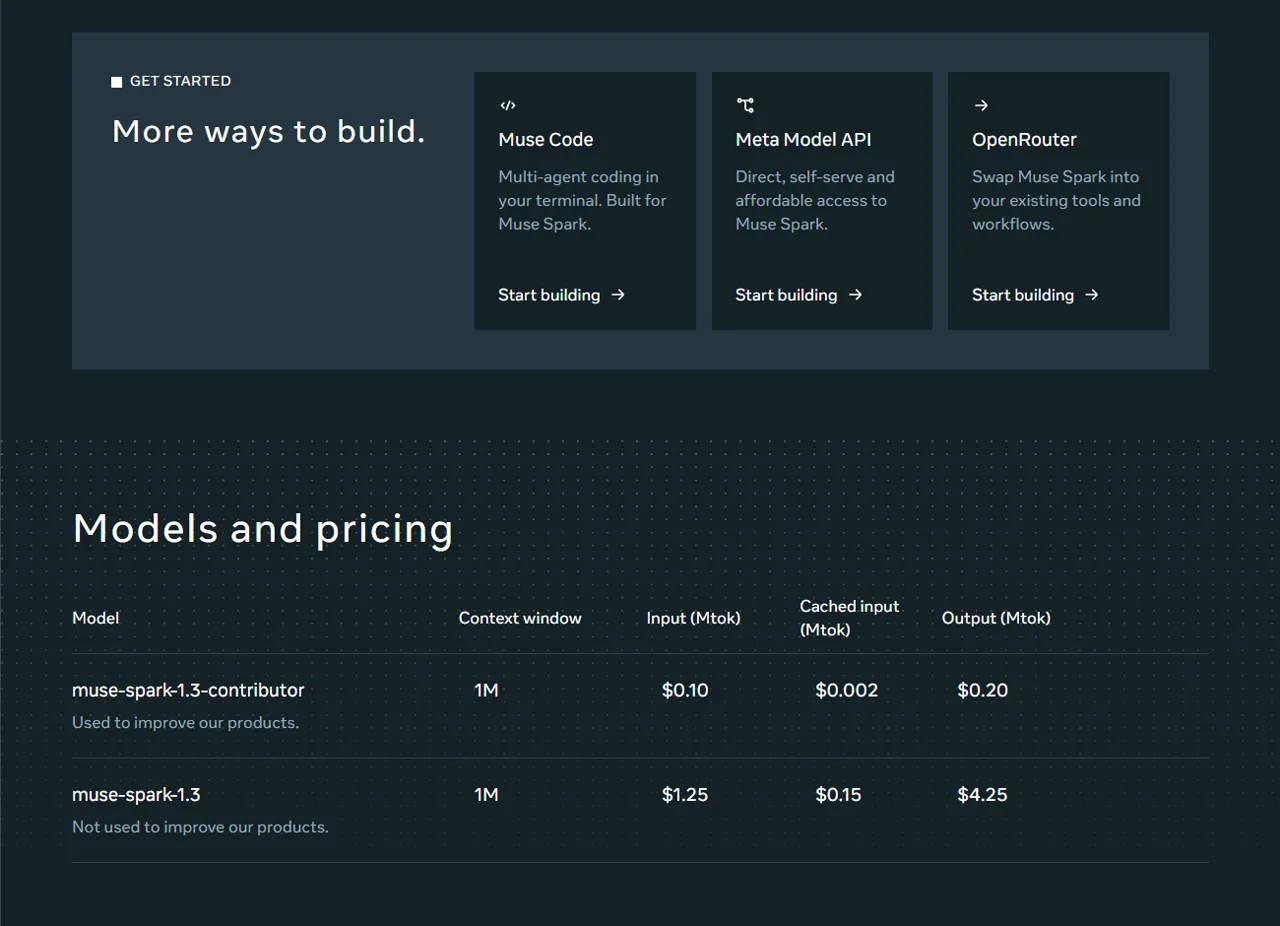
The harga token resmi tidak berubah dari versi 1.2, tetapi biaya per tugasnya berbeda. Kami Ulasan platform AI serba guna menjelaskan mengapa harga akses dan biaya alur kerja harus dievaluasi secara terpisah. Analisis Buatan mencatat nilai $0,55 per tugas Indeks Kecerdasan untuk tingkat 1,3, dibandingkan dengan $0,40 untuk tingkat 1,2; hal ini terutama disebabkan oleh sekitar 57% token masukan lebih banyak pada evaluasi agen. Tingkat kontributor sangat murah, tetapi ketentuan penggunaan datanya merupakan pilihan produk yang sesungguhnya, bukan sekadar catatan kaki.
Akses API Muse Spark 1.3
Meta’s buku resep resmi sekarang menggunakan muse-spark-1.3 sebagai pengaturan default dan menggunakan jendela konteks sebesar 1.048.576 token. API ini kompatibel dengan SDK OpenAI. Muse Code dan Meta Model API telah dikonfirmasi sebagai jalur akses yang tersedia saat ini. Halaman model Meta juga menampilkan OpenRouter, meskipun tombolnya masih mengarah ke URL versi 1.2 saat diklik, jadi pastikan untuk memverifikasi rute tersebut sebelum penerapan. Untuk informasi latar belakang mengenai interoperabilitas agen, lihat panduan kami tentang MCP dan alat-alat AI.
import os
from openai import OpenAI

client = OpenAI(
    base_url="https://api.meta.ai/v1",
    api_key=os.environ["MODEL_API_KEY"],
)

response = client.chat.completions.create(
    model="muse-spark-1.3",
    messages=[{"role": "user", "content": "Periksa patch ini untuk memastikan tidak ada regresi."}],
)

print(response.choices[0].message.content)
Tes Pemrograman Praktis: 3 dari 3 Lulus
Kami menguji tiga tugas repositori dengan tingkat kesulitan sedang melalui API pada suhu nol, dengan menggunakan satu respons per tugas. Setiap respons harus mengembalikan berkas-berkas lengkap dalam format JSON terstruktur. Kami kemudian menerapkan berkas-berkas tersebut di dalam direktori sekali pakai dan menjalankan pemeriksaan publik serta tersembunyi. Ini adalah pengujian kecil yang terkendali, bukan pengganti Terminal-Bench atau uji coba repositori produksi.
5 dari 5 pengujian; 18,4 detik; 2.473 token; $0,00905. Model tersebut menemukan himpunan ID yang telah diproses namun tidak digunakan, menambahkan pemeriksaan duplikat sejak dini, dan menulis pengujian regresi.
Pemeriksaan tipe dan dua pemeriksaan saat runtime berhasil dilalui; 47,6 detik; 4.945 token; $0.01661. Validasi, penyimpanan data, dan pencatatan audit dipisahkan tanpa melanggar batas transaksi.
9 dari 9 tes; 20,3 detik; 3.789 token; $0,01446. Kompatibilitas CSV, kesalahan bernomor baris, keluaran atomik, keamanan uji coba tanpa eksekusi, bantuan, dan dokumentasi semuanya lulus.
Total: 11.207 token dan $0.04013. Waktu yang tercantum adalah waktu permintaan dari awal hingga akhir, bukan latensi API Meta asli atau TTFT.
Hasilnya ternyata lebih baik daripada yang ditunjukkan oleh angka “3/3” semata: ketiga respons pertama tersebut dapat ditinjau dan mempertimbangkan batasan yang ada. Prinsip bukti yang sama juga berlaku saat membaca karya kami Ulasan GPT-5. Namun, sampel ini tidak mengukur keandalan pemanggilan alat yang berulang, navigasi pada repositori besar, maupun lapisan orkestrasi Muse Code. Pembaca yang sedang mempertimbangkan alternatif dengan anggaran terbatas mungkin juga akan menemukan bahwa perbandingan model pengkodean anggaran berguna.
Reaksi Awal Para Pengembang
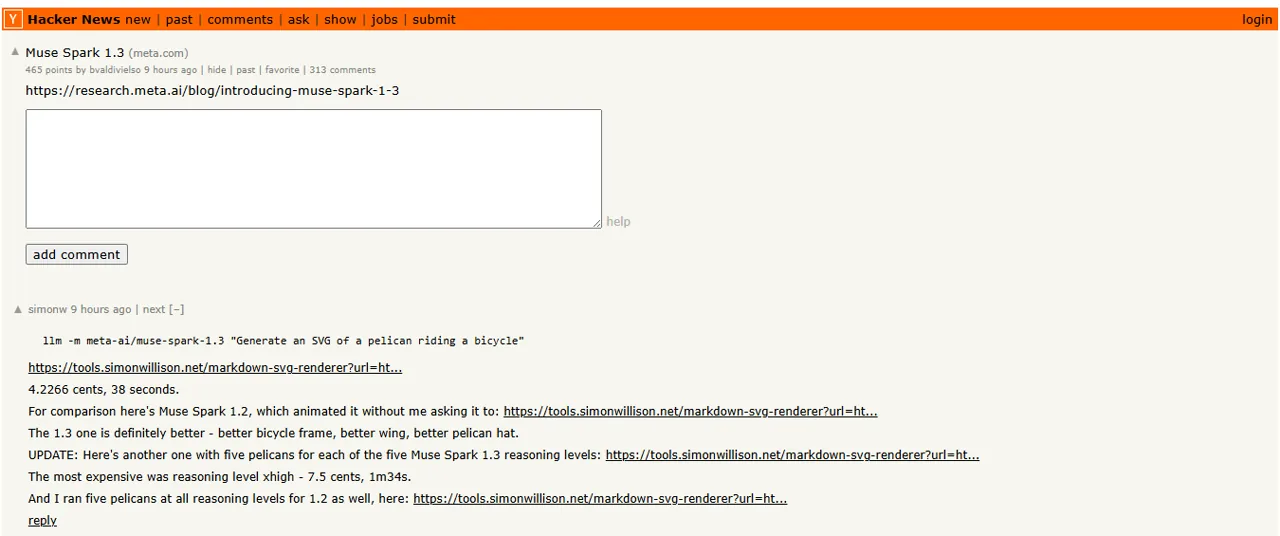
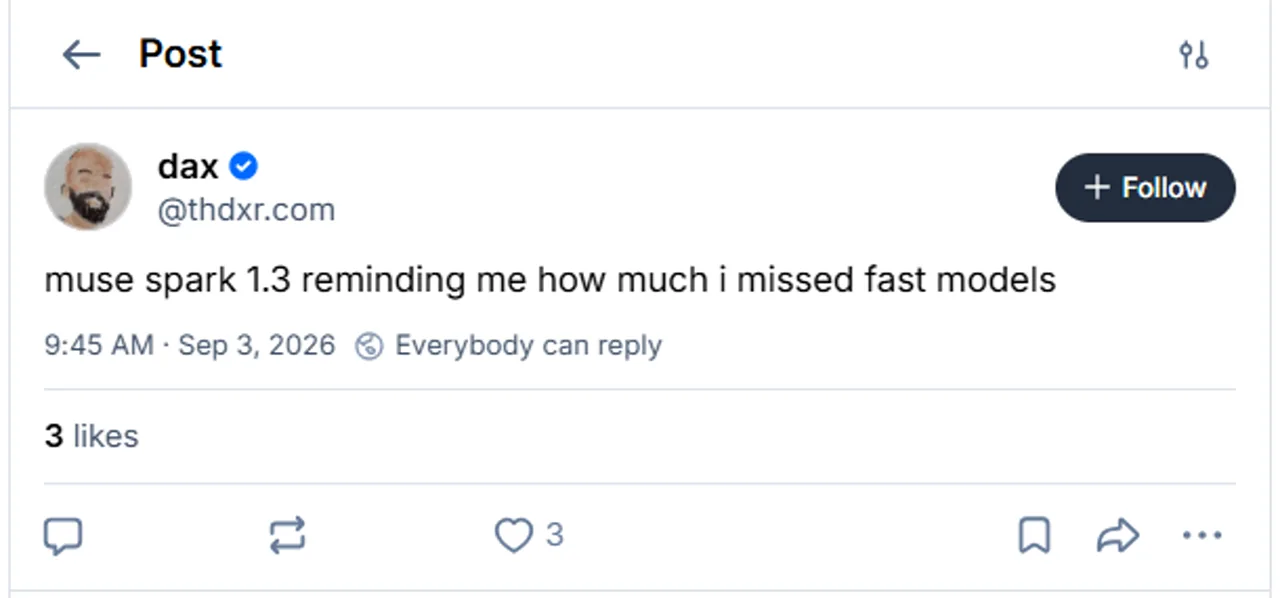
Reaksi awal beragam dan masih terlalu sedikit untuk disebut sebagai konsensus. Dalam sebuah Uji coba Hacker News, Simon Willison melaporkan catatan waktu 38 detik dengan nilai 4,2266 sen dalam lomba SVG dan menilai hasil 1,3 tersebut “jelas lebih baik” daripada perbandingannya dengan versi 1,2. Dax menjelaskan peluncuran tersebut sebagai pengingat betapa ia sangat merindukan para model cantik. Sung Kim, setelah sekitar satu jam mencoba Muse Code, ia mengatakan bahwa modelnya mungkin bagus, tetapi produk Muse Code “masih perlu banyak perbaikan.” Komentar terakhir itu berkaitan dengan pengalaman pengguna, bukan sekadar pengujian model semata.
Kelebihan dan kekurangan
Apa yang berhasil
- Skor xhigh publik yang tinggi
- Jendela konteks 1M-token
- API yang kompatibel dengan OpenAI
- Ketiga tugas pemrograman tersebut lolos pada respons pertama
- Tarif token untuk tingkatan kontributor yang sangat rendah
Yang patut ditonton
- Hasil teratas pada bagian "Headline" bukanlah tampilan publik bawaan
- Biaya tugas independen naik dibandingkan dengan 1,2
- Dua metrik independen mengalami regresi
- Data kontributor dapat meningkatkan kualitas produk Meta
- Tanggapan awal terhadap Muse Code beragam
Siapa yang sebaiknya menggunakan Muse Spark 1.3?
GUNAKAN UNTUK
Evaluasi agen pemrograman, pengembangan repositori konteks berskala besar, otomatisasi berbasis alat, serta eksperimen yang mempertimbangkan aspek biaya di mana kebijakan data dianggap dapat diterima.
LEWATI ATAU TUNGGU KETIKA
Anda membutuhkan keandalan produksi jangka panjang yang telah teruji, membutuhkan kapasitas maksimal saat ini, atau tidak dapat menerima penggunaan data pada tingkatan kontributor dan menganggap harga standar tidak kompetitif.
Kesimpulan Ulasan Muse Spark 1.3
Muse Spark 1.3 layak direkomendasikan untuk dievaluasi. Sistem ini memadukan kinerja publik tingkat terdepan, hasil yang solid pada konteks panjang, kemudahan penggunaan API yang sudah dikenal, serta harga yang sangat kompetitif. Tiga tugas pemrograman respons awal kami memperkuat bukti bahwa sistem ini mampu mengikuti batasan multi-file dan menghasilkan patch yang dapat diuji.
Pilih tingkatan standar untuk kode sensitif. Untuk perbandingan lain yang inovatif, lihat GPT-5 vs Claude 4. Anggap hasil benchmark maksimum sebagai bukti awal sampai tingkat penalaran tersebut tersedia secara luas. Dan evaluasi Muse Code secara terpisah dari API model: pengalaman pengguna (UX), siklus alat, dan kontrol repositori suatu agen dapat berhasil atau gagal terlepas dari model dasarnya.
Pertanyaan Umum (FAQ) Muse Spark 1.3
Apa itu Muse Spark 1.3?
Muse Spark 1.3 adalah model alur kerja pemrograman dan agen buatan Meta yang diluncurkan pada 2 September 2026, dilengkapi dengan jendela konteks sebesar 1 juta token serta kemampuan pengenalan gambar, video, dan dokumen secara bawaan.
Berapa harga Muse Spark 1.3?
Model standar dikenakan biaya sebesar $1,25 per juta token masukan, $0,15 untuk masukan yang disimpan dalam cache, dan $4,25 untuk keluaran. Model kontributor dikenakan biaya masing-masing sebesar $0,10, $0,002, dan $0,20, namun datanya dapat digunakan untuk meningkatkan produk Meta.
Apakah fitur max reasoning tersedia?
Meta menyatakan bahwa mode penalaran yang sudah ada tersedia sejak peluncuran, sedangkan mode "max" akan menyusul setelah melalui pengujian keamanan tambahan. Periksa dokumentasi API terkini sebelum menganggap fitur tersebut sudah tersedia secara umum.
Apakah Muse Spark 1.3 lulus uji pemrograman?
Ya. Respons awalnya telah lulus semua pemeriksaan eksekusi pada pengujian perbaikan bug Python, refaktorisasi TypeScript, dan fitur JSONL kami. Contoh tersebut hanya mencakup tiga tugas yang terkendali dan bukan merupakan angka keandalan secara umum.
Apakah Muse Spark 1.3 lebih baik daripada 1.2?
Secara umum, berdasarkan bukti yang tersedia. Skor kecerdasan publik xhigh naik dari 57 menjadi 61, dan Meta melaporkan peningkatan signifikan dalam kemampuan agen dan pemrosesan konteks panjang; namun, Analisis Buatan juga menemukan biaya tugas yang lebih tinggi serta sedikit kemunduran dalam pengambilan informasi konteks panjang dan kalibrasi fakta.
Haruskah saya menggunakan model kontributor atau model standar?
Gunakan opsi "standar" untuk prompt yang sensitif atau eksklusif, karena Meta menyatakan bahwa data tersebut tidak digunakan untuk meningkatkan produknya. Opsi "kontributor" jauh lebih murah, tetapi prompt-nya mungkin digunakan untuk peningkatan produk.