« Wan 3.0 Prime » est actuellement un nom de produit indiquant un itinéraire plus rapide ; il ne s'agit pas d'une version officielle de Wan ayant fait l'objet d'une vérification distincte dans les sources que nous avons consultées. GlobalGPT propose une interface Prime Video pleinement fonctionnelle, et notre test comparatif de la première sortie via l’API Anywhere s’est achevé bien plus rapidement sur le parcours Prime. Prime mérite donc d’être pris en considération lorsque le temps d’attente entrave le travail proprement dit — mais cela ne prouve pas pour autant un rapport de vitesse universel, un gain en termes de qualité ni le prix officiel de Prime.
Le meilleur point de départ, d'un point de vue pratique, est l'espace de travail Wan 3.0 Prime sur GlobalGPT. GlobalGPT s'avère utile dans ce contexte, car il regroupe les modèles de chat, d'image et de vidéo au sein d'un même compte : vous pouvez tester une consigne vidéo, la comparer à d'autres modèles et conserver l'ensemble du processus de recherche ou de développement dans le même écosystème. Si vous souhaitez explorer différentes pistes avant de choisir une direction, vous pouvez également Testez votre propre workflow d'IA sur GlobalGPT.
Ce guide fait la distinction entre ce qui est officiel, ce que montrent visiblement les interfaces actuelles et ce qui a été effectivement observé lors d'un test contrôlé. Il classe également séparément les dollars Wan 3.0 standard, les crédits GlobalGPT et les quotas Anywhere, car les considérer comme interchangeables donnerait lieu à un prix qui n'est pris en charge par aucune source.
Qu'est-ce que Wan 3.0 Prime ?
La définition la plus sûre est la suivante : « Wan 3.0 Prime » est le nom commercial actuel du produit et l'identifiant de l'API permettant d'accéder plus rapidement à la génération de vidéos de type Wan 3.0. Nous avons vérifié que GlobalGPT dispose d'une page sous son nom complet et qu'Anywhere répertorie une page distincte wan3.0-video-prime itinéraire à côté de wan3.0-vidéo.
Ce que nous avons fait pas Cette découverte était tout aussi importante. Les recherches effectuées sur les sources Wan, Alibaba et QwenCloud n’ont pas permis de trouver de page officielle directement vérifiée utilisant le nom complet “ Prime ”. Cela ne prouve pas que cette version soit non officielle ou indisponible ; cela signifie simplement que l’article ne devrait pas affirmer que « Alibaba a lancé Wan 3.0 Prime » comme s’il s’agissait d’un fait officiel avéré.
La référence standard Wan 3.0
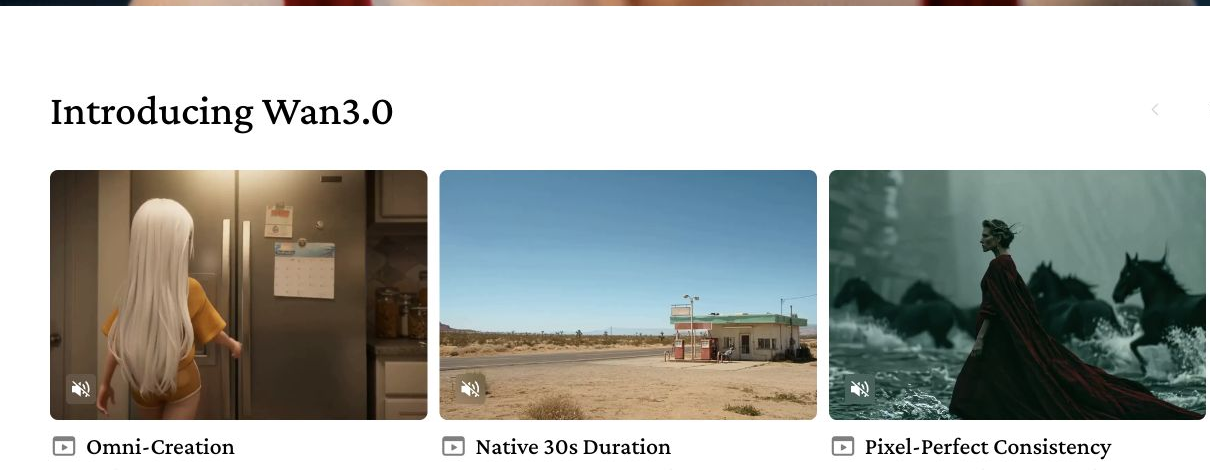
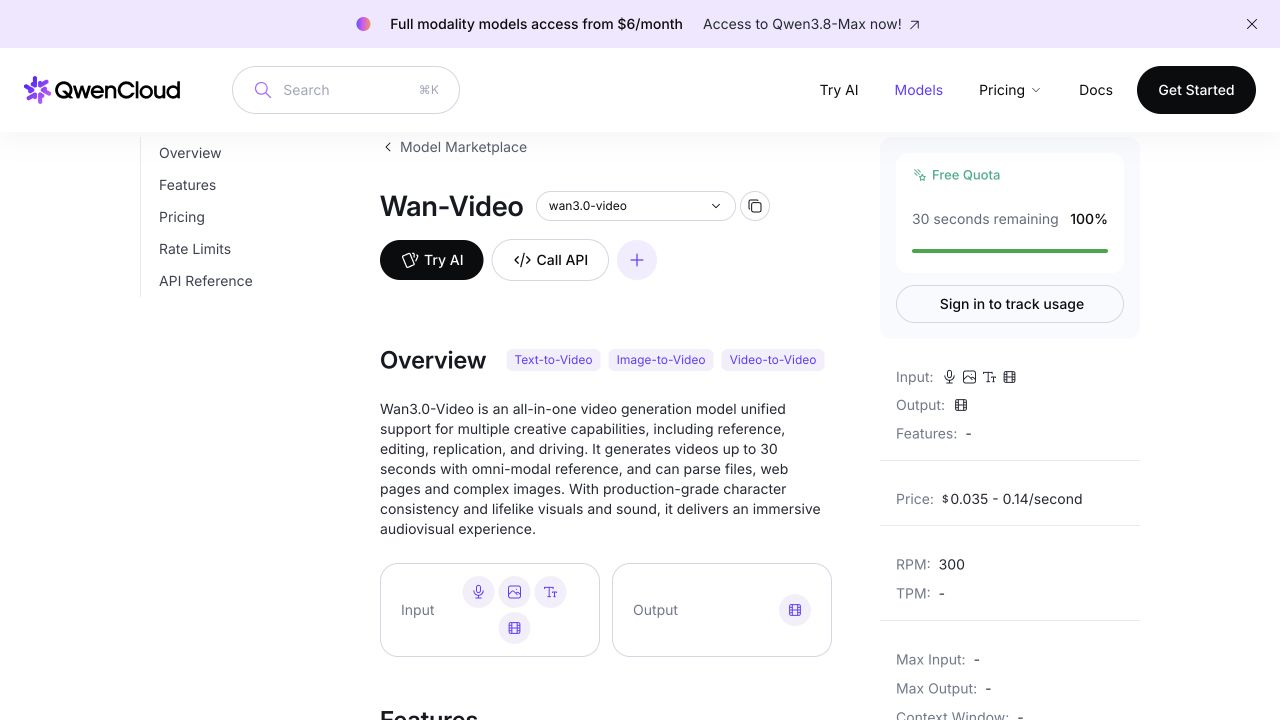
Le site officiel de Wan décrit la version standard de Wan 3.0 comme offrant une vidéo native d'une durée maximale de 30 secondes et un flux de travail de création polyvalent pouvant utiliser de nombreux éléments de référence. QwenCloud définit le modèle d'API standard comme suit : wan3.0-vidéo, énumère des cas d'utilisation de type « texte vers vidéo », « image vers vidéo » et « vidéo vers vidéo », et présente des entrées audio, image, texte et vidéo. Il s'agit là de capacités solides du modèle standard, mais elles ne définissent pas automatiquement ce qui change au sein de Prime.
Wan 3.0 Prime vs Wan 3.0 : quelles sont les véritables différences ?
La comparaison pertinente n’est pas de se dire “ Prime doit forcément être mieux ”. Il s’agit d’une décision qui repose sur quatre critères : l’itinéraire auquel vous avez accès, le gain de temps d’attente, la pertinence du premier résultat obtenu par rapport à votre besoin, et le prix réel de cet itinéraire. Voici les arguments que nous pouvons avancer aujourd’hui.
| Point de décision | Wan 3.0 standard | Wan 3.0 Prime | État des preuves |
|---|---|---|---|
| Identifiant officiel du modèle QwenCloud | wan3.0-vidéo | Aucun identifiant Prime n'a été trouvé sur QwenCloud | Norme vérifiée ; Écart par rapport à la valeur de référence |
| Accès à GlobalGPT | Ce n'est pas l'objet de cette vérification | Page dédiée à Prime Video vérifiée | Accès Prime vérifié |
| Itinéraire d'essai « Anywhere » | wan3.0-vidéo | wan3.0-video-prime | Les deux identifiants d'itinéraire ont été vérifiés |
| Un créneau disponible chez un prestataire compatible | 299,653 secondes | 96,966 secondes | Une seule paire de première sortie |
| Différence visuelle constatée | Déplacement/approche plus marquée | Une silhouette en papier légèrement plus stable | Observation au niveau des tâches : pas de solution universelle |
| Test de performance indépendant | La ligne standard existe | Aucune ligne « Prime » trouvée | Non directement comparable |
| Prix officiel unifié en dollars américains | Tarifs standard QwenCloud disponibles | Non vérifié | Ne déduisez pas de prime |
| GlobalGPT : valeur par défaut cochée | Non mesuré lors de ce contrôle | 800 crédits en 5S · 480P · 16:9 | Il s'agit uniquement d'une information relative à une interface obsolète |
Pour les créateurs, l'avantage le plus évident et le plus défendable de Prime est donc temps d'itération potentiellement plus court. Pour les équipes, ce n’est pas la mention en elle-même qui a de la valeur, mais le fait que les minutes gagnées permettent de réduire les retards de révision, le temps de travail inutilisé ou les délais de publication manqués. Pour un rendu unique non urgent, ce même gain de temps peut s’avérer moins intéressant qu’un prix connu.
Plan d'accès : GlobalGPT, QwenCloud et le lieu de l'épreuve
Le nom figurant sur un sélecteur de modèles ne représente qu'un aspect du produit. C'est l'interface qui l'entoure qui détermine les données que vous pouvez saisir, la manière dont les paramètres sont présentés, l'affichage du coût et la facilité avec laquelle vous pouvez consulter le résultat. Pour Wan 3.0 Prime, ces différences au niveau des itinéraires ont leur importance, car il n'existe pas encore de spécification officielle ni de grille tarifaire Prime permettant de comparer directement toutes les offres.
GlobalGPT : le modèle d'entrée de gamme Prime destiné aux créateurs et certifié
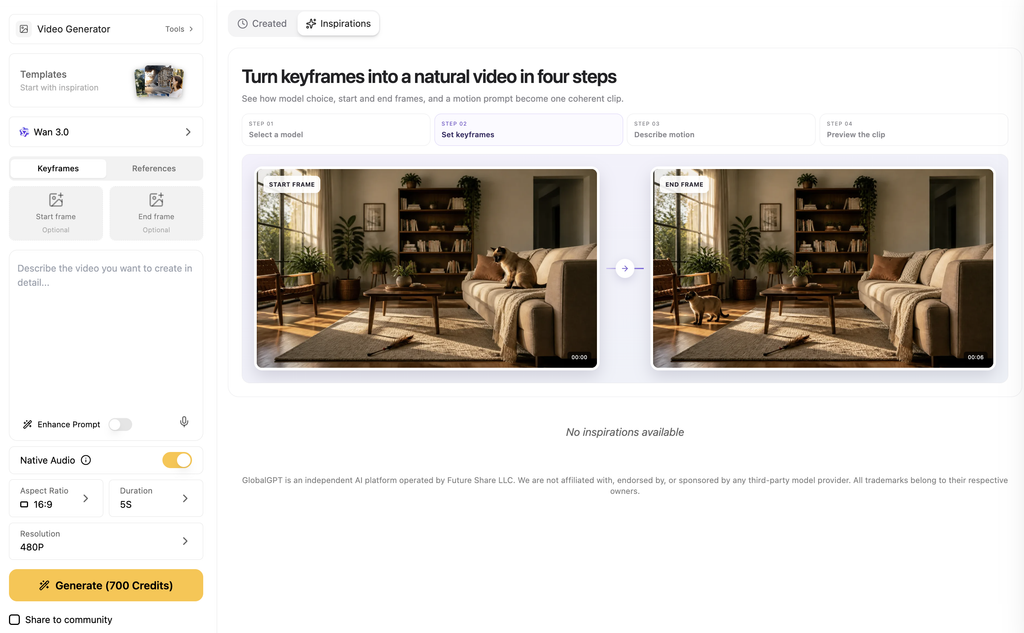
GlobalGPT est, dans le cadre de cette étude, la solution la plus claire et la plus éprouvée pour un utilisateur non développeur. Sa page « Prime » propose des commandes visibles pour les images clés, les références, les images de début et de fin, le format d’image, la durée et la résolution. L’utilisateur peut ainsi rester dans un espace de travail multimodèle plus vaste, plutôt que d’ouvrir un nouveau compte et de recréer le contexte pour chaque modèle de chat, d’image ou de vidéo. Il s’agit là d’un véritable avantage en termes de flux de travail, avant même de se prononcer sur la qualité des modèles.
En contrepartie, les crédits constituent une unité spécifique à l'interface. La page consultée indiquait 800 crédits pour une configuration par défaut, mais cet article ne fournit aucune conversion vérifiée en dollars ni aucune preuve que tous les modes ou toutes les résolutions utilisent le même total. Considérez le chiffre affiché comme un devis indicatif pour l'écran actuel, et non comme un tarif définitif.
QwenCloud : la référence officielle en matière d'API standard
QwenCloud est la meilleure ressource disponible ici pour l'itinéraire standard. Elle fournit les informations exactes wan3.0-vidéo l'identifiant du modèle, les types d'entrée, le contexte de durée de sortie et un tableau indiquant le coût en dollars américains par seconde en fonction de la résolution. Cela en fait un outil utile pour la planification technique et pour établir une base de référence en matière de coûts standard. Il ne fournit toutefois pas l'identifiant officiel du modèle Prime ni le prix Prime manquants ; un développeur ne doit donc pas ajouter tacitement le terme “ prime ” au nom du modèle documenté ni réutiliser le tarif standard.
Anywhere : le lieu dédié aux comparaisons contrôlées
Anywhere exposait les deux identifiants de route nécessaires à un test de correspondance ; il s'est donc révélé utile en tant que terrain neutre pour la paire testée dans le cadre de cet article. Il ne s'agit ni d'une recommandation commerciale, ni de la source de nos affirmations concernant le flux de travail GlobalGPT. Les enregistrements de tâches renvoyés fournissaient les champs relatifs aux horaires du fournisseur, au statut, au support et à la facturation ; toutefois, l’unité de quota et le montant réel débité n’étaient pas documentés séparément.
| Question à se poser avant de choisir un itinéraire | Pourquoi c'est important |
|---|---|
| Existe-t-il un modèle ou un identifiant d'itinéraire précis ? | Le fait qu’un nom soit bien connu dans le domaine du marketing ne garantit pas pour autant qu’il offre les mêmes fonctionnalités ou les mêmes options de configuration. |
| Quelles données sont réellement acceptées ? | Le texte, les images clés, les références et les sources vidéo permettent de résoudre divers problèmes de production. |
| Comment s'affiche le devis ? | Les champs « USD par seconde », « crédits » et « quota » ne peuvent pas être comparés sans une conversion vérifiée. |
| Pouvez-vous conserver le premier résultat ? | Pour qu’une comparaison soit valable, il faut disposer du support d’origine, des paramètres, des durées et du nombre de soumissions. |
| Que se passe-t-il en cas d'échec ? | Les règles relatives aux nouvelles tentatives et aux frais peuvent modifier le coût réel, même lorsque le tarif affiché semble simple. |
Quelles sont les tâches pour lesquelles le Wan 3.0 Prime est le plus adapté ?
La méthode Prime prend tout son intérêt lorsque la rapidité d'itération a un impact mesurable. Une équipe de réseaux sociaux examinant dix concepts, une agence attendant les retours d'un client ou une équipe produit élaborant différentes versions d'un storyboard peuvent passer plus de temps à attendre qu'à rédiger proprement dit. Dans ces flux de travail, obtenir plus rapidement un premier résultat exploitable permet de faire avancer la session de révision.
- Ébauches de concept et de storyboard : de courts extraits où la composition, la mise en scène et l'ambiance générale priment sur le rendu final au pixel près.
- Animation mettant en avant un produit ou une campagne : un sujet bien maîtrisé, un plan de prise de vue simple et un petit nombre de contraintes visuelles importantes.
- Transitions basées sur des images clés : des séquences dans lesquelles le plan d’ouverture et le plan de clôture permettent de structurer l’arc visuel souhaité.
- Exploration guidée par des références : les premières tentatives visant à préserver un produit, un personnage ou un univers visuel avant de s'engager dans une production à plus long terme.
- Séances de révision à durée déterminée : une collaboration en direct ou en temps réel où une attente de cinq minutes vient sans cesse interrompre la prise de décision.
Prime s'avère moins intéressant lorsque le prix du parcours est inconnu, lorsqu'un rendu final unique n'est soumis à aucune échéance, ou lorsque la tâche repose sur des interactions physiques subtiles, une cohérence temporelle à long terme ou une qualité évaluée de manière indépendante. Notre exemple constitue un avertissement utile : les deux méthodes ont permis d'obtenir de jolis effets de pluie et de reflets, mais elles ont toutes deux eu du mal à rendre visible le déplacement de l'eau par une coque en papier légère. Une livraison plus rapide ne dispense pas d'un contrôle qualité au niveau de chaque plan.
Rapidité et qualité : ce que les données permettent — et ne permettent pas — d'affirmer
Le modèle Standard Wan 3.0 dispose déjà d'un contexte de qualité indépendant. Dans le classement « texte-vidéo » d’Artificial Analysis enregistré le 26 août 2026, le modèle standard figurait entre la 1re et la 2e place avec un Elo de 1 240, un intervalle de confiance 95% de -9/+9 et 5 924 échantillons. La page affichait également le tarif de l’API, soit 1 TP41T12,00 par minute pour cette ligne du classement standard.
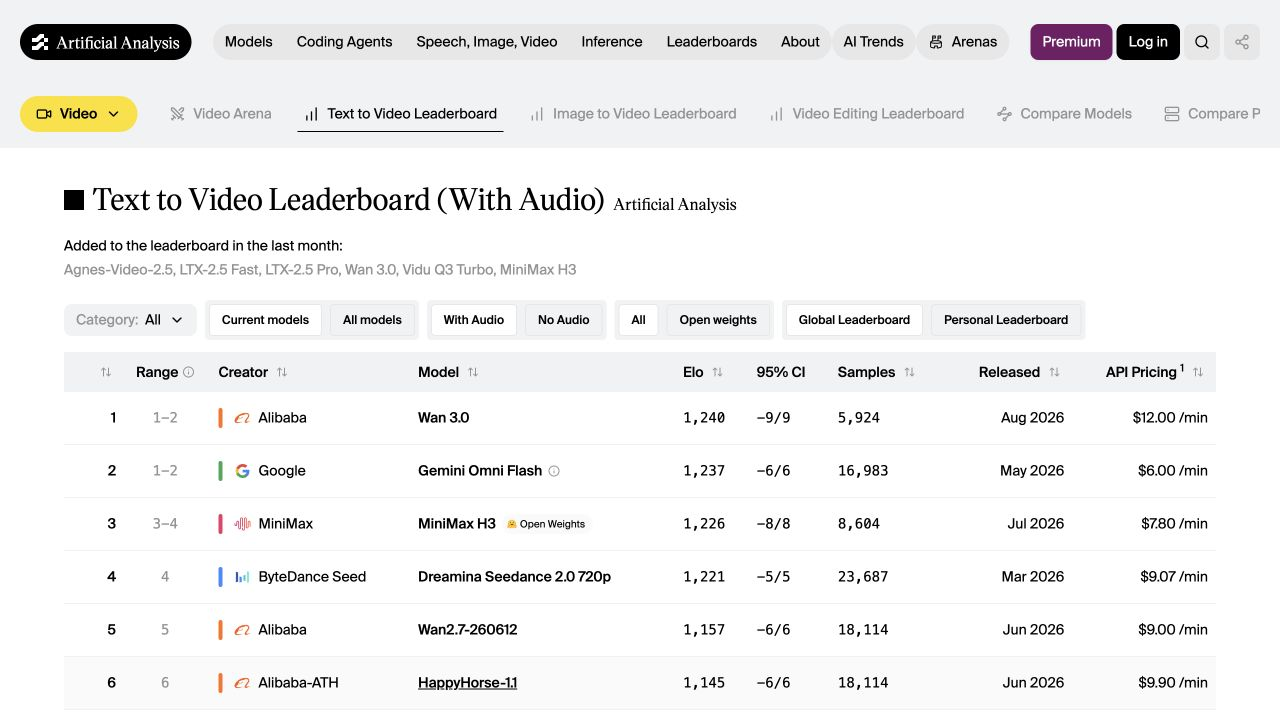
Cette capture d'écran ne permet pas de déterminer si Prime est plus performant. Aucune ligne « Prime » n'a été vérifiée, et un niveau de routage peut modifier la priorité dans la file d'attente ou la priorité d'inférence sans pour autant créer un modèle évalué de manière indépendante. De même, notre paire appariée peut décrire deux résultats enregistrés, mais une seule invite ne suffit pas à garantir la reproductibilité d'un résultat d'une personne à l'autre, d'un produit à l'autre, d'un mouvement de caméra à l'autre ou sur des scènes longues.
- Prise en charge : Prime a été plus rapide de 202,687 secondes lors de notre seule observation où les temps des fournisseurs correspondaient.
- Prise en charge : Dans cette série, Prime a tenu la silhouette du bateau en papier avec un peu plus d'assurance.
- Non pris en charge : un multiplicateur de vitesse fixe pour toutes les charges de travail.
- Non pris en charge : parité ou supériorité universelle en matière de qualité.
- Non pris en charge : Le meilleur score au classement officiel revient à Prime.
Tarification de Wan 3.0 : ce que nous pouvons facturer dès aujourd'hui
QwenCloud publie une référence claire concernant les itinéraires standard. Le 26 août 2026, son wan3.0-vidéo La page indiquait $0.05, $0,10 et $0,20 par seconde pour les résolutions 480p, 720p et 1080p, tandis que la page affichait des taux 30%-off de $0,035, $0,07 et $0,14 par seconde. Les promotions pouvant évoluer, le calculateur ci-dessous fournit une estimation ponctuelle et non un devis définitif.
Il n'y a aucune raison valable d'intégrer ces chiffres dans Prime. Nous n'avons pas pu vérifier l'existence d'un cours officiel unifié de Prime en dollars américains, et les crédits GlobalGPT ne sont pas présentés ici sous forme de conversion en dollars américains. Les deux panneaux du calculateur restent donc distincts, conformément à leur conception.
Registre des prix · trois signaux non convertibles
Ce que les données actuelles permettent réellement d'évaluer
Vérifié le 26 août 2026
QwenCloud · USD standard
$0,035–$0,14 / sNorme officielle wan3.0-vidéo taux affichés : 30%-off. Les taux de liste restent distincts ; aucun de ces chiffres n'est présenté comme un cours « Prime ».
GlobalGPT · Crédits Prime
800 créditsL'écran Prime testé affichait 800 crédits dans sa configuration par défaut : 5S · 480P · 16:9. Il s'agit d'une information relative à l'interface, et non d'une conversion en dollars américains ni d'un prix correspondant à l'ensemble des réglages.
N'importe où · Champs de retour de test
Quota de 500 000 / 800 000Les tâches « Standard » et « Prime » ont été renvoyées cost_usd=0 avec des valeurs de quota de 500 000 et 800 000. Leur unité et leur montant réel n'ayant pas fait l'objet d'une vérification indépendante, ces valeurs ne sont ni converties ni qualifiées de « gratuites ».
Conversion impossible : Aucun prix officiel unifié en USD pour Wan/QwenCloud Prime n'a été vérifié. Le montant en USD, les crédits GlobalGPT et le quota Anywhere restent donc indiqués sur des lignes distinctes.
Estimation standard QwenCloud
wan3.0-vidéo estimation · taux × duréeCharge de travail par défaut vérifiée GlobalGPT
La modification de la durée, de la résolution, du format d'image ou du mode peut entraîner une modification des génériques affichés. Vérifiez à nouveau avant de valider.
Sources : Tarifs de la solution QwenCloud Standard WAN 3.0 - Vidéo et le motif à carreaux Interface GlobalGPT Wan 3.0 Prime. Les dollars américains et les crédits ne sont délibérément pas placés sur une même échelle de valeur.
Comment interpréter les trois signaux de facturation
- QwenCloud USD : une norme officielle
wan3.0-vidéovaleur de référence par seconde liée à la résolution et à la date de vérification. - Crédits GlobalGPT : une valeur visible de 800 crédits sur un écran par défaut de Prime sélectionné — 5 secondes, 480p et 16:9 — ce n'est pas un taux universel.
- Quota « n'importe où » : les résultats fournis par les deux tâches de test. Leur unité et leur montant réel n'ayant pas été documentés de manière indépendante, cet article ne procède à aucune conversion et ne qualifie pas ces résultats de « gratuits ».
Avant de lancer une véritable série de production, ouvrez l'itinéraire que vous comptez utiliser, définissez la durée réelle et la résolution, puis vérifiez à nouveau le total affiché. Cette vérification d'une minute est plus fiable que de se fier à un chiffre provenant d'un autre fournisseur ou de l'état d'une interface.
Comment évaluer la valeur sans fixer un « prix de référence » ?
En l'absence d'une cotation Prime USD unifiée et vérifiée, un calcul classique du type “ Prime coûte X% de plus ” relèverait de la fiction. Vous pouvez néanmoins prendre une décision éclairée en isolant les variables observables sur votre propre parcours : la cotation affichée, le temps moyen du fournisseur, le nombre d'itérations, le pourcentage de résultats exploitables et le délai humain associé à chaque temps d'attente.
- Étape 1 : enregistrer le total affiché pour l'itinéraire après avoir défini la durée réelle, la résolution et le mode de saisie.
- Étape 2 : N'effectuez qu'une petite comparaison pré-approuvée avec des données d'entrée identiques et conservez le premier résultat valide.
- Étape 3 : un temps record pour obtenir un résultat exploitable, et pas seulement un argument marketing sur la rapidité.
- Étape 4 : multiplier le gain de temps habituel par le nombre d'itérations qui ont lieu au cours d'un cycle de révision réel.
- Étape 5 : vérifier si l'itinéraire plus rapide a une incidence sur le débit des validations, le temps d'inactivité du personnel ou un délai, et si le résultat obtenu répond toujours aux exigences de la tâche.
Par exemple, notre binôme a gagné 202,687 secondes sur une tâche de cinq secondes. Ce chiffre est réel pour ce binôme, mais il ne s'agit pas encore d'une moyenne. Une équipe ne doit pas multiplier ce chiffre par son volume mensuel tant que des essais répétés sur ses propres invites n’ont pas démontré que le gain de temps est constant. Cette approche permet de prendre une décision fondée sur le travail réel, et non sur une conversion monétaire spéculative.
| Signal de valeur | Ce qu'il faut enregistrer | Ne pas remplacer par |
|---|---|---|
| Devis de trajet | Affichage du montant actuel en USD ou du crédit après les réglages finaux | Le prix pratiqué par un autre prestataire |
| Latence | Temps de transmission au terminal par le fournisseur et, le cas échéant, temps d'attente constaté par l'utilisateur | Un pourcentage de vitesse universel issu d'une seule course |
| Ergonomie | La première version respecte-t-elle les contraintes indispensables du cahier des charges ? | La seule préférence esthétique |
| Coût de l'itération | Citation × nombre de tentatives prévu dans le cadre d'une politique de relance fixe | Hypothèse de relances illimitées |
| Impact sur l'activité | Durée de la révision, risque lié aux délais et retard de transfert | Le mot “ Prime ” comme gage de qualité |
Comment utiliser Wan 3.0 Prime sur le GlobalGPT
L’interface Prime actuelle de GlobalGPT s’adresse davantage aux créateurs qu’aux développeurs, et ne repose pas sur une approche « API-first ». L’écran affiché présentait les modes « Keyframes » et « References », des champs de saisie pour les images de début et de fin, un champ de saisie de texte, ainsi que des commandes permettant de régler le format d’image, la durée et la résolution. Cela en fait un outil pratique pour quiconque souhaite réaliser un plan sans avoir à développer au préalable un client API.
- Choisissez le mode de saisie de manière réfléchie. Utilisez une description textuelle pour une nouvelle scène, des images clés lorsque le début ou la fin de la composition sont importants, et des références lorsque l'identité visuelle ou les éléments visuels doivent être repris dans le résultat final.
- Commencez par la version préliminaire utile la moins chère. Cinq secondes et une résolution inférieure suffisent souvent pour évaluer la composition, la direction du mouvement et la stabilité du sujet avant de se lancer dans un rendu plus lourd.
- Décrivez le mouvement, et pas seulement l'apparence. Précisez le sujet, l'action, la direction, le comportement de la caméra, l'environnement et ce qui ne doit pas apparaître.
- Vérifiez à nouveau les crédits affichés. La valeur de 800 crédits indiquée sur notre capture d'écran ne concerne que l'état par défaut visible à la date de vérification.
Si vous hésitez encore entre plusieurs modèles, Notre guide pratique des meilleurs générateurs de vidéos basés sur l'IA permet une comparaison plus large. Pour les prises de vue qui nécessitent l’utilisation d’un chariot, d’un mouvement de suivi ou d’une caméra fixe, le Guide pratique des commandes de déplacement des caméras vidéo basées sur l'IA constitue une référence utile pour la planification, même si vous adaptez par la suite la formulation à Wan.
Utilisation de la ligne de commande GlobalGPT dans Codex, du code Claude et du curseur
GLB CLI constitue une couche de workflow distincte du test présenté dans cet article. Elle relie un compte GlobalGPT à des outils de terminal et d’agent destinés au traitement du chat, des images et des vidéos ; nos comparaisons de temps entre la version Prime et la version standard proviennent de l’API Anywhere et ne doivent pas être interprétées comme des mesures des performances de la CLI.
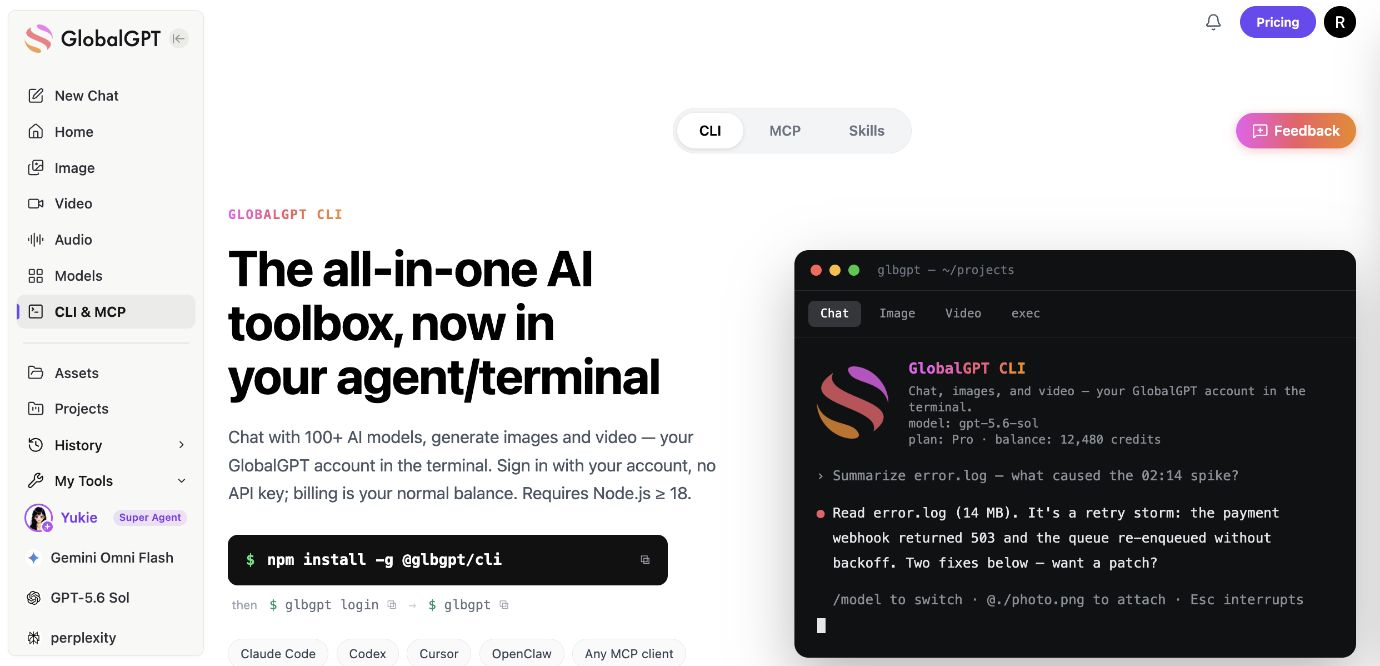
L'avantage pratique réside dans la continuité. Vous pouvez garder les variantes de brief, les instructions, les noms de fichiers et les notes de révision à proximité de votre travail, au lieu de devoir les copier depuis des onglets sans rapport avec celui-ci. La page officielle de l'interface en ligne de commande (CLI) indique la commande d'installation : npm install -g @glbgpt/cli et cite Codex, Claude Code et Cursor parmi les hôtes pris en charge.
- Codex : Mener de front la recherche assistée par des modèles et la préparation des ressources, parallèlement aux travaux liés au référentiel ou aux ensembles de contenus. Découvrez comment Utilisation de la ligne de commande GlobalGPT dans Codex.
- Code Claude : Intégrez ce même compte dans les processus de codage et de révision. Suivez le guide pour Utilisation de l'interface CLI GlobalGPT dans le code Claude.
- Curseur : Conservez l'accès au modèle dans l'éditeur lorsque vous travaillez avec des prompts, des scripts ou des ressources front-end. Découvrez comment Utilisation de la ligne de commande GLBGPT dans Cursor.
La page CLI vérifiée confirme cette affirmation concernant le flux de travail général. Elle ne prouve toutefois pas que chaque hôte expose Wan 3.0 Prime avec des commandes, des crédits ou une disponibilité identiques ; il convient donc de vérifier séparément l’espace de travail Web Prime et le flux de travail CLI.
Un processus de production pratique basé sur un modèle mixte
L'intérêt principal d'une plateforme multimodèle ne réside pas dans le fait d'envoyer partout la même instruction vague, mais bien dans la possibilité de diviser le travail en étapes et d'utiliser la fonctionnalité la plus adaptée à chacune d'entre elles. Voici à quoi ressemble un flux de travail concis :
- Résumé : utiliser un modèle de raisonnement ou de rédaction pour transformer l'objectif commercial en un contrat de tournage précisant le sujet, l'action, la caméra, le calendrier et les exclusions.
- Préparation de la référence : Créez ou sélectionnez l'image de départ, l'image de fin et les repères visuels avant d'ouvrir le générateur vidéo.
- Brouillon : soumettez la vidéo utile la plus courte possible, avec la résolution minimale acceptable pour la révision ; conservez la première citation générée et affichée.
- Critique : Vérifiez séparément la conformité immédiate, l’identité, les mouvements, la continuité, la caméra, les artefacts textuels, les contacts physiques et les preuves audio.
- Transmettre à un niveau supérieur : Ne passez au mode « Prime » ou à un réglage plus intense que si le gain de temps escompté ou les exigences de qualité justifient le devis actuel de l'itinéraire.
- Archives : Conservez ensemble les champs « délai », « itinéraire », « paramètres », « durée », « coût » et « support final » afin que la prochaine comparaison soit reproductible.
Codex, le code Claude ou le curseur permettent d'organiser ces ressources textuelles et ces enregistrements via l'interface CLI de GLB, tandis que la page GlobalGPT Prime, certifiée, offre les commandes visuelles de la vidéo. Il s'agit d'éléments liés au sein d'un flux de travail, mais ils ne constituent pas la même surface de mesure.
Notre test comparatif entre les versions « Wan 3.0 Prime » et « Standard »
Nous avons envoyé une tâche « texte vers vidéo » identique aux routes Anywhere wan3.0-vidéo et wan3.0-video-prime: même consigne « bateau en papier », cinq secondes, 720p et format 16:9. Nous avons conservé le premier résultat valide de chaque itération, sans recourir à aucune nouvelle tentative automatique ni à aucun réajustement de qualité. Les deux fichiers sont des MP4 H.264 lisibles en 1280×720, d’une durée d’environ 5,038 secondes, avec des pistes audio stéréo AAC.
Épreuve n° 1 · Parcours standard
Des mouvements plus marqués, une rigidité des objets plus faible
wan3.0-vidéoCe que cela a révélé
On y voit un bateau en papier rouge, une rue pluvieuse aux lumières néon, des reflets cohérents et un plan bas continu. Le déplacement de gauche à droite et l'approche sont faciles à suivre.
Limite visible
Les plis extérieurs se rééquilibrent subtilement à mesure que la coque s'allonge. Le sillage, le tangage et le déplacement de la coque restent faibles, ce qui peut donner l'impression que le contact se fait par glissement.
Conclusion pratique : Une image stylisée et percutante mettant en scène un héros, avec une ambiance et un mouvement bien définis, sans pour autant respecter strictement la cohérence des objets ni les lois de la physique de l'eau.
Afficher l'invite, les paramètres et les limites des éléments de preuve
Paramètres : API Anywhere · conversion de texte en vidéo · 5 secondes · 720p · 16:9 · une seule requête POST · aucune nouvelle tentative automatique · aucune nouvelle génération pour des raisons de qualité.
Périmètre de facturation : L'API a renvoyé
cost_usd=0 et la valeur du quota indiquée ci-dessus, mais l'unité de quota et le montant réel du débit n'ont pas fait l'objet d'une vérification indépendante. Cette diffusion n'est pas qualifiée de « gratuite ». La présence d'un signal stéréo non silencieux a été confirmée ; la qualité d'écoute et la synchronisation audio n'ont pas été vérifiées.Test 2 · Itinéraire principal
Réalisation plus rapide, géométrie du papier légèrement plus régulière
wan3.0-video-primeCe que cela a révélé
J'ai conservé le bateau isolé, la pluie, les reflets néon et le plan bas continu. Les plis principaux du papier sont restés légèrement plus stables que dans l'échantillon « Standard » correspondant.
Limite visible
La trajectoire s'oriente encore en partie vers la caméra, les mouvements latéraux sont limités, et la coque ne présente toujours pas de sillage ni de réaction au contact convaincants.
Conclusion pratique : Une prise de vue nette et maîtrisée du héros, qui alliait une géométrie du sujet plus stable à un temps de prise de vue nettement plus court lors de cette seule prise ; cela ne constitue pas pour autant une preuve de supériorité universelle.
Afficher l'invite, les paramètres et les limites des éléments de preuve
Paramètres : API Anywhere · conversion de texte en vidéo · 5 secondes · 720p · 16:9 · une seule requête POST · aucune nouvelle tentative automatique · aucune nouvelle génération pour des raisons de qualité.
Périmètre de facturation : L'API a renvoyé
cost_usd=0 et la valeur du quota indiquée ci-dessus, mais l'unité de quota et le montant réel du débit n'ont pas fait l'objet d'une vérification indépendante. Cette diffusion n'est pas qualifiée de « gratuite ». La présence d'un signal stéréo non silencieux a été confirmée ; la qualité d'écoute et la synchronisation audio n'ont pas été vérifiées.Dans cette comparaison, Prime a réalisé le parcours en 96,966 secondes contre 299,653 secondes pour Standard, soit un écart de 202,687 secondes. Les deux versions ont conservé l’ambiance néon sous la pluie, avec un seul bateau et un plan bas continu. La géométrie sur papier de Prime était légèrement plus stable ; Standard a créé une impression plus marquée de déplacement et d’approche. Aucun des deux résultats n’a entièrement résolu les problèmes physiques liés au sillage, au tangage ou au contact avec la coque.
Il s'agit d'une observation, et non d'une référence. Des invites répétées, des durées plus longues et des tâches basées sur des images pourraient modifier à la fois la vitesse et la qualité. Les pistes audio contenaient des signaux stéréo non silencieux et variant dans le temps, mais aucun test d'écoute humain fiable n'ayant été réalisé, nous ne prétendons pas que le son soit naturel ni que la synchronisation soit correcte.
Paramètres et conseils pour une première exécution réussie
1. Adapter le mode de saisie à l'incertitude
Utilisez la génération de texte seul lorsque vous explorez une idée et que vous pouvez vous passer d'une interprétation visuelle. Utilisez des images clés de début et de fin lorsque la composition à des moments précis est importante. Utilisez des références lorsqu'un produit, un personnage ou un langage visuel doit rester reconnaissable. Ne partez pas du principe que chaque entrée affichée sur une interface existe sur chaque route d'API.
2. Verrouiller les paramètres avant de comparer les itinéraires
Pour qu’une comparaison de vitesse ou de qualité soit équitable, il faut que le message de départ, la durée, la résolution, le format d’image et les fichiers d’entrée soient identiques. Conservez le premier résultat valide au lieu de relancer un parcours jusqu’à ce que le résultat soit meilleur. Enregistrez l’identifiant du parcours, le nombre de soumissions, le temps du fournisseur, les fichiers livrés et les champs de facturation afin que le résultat puisse être vérifié.
3. Rédigez un contrat de mouvement, pas un tableau d'inspiration
- Sujet : un objet ou un personnage clairement désigné, en précisant notamment sa couleur ou sa forme.
- Action : direction, ordre et état d'achèvement — “ se déplace de gauche à droite ” est plus clair que “ dynamique ”.”
- Caméra : prise fixe, suivi, travelling, panoramique ou orbite ; évitez les consignes contradictoires concernant le mouvement de la caméra.
- L'environnement : l'éclairage, les conditions météorologiques, la surface et les reflets qui influencent le mouvement.
- Continuité : on parle de “ plan-séquence ” lorsque les coupures rendraient la tâche impossible.
- Contraintes négatives : les personnes superflues, les objets en double, le texte, les logos ou les mouvements de caméra qui ne doivent pas apparaître.
Notre exercice sur les bateaux en papier a suivi cette structure, ce qui a permis de concrétiser l'analyse des défaillances : les trajectoires respectaient les contraintes liées aux scènes et à la continuité, tandis que les plis rigides et la physique du contact avec l'eau restaient imparfaits. Si vous souhaitez découvrir un autre exemple de tests vidéo fondés sur des données factuelles, consultez notre test pratique du Seedance.
Limites et risques à prendre en compte
- Dénomination : Cette étude n'a permis de trouver aucune page officiellement vérifiée de Wan, Alibaba ou QwenCloud utilisant le nom complet « Prime ».
- Tarifs officiels Prime : aucune cotation officielle unifiée du Prime USD n'a pu être vérifiée.
- Indice de référence « Independent Prime » : La ligne « Analyse artificielle » disponible concerne la version standard de Wan 3.0, et non la version Prime.
- Crédits : Le chiffre de 800 crédits correspond à une indication obsolète affichée par défaut à l'écran, et non à un montant universel ni à un montant en dollars américains.
- Facturation test : N'importe où renvoyé
cost_usd=0ainsi que les valeurs des quotas, mais le débit monétaire réel et l'unité de quota n'ont pas fait l'objet d'une vérification indépendante. - Stabilité : Une seule paire appariée ne permet pas de garantir la reproductibilité d'une instruction à l'autre, quelle que soit la durée ou le mode de saisie.
- Audio : Les deux fichiers contiennent un signal audio, mais la qualité sonore et la synchronisation n'ont pas encore été vérifiées.
- Déploiement local : Aucune source Prime « open-weight » ou « local-download » vérifiée n'a été trouvée.
À qui s'adresse Wan 3.0 Prime ?
| Cas d'utilisation | Prime est plus intéressant lorsque… | La norme reste pertinente lorsque… |
|---|---|---|
| Itération créative rapide | L'attente interrompt l'affinage des suggestions ou la révision en temps réel | Vous effectuez des rendus de manière occasionnelle et pouvez patienter |
| Flux de travail d'une agence ou d'une équipe | Le temps gagné permet de réduire les délais liés aux transferts et aux validations | Le coût supplémentaire lié à l'itinéraire est inconnu ou ne peut être pris en compte dans le budget |
| Photos de produits phares | Vous accordez de l'importance à un premier jet soigné et vous continuerez à vérifier les aspects physiques | Il faut disposer de preuves répétées de stabilité avant de faire son choix |
| Production d'API | Le parcours précis permet de définir un prix justifiable et un accord de niveau de service (SLA) opérationnel | Seuls les prix officiels standard peuvent actuellement être vérifiés |
| Assurance qualité indépendante | Votre propre test de mise en situation facilite ce choix | Il vous faut un indice de référence « Prime » indépendant et publié |
La règle la plus défendable est simple : Utilisez Prime lorsque les gains de temps d'attente mesurés modifient la rentabilité de votre flux de travail et que le premier résultat exploitable répond toujours aux exigences de la tâche. Choisissez « Standard » lorsque l’urgence est faible, que le prix « Prime » n’est pas clair ou que vous avez besoin d’un itinéraire s’appuyant sur une référence officielle plus précise.
FAQ Wan 3.0 Prime
Le Wan 3.0 Prime est-il un modèle officiel d'Alibaba ?
Une page produit actuelle consacrée au GlobalGPT et un itinéraire « Anywhere » utilisent le nom complet, mais cette recherche n'a pas permis de trouver de page Wan, Alibaba ou QwenCloud directement vérifiée définissant « Prime » comme un modèle officiel distinct. Cette description prudente correspond à un produit actuel ou à une désignation de parcours accéléré. Cela pourrait changer si une page officielle consacrée à « Prime » venait à apparaître ; veuillez donc vérifier à nouveau les sources du fournisseur avant publication.
Wan 3.0 Prime est-il plus rapide que la version standard de Wan 3.0 ?
Le temps d'exécution a été plus rapide dans notre paire contrôlée. L'itinéraire « Standard » a pris 299,653 secondes et l'itinéraire « Prime » 96,966 secondes, de la soumission à la fin de la sortie du fournisseur, soit une différence de 202,687 secondes. Comme la comparaison s’est appuyée sur une seule requête et une seule première sortie valide par itinéraire, elle permet une observation au niveau de la tâche, mais ne garantit pas un multiplicateur de vitesse pour d’autres requêtes, durées, régions ou conditions de file d’attente.
Prime offre-t-il une meilleure qualité vidéo ?
Pas de manière générale, d’après les données disponibles. Le mode « Prime » a permis de maintenir la silhouette du bateau en papier légèrement plus stable dans notre paire enregistrée, tandis que le mode « Standard » a rendu le mouvement et l’approche plus marqués. Les deux modes ont préservé la scène et ont tous deux présenté une physique faible au niveau du sillage et du contact avec la coque. Il n’existe pas de test de performance indépendant et vérifié pour le mode Prime dans cette étude ; le classement standard de Wan 3.0 ne permet donc pas de trancher la question.
Combien coûte Wan 3.0 Prime ?
Aucun prix officiel unifié du Prime USD n’a été vérifié. L'écran par défaut de GlobalGPT, réglé sur 5 secondes, 480p et 16:9, affichait 800 crédits, mais ce chiffre ne correspond ni à une conversion en dollars ni à une cotation pour des paramètres modifiés. Les tarifs en dollars par seconde de QwenCloud mentionnés dans cet article s'appliquent uniquement à la configuration standard. wan3.0-vidéo. Veillez à toujours vérifier le total actuel après avoir défini votre itinéraire réel, la durée, la résolution et le mode de saisie.
Wan 3.0 Prime est-il gratuit ?
Cet article ne fait pas cette affirmation. Les résultats de la recherche de tâches « Anywhere » renvoyés cost_usd=0 et les valeurs de quota, mais le débit monétaire réel et l'unité de quota n'ont pas fait l'objet d'une vérification indépendante. Le code GlobalGPT indique les crédits, et les plans ou soldes disponibles peuvent varier. Un champ à zéro dans une réponse API ne suffit pas à garantir qu'un autre utilisateur, un autre itinéraire ou une future requête sera disponible.
Puis-je utiliser Wan 3.0 Prime via l'interface CLI du GlobalGPT ?
La page CLI native de GlobalGPT vérifie le fonctionnement général des fonctionnalités de chat, d’image et de vidéo dans Codex, Claude Code et Cursor. Elle ne prouve pas que Prime s’affiche avec des commandes identiques sur tous les hôtes. Vérifiez la liste actuelle des modèles CLI de votre compte avant de planifier une automatisation spécifique à Prime, et ne confondez pas les temps de test « Anywhere » mentionnés dans cet article avec toute évaluation des performances de la CLI GLB.
Verdict : le Wan 3.0 Prime en vaut-il la peine ?
Le Wan 3.0 Prime s'avère prometteur pour les tâches sensibles à la latence, et notre paire appariée unique corrobore cette conclusion restrictive. La mise en œuvre a été beaucoup plus rapide et a permis de stabiliser légèrement la silhouette du bateau en papier, mais elle n’a pas éliminé les défauts liés à la physique du mouvement et ne dispose pas d’un prix officiel unifié en dollars américains vérifié ni d’une référence Prime indépendante. Cela en fait un choix lié au flux de travail, et non une amélioration automatique de la qualité.