The smartest model for coding in 2026 depends on the work. For difficult multi-file reasoning and agent tasks, GPT-5.6 Sol is the premium choice; GPT-5.6 Terra is the better daily balance, while GPT-5.6 Luna is the low-cost option for quick fixes. If you have a hard math or logic bug, start with Sol rather than asking a lightweight model to invent an answer.
You do not need to spend $100 or more on an official plan for every coding task. OpenAI lists ChatGPT Plus at $20 per month and Pro from $100 per month on its current pricing page; API use is billed separately by tokens. GlobalGPT gives you a tracked GPT-5.6 Sol entry alongside other models in one dashboard. Its Basic Plan costs only $5.8, which is much cheaper than any official subscription. You can use the world’s best coding AI without worrying about region blocks or complex credit card rules.
If you need more than just text, our Pro Plan ($10.8) is the perfect deal. It unlocks advanced tools like Sora 2 Flash, Veo 3.1 or Kling for video and Nano Banana, Midjourney or Flux for high-quality images. You can write your code, design your app icons, and make a demo video for your project all in one place. GlobalGPT is the only platform that covers your entire workflow for such a low price.
The 2026 Developer Landscape: Why Choosing the Right “Sub-Model” Matters
In 2026, the era of using one “all-purpose” AI for coding is over. Projects have become too large and the code is too complex. If you try to use a basic AI to build a high-performance database or a complex 3D engine, it will fail. Why? Because different ChatGPT models are now built with different “brains.”
1. The Cost of “Context” and Speed
In the past, you only cared about the answer. In 2026, you care about latency (speed) and context (memory).
- Speed Models: These are great for “Autocomplete” and simple syntax fixes. If you use a slow, heavy model for a missing semicolon, you are wasting money and time.
- Thinker Models: These use a process called “Chain of Thought.” They might take 30 seconds to start typing, but they can plan 10 steps ahead to make sure your app doesn’t crash later.
2. From “Chatbot” to “Agent”
Coding in 2026 is no longer about copy-pasting code snippets. Models like GPT-5.6 Sol and GPT-5.6 Terra now support agent-style workflows. They can:
- Read your entire file folder (not just one file).
- Connect to your local Terminal to run tests.
- Identify “technical debt” (lazy code that causes problems later).
February 2026 baseline: The next sentence preserves the original launch-era comparison so you can see how the recommendation changed.
Coding in 2026 is no longer about copy-pasting code snippets. Models like GPT-5.3-Codex and GPT-5.2 Pro now act as Agents. They can:
3. The Danger of “Hallucination” in Complex Logic
As software grows, a single wrong line of code can break thousands of lines of logic. 2026 models are ranked by their “Reasoning Reliability.” If you use a fast-but-simple model like GPT-5.6 Luna for deep architectural design, it might “hallucinate” (make up) a library that doesn’t exist. This is why professional developers now use a “Multi-Model Stack.”
February 2026 baseline: This dated paragraph remains below the current Luna guidance as historical context.
As software grows, a single wrong line of code can break thousands of lines of logic. 2026 models are ranked by their “Reasoning Reliability.” If you use a fast-but-simple model like o4-mini for deep architectural design, it might “hallucinate” (make up) a library that doesn’t exist. This is why professional developers now use a “Multi-Model Stack.”

GPT-5.6 Sol: The New Standard for Agentic Software Engineering
GPT-5.6 Sol is the premium coding model in the current GPT-5.6 family. Use the verified GlobalGPT GPT-5.6 Sol route when a task needs long-horizon planning, repository-wide edits, or repeated test-and-fix cycles.
OpenAI’s current API rate card lists GPT-5.6 Sol at $5 per 1 million input tokens and $30 per 1 million output tokens for standard short-context use. That output price is high, but it can be economical when a stronger first pass prevents multiple retries. For Codex-specific usage, consult the separate Codex pricing rules.
February 2026 baseline: These two paragraphs are retained as the original dated comparison, not as the current model recommendation.
The GPT-5.3-Codex is the newest “Boss” in the coding world. It is called a “General Work Agent.” This means it doesn’t just write code; it can actually use your computer’s terminal to run and test it.
It scored 77.3% on the Terminal-Bench 2.0 test. This is the highest score ever. It is great for setting up complex servers or fixing bugs across hundreds of files at once. However, it is very hard to get a direct account for this model in many countries.

GPT-5.6 Terra: The Reliable Production Workhorse for Daily Tasks
GPT-5.6 Terra is the model most people should try every day. It balances quality and speed, and its standard API rates are $2 per 1 million input tokens and $12 per 1 million output tokens according to OpenAI’s pricing table.
For README files, documentation, Python scripts, and ordinary refactors, Terra usually makes more sense than paying the Sol rate for every prompt. When a task becomes architecture-heavy or retry-heavy, move it up to Sol instead of forcing one model to fit every job.
February 2026 baseline: This original daily-driver comparison is retained as historical context beneath the current Terra recommendation.
GPT-5.2 Pro is the model most people should use every day. It is the default flagship on GlobalGPT. It won 74.1% of tests against human experts in real-world jobs like making spreadsheets and writing Python scripts.
It is 25% faster than the older GPT-5. Unlike o3, it gives you answers almost instantly. It is also very “warm” and professional, making it perfect for writing README files or explaining code to your teammates.
February 2026 baseline: These original o3 paragraphs are preserved for the historical comparison; use the current choice table above for recommendations.
When you have a bug that makes no sense, you need o3-Pro. This model uses “Chain of Thought” to think before it speaks. It is like a senior developer who double-checks every line.
It is currently the king of LeetCode Hard problems. If you are building a new database or a complex math tool, o3-Pro is your best partner. The only downside is that it can be slow because it “thinks” for 20-30 seconds before answering.

GPT-5.6 Luna: High-Frequency Debugging & Small Refactors
GPT-5.6 Luna is the “Fast Assistant.” It is built for speed. If you have a simple syntax error or need a quick CSS fix, this is the one to use.
OpenAI lists Luna at $0.20 per 1 million input tokens and $1.20 per 1 million output tokens for standard short-context API calls. It does not have the same depth as Sol, but it is a sensible high-volume helper for junior developers who need quick feedback while learning.
February 2026 baseline: These original high-frequency model paragraphs are kept as a dated snapshot below the current Luna recommendation.
The o4-mini-high is the “Fast Assistant.” It is built for speed. If you have a simple syntax error or need a quick CSS fix, this is the one to use.
Official Pro accounts give you 300 messages a day, which is a lot. It doesn’t have the deep logic of o3, but it is much smarter than the old GPT-4o. It is great for junior developers who need a constant helper while learning.

The Codex Agent: Self-Healing & Automated Environment Setup
The Codex Agent is a special preview for 2026. It can “Self-Heal.” This means if the code it writes has a bug, it will see the error in the console and fix it automatically before you even see it.
It also works with the Canvas Web Preview. You can see your website change in real-time as the AI writes the code. It feels less like a chatbot and more like an invisible pair-programmer.

Official Limits vs. Reality: Why Developers Compare the $100 Pro Plan
OpenAI’s current pricing page lists ChatGPT Pro from $100 a month, while Plus is $20 a month. ChatGPT plan limits and Codex usage are separate from API token billing, and the published limits guidance explains why a paid plan can still have usage guardrails.
February 2026 baseline: The original price comparison is retained as a dated snapshot; the current plan figures are the $100 Pro and $20 Plus values above.
OpenAI’s official ChatGPT Pro costs $200 a month. That is a lot of money for a single developer. Even if you pay, they have “abuse guardrails.” If you use o3 or Codex too much, they might slow you down or temporarily block your account.
Also, many developers live in countries where they cannot easily use a credit card or access the site without a VPN. These barriers make official accounts very frustrating for professional work.

GlobalGPT: Access the Full 2026 Coding Stack Starting at $5.8
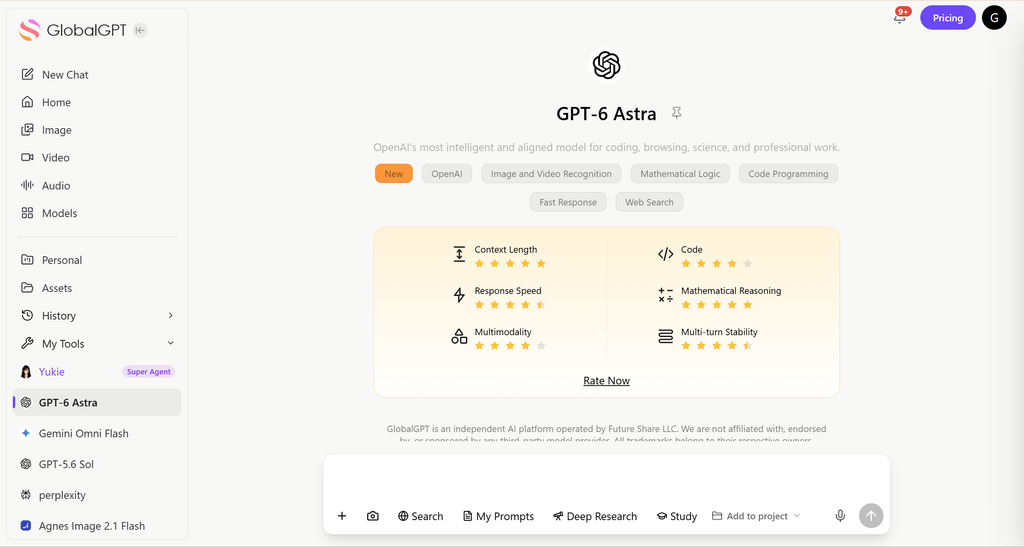
GlobalGPT solves all these problems. You don’t have to choose between models. You get GPT-5.6 Sol and other current model routes on one simple dashboard. Start with the GlobalGPT signup task entry when you want to compare models before committing to a separate plan.
February 2026 baseline: This original platform description is retained as a dated comparison; current model access is described in the paragraph above.
GlobalGPT solves all these problems. You don’t have to choose between models. You get all of them—GPT-5.2 Pro, o3, and GPT-5.1—on one simple dashboard.

Our Basic Plan is only $5.8, which gives you access to the best LLMs for less than a coffee in some cities. For power users, our Pro Plan ($10.8) adds Video AI like Sora 2 Flash and high-end images like Midjourney. You can finish your entire coding project and make a demo video for it in one place without switching platforms.


Decision Matrix: Which ChatGPT Model Should You Prompt Right Now?
To help you choose, use this quick guide:
| Use case | Recommended model | Why |
|---|---|---|
| Complex logic, hard math, architecture | GPT-5.6 Sol | Highest-capability option; worth the premium when retries cost more than tokens. |
| Daily coding, documentation, research | GPT-5.6 Terra | Balanced quality, speed, and standard API cost. |
| Quick fixes, CSS tweaks, high volume | GPT-5.6 Luna | Lowest official API rate for simple tasks. |
| Multi-file agent work | GPT-5.6 Sol in Codex | Use Codex when the workflow needs repository context, tools, and tests. |
FAQ: What Developers Are Asking in 2026
- Is GPT-5.6 Sol better than Terra for coding? It depends on the task. Sol is the better fit for architecture, multi-file changes, and difficult debugging where retries are expensive. Terra is faster and cheaper for documentation, routine code, and everyday refactors.
- Which GPT-5.6 model has the lowest coding cost? Luna has the lowest standard API rate at $0.20 input and $1.20 output per 1 million tokens. It is best for simple, high-volume work; use Terra or Sol when a wrong answer would create expensive rework.
- Are there message or usage limits for coding? Yes. ChatGPT plan access, Codex credits, and API token billing are different systems. OpenAI documents plan-specific usage and Codex credit rules separately, so a subscription does not mean unlimited API calls or unlimited agent runs.
- Can I use GPT-5.6 Sol for coding on GlobalGPT? Yes. The verified GPT-5.6 Sol GlobalGPT route is available for entering the model workflow. GlobalGPT pricing and access are platform-specific, while OpenAI’s API and ChatGPT limits remain separate.
- Should I use ChatGPT, Codex, or an API? Choose ChatGPT for a fixed monthly workspace, Codex for repository-aware agent workflows, and the API when you need your own application or automation. The ChatGPT model-choice guide helps map the task before you pay.
- How do I start without a US credit card? Start with the GlobalGPT signup task entry to compare current model routes in one workspace. For direct OpenAI access, use its official upgrade instructions and check the payment methods available to your account and region.
Official Sources
- ChatGPT pricing – consumer plan prices and included access.
- OpenAI API pricing – GPT-5.6 Sol, Terra, and Luna token rates.
- Codex pricing – credit-based coding usage and plan rules.
- OpenAI model release notes – model availability and product changes.