Claude Sonnet 5.5 is a strong everyday work model: capable enough for a difficult bug fix or a dense document, with a lower token price than Opus 5.5. Its appeal is especially clear when you can define what a good answer looks like. For open-ended strategy or an unfamiliar problem with many moving parts, Opus still deserves a place in your workflow.
In our GlobalGPT tests, Sonnet 5.5 drafted customer emails, repaired a money-allocation function that passed 43 checks, and correctly reconciled a 13,078-word set of invoice records. The email also introduced a small process assumption that needed checking. The more interesting question is when its speed and price translate into a better working day—and when extra reasoning starts to cost more than it saves.
يمكنك استخدام Claude Sonnet 5.5 on GlobalGPT alongside other leading models for writing, coding, research, images, and video. One multi-model subscription gives you an affordable way to carry a project from its first draft to its finished assets without managing a separate subscription for every step.
Claude Sonnet 5.5: the quick verdict
A practical default for clearly defined work
Start with Sonnet for a brief, a bug, a document, or a first implementation. Give it the source material, constraints, and acceptance checks. Move to Opus when the hard part is deciding what the problem really is.
What impressed us: controlled formatting, robust code, and correct document reconciliation.
What to watch: small assumptions can slip into polished copy; reasoning adds cost; long context does not guarantee recall.
This is a review of a newly released model, not a months-long production study. We combine Anthropic’s specifications, published evaluations, and three practical tasks run on October 1, 2026. The writing task was repeated twice; the code and document tasks were each run once. The results below keep that small sample in view.
What is new in Claude Sonnet 5.5?
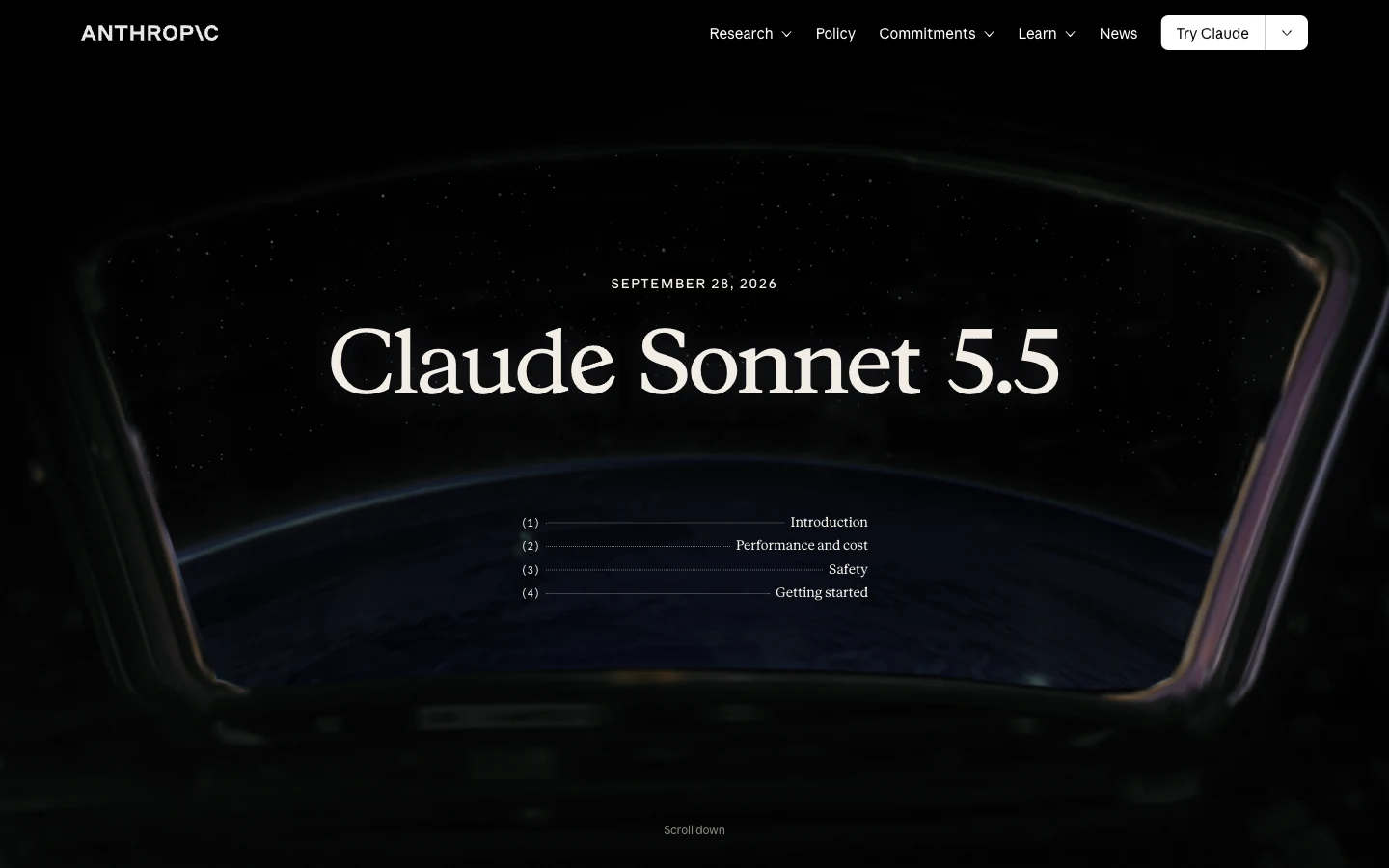
Anthropic released Sonnet 5.5 on September 28, 2026 as a faster, lower-cost complement to Opus 5.5. Its stated strengths are well-scoped everyday work, fixing bugs, and producing polished documents, slides, and spreadsheets. That positioning matters: you do not need the most expensive model for every edit, support reply, or implementation task.
What is new in Claude Sonnet 5.5?
| الميزة | Sonnet 5.5 | ما يعنيه ذلك عمليًّا |
|---|---|---|
| المدخلات والمخرجات | Text and images in; text out | Ask about a chart or screenshot, then turn the answer into a draft or plan. |
| نافذة سياق واجهة برمجة التطبيقات (API) | مليون توكن | Room for extensive source material; organize and label it carefully. |
| Standard API maximum output | 128 ألف توكينز | A model limit, not a recommended length for every answer. |
| التفكير المنطقي | التفكير التكيفي | Effort can change both completion time and total token use. |
| قطع المعرفة | June 2026 | Use current sources or search tools for changing facts. |
These context and output limits describe the Claude API. The amount you can upload or receive in a particular app also depends on that product’s interface. Similarly, a model that understands an image is not an image generator. Sonnet can critique a visual or write a production brief; an image or video model creates the finished media.
The useful upgrade is the combination of stronger task execution and quicker iteration. You can ask for a first pass, inspect the weak part, and request a focused revision. A good prompt gives it a destination: “Keep every figure unchanged, shorten this to 200 words, and list anything the source does not establish.”
Claude Sonnet 5.5 pricing: token rates and real cost
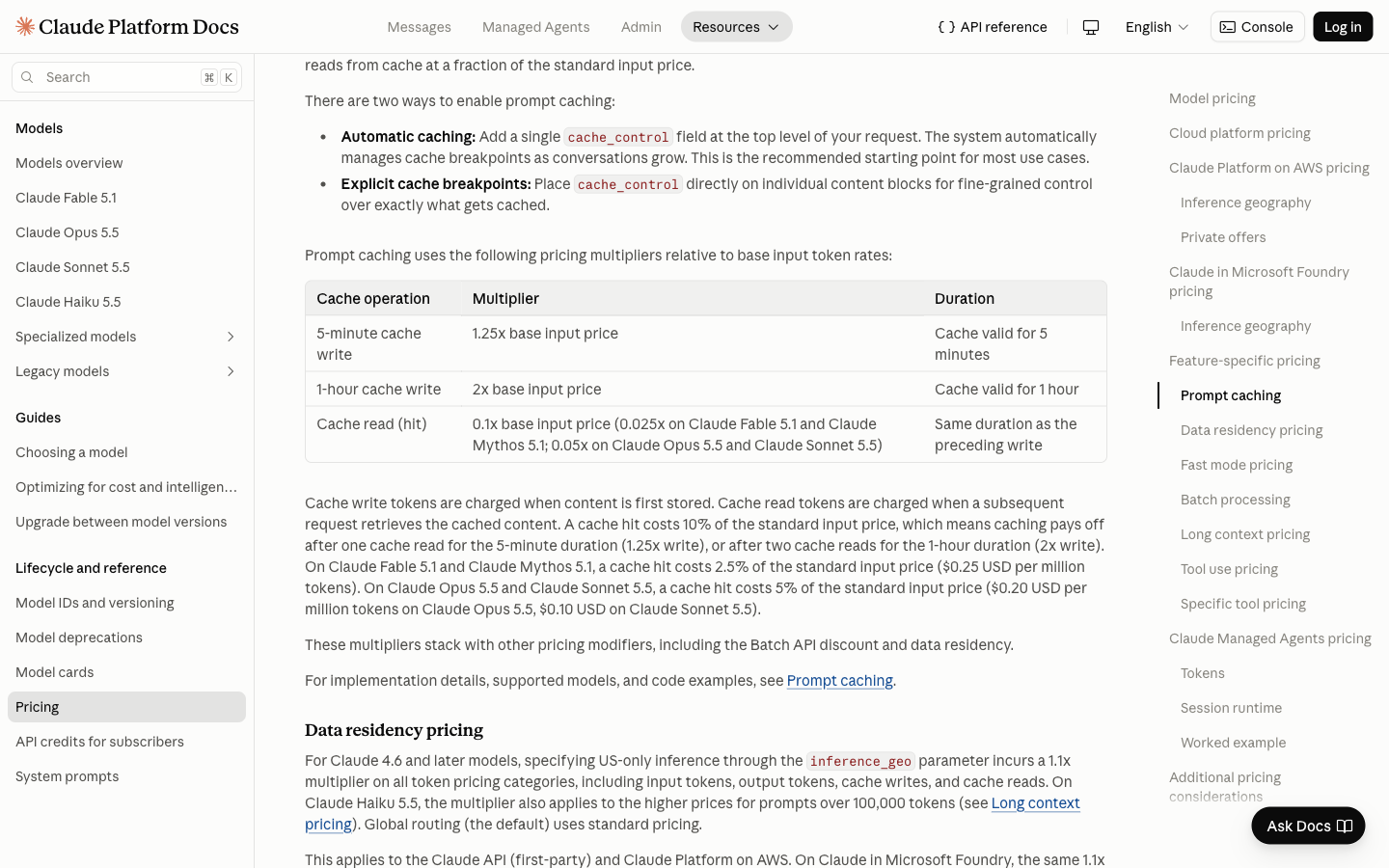
Sonnet 5.5 costs $2 per million input tokens and $10 per million output tokens at Anthropic’s standard API rates. Those are the same unit prices as Sonnet 5. Compared with Opus 5.5’s $4 input and $20 output rates, Sonnet costs half as much per input or output token—but a completed task may consume a different number of tokens.
Claude Sonnet 5.5 pricing: token rates and real cost
| API billing category | Price per million tokens |
|---|---|
| المدخلات غير المخزنة في ذاكرة التخزين المؤقت | $2.00 |
| الإنتاج، بما في ذلك الرموز الرقمية المُفوَّرة | $10.00 |
| قراءة ذاكرة التخزين المؤقت / تحديثها | $0.10 |
| Cache write, 5 minutes | $2.50 |
| Cache write, 1 hour | $4.00 |
For an uncached request, multiply input tokens by $2 per million and output tokens by $10 per million. A 10,000-token input with 2,000 output tokens costs $0.04. A 100,000-token input with 10,000 output tokens costs $0.30. These are worked API examples, not a GlobalGPT bill; tools, cache operations, service tiers, and other pricing modifiers can change the total.
What a request can cost
Illustrative standard API costs per request. Uncached input and output only.
Formula: (input tokens × $2 + output tokens × $10) ÷ 1,000,000. Billed thinking counts toward output. These are examples, not subscription prices or measured bills.
Anthropic’s “up to 30% less per task” claim comes from completing some work with fewer tokens. It is not a 30% price cut. At the other extreme, Artificial Analysis’s launch evaluation measured about $7.60 per Intelligence Index task at Max effort, roughly 50% above Sonnet 5 in that test. Those demanding benchmark tasks are not ordinary chat messages, but they show why turning reasoning all the way up can erase an apparent bargain.
API billing, Claude subscriptions, and GlobalGPT are different choices
Claude’s consumer plans use subscription pricing: Free is $0, Pro is $20 monthly or $200 billed annually, and Max starts at $100 per month, before applicable taxes. App usage has plan limits. Anthropic also lists $100 or $200 in monthly API credits for the corresponding Max tiers; Free and Pro do not include monthly API credits. Compare app access and API allowances separately when choosing a plan. A multi-model platform suits people whose work regularly moves across model families and media types.
If your day includes writing a launch page, reviewing code, and creating campaign visuals, GlobalGPT brings those tools together. Its value is the breadth of the workflow in one subscription, rather than paying for several standalone products simply to finish one project. Choose the plan around the work you actually do.
Benchmarks: close to Opus in some tasks, not every task
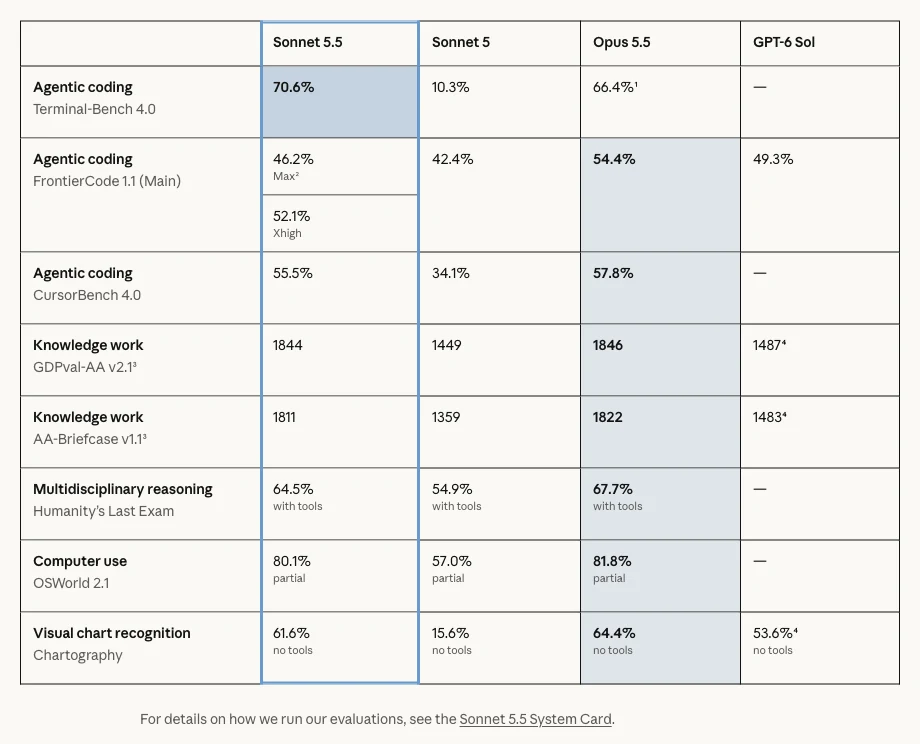
The launch results show a substantial step beyond Sonnet 5. They also show why one headline score cannot settle a model choice. Sonnet 5.5 leads the reported Terminal-Bench comparison, while Opus 5.5 remains ahead on FrontierCode and CursorBench. Near-equal knowledge-work ratings are promising, but they do not make the models interchangeable.
Benchmarks: close to Opus in some tasks, not every task
| Evaluation in Anthropic’s launch table | Sonnet 5.5 | السوناتة الخامسة | الأوبوس 5.5 | GPT-6 Sol |
|---|---|---|---|---|
| Terminal-Bench 4.0 | 70.6% | 10.3% | 66.4% (Xhigh) | - |
| FrontierCode 1.1 Main | 52.1% (Xhigh); 46.2% (Max) | 42.4% | 54.4% | 49.3% |
| CursorBench 4.0 | 55.5% | 34.1% | 57.8% | - |
| GDPval-AA الإصدار 2.1 | 1844 Elo | 1449 Elo | 1846 Elo | 1487 |
| AA-Briefcase v1.1 | 1811 Elo | 1359 Elo | 1822 Elo | 1483 |
| الامتحان الأخير للبشرية | 64.5% مع الأدوات | 54.9% with tools | 67.7% مع الأدوات | - |
| OSWorld 2.1 | 80.1% جزئي | 57.0% partial | 81.8% جزئي | - |
| علم الخرائط | 61.6% بدون أدوات | 15.6% no tools | 64.4% بدون أدوات | 53.6% no tools |
These are published benchmark results, separate from our GlobalGPT tests. The evaluations use different environments and effort settings; Elo ratings are not percentage accuracy. The GPT-6 Sol values appear in Anthropic’s published comparison table, and a dash means that the page did not report a value for that evaluation. Anthropic also notes that the launch GDPval-AA and AA-Briefcase runs used a pre-release deployment with a structured-output bug that was later fixed. Treat the table as a picture of those evaluations, not a guarantee about your workload.
The FrontierCode result is particularly useful: Sonnet scored better at Xhigh than at Max. Anthropic attributes the Max drop to additional review passes, timeouts, and changes outside the requested scope. More thinking can become more work without becoming a better answer. Start with a clear task and increase effort when you have a specific reason.
Independent results add context. Artificial Analysis reported an Intelligence Index score of 56 at its Max/default-fallback configuration, alongside unusually heavy output-token use. A CodeRabbit review-pipeline evaluation found 6 of 13 difficult signal cases caught by Sonnet 5.5, versus 4 of 13 by Sonnet 5, with a lower mean runtime. That is a small vendor study, not proof that every code review will improve, but it is a useful example of evaluating a complete task rather than just a score.
How fast is Claude Sonnet 5.5?
Anthropic reports output generation more than 30% faster than Sonnet 5. Output generation is only one part of waiting for an answer: input processing, reasoning, network time, and service load also matter. A model can write quickly once it starts and still spend time working before the final answer arrives.
Our three repetitions of the same customer-email prompt completed in 11.60, 12.16, and 11.78 seconds, for a median of 11.78 seconds. The code task took 19.08 seconds and the document task 16.42 seconds. We timed the complete response, including service and network overhead. We did not measure first-token latency or run a Sonnet 5 control, so these timings do not establish a 30% improvement.
For everyday use, that makes the model worth trying on work you revise in short cycles. Ask for the finished deliverable first, keep the scope narrow, and avoid requesting a sprawling explanation when all you need is a corrected function or a short reply. Where effort controls are exposed, evaluate the lighter settings before defaulting to Max.
Real-world performance: three GlobalGPT tests
We used practical tasks with answers we could check. All requests used Claude Sonnet 5.5 with the same 6,000-token output ceiling and no external tools. We left sampling and reasoning controls at the service defaults. We kept the first completed output for each task; the two extra writing runs are a separate consistency check. All five calls completed without a retry.
Writing: a customer reply with promises kept under control
The brief asked for a 90–120-word email to Maya about a delayed blue lamp, exactly three bullet points, a dispatch deadline of October 4, and an option to reply “refund” for a full refund to the original payment method. It explicitly prohibited an invented cause, arrival guarantee, discount, or immediate refund promise.
The first answer was 110 words with exactly three bullets, and kept the dispatch deadline and refund terms intact. It did not invent a delivery date, delay cause, or extra perk. However, it added “you do not need to reply” for customers who keep the order—a process detail absent from the brief. That makes it a useful draft, but not a perfect pass on the strict facts-only requirement.
The repeats were 101 and 97 words and also met the formatting rules, but both repeated the same no-action assumption. The third answer additionally used two bullets for essentially the same “keep the order and wait” option. Before sending a customer-facing reply, confirm the operational details and remove redundancy.
Writing test: format passed, one process assumption
First answer: 110 words, 3 bullets, 11.60 seconds. The dispatch and refund terms were correct. The instruction to keep the order without replying was not supplied in the brief and needs confirmation. Repeats: 101 and 97 words; both repeated that assumption.
Claude Sonnet 5.5 · GlobalGPT · October 1, 2026 · 6,000-token output ceiling · no tools · sampling and effort left at service defaults. Time means complete response, not first token.
Task instruction
Write an English customer-service email to Maya about order R-418, a blue lamp whose dispatch has been delayed. The complete email must be 90–120 words inclusive and contain exactly three bullet points. Include an apology, explain the next step clearly, and use only these facts: the lamp will be dispatched by October 4; alternatively Maya can reply “refund” to request a full refund to the original payment method. Do not promise a delivery or arrival date, an instant refund, a discount, compensation, or any other unprovided benefit. Do not invent a cause for the delay. The deadline is for dispatch, not delivery. Include a greeting and sign-off. Return only the email. For this task, a word is a whitespace-separated token, excluding a standalone bullet marker.
الناتج الأول الكامل
Subject: Update on your order R-418

Hi Maya,

I'm sorry that your blue lamp, order R-418, has been delayed in dispatch. I know this is frustrating, and I apologize for the inconvenience.

Here is where things stand and what you can do next:

- Your lamp will be dispatched by October 4.
- If you would like to keep your order, you do not need to reply.
- If you would rather not wait, reply "refund" to this email, and we will process a full refund to your original payment method.

Thank you for your patience and understanding. Please reply if you have any questions about your order.

Kind regards,
Customer Service Team
Writing repeat 2 · full output
Dear Maya,

I am sorry that your order R-418, the blue lamp, has been delayed in dispatch. I understand this is frustrating, and I apologize for the inconvenience.

Here is what happens next:

- Your blue lamp will be dispatched by October 4.
- If you would like to wait, you do not need to do anything.
- If you would rather not wait, reply "refund" to this email to request a full refund to your original payment method.

Please note that October 4 is our dispatch deadline, not a delivery date.

Thank you for your patience and understanding.

Kind regards,
Customer Service Team
Writing repeat 3 · full output
Subject: Update on your order R-418

Hi Maya,

I'm sorry that your blue lamp, order R-418, has been delayed in dispatch. I apologize for the inconvenience and appreciate your patience.

Here are your options:

- Wait for dispatch: your lamp will be dispatched by October 4.
- Request a refund: reply with the word "refund" and we will process a full refund to your original payment method.
- Keep the order: if you are happy to wait, no further action is needed.

Please note that October 4 is our dispatch deadline, not a delivery date.

Kind regards,
Customer Service Team
Your lamp will be dispatched by October 4. … If you would rather not wait, reply “refund” to this email, and we will process a full refund to your original payment method.
Excerpt from the first GlobalGPT writing test; an intervening bullet is omitted.
This is a useful pattern for customer communication and business writing: provide the approved facts, define the tone, and state which promises must not appear. Sonnet can then help with wording without being asked to invent your policy.
Coding: repair the rounding logic, then prove the totals
Our faulty Python function split money using floating-point numbers and rounded each share independently. That can create or lose cents. We asked Sonnet to replace it with a Decimal-based largest-remainder allocation, preserve the total, break ties by the original index, and reject invalid inputs.
The first returned function passed 43 of 43 checks, covering zero amounts, fractional weights, deterministic ties, malformed inputs, large values, and precision boundaries. It parsed decimal strings, converted them into exact integer quantities, and assigned the remaining cents in a stable order. The useful result was not just plausible-looking code: the shares actually added up.
That supports using Sonnet for a focused implementation with explicit acceptance criteria. This was a standalone function test, not an autonomous repository repair or a security audit. For production code, add your own integration tests and review error handling in the surrounding application.
Coding test: 43 checks passed
First answer: 19.08 seconds. Passed all 43 checks for correct allocation, stable ties, input validation, and precision. Evaluated as a standalone function, not an autonomous repository repair.
Claude Sonnet 5.5 · GlobalGPT · October 1, 2026 · 6,000-token output ceiling · no tools · sampling and effort left at service defaults. Time means complete response, not first token.
Task instruction
Replace the faulty Python function below with a correct implementation of allocate_cents(total: str, weights: list[str]) -> list[int]. Return only executable Python source, without Markdown fences or explanation.

Requirements:
1. total is a nonnegative finite USD amount written as a string, with zero, one, or two fractional digits, such as "0", "12.3", or "12.34". Require ASCII decimal digits with an optional single decimal point. Reject signs, exponent notation, whitespace, NaN/Infinity, an empty string, a trailing decimal point, leading decimal point, and more than two fractional digits, including "1.000". Leading zeroes are allowed. Reject non-string inputs with ValueError.
2. weights is a nonempty list of strings. Each string uses ASCII decimal digits, optionally with a decimal point and one or more digits after it. Require finite nonnegative values with at least one strictly positive weight. Reject invalid strings, signs, exponent notation, whitespace, non-string entries, or a non-list weights input with ValueError. Leading zeroes are allowed.
3. Use Decimal to parse and preserve the supplied decimal amounts exactly. Convert dollars to integer cents. Allocate integer cents in proportion to the weights, using the largest-remainder method: take each exact quota's floor, then assign remaining cents to the greatest fractional remainders. Break ties by lower original index. The returned list must preserve the input order and sum exactly to the total cents.
4. Do not silently lose precision for long valid values or very unequal weights. Do not mutate the weights. Import only from decimal or math if imports are needed. No file, network, environment, process, or input/output operations.

Faulty implementation:
def allocate_cents(total: str, weights: list[str]) -> list[int]:
    cents = round(float(total) * 100)
    values = [float(w) for w in weights]
    return [round(cents * w / sum(values)) for w in values]
الناتج الأول الكامل
def allocate_cents(total: str, weights: list[str]) -> list[int]:
    from decimal import Decimal

    DIGITS = frozenset("0123456789")

    def valid(s, max_frac):
        if not isinstance(s, str) or not s:
            return False
        parts = s.split(".")
        if len(parts) > 2:
            return False
        if not parts[0] or not all(c in DIGITS for c in parts[0]):
            return False
        if len(parts) == 2:
            frac = parts[1]
            if not frac or not all(c in DIGITS for c in frac):
                return False
            if max_frac is not None and len(frac) > max_frac:
                return False
        return True

    def digits_to_int(digs):
        s = "".join(map(str, digs))
        value = 0
        step = 1000
        for i in range(0, len(s), step):
            chunk = s[i:i + step]
            value = value * (10 ** len(chunk)) + int(chunk)
        return value

    def to_scaled(s):
        # returns (integer mantissa, exponent) with value = mantissa * 10**exponent
        d = Decimal(s)
        sign, digs, exp = d.as_tuple()
        return digits_to_int(digs), exp

    if not valid(total, 2):
        raise ValueError("invalid total")
    if not isinstance(weights, list) or len(weights) == 0:
        raise ValueError("invalid weights")
    for w in weights:
        if not valid(w, None):
            raise ValueError("invalid weight")

    mant, exp = to_scaled(total)
    if exp >= -2:
        cents = mant * 10 ** (exp + 2)
    else:
        cents = mant // 10 ** (-exp - 2)  # unreachable for validated input

    parsed = [to_scaled(w) for w in weights]
    min_exp = min(e for _, e in parsed)
    ints = [m * 10 ** (e - min_exp) for m, e in parsed]
    W = sum(ints)
    if W <= 0:
        raise ValueError("at least one weight must be positive")

    result = []
    rems = []
    for i, w in enumerate(ints):
        q, r = divmod(cents * w, W)
        result.append(q)
        rems.append((-r, i))

    remaining = cents - sum(result)
    rems.sort()
    for k in range(remaining):
        result[rems[k][1]] += 1
    return result
Documents: find the right records after corrections and duplicates
The third task supplied a synthetic, 13,078-word invoice packet: 120 base records, eight corrections, and four archive copies. Sonnet had to select only approved Atlas invoices dated in September 2026, use the highest version of each record, and return strict JSON with the total and three sensible follow-up checks.
It selected all 16 correct invoice IDs, returned the exact $15,305.66 total, and respected the JSON structure. Its follow-ups covered ledger reconciliation, supporting documents for corrections, and duplicate or cutoff checks. It did not count an old archive copy as a new invoice.
This is the kind of detail that matters in document work: the newest correction must win, even when an older copy appears later in the packet. The result is promising for bounded document extraction. It is still one synthetic exercise, far smaller than the advertised one-million-token context window; important financial work needs an independent calculation.
Document test: 16 records, exact total
First answer: 16.42 seconds. All 16 invoice IDs and the $15,305.66 total matched the independent reference; strict JSON and three follow-ups were also correct.
Claude Sonnet 5.5 · GlobalGPT · October 1, 2026 · 6,000-token output ceiling · no tools · sampling and effort left at service defaults. Time means complete response, not first token.
The supplied synthetic packet contained 120 base records, eight corrections, and four archive copies (13,078 words). Fields were ID, version, project, date, status, amount, and narrative notes. The instruction below is complete; the long source packet is summarized here.
Task instruction
Audit the synthetic project invoice records below. For each ID use only the highest version; identical duplicate records do not create additional invoices. The highest version can appear before an older archive copy. Select only records whose final project is Atlas, final status is approved, and final date falls in September 2026. Amounts are USD. Return strict JSON with exactly these keys: "ids" (unique selected IDs sorted ascending), "total_usd" (a string with exactly two decimal places), and "action_items" (exactly three concise strings giving sensible next accounting checks). Do not add Markdown fences or explanatory text. Ignore narrative notes for filtering; all accounting fields are structured. Do not count records from other months, draft records, Orion records, old versions, or repeated copies.
الناتج الأول الكامل
{"ids":["INV-003","INV-008","INV-020","INV-032","INV-038","INV-044","INV-050","INV-056","INV-062","INV-068","INV-074","INV-086","INV-092","INV-098","INV-104","INV-116"],"total_usd":"15305.66","action_items":["Reconcile the 16 selected invoices and the 15,305.66 USD total to the September 2026 Atlas general ledger and accounts payable subledger.","Review the records changed by corrections (INV-003, INV-008, INV-020, INV-050, plus the excluded INV-002, INV-014 and INV-026) for approval evidence and supporting documents.","Confirm that duplicate archive copies were not posted as separate invoices, and check for accrual or cutoff issues on corrected invoices dated near month-end."]}Sonnet 5.5 vs Opus 5.5: which should you use?
Choose around the shape of the job. Sonnet is a sensible first choice when the instructions and finish line are clear. Opus is the stronger starting point when the task requires sustained judgment, discovering missing assumptions, or coordinating a long chain of decisions. Read our مراجعة Claude Opus 5.5 for a closer look at that model.
Sonnet 5.5 vs Opus 5.5: which should you use?
| مهمتك | Recommended starting point | لماذا |
|---|---|---|
| Rewrite a brief, draft customer copy, extract records | Sonnet 5.5 | Clear constraints make quality easier to verify. |
| Fix a scoped bug or implement a specified function | Sonnet 5.5 | Strong task execution at a lower input/output token rate. |
| Decide architecture with incomplete requirements | الأوبوس 5.5 | The hard part is sustained judgment, not just implementation. |
| Finish a campaign with text, images, and video | سير العمل متعدد النماذج GlobalGPT | Use Sonnet for the brief and specialist models for the assets. |
A useful workflow is to ask a stronger reasoning model to critique a difficult plan, then give Sonnet the agreed specification and concrete checks. The model choice can change between stages. You do not have to turn every small revision into your most expensive reasoning task.
Put Sonnet 5.5 to work on GlobalGPT
GlobalGPT makes the model useful as part of a broader working setup. Open Claude Sonnet 5.5 for the writing or analysis step, then move into another model when the project needs a different strength. You can develop a campaign brief, refine the copy, create visuals, and produce video without rebuilding the workflow across several subscriptions.
For a better first result, send the source material and a small set of acceptance rules together. For writing, specify audience, length, tone, and facts that must stay unchanged. For code, provide the failing example and expected behavior. For documents, label the source sections and say how to handle conflicting versions. These prompts for writing, research, and coding give you reusable starting points.
Developers can also connect their terminal workflow through GlobalGPT CLI with Claude Code. Use the website for the broader project and the CLI where it fits the development process. The value is a connected set of tools, with model choice driven by the next task.
Limitations and upgrade details worth knowing
High effort is a choice, not a quality guarantee. Sonnet can overwork a narrow problem or expand beyond the requested changes. Ask it to preserve scope, run the relevant checks, and stop when the acceptance criteria are met. If the product exposes effort controls, compare completed-task quality and cost before increasing them.
Current facts still need current sources. The model’s June 2026 knowledge cutoff is not live knowledge of every price, policy, or release. Supply the current document or use a workflow with search tools. For sensitive material, check the privacy and retention terms of the service and account you actually use; a model name does not determine those settings.
API migrations need more than a model-name swap. Sonnet 5.5 changes some older request patterns. The direct Claude API rejects non-default temperature, top_p, and top_k settings, and old thinking or forced-tool configurations can need updating. Adaptive thinking is the default; the documented between_tools mode removes up-front thinking at High effort or below. The current overview also documents that forced tool use returns an error, older computer-use tooling is not accepted on the Claude API and Google Cloud, and text between tool calls can arrive in thinking blocks. Review the الدليل الرسمي للهجرة before moving an application. Our دليل واجهة برمجة التطبيقات (API) لـ Claude covers the broader setup and billing concepts.
Anthropic also applies safeguards to higher-risk cybersecurity and biology requests. Routine software development remains part of the model’s intended use. If a task is legitimate but sensitive, describe the scope and permissions clearly rather than assuming every refusal is a general coding limitation.
Final verdict: a good model to make part of your daily workflow
Sonnet 5.5 earns its place through practical, checkable work. The strongest reasons to use it are capable scoped coding and useful document handling at a lower API token price than Opus. Writing is a good use too, with a final check for plausible details that were never in the brief. Our small test set supports that everyday-work positioning; it does not establish a universal win on speed, cost, or complex reasoning.
Start with a real task whose output you can judge. Keep the constraints explicit, check the important details, and move to another model when the problem changes. Try Sonnet 5.5 on GlobalGPT to put writing, coding, analysis, and the next creative step into one multi-model workflow.
الأسئلة الشائعة
What is Claude Sonnet 5.5?
Claude Sonnet 5.5 is an Anthropic model released on September 28, 2026. It supports text and image input with text output, and is designed for fast everyday coding, writing, document work, and tool-assisted workflows.
How much does Claude Sonnet 5.5 cost?
Anthropic’s standard API price is $2 per million input tokens and $10 per million output tokens. Cache reads cost $0.10 per million tokens. Claude app subscriptions and GlobalGPT plans are separate from these API rates.
Is Claude Sonnet 5.5 faster than Sonnet 5?
Anthropic reports more than 30% faster output generation than Sonnet 5. In our GlobalGPT writing test, three complete responses took 11.60–12.16 seconds. We did not run Sonnet 5 as a control, so our test does not measure a generation-to-generation speed improvement.
Is Sonnet 5.5 better than Opus 5.5?
Choose Sonnet 5.5 for well-defined tasks and a lower input/output token price. Opus 5.5 is the stronger starting point for complex, open-ended work requiring sustained judgment. Sonnet leads some published evaluations, but there is no universal winner.
Can Claude Sonnet 5.5 handle long documents?
The Claude API specifies a one-million-token context window. In our smaller 13,078-word synthetic document test, Sonnet selected all 16 qualifying records and calculated the correct total. That result does not establish accuracy across the full advertised context window.
Can I use Claude Sonnet 5.5 on GlobalGPT?
Yes. GlobalGPT provides Claude Sonnet 5.5 alongside other AI models, so you can draft, code, analyze documents, and continue into image or video work in one platform.
المصادر وملاحظات الاختبار
Launch specifications and prices were checked on October 13, 2026; the hands-on tests below ran on October 1, 2026. Primary references: Anthropic’s launch announcement, Sonnet 5.5 model reference, تسعير واجهة برمجة التطبيقات (API), و تسعير اشتراك كلود. Independent context comes from Artificial Analysis and the CodeRabbit study linked above.
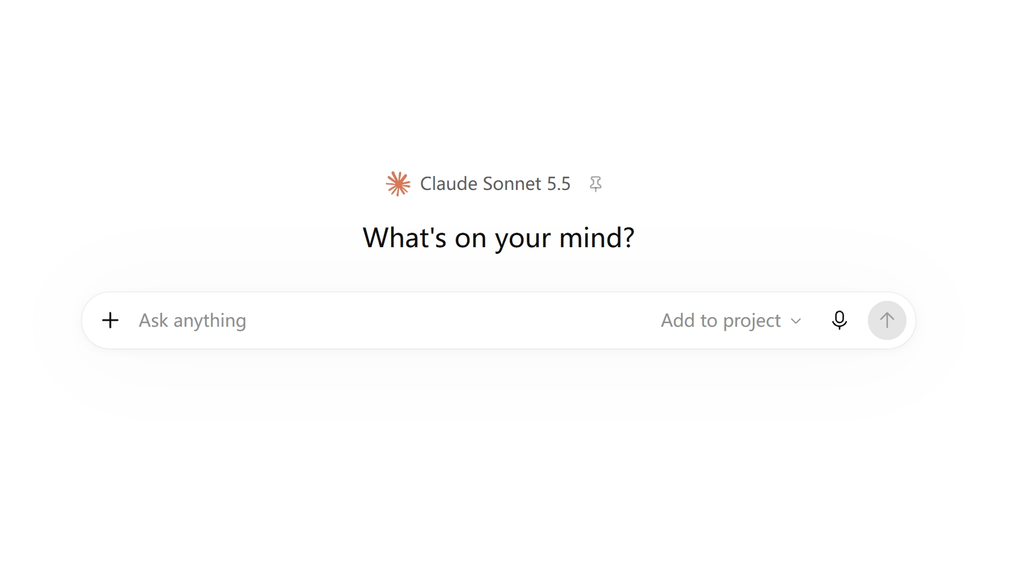
GlobalGPT tests used the first completed answer on three tasks, plus two writing repeats. No external tools were enabled. Timings cover complete responses, including network and service overhead; no reasoning-effort value was selected. The invoice packet was synthetic and contained no customer data. The header illustration was generated for this review; the other images are screenshots of the named websites.