
For Muse Wonder vs ChatGPT, choose ChatGPT when you want an integrated workspace; try Muse Wonder when you want another serious model for code repair and source-based analysis. Muse Wonder earned that trial in our production tests: the selected examples passed 29 independent checks. Those results support a practical shortlist, rather than a universal quality ranking.
The first decision is what you are buying. Muse Wonder is a model with several access routes. ChatGPT is an application whose model, tools and usage allowance depend on the surface and plan. For developers, the useful model-level comparison is Wonder against GPT-6.1 Sol or GPT-6 Astra. For everyday work, the application around the model can matter just as much.
We reuse the outputs from our Muse Wonder review, tested October 14, 2026. The code example is the follow-up with explicit identity requirements. We refreshed official product and price sources for this article; no new ChatGPT benchmark was run. This comparison is published by GlobalGPT, where the Muse tests were completed.
If you want to compare model responses before committing to a separate workflow, open Muse Wonder on GlobalGPT and bring a task with an answer you can check.
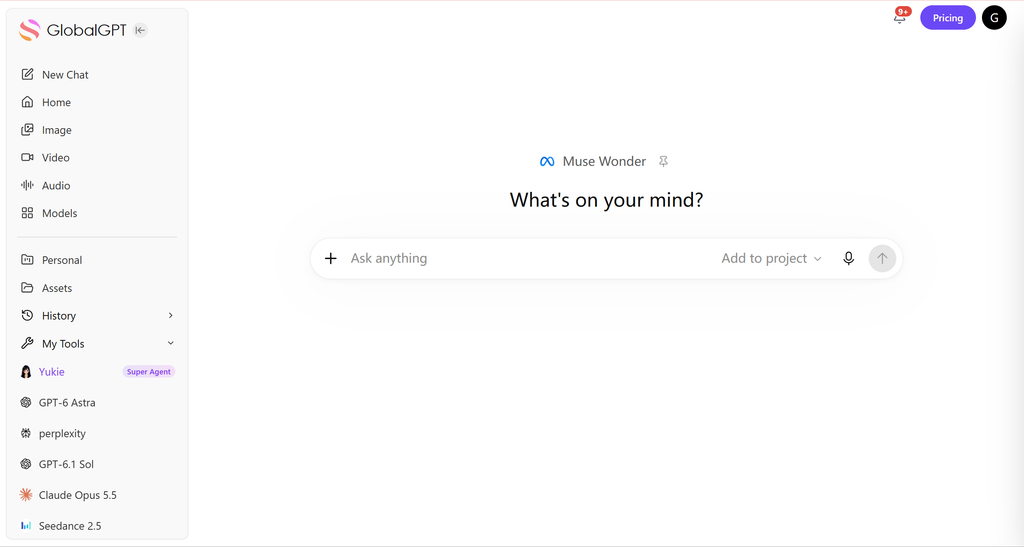
Muse Wonder vs ChatGPT: the quick comparison
Choose a workspace
ChatGPTProjects, files and tools together, with plan-dependent availability.
Try another model
Muse WonderPromising code and source handling in our selected production examples.
Build with an API
Compare exact IDsWonder, GPT-6.1 Sol and Astra have different rates and access routes.
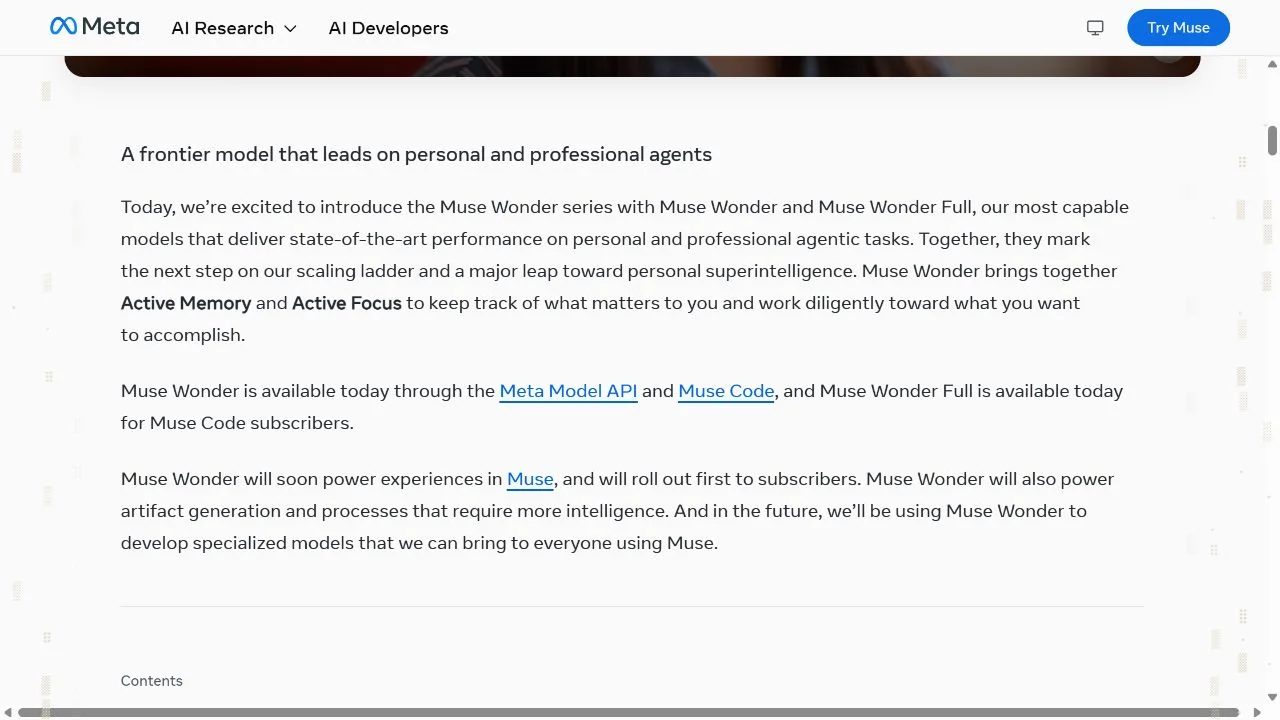
Da Meta Muse Wonder launch announcement separates standard Wonder, available through Meta Model API and Muse Code, from Wonder Full for Muse Code subscribers. It describes the consumer Muse rollout as coming first to subscribers. Access to one route does not identify every feature available through another.
OpenAI current ChatGPT model documentation recommends GPT-6.1 Sol for complex coding and agent work when available, and Astra for the hardest end-to-end work. It explicitly places GPT-6.1 Sol in Work and Codex, rather than Chat. “ChatGPT” alone is therefore too vague a model label for a reproducible comparison.
Compare the layer that matters
Exact model label, prompt, reasoning setting and accepted output.
Files, projects, integrations, tool permissions and a finished deliverable.
Subscription allowance or API usage, plus retries and human editing time.
For the GPT side, our GPT-6.1 Sol vs GPT-6 Astra comparison supplies the useful starting rule: evaluate Sol for value, then pay for Astra where extra capability earns its price. That article compares specifications and cost scenarios; it does not supply saved same-prompt outputs against Muse Wonder.
Coding: what the Muse Wonder result shows
Our Muse test started with a JavaScript deduplication function that treated zero, false and absent IDs alike. The selected follow-up made Symbol, object, function and BigInt identity explicit. Muse Wonder returned a compact implementation that lowercases strings and preserves other values directly in a Set.
Follow-up code-repair test for the same uniqueById task. Return a corrected runnable JavaScript function, a short explanation, and exactly five assert-style tests. Do not claim you executed tests.

Acceptance requirements:
- Preserve input order and return the first record for each duplicate ID. Never mutate the array or records.
- Records whose id is absent, null or undefined are always kept.
- Compare string IDs case-insensitively. Keep number 0, boolean false and string '0' distinct.
- Preserve JavaScript ID identity: two distinct Symbol('x') values must remain separate, repeating the very same Symbol must deduplicate, and repeated Symbol.for('shared') values must deduplicate.
- Different objects or functions used as IDs remain distinct; repeated references deduplicate. BigInt 1n and number 1 remain distinct.
- Use the original sample [{id:0},{id:false},{id:'A'},{id:'a'},{name:'one'},{name:'two'}], keeping 0, false, first A, and both id-less records.

The five supplied tests should cover the ordinary sample, missing/null IDs, Symbol identity, object-reference identity and BigInt versus number. Use an implementation that preserves values rather than collapsing distinct identities into textual keys.
If automatic copy is blocked, select the text and press Ctrl/Cmd+C.function uniqueById(records) {
const seen = new Set();
return records.filter((record) => {
// Absent, null, and undefined IDs are always kept.
if (record == null || record.id == null) {
return true;
}
const id = record.id;
// Normalize only strings for case-insensitive comparison.
// All other values are stored as-is, preserving their identity.
const key = typeof id === "string" ? id.toLowerCase() : id;
if (seen.has(key)) {
return false;
}
seen.add(key);
return true;
});
}If automatic copy is blocked, select the text and press Ctrl/Cmd+C.Independent code checks
13 / 13Order, missing IDs, input preservation, distinct types and identity.
Model-supplied assertions
5 passedExecuted separately; not added to the 29 independent checks.
Test environment
GlobalGPTProduction Muse Wonder entry, default UI settings, October 14.
The result is useful because the acceptance criteria are concrete. Two Symbols with the same description remain distinct; repeated use of the same Symbol deduplicates. Objects and functions keep reference identity, and 1n remains different from 1. The function also preserves record order and leaves the input unchanged.
These checks ran in our verification environment after the model returned its answer. The model did not edit a repository or prove that it ran the tests itself. The production interface was labelled muse-wonder, with no exposed reasoning-effort selector; the exact provider backend version was not independently attested.
For a coding buyer, that makes Muse Wonder a credible candidate for a bounded repair. It does not establish that Wonder beats Sol or Astra on a repository migration. Use the Guia sobre o melhor modelo de IA para programação to decide which competing model and task family to evaluate next.
Research and planning: judge the evidence handling
The source-handling example is especially relevant if you use ChatGPT for research. We supplied a short fictional Orion Agent packet with an old announcement, newer official pricing and status pages, and an unsupported community claim. The output had to reconcile the conflict and preserve missing information.
Muse Wonder review test 2: evidence reconciliation.
Use only this fictional source packet. Return ONLY valid JSON with keys launch_date, plan_monthly_usd, api_input_per_million_usd, region_status, unresolved, citations. Each factual value must have its source IDs in citations. Do not silently average contradictions or invent missing facts.

[S1] Product announcement, dated 2026-10-12: Orion Agent launched October 12. Pro plan $19/month. Available in US and EU.
[S2] Official pricing page, updated 2026-10-14: Pro plan $24/month, billed monthly. API input $4 per million tokens. API output is not listed.
[S3] Official status page, updated 2026-10-14: US access operational. EU rollout paused; no restart date supplied.
[S4] Community post, dated 2026-10-14: Someone says the plan is $12 and EU works; no screenshot or link.

Prefer newer official evidence for the same field. List any unresolved information explicitly.
If automatic copy is blocked, select the text and press Ctrl/Cmd+C.
{"launch_date": "2026-10-12", "plan_monthly_usd": 24, "api_input_per_million_usd": 4, "region_status": {"US": "operational", "EU": "paused"}, "unresolved": ["API output price is not listed in the sources.", "EU rollout restart date is not supplied.", "Conflicting claims were not used as the basis for the selected values: S1 listed the Pro plan at $19/month and EU as available, while the unofficial and unsupported S4 claimed $12/month and that EU works; the newer official S2 and S3 were preferred instead."], "citations": {"launch_date": ["S1"], "plan_monthly_usd": ["S2"], "api_input_per_million_usd": ["S2"], "region_status": ["S3"]}}The response passed all eight checks. It selected the newer official $24 monthly price, retained the original launch date, marked the EU rollout paused, and left the missing API output price and restart date unresolved. These are fictional task values, not Wonder or ChatGPT prices.
That is a good pattern for research assistance: keep source identifiers, compare dates for the same field, and say what the packet cannot resolve. The task used supplied text, so it measures neither live web-search accuracy nor million-token retrieval. A ChatGPT comparison would need the same packet and the same acceptance checks.
For business documents, choose the data route as carefully as the model. Our Comparação de privacidade de dados em IA explains the policy questions to ask before uploading files. Correct source selection alone does not establish the privacy or retention terms of either service.
Planning result: a useful plan still needs execution
Muse Wonder review test 3: recovery planning, not real tool execution.
A browser agent must gather public product prices and prepare a comparison draft. The official pricing page returns HTTP 500. One marketplace lists input $4/M and output $20/M. A Reddit search snippet claims $1/M. The user wants an evidence screenshot and a hands-on result. No authorized API key is available.
Write exactly six numbered steps, at most 140 words total. Include a bounded retry, retain the failed-page record, attribute marketplace pricing, do not treat the Reddit snippet as verified, and clearly distinguish preparation from a completed model test. Do not bypass login or fabricate screenshots/outputs. End step 6 with a concrete stopping condition.
If automatic copy is blocked, select the text and press Ctrl/Cmd+C.
1. Retry official pricing page up to three times with brief delays; retain timestamp, URL, HTTP 500 status, and any genuine error-page screenshot as failure record.
2. Record marketplace listing as marketplace-attributed pricing: input $4/M and output $20/M, with source URL/date; do not present as official pricing.
3. Log Reddit snippet claim of $1/M as unverified lead only; exclude from verified comparison until corroborated by official or reputable source.
4. Draft comparison table separating verified, attributed, and unverified entries, noting missing official confirmation.
5. Prepare—do not run—model test plan, prompts, and scoring sheet; without authorized API key, do not bypass login or fabricate screenshots/outputs; label status “not tested.”
6. Report draft as preparation only, not completed model test, and stop when three retries fail and no authorized key arrives by agreed deadline.
The plan passed eight checks, using six steps and 126 words, excluding step numbers. It bounded retries, attributed the marketplace rate and kept preparation separate from completed testing. It was a planning task; no browser recovery or autonomous execution took place.
Code follow-up · checks passed
Source JSON · checks passed
Recovery plan · checks passed
29 selected independent checks across three task types. Five supplied assertions are separate. This is an evidence summary, not a competitor leaderboard.
Memory, files and tools: compare the whole workflow
ChatGPT’s strongest reason to stay on your shortlist is the workspace. OpenAI’s ChatGPT Features documentation brings together projects, long-running chats, web browsing, files, images and plugins. Its Work and Codex surfaces support different kinds of deliverables and development tasks. Evaluate the surface you would actually use.
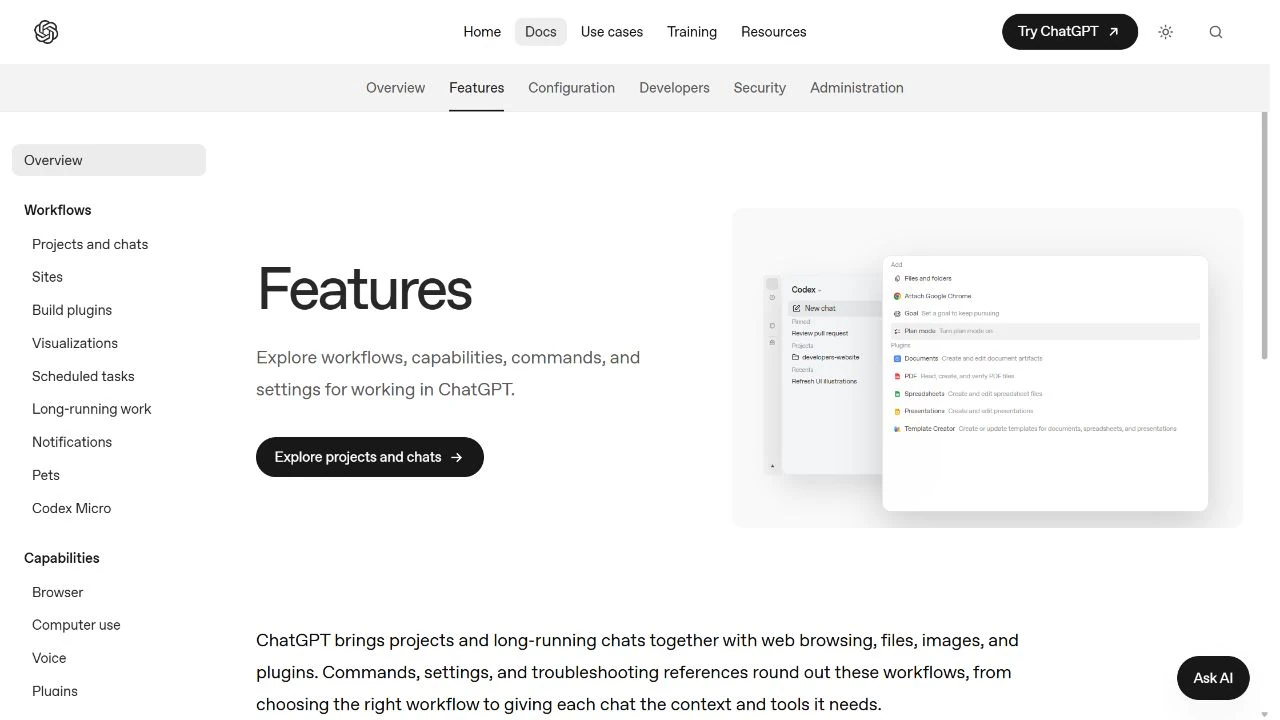
For someone moving between a spreadsheet, a research memo and a codebase, that integration can matter more than which model writes the nicest first answer. ChatGPT is the better fit to evaluate first if the real requirement is a finished artifact with files and tools kept in one workflow. Availability and controls still depend on the account, client and workspace.
Meta describes Active Memory as retaining and retrieving useful context across conversations, and Active Focus as working toward a difficult goal while adapting to blockers. Those are model-maker claims with real workflow relevance. Our short text tasks did not test persistent memory, long context, multimodal files or live computer use, and the GlobalGPT chat runs do not establish that every native Muse feature is exposed.
For a memory comparison, give each supported application the same harmless preference, start a separate conversation, then check accurate recall, an updated preference and removal controls. For tool work, ask for a small deliverable and inspect the actual file or trace. A written plan and a completed action deserve different scores.
Pricing: subscriptions and API costs are different
ChatGPT plans: pay for an application and its allowance
O official ChatGPT Work and Codex pricing page lists Free at $0, Go at $8/month, Plus at $20/month and Pro options at $100, $200 or $500/month. These are listed USD plan prices checked October 14, 2026. GPT-6.1 Sol’s launch access includes Plus, Pro, Business, Enterprise and Edu; Free and Go are outside that launch rollout.
Mais
$20 / mêsListed subscription price; usage varies with model, task and tools.
Prós
From $100 / month$100, $200 or $500 plan options; not a flat unlimited API allowance.
Wonder access
Route-specificStandard API, Muse Code and GlobalGPT credits have different billing.
ChatGPT Work and Codex share usage, and API token prices are separate from included subscription usage. Do not divide a $20 subscription by an API request price to invent a guaranteed task count. Our por qual IA vale a pena pagar focuses on the broader question of whether the finished work earns the subscription cost.
API rates: compare Wonder with the exact GPT models
O OpenRouter Muse Wonder listing quotes $4 per million uncached input tokens, $0.20 per million cached input tokens and $20 per million output tokens. These are marketplace-listed Wonder rates, rather than a Muse Code checkout price or an audited GlobalGPT debit.
OpenAI GPT-6.1 Sol model page lists Standard API rates of $2/M input, $0.10/M cached input and $10/M output. Its GPT-6 Astra documentation lists $10/M, $1/M and $50/M respectively. Those rates describe API usage, not the price of ChatGPT messages.
Listed API rates · USD per 1M tokens
GPT-6.1 Sol
- Entrada não armazenada em cache
- $2
- Entrada em cache
- $0.10
- Saída
- $10
Muse Wonder
- Entrada não armazenada em cache
- $4
- Entrada em cache
- $0.20
- Saída
- $20
GPT-6 Astra
- Entrada não armazenada em cache
- $10
- Entrada em cache
- $1
- Saída
- $50
Wonder: OpenRouter listing. GPT models: OpenAI Standard API rates. Checked October 14, 2026. Different billing routes; no subscription-equivalence claim.
For a simple estimate with 10,000 uncached input tokens and 2,000 output tokens, Sol is $0.04, Wonder is $0.08 and Astra is $0.20. The formula is input tokens ÷ 1,000,000 × input rate, plus output tokens ÷ 1,000,000 × output rate. This holds token volumes fixed for arithmetic; the same prompt can use different token counts across models.
10,000 uncached input + 2,000 output tokens · estimate only
Cost bars, not quality scores. Excludes cache writes, tools, service-tier changes, taxes and other applicable charges. No review task debit was audited.
At these short-request rates, Wonder is twice Sol for uncached input and output, and 40% of Astra. Astra’s premium over Sol remains fivefold. OpenAI applies higher full-request rates above 272K input tokens, so these examples should not be stretched into million-token estimates. The Guia de preços do GPT-6 Astra covers that larger-request cost boundary.
The buying rule is to measure cost per accepted result. A cheaper response that needs substantial editing can cost more in practice. These examples establish rate differences; they do not establish equal output quality, identical tokenization or the cost of our saved Muse tasks.
What X and Reddit add to the comparison
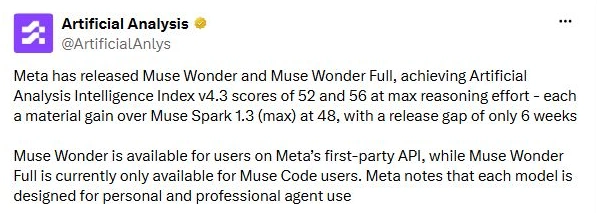
Artificial Analysis’s original X assessment reports Intelligence Index v4.3 scores of 52 for Wonder and 56 for Wonder Full at maximum reasoning effort. These are attributed third-party results reused from our review. They are not our GlobalGPT checks, and this excerpt does not establish a ChatGPT winner.
The more actionable community point is version clarity. On Reddit, u/noobiethe13 wrote: “wonder’s on the API, full is only through Muse Code subs for now. reviews should say which one they actually tried”. The original LocalLLaMA post was removed, while this comment remained readable when captured October 14.

Apply the same standard to ChatGPT: record Chat, Work or Codex, the selected model and the available tools. A comment about Wonder Full and an answer from standard Wonder can both be real, while describing different products. These named sources add context; they do not represent X-wide or Reddit-wide consensus.
How to compare both with your own task
Use one recent task you already know how to judge. For code, define accepted inputs and run the same checks. For research, supply the same dated source packet. For a workspace task, require the actual document, spreadsheet or changed files. Start fresh conversations so earlier feedback does not give one model an advantage.
01 · Fix the task
Same inputKeep prompts, files, permissions and acceptance criteria the same.
02 · Save the result
Produção efetivaRecord model, surface, settings, retries and any human corrections.
03 · Choose on value
Accepted workCompare correctness, usable deliverables, time and total spend.
For a quick response comparison, open GPT-6.1 Sol on GlobalGPT beside the verified Muse Wonder entry and reuse the prompts above. That keeps the interface convenient while leaving native ChatGPT Work and Codex features as a separate application test.
O fluxo de trabalho de modelos de IA “tudo em um” explains how to keep repeated model trials in one workspace. GlobalGPT is useful for comparing chat responses; it does not replace a repository agent, provide every native feature or turn a platform label into independent backend-version attestation.
Qual você deve escolher?
Choose ChatGPT first if your main need is an integrated place to work. Projects, file handling, plugins and the Work/Codex surfaces are concrete reasons to evaluate the application. Judge the artifact you receive and the editing time it saves. Check the account’s model access before assuming a particular GPT model is available everywhere.
Try Muse Wonder if you want another capable model for a specific, verifiable job. The reused code, JSON and planning examples earned a positive trial recommendation. Start with a small code repair or source packet, then expand only after the result meets your own checks.
For API builders, start the cost comparison with GPT-6.1 Sol. Its listed uncached input and output rates are half Wonder’s. Keep Astra in the evaluation for harder work where its extra capability can justify the bill. No saved evidence here establishes which of those three will clear your particular quality bar.
For Muse Wonder vs ChatGPT, the sensible next step is a task-level trial. Keep ChatGPT if the workspace saves you time; add Muse Wonder when its outputs improve a workflow you can measure. You can compare responses on GlobalGPT before deciding whether a separate native application or API integration is worth the move.
Muse Wonder vs ChatGPT FAQ
Is Muse Wonder better than ChatGPT?
Muse Wonder is worth testing for coding and source-based analysis. ChatGPT is the stronger fit when you want an integrated workspace. Our reused Muse tests passed 29 checks; they do not establish a head-to-head quality winner.
Which ChatGPT model does this comparison use?
The model discussion uses GPT-6.1 Sol and GPT-6 Astra. OpenAI documents Sol in ChatGPT Work and Codex, not Chat. Availability depends on the plan, client, rollout and workspace settings.
Which is better for coding?
Muse Wonder’s code-repair follow-up passed 13 independent checks, plus five supplied assertions. GPT-6.1 Sol is the lower-cost GPT option to evaluate first; run the same repository tests before choosing a coding default.
How much does Muse Wonder cost compared with ChatGPT?
OpenRouter lists Wonder at $4/M input and $20/M output tokens. ChatGPT Plus is listed at $20/month, with Pro from $100/month. API token rates and subscription allowances are separate billing systems.
Is Muse Wonder cheaper than GPT-6.1 Sol or Astra?
At the listed short-request API rates, Wonder costs twice Sol for uncached input and output, and 40% of Astra. These ratios compare API rates, not ChatGPT subscriptions or the cost of an accepted result.
Can I use Muse Wonder and GPT-6.1 Sol on GlobalGPT?
Yes. We verified both GlobalGPT product entries. The reused Muse tests ran on the production Muse Wonder route. Comparing chat responses there is separate from testing ChatGPT’s native Work or Codex features.
Is Muse Wonder Full the version tested here?
No. The reused production interface was labelled Muse Wonder. Meta distinguishes standard Wonder from Wonder Full, which its launch announcement makes available to Muse Code subscribers.
Did you run a new Muse Wonder vs ChatGPT benchmark?
No. This article reuses the published Muse Wonder tests and the GPT comparison’s cost framework, with refreshed official sources. No matched ChatGPT output, persistent-memory trial or live computer-use comparison was run.