

GPT-6 Sol pricing is easy to misread because two questions get mixed together. An API quote is a metered calculation based on tokens and a provider rate card. A subscription/workflow route is a broader decision about how often you need one model, several models, and connected tools.
This guide uses GPT-6 Sol in GlobalGPT for the hands-on checks. OpenAI’s official release page lists GPT-6 Sol at $2 per million input tokens and $10 per million output tokens, with a 90% discount on cached input reads (about $0.20 per million cached input tokens). The calculator below uses those published rates when you enter them and keeps the subscription route separate.
For broader interactive work, GlobalGPT keeps GPT-6 Sol alongside other models and AI functions in one dashboard. That matters when the real job moves from research to drafting, code, images, video, or a CLI-connected workflow.
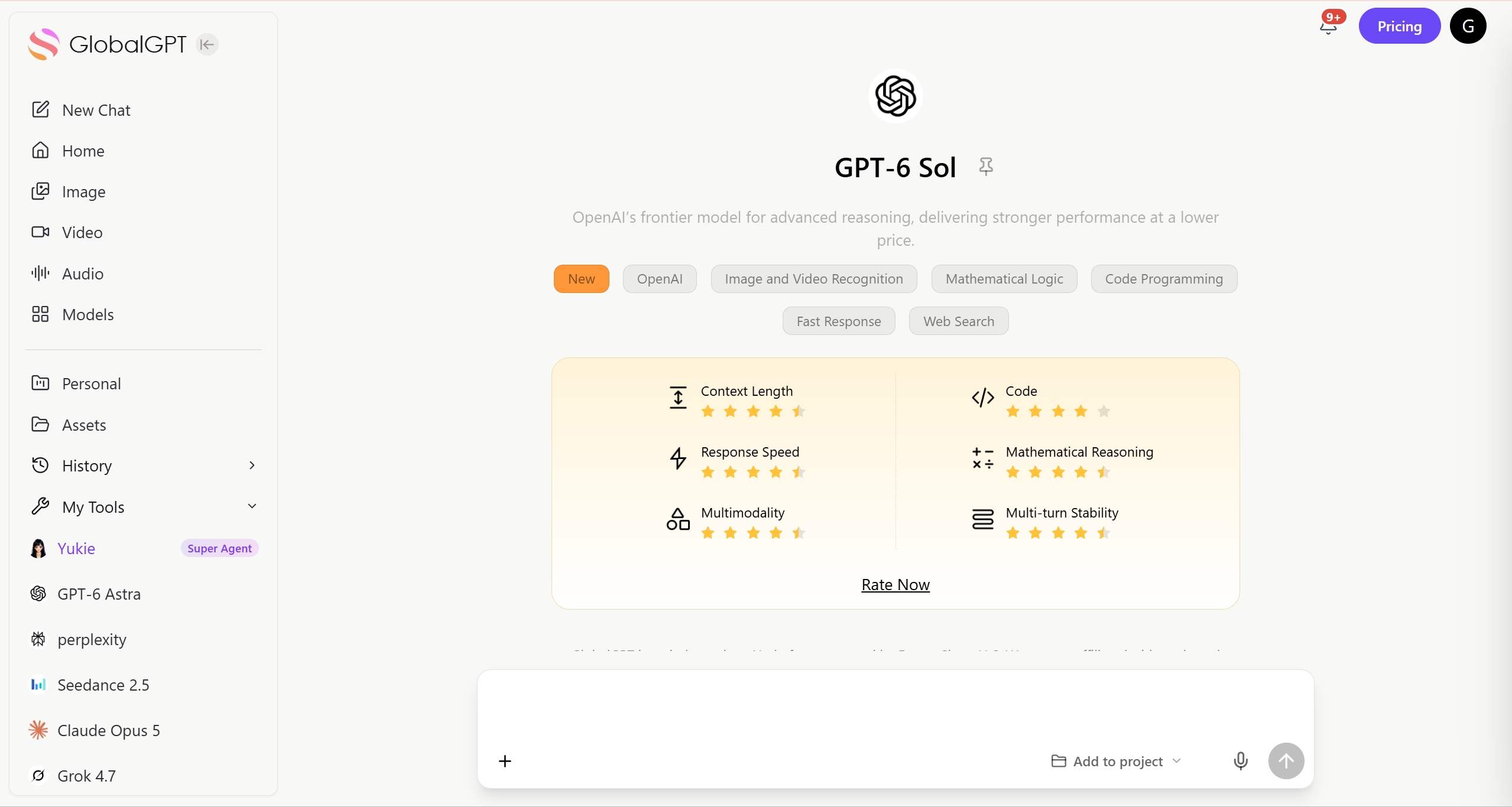
A GlobalGPT-werkruimte offers a subscription route across models and AI functions. That is a different purchase from a provider’s metered API calls. The GPT-6 Sol review explains where the model fits into a broader workflow.
What “GPT-6 Sol pricing” can mean
There are three separate cost questions: the API’s input/output token meter, optional rules such as cached or batch processing, and the value of a subscription that bundles access and workflow tools. Only the first two can be reduced to a token formula.
- API: best when software sends predictable requests and you need a traceable per-call estimate.
- Subscription/workflow: best when people switch among models and functions during a broader task.
- Mixed route: useful when production calls are programmable but exploration, writing, or multimodal work is interactive.
Official API pricing status
OpenAI lists GPT-6 Sol at $2 per million input tokens and $10 per million output tokens. The same release page says cached input reads receive a 90% discount, which works out to $0.20 per million cached input tokens. OpenAI presents these rates as 50% lower than GPT-5.6 Sol promotional pricing.
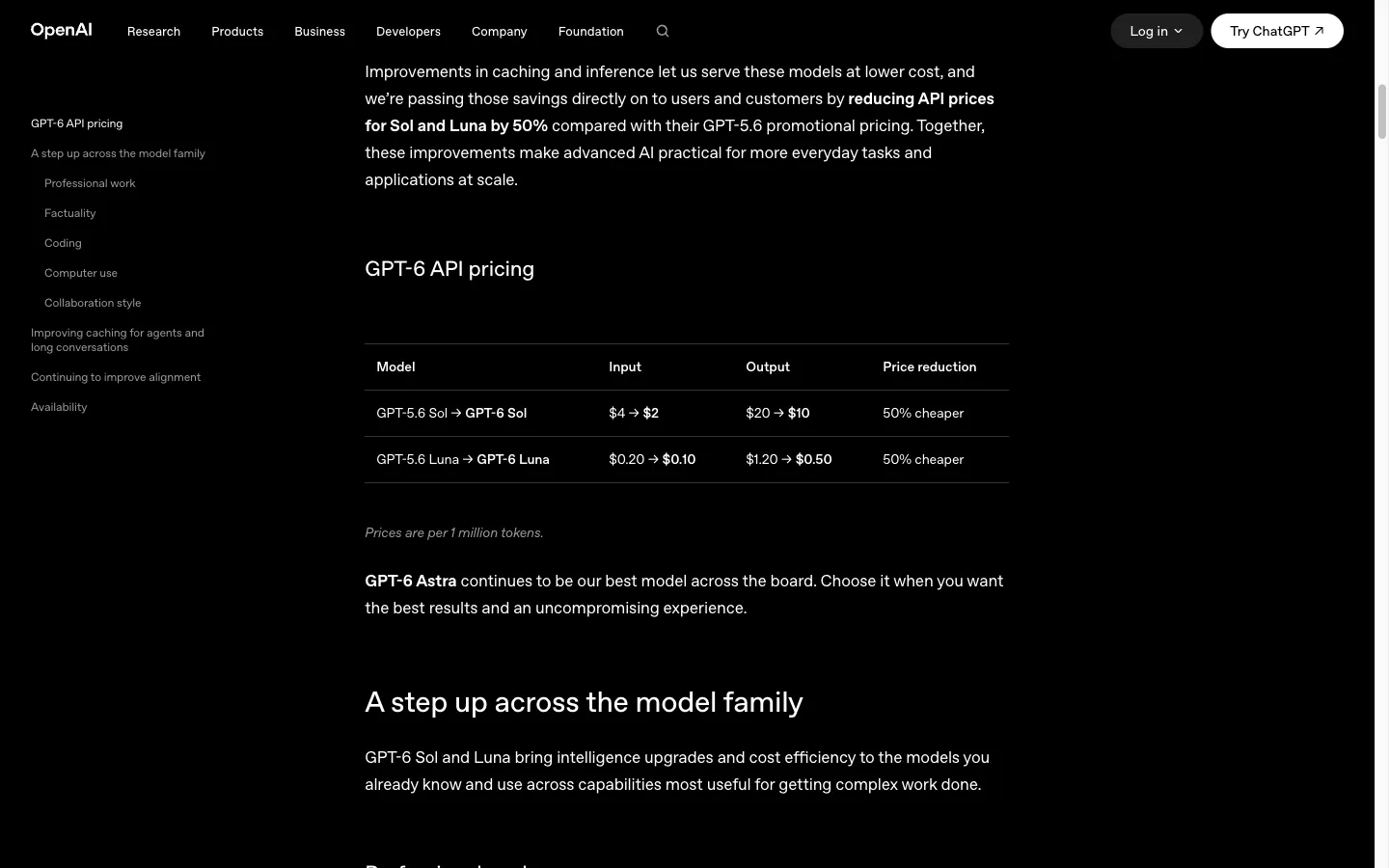
At the same token count, output costs five times as much as uncached input. Keeping an answer concise can matter as much as shortening the prompt.
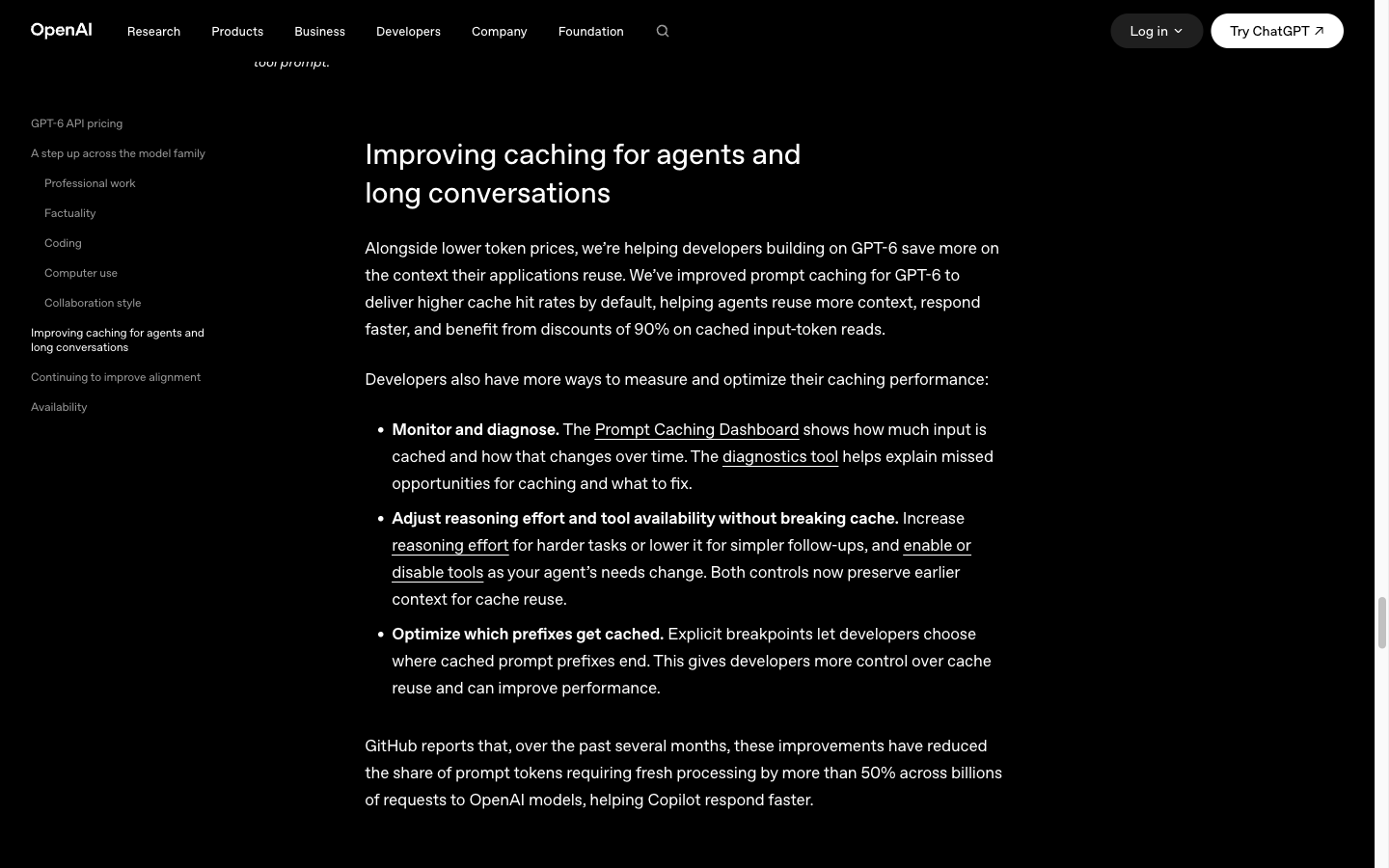
The discount turns $2 per million input tokens into $0.20 per million qualifying cached reads. A repeated prompt is not proof of a cache hit; use recorded cached-token usage when reconciling actual costs.
Worked estimates at the published rates
The following examples use the published GPT-6 Sol rates. They show how token counts turn into an API estimate; they are not a subscription price.
| Scenario | Invoer | Uitgang | Formula | Resultaat |
|---|---|---|---|---|
| Short Q&A | 12,500 @ $2/M | 2,000 @ $10/M | 0.0125×2 + 0.002×10 | $0.045 |
| Structured ledger | 1,200,000 @ $2/M | 300,000 @ $10/M | 1.2×2 + 0.3×10 | $5.40 |
| Cached context | 1,000,000 @ $0.20/M | 100,000 @ $10/M | 1×0.20 + 0.1×10 | $1.20 |
Divide tokens by one million before multiplying by the per-million rate. Apply the cached rate only to input tokens that actually qualify for a cache hit; charge the remaining input at the standard rate.
A 90% input discount does not mean a 90% smaller bill
Calculated example: 1 million total input tokens + 100,000 output tokens. Teal is input cost; rust is output cost. Only the input-cache hit changes.
The saving is $1.80, or 60% of this example’s total. Output still costs $10 per million tokens. A long answer can therefore dominate the bill even when the prompt is cached.
Cost = (total input − cached input) / 1M × $2
     + cached input / 1M × $0.20
     + output / 1M × $10
Derived from OpenAI’s published standard rates and 90% cached-read discount. Assumes eligible cache hits; excludes tool charges, taxes and other billing adjustments.Interactive API and workflow calculator
Use the published GPT-6 Sol rates as the starting values: $2/M input, $10/M output, and $0.20/M cached input. The route selector explains the GlobalGPT decision boundary without mixing a subscription price into the API arithmetic.
GPT-6 Sol API cost calculator
Use the published OpenAI rates as your starting point: $2/M input, $10/M output, and $0.20/M cached input. You can replace them when a newer official rate card changes.
API result = (total input − cached input) ÷ 1,000,000 × input rate + output ÷ 1,000,000 × output rate + cached input ÷ 1,000,000 × cached rate. Workflow value is shown as a route decision, not a subscription price.
Hands-on GPT-6 Sol checks
What the three hands-on checks actually establish
| Controleer | Waargenomen resultaat | Wat het ondersteunt |
|---|---|---|
| P01: short arithmetic | $0.041 from the supplied fictional $2/$8 rates | Following given rates and labeling the estimate fictional; not today’s official bill. |
| P02: structured estimate | $7.20 from the fictional $3/$12 ledger; 105 actual input tokens | JSON arithmetic and preserving unknowns. The 1.2M token figure was a ledger value, not a long-context test. |
| P03: calculator function | First attempt hit its output limit; the second returned the complete function | Code generation with one disclosed retry. It did not test the Batch API, a provider bill or batch discounts. |
These checks answer how the model handles a pricing task. The official rate card above answers what the provider charges. Keeping those questions separate prevents a model-generated number from becoming a pricing claim.
These checks use GPT-6 Sol in GlobalGPT. They show how the model handles pricing math, structured data, and calculator code; the provider billing table above comes from OpenAI’s published release page. P01 and P02 retain their first outputs. P03 was retried once because its first response stopped at the output limit before completing the function.
P01 · Short pricing Q&A
P01-short · first returned outputHTTP 2005.23sIn this check: GPT-6 Sol handled the prompt in GlobalGPT. The result shows how it handles pricing math and structured instructions; it is separate from any provider rate card.
Gebruik: 109 input · 132 output · 241 total · finish_reason=stop.
View exact prompt and complete output
Prompt
You are testing a pricing explainer. Use only this supplied fictional rate card: input $2.00 per million tokens, output $8.00 per million tokens. Question: what would 12,500 input tokens and 2,000 output tokens cost? Show the formula, label the result as fictional, and say what information is still needed for a real provider quote.
Volledige uitvoer
**Fictional cost:**
(12,500 ÷ 1,000,000 × $2.00) + (2,000 ÷ 1,000,000 × $8.00) = **$0.041** (4.1¢).

For a real provider quote, you’d need the provider and model, their current rates, and any applicable discounts, extra charges, or taxes.
P02 · Structured cost estimate
P02-structured · first returned outputHTTP 2005.639sIn this check: GPT-6 Sol handled the prompt in GlobalGPT. The result shows how it handles pricing math and structured instructions; it is separate from any provider rate card.
Gebruik: 105 input · 196 output · 301 total · finish_reason=stop.
View exact prompt and complete output
Prompt
Return a compact JSON object with keys input_cost, output_cost, total_cost, assumptions, unknowns. Use this fictional ledger: 1,200,000 input tokens, 300,000 output tokens; rates are input $3/M and output $12/M; cached input rate is not supplied. Do not add a cached discount or any provider fact.
Volledige uitvoer
{"input_cost":3.60,"output_cost":3.60,"total_cost":7.20,"assumptions":["USD; all input tokens billed at $3/M with no cached discount"],"unknowns":["cached input rate","cached input token count"]}P03 · Cost-calculator function
P03-code-batch · second attempt after output-limit truncationHTTP 20013.602sIn this check: GPT-6 Sol handled the prompt in GlobalGPT. The result shows how it handles pricing math and structured instructions; it is separate from any provider rate card.
Gebruik: 129 input · 757 output · 886 total · finish_reason=stop.
Retry: attempt 1 stopped at max_tokens and was incomplete; retry permitted for malformed output
View exact prompt and complete output
Prompt
Write a complete, runnable JavaScript function estimateTokenCost(inputTokens, outputTokens, inputRatePerMillion, outputRatePerMillion) for a pricing calculator. Requirements: return a clear validation error for empty, non-numeric, negative, or non-finite values; accept zero only when both token counts are zero; use ordinary arithmetic; include one normal example and one very large finite example without causing Infinity; do not claim these rates are real. Return only the complete JavaScript code and a short note.
Volledige uitvoer
```javascript
function estimateTokenCost(
  inputTokens,
  outputTokens,
  inputRatePerMillion,
  outputRatePerMillion
) {
  const values = {
    inputTokens,
    outputTokens,
    inputRatePerMillion,
    outputRatePerMillion
  };

  for (const [name, value] of Object.entries(values)) {
    if (typeof value !== "number" || !Number.isFinite(value)) {
      return { error: `${name} must be a finite number.` };
    }
    if (value < 0) {
      return { error: `${name} cannot be negative.` };
    }
  }

  const bothCountsZero = inputTokens === 0 && outputTokens === 0;
  if (!bothCountsZero && (inputTokens === 0 || outputTokens === 0 ||
      inputRatePerMillion === 0 || outputRatePerMillion === 0)) {
    return { error: "Zero values are allowed only when both token counts are zero." };
  }

  const cost =
    (inputTokens / 1_000_000) * inputRatePerMillion +
    (outputTokens / 1_000_000) * outputRatePerMillion;

  if (!Number.isFinite(cost)) {
    return { error: "The calculated cost is not finite." };
  }

  return { cost };
}

// Illustrative rates only; these are not real prices.
console.log(estimateTokenCost(1_000, 500, 2, 4));
console.log(estimateTokenCost(1e150, 2e150, 3e150, 4e150));
```

Note: The examples use hypothetical rates.
API vs GlobalGPT workflow route
Price is only one part of the decision. An API can be the right instrument for a backend call even when a subscription/workflow route is better for the surrounding human work.
| Vraag | API-route | GlobalGPT workflow route |
|---|---|---|
| How is cost measured? | Metered tokens from a verified provider rate card. | Current plan terms, access rules, and workflow value; verify the live page. |
| What work fits? | Programmable calls, batch jobs, production services. | Interactive research, writing, coding, and multiple AI functions in one dashboard. |
| What should you verify? | Input/output units, cache/batch rules, limits, and model ID. | Current plan price, model mapping, quotas, and usage controls. |
| Where does CLI fit? | Direct application integration. | GlobalGPT’s CLI can connect model access with terminals and existing workflows when available to your account. |
Collect real token counts from your application, calculate API exposure with the verified rate card, and separately estimate the value of the multi-model dashboard across the rest of the task. Keep those ledgers separate.
FAQ
What is the official GPT-6 Sol API price?
OpenAI lists GPT-6 Sol at $2 per million input tokens and $10 per million output tokens. Cached input reads receive a 90% discount, equivalent to $0.20 per million cached input tokens on the published release page.
Is GPT-6 Sol included in a GlobalGPT plan?
Do not infer plan inclusion from a model directory. Check the current GlobalGPT plan page and model mapping shown for your account.
How do I estimate one API request?
Subtract cached input from total input first. Charge uncached input at $2/M, eligible cached input at $0.20/M, and output at $10/M. Add separately documented tool or other charges where applicable.
Should I use an API or a subscription?
Use the API for programmable metered calls with a verified rate card. Consider GlobalGPT when your work spans several models and AI functions in one dashboard. A mixed route can make sense when production calls and interactive work have different needs.
Make the rate card do the arithmetic, and make the workflow do the deciding. Recheck live pricing and plan terms before committing budget.