
Snel antwoord: GPT-6 Sol completed the tested five-section brief under a 2,400-token output cap; Claude Opus 5.5 gave the more precise diagnosis in our short code-review task. Neither result establishes a permanent overall winner.
The useful comparison is broader than a score. Claude Opus 5.5 and GPT-6 Sol differ in how they handle writing, research synthesis, code review, structured responses, access routes, and day-to-day workflow. The task results below show where those differences matter.
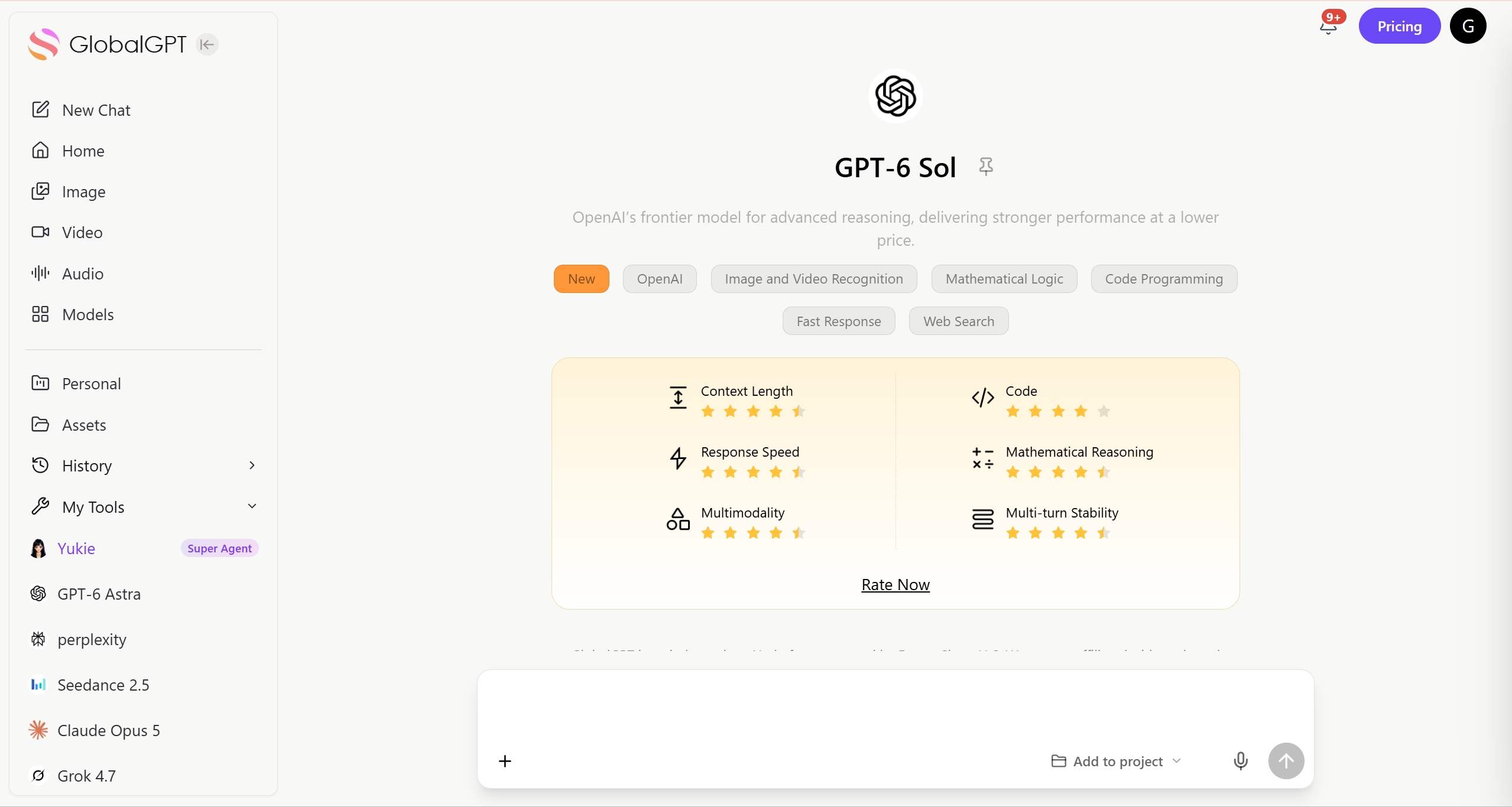
GlobalGPT gives you both models in one affordable multi-model subscription, alongside other models and AI capabilities. One dashboard can carry a project from research and writing into coding, images, and video, while its CLI connects the same working context to terminal and production tools.
Kort antwoord
Choose GPT-6 Sol first for the constrained writing workflow tested here; it completed all five sections within the shared 2,400-token output cap. Choose Claude Opus 5.5 when diagnosis, explicit risk analysis, and strict JSON matter more. Use both when the work changes shape during the day.
What each model is good at
Claude Opus 5.5 fits deliberate work: reviewing a code change, teasing apart a messy requirement, naming risks, and preserving a strict output contract. Anthropic positions it around coding, computer use, knowledge work, safety, and more natural long-session communication. See the Claude Opus 5.5 review for a separate model-focused view. It is a natural choice when a careful second pass is worth more than a shorter first answer.
GPT-6 Sol fits throughput with constraints: a long brief, a decision memo, a structured plan, or a draft that must include many requested sections. OpenAI describes it as a more affordable GPT-6 model for professional work, factuality, coding, computer use, and collaboration. The GPT-6 Sol review covers the model in its own right; in the long-form task here it completed the contract in the first output, which is useful when the cost of a missing section is high.
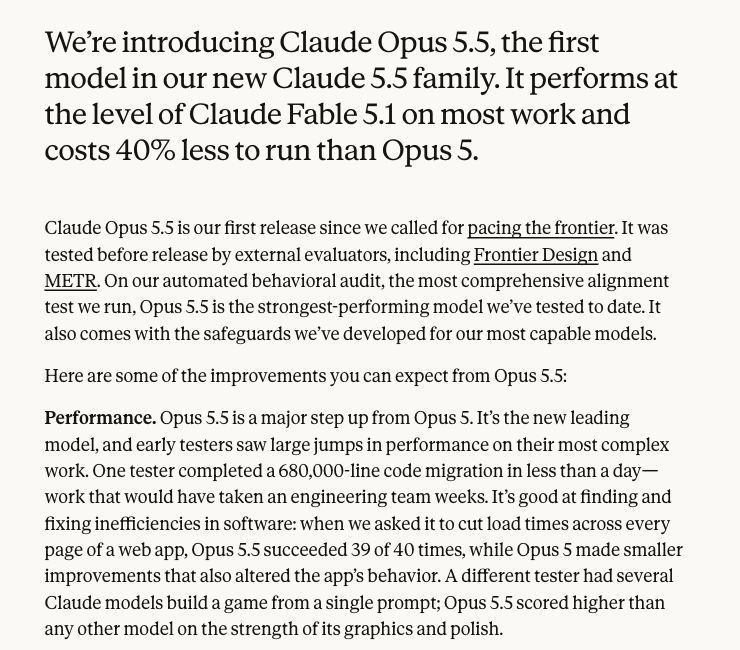
This is Anthropic’s own account of the release, including examples from early testers. It supports the product’s intended direction; it does not establish a head-to-head result against GPT-6 Sol. Our matched prompts below address the narrower question of what each model returned in this run.
Feature and capability comparison
Claude Opus 5.5 vs GPT-6 Sol: capability map
| Beslissingsgebied | Claude Opus 5.5 | GPT-6 Sol |
|---|---|---|
| Langdurig schrijven | Strong at careful, nuanced drafting and explicit caveats | Strong at completing a long, multi-constraint brief in one pass |
| Onderzoekssynthese | Detailed reconciliation and risk explanation | Compact synthesis with a clear recommendation |
| Coding and review | Precise diagnosis and structured risk reporting | Useful minimal patches; validate edge-case explanations |
| Gestructureerde uitvoer | Reliable strict JSON in the tested task | Valid JSON with all requested keys in the tested task |
| Multimodal and tools | Check the route and model access for the specific task | Check the route and model access for the specific task |
| Best working style | Deliberate review, complex reasoning, and risk-sensitive work | Completed the tested constrained brief under the fixed output cap |
Hoe dit te lezen: these are workflow tendencies, not a universal leaderboard. The right choice depends on whether you value deliberate review or completion of this dense brief under the same output cap.
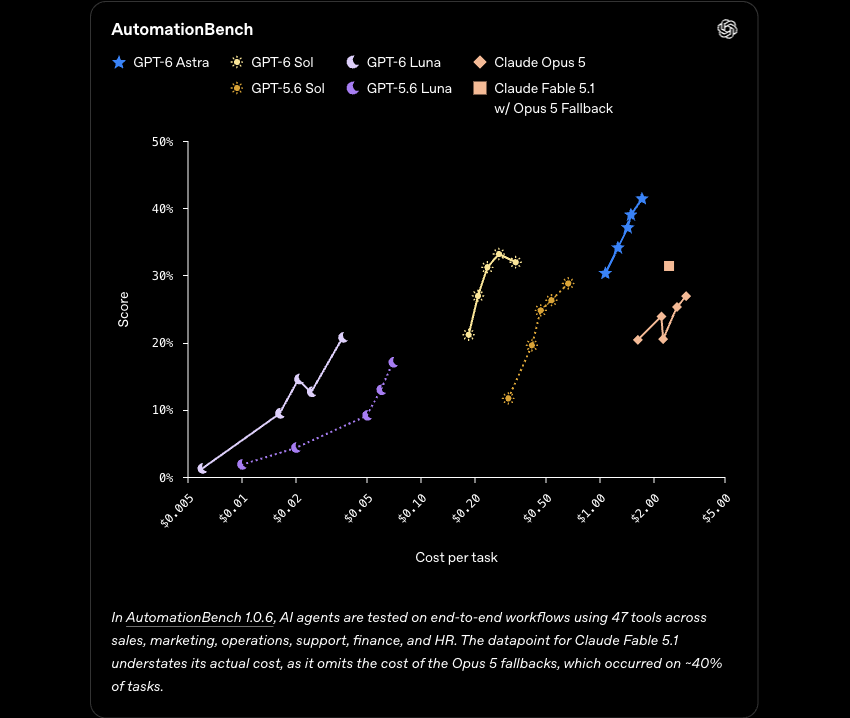
Read both axes: moving upward indicates a higher score, while moving left indicates lower cost per task. The Claude series here is Opus 5, not Opus 5.5. This publisher-reported chart helps explain Sol’s cost-efficiency positioning; it cannot settle the comparison in this article. The footnote also says the Fable datapoint omits some fallback costs.
Writing, long documents, and research synthesis
For writing, this test distinguishes completion under a fixed output cap from the quality of editorial scrutiny. GPT-6 Sol made the stronger showing on the long-form contract. Claude Opus 5.5 made the stronger showing when the job was to diagnose, qualify, and explain. For research notes, both models reached the same practical resolution, so the quality of the source material and review process still matter more than a headline winner.
- Use GPT-6 Sol for a first draft with many constraints, a decision memo, or a structured content plan.
- Use Claude Opus 5.5 to challenge assumptions, surface risks, and tighten a draft before it reaches a client or production system.
- When facts matter, give either model the source material and keep a human review step.
Coding, structured output, and tool-ready work
Both models returned valid JSON with all requested keys and the same minimal patch. Claude described the existing filter correctly; GPT-6 Sol incorrectly said a None element would raise an error. That supports Claude for diagnosis in this particular task. The risk-field type was not specified in the prompt, so Sol’s risk string is not a contract violation.
For tool-ready work, judge the output contract you actually need: valid JSON shape, complete fields, reproducible commands, and a patch that can be applied without interpretation. Both models can be part of that pipeline, with tests and review kept in the loop.
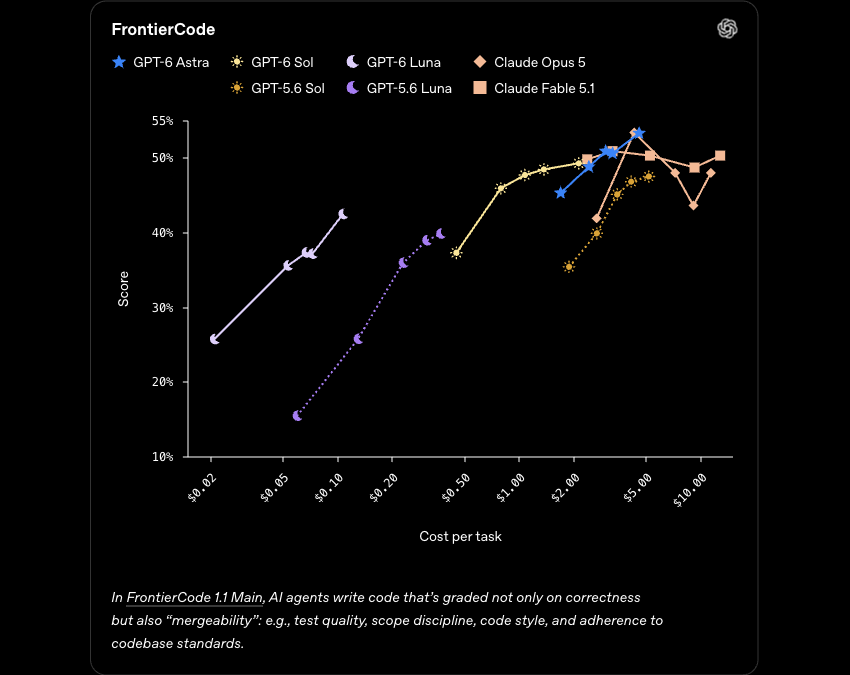
This benchmark covers broader agentic coding than our short code-review prompt. Its Claude comparator is Opus 5, so it is context for Sol’s coding positioning rather than evidence that Sol beats Opus 5.5. In our own task, both patches were correct; the useful distinction was the accuracy of the diagnosis.
Price and access
Price and access: compare the route, not only the model
| Route | Waarvoor u betaalt | Wanneer dat zinvol is |
|---|---|---|
| Claude Opus 5.5 API | Anthropic lists $4 per million input tokens, $20 per million output tokens, and $0.20 per million cache-read tokens on its September 22, 2026 release page | You are building a product or automated pipeline and want direct token billing |
| GPT-6 Sol API | OpenAI lists $2 per million input tokens and $10 per million output tokens, with a 50% reduction from GPT-5.6 Sol promotional pricing; cached input reads receive a 90% discount | You need a direct provider API contract and want lower metered cost for sustained work |
| GlobalGPT | One affordable subscription with both models plus many other models and AI functions | You want research, writing, coding, image, and video work in one dashboard |
These figures are API token rates, not subscription prices. OpenAI positions GPT-6 Sol as the lower-cost member of the GPT-6 family for professional work, factuality, coding, computer use, and collaboration, while Anthropic positions Claude Opus 5.5 around coding, computer use, knowledge work, safety, and communication. GlobalGPT keeps both models and the rest of the toolchain available through one affordable subscription, while its CLI connects that access to a terminal, development workflow, and existing production tools.
Primaire bronnen: Anthropic’s Claude Opus 5.5 release page en OpenAI’s GPT-6 Sol and Luna release page.
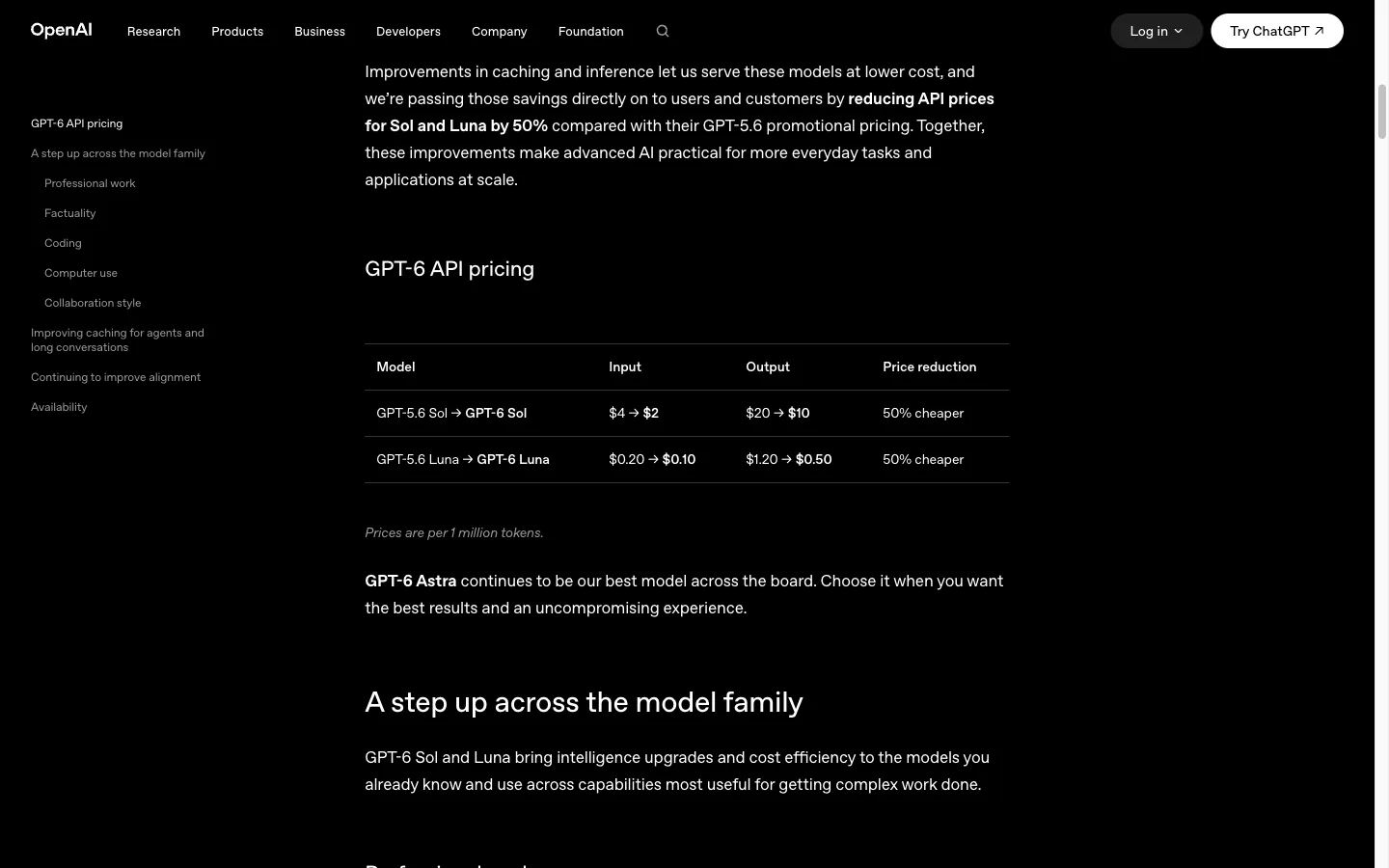
These rates apply to API tokens. They do not quote a monthly consumer subscription or a GlobalGPT plan.
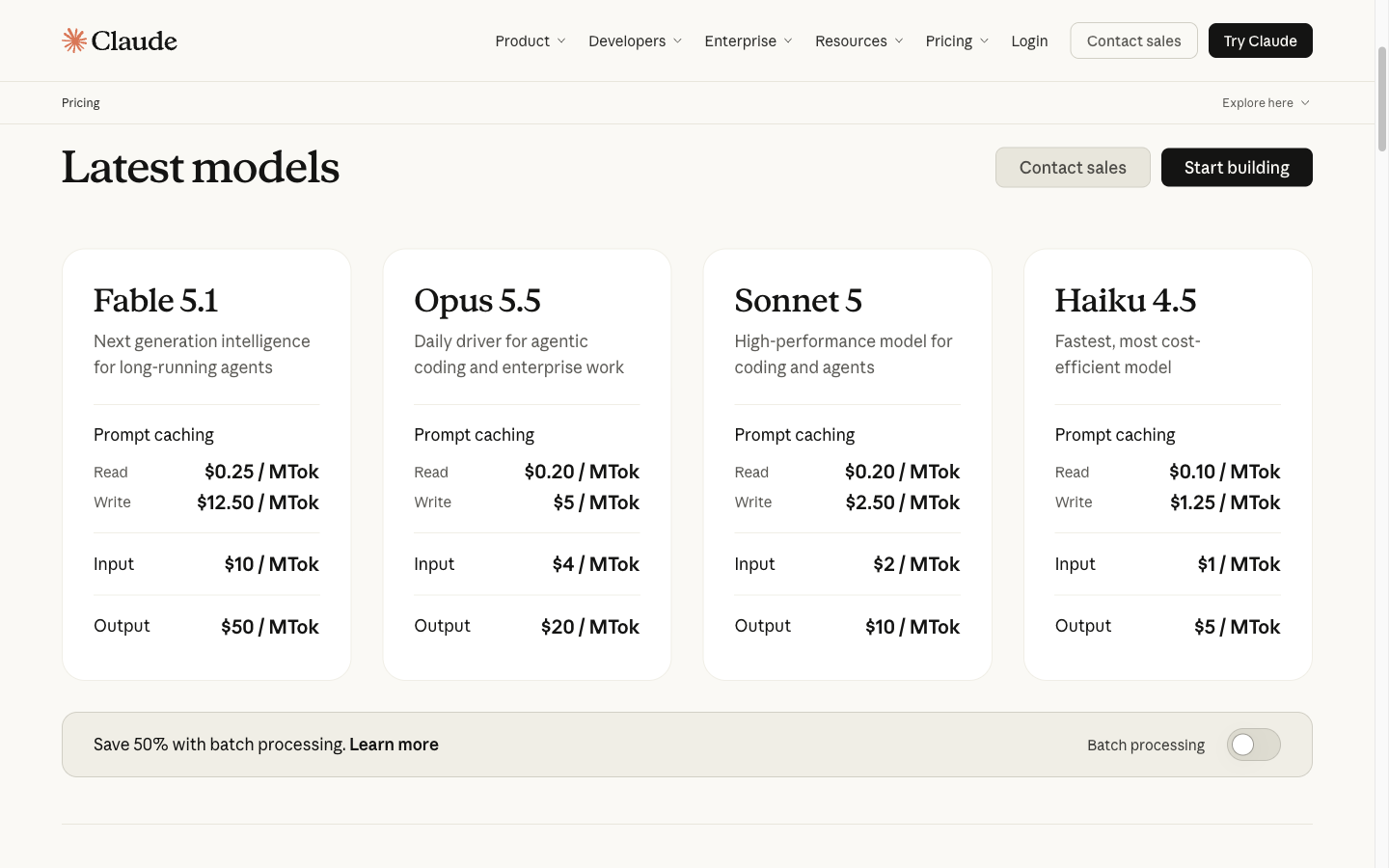
Opus 5.5’s standard input and output rates are twice Sol’s, while both published cached-read rates are $0.20/M. A heavily cached workflow can therefore have a different cost gap from an uncached one; compare the same token mix before choosing on price.
What the rate difference means for the same workload
Calculated example: 1 million uncached input tokens + 100,000 output tokens, standard API rates. Teal is input cost; rust is output cost.
Sol costs half as much for this identical token mix. That is a rate-card calculation, not a claim that every completed task costs half as much: retries, output length, cache hits, tool charges and reasoning settings can change the bill.
Bronnen: Anthropic API pricing en OpenAI release pricing, checked September 25, 2026.Estimate direct API cost
API-kostencalculator
Enter the tokens you expect to send and receive. The estimate uses the verified API rates above: Claude Opus 5.5 at $4/M input and $20/M output; GPT-6 Sol at $2/M input and $10/M output.
| Model | Input rate | Output rate | Geschatte kosten |
|---|---|---|---|
| Claude Opus 5.5 | $4 / M | $20 / M | $9.00 |
| GPT-6 Sol | $2 / M | $10 / M | $4.50 |
This is a token-billing estimate for direct API use. It does not calculate a consumer subscription or GlobalGPT plan price, and it excludes cache discounts, tools, taxes, and other provider-specific charges.
Who should choose which model?
Welk model moet je kiezen?
| Jouw prioriteit | Pick first | Waarom |
|---|---|---|
| A polished long memo with many constraints | GPT-6 Sol | The revised long-form task reached the requested decision rule in one output |
| Code diagnosis, strict JSON, and explicit risks | Claude Opus 5.5 | The coding task produced the more exact diagnosis and risk inventory |
| Research notes that need reconciliation | Ofwel | The controlled source-synthesis task was a tie |
| A mixed weekly workflow | GlobalGPT with both | Keep model choice, writing, coding, images, and video in one dashboard; use CLI when work moves to a terminal |
Use both models in one complete workflow
Een praktische GlobalGPT-workflow
- Start with a research brief and ask one model to expose assumptions.
- Move the cleaned brief into the other model for drafting or a second opinion.
- Use the stronger coding route for implementation, review, and structured output.
- Keep the resulting work in the same dashboard, then use the GlobalGPT CLI workflow when it needs to enter a terminal or production tool.
That workflow is the main value of access to both models: you can route the task, rather than rewrite your process around one model.

How the comparison was run
Both models received the same system message, task inputs, source material, and no tools or browsing. Each result retains the first returned output, including output-limit truncation. This is a practical comparison for choosing a workflow, not a universal ranking of every capability.
Comparison method
How this comparison was run
| Toestand | Comparison rule |
|---|---|
| Modellen | Claude Opus 5.5 and GPT-6 Sol, exact IDs confirmed in the live model directory |
| Prompt parity | Same system message, task prompt, source material, no tools or browsing |
| Taken | T01 boundary check, T01R explicit long-form comparison, T02 source synthesis, T03 code/JSON |
| Herpogingen | Only transport/capacity/empty-envelope failures; valid weak output is retained |
| Scores | 10 points per scored task: objective contract 4, traceability 3, usefulness 2, format 1 |
The first prompt checks whether a model will guess when key context is missing, so it is kept separate from the winner calculation. The direct comparison names both models and gives them the same brief. No stability reruns were used.
Why the first prompt did not pick a winner
Context handling
Why the first prompt did not pick a winner
Both models refused to invent model identities because the original prompt did not name them. That is the right response to missing context, but it cannot tell us which model is better at the work itself.
Claude Opus 5.5 · full input
You are comparing two AI models for a practical buyer guide. Using only the source packet below, write 700–900 words with exactly these headings: Decision, Evidence, Caveats, Next step. Preserve these facts exactly: Project North has a 12-week deadline; the migration budget is $48,000; the security review is not scheduled. If a fact is unresolved, say so explicitly. Do not invent prices, benchmarks, or product capabilities.

SOURCE PACKET:
Project North is a 12-week migration for a 40-person team. The approved migration budget is $48,000. Security review timing has not been scheduled. The team wants a model recommendation for research, writing, and code review. A stakeholder note says the current draft is too long, but gives no word count.

Return only the guide.
Claude Opus 5.5 · full output
## Decision

No recommendation between the two models can be made from the supplied source packet. The packet does not name either model or give any prices, benchmark results, or product capabilities. Choosing one model over the other now would mean inventing the evidence this guide is supposed to rely on.

The practical decision is to hold the model selection. Treat the next phase as a structured evaluation governed by three fixed constraints:

- Project North has a 12-week deadline.
- The migration budget is $48,000.
- The security review is not scheduled.

Any model that goes forward must fit inside the 12-week deadline and the $48,000 migration budget. It must also pass a security review, and that review is not yet on the calendar. Until the two models are identified and assessed against the team's three stated uses (research, writing, and code review), the selection remains unresolved. This guide says so plainly rather than offering a preference the evidence cannot support.

## Evidence

The source packet contains the following facts, and only these facts inform this guide:

- **Scope and timing:** Project North is a 12-week migration.
- **Team size:** The migration serves a 40-person team.
- **Budget:** The approved migration budget is $48,000.
- **Security:** Security review timing has not been scheduled.
- **Use cases:** The team wants a model recommendation for research, writing, and code review.
- **Stakeholder feedback:** A stakeholder note says the current draft is too long, but it gives no word count.

The packet does not contain several things a comparison would normally rest on. It does not identify the two models being compared. It does not state per-seat, per-token, or subscription pricing for either option. It provides no benchmark scores and no results from internal testing. It does not describe what either model can or cannot do for research, writing, or code review. It says nothing about data-handling terms, deployment options, or integration requirements.

Because none of these items appear in the packet, this guide does not estimate them. Whether either model fits within the $48,000 budget for a 40-person team is unknown. Whether either model performs better at research, writing, or code review is also unknown. Any figure or capability claim added here would be fabricated.

## Caveats

Several unresolved questions affect how this decision should be read.

**Model identities are unresolved.** The comparison concerns two AI models, but the packet does not say which ones. Every downstream judgment depends on answering this first.

**Budget scope is unresolved.** The packet calls the $48,000 figure the "approved migration budget." It does not say whether that amount is meant to cover model licensing or usage fees. It may instead cover only migration work such as staff time, tooling, or services. If model costs must come out of the same $48,000, the cost headroom for either model is narrower than the headline number suggests. This needs confirmation.

**Security review timing is unresolved and is a schedule risk.** The security review is not scheduled. With a 12-week deadline, an unscheduled review is a real risk to the timeline. The packet does not say how long a review takes or whether a failed review would force a switch to the other model. Both outcomes could consume a meaningful share of the 12 weeks. No model should be treated as approved until the review is complete.

**Use-case weighting is unresolved.** The team named three uses: research, writing, and code review. The packet does not say whether they matter equally or whether one dominates. A model that is stronger in one area might be weaker in another, and without a weighting there is no basis for trading these off.

**Usage volume is unresolved.** The team has 40 people, but the packet does not say how many will use the model or how heavily. Usage volume could strongly affect cost under some pricing structures. That cannot be assessed without pricing data and usage estimates.

**The length instruction con
GPT-6 Sol · full input
You are comparing two AI models for a practical buyer guide. Using only the source packet below, write 700–900 words with exactly these headings: Decision, Evidence, Caveats, Next step. Preserve these facts exactly: Project North has a 12-week deadline; the migration budget is $48,000; the security review is not scheduled. If a fact is unresolved, say so explicitly. Do not invent prices, benchmarks, or product capabilities.

SOURCE PACKET:
Project North is a 12-week migration for a 40-person team. The approved migration budget is $48,000. Security review timing has not been scheduled. The team wants a model recommendation for research, writing, and code review. A stakeholder note says the current draft is too long, but gives no word count.

Return only the guide.
GPT-6 Sol · full output
## Decision

Do not name a winning model yet. The source packet asks for a recommendation between two AI models, but it does not identify either model or provide results for research, writing, or code review. A claim that one is better would therefore be unsupported. The practical recommendation is to compare the two candidates against the team’s own work before making a selection.

Project North has a 12-week deadline. The migration budget is $48,000. The security review is not scheduled. Those facts make the decision time-sensitive, but they do not justify guessing. A useful choice must account for whether a model helps the 40-person team complete its actual tasks, how its use fits within the approved budget, and what remains uncertain until security review timing is known.

Treat the recommendation as conditional: choose the model that performs better on representative work, can be used within the approved migration budget, and clears any review needed for its intended use. If neither candidate meets those conditions, the guide should say that neither can yet be recommended. The available material does not establish that either condition has been met.

## Evidence

The team wants a model recommendation for three kinds of work: research, writing, and code review. These are the appropriate comparison categories because they come from the stated need, not from assumed product strengths. The packet contains no examples of either model’s output, no evaluation results, and no description of what the two candidates offer. It also contains no prices or benchmarks. As a result, there is no evidentiary basis for ranking the models on accuracy, speed, quality, cost, or suitability.

The project context does provide useful decision criteria. Project North is a migration for a 40-person team, so a comparison should reflect tasks people on that team would actually perform. The approved migration budget is $48,000; any proposed use of a model must be assessed against that amount rather than an invented allowance for AI tools. The security review is not scheduled, which leaves the timing of a review—and its effect on adoption—unresolved.

A stakeholder has said the current draft is too long, but has not supplied a word count. That is evidence of a preference for concision, not a measurable limit for model output. When comparing writing samples, reviewers can assess whether each candidate follows a request to be concise and preserves essential facts. They should not claim that either model satisfies a stakeholder-specified word limit, because none was given.

For research, useful evidence would be whether each candidate distinguishes supplied facts from open questions and avoids unsupported conclusions. For writing, it would be whether each produces a clear, appropriately brief draft without dropping constraints. For code review, it would be whether each identifies issues in a provided example and explains them in a way a reviewer can check. These are proposed tests, not findings about either model.

## Caveats

The largest caveat is that the candidates themselves are unresolved: the packet does not name them. It also does not say how the team would access them, what they cost, or whether either is available for the intended work. No product capability should be inferred from the phrase “AI models.” Even a well-designed comparison cannot yield a product recommendation until the candidates and evaluation evidence are known.

The migration budget is approved, but the packet does not allocate any portion of it to model use or testing. Do not treat $48,000 as an AI purchasing budget. Likewise, a 12-week deadline does not establish a date by which security review will occur. Because the security review is not scheduled, whether and when a candidate could be used under the team’s requirements remains unresolved.

The three requested uses may also produce different results. One candidate could be preferable for one task and not another; the packet provides no basis for assuming a single winner across research, writing, and code review. A recommendation should make any such tradeoff visible rather than hiding it in an overall label. If the team decides that one category matters more than the others, that priority should come from the stakeholders, not from this guide.

Finally, the note about the draft being too long should not be mistaken for evidence about model performance. It describes feedback on a current draft, without identifying its author or giving a target length. It can inform how the final recommendation is presented, but it cannot settle the comparison.

## Next step

Identify the two candidates and ask the team for representative research, writing, and code-review tasks. Give each model the same materials and instructions for each task, including directions to mark uncertainty and avoid adding facts. Have reviewers record what each answer gets right, what it misses, and which claims require verification. Keep task-specific observations separate so that a strong writing sample does not stand in for evidence about code review.

Before choosing, confirm the cost of the intended use against the $48,000 migration budget and establish when the security review can occur. Neither answer is in the packet. If those questions cannot be resolved in time for a decision, report that constraint plainly rather than presenting a provisional preference as an approved choice.

The final buyer recommendation can then be short and auditable: name the candidates, state the evidence for each of the three uses, explain any tradeoffs, and identify outstanding approval or budget questions. Until that information exists, the honest answer for Project North is not “Model A” or “Model B.” It is that the comparison has not yet been supported by evidence.
Treat this as a context-handling check, not a quality ranking.
Langdurig schrijven
Completion under the same 2,400-token output cap
The same brief required five sections. Both models had a 2,400-token output allowance; the returned metadata explains the visible difference.
Claude reached the configured output ceiling before the Decision rule. Sol completed the brief within that ceiling. This supports a recommendation for this constrained run, not a general ranking of maximum writing ability or speed. The full returned text, including the truncated response, is preserved below.
Long-form task
Long-form writing: GPT-6 Sol completed the brief
This is the first direct comparison task. The prompt explicitly named Claude Opus 5.5 en GPT-6 Sol, gave both the same Project North briefing packet, and required a conditional decision memo.
| Maat | Claude Opus 5.5 | GPT-6 Sol |
|---|---|---|
| Visible length | 648 words; finish_reason=length | 1,065 words; finish_reason=stop |
| Required sections | 4 of 5; Decision rule missing after truncation | 5 van 5 |
| Four-row scorecard | Present and symmetric | Present and symmetric |
| Pilot checks / stop condition | Started but truncated before completion | Three checks and a stop condition |
| Score | 7.0 / 10 | 10.0 / 10 |
Meenemen: With the same 2,400-token output cap, GPT-6 Sol returned all five sections, while Claude Opus 5.5 reached the cap before the Decision rule. This shows completion under this configuration; it does not establish either model’s maximum writing ability or general speed.
Shared full input
You are writing a decision memo for a team choosing between Claude Opus 5.5 and GPT-6 Sol. The model names are fixed and must appear exactly as written. Using only the evidence packet below, write 900–1100 words with exactly these sections: Executive recommendation; What the evidence supports; Where the evidence is missing; 30-day pilot; Decision rule.

Requirements: (1) compare Claude Opus 5.5 and GPT-6 Sol symmetrically; (2) separate observed evidence, assumptions, and unknowns; (3) preserve the exact dates, budget, team size, and unresolved security status; (4) include a compact four-row scorecard covering research synthesis, long-form writing, code review, and structured JSON; (5) give a conditional recommendation rather than inventing a winner; (6) list three measurable pilot checks and a stop condition; (7) do not invent prices, benchmarks, context limits, or product capabilities.

EVIDENCE PACKET
- Project North is a 12-week migration for a 40-person team.
- The approved migration budget is $48,000. The packet does not say whether model usage is inside that budget.
- Security review timing is not scheduled.
- The team needs research synthesis, long-form writing, code review, and structured JSON extraction.
- A stakeholder says the current draft is too long, but no target word count is approved.
- No controlled outputs from Claude Opus 5.5 or GPT-6 Sol are supplied yet.
- The team wants an auditable choice and can run a 30-day pilot with identical prompts and human review.

Return only the memo. Do not claim that the evidence packet proves either model is better.
Claude Opus 5.5 · complete returned output
## Executive recommendation

Do not select Claude Opus 5.5 or GPT-6 Sol yet. The evidence packet contains no controlled outputs from either model. There is therefore no observed basis for declaring one better than the other on any of the four required workloads.

The recommendation is conditional. Run a 30-day pilot that gives both models identical prompts and applies the same human review. Then select the model that meets thresholds agreed before the pilot starts, as long as the security and budget questions below are resolved first. There are three possible outcomes:

- **One model clears the thresholds:** choose that model.
- **Both clear:** apply the tie-breakers in the Decision rule.
- **Neither clears:** adopt neither.

This approach gives the team the auditable choice it has asked for.

The fixed project facts are:

- Project North is a 12-week migration for a 40-person team.
- The approved migration budget is $48,000. The packet does not say whether model usage is inside that budget.
- Security review timing is not scheduled.
- The packet supplies no calendar dates (no project start date, end date, or pilot window), so this memo does not assign any.

## What the evidence supports

**Observed evidence.** These are facts stated directly in the packet:

- Project North is a 12-week migration for a 40-person team.
- The approved migration budget is $48,000, and its coverage of model usage is unstated.
- Security review timing is not scheduled.
- The required workloads are research synthesis, long-form writing, code review, and structured JSON extraction.
- A stakeholder says the current draft is too long, but no target word count is approved.
- No controlled outputs from Claude Opus 5.5 or GPT-6 Sol have been supplied.
- The team wants an auditable choice and can run a 30-day pilot with identical prompts and human review.

**What this supports.** The evidence defines what must be evaluated and how, but not which model wins. It justifies a structured, side-by-side pilot. It does not justify any claim about quality, speed, cost, context handling, or feature availability for either model.

**Scorecard (current state of evidence)**

| Workload | Claude Opus 5.5 | GPT-6 Sol | Pilot measure |
|---|---|---|---|
| Research synthesis | No controlled output supplied | No controlled output supplied | Blind reviewer rubric score |
| Long-form writing | No controlled output supplied | No controlled output supplied | Rubric score plus adherence to an approved length target |
| Code review | No controlled output supplied | No controlled output supplied | Share of known issues identified |
| Structured JSON | No controlled output supplied | No controlled output supplied | Schema-validation pass rate |

Every cell for both models is identical because the packet treats them identically. No row currently favors either model.

## Where the evidence is missing

**Unknowns.** The packet is silent on each of these:

- Whether model usage costs fall inside the $48,000 migration budget or require separate funding.
- When security review will happen, what it will cover, and whether either model is acceptable under it. Security status is unresolved for both models.
- Calendar dates for the 12-week migration and the 30-day pilot.
- An approved target word count for long-form writing. The stakeholder's "too long" comment cannot be scored without one.
- Pricing, benchmark results, context limits, and product capabilities for Claude Opus 5.5 and GPT-6 Sol. None are supplied, and this memo does not assume any.
- Who the human reviewers are, how many there are, and how disagreements between them will be resolved.
- What data the pilot may use before security review is complete.

**Assumptions.** These are proposals made in this memo, not facts from the packet, and each requires team approval:

- The pilot can use non-sensitive or synthetic material until security review clears real data.
- Reviewers can be blinded to which model produced each output.
- The team can assemble a fixed prompt set for each workload that represents Project North's real tasks.
- The pass thresholds proposed below are starting points that the team may change before the pilot begins, but not during it.

## 30-day pilot

**Design**

1.
GPT-6 Sol · complete returned output
## Executive recommendation

Do not select Claude Opus 5.5 or GPT-6 Sol yet. Project North is a 12-week migration for a 40-person team, and the packet supplies no controlled outputs from either model. It therefore supports a comparison plan, not a performance verdict. Run the available 30-day pilot with identical prompts and human review, then make an auditable choice against criteria agreed before results are examined. Choose either model only if its reviewed work meets the team’s needs, its use fits the approved financial arrangement, and the unresolved security review permits adoption. If those conditions are not met, defer selection rather than treating an incomplete comparison as a win.

The approved migration budget is $48,000. The packet does not say whether model usage is inside that budget. Security review timing is not scheduled. Those are decision constraints for Claude Opus 5.5 and GPT-6 Sol alike, not evidence for favoring one.

## What the evidence supports

**Observed:** The team needs research synthesis, long-form writing, code review, and structured JSON extraction. It wants an auditable choice and can run a 30-day pilot using identical prompts and human review. A stakeholder says the current draft is too long, but no target word count is approved. That feedback identifies an issue to test in writing outputs; it does not establish a preferred model or an acceptable length.

The current task-by-task scorecard is deliberately unranked:

| Workstream | Claude Opus 5.5 | GPT-6 Sol | Pilot evidence to collect |
|---|---|---|---|
| Research synthesis | Not yet tested | Not yet tested | Reviewer-rated accuracy, coverage, and traceability |
| Long-form writing | Not yet tested | Not yet tested | Reviewer-rated usefulness, clarity, and concision |
| Code review | Not yet tested | Not yet tested | Reviewer-verified findings and unsupported claims |
| Structured JSON | Not yet tested | Not yet tested | Valid outputs and correct field extraction |

**Assumption for planning, not an observed result:** Comparable work samples and a common review rubric can reveal differences relevant to Project North. The pilot should test that assumption. Identical prompts alone will not make the choice auditable: the team must also retain the inputs, both outputs, review criteria, reviewer judgments, and reasons for any exclusions or reruns. Human review should apply the same standard to each model.

For long-form writing, reviewers should distinguish “too long” from “not useful.” A shorter answer could omit necessary material; a longer answer could still be clear and usable. Because no target word count is approved, the pilot can record length and reviewer judgments, but should not retroactively declare an arbitrary word count to be the acceptance standard. The same discipline applies across the other tasks: record what reviewers observed, rather than converting preferences into claims about general model capability.

## Where the evidence is missing

**Unknown:** The packet contains no controlled outputs from Claude Opus 5.5 or GPT-6 Sol. It establishes no relative quality, reliability, or suitability for any of the four workstreams. It also gives no prices, context limits, benchmarks, or product-capability information. This memo consequently cannot estimate usage cost or infer which model would perform better on Project North’s material.

The budget boundary needs clarification before a purchasing decision. The $48,000 is the approved *migration* budget; whether model usage must be paid from it is unstated. Treating it as either included or additional would create a financial assumption the packet does not support. The team should document the answer and the applicable approval path before committing to sustained use.

Security is likewise unresolved for both candidates. Security review timing is not scheduled, and the packet provides no security outcome. A strong pilot result would not resolve that status. The team should identify who can schedule and decide the review, what information that reviewer requires, and whether pilot activity itself is permitted under applicable rules; the packet does not answer those questions. No calendar start or finish dates are supplied for the migration, pilot, or security review, so the team should not imply that a security decision will arrive within the 30-day pilot or the 12-week migration.

## 30-day pilot

Before the first comparison, the team should select representative prompts for all four workstreams, define the expected form of each response, and agree on a human-review rubric. Both models should receive identical prompts and the same review instructions. Reviewers should record their judgments against the work rather than against a model’s reputation. Preserve the prompt, output, review, and any correction requested so that a later reader can reconstruct each judgment. Record deviations from the common process instead of silently dropping difficult cases.

Use three measurable checks:

1. **Reviewed task quality:** For research synthesis, long-form writing, and code review, count the proportion of outputs reviewers accept for the stated task. Also record rejection reasons separately—for example, missing coverage, unclear writing, or an unverified code-review finding. Report results by workstream and model, not just as one pooled score.
2. **Structured JSON reliability:** Count outputs that match the agreed structure and outputs whose extracted fields a reviewer verifies as correct. Report both rates for Claude Opus 5.5 and GPT-6 Sol; a structurally valid answer should not be counted as accurate solely because it parses.
3. **Review effort and traceability:** Record the human time required to check and, where needed, correct each output. Count cases lacking enough retained evidence to explain the reviewer’s decision. Compare these measures on the same prompt set, including cases where neither output is acceptable.

Agree on acceptance standards and how ties will be handled before viewing pilot results; the packet provides no benchmark from which to derive numerical thresholds. At the end of 30 days, publish the rubric, counts, reviewer reasons, and unresolved questions. **Stop condition:** pause adoption if security requirements for the pilot or subsequent use cannot be satisfied, or if the team cannot establish a valid budget and approval path. Do not substitute favorable quality scores for either clearance.

## Decision rule

Select Claude Opus 5.5 if its pilot evidence meets the pre-agreed standards, is materially stronger on the workstreams the team prioritizes, and its security and financial conditions are resolved. Apply exactly the same rule to GPT-6 Sol. If both meet the standards without a material, relevant difference, decide using documented project priorities and resolved constraints rather than claiming a performance winner. If neither qualifies—or the budget boundary or security status remains unresolved—make no model selection yet. That outcome preserves an auditable decision for the 40-person team without asserting more than the evidence can support.
Metadata: Claude — HTTP 200 · 25.98s · finish_reason=length · prompt_tokens=598 · completion_tokens=2400
GPT — HTTP 200 · 27.763s · finish_reason=stop · prompt_tokens=386 · completion_tokens=1695
Source synthesis
Research task
Source synthesis: a draw
Both models resolved the date conflict to 15 October, kept the agreed $12,000 budget, and treated “always accurate” as an unsupported manager claim. The result is a tie on this task.
| Maat | Claude Opus 5.5 | GPT-6 Sol |
|---|---|---|
| Score | 9.5 / 10 | 9.5 / 10 |
| Conflict handling | S2 controls the deadline | S2 controls the deadline |
| Unsupported claim | Marked unsupported | Marked unsupported |
| Practical difference | More detailed risk explanation | More compact recommendation |
Shared full input
Reconcile the source notes below. Return (1) a Markdown table with columns Claim, Controlling source, Status, Reason and (2) a recommendation of about 250 words. Use the later dated policy note as controlling only for the deadline conflict. Mark unsupported claims as unsupported. Do not add facts.

[S1 2026-09-01] Pilot ends on 30 September. Budget is $12,000.
[S2 2026-09-03] Pilot ends on 15 October. Budget remains $12,000.
[S3 2026-09-02] Legal has not approved external data sharing.
[S4 2026-09-04] A manager says the model is “always accurate”; no test evidence is attached.
[S5 2026-09-04] The pilot team has 8 members.
[S6 2026-09-05] The decision memo must list unresolved risks.

Return only the table and recommendation.
Claude Opus 5.5 · complete output
| Claim | Controlling source | Status | Reason |
|---|---|---|---|
| Pilot ends on 30 September | S2 (2026-09-03) | Superseded | Conflicts with S2. The later dated note controls the deadline conflict. |
| Pilot ends on 15 October | S2 (2026-09-03) | Supported (controlling) | This is the later dated note on the deadline conflict, so it overrides S1. |
| Budget is $12,000 | S1 and S2 | Supported | Both sources agree, and S2 states that the budget "remains" $12,000. There is no conflict. |
| Legal has not approved external data sharing | S3 | Supported | Stated directly and not contradicted by any other source. |
| The model is "always accurate" | S4 | Unsupported | This is a manager's assertion with no test evidence attached. |
| The pilot team has 8 members | S5 | Supported | Stated directly and not contradicted. It comes from a single source. |
| The decision memo must list unresolved risks | S6 | Supported | This is a stated requirement for the memo and is not contradicted. |

**Recommendation**

The decision memo should use 15 October as the pilot end date. S2 is the later dated note and controls the deadline conflict, which supersedes the 30 September date in S1. The later-date rule applies only to this conflict. The other claims were assessed on their own support.

The budget should be recorded as $12,000. S1 and S2 agree on this figure, so no reconciliation is needed. The team size of eight members can also be included. It rests on S5 alone, but no source contradicts it.

S6 requires the memo to list unresolved risks, and the notes support at least two.

- **External data sharing:** Legal has not approved it (S3). The memo should state this plainly. It should not imply that external data sharing is permitted during the pilot.
- **Model accuracy:** The claim that the model is "always accurate" is unsupported. S4 notes that no test evidence is attached, and it records the claim only as a manager's statement. The memo should not present it as a finding or rely on it to justify decisions. It should list model accuracy as unverified until supporting evidence is provided.

Finally, the memo should briefly note that the pilot end date changed between S1 and S2. Readers may encounter the earlier 30 September date elsewhere, and this note would explain why 15 October is used. The memo should not add explanations for the change, test results, or legal status updates, because none appear in the source notes.
GPT-6 Sol · complete output
| Claim | Controlling source | Status | Reason |
|---|---|---|---|
| The pilot ends on 30 September. | S2 (2026-09-03) | Superseded | The later dated note controls the deadline conflict and gives 15 October. |
| The pilot ends on 15 October. | S2 (2026-09-03) | Supported | S2 supplies the controlling deadline. |
| The budget is $12,000. | S1 and S2 | Supported | Both notes give the same amount. |
| Legal has not approved external data sharing. | S3 | Supported | S3 states this directly; no later note addresses that approval. |
| The model is “always accurate.” | S4 | Unsupported | A manager makes the claim, but no test evidence is attached. |
| The pilot team has 8 members. | S5 | Supported | S5 states the team size. |
| The decision memo must list unresolved risks. | S6 | Supported | S6 states this requirement. |

**Recommendation:** Use 15 October as the pilot end date in the decision memo. S2 is later than S1 and resolves their deadline conflict. Keep the budget at $12,000: the notes agree on that amount, so the deadline change provides no basis for changing it. Record the pilot team size as 8 members, as stated in S5.

List unresolved risks explicitly, as S6 requires. The memo should state that Legal has not approved external data sharing, without implying that approval has since been granted or that sharing is permitted. It should also distinguish the manager’s statement about accuracy from an established finding. S4 records the statement that the model is “always accurate,” but supplies no test evidence. Do not present that statement as a verified result.

Keep the reconciliation narrow. S2 controls the conflicting end dates; it does not displace the separate notes about Legal, accuracy, team size, or memo requirements. Where the notes do not establish an outcome, leave it unresolved rather than supplying an assumption. In particular, the record supports neither a claim that external data sharing has been approved nor a claim that the model’s accuracy has been demonstrated.

The resulting memo can therefore use the 15 October deadline and $12,000 budget while identifying the two evidence gaps apparent in these notes: outstanding Legal approval for external data sharing and the absence of test evidence for the accuracy assertion.
Metadata: Claude — HTTP 200 · 12.846s · finish_reason=stop · prompt_tokens=338 · completion_tokens=1193
GPT — HTTP 200 · 12.322s · finish_reason=stop · prompt_tokens=230 · completion_tokens=714
Coding and structured output
The coding difference was in the explanation
Original filtering condition: if t
A None element is falsy, so this filter already skips it.
Both models returned valid JSON with the four requested keys and the same minimal patch. Claude correctly described the existing filter; GPT-6 Sol incorrectly said that a None element would cause an error. That specific diagnosis error matters when a reviewer decides whether a patch addresses the actual failure.
Claude supplied a risk list and Sol supplied a short risk string. The prompt did not require a particular type for that field, so this difference is not a contract violation. Sol’s task score is 9.0/10 after correcting the earlier unsupported half-point deduction; its factual-accuracy deduction remains.
Coderingstaak
Coding and structured output: Claude Opus 5.5 was more precise
Both models returned valid JSON with the requested keys and the same minimal patch. Claude correctly explained that the original filter already skips a Geen element. GPT-6 Sol incorrectly said that a Geen element would cause an error. The prompt did not require a particular type for the risks field.
| Maat | Claude Opus 5.5 | GPT-6 Sol |
|---|---|---|
| Score | 10.0 / 10 | 9.0 / 10 |
| Patch | Correct and minimal | Correct and minimal |
| Diagnose | Correctly isolates both defects | Overstates the None-element failure |
| Requested JSON contract | Valid JSON; all four keys present | Valid JSON; all four keys present |
Shared full input
Return strict JSON only with keys diagnosis, patch, tests, risks. Diagnose and minimally patch this Python function so all three cases pass. The patch must keep the function signature.

def normalize_tags(tags):
    return ','.join(sorted(set(t.strip().lower() for t in tags if t)))

Cases:
1) [' AI ', 'ai', 'Code'] -> 'ai,code'
2) None -> ''
3) ['  ', None, 'SEO'] -> 'seo'

Do not execute code and do not include Markdown fences or prose outside the JSON.
Claude Opus 5.5 · complete output
{"diagnosis":"Two defects, traced by reading the code (not executed). (a) Case 2: when tags is None, the generator iterates over None and raises TypeError instead of returning ''. (b) Case 3: the filter 'if t' runs before stripping. The whitespace-only tag ' ' is truthy, so it passes and becomes ''. The result is sorted(['', 'seo']), which joins to ',seo' instead of 'seo'. The None element in case 3 is already dropped by 'if t'. Case 1 already works: ' AI ', 'ai' and 'Code' normalize to {'ai', 'code'}, giving 'ai,code'.","patch":"def normalize_tags(tags):\n return ','.join(sorted(set(t.strip().lower() for t in (tags or []) if t and t.strip())))","tests":["assert normalize_tags([' AI ', 'ai', 'Code']) == 'ai,code' # traced: {'ai','code'} -> 'ai,code'","assert normalize_tags(None) == '' # traced: (None or []) -> [] -> ''","assert normalize_tags([' ', None, 'SEO']) == 'seo' # traced: ' ' fails t.strip(), None fails t, 'SEO' -> 'seo'"],"risks":["Non-string elements such as 123 will raise AttributeError on .strip(). This is unchanged from the original behavior.","'tags or []' treats any falsy input (for example '' or an empty tuple) as empty. This is consistent with the required None -> '' behavior.","If a single string is passed instead of an iterable of tags, it is iterated character by character. This is unchanged from the original behavior.","Internal whitespace is not collapsed, so 'machine learning' and 'machine learning' remain distinct tags.","Tests were derived by manual tracing only and were not executed, as instructed."]}GPT-6 Sol · complete output
{"diagnosis":"The function raises an error when tags is None or contains None, and it retains entries that become empty after stripping.","patch":"def normalize_tags(tags):\n return ','.join(sorted(set(t.strip().lower() for t in (tags or []) if t and t.strip())))","tests":[{"input":[" AI ","ai","Code"],"expected":"ai,code"},{"input":null,"expected":""},{"input":[" ",null,"SEO"],"expected":"seo"}],"risks":"Not executed. Non-None entries are assumed to be strings."}Metadata: Claude — HTTP 200 · 10.832s · finish_reason=stop · prompt_tokens=244 · completion_tokens=965
GPT — HTTP 200 · 7.71s · finish_reason=stop · prompt_tokens=146 · completion_tokens=305
Eindoordeel
Praktische keuze
Which model fits your work?
GPT-6 Sol leads this small first-output set because it completed the amended long-form contract while Claude Opus 5.5 hit the shared 2,400-token output cap. Claude Opus 5.5 leads the code/JSON task on diagnostic precision. Source synthesis is a tie.
Kies GPT-6 Sol when the immediate priority is completing a long, multi-constraint decision document in one pass. Choose Claude Opus 5.5 when a code or structured-output review benefits from a more explicit diagnosis and risk inventory. If your work mixes both, route each task to the model that fits it best instead of forcing one universal winner.
GlobalGPT gives you a practical way to keep both models and the rest of your AI workflow in one dashboard. Research, writing, coding, images, video, and CLI-connected production work can stay in the same working environment.
Veelgestelde vragen
Which model won the comparison?
GPT-6 Sol led the small first-output set 28.5 to 26.5 after the original boundary task was excluded and the JSON-contract deduction was corrected. That lead came from completing the revised long-form contract under the same 2,400-token output cap; Claude Opus 5.5 led the code and structured-output task, while source synthesis was a tie.
Why was the first long-form test excluded?
The original prompt did not name either model. Both models correctly refused to guess the missing identities, so that response checks whether a model asks for missing context rather than pretending to know.
Is Claude Opus 5.5 better for coding?
In this code and JSON task, Claude Opus 5.5 gave the more precise diagnosis and structured risk list. One task is not enough to establish a universal coding ranking.
Is GPT-6 Sol better for writing?
GPT-6 Sol completed the revised long-form memo within the requested range in the first output. The result supports that workflow recommendation for this test, not a general claim about every writing task.
Can I test both models without switching platforms?
GlobalGPT is designed as a multi-model AI subscription with multiple AI functions in one dashboard. It is useful for running the same research, writing, and coding prompt pack across models and keeping the workflow in one place.
GlobalGPT lets you keep both models and the rest of your AI workflow in one place. Start with the model that fits the immediate task, then move the work through research, writing, coding, images, video, or CLI-connected production steps without opening a separate service for every part.