

On June 9, 2026, Anthropic officially released Claude Fable 5, claiming that it outperforms every Claude model the company has released so far. But is it really that powerful?
As of September 25, 2026, Anthropic’s official model overview and Claude Platform pricing page list Claude Fable 5.1 as the current Fable model. Fable 5 is therefore best read as the June 2026 launch and access snapshot below, while current API pricing is $10 per million input tokens, $50 per million output tokens, $12.50 per million 5-minute cache writes, $20 per million 1-hour cache writes, and $0.25 per million cache hits and refreshes.
In this guide, we’ll take a closer look at what Claude Fable 5 is, how it differs from Claude Mythos 5, how it performs in benchmarks, how much it costs, and how you can try it yourself.
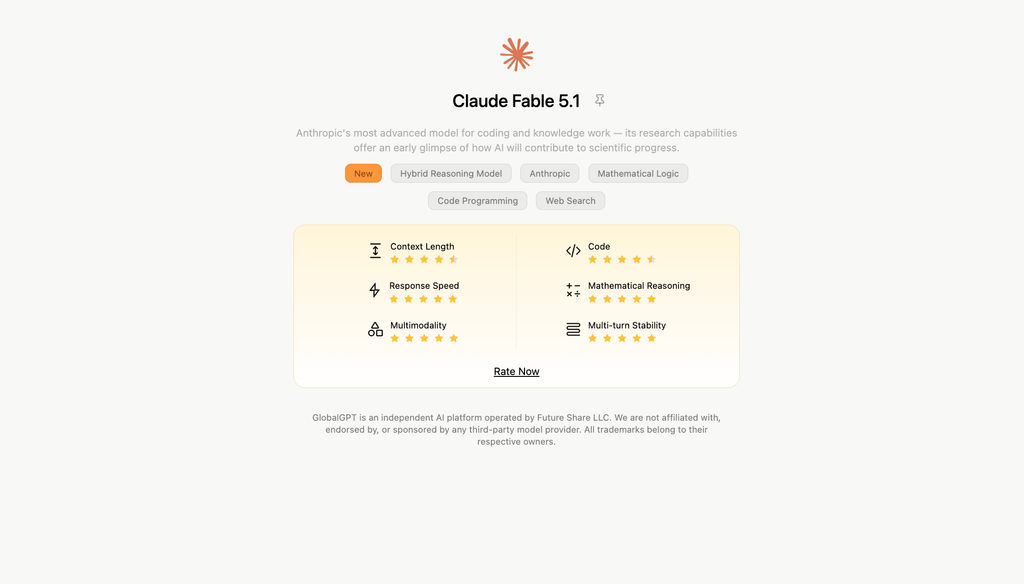
What Is Claude Fable 5?
Claude Fable 5 is Anthropic’s newest flagship AI model and one of the most powerful versions of Claude available today. It was introduced in June 2026 as the first public release of a Mythos-class model, giving developers and businesses access to a new level of reasoning, coding, research, and agent capabilities.
In simple terms, Claude Fable 5 is designed for people who need an AI model that can handle more complex tasks, think through difficult problems, and work across longer workflows than previous Claude models.

Let’s take a closer look at what makes Claude Fable 5 different and why Anthropic considers it a major step forward.
Claude Fable 5 in One Sentence
Claude Fable 5 is Anthropic’s most advanced publicly available AI model, built to deliver stronger reasoning, coding, research, and agent performance than previous Claude releases.
It is designed for demanding use cases such as software development, business analysis, long-form research, and multi-step AI workflows. According to Anthropic, Fable 5 brings many of the capabilities of its more advanced Mythos-class systems to public users while maintaining additional safety protections.
Why Anthropic calls it a “Mythos-class” model
The term “Mythos-class” refers to Anthropic’s newest generation of frontier AI models, which are designed to be more capable than previous Claude models.
They can:
- handle more complex reasoning
- perform better on difficult coding tasks
- work through longer research projects
- support advanced AI agents that need to complete multi-step workflows.
Before Fable 5, Anthropic had already developed Mythos-level systems internally, but they were not broadly available to the public because of safety concerns around certain advanced capabilities. Claude Fable 5 is the first model that allows public users to access much of that Mythos-class intelligence in a safer and more controlled way.
In other words, Anthropic sees Fable 5 as a bridge between its highly restricted research systems and the AI products that developers and businesses can use every day.
How Fable 5 Fits Into the Claude Model Family?
For a current family comparison, see what Claude Fable 5.1 is and the Claude Opus, Fable, and Sonnet comparison.
Claude Fable 5 sits at the top of Anthropic’s current public model lineup.
While smaller Claude models focus on speed, lower costs, and lightweight tasks, Fable 5 is built for users who need maximum performance. It can handle more complex reasoning, larger projects, and longer multi-step workflows than most previous Claude models.
For developers, researchers, and enterprise teams, Claude Fable 5 is now Anthropic’s primary flagship model. It represents the company’s latest progress in building AI systems that are more capable, more reliable, and better suited for real-world work.
Claude Fable 5 Release Date and Availability
Claude Fable 5 is already available, but its access rules are a little different depending on whether you use Claude as a paid subscriber, through the API, or through an enterprise cloud platform.
When Was Claude Fable 5 Released?
Claude Fable 5 was released on June 9, 2026.
Anthropic announced Claude Fable 5 together with Claude Mythos 5. Fable 5 is the public version, while Mythos 5 is only available to selected approved customers through limited access programs.

Who Can Use Claude Fable 5?
Claude Fable 5 is available to public users, developers, and businesses, but the exact access path depends on the product you use.
- For regular Claude users, Claude Fable 5 promotional access is available for a limited time to users on:
- Claude Pro
- Claude Max
- Claude Team
- Seat-based legacy Enterprise plans, where enabled by the organization
It is not available on the Free plan. It also does not apply to usage-based Enterprise plans, Claude Agent SDK credits, or API usage.
- For developers, it is available through the Claude API and supported cloud platforms.
In simple terms, Claude Fable 5 is not just an internal research model anymore. It is now available for real users, apps, and business workflows.

Is Claude Fable 5 Available in Claude Pro, Max, Team, and Enterprise?
Yes. According to Anthropic, Claude Fable 5 is included on Claude Pro, Max, Team, and seat-based Enterprise plans from launch through June 22, 2026, at no extra cost.
Starting June 23, 2026, Anthropic says Fable 5 will be removed from those plans and will require usage credits. The company also says it plans to restore Fable 5 as a standard part of subscription plans when capacity allows, but there is no fixed date yet.
So, if you are using a paid Claude subscription, Fable 5 may be available now, but its long-term access model may change.
How to Access Claude Fable 5
For readers who want to try the current route without maintaining another standalone Claude account, GlobalGPT’s Claude Fable 5.1 entry puts the current Fable route beside GPT-6 Astra, Claude Opus 5.5, and other models. The platform plan is a multi-model purchase decision, while Anthropic’s API rates remain token-based.
You can access Claude Fable 5 from several Claude products, including:
- Claude on the web
- Claude Mobile
- Claude Desktop
- Claude Cowork
- Claude Code
- Claude Design
- Claude for Microsoft 365
- Claude for Teams
- Claude in Slack
For Claude on the web, Claude Desktop, and Claude Mobile, you just need to open the model picker and select “Fable 5.”

For Claude Code, you need to use version 2.1.170 or later. For Claude Cowork, you need to be on the latest version of Claude Desktop.
If you cannot see Fable 5, check whether you are on a paid Claude plan, whether the promotional period is still active, and whether your organization has enabled access.
Is Claude Fable 5 Available Through the API?
Yes. Claude Fable 5 is generally available through the Claude API starting June 9, 2026.
Anthropic’s model documentation also says Claude Fable 5 is available through Claude Platform on AWS, Amazon Bedrock, Google Vertex AI, and Microsoft Foundry.
This means developers and enterprise teams can use Claude Fable 5 not only inside Claude chat, but also inside their own apps, tools, agents, and business systems.
Claude Fable 5 Key Features: From Chatbot to Autonomous Project Executor
For practical implementation, see the Claude API guide and Claude coding workflow guide.
Anthropic does not position Claude Fable 5 as simply a better chatbot. The launch story is about a model that can plan, execute, and self-correct across long-horizon tasks.
For that reason, the key features below are organized around the capabilities behind Anthropic’s official examples, not around generic product specs. The six most important themes are:
- long-horizon, high-autonomy agentic capability;
- software engineering and large-scale code migration;
- state-of-the-art vision and multimodal reasoning;
- knowledge work, finance, and legal reasoning;
- life sciences, genomics, and scientific discovery;
- the Fable / Mythos dual release and safeguards.
1. Long-horizon & high-autonomy agentic capability
The most important shift in Fable 5 is its ability to handle long-horizon, high-autonomy tasks. Many earlier models behaved like advanced answer engines: the user asks one step, the model answers one step. When the task gets long, they can lose the goal, forget context, or require constant human decomposition.
Fable 5 is positioned more like a working agent. Anthropic emphasizes that the longer and more complex the task, the larger Fable 5’s advantage becomes. It can stay focused across long contexts and multi-step workflows, and it can use its own notes to reflect on progress and correct mistakes.

For this feature, ordinary Q&A benchmarks are not enough. The hard part is not knowing one answer; it is executing over time. Toolathlon and AutomationBench are more useful here because they test real tool use and enterprise automation.
| Benchmark / case | Fable 5 data | Comparison / context | What it shows |
| Toolathlon | Pass@1: 61.7 | 108 real tool-use tasks; 604 tools; 32 apps | Tests tool use across office work, ecommerce, operations, data, and web research. |
| Toolathlon turn count | 19.8 avg turns | Opus 4.8: 24.5 avg turns | Fable 5 can complete tasks with fewer turns. |
| AutomationBench | 17.4% | Opus 4.8: 15.5% | Tests end-to-end enterprise automation workflows. |
| AutomationBench environment | 47 apps | CRM, Slack, Google Workspace, and more | Requires endpoint discovery, sequential API calls, and policy following. |
The signal is that Fable 5 can push multi-step work toward an outcome. It is less about one good answer and more about sustained task execution.
2. Software engineering and large-scale code migration
Software engineering is one of Fable 5’s strongest application areas. Earlier coding models could write functions or explain bugs, but they were less reliable inside a real repository. They could miss context, edit the wrong file, skip tests, or stop at advice instead of completing the change.
Fable 5 is closer to an engineering agent: it can read a codebase, locate issues, make cross-file changes, write tests, handle terminal tasks, and stay consistent across longer development workflows.
The coding benchmarks show the generational improvement. SWE-bench and Terminal-Bench are not just testing code snippets. They test real bug fixing, terminal operation, and multi-step engineering work.
| Benchmark | Fable 5 | Comparison | What it shows |
| SWE-bench Pro | 80 | Opus 4.8: 69.2; GPT-5.5: 58.6 | Real software engineering issues, not isolated code generation. |
| SWE-bench Verified | 95 | Opus 4.8: 88.6; Gemini 3.1 Pro: 80.6 | Closer to real GitHub issue repair tasks. |
| Terminal-Bench 2.1 | 84.3 | Opus 4.8: 82.7; Gemini CLI: 70.7 | Tests difficult terminal-based tasks. |
| FrontierCode Diamond subset | #1 / 29.3% | Fable 5 is listed as #1 in the system card | Measures harder coding challenges. |
But the most persuasive evidence is Stripe’s early testing example.
Stripe used Claude Fable 5 to help migrate a Ruby codebase with more than 50 million lines of code. According to Stripe, the task was completed in about one day, while a manual migration was estimated to take roughly two months.
This example matters because it shows that Fable 5 is not only good at coding benchmarks. It can work on large, messy enterprise codebases and help complete long-running engineering tasks.
3. State-of-the-art vision and multimodal reasoning
Fable 5’s vision capability deserves to be treated as its own highlight. Here, “vision” does not mean simply describing an image. It means extracting precise numbers from figures, understanding complex interfaces, turning screenshots into source code, and completing complex visual tasks with less scaffolding.
Earlier models often had two problems on vision tasks. They could describe the rough content of an image, but were less reliable at extracting exact numbers. They could recognize interface elements, but struggled to turn visual information into executable code or long-term strategy.

The official article gives several strong examples:
Watch the Claude Fable 5 vision demo on YouTube
Earlier Claude models needed extra scaffolding such as maps, navigation aids, or state tools to make progress in this kind of game. Fable 5 can do much more with a minimal vision-only harness: it reads the raw game screen, interprets the current state, chooses the next action, and keeps following a long-term strategy. This belongs in the vision section because it proves more than image recognition; it shows sustained visual feedback understanding.
| Benchmark / example | Fable 5 | Comparison / context | What it shows |
| Scientific figure extraction | Extracts precise numbers from detailed scientific figures | Earlier models more often stayed at rough description | Shows vision can support research and data analysis. |
| Screenshot-to-code | Can rebuild a web app’s source code from screenshots alone | Does not rely on the full source code as input | Shows interface understanding combined with code generation. |
| Pokémon FireRed | Beat FireRed with a minimal vision-only harness | Previous Claude models struggled even with extra helpful tools | Shows stronger visual state tracking, feedback interpretation, and long-term strategy. |
| Blueprint-Bench 2 | 38.6% | Opus 4.8: 14.5%; GPT-5.5: 36.2% | Reconstructs 2D floor plans from photos, testing spatial reasoning. |
These examples separate Fable 5 from a basic image-chat model. It does not only describe visuals; it can turn visual information into action: write code, play a game, reason spatially, and extract data from scientific figures.
4. Knowledge work, finance, and legal reasoning
Fable 5 also emphasizes advanced knowledge work, especially finance, law, chart interpretation, root-cause analysis, and complex document reasoning. Many earlier models could summarize materials, but became less stable when asked to analyze finance documents, revise contracts, or cross-check evidence across files.
The launch article and early customer feedback highlight several strong results:
| Scenario / benchmark | Fable 5 / Mythos 5 result | Comparison / context | What it shows |
| Hebbia advanced finance reasoning | Highest score | Senior-level finance reasoning | Strong across documents, charts, tables, and deep finance reasoning. |
| IMC trading evals | Nearly aced | Factual lookup, conceptual reasoning, root-cause, expected-value analysis | Shows judgment in trading and finance analysis. |
| Legal redlines | Matched or beat the current top model every time in blind lawyer review | Contract revision / redline tasks | Shows professional legal editing, not only legal text reading. |
| Real-World Finance v2 | 74% pairwise preference | Compared with Opus 4.8 | Evaluators preferred Fable/Mythos 5 on realistic finance tasks. |
| OfficeQA Pro | 57.9% | GPT-5.5: 52.6%; Opus 4.8: 48.1% | Tests retrieval and numerical reasoning in office knowledge work. |
The key point is not that Fable 5 knows finance and legal vocabulary. It can work through complex materials: read documents, interpret charts, compare clauses, find evidence, and perform numerical reasoning. That is closer to the work pattern of a senior analyst.
5. Life sciences, genomics, and scientific discovery
Life sciences is one of the strongest and most sensitive parts of the launch story. Many of these examples mainly reflect Claude Mythos 5 under trusted access, not the unrestricted public Fable 5 model. In other words, this section shows the scientific capability of the underlying Mythos-class model family.

The official article gives several striking examples:
| Scenario / case | Mythos 5 result | Comparison / context | What it shows |
| Drug design | Internal protein design experts estimated ~10x acceleration | Drug design workflow | Suggests faster experimental design cycles. |
| Protein targets | 9 of 14 targets produced strong candidates | Candidates are under further investigation | Shows practical value in protein design. |
| Molecular biology hypotheses | Scientists preferred Mythos 5 hypotheses about 80% of the time | Compared with Opus-class models | Shows stronger generation of persuasive new scientific hypotheses. |
| Genomics custom ML model | Built a model that beat a recent Science model while being 100x smaller | Given only high-level human instructions and millions of cells of data | Shows autonomous progress from data processing to model design. |
This section is useful for showing the frontier scientific potential of Fable/Mythos 5. But it should be written carefully: the life-science and genomics examples mainly reflect Mythos 5 in trusted-access settings, while Fable 5 is the public version with stronger safeguards.
6. Fable / Mythos dual release and safeguards
The relationship between Fable 5 and Mythos 5 is central to the launch. They come from the same Mythos-class model family, but they are deployed for different levels of access and risk.
Fable 5 is the public and API-facing version. It is meant for general high-value work, but it includes extra safeguards. Mythos 5 is for higher-trust settings, mainly vetted partners in safety, defense, and scientific research.
| Mechanism / risk area | Fable 5 behavior | User impact |
| Harmful bio/chem | Uses additional classifiers and ASL-3-related protections | High-risk requests may be blocked. |
| Harmful cyber | Adds protections around cyber-offensive capabilities | Some cyber requests may be refused or fall back. |
| Autonomous / agentic risk | Detects high-risk autonomous behavior | Long agentic workflows may face extra limits. |
| Frontier AI R&D | Adds restrictions around competitive AI acceleration risks | AI R&D-related requests may trigger special handling. |
| Claude apps | May switch to a fallback model | Users may see a message that the model has been switched and should try again. |
| Messages API | Blocked by default; server-side fallback is optional | Product teams should log actual returned model metadata. |
This makes the release unusual. Anthropic is not simply opening the strongest model without constraints. It is separating capability access: Fable 5 brings strong capabilities to the public market, while more sensitive capabilities are handled through Mythos 5 and trusted access.
Integrated performance snapshot
If the reader only looks at one summary, the pattern is clear: long-horizon autonomy, coding, vision, knowledge work, life sciences, and safeguards are the main story. This is less a single benchmark win and more a broader shift from “chat model” to “complex project executor.”
One-sentence summary
| Capability area | Representative benchmark / case | Data | Comparison |
| Software engineering | SWE-bench Pro | 80 | Opus 4.8: 69.2 |
| Software engineering | Stripe Ruby migration | 50M+ lines; about one day | Manual estimate: roughly two months |
| Vision tasks | Pokémon FireRed | Beat with a minimal vision-only harness | Previous Claude models struggled even with extra tools |
| Vision-to-code | Screenshot-to-code | Rebuilds web app source code from screenshots alone | Combines interface understanding and code generation |
| Document understanding | GDP.pdf | 29.8% | Opus 4.8: 22.5% |
| Finance tasks | Real-World Finance v2 | 74% preference | Compared with Opus 4.8 |
| Tool use | Toolathlon Pass@1 | 61.7 | Opus 4.8: 59.9 |
| Enterprise automation | AutomationBench | 17.4% | Opus 4.8: 15.5% |
| Life sciences | Protein targets | 9 / 14 strong candidates | Mythos 5 trusted-access setting |
Claude Fable 5 / Mythos 5 is not mainly about giving better answers. Its core story is long-horizon, high-autonomy execution: it can migrate large codebases, solve complex visual tasks, handle finance and legal knowledge work, and, in Mythos 5 trusted-access settings, help push frontier scientific research.
Claude Fable 5 vs Claude Mythos 5
One of the most confusing things about Anthropic’s latest release is that it launched two closely related models at the same time: Claude Fable 5 and Claude Mythos 5.
At first glance, the two models sound almost identical. Both belong to Anthropic’s new Mythos generation, and both are described as more capable than previous Claude models.

So why can anyone use Claude Fable 5, while Claude Mythos 5 remains restricted?
The answer comes down to deployment and safety. Claude Mythos 5 represents Anthropic’s most capable restricted-access version of this model family, while Claude Fable 5 is the public-facing version designed to preserve as much of that intelligence as possible with additional safeguards around a small number of sensitive capabilities.
The Difference Between Claude Fable 5 and Claude Mythos 5
At a high level, Claude Fable 5 and Claude Mythos 5 are built on the same generation of Anthropic’s AI technology, but they are designed for different deployment environments.
| Model | Who can use it? | Main idea | Safety approach |
| Claude Mythos 5 | Restricted access, selected partners | Anthropic’s most capable Mythos-class model | More powerful capabilities are kept behind tighter access controls |
| Claude Fable 5 | Public-facing model for general users, developers, and enterprise customers | Most Mythos-level intelligence made broadly available | Extra safeguards limit or reroute a small set of high-risk requests |
Claude Mythos 5 is the more restricted version. Anthropic has positioned it for trusted partners and higher-risk use cases, including work connected to Project Glasswing. Because Mythos-level capability can be useful in areas such as vulnerability discovery, attack-path analysis, and other sensitive domains, Anthropic has chosen not to make Mythos 5 broadly available to the public.
Claude Fable 5, by contrast, is the generally available model for developers, enterprise customers, and ordinary Claude users. It is meant to bring most Mythos-level reasoning, coding, long-context analysis, research ability, and agentic task performance into a public product, while adding extra controls around requests that could create real-world harm.
A useful way to think about the relationship is:
- Mythos 5 = Anthropic’s most capable restricted-access model
- Fable 5 = The public version of that capability with additional safety guardrails
In other words, Fable 5 is not simply a weaker model. Most of the intelligence remains available. What differs is how the system handles a small set of high-risk requests that Anthropic believes require tighter controls.
Why Fable 5 Has Extra Safety Guardrails
This raises the next obvious question:
If Fable 5 keeps most of the intelligence of the Mythos generation, why does it need extra guardrails at all?
The short answer is that Fable 5 is unusually capable for a model that is broadly available. Anthropic says it performs strongly but the same strengths can become risky when a request moves into areas where detailed reasoning could enable real-world harm.
For example:
- A model that can reason through complex codebases may also be more useful for advanced cyber operations.
- A model that can understand scientific workflows may also be more useful for dangerous biological or chemical misuse.
- A model that can plan long-horizon tasks may also be more capable when asked to automate harmful activity.
That is the basic tradeoff behind Fable 5. Anthropic is trying to make a Mythos-class model available to general users, while limiting a small set of capabilities that it believes should not be exposed without tighter controls.
For most users, this should not change the day-to-day experience. If you use Claude for coding, writing, research, document analysis, business planning, studying, or productivity work, Fable 5 should usually behave like the powerful model Anthropic advertised.
The safeguards mainly become visible when a request approaches a restricted area.
What Capabilities Are Restricted in Fable 5?
This raises an obvious question:
If Fable 5 is based on Mythos-level technology, what exactly was removed?
Anthropic has not published a complete public list of every restriction. However, the company has confirmed that Fable 5 includes extra safety classifiers and safeguards that can block, refuse, or reroute requests in specific high-risk categories. It means Fable 5 may avoid or reroute requests when the system classifies them as too close to operational harm.
These restrictions mainly focus on areas such as:
– Advanced cybersecurity operations
– Biological research that could be misused
– Chemistry-related tasks with potential safety concerns
– Autonomous or agentic behavior that could cause high-impact harm
– Frontier AI development or competitive acceleration concerns
- For cybersecurity, the key distinction is intent and operational risk. Defensive security work, vulnerability research, detection, and authorized testing may still be legitimate. But requests that resemble credential theft, malware development, unauthorized intrusion, stealthy exploitation, or large-scale cyberattack planning can trigger safeguards.
- For biology and chemistry, the concern is that a highly capable model could help users move from general knowledge into actionable misuse. That includes requests that could enable dangerous biological work, harmful lab procedures, toxic chemical misuse, or troubleshooting steps that make dangerous activity easier to carry out.

However, many users say that Fable is too sensitive about safety. It blocks people from asking about many different topics.
What Happens If You Reach a Restricted Area?
One question many users have is:
If Claude Fable 5 has restrictions, what happens when I ask something that falls into a restricted category?
The answer depends on where you are using Claude. Anthropic does not always simply end the conversation. In some cases, Fable 5 may refuse the request. In other cases, Claude may automatically switch to another model so the user can continue working.
| Where you use Fable 5 | What may happen | What to do next |
| Claude apps | Claude may automatically rerun the blocked Fable 5 request on Claude Opus 4.8 in the same conversation. | After that switch, the model picker may stay on Opus for the rest of the conversation. Users can switch back to Fable 5 manually, but if the original risky request is still present, the same safeguard may trigger again. Anthropic’s support guidance suggests editing the message before retrying. |
| Claude Messages API | A refused request may return a normal API response with stop_reason:"refusal" rather than a transport error. | Developers who want automatic retry can configure a fallback model, such as claude-opus-4-8, so refused requests are resent to another Claude model. |
| API with fallback configured | Developers can set a fallback model, such as `claude-opus-4-8`, so refused requests are resent to another Claude model. |
This also matters for people testing or benchmarking Fable 5. If a request is routed to Opus 4.8, the user may think they are evaluating Fable 5 when the answer actually came from another model. For serious testing, it is worth checking the model label or response metadata rather than assuming every answer came from Fable 5.
For everyday users, the practical takeaway is simple:
- Fable 5 should handle normal coding, writing, research, analysis, and productivity tasks without issue.
- If your request touches cyber, biology, chemistry, frontier AI development, or autonomous high-impact actions, Fable 5 may answer with safer boundaries.
- In some cases, the request may be refused.
- In Claude apps, Claude may switch to Opus 4.8 so the conversation can continue under a different safeguard profile.
Claude Fable5 Pricing and Plan Access
For the subscription side of the decision, compare the Claude Fable 5 pricing guide with the broader Claude plans and API pricing guide.
Claude Fable 5 pricing has two layers: API-based token pricing for developers, and subscription-based access for Claude.ai users. On the API side, Fable 5 is priced as a premium model for long-running agents and complex work: $10 per million input tokens and $50 per million output tokens. Prompt caching changes the cost profile: cache writes are listed at $12.50 per million tokens, while cache reads are much cheaper at $0.25 per million tokens. This means Fable 5 can be expensive for long outputs, but repeated large-context workflows can become more efficient when prompt caching is used well.

For Claude.ai users, Claude Fable 5 pricing is less about visible token rates and more about plan access, usage limits, and credits. Claude’s current consumer and team pricing is roughly structured as follows:
- Free: $0, but promotional Fable 5 access is not included.
- Pro: $17/month when billed annually, or $20/month billed monthly.
- Max: starts at $100/month, with 5x or 20x more usage than Pro.
- Team Standard: $20/seat/month annually, or $25 monthly.
- Team Premium: $100/seat/month annually, or $125 monthly.
- Enterprise: listed as seat price plus usage at API rates; Anthropic shows $20/seat with usage cost scaling by model and task.
In June 2026, Anthropic offered a temporary Claude Fable 5 promotional access period. The promotion runs from June 9, 2026 through June 22, 2026 at 11:59:59 PM PT. During that period, Fable 5 is included at no extra charge for eligible paid plans, but it still draws from the plan’s existing usage limits and at a higher rate than other models. The promotion applies to Pro, Max, Team, and seat-based legacy Enterprise plans, where enabled by the organization.
Several important exclusions matter for readers comparing Claude Fable 5 pricing across plans:
- The promotion does not apply to the Free plan.
- It does not apply to usage-based Enterprise plans.
- It does not cover Claude Agent SDK credits.
- It does not cover API usage, which is billed separately at standard API rates.
- Some Team or Enterprise users may not see Fable 5 if their organization has not enabled it.
- Claude Code users need version 2.1.170 or later to access Fable 5.
After June 22, 2026, Fable 5 is no longer included in normal plan usage limits. Users who want to continue using it beyond included limits need usage credits, which switch usage to pay-as-you-go pricing at standard API rates. This is why Claude Fable 5 pricing should not be read as a simple subscription perk: for heavy users, the real cost may come from usage credits, long context, output-heavy tasks, model switching, and whether Fable 5 is being used through Claude.ai or the API.
Should You Use Claude Fable 5?
If you are choosing a lower-cost workflow, compare Claude alternatives and the GPT-6 Astra vs Claude Fable 5.1 comparison.
Claude Fable 5 is worth using when model quality matters more than raw speed or cost. Anthropic positions it as its most capable widely released model, especially for demanding reasoning, long-horizon agentic work, coding, knowledge work, and complex visual tasks. It also supports a 1M-token context window and up to 128k output tokens, which makes it a better fit for large codebases, long documents, multi-step research, and enterprise workflows than everyday chat or simple content generation.
That said, Fable 5 is not the default best choice for every workload. Anthropic’s own model-selection guidance says teams should balance capability, speed, cost, and effort settings, then test with their own prompts and data before upgrading. In practice, Fable 5 should be treated as the “use when needed” model, not the cheapest always-on option.
| Need | Best starting point | Why |
| Maximum reasoning quality | Claude Fable 5 | Best fit for the hardest reasoning, coding, agentic, and long-context tasks |
| Lower cost with strong performance | Claude Sonnet 4.6 or Claude Opus 4.8 | Better balance when Fable-level capability is not required |
| Fast, high-volume tasks | Claude Haiku 4.5 | More economical for straightforward classification, extraction, routing, and simple generation |
| Production migration from Opus 4.8 | Test Fable 5 on a benchmark set first | Migration is mostly drop-in, but pricing, always-on adaptive thinking, and refusal/fallback behavior can change results |
| Sensitive data or strict ZDR requirement | Avoid Fable 5 for now | Anthropic says Fable 5 requires 30-day retention and is not available under zero data retention |
Use Claude Fable 5 if you need maximum Claude intelligence
Use Claude Fable 5 when the task is expensive to get wrong. The strongest use cases are not short prompts like “write a paragraph” or “summarize this email,” but work where the model has to maintain context, plan, verify, and make judgment calls over many steps.
Good fits include:
- Large software engineering tasks: codebase navigation, refactoring, debugging, architecture review, test generation, and agentic coding.
- Long-context research: comparing many documents, extracting evidence, producing cited analysis, or working across very large files.
- Complex business analysis: financial reasoning, legal-style document review, enterprise knowledge work, and multi-source synthesis.
- Visual and spatial reasoning: interpreting screenshots, diagrams, product flows, or visual QA tasks.
- Autonomous or semi-autonomous workflows: tasks where the model uses tools, keeps state, and works over a longer horizon.
Community discussion around Fable 5 is also leaning in this direction: many users are treating it less as a casual chat upgrade and more as infrastructure for long-running Claude Code or agentic work. That is a useful framing. If your task is small, you may not feel enough difference to justify the cost. If your task is large, messy, and multi-step, Fable 5 is where the upgrade is most likely to show.
Use a lighter Claude model if you need lower cost or speed
A lighter model is usually the better first choice when your task is simple, latency-sensitive, or high-volume. Anthropic’s guidance explicitly recommends starting with a fast, cost-effective model for many applications, testing the use case, and upgrading only when there is a clear capability gap.
Use a lighter Claude model when:
- You are building prototypes and want fast iteration.
- You need real-time or near-real-time responses.
- You process a large number of similar requests.
- The task is mostly extraction, classification, rewriting, routing, or summarization.
- You can tolerate occasional lower-quality answers or use Fable only as an escalation model.
- Your API bill matters more than marginal reasoning gains.
For teams already using Claude Opus 4.8, upgrading to Fable 5 is mostly a model-name change at the API level, but it is not “free” operationally. Fable 5 costs $10 per million input tokens and $50 per million output tokens, double Opus 4.8’s $5/$25 pricing in Anthropic’s migration guide. It also has always-on adaptive thinking, so teams should re-baseline latency, output length, refusal handling, and total cost on their own workloads before switching broadly.
Best-fit users: developers, analysts, researchers, and enterprises
Claude Fable 5 is best for users who can turn higher intelligence into real productivity gains.
Best-fit users include:
- Developers who use Claude for multi-file coding, debugging, refactoring, code review, migration work, and long-running Claude Code sessions.
- Data analysts and financial analysts who need careful reasoning across tables, documents, assumptions, and edge cases.
- Researchers who work with long papers, technical reports, experimental notes, or large evidence sets.
- Product and operations teams handling complex workflows where the model must synthesize context rather than just generate text.
- Enterprises that need frontier-level model quality for internal tools, knowledge work, support automation, compliance review, and agentic workflows.
Fable 5 is a weaker fit for:
- Casual users who mainly want everyday chat.
- Teams with strict zero-data-retention requirements.
- Workloads where speed and cost matter more than deep reasoning.
- Sensitive cyber, bio, chemistry, or model-distillation-adjacent workflows where safety classifiers may trigger refusals or fallback behavior.
Bottom line: use Claude Fable 5 when the task is important enough that better reasoning changes the outcome. Use Sonnet, Haiku, or Opus when you need a cheaper, faster, or more predictable production model. Anthropic’s own upgrade advice is the right rule of thumb: build a small benchmark from your real prompts, compare quality, edge-case handling, latency, and cost, then upgrade only where Fable 5 clearly pays for itself.
FAQ About Claude Fable 5
What is the current Claude Fable model?
As of September 25, 2026, Anthropic’s current model overview lists Claude Fable 5.1. The June 2026 Fable 5 launch remains useful historical context, but current model selection and API pricing should use the 5.1 entry.
What is Claude Fable 5.1 API pricing?
Anthropic’s current pricing page lists $10 per million input tokens and $50 per million output tokens. Prompt caching is listed at $12.50 per million for 5-minute writes, $20 for 1-hour writes, and $0.25 for cache hits and refreshes.
Can I try Claude Fable 5.1 through GlobalGPT?
Yes. GlobalGPT provides a separate Claude Fable 5.1 route for readers who want to compare Claude with GPT-6 Astra and other models in one workspace. The Fable 5.1 entry is the current route.
What Is Project Glasswing?
Project Glasswing is Anthropic’s cybersecurity initiative that gives a limited group of trusted organizations access to Claude Mythos Preview, an advanced AI model designed to discover software vulnerabilities, analyze attack paths, and help generate security fixes. Unlike Claude models built primarily for writing, coding, or research, Mythos is focused on cybersecurity and vulnerability detection. Anthropic says the model is powerful enough that it is not being released to the general public, and is instead being tested with governments, infrastructure operators, technology companies, and security researchers. The goal of Project Glasswing is to strengthen global cyber defenses by helping organizations find and fix critical security flaws before attackers can exploit them.
Should I use Claude Fable 5?
Use Claude Fable 5 if you need Anthropic’s strongest generally available model for complex, high-value work. It is best suited for tasks where better reasoning, long context, and stronger judgment can meaningfully improve the result.
You probably do not need Fable 5 for simple summaries, short rewrites, basic chatbot replies, or high-volume low-cost automation.
How much does Claude Fable 5 cost?
As of September 25, 2026, Claude Fable 5.1 API pricing is:
| Token type | Price |
|---|---|
| Input tokens | $10 per million tokens |
| Output tokens | $50 per million tokens |
| 5-minute cache write | $12.50 per million tokens |
| 1-hour cache write | $20 per million tokens |
| Cache hits / refreshes | $0.25 per million tokens |
Source: Anthropic’s official Claude pricing page.