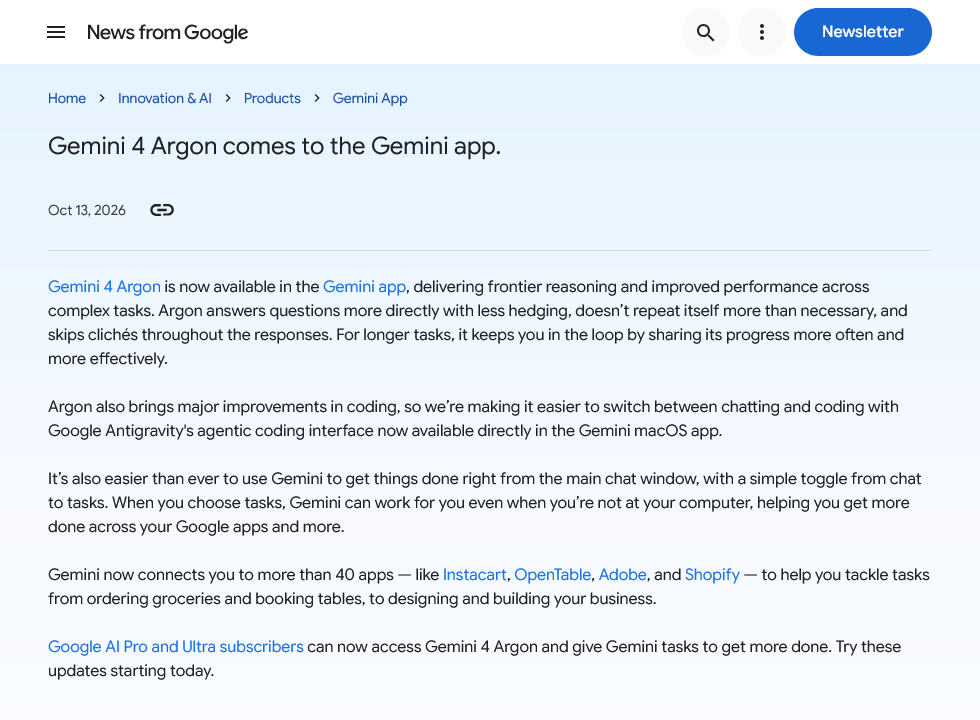
Gemini 4 Argon is available in the Gemini app for Google AI Pro and Ultra subscribers, and through the paid Gemini Developer API. The cheapest verified subscription route for app access is Google AI Pro at $19.99 USD per month on the Google One page checked October 14, 2026. Standard API pricing is $2 per million input tokens and $10 per million output tokens through November 30, 2026, rising to $4 and $20 on December 1.
The catch is the route. A Pro subscription can unlock Argon in the Gemini app without unlocking Argon in AI Studio or your API project. Google’s Gemini app announcement confirms Pro and Ultra app access; its developer documentation describes a separate paid-access requirement.
Choose your access route first.
Pro: $19.99 USD/month on the checked Google One page.
Standard: $2 input / $10 output per million tokens through November 30, 2026.
1,048,576 tokens for input, thinking, and output.
Checked October 14, 2026. API output pricing includes thinking; local subscription checkout can differ.
This guide shows how to use Gemini 4 Argon, which access route to choose, what each route costs, and what to check when the model is missing. We also ran three small tasks through an OpenAI-compatible test API, including a price calculator whose generated Python code passed 20 behavioral checks. These are practical observations, rather than a ranking of Argon against other models.
What is Gemini 4 Argon?
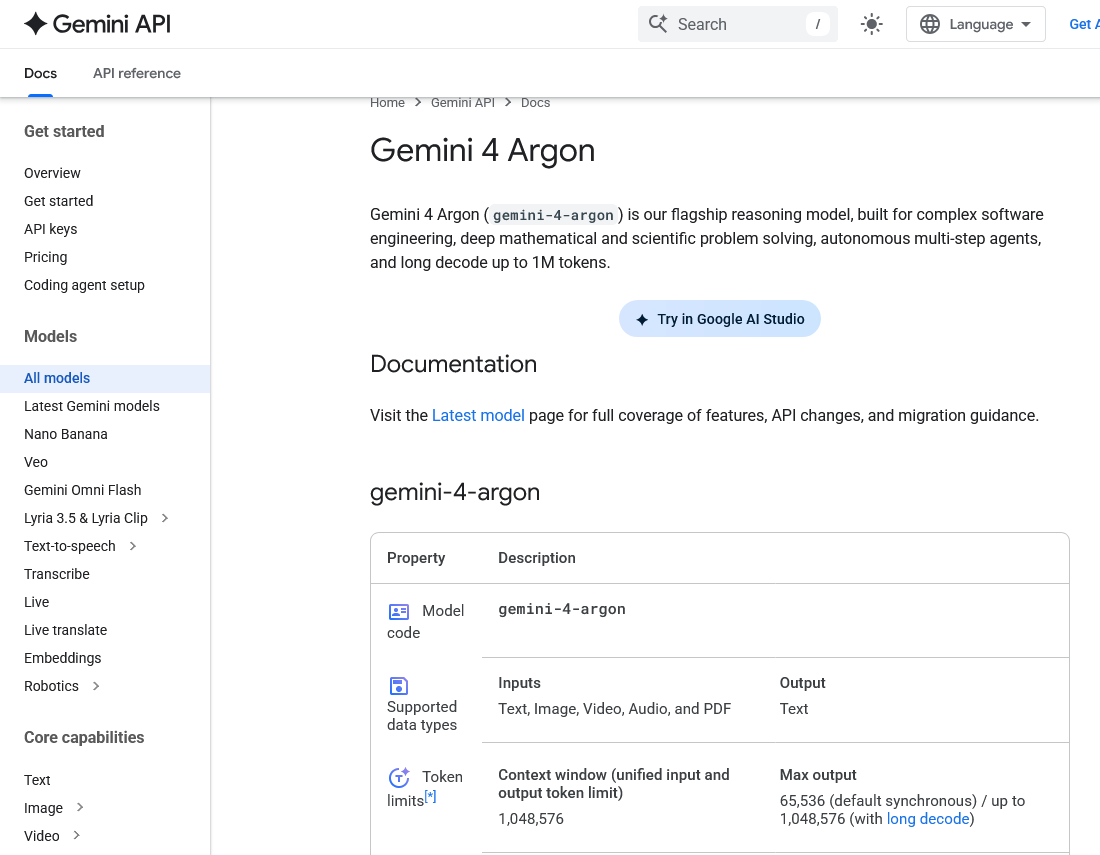
Gemini 4 Argon is Google’s flagship reasoning model for demanding software engineering, mathematical and scientific work, and complex knowledge tasks. Its exact API model ID is gemini-4-argon. . official model reference lists it as a stable model, with an October 2026 update.
Its most useful distinction is a unified context budget. Input, thinking, and output share 1 048 576 токенов. Default synchronous output stops at 65 536 токенов; longer generation needs the appropriate long-decode workflow. A large input window does not give you a separate million-token output allowance.
gemini-4-argonArgon accepts text, images, video, audio, and PDF inputs, and produces text. It supports tools such as function calling, code execution, file search, search grounding, and structured outputs. Audio generation, image generation, and the Live API are not supported by this model endpoint. A Gemini app feature that creates media can use another model behind the scenes.
For a cheaper model to evaluate alongside Argon, our Gemini 3.8 Краткий обзор covers another current Google model with its own prices and test findings. Choosing Argon should come from a task that benefits from deeper reasoning, rather than the newest model name alone.
Where can you access Gemini 4 Argon?
Choose the product around the work you want to finish. The Gemini app suits conversations and document analysis. AI Studio suits prompt development and API experimentation. The Gemini Developer API suits software that calls the model. Google Antigravity provides an agentic development environment.
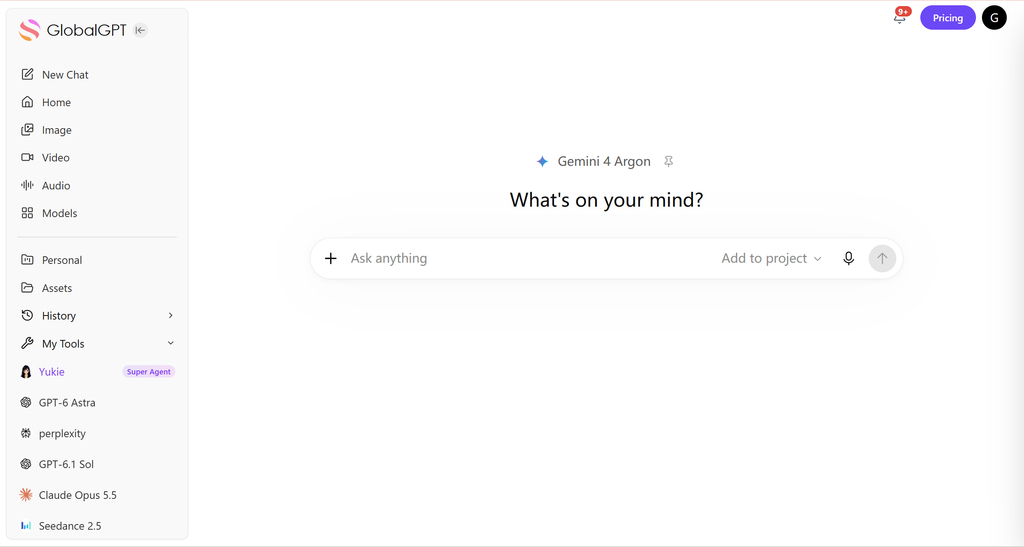
Use the dedicated Gemini 4 Argon chat page in your GlobalGPT account.
Eligible Pro and Ultra subscriptions include Argon app access.
Use an eligible paid API project or the documented Ultra route.
Fund a paid project; personal Pro does not unlock Argon for your API key.
The launch announcement identifies an Ultra subscriber route.
How to use Gemini 4 Argon on GlobalGPT
Откройте GlobalGPT Gemini 4 Argon page, sign in to your GlobalGPT account, and select Gemini 4 Argon for your conversation. Start with a concrete task and the relevant source material; the document-analysis prompt below works as a useful template.
GlobalGPT brings Argon and other AI tools into one account. This is a platform chat route with its own account and billing, separate from your Google AI subscription or a Gemini API project. The Google prices below describe Google’s services.
Google's developer launch announcement says developers can build using the paid Gemini API tier in AI Studio and Android Studio, and that Google AI Ultra subscribers can try Argon in AI Studio and Antigravity. It does not make a personal Pro subscription an entitlement for every developer route.
This distinction matters before you upgrade. Paying for a chat subscription and funding an API project solve different problems. Our Сравнение версий Google AI Plus и Pro explains the broader plan differences; use the fresh Argon-specific facts here when deciding whether either plan covers this model.
How to use Gemini 4 Argon in the Gemini app
Open the Gemini app with the Google account that holds your eligible Pro or Ultra subscription. Look for Gemini 4 Argon among the available model choices. Confirm the selected model before starting your task, especially if the app offers several reasoning or speed options. Google’s October 13 announcement establishes the subscription entitlement; your account’s visible controls establish what has reached you.
Give Argon a concrete job, attach the relevant material, and define a useful output. “Analyze this PDF” leaves it to guess what matters. A better request names the decision, asks for evidence locations, and tells the model how to handle missing information.
Read the attached proposal and write a decision memo for our operations lead.
Use these headings: Recommendation, Evidence, Costs, Open Questions, Next Step.
Cite the page or section for each factual claim.
Keep confirmed facts separate from estimates and assumptions.
If the document does not state a price, deadline, or owner, mark it unknown.
Limit the memo to 600 words.
Review the citations against the source document before acting on the memo. The most useful answer gives you a decision and a way to verify it. Fluency alone does not establish that a figure, contract term, or recommendation is correct.
If your goal is a chart or interactive explanation, our Gemini app interactive visualizations guide covers that product workflow. Keep the app interface and its additional tools separate from what the Argon API endpoint returns.
How to use Gemini 4 Argon in AI Studio and the API
For prompt experimentation, Google’s documented Argon AI Studio link opens the model-specific entry. Check that the selected project has eligible access. If Argon is marked paid, a personal Pro subscription does not remove the developer access requirement.
For an application, create or select a Gemini API project, obtain its API key, and set up the paid tier when required. Google’s billing guide describes linking a billing account and the current prepay setup, including a $5 minimum or local-currency equivalent where prepay applies. A credit balance is an API funding mechanism, rather than a monthly Gemini app subscription.
Google recommends the Interactions API in its current Argon quickstart and migration guide. After installing the current google-genai package and setting GEMINI_API_KEY in your environment, a short request looks like this. The example adapts Google’s documented quickstart; our hands-on tests used a separate compatible API.
from google import genai

client = genai.Client()
interaction = client.interactions.create(
    model="gemini-4-argon",
    input="Explain the main risks in migrating a payment service, in five bullets.",
)
print(interaction.output_text)Start with one representative request. Inspect the output, status, and usage before processing a whole dataset. Use low, medium, or high thinking based on the task; Google’s default is medium. Its migration guide says температура, top_p, и top_k are ignored for Argon, so copying old sampling settings does not give you a reliable control over this model.
If you are migrating a previous Gemini integration, review explicit caching calls and output caps as well as the model string. Argon supports implicit caching, with cache hits discounted according to the price table, but does not support explicit cached_content objects. Our older Руководство по ценам на API Gemini 3.1 Pro is useful background for an existing integration; its model-specific rates and limits should not be carried over to Argon.
How to generate more than 65,536 tokens
On the Interactions API, long decode needs background execution and a max_output_tokens value above 65,536. The remaining unified context budget still applies. Google’s long-decode guide explains how the service generates continuation hops and how to join their text outputs.
For example, 980,000 input tokens leave at most 68,576 tokens for thinking and output within the 1,048,576-token window. Asking for 100,000 output tokens exceeds the combined budget, even if you enable long decode.
Long decode also changes how you should read spending. Each continuation hop sends earlier material back as input, with repeated input receiving the documented implicit-cache discount. The sum of billable input across hops is not the size of your final context. Monitor the interaction’s actual usage totals rather than pricing a very long task from the original prompt alone.
Gemini 4 Argon pricing: subscriptions and API rates
There are two different bills to consider: a subscription for Google’s consumer products and token usage for your developer project. The following USD subscription prices were rendered on the Google One plans page on October 14, 2026. Local currency, eligibility, and checkout offers can differ.
Lowest verified subscription price for Argon in the Gemini app.
Higher usage tier; includes Argon app access.
Higher usage tier; includes Argon app access.
Rendered USD monthly prices checked October 14, 2026. These subscriptions and developer token bills are separate.
Google AI Plus was listed at $4.99 USD per month, but the verified plan page identifies Pro and Ultra as the Argon app-access plans. Ultra’s higher usage allowances may matter for frequent heavy work; choose them for an observed usage need rather than assuming every request requires the highest tier.
API introductory pricing through November 30, 2026
Google's Gemini Developer API price table publishes separate Standard, Batch, Flex, and Priority rates. Every figure below is USD per one million tokens. Output prices include thinking tokens. The December column is the published price change, not another first-month offer.
Output includes thinking tokens. No Free API tier for Argon. Caching and grounding are priced separately.
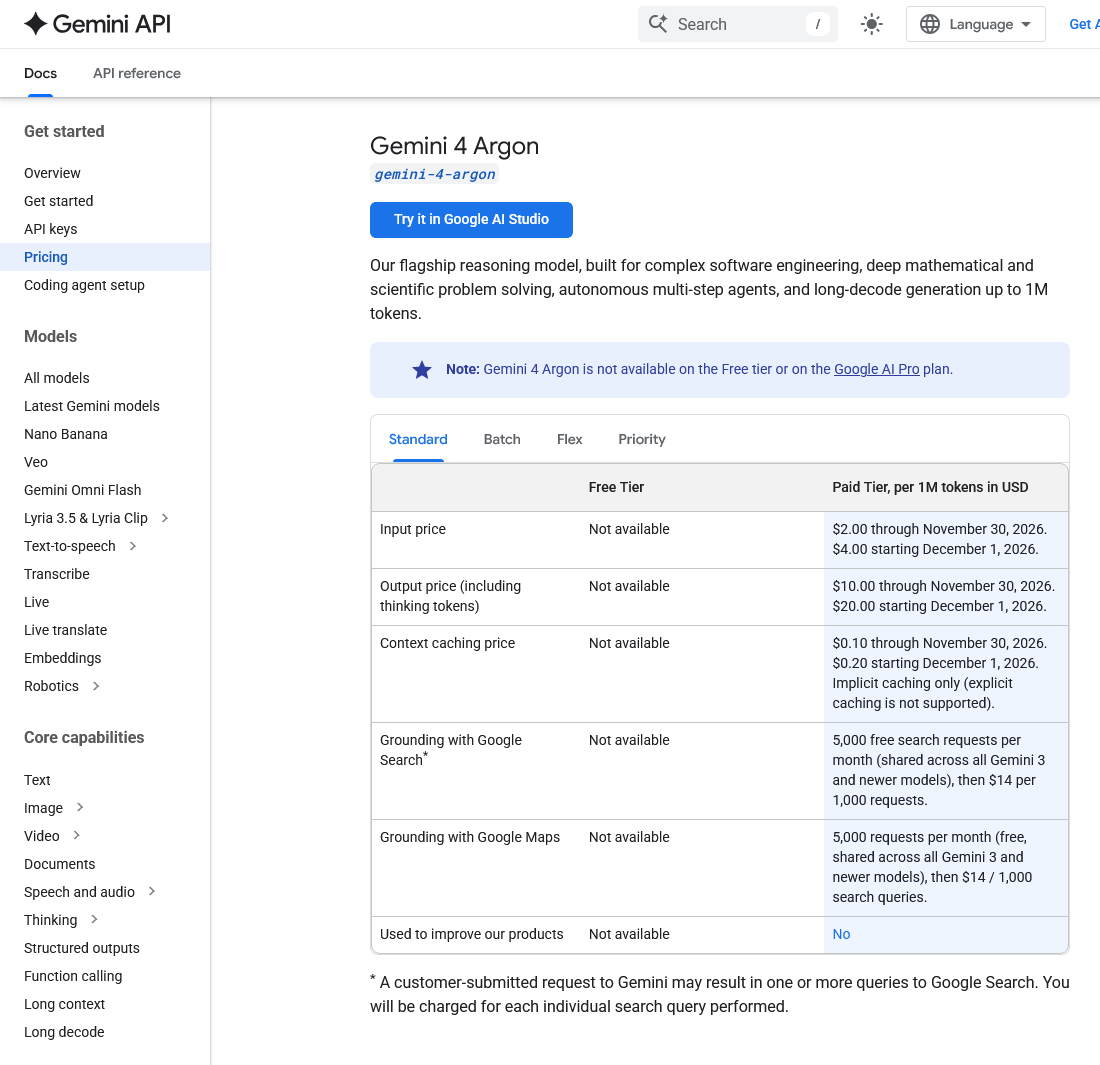
Implicit cached input is $0.10 per million tokens for Standard through November 30, then $0.20 from December 1. Batch and Flex cached input is $0.05, then $0.10; Priority is $0.18, then $0.36. Explicit cache creation is unsupported, so do not add a cache-storage workflow borrowed from an older model.
The Standard and Priority tables also list Search and Maps grounding charges separately: a shared allowance of 5,000 requests per month across Gemini 3 and newer models, followed by $14 per 1,000 requests or queries as specified by the relevant row. One model request can cause multiple Search queries. Token rates alone do not cover every tool-enabled task.
What does a real request cost?
Для 25,000 uncached input tokens and 4,000 billable output tokens, Standard’s introductory estimate is (25,000 ÷ 1,000,000 × $2) + (4,000 ÷ 1,000,000 × $10) = $0.09. The output count must already include billed thinking tokens. At the December rates, the same quantities cost $0.18.
25,000 uncached input + 4,000 billable output tokens
Token-rate estimates. Output already includes thinking. Excludes grounding, tax, and other charges.
Batch’s corresponding token estimate is $0.045 during the introductory period and $0.09 afterward. One hundred identical jobs would be $4.50 or $9.00 on Batch, compared with $9.00 or $18.00 on Standard. These are rate-based estimates excluding grounding, other charges, taxes, and any different usage produced by the model.
A workflow that sends routine extraction to a cheaper model and escalates the difficult cases can reduce spending more effectively than putting every job on a flagship by default. Our руководство по мультимодельному рабочему процессу explains that routing approach without making an Argon access promise for another platform.
Availability, limits, and missing-model problems
Argon has an official stable model ID and live access documentation, but availability still depends on the product, region, account, and billing state. Google’s AI Studio and API regions page lists supported territories and states an 18+ requirement for that developer service. Do not assume the Gemini app and AI Studio use identical eligibility rules.
If the model is visible but a request fails, record the error and check the correct project’s billing and credit state. If the answer ends early, inspect the output limit and terminal status before concluding that Argon cannot finish the task. A small output cap can be consumed by thinking; a higher cap also increases the spending ceiling.
Older rate-limit advice may refer to another model or another billing setup. Our Руководство по ограничениям Gemini 3.1 Pro provides background on quota terminology, while the current Argon project and official documentation should determine the limits you use today.
Early access feedback: useful, but account-specific
In the October 13 Reddit thread started by u/Radiant_Tradition647, one commenter, u/PhraseMargin, reported getting Argon on Pro while the original post questioned why access was missing. That is evidence of those users’ experiences, rather than a universal rollout schedule or a measured daily quota.
In a separate October 13 discussion started by u/swiftidnc739, users debated the difference between app access and the paid developer or Antigravity routes. Google’s current product documentation is the stronger source for entitlement. A model appearing in a picker, a user’s subscription, and a successful request are three different things to verify.
Our Gemini 4 Argon tests: costs, evidence, and code
We tested the model ID gemini-4-argon through an OpenAI-compatible test API on October 14, 2026. Each successful response returned that model string. We supplied fixed facts and explicit acceptance criteria, retained the raw outputs, and checked the relevant calculations and code. These small tasks do not test the full million-token window, native app tools, long decode, official rate limits, or Google’s billing.
The first two submissions failed during TLS transport and returned no model output. Each completed on one retry, with the successful raw responses and retry records retained. The coding task completed on its first submission. Gateway round-trip times include network and service overhead, so they are not reported here as model inference speed.
Наш сайт AI model testing methodology explains the difference between a useful task observation and a broad quality claim. This article’s venue is the compatible test API identified above.
One successful run per task through the compatible test API. First two tasks needed a retry after a TLS transport failure. No comparative ranking or audited billing result.
Test 1: a Pro subscriber choosing an API budget
We supplied the app-access statement, developer-access statement, and dated token prices. The user already held Pro, needed occasional app document analysis, and had 100 backend jobs of 25,000 input and 4,000 billable output tokens. The response separated app and API access and got all five requested cost figures right.
Verified-source excerpts supplied for this task (checked 2026-10-14):
1. Google Gemini app announcement, 2026-10-13: Google AI Pro and Ultra subscribers can access Gemini 4 Argon in the Gemini app.
2. Developer announcement, 2026-10-13: Build with the paid tier of the Gemini API in Google AI Studio and Android Studio. Google AI Ultra subscribers can try Argon in AI Studio and Google Antigravity.
3. Gemini Developer API pricing: Argon is not available on the Free API tier or through Google AI Pro for that developer route. Standard rates per 1M tokens are input $2 and output $10 through 2026-11-30, then input $4 and output $20 from 2026-12-01. Output rates include thinking tokens. Batch and Flex rates per 1M are input $1/output $5 through 2026-11-30, then input $2/output $10 from 2026-12-01. Priority is $3.60/$18, then $7.20/$36. Search/Maps charges and tax are separate. Implicit cache is supported; explicit cache is not.
4. Argon model reference: unified input-plus-output context limit 1,048,576 tokens; default synchronous max output 65,536; long decode can reach 1,048,576 subject to the same unified context budget. Inputs text, image, video, audio, PDF; output text. No image generation, audio generation or Live API.
5. These excerpts do not state Google AI Pro/Ultra subscription prices, exact daily Argon message quotas, or availability in every country. They do not establish a third-party platform's Argon access.

User situation: I already pay for Google AI Pro. I need occasional document analysis in a chat app, plus a separate backend job processing exactly 25,000 uncached input tokens and 4,000 billable output tokens per request. The 4,000 output count already includes thinking. I expect 100 such jobs per month and can tolerate asynchronous delivery.
Return JSON only, with keys app_route, developer_route, standard_per_job_october_usd, standard_per_job_december_usd, standard_100_jobs_october_usd, batch_per_job_october_usd, batch_per_job_december_usd, recommended_backend_tier, subscription_price_known, caveats.
Calculate from these excerpts only. Explain the Google AI Pro distinction without treating the app announcement and developer pricing as the same route. Do not invent a subscription price, country list, free Argon tier, or third-party access. Use numeric values for the cost fields. Keep the complete answer under 700 words.
Complete original output; scroll to read all lines or use Copy.
The response grouped Batch and Flex in its recommendation. For a workload explicitly designed around asynchronous submission, Batch is the straightforward choice; Flex is a separate consumption option. The model’s recommendation is not a substitute for checking that option’s operational requirements. It also used the phrase “trial access” for Ultra, whereas Google’s announcement says subscribers can try the model without establishing a universal free-trial allowance.
Test 2: seven cases with missing or conflicting information
We gave Argon seven cases covering Pro app access, a free API project, direct MP3/PNG generation, an oversized input-output request, an unsigned forum claim, omitted thinking-token costs, and assumed feature parity. Its JSON covered all seven cases. It rejected the unsupported media outputs, included thinking in billable output, and identified both limits in the oversized request.
Verified-source excerpts supplied for this task (checked 2026-10-14):
1. Google Gemini app announcement, 2026-10-13: Google AI Pro and Ultra subscribers can access Gemini 4 Argon in the Gemini app.
2. Developer announcement, 2026-10-13: Build with the paid tier of the Gemini API in Google AI Studio and Android Studio. Google AI Ultra subscribers can try Argon in AI Studio and Google Antigravity.
3. Gemini Developer API pricing: Argon is not available on the Free API tier or through Google AI Pro for that developer route. Standard rates per 1M tokens are input $2 and output $10 through 2026-11-30, then input $4 and output $20 from 2026-12-01. Output rates include thinking tokens. Batch and Flex rates per 1M are input $1/output $5 through 2026-11-30, then input $2/output $10 from 2026-12-01. Priority is $3.60/$18, then $7.20/$36. Search/Maps charges and tax are separate. Implicit cache is supported; explicit cache is not.
4. Argon model reference: unified input-plus-output context limit 1,048,576 tokens; default synchronous max output 65,536; long decode can reach 1,048,576 subject to the same unified context budget. Inputs text, image, video, audio, PDF; output text. No image generation, audio generation or Live API.
5. These excerpts do not state Google AI Pro/Ultra subscription prices, exact daily Argon message quotas, or availability in every country. They do not establish a third-party platform's Argon access.

Additional case records:
A. Mara has Google AI Pro and wants to analyze a 30-page PDF inside the Gemini app. Her country and age eligibility have not been checked.
B. Dev has a free Gemini API project and wants to run Argon from Python. He assumes his personal AI Pro subscription unlocks his API key.
C. Lea needs Argon to generate an MP3 narration and a PNG poster directly through its model endpoint.
D. Noor needs a 100,000-token textual output. She expects it to work with an unchanged default synchronous request. Her input is 980,000 tokens.
E. An unsigned forum note says: "Everyone gets 500 Argon messages a day, every country works, Pro is $19.99 and Ultra is $249.99." No original source is attached. These are unverified statements.
F. A budgeting spreadsheet lists 8,000 displayed answer tokens and 2,000 thinking tokens but uses only the 8,000 to estimate output spending.
G. A procurement manager wants proof that all native Gemini app features also exist on every OpenAI-compatible API.
Return valid JSON only: {"cases":[{"id":"A", "decision":"...", "reason":"...", "missing_information":[]}],"unverified_claims":[],"unified_context_calculation":{"input":980000,"proposed_output":100000,"total":1080000,"within_limit":false},"billing_output_tokens_for_F":10000}.
Include all seven cases A-G once. Use only supplied evidence; do not treat record E as an authority. For D, explicitly consider both the default output limit and unified input/output limit. Keep the complete answer under 850 words.Complete original output; scroll to read all lines or use Copy.
The useful behavior was its treatment of unknowns. The supplied evidence bundle deliberately omitted subscription prices and exact daily quotas. Argon left those claims unverified rather than adopting an unsigned forum note. The subscription prices elsewhere in this article come from our separate Google One page check, not from that test response.
Test 3: generate a dated API price helper, then run it
We asked for a standard-library Python function that estimates uncached token costs, switches rates on December 1, uses Десятичный, and rejects invalid inputs. We ran the returned code without editing it after inspecting its imports and calls. All 20 behavioral checks passed, including the November 30/December 1 boundary, each service tier, fractional-cent precision, and invalid token/date values.
Write a small Python 3 standard-library helper for a Gemini 4 Argon API spending estimate.
Return raw Python code only, with no Markdown fences and no prose. The public function must be estimate_cost(input_tokens, output_tokens, when, tier='standard') and return a Decimal USD total with no premature rounding. when is an ISO date string YYYY-MM-DD. Both token counts must be nonnegative integers; reject bool, float, string and negative values with ValueError. Reject unknown tiers and invalid dates with ValueError.
Rates per one million tokens, through November 30, 2026 inclusive: standard input 2/output 10, batch and flex input 1/output 5, priority input 3.60/output 18. From December 1, 2026 inclusive: standard 4/20, batch and flex 2/10, priority 7.20/36. Reject dates earlier than October 13, 2026, because these launch rates are the only supplied historical evidence.
Assume all input is uncached and output_tokens already includes billed thinking tokens. Exclude cache, grounding, taxes, consumer subscriptions and third-party prices. Keep it short, readable and directly executable. Include a concise docstring documenting estimate scope and thinking-token treatment. Do not send a network request or read environment variables.
Complete original output; scroll to read all lines or use Copy.
The function is an estimate helper for the supplied rate table. It does not retrieve your API usage, count tokens, audit debits, or price long-decode continuation hops on its own. Update its rates when Google’s published prices change.
For a more demanding coding decision, evaluate repository changes and regression behavior on your own workload. Our coding-model selection guide discusses those task dimensions; passing this small helper exercise does not establish that Argon is the best model for an entire codebase.
Which Gemini 4 Argon route should you choose?
Start in the Gemini app if you already hold Pro and want answers, document analysis, or structured writing. Start with a funded API project if you need repeatable calls from software. Consider Ultra when you need its verified developer-product access or higher app allowances. Use Batch when delayed processing fits the job and the lower token rate is useful.
The important buying decision is whether you need a consumer workflow, a developer workflow, or both. Once that is clear, evaluate a representative task and inspect its real usage. That gives you a stronger reason to pay than a context-window headline or a launch-day testimonial.
Часто задаваемые вопросы
Can I use Gemini 4 Argon on GlobalGPT?
Yes. The dedicated Gemini 4 Argon page on GlobalGPT is live. Sign in to your GlobalGPT account and choose Argon for a chat. GlobalGPT account access and billing are separate from Google’s subscriptions and API pricing.
Is Gemini 4 Argon available now?
Yes. Google announced Gemini app and developer access on October 13, 2026, and lists gemini-4-argon as stable. Eligibility differs by product, account, region, and billing setup.
Does Google AI Pro include Gemini 4 Argon?
Yes, for eligible Gemini app access. Pro does not unlock Argon in the Gemini Developer API or AI Studio. Google’s developer launch identifies paid API access and an Ultra route for AI Studio and Antigravity.
How much does Gemini 4 Argon cost in the Gemini app?
Google One’s USD page listed Pro at $19.99/month, Ultra 5x at $99.99/month, and Ultra 20x at $199.99/month on October 14, 2026. Pro and Ultra include Argon app access; local checkout terms can differ.
What is the Gemini 4 Argon API price?
Standard is $2 per million input and $10 per million output tokens through November 30, 2026, then $4 and $20 from December 1. Output includes thinking. Batch, Flex, caching, and grounding have separate rates.
Can I use Gemini 4 Argon for free?
Argon is not included in the Free Gemini API tier. Pro and Ultra app access use subscription entitlements. Any account-specific offer is a separate route and does not establish unrestricted free API use for everyone.
What is the exact Gemini 4 Argon model ID?
The official stable model ID is gemini-4-argon. Select that model in the supported developer product or use it in your API request, with an eligible project and access route.
Can Gemini 4 Argon generate one million output tokens?
Long decode can exceed 65,536 tokens, but input, thinking, and output share 1,048,576 tokens. On Interactions, enable background execution and raise the output cap; the default synchronous limit remains 65,536.
Can Gemini 4 Argon generate images or audio?
Its endpoint accepts text, images, video, audio, and PDF inputs and outputs text. The model reference lists image generation, audio generation, and the Live API as unsupported. Other Gemini products can use separate models for media.
Why can I see Argon but not use it in AI Studio?
A visible model does not prove that the selected project can run it. Check developer eligibility, region and age requirements, the active project’s paid billing state, and any applicable Ultra entitlement.