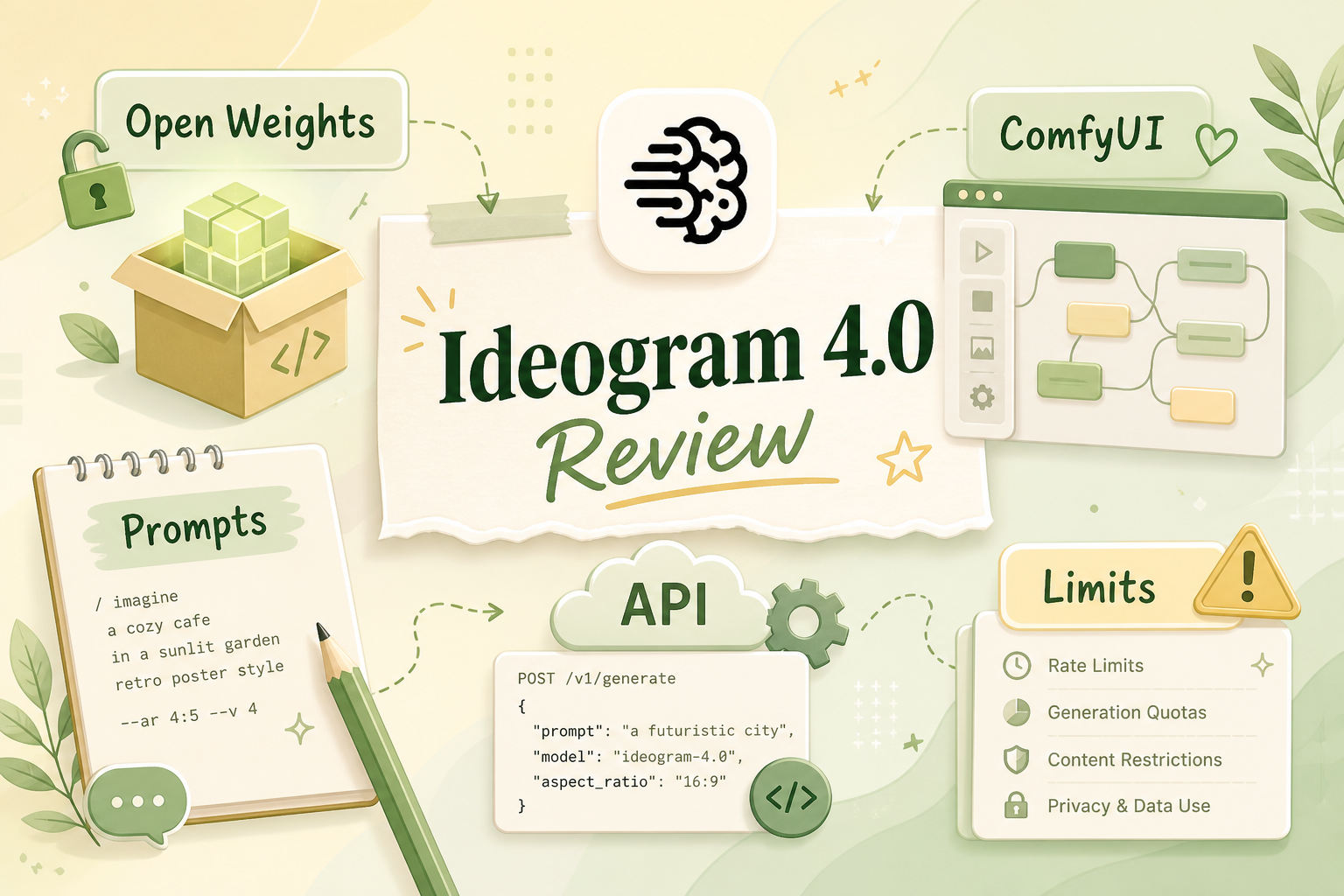
Quick answer: Ideogram 4.0 is a 9.3B open-weight image model built for typography, structured layouts, and native 2K generation. In our hosted tests it handled bilingual poster text and materials well, but missed exact-count details and ignored the requested orientation once. Public weights are non-commercial; production requires the hosted API or separate commercial rights.
Ideogram 4.0 arrives with a rare combination: downloadable weights, a design-first prompt format, and a hosted API that can be used commercially. That makes it more interesting than a routine image-model update—but also easier to misunderstand.
We checked the official repository, prompting and inference guides, API reference, license, and pricing page. We also ran bilingual typography and product-photography tasks through Broly Anywhere, then compared the same two prompts with GPT Image 2 and Nano Banana 2 baselines. This is a practical review, not a claim that one image wins every category.
If you are surveying the wider market first, our guide to the best AI image generators in 2026 explains how design control, editing, realism, and workflow convenience pull in different directions.

All-in-one AI platform for writing, image&video generation with GPT-5, Nano Banana, and more
What Is Ideogram 4.0, and What Changed?
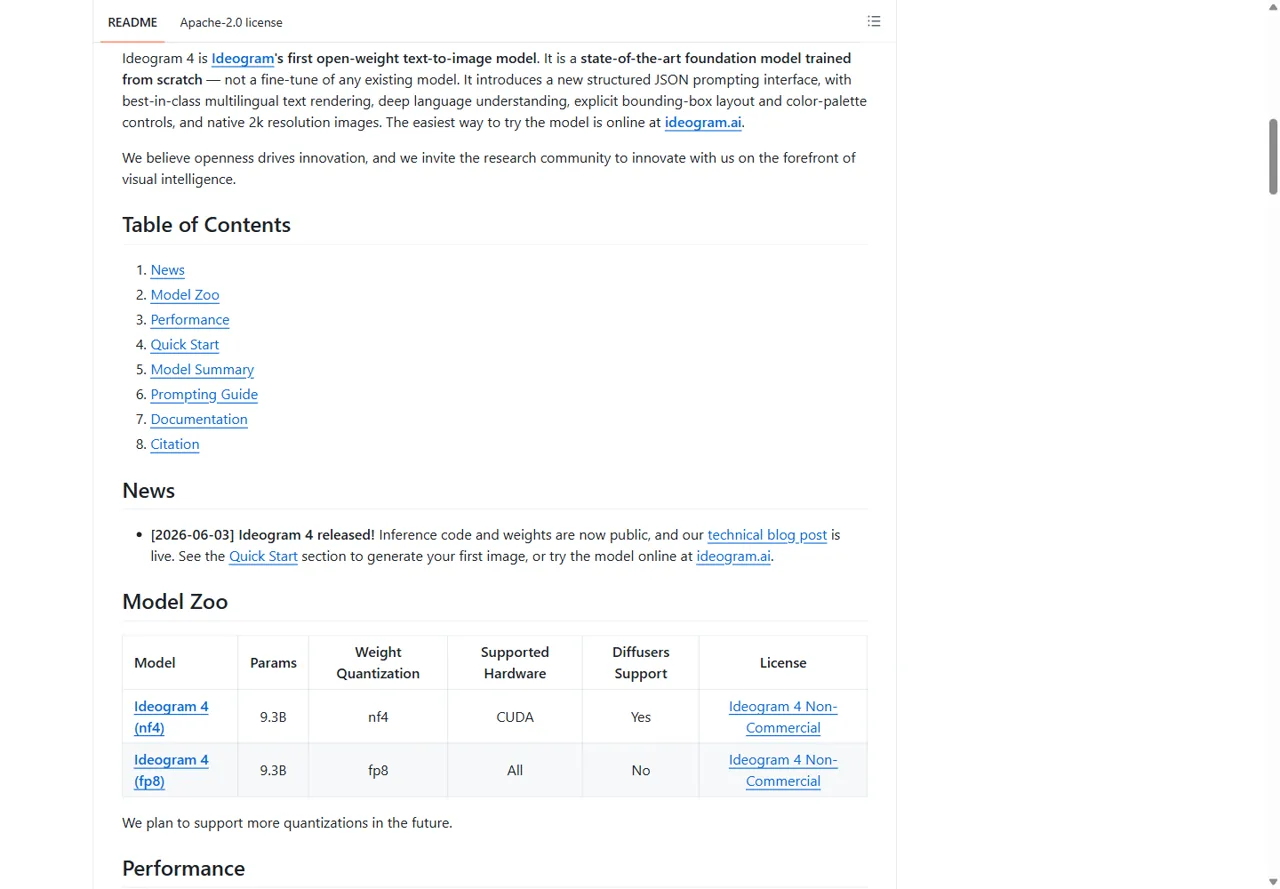
Ideogram released Ideogram 4.0 on June 3, 2026 as its first open-weight text-to-image model trained from scratch. The official repository describes a 9.3B-parameter model with gated NF4 and FP8 variants.
The core idea is structured design. Ideogram 4 uses a 34-layer single-stream diffusion transformer and a frozen Qwen3-VL-8B-Instruct text encoder. That architecture matters less to most creators than the workflow it enables: long structured captions, explicit in-image text, normalized placement boxes, and named color palettes.
The inference guide documents image dimensions from 256 to 2048 pixels per side, in multiples of 16, and aspect ratios as wide as 6:1 or as tall as 1:6. It lists 48 steps for Quality, 20 for Default, and 12 for Turbo.
Is Ideogram 4 Open Source? The License Explained
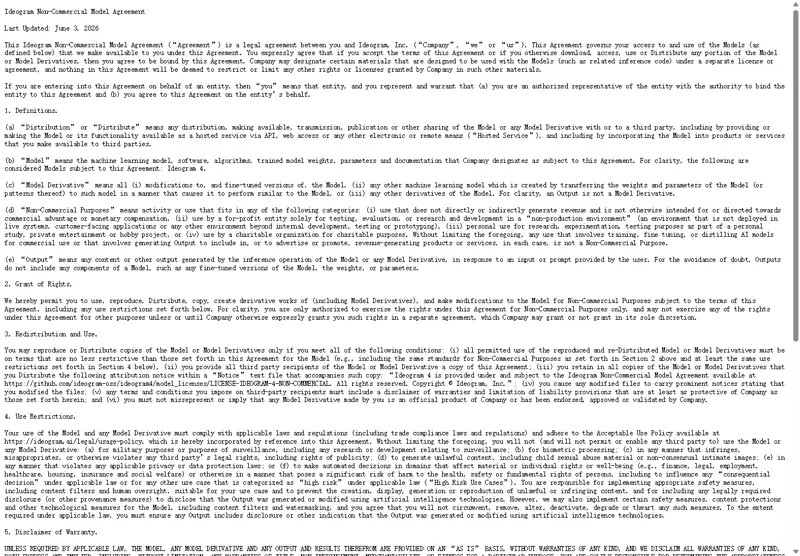
The precise label is open weight. You can inspect the repository and request the downloadable model files, but access to weights is not the same as an unrestricted open-source license.
The public NF4 and FP8 weights link to the Ideogram Non-Commercial Model Agreement. It covers non-commercial purposes and internal non-production evaluation or research under the agreement. It should not be read as automatic permission to ship client work or a commercial image service.
Research, evaluation, and uses allowed by the non-commercial agreement.
A separate Ideogram commercial-license conversation.
Paid per-image generation presented for commercial use.
If commercial rights are the deciding issue, use our broader commercial-use guide for AI images as a checklist, then apply the current Ideogram agreement and your own legal review to the actual project.
Ideogram 4 Quality: Text, Layout, and Photorealism
Our hands-on venue was Broly Anywhere’s asynchronous image task API. It reported Ideogram as the upstream provider and exposed Default, Turbo, and Quality routes. GPT Image 2 and Nano Banana 2 baselines ran through GlobalGPT. Because the venues, seeds, and output sizes differ, the comparison is directional.
Required bilingual text groups correct in Ideogram T1.
T2A added bottle text despite “no extra text.”
T5 requested exactly two black knobs.
Server task times across six successful runs.
Test 1: bilingual typography and poster design
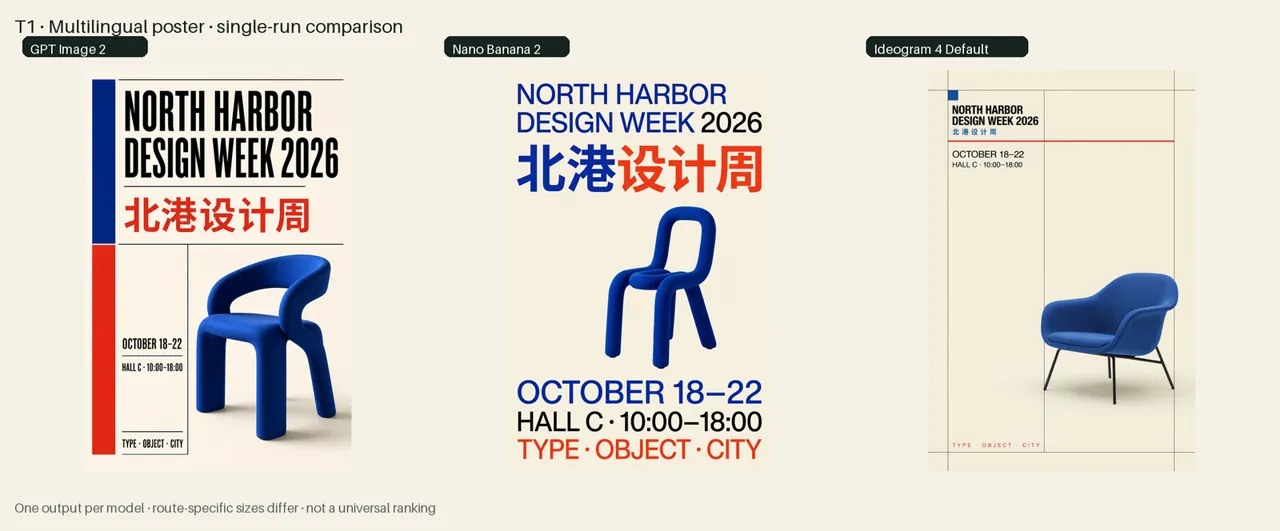
The poster required six exact English and Chinese text groups, a sculptural cobalt chair, an ivory/blue/red/black palette, a Swiss grid, and no extra logo or watermark. Ideogram 4 rendered all six groups correctly in this run, including 北港设计周.
All three baseline models rendered the required text correctly. Ideogram used the most explicit visible grid and the most negative space; GPT Image 2 used the densest editorial hierarchy; Nano Banana 2 used the largest centered copy. Our separate Nano Banana 2 text-rendering test provides more model-specific context.
Test 2: product detail and photorealism
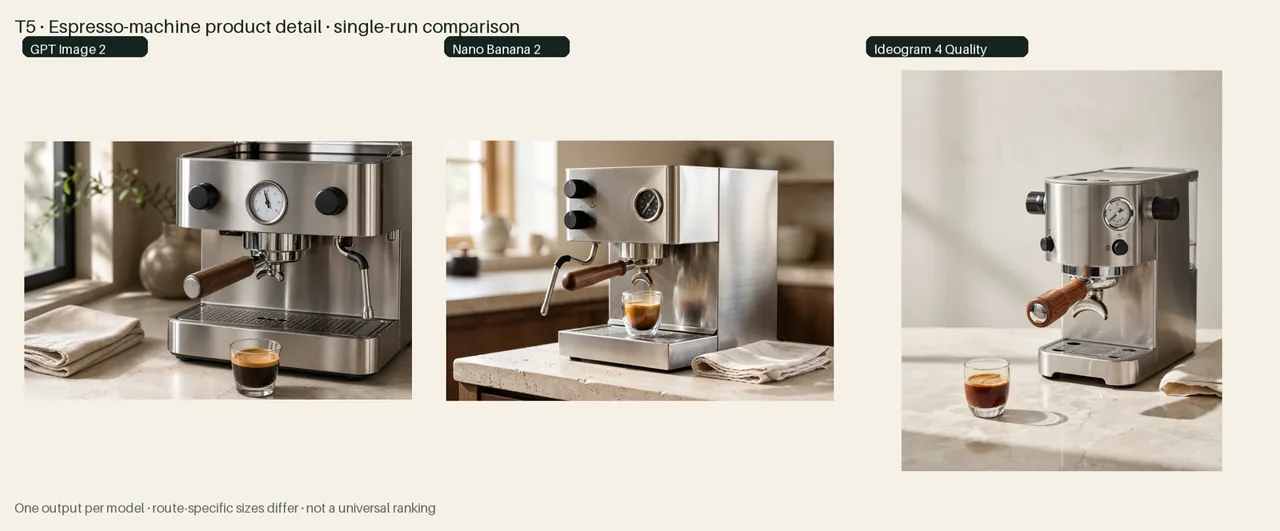
Ideogram 4 Quality produced convincing brushed steel, walnut, limestone, linen, reflections, and espresso crema. Morning light came from the left, and the still-life composition felt spacious and premium.
Instruction precision was weaker. The machine showed four black control elements instead of exactly two, the pressure-gauge markings did not make a near-9-bar reading reliably verifiable, and the route returned a 1792×2240 portrait image after a 1536×1024 landscape request.
For practical realism work, material quality is only half the job; inventory and geometry still need checking. Our workflow for how to make AI-generated images look real focuses on those production checks.
Independent typography evidence
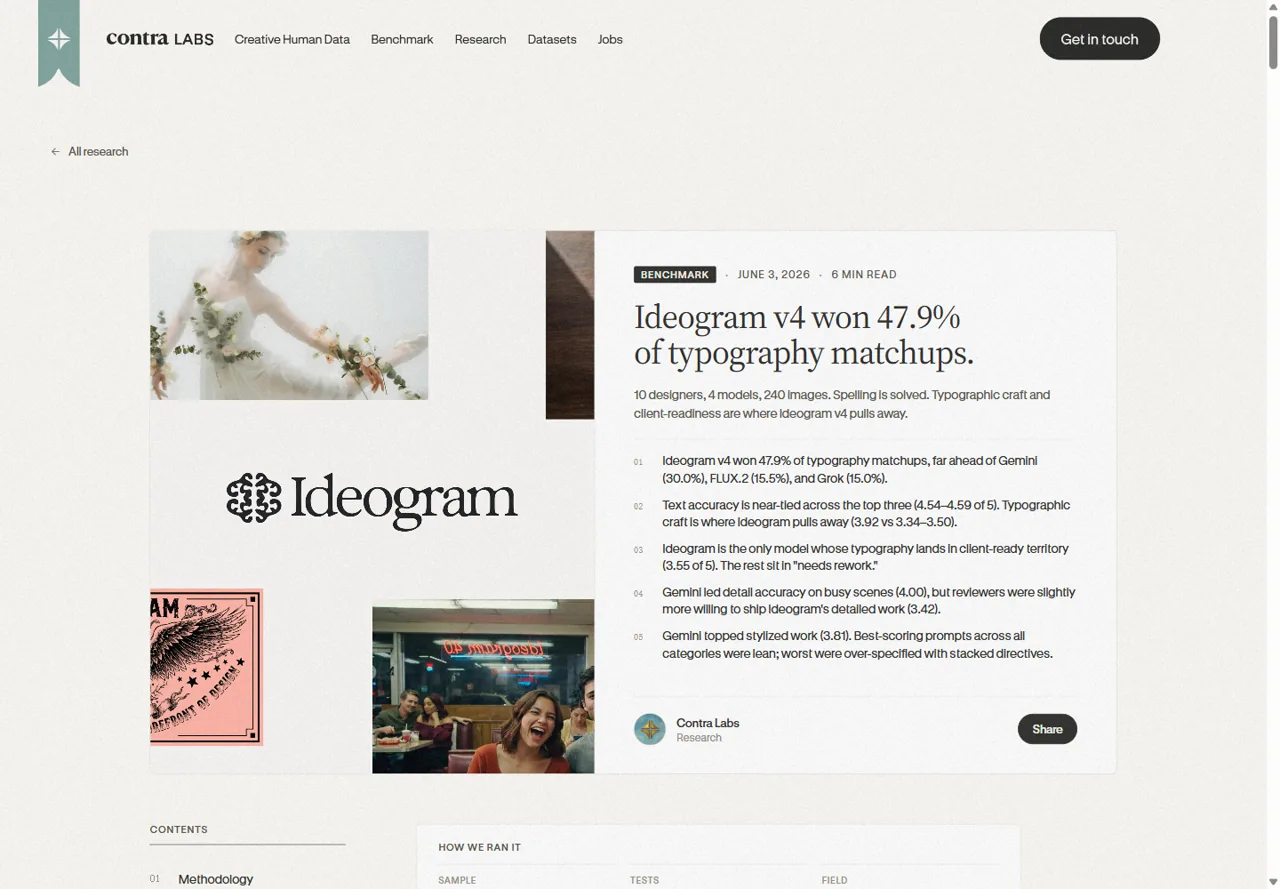
A Contra Labs blind study used 10 working designers, four models, 60 prompts, and 240 images. Ideogram 4 won 47.9% of typography matchups and received a 3.55/5 client-work score. The same study found Gemini stronger in detailed-scene accuracy and stylized work, so the result is a typography lead—not a universal quality crown.
How Ideogram 4 JSON Prompts and Bounding Boxes Work
Ideogram’s official prompting guide says the model was trained on structured JSON captions. A caption can describe the background and elements separately, including text strings, object descriptions, normalized bounding boxes, and a style color palette.
Bounding boxes use normalized 0–1000 coordinates in the order shown by the official schema. This makes a prompt portable across image resolutions. It is still generative guidance rather than an editable design-canvas constraint.