
Model information updated September 26, 2026.
How much is Grok 4? The answer depends on the route. The current Grok 4.7 API model page lists a base price of $2 per million input tokens and $6 per million output tokens, with a 500,000-token context window and higher pricing above 200K context. Consumer subscriptions through X, SuperGrok and Heavy are separate purchases.
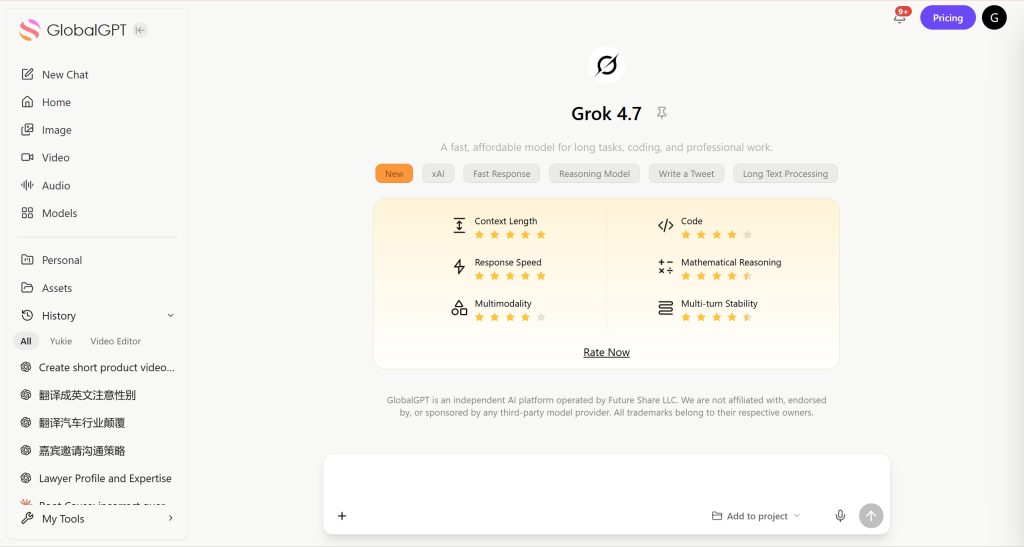
If comparing these routes feels confusing, GlobalGPT gives you a simpler starting point: compare Grok 4.7, GPT-6 Astra, Claude Opus 5.5, Gemini 3.1 Pro and Perplexity in one workspace. Basic starts at $5.80 per month equivalent with annual billing, making it easier to decide which model fits your work.
More importantly, GlobalGPT covers the complete workflow instead of stopping at chat. You can move from research and drafting into Grok Imagine, Sora 2, Google Veo 3.1, and image tools like GPT Image, Nano Banana 2, and Unikorn (MJ-like) inside one dashboard, so creators and teams can go from idea to final visual output without juggling separate subscriptions or switching platforms.
- How much is Grok 4 right now?
- Is Grok 4 free, or do you have to pay for it?
- Free Access
- Paid Subscription Access
- Heavy / Flagship / API Access
- Creative Workflow Expansion
- Why is Grok 4 pricing so confusing in 2026?
- What does “Grok 4” actually mean in 2026?
- How much does the Grok 4 API cost?
- What can Grok 4 actually do that makes it worth paying for?
- What is Grok Imagine, and why should Grok 4 buyers care?
- How much does Grok Imagine cost for image and video generation?
- Why GlobalGPT may be the better choice if you came here for Grok 4 pricing
- Can you use Grok 4 and Grok Imagine on GlobalGPT?
- What should you buy right now: official Grok, Grok Imagine access, API credits, or GlobalGPT?
- FAQs about Grok 4 pricing, SuperGrok, API costs, and Grok Imagine
How much is Grok 4 right now?
The short answer for most users
There is no single Grok price. X Premium+, SuperGrok and Heavy are consumer routes; the original article’s X web example was $40/month or $395/year, with local pricing and taxes varying. The current Grok 4.7 API base rate is $2 input/$6 output per million tokens. The older 4.20 and 4.1 Fast comparison below describes those specific models rather than the newest flagship.

The July 2025 Grok 4 launch named SuperGrok and Premium+ access and introduced SuperGrok Heavy for Grok 4 Heavy. Those are launch access statements; current subscription model access, quotas and checkout prices are a separate question from developer token pricing.
Why Grok 4 does not have one single price
“Grok 4” can mean Grok on X, Grok on grok.com/apps, the xAI API, or Heavy and other 4.x variants. These routes have different billing: consumer subscriptions use a fixed fee, while API requests incur token and optional tool charges. Grok 4.7 is the current flagship API model; 4.20 and 4.1 Fast below are earlier model comparisons.
That means a user searching “how much is Grok 4” is often really asking one of three hidden questions: How much do I pay per month to use Grok personally? How much do I pay per token to build with xAI? or How much do I need to spend to get the strongest Grok-related workflow, including image and video generation? A high-quality pricing guide has to answer all three.
What is officially confirmed, and what is not publicly disclosed
There are separate consumer, API and creative-media buying routes. Grok 4.7 is the current frontier API model documented here, while the older Grok 4.20 and Grok 4.1 Fast rows remain useful only as model-specific comparisons.
For SuperGrok and Heavy, use the official billing surface for the plan, currency, tax and billing period shown to your account. A launch announcement naming access does not establish a permanent price or unlimited quota.
Which Grok option is cheapest for casual users, power users, and developers?

For casual use, compare the local X or SuperGrok subscription checkout. For programmable work, Grok 4.7 is xAI’s current flagship recommendation, at $2/M input and $6/M output at the base tier. Grok 4.1 Fast is a separate older cost-oriented comparison; choose using your actual token volume, tool use and task quality.
Grok Pricing Routes: Original Comparison
This table shows why “Grok 4 price” is a multi-route purchase decision, not one sticker price.
| Route | Type | What it is | Publicly visible pricing | Pricing visibility |
|---|---|---|---|---|
| X Premium+ | Subscription | X subscription route that xAI named as a Grok 4 access path | $40/month or $395/year | Public price visible |
| SuperGrok | Subscription | Official Grok 4 access tier | Access confirmed; exact public price not consistently exposed | Access confirmed only |
| SuperGrok Heavy | Subscription | Official Grok 4 Heavy access tier | Access confirmed; exact public price not consistently exposed | Access confirmed only |
| Grok 4.20 API | API | Earlier flagship model; separate from Grok 4.7 | $2.00 input / $6.00 output per 1M tokens | Public price visible |
| Grok 4.1 Fast API | API | Lower-cost xAI API model | $0.20 input / $0.50 output per 1M tokens | Public price visible |
Source basis: X Premium+ public pricing, xAI API pricing, and xAI’s Grok 4 launch disclosures on access routes.
Is Grok 4 free, or do you have to pay for it?
What free users can actually access
Grok today does have a public-facing web and app presence, and xAI’s later Grok 4.1 release states that Grok 4.1 became available to all users on grok.com, X, iOS, and Android. That tells us the consumer Grok experience is broader now than it was on Grok 4 launch day. But it does not mean free users automatically get the highest-end Grok 4 or Heavy access that launch-era messaging tied to paid tiers.
What paid users unlock with Premium+, SuperGrok, and Heavy
What paid access clearly changes is which model tier you can reach and how much usage headroom you get. xAI’s own Grok 4 launch post tied Grok 4 to SuperGrok and Premium+, and explicitly introduced SuperGrok Heavy for Grok 4 Heavy, which xAI positioned as the most powerful version. On the X side, Premium+ is the highest public consumer subscription tier named in X Help.
Is free access enough for most people?
Free access can be enough if your need is light chat, quick lookups, or simple experimentation. It becomes much less attractive if your intent is the same as the keyword here: you are not just browsing Grok casually, you are evaluating whether to pay for flagship reasoning, deeper search workflows, or now Grok Imagine creative capabilities. Those are exactly the situations where free access is least likely to be sufficient.
When upgrading makes sense
Upgrading makes sense when you need one of four things: the strongest Grok tier, more dependable real-time search workflows, API access for automation or products, or creative output beyond text. The addition of Grok Imagine changes the economics here, because some users searching “Grok 4 price” are no longer only buying a chatbot; they are evaluating whether the xAI ecosystem now justifies a broader paid workflow.
Grok User Upgrade Funnel
This funnel shows how user needs typically progress from free experimentation to paid subscriptions,
flagship or API access, and finally broader creative workflows with Grok Imagine.
Free Access
Light chat, quick testing, and simple exploration of the Grok experience.
Paid Subscription Access
Premium+ or SuperGrok for higher-tier access, stronger models, and more usage headroom.
Heavy / Flagship / API Access
Grok 4.7 API for current programmable reasoning and coding workflows; Heavy is a separate consumer route.
Creative Workflow Expansion
Grok Imagine adds image and video generation, expanding Grok from chat into a broader creative stack.
Why is Grok 4 pricing so confusing in 2026?
“Grok 4” now refers to more than one buying path
“Grok 4” can refer to the original July 2025 model, Heavy, later Fast variants or a newer frontier API model such as Grok 4.7. Name the exact model and product before comparing context windows or prices.
Subscription pricing vs API pricing vs business pricing
In 2026, there are three different economic layers in play: consumer subscriptions, developer API billing, and business/enterprise deployment. The first is about monthly access. The second is about token and tool usage. The third is about organization-scale workflow integration, which xAI also now positions through Grok Business and Grok Enterprise.
Why older Grok 4 articles are already outdated
A lot of content became outdated the moment xAI shifted attention from launch-day Grok 4 to newer variants like Grok 4.1 and Grok 4.20, and then added Grok Imagine. A page that still treats “Grok 4” as a single static purchase is missing how fast xAI’s own lineup has moved.
Why users searching “how much is Grok 4” are often really asking a bigger question
The deeper question is usually not “What number is on the invoice?” but “Which xAI route gives me the right mix of reasoning, search, tool use, and creative output without overpaying?” That is why a strong pricing guide has to move from nominal price to actual workflow cost.
What does “Grok 4” actually mean in 2026?

Grok 4 vs Grok 4 Heavy
Grok 4 was the original flagship launch model with native tool use, real-time search integration, and a 256,000 context window. Grok 4 Heavy is xAI’s higher-compute version designed to consider multiple hypotheses at once, with xAI positioning it as the strongest Grok 4 variant for hard reasoning.
Grok 4 vs Grok 4.1 Fast
Grok 4.1 Fast is not “Grok 4 but slightly newer.” It is a more explicitly cost-efficient, tool-calling-focused model family that xAI says has a 2M-token context window, launches with an Agent Tools API, and is priced for much cheaper high-volume usage. xAI positions it as the better starting point for autonomous agents and deep research pipelines where cost and speed matter.
Grok 4 vs Grok 4.20
Grok 4.20 is a later model than the original Grok 4 and has its own specifications. It should no longer be presented as the newest flagship: the current Grok 4.7 model page lists 500K context and its own pricing rules.
Which Grok model is the newest right now?
Grok 4.7 is the current frontier model in the API documentation used here. Consumer app plan availability is a separate field; access to an API model does not establish which subscription includes it.
Which Grok model is best for chat, coding, search, and tool use?
For the current frontier API option, compare Grok 4.7. Grok 4.1 Fast remains a separate cost-oriented model in the original comparison. Heavy names a consumer route, and Grok Imagine handles creative media; do not use one route’s limits as another route’s entitlement.
Grok Version Timeline
This timeline helps readers understand how Grok has evolved from the original Grok 4 launch
into newer flagship and creative products, preventing outdated assumptions about which version
is current today.
Launch
Grok 4
The original flagship Grok 4 launch model, positioned around frontier reasoning and real-time search.
Higher Compute
Grok 4 Heavy
A stronger high-compute version designed for harder reasoning tasks and more demanding workflows.
Broader Access
Grok 4.1
A newer consumer-facing step that expanded the Grok experience across web, X, and mobile apps.
Efficiency
Grok 4.1 Fast
A lower-cost, tool-calling-focused model designed for developer workflows and agent use cases.
Current Flagship
Grok 4.20
The latest flagship model family in xAI’s current API lineup, with stronger positioning for advanced use.
Creative Expansion
Grok Imagine API
xAI’s image and video generation layer, expanding Grok from text AI into a broader creative ecosystem.
How much does the Grok 4 API cost?
Earlier API comparison: Grok 4.20 and Grok 4.1 Fast

In the earlier comparison, Grok 4.20 was the premium flagship option. Its listed rates were:
- $2.00 per 1M input tokens
- $6.00 per 1M output tokens
Grok 4.1 Fast is the more cost-efficient option. It costs:
- $0.20 per 1M input tokens
- $0.50 per 1M output tokens
Both models support a 2M context window, which is important for long-context workflows and agent-style tasks.
For the newer Grok 4.7, the official model page lists 500K context, $2/M input, $0.50/M cached input and $6/M output at the base tier. Requests above 200K context use a higher tier. At base rates, 100K uncached input plus 10K output costs $0.26 before tools and taxes.
What extra costs developers forget to count
This is where real cost diverges from sticker price. xAI’s current tool pricing page says web search, X search, and code execution each cost $5 per 1,000 calls. File attachments cost $10 per 1,000 calls, and collections search costs $2.50 per 1,000 calls. That means a deep-research or agentic workflow can cost meaningfully more than a pure token spreadsheet suggests.
Why token pricing is not the same as total cost
Token pricing covers only the model interaction itself. It does not automatically capture tool-use amplification, long sessions, internal reasoning tokens, image tokens, or file/search overhead. xAI explicitly says requests using server-side tools are priced based on two components: token usage and tool invocations, and that costs scale with query complexity.
Is the API cheaper than paying for a subscription?
The API is cheaper only if your usage is light, controlled, or highly optimized. For experimentation, internal tools, or usage-based products, the API can be more rational than a monthly subscription. But if you are a heavy individual user who wants a ready-made interface, subscriptions are simpler. If you are doing agentic search, file analysis, and code execution at scale, API spend can rise faster than many first-time buyers expect.
Model-specific API rates from the original comparison
| Model | Official positioning | Context | Text input | Output |
|---|---|---|---|---|
| Grok 4.20 Reasoning | Earlier flagship | 2M | $2.00 / 1M | $6.00 / 1M |
| Grok 4.20 Non-Reasoning | Lower-latency 4.20 variant | 2M | $2.00 / 1M | $6.00 / 1M |
| Grok 4.1 Fast Reasoning | Cost-efficient tool-calling model | 2M | $0.20 / 1M | $0.50 / 1M |
| Grok 4.1 Fast Non-Reasoning | Lower-latency 4.1 Fast variant | 2M | $0.20 / 1M | $0.50 / 1M |

What can Grok 4 actually do that makes it worth paying for?
- Real-time web and X search: One of Grok’s core differentiators is that xAI consistently frames it as a model family with real-time web and X search tightly integrated into the workflow. The original Grok 4 launch emphasized real-time search across X, the web, and news sources, while the later Grok 4.1 Fast release doubled down on native search agents and deep-research use cases.
- Native tool use and agent workflows: xAI positions Grok 4.7 for coding and agentic tool calling. Search and other tools must be enabled for the relevant workflow; the model does not automatically know current events without them.
- Reasoning, coding, and research use cases: At launch, xAI positioned Grok 4 as a frontier reasoning model with a 256k context window, multimodal understanding, and strong academic benchmark claims. Later, Grok 4.1 Fast was positioned as a better answer for long-horizon autonomous agents with a 2M-token context window, better factuality than Grok 4 Fast, and strong benchmark framing for tool calling and deep research.
- When Grok 4 Heavy matters: Heavy matters when the cost of being wrong is high enough that extra compute is worth the wait. xAI’s own launch framing for Heavy is not “slightly better Grok,” but a separate high-compute mode designed to test multiple hypotheses in parallel and push the ceiling on hard reasoning tasks. That makes Heavy attractive for difficult technical, research, and strategy problems, but too slow and expensive-seeming for casual daily chat.
- When Grok is overkill for your needs: If you only need simple drafting, lightweight brainstorming, or occasional search, Grok’s strongest paid paths may be overkill. The premium logic makes more sense when you genuinely need current-information retrieval, tool-use automation, or a broader xAI ecosystem rather than a general-purpose chatbot.
Grok Capability Radar
This radar chart helps readers understand where the Grok ecosystem is positioned most strongly:
search, tool use, reasoning, coding, and creative expansion.
Grok ecosystem
Typical general chatbot
What is Grok Imagine, and why should Grok 4 buyers care?
What Grok Imagine actually does
Grok Imagine API launched on January 28, 2026 as xAI’s unified creative API bundle for end-to-end creative workflows. xAI describes it as its most powerful video-audio generative model yet, able to animate images, generate from text, and refine cinematic sequences. xAI’s docs now split this into image generation and video generation capability pages.

Why Grok is no longer just a chatbot
This is the biggest strategic shift behind the keyword. In 2025, “How much is Grok 4?” mostly implied a reasoning model question. In 2026, it can also imply a creative-stack question, because xAI now pairs its text/reasoning lineup with Grok Imagine for image and video generation. That makes Grok a broader ecosystem purchase, not just a premium chat subscription.
Does Grok Imagine make Grok subscriptions more valuable?
Grok Imagine can add value if you need creative outputs alongside chat. Consumer inclusion, quotas and API billing are separate: an API capability page does not prove that a particular subscription includes the same feature.

Is Grok Imagine included, limited, or separately monetized?
What is fully documented is the API side. xAI’s docs state that image generation uses flat per-image pricing, while video generation uses per-second pricing affected by duration and resolution. That means even when users arrive through a “Grok 4 price” query, they should be prepared for a second pricing layer once creative generation enters the picture.
Why this matters for creators, marketers, and agencies
For creators, marketers, and agencies, Grok pricing is no longer just a reasoning-model budget line. It is now part of a bigger decision about whether xAI can handle ideation, drafting, image generation, video generation, and editing inside one ecosystem. That is a much more strategic question than “What is the monthly fee?”
How much does Grok Imagine cost for image and video generation?
How image pricing works
xAI’s image generation docs say image generation uses flat per-image pricing, not token-based pricing, and that each generated image incurs a fixed fee regardless of prompt length. They also say that for image editing, you are charged for both the input image and the generated output image.
How video pricing works
xAI’s video generation docs say video generation uses per-second pricing, and that both duration and resolution affect the total cost. That is a very different billing logic from text-model tokens, which is why Grok buyers who expand into video often underestimate total spend at first.
What affects total Grok Imagine cost
The biggest cost variables are duration, resolution, editing mode, and whether you are using reference images. xAI’s docs currently cap generation at 15 seconds, editing input videos at 8.7 seconds, and extension lengths at 2–10 seconds, while supported resolutions are 480p or 720p. Reference-image video generation allows up to 7 reference images and a maximum 10-second duration in that mode.
Is Grok Imagine good value compared with Sora, Veo, Kling, and Runway?
At launch, xAI framed Grok Imagine as state-of-the-art across quality, cost, and latency, and cited Artificial Analysis ranking snapshots on the launch page. Whether it is the single best value for every creator is a moving target, because video-model rankings change quickly. The safe conclusion is that xAI is clearly positioning Grok Imagine as a serious top-tier option, not a side feature.
Is Grok Imagine better for fast content or polished production?
Its current docs and launch framing make it look especially attractive for fast iteration, editing, short-form generated clips, and integrated creative workflows. The current limitations—shorter clip durations and up to 720p output—also suggest that buyers should not assume it replaces every polished long-form production workflow yet.
Grok Imagine Pricing and Limits
This table makes it easy to compare Grok Imagine image and video billing logic, usage limits, duration, resolution, and editing constraints in one place.
| Format | Billing Logic | Core Limit | Duration / Output | Resolution / References | Editing Constraints |
|---|---|---|---|---|---|
| Image Generation Per-image pricing | Flat fee per generated image, not token-based | Each output image is billed as a fixed image-generation action | Up to 10 output images per request | Supports standard image generation and editing workflows | For image editing, both the input image and the generated output image are billed |
| Video Generation Per-second pricing | Charged by generated video length, with cost affected by duration and resolution | Different limits apply for generation, editing, and extension | Generation: 1–15 seconds Editing input video: up to 8.7 seconds Extension: 2–10 seconds | 480p or 720p output Reference-image mode supports up to 7 images and up to 10 seconds | Video editing does not support custom aspect ratio; extension inherits the source video settings |
Why GlobalGPT may be the better choice if you came here for Grok 4 pricing
One subscription vs multiple official subscriptions
GlobalGPT’s current public positioning is straightforward: it is an all-in-one AI platform that gives users access to multiple major model families with one account, and its pricing pages show plans starting at $5.8/month for Basic and $10.8/month for Pro on annual billing. That changes the cost conversation from “How much is one Grok tier?” to “How much does it cost to cover my whole AI workflow?”

Access Grok-style reasoning, AI search, image generation, and video creation in one place
GlobalGPT’s directory brings language models and creative tools together, including Grok 4.7, GPT-6 Sol, GPT-6 Astra, Gemini 3.1 Pro, GPT Image 2.5, Nano Banana tools, Veo 3.1 and Seedance 2.5. Named routes have their own controls and credit costs.

Why GlobalGPT is a stronger fit for real end-to-end workflows
If your real workflow is research → drafting → image generation → video generation, GlobalGPT’s public product structure is easier to justify than paying individually across multiple official products. GlobalGPT itself describes the platform as an all-in-one workspace for writing, research, visuals, and automation through a single account.
What you get on GlobalGPT that Grok alone does not solve
The most important difference is not “better Grok” but broader optionality. Grok alone solves the xAI portion of the stack. GlobalGPT’s current pages position it as a way to access multiple frontier model families and multiple creative tools from one dashboard, which is often more valuable for mixed workflows than buying only one official ecosystem.
Why this matters even more now that Grok Imagine is part of the conversation
Grok Imagine makes xAI more compelling than before, but it also raises the stakes of choosing the right buying route. Once image and video matter, more users will compare ecosystems, not just text-model subscriptions. That is exactly where bundled platforms become more attractive.
Can you use Grok 4 and Grok Imagine on GlobalGPT?
Where Grok appears inside the GlobalGPT ecosystem
Yes. GlobalGPT lists Grok 4.7 in its model directory, providing Grok text and reasoning workflows alongside other model families. This is a platform route, distinct from an X subscription or a direct xAI API account.
How GlobalGPT highlights Grok Imagine for creators
GlobalGPT currently highlights Grok Imagine as a video capability, not as a full image-and-video Grok Imagine stack. In other words, GlobalGPT offers Grok-related LLM access and Grok Imagine video generation, but does not currently provide Grok Imagine image generation. This distinction matters because users comparing official xAI access with GlobalGPT need to understand that the available Grok-related capabilities are not identical across platforms.
Why this is more practical than switching between multiple official products
For many users, the practical value is not just raw access, but less switching. Instead of using one platform for Grok-style reasoning and another separate workflow for video generation, users can keep LLM tasks and Grok-related video creation inside one dashboard. That makes GlobalGPT especially convenient for users who value a unified workspace more than exact one-to-one feature parity with every official xAI surface.
What kind of user should choose this route
This route makes the most sense for users who want Grok-related text workflows plus video creation as part of a broader all-in-one AI stack. It is especially relevant for creators, marketers, agencies, and researchers who compare multiple models regularly and want fewer platform switches. However, users who specifically need the official full Grok Imagine image capability should understand that this is not currently the same as full native xAI feature coverage.
MODEL GUIDE · SEPTEMBER 2026
Grok 4.7
Compare the current Grok model with GPT-6 Astra, Claude Opus 5.5 and Gemini 3.1 Pro in GlobalGPT. Direct xAI API billing is separate.
What should you buy right now: official Grok, Grok Imagine access, API credits, or GlobalGPT?
Buy official Grok if…
Buy official Grok if your priority is the native xAI experience, especially if you are already inside X, care about official product parity, or specifically want Grok access the way xAI packages it on its own consumer surfaces.
Use the xAI API if…
Use the xAI API if you need programmable model access, token tracking or an integration. Compare Grok 4.7’s base rates, higher-context tier and tools with a cheaper model on a representative workload.
Care about Grok Imagine if…
Care about Grok Imagine if your decision is no longer only about text. If you need image generation, image editing, video generation, or short cinematic workflows, Grok Imagine materially changes the value of the xAI ecosystem.
Choose GlobalGPT if…
Choose GlobalGPT if the real problem you are solving is not “How do I buy one Grok tier?” but “How do I get strong reasoning, search, image, and video tools without paying for several separate official subscriptions?” That is where GlobalGPT’s public pricing and all-in-one positioning are strongest.
Wait if…
Wait if your use case is still unclear, your workload is too light to justify paying now, or you specifically need details—such as the live public SuperGrok billing number—that are better verified inside the current official billing surfaces before purchase.
FAQs about Grok 4 pricing, SuperGrok, API costs, and Grok Imagine
How much is Grok 4 per month?
If you are using the X route, the clearest public official number is X Premium+ starting at $40/month on web. But “Grok 4 per month” is incomplete because some access paths are subscription-based and others are usage-based through the API.
Is Grok 4 included with X Premium+?
Yes. xAI’s Grok 4 launch post explicitly said Grok 4 is available to Premium+ subscribers, alongside SuperGrok.
Why do some sites say Grok 4 is $30 and others say $300?
Because they are usually comparing different products: a monthly consumer plan, an annualized number, a business plan, or API usage. An accurate article must keep those separate.
Is Grok 4.20 newer than Grok 4?
Yes. Grok 4.20 came after Grok 4, but it is not the newest model discussed here. xAI’s current Grok 4.7 page lists a 500K context window and separate pricing rules.
Is Grok Imagine free?
xAI’s official docs do not frame Grok Imagine API as free. They document per-image pricing for image generation and per-second pricing for video generation.
Does Grok Imagine make videos with audio?
xAI describes Grok Imagine as its most powerful video-audio generative model yet, and GlobalGPT’s home page describes Grok Imagine as cinematic video generation with synchronized audio.
Which is cheaper: official Grok or GlobalGPT?
GlobalGPT Basic starts at $5.80/month equivalent and Pro at $10.80/month equivalent with annual billing. Value depends on the models and creative tools you use; these are not native xAI subscriptions.
Which GlobalGPT plan is best for creators?
For creators, Pro is the stronger fit because GlobalGPT’s own public materials most clearly associate that tier with broader image/video workflow value.
Can I use Grok without X?
Yes. Grok is available on grok.com, apps, and the xAI API; it is not only an X feature.
What is the best alternative to Grok 4?
Compare GPT-6 Astra for mixed professional work, Claude Opus 5.5 for coding and reasoning, Gemini 3.1 Pro for Google-oriented workflows, and Perplexity for research. GlobalGPT brings multiple families into one subscription.