
Revisión del modelo · Pruebas de rendimiento oficiales · Pruebas de API con el mismo prompt
Gemini 3.8 Flash es el nuevo modelo de Flash de Google, ya disponible de forma generalizada, destinado a la ingeniería de software a largo plazo, los agentes y el trabajo intelectual complejo. Las afirmaciones de lanzamiento son contundentes. Nuestras primeras pruebas controladas son mucho menos concluyentes.
Este análisis de Gemini 3.8 Flash distingue los datos oficiales de los resultados obtenidos en la práctica. Las páginas de Google recogen la fecha de lanzamiento, el estado del modelo, la ventana de contexto, los precios, las herramientas y las afirmaciones sobre el rendimiento. Siete tareas de la API con la misma consulta muestran lo que el modelo devolvió realmente en comparación con Gemini 3.7 Flash.
Si quieres repetir la comparación sin tener que gestionar pestañas de modelos por separado, GlobalGPT ofrece un único espacio de trabajo para probar varios modelos de IA. Para conocer el contexto de la generación anterior, nuestro Gemini 3.6: reseña rápida muestra lo rápido que ha ido cambiando la línea Flash.
Reseña rápida del Gemini 3.8: La respuesta breve
Gemini 3.8 Flash no superó a Gemini 3.7 Flash en esta primera evaluación de siete tareas. De los seis pares evaluados, el 3,8 ganó la tarea de planificación front-end, empató en la corrección de un error en Python y perdió cuatro tareas relacionadas con la precisión del estado, el razonamiento con datos, la planificación de agentes acotados y la edición de SEO. La tarea de investigación restante no arrojó resultados concluyentes.
La diferencia no radicaba en los conocimientos puros y duros. Se debía a pequeños defectos en el trabajo final: una afirmación errónea sobre el denominador, etiquetas de estado menos precisas, una redacción menos concisa y un plan de herramientas menos concreto. Esos son precisamente los detalles que determinan si una respuesta se puede utilizar de inmediato.
Resumen de la reseña
| Medida | Gemini 3,8 Flash | Gemini 3.7 Flash |
|---|---|---|
| Tareas completadas | 1 | 4 |
| Corbatas | 1 | 1 |
| Tiempo transcurrido hasta la finalización de la tarea | 49,266 s | 42,909 s |
| Tokens de salida de tareas completadas | 9,199 | 7,489 |
| Coste estimado de la tarea completada | $0.036121 | $0.028569 |
Estos resultados se refieren a seis pequeñas tareas de texto realizadas en una ruta de la API y con una configuración. No constituyen una clasificación universal de ninguno de los dos modelos.
¿Qué es el Gemini 3.8 Flash?
Google describe el Gemini 3.8 Flash como su sistema Flash más inteligente y versátil para la programación y los agentes, con especial énfasis en la ingeniería de software a largo plazo y el trabajo intelectual. Se basa en el sistema Flash Gemini 3.7, en lugar de en una arquitectura completamente independiente.
El posicionamiento es importante porque no se trata simplemente de un chatbot genérico más barato. Google presenta 3.8 Flash como un modelo de agente de producción capaz de razonar a partir de documentos, herramientas, código y secuencias de tareas más largas, al tiempo que mantiene la latencia y la escalabilidad propias de Flash.
Fecha de lanzamiento de Gemini 3.8 Flash
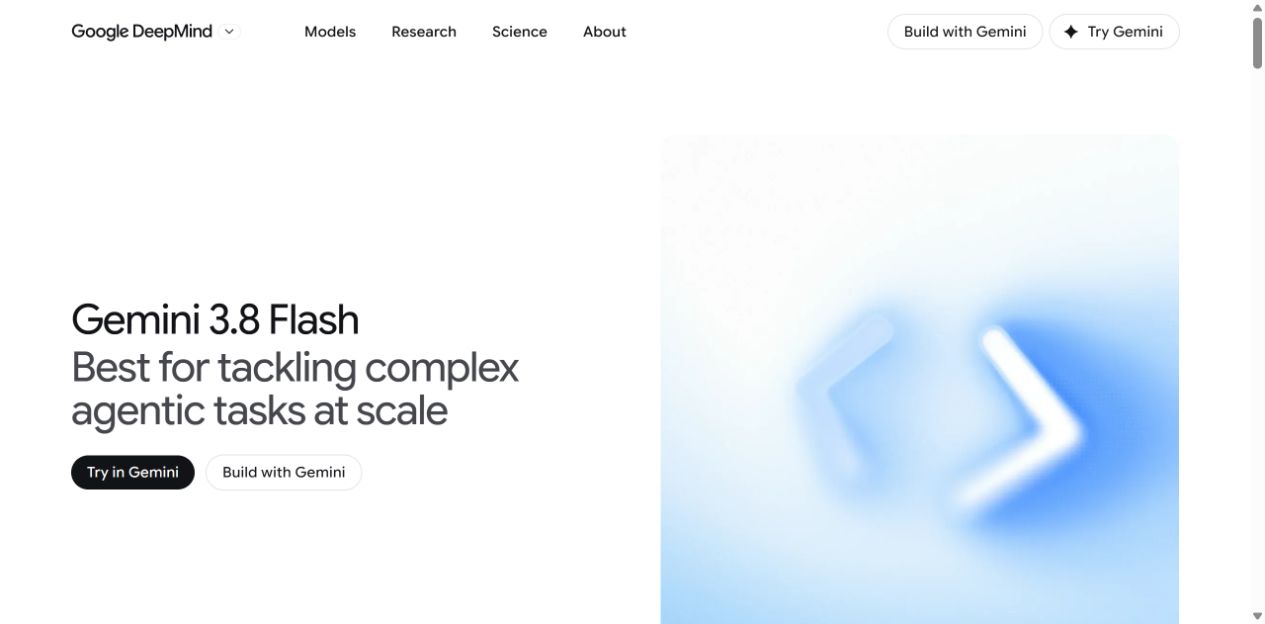
En ficha oficial del modelo se publicó el 2 de septiembre de 2026. En la página del producto de Google, el modelo aparece como «disponible de forma general» y no como «solo en versión preliminar».
¿Qué ha cambiado con respecto a la versión 3.7 Flash de Gemini?
El enfoque oficial se centra ahora en las tareas de los agentes de mayor duración y en los resultados finales. Google destaca la ingeniería de software, el razonamiento riguroso, la ejecución de herramientas, la comprensión multimodal y el trabajo empresarial complejo. En nuestro pequeño conjunto de pruebas, ese enfoque se tradujo en el mejor rendimiento en el front-end, pero no en respuestas finales más fiables en todos los ámbitos.
Gemini 3.8: Especificaciones y disponibilidad de la memoria flash
| Especificación | Gemini 3,8 Flash | Pruebas |
|---|---|---|
| ID del modelo de API | gemini-3.8-flash | Página oficial de precios y respuestas de la API devueltas |
| Estado | Disponibilidad general | Página de producto de Google DeepMind |
| Contexto de entrada | Hasta 1 millón de tokens | Ficha técnica oficial |
| Longitud máxima del texto | 64 000 tokens | Ficha técnica oficial |
| Datos de entrada | Texto, imágenes, audio, vídeo y archivos PDF | Página oficial del producto |
| Salida | Texto | Ficha técnica oficial |
| Soporte para herramientas | Llamadas a funciones, la búsqueda como herramienta, el uso del ordenador | Página oficial del producto |
| Superficies de acceso oficiales | Aplicación Gemini, plataforma Gemini Enterprise Agent, Google AI Studio, API de Gemini, modo IA y Google Antigravity | Ficha técnica oficial |
| Límite de conocimientos | Marzo de 2026 para algunos dominios; enero de 2025 para otros | Ficha técnica oficial |
Una ventana de 1 millón de tokens es una cuestión de capacidad, no una prueba de que se puedan recuperar perfectamente documentos largos. El paquete de pruebas que se muestra a continuación incluye una breve tarea de extracción sensible al estado, pero no establece el rendimiento con un millón de tokens.
Gemini 3.8 Precios de Flash y coste de la API
En Página oficial de precios de la API Gemini indica una tasa de lanzamientos hasta el 31 de diciembre de 2026 de $0,75 por cada millón de tokens de entrada y $3,75 por cada millón de tokens emitidos, incluidas las fichas de reflexión. El 1 de enero de 2027, esas tarifas aumentarán a $1,50 y $7,50.
Variación del precio publicado
Precio del plan de pago por cada millón de tokens. Las tarifas de enero de 2027 duplican las tarifas de lanzamiento de 2026.
Gemini 3.8 Flash y Gemini 3.7 Flash tenían la misma tarifa inicial publicada durante nuestro periodo de prueba. Aun así, la 3.8 resultó más cara en todos los pares completados, ya que su consumo de tokens registrado fue mayor. En los periodos T02–T07, las estimaciones fueron de $0,036121 para el 3,8 y de $0,028569 para el 3,7.
Para conocer otro punto de la curva de velocidad y coste, consulta nuestro Reseña del Gemini 3.5 Flash Lite. Un modelo «Lite» está pensado para un tipo de trabajo diferente, por lo que su precio más bajo no debe interpretarse automáticamente como una ventaja en cuanto a calidad.
Gemini 3.8: Pruebas de rendimiento oficiales de Flash
La página de rendimiento de Google destaca cuatro áreas: DeepSWE v1.1, Vals Finance Agent v2, Harvey’s Legal Agent Benchmark y HLE-Verified. Sus gráficos muestran que Gemini 3.8 Flash supera a Gemini 3.7 Flash en las tres evaluaciones, con los porcentajes exactos publicados.
| Evaluación oficial | Gemini 3,8 Flash | Gemini 3.7 Flash | Límite de las pruebas |
|---|---|---|---|
| DeepSWE v1.1 | Por encima de 70% en el gráfico de Google | Por debajo de 3,8 en el gráfico | Google afirma que 3,8 es el valor de referencia en el ámbito de la eficiencia; el gráfico público no muestra un valor numérico concreto. |
| Vals Finance Agent v2 | 61.4% | 59.0% | Gráfico oficial de Google; la metodología completa del índice de referencia sigue siendo importante. |
| Índice de referencia de los representantes legales de Harvey | 10.0% | 8.8% | Este resultado de referencia no garantiza la exactitud jurídica en la aplicación. |
| Verificado por HLE | 54.9% | 53.6% | No mide directamente la edición SEO, la planificación de la interfaz de usuario ni la eficiencia en las respuestas. |

Cómo hemos probado el Gemini 3.8 Flash
Ambos modelos recibieron la misma indicación de tarea, una temperatura de 0, un límite máximo de salida de 3.200 tokens y la misma ruta de la API. El T02 se volvió a ejecutar una vez para ambos modelos después de que la primera solicitud 3,8 fallara por motivos técnicos; solo se puntúa la repetición que coincidió.
| Campo registrado | Cómo se utilizaba |
|---|---|
| ID del modelo devuelto | Se ha confirmado que el modelo solicitado ha respondido. |
| Producción real | Se compararon la corrección, la exhaustividad, la fidelidad al estado original y la necesidad de edición. |
| Segundos transcurridos | Tiempo de respuesta local de extremo a extremo medido, no la latencia del lado del proveedor. |
| Tokens de entrada y salida | Estimaciones de costes a nivel de tarea, según la tarifa inicial oficial. |
| Motivo de finalización | He distinguido las respuestas útiles de los resultados incompletos o con un presupuesto limitado. |
Gemini 3.8: Resultados de las pruebas en condiciones reales de Flash
Cada ficha reúne la tarea, el trabajo entregado, las mediciones y el veredicto editorial. Los extractos se han abreviado para facilitar su lectura, pero conservan los detalles decisivos.
Prueba 1: Síntesis de la investigación
Tarea: Elabora una recomendación de compra de 180 palabras a partir de un conjunto de datos fijos, con tres razones, dos incógnitas y un plan de pruebas.
Gemini 3,8 Flash
18,211 s · 361 tokens de entrada / 3.196 tokens de salida · estimación: $0,012256
“Recomendamos elegir el Modelo A… 3. Paridad de costes: el precio inicial de la API es el mismo tanto para el Modelo A como para el Modelo B”.”
Gemini 3.7 Flash
13,490 s · 108 tokens de entrada / 3.196 tokens de salida · est. $0,012066
“Recomendamos encarecidamente realizar una prueba piloto y adquirir el Modelo A… El precio de lanzamiento de la API sigue siendo exactamente el mismo para ambos modelos hasta el 3 de diciembre”.”
Ambas respuestas se interrumpen a mitad de la frase, antes de mencionar las incógnitas necesarias y el plan de pruebas. La respuesta 3.8 indica basta, mientras que el informe 3.7 indica longitud; ninguna de las dos razones mencionadas modifica la valoración sobre la facilidad de uso.
Prueba 2: Corrección de un error en Python
Tarea: Devuelve los tres registros con mayor valor entre los que han sido pagados, mantén el orden de entrada en caso de empate, gestiona los datos vacíos, explica la causa principal y añade dos pruebas.
Gemini 3,8 Flash
7,969 s · 344 tokens de entrada / 1.517 tokens de salida · est. $0,005947
paid.sort(key=lambda r: r["amount"], reverse=True)
En él se explicaba el ordenamiento estable de Python y se analizaban la clasificación, los empates, el filtrado y las entradas vacías.
Gemini 3.7 Flash
7,818 s · 91 tokens de entrada / 1.359 tokens de salida · est. $0,005164
paid.sort(key=lambda r: r["amount"], reverse=True)
Ofreció la misma solución mínima y cumplió los mismos criterios de aceptación.
El código es funcionalmente equivalente. La respuesta del punto 3.7 es ligeramente más corta y consume menos recursos, pero eso no basta para marcar una diferencia en la calidad del resultado.
Prueba 3: Plan de implementación de la interfaz de usuario textual
Tarea: Planifica cinco correcciones priorizadas, el comportamiento de respuesta y el control de calidad para un proceso de pago descrito. No se ha facilitado ninguna captura de pantalla.
Gemini 3,8 Flash
10,128 s · 340 tokens de entrada / 1.509 tokens de salida · est. $0,005914
Especificaba una cuadrícula para ordenador de 58/42, un botón de llamada a la acción (CTA) de 48-52 píxeles, una nota de confianza cercana, una alerta contextual de descuento, un acordeón con el resumen del pedido para móviles, estados de enfoque y comprobaciones de desbordamiento.
Gemini 3.7 Flash
8,149 s · 87 tokens de entrada / 1.416 tokens de salida · estimación: $0,005375
Propuso una estructura similar para la red fija y la telefonía móvil, pero introdujo el “pago cifrado de 256 bits”, un detalle que no figuraba en la tarea.
Ambos planes son viables. El plan 3.8 cuenta con una lista de comprobación de control de calidad más rigurosa y evita tener que inventarse una afirmación específica sobre el cifrado.
Prueba 4: Extracción sensible al estado
Tarea: Resume Orion y conserva los estados «confirmado», «planificado», «aprobado», «pendiente», «desconocido» y «sin verificar» en una tabla de hechos.
Gemini 3,8 Flash
6,292 s · 371 tokens de entrada / 1.122 tokens de salida · est. $0,004486
Calificó al segundo piloto como “Confirmado / Pendiente” y señaló que el primer piloto “gestionó con éxito” 82% de casos.
Gemini 3.7 Flash
7,126 s · 118 tokens de entrada / 1.152 tokens de salida · est. $0,004409
Mantuvo el estado de la implantación como “Planificado (sin aprobar)”, el de la revisión jurídica como “Planificado (pendiente)” y el de la preparación para la producción como “Desconocido”.”
Ambas conservan los datos fundamentales, pero la 3.7 distingue con mayor precisión entre “aprobado”, «en fase de planificación», «pendiente de revisión» y «estado desconocido». Ambas añaden «con éxito» a la declaración neutral del programa piloto 82%.
Prueba 5: Razonamiento con datos
Tarea: Calcular el ROAS y la tasa de conversión de la publicidad de pago, gestionar correctamente un denominador con gasto cero, clasificar los canales y recomendar una distribución condicional $300.
Gemini 3,8 Flash
11,074 s · 377 tokens de entrada / 2.355 tokens de salida · est. $0,009114
Clasificó correctamente el correo electrónico (7,0×), la búsqueda (3,0×) y las redes sociales (2,6×), y excluyó el ROAS de los socios. A continuación, señaló que un gasto nulo da lugar a un denominador nulo tanto para el ROAS como para el CPA.
Gemini 3.7 Flash
9,106 s · 124 tokens de entrada / 1.969 tokens de salida · estimación: $0,007477
Mostró las mismas clasificaciones correctas y consideró que el ROAS de los socios no era medible; a continuación, propuso $200 Correo electrónico / $100 Búsqueda cuando el correo electrónico pueda ampliarse.
La respuesta 3.8 contiene un error matemático real: el CPA se calcula dividiendo el gasto entre las conversiones, por lo que $0 dividido entre 4 da $0, y no es un caso de denominador nulo.
Prueba 6: Planificación agentiva acotada
Tarea: Utiliza cuatro herramientas concretas para recopilar un precio oficial de la API, descarta cualquier dato no oficial o ambiguo y define el concepto de «finalización» en menos de 220 palabras.
Gemini 3,8 Flash
5,603 s · 354 tokens de entrada / 948 tokens de salida · estim. $0,003821
Identificó las fases de búsqueda, obtención, análisis y almacenamiento, y luego añadió controles de autenticidad, disponibilidad y claridad en los precios.
Gemini 3.7 Flash
5,127 s · 101 tokens de entrada / 894 tokens de salida · estimación: $0,003428
Utilizaba una sintaxis explícita para la llamada a herramientas, denominada model_pricing.csv, exigía velocidades de entrada y salida distintas, y definía como «finalización» una fila verificada.
Ambos planes cumplen las condiciones de parada. El plan 3.7 es más concreto en cuanto a las llamadas disponibles y al artefacto guardado, sin dar por hecho que las herramientas se hayan ejecutado.
Prueba 7: Redacción y edición optimizadas para SEO
Tarea: Devuelve solo HTML, utiliza “Gemini 3.8 Flash review” exactamente una vez, mantén los cuatro datos fijos y evita resultados, precios, fechas o afirmaciones sobre el acceso que no estén contrastados.
Gemini 3,8 Flash
8,200 s · 379 tokens de entrada / 1.748 tokens de salida · est. $0,006839
<p>En nuestra reseña del Gemini 3.8 Flash evaluamos el modelo de Google comparando los resultados de las pruebas de rendimiento oficiales con las pruebas de la API realizadas con el mismo prompt; los resultados prácticos están pendientes, tal y como se indica en el informe de evaluación:</p>Gemini 3.7 Flash
5,583 s · 126 tokens de entrada / 699 tokens de salida · est. $0,002716
<p>Esta reseña del Gemini 3.8 Flash analiza el nuevo modelo de Google comparando los resultados oficiales de las pruebas de rendimiento con las pruebas de la API realizadas con la misma solicitud, aunque los resultados prácticos aún están pendientes.</p>Ambas cumplen con la estructura y los datos fijos. La frase del apartado 3.7 es más clara y se lee como un texto optimizado para SEO apto para su publicación; la construcción ’tal y como indican los registros de evaluación“ del apartado 3.8 resulta poco fluida.
Gemini 3.8 Ficha de evaluación de la prueba Flash
| Tarea | Ganador | La diferencia decisiva |
|---|---|---|
| Síntesis de la investigación | No concluyente | Ambos están incompletos |
| Corrección de un error en Python | Corbata | Código equivalente y cobertura |
| Plan de interfaz de usuario | Gemini 3,8 Flash | Mejor control de calidad y sin afirmaciones inventadas sobre el cifrado |
| Extracción de estado | Gemini 3.7 Flash | Etiquetas de estado más precisas |
| Razonamiento basado en datos | Gemini 3.7 Flash | No hay error en el denominador de CPA |
| Planificación agencial | Gemini 3.7 Flash | Más llamadas concretas y artefactos |
| Edición SEO | Gemini 3.7 Flash | Una frase más clara y apta para su publicación |
El resultado supone un contrapunto útil a la noticia del lanzamiento. Es posible que Gemini 3.8 Flash obtenga mejores resultados en las evaluaciones con agentes oficiales y a largo plazo que Google ha decidido destacar, pero la versión 3.7 produjo un trabajo final de mayor calidad en cuatro de nuestras pequeñas tareas controladas.
Gemini 3.8 Limitaciones del Flash que hemos observado
El mayor problema no fue un fallo grave. Fue trabajo adicional de corrección: un error en el denominador, una descripción imprecisa del estado, una frase poco natural desde el punto de vista del SEO y un mayor número de tokens utilizados en cada tarea completada. T01 también finalizó antes de completar un trabajo de 180 palabras con especificaciones muy concretas.
Este paquete de pruebas solo ha utilizado texto. No evalúa imágenes, audio, vídeo, archivos PDF, el uso del ordenador, la recuperación real de contexto extenso ni la ejecución del agente durante varias horas. La ficha del modelo de Google también señala posibles alucinaciones, lentitud ocasional o tiempos de espera, y un mayor uso de tokens en niveles de esfuerzo más intensos.
Reseña rápida del Gemini 3.8: veredicto final
Gemini 3.8 Flash supone una mejora oficial significativa para cargas de trabajo de tipo «agentico» y de largo plazo, pero no es una actualización automática para todas las tareas cotidianas. Se impuso en uno de los seis pares válidos de este análisis, mientras que Gemini 3.7 Flash ganó en cuatro y consumió menos tiempo, menos tokens de salida y un coste estimado menor.
La lección práctica es que pruebes el trabajo que realmente lanzas. Si tu carga de trabajo consiste en tareas de ingeniería de software de larga duración o en la ejecución de agentes con gran volumen de documentación, las recomendaciones oficiales de Google en materia de pruebas de rendimiento hacen que merezca la pena probar seriamente la versión 3.8. Si tu prioridad es la edición concisa, los análisis de datos de pequeño volumen o los resúmenes en los que el estado es un factor clave, nuestros primeros resultados indican que la versión 3.7 sigue siendo muy competitiva.
Se observó el mismo patrón en nuestro anterior… Comparación entre Gemini 3.6 Flash y Gemini 3.1 Pro: las etiquetas de generación no sustituyen a la inspección de la producción in situ. Ejecuta un mensaje de aviso periódico en GlobalGPT, revisa la respuesta final y basate en las pruebas, en lugar de en el número de versión.
Gemini 3.8 Preguntas frecuentes sobre Flash
¿Cuándo se lanzó la versión Gemini 3.8 Flash?
Google DeepMind publicó la ficha del modelo Gemini 3.8 Flash el 2 de septiembre de 2026.
¿Está disponible de forma generalizada la versión Gemini 3.8 Flash?
Sí. En la página oficial del producto de Google se indica que el Gemini 3.8 Flash está disponible de forma generalizada.
¿Cuál es el identificador de modelo de la API Flash Gemini 3.8?
El identificador oficial del modelo es gemini-3.8-flash, que además coincidía con el ID del modelo devuelto en nuestras pruebas de la API.
¿Cuánto cuesta el Gemini 3.8 Flash?
Hasta el 31 de diciembre de 2026, Google establece una tarifa de $0,75 por cada millón de tokens de entrada y de $3,75 por cada millón de tokens de salida, incluidos los tokens de reflexión. A partir del 1 de enero de 2027, las tarifas aumentarán a $1,50 y $7,50.
¿El Gemini 3.8 Flash es gratuito?
La página de tarifas de Google incluye un plan gratuito con acceso limitado a los modelos y tokens de entrada y salida gratuitos. Los límites y la disponibilidad de los modelos pueden variar según la cuenta y la ruta.
¿Qué es la ventana de contexto «Gemini 3.8 Flash»?
Según la ficha técnica oficial, Gemini 3.8 Flash admite hasta 1 M de tokens de entrada y hasta 64 K de tokens de texto de salida.
¿El Gemini 3.8 Flash es compatible con imágenes, audio, vídeo y archivos PDF?
Sí, como entradas. La página del producto de Google enumera las entradas de texto, imagen, vídeo, audio y PDF; la ficha del modelo indica que la salida es de texto.
¿Es compatible el Gemini 3.8 Flash con herramientas?
Google incluye en su lista las llamadas a funciones, la búsqueda como herramienta y el uso del ordenador. La disponibilidad de las herramientas puede depender del producto y de la ruta de la API.
¿Es la versión Gemini 3.8 Flash mejor que la Gemini 3.7 Flash?
No en todas las tareas. Gemini 3.8 Flash ganó uno de los seis pares de tareas evaluables en esta revisión, Gemini 3.7 Flash ganó cuatro y hubo un empate en un par. Las evaluaciones oficiales de Google destacan un mejor rendimiento de los agentes a largo plazo y en ingeniería de software.
¿Es la memoria Flash Gemini 3,8 adecuada para la programación?
Ambos modelos generaron la corrección mínima correcta en Python en nuestra tarea de programación. La postura oficial de Google y la afirmación de DeepSWE hacen que la versión 3.8 resulte especialmente relevante para flujos de trabajo de ingeniería de software más largos, algo que nuestra pequeña corrección de errores no permitió evaluar.
¿Por qué el Gemini 3.8 Flash resultó más caro en las pruebas si la tarifa publicada era la misma?
El uso registrado de tokens fue mayor en todos los pares completados. Una tarifa común por token puede seguir dando lugar a un coste total más elevado cuando una respuesta consume más tokens.
¿Dónde puedo acceder a la versión 3.8 de Gemini Flash?
Google incluye en su lista la aplicación Gemini, la plataforma Gemini Enterprise Agent, Google AI Studio, la API de Gemini, el modo IA y Google Antigravity. La disponibilidad puede variar en función de la cuenta, el producto y la región.
¿Se verifican aquí de forma independiente los resultados de las pruebas de rendimiento?
No. En la sección de comparativas se citan directamente las afirmaciones oficiales de Google. No fue posible contactar con Artificial Analysis durante la investigación, por lo que los datos de su clasificación no se incluyen como pruebas verificadas en este borrador.