
The best AI writing tool depends on the work in front of you. A novelist may care about voice and revision; a researcher may care about source trails; a technical writer may care about structure and consistency. That is why a single “best” badge is less useful than a clear task fit.
ChatGPT remains a capable generalist, but other tools can be a better fit for a particular step. If you want to compare the wider field by use case, see this guide to 12 AI writing tools.
GlobalGPT is useful when the job moves from research to drafting, revision, coding help, or visual assets. It gives you one place to switch between different model families and functions, so you can keep the workflow together while you test which output actually fits the brief.

Choose by task, not by a universal score
A writing comparison becomes useful when it names the task, the evidence, and the failure that would matter. “Human-like” is too vague on its own. Ask whether the tool kept the requested voice, preserved facts, cited the right source, followed the format, and left you with less cleanup.
- Voice and revision: give every tool the same passage, tone brief, and list of facts to preserve.
- Research: ask for sources, open the most important links, and check whether each source supports the sentence it follows.
- Structure: test a real outline, table, or technical explanation rather than a short demo prompt.
- Fresh information: check whether web or X search is enabled; a model name alone does not prove live access.
- Workflow cost: compare the number of tabs, subscriptions, file handoffs, and review steps the tool adds to your day.
| Writing job | Tool or route to check | Why it may fit | What to verify |
|---|---|---|---|
| Long-form voice and revision | Claude | Useful when preserving tone, pacing, and editorial intent matters | Run the same passage through a fixed revision brief |
| Multimodal notes and source material | Gemini | Worth checking when the brief includes files, images, or a connected research surface | Confirm the exact product surface and current limits |
| Source-led research | Perplexity | Designed around web answers with linked sources | Open the sources; citations are a starting point, not an accuracy guarantee |
| Structured technical drafts | DeepSeek | A candidate for manuals, API notes, and tightly formatted explanations | Check the current model name, endpoint, and output quality on your task |
| Current events and social context | Grok | Useful only when the required web or X search tools are enabled | Separate live retrieval from the writing quality of the draft |
| One connected workspace | GlobalGPT | Lets a writer move between multiple model families and creative tools in one workflow | Check the live catalog and the plan terms before choosing |
These are task-fit starting points, not a current model ranking. Names, access, search tools, and plan limits can change.
Where each tool fits
Claude: a strong candidate for voice-preserving revision
Claude is a sensible candidate when the hard part is keeping a writer’s intent while improving rhythm, clarity, or structure. Give it the original passage and a short list of non-negotiable details. The useful question is not whether the prose sounds warm; it is whether the revision became clearer without sanding off the author’s choices.
Gemini: check the multimodal and connected-research surface
Gemini is worth considering when the brief includes screenshots, documents, images, or a research workflow that depends on a connected Google surface. The product surface matters here: an API model, a consumer app, and a search-assisted workflow are different things. Confirm which one you are using before comparing outputs.
Perplexity: a source-led route for research-heavy drafts
Perplexity is a useful route when your first job is to gather web evidence with linked sources. It can shorten the distance between a question and a reading list, but citations are not a guarantee that every sentence is correct. Open the sources and keep the final verification step. You can also read the earlier Perplexity and ChatGPT comparison for the research question behind this page.
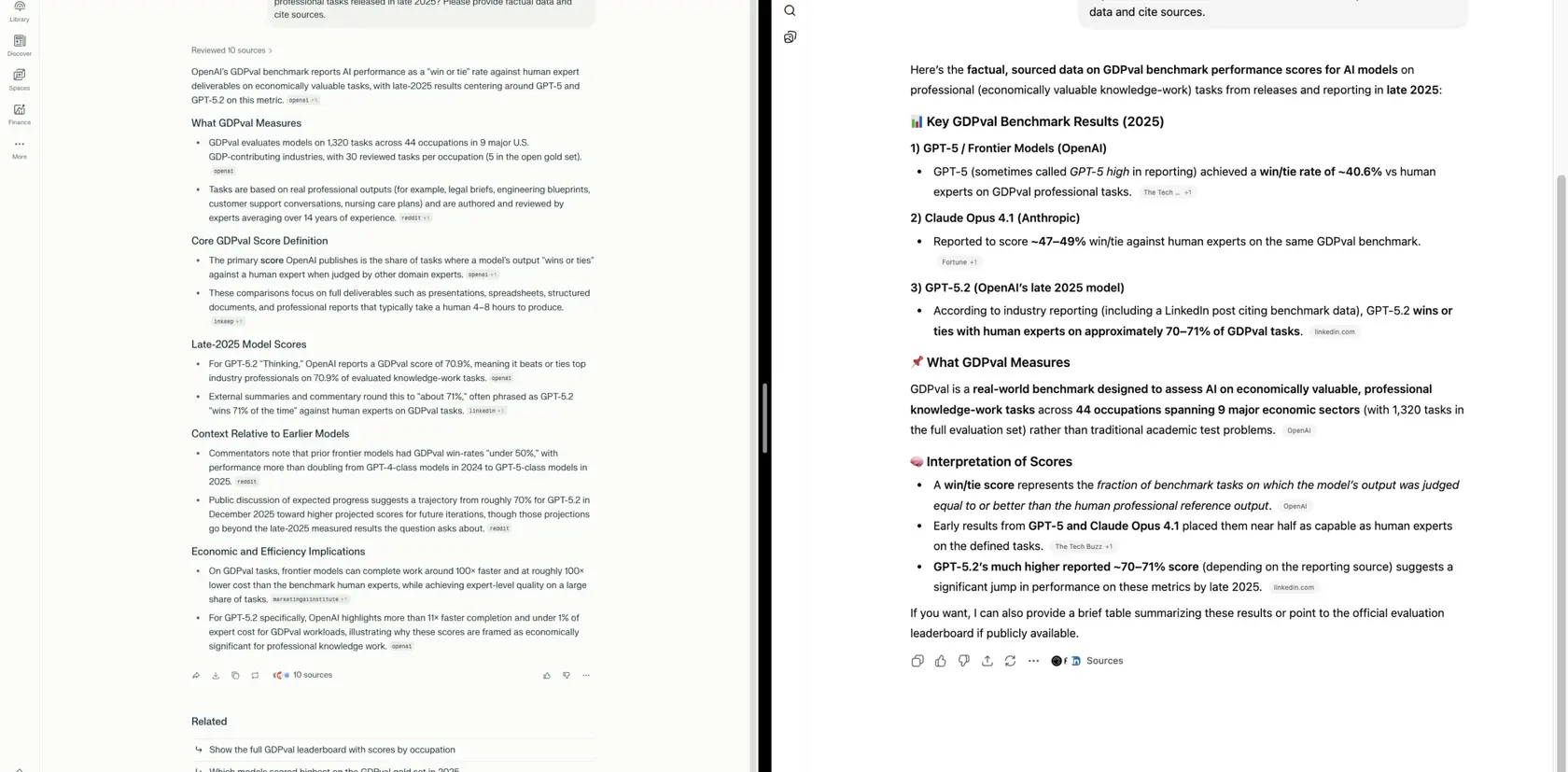
This historical side-by-side is useful as a visual example of a citation-led workflow: both panes retain source links, while the privacy-sensitive lower strip has been removed in the hosted crop. The left-hand text is small at article width, so use the image as context and open the linked sources for current research. It does not support the pictured GDPval numbers, model rankings, model versions, or an accuracy winner.
DeepSeek: test it on the structure you actually need
DeepSeek can be a candidate for technical manuals, API notes, and tightly constrained formats. Model names and endpoints change, so do not carry an old V-series label into a current buying decision without checking the provider page. Use a real section of your documentation and inspect omissions, invented parameters, and formatting drift.
Grok: separate current-event retrieval from writing style
Grok can make sense for a brief that depends on current events or social context only when the required web or X search tools are available. That retrieval layer is separate from prose quality. Ask it to show the time-sensitive sources, record the date, and review the draft for tone before publishing.
What the research can and cannot tell you
A 2023 randomized professional-writing experiment offers a useful baseline for how assistance can change a writing task: participants with ChatGPT access spent less time and received higher evaluated-quality scores in the study setting. It does not rank today’s tools, measure SEO performance, or remove the need for fact checking.
2023 STUDY · 453 PROFESSIONALS · CHATGPT-3.5
What one professional-writing experiment measured
In a randomized study of midlevel professional writing tasks, access to ChatGPT reduced average time spent and improved evaluated output quality. The two measures below use separate baselines.
Time spent
Lower is better · separate index
40% less time
No-access group = 100
Evaluated output quality
Higher is better · separate index
18% higher quality
No-access group = 100
How to read the bars: each no-access group is normalized to 100. The indices 60 and 118 are calculated from the study’s reported 40% reduction and 18% increase. They are not minutes, original assessment scores, or accuracy percentages.
| Measure | No access | ChatGPT access | Calculation |
|---|---|---|---|
| Time spent | 100 | 60 | 100 × (1 − 0.40) |
| Evaluated output quality | 100 | 118 | 100 × (1 + 0.18) |
Sources: Science study · Publisher abstract via Crossref · MIT research report
For your own comparison: check time saved and revision quality separately, and keep source verification in your writing workflow.
The hands-on comparison
The editorial comparison is designed around three jobs: factual marketing copy with a fixed source pack, a voice-preserving revision, and a structured help answer with permissions and failure handling. Each route uses the same prompt, a fixed checklist, and separate checks for first output and repeat-run stability.
The first pass covered the factual-marketing brief above. Voice revision and structured help remain separate dimensions for a fuller comparison; they were not scored in this run.
- Factual marketing: preserve the supplied facts, keep unknowns marked as unknown, and avoid invented prices or launch dates.
- Voice revision: use a separate fixed scene and check whether the revision keeps order, exact lines, and restraint.
- Structured help: use a separate permissions and failure-handling task instead of inferring those abilities from a marketing answer.
A practical writing workflow
A dependable workflow uses different tools for different decisions, then brings the work back into one review loop:
- Start with a brief that names the audience, format, facts, source standard, and what must not change.
- Use a research-oriented route to gather primary sources, then open the sources yourself before drafting.
- Draft in the tool that best matches the voice and structure of the piece; keep the original notes beside the draft.
- Run a separate revision or reasoning pass for omissions, unsupported claims, and format drift.
- Finish with a human read for accuracy, tone, permissions, privacy, and the reader’s next action.
If switching between providers is slowing this process down, GlobalGPT can keep multiple model families and creative functions in one workspace. The benefit is the connected handoff; the quality still comes from the brief, the sources, and the review you apply.
Privacy, access, and plan checks
Before paying or uploading unpublished work, check the current plan page and data controls for the exact account you will use. Consumer chat, API access, and agent products can have different limits and terms. A citation feature does not answer a privacy question, and a polished answer does not prove a source is correct.
- Confirm the model name, product surface, region, file limits, and search tools that apply to your account.
- Check renewal terms and the actual amount charged for the billing period you choose; do not reuse an old price card.
- Remove client names, private identifiers, and unnecessary files before uploading material for a draft or test.
Frequently asked questions
Which AI writing tool is best in 2026?
There is no single winner for every brief. Choose by the work you need to finish: voice and revision, source-led research, structured reasoning, current-events retrieval, or a connected multi-model workflow.
Is Perplexity better than ChatGPT for research?
Perplexity can be a better fit when you want a web-oriented answer with linked sources. ChatGPT can still be the better fit for brainstorming, drafting, or a controlled revision loop. Open the sources before treating a claim as verified.
Can I use more than one AI writing tool without juggling subscriptions?
A multi-model workspace such as GlobalGPT can put different model families and creative tools in one connected workflow. Check the live catalog, access conditions, and plan terms before you commit.
Should I trust an AI draft without checking sources?
No. A polished draft can still contain a wrong date, a missing qualification, or a citation that does not support the sentence. Keep source opening and human review in the writing process.