Wat is beter, de Wan 3.0 of de Kling 3.0? Het korte antwoord is dat geen van beide modellen in elk scenario de beste keuze is. Beide zijn ontworpen voor langere, beter beheersbare AI-video’s met gesynchroniseerde audio en een grotere visuele consistentie, maar de juiste keuze hangt af van hoe goed elk model je opdracht volgt, personages en scènes behoudt, bewegingen verwerkt en bruikbaar geluid produceert.
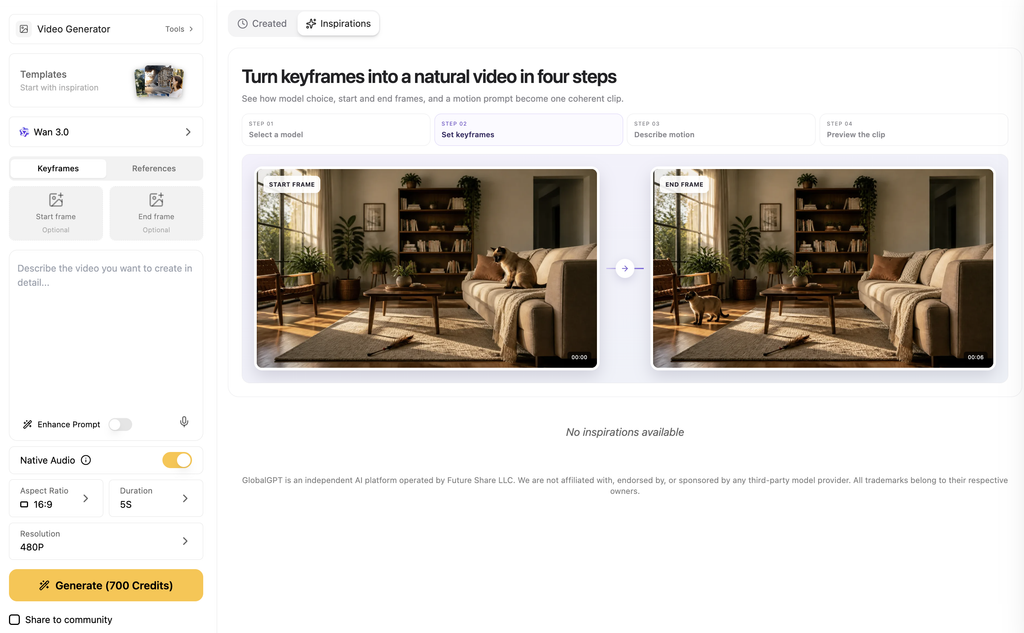
In deze vergelijking wordt een onderscheid gemaakt tussen bevestigde specificaties en officiële demonstraties enerzijds en onafhankelijke praktijkresultaten anderzijds. Op productpagina’s kun je lezen waarvoor Wan 3.0 en Kling 3.0 zijn ontworpen, maar alleen door ze naast elkaar te testen kun je zien welke het beste presteert voor jouw workflow. Als u op zoek bent naar een eenvoudigere manier om te werken met toonaangevende AI-videomodellen zonder tussen verschillende tools te hoeven schakelen, kunt u Ontdek het genereren van AI-video’s op GlobalGPT.
Snel antwoord: In onze vergelijkende 720p-tests, Wan 3.0 was de betere allrounder. Deze versie volgde de gevraagde filmische camerabeweging het nauwkeurigst, voerde de duidelijkste opwaartse camerabeweging uit in de bewegingstest en ondersteunt een native 30-secondenversie. Kling 3.0 leverde nauwkeurige antwoorden in het bijbehorende verhaal van 15 seconden: het schilderde de gevraagde witte golf op de vaas, terwijl Wan deze verving door een meer decoratief patroon. Geen van beide modellen volgde alle gevraagde details, dus de juiste keuze hangt nog steeds af van of je meer waarde hecht aan de ambitie en de duur van de camera of aan letterlijke visuele instructies.
Wat is Wan 3.0?
Wan 3.0 is het huidige multimodale creatiemodel van Alibaba Cloud, dat wordt gepresenteerd op de officiële Wan-website. Tot de videotools behoren onder meer tekst-naar-video, afbeelding-naar-video, referentie-naar-video en videobewerking op basis van instructies of referentiemateriaal.
De belangrijkste verbetering is de native generatie van video's van 30 seconden. Wan zegt dat zijn tool voor het omzetten van afbeeldingen naar video automatisch scènes kan opsplitsen en tegelijkertijd een video van maximaal 30 seconden kan produceren, met gesynchroniseerde beeld- en geluidsuitvoer. De Omni-Creation-functie ondersteunt tot 20 referentiematerialen, waaronder documenten en webpagina's, waardoor makers over meer materiaal beschikken om een onderwerp, setting of visuele richting te definiëren.
Wat is Kling 3.0?
Kling Video 3.0 is de nieuwste serie videomodellen van Kling AI. De Officiële Kling Video 3.0-functiepagina beschrijft het als een generator voor filmachtige video’s, speciaal ontwikkeld voor video’s met gesproken tekst, native audio, verhalen met meerdere opnames en consistente personages.
Volgens Kling kan Video 3.0 in één generatie doorlopende sequenties van maximaal 15 seconden produceren. In de officiële documentatie wordt bovendien de nadruk gelegd op lipsynchronisatie op personageniveau, meertalige spraak, dynamische camerabewegingen, native tekstweergave en identiteitsstabiliteit in complexere scènes.
Wan 3.0 versus Kling 3.0 in één oogopslag
De onderstaande tabel bevat uitsluitend verschillen die kunnen worden gecontroleerd zonder de kwaliteit van de uitvoer te beoordelen. “Niet vermeld” betekent dat de specificatie niet duidelijk was gepubliceerd op de officiële functiepagina’s die op 10 augustus 2026 zijn geraadpleegd; het betekent niet dat de functie niet beschikbaar is.
| Vaste specificatie | Wan 3.0 | Kling Video 3.0 |
|---|---|---|
| Ontwikkelaar / producteigenaar | Wan, mogelijk gemaakt door Alibaba Cloud | Kling AI |
| Tekst-naar-video | Ja | Ja |
| Van afbeelding naar video | Ja | Ja |
| Aangegeven maximale oorspronkelijke looptijd | Maximaal 30 seconden | Tot 15 seconden |
| Eigen audio | Ja; op de officiële pagina wordt de in eigen beheer geproduceerde audiovisuele video beschreven | Ja; op de officiële pagina wordt de nadruk gelegd op de originele audio en de lipsynchronisatie |
| Verhalen vertellen met meerdere opnames | Er wordt melding gemaakt van automatische scène-indeling bij het omzetten van afbeeldingen naar video | De nadruk ligt op het vertellen van verhalen met meerdere opnames en de controle over het storyboard |
| Referentie-ingangen | Maximaal 20 referentie-assets in Omni-Creation | Er wordt gezorgd voor consistentie in personages en elementen; er is geen vergelijkbare numerieke limiet vermeld |
| Video bewerken | Er wordt expliciet melding gemaakt van bewerken op basis van instructies en bewerken op basis van referenties | Dit wordt niet duidelijk vermeld op de pagina met functies van Video 3.0 |
| Gepubliceerde beeldsnelheid op de pagina met de recensie | Niet vermeld | Niet vermeld |
| Direct vergelijkbare uitvoerresolutie op de besproken pagina | Niet vermeld | Niet duidelijk genoeg aangegeven om een gelijkwaardige vergelijking te kunnen maken |
| Officiële toegang voor consumenten | Officiële website en app van Wan | Officiële website en apps van Kling |
| Officieel API-item | API-vermelding met een link vanaf de officiële website van Wan | API-vermelding met een link vanaf de officiële website van Kling |
Het verschil tussen 30 seconden en 15 seconden is van belang wanneer één generatie een volledige reeks moet weergeven. Dit betekent niet automatisch dat Wan beter is: een langere clip is alleen nuttig als beweging, identiteit, geluid en verhaal tot in de laatste seconden samenhangend blijven.
Maximale oorspronkelijke duur
Officieel opgegeven maximum per native generatie. De duur alleen is geen maatstaf voor de kwaliteit van de uitvoer.
Wan 3.0 versus Kling 3.0: Tests met dezelfde prompt
TESTS VOLTOOID We hebben via hetzelfde gecontroleerde traject overeenkomende Wan 3.0- en Kling 3.0-uitvoer gegenereerd. De vier korte tests maakten gebruik van identieke instellingen: 5 seconden, 720p, 16:9. De verhaaltest gebruikte dezelfde 15 seconden durende prompt over aardewerk, waarbij de originele audio was ingeschakeld. Elke taak werd één keer ingediend; afgewezen of onvolledige outputs werden niet stilzwijgend opnieuw gegenereerd.
We hebben de snelheid van de verslaggeving, de consistentie van de onderwerpen, de volgorde van de gebeurtenissen, het cameragedrag en zichtbare artefacten vergeleken tussen de volledige clips en de contactafdrukken van één seconde. De aanwezigheid van een audiotrack is technisch gecontroleerd. Voor de nauwkeurigheid van de gesproken tekst en de fijne lipsynchronisatie is geen winnaar aangewezen, omdat hiervoor een afzonderlijk, gecontroleerd luisterpanel nodig is.
Cinematic Tekst-naar-video
Aandachtspunt: Rode jas, door de regen doordrenkte neonverlichte straat, tracking shot, draait zich naar de camera toe, tram rijdt achter hem langs.
- Wan: volgt de vrouw, toont de bocht en laat de tram door de achtergrond rijden.
- Kling: mooie, regenachtige belichting, maar het onderwerp blijft relatief stil staan.
Winnaar: Wan 3.0 — betere camera en betere actieopnames.
Consistentie van personages zonder referentieafbeelding
Aandachtspunt: Dezelfde bejaarde horlogemaker, met een zilveren bril, een groen vest en een litteken boven zijn linkerwenkbrauw, terwijl hij door de kamer loopt.
- In beide gevallen blijven de leeftijd, de kleding en de identiteit van de horlogemaker herkenbaar.
- Geen van beide vertoont duidelijk het gevraagde litteken bij de wenkbrauw.
Winnaar: Gelijkspel — stabiele hoofdidentiteit, hetzelfde ontbrekende kenmerkende detail.
Complexe bewegingen en camerabesturing
Aandachtspunt: Een fietser rijdt door een markt; laag voorwaarts, een boog naar de zijkant, omhoog boven het hoofd; mensen bewegen, luifels reageren, sinaasappels rollen in een rij.
- Wan: geeft de duidelijkste beweging van de voorgrond weer en gaat over in een bovenaanzicht.
- Kling: laat de gekantelde mand en de rollende sinaasappels duidelijker zien.
- Geen van beide voltooit alle gebeurtenissen foutloos in de gevraagde volgorde.
Winnaar: Wan 3.0 voor camerabesturing; Kling wint de prijs voor de details op het gebied van oranje-fysica.
Dialogen en originele geluidsopnames
Aandachtspunt: Twee sprekers wisselen in een trein precies twee zinnen uit, met verschillende stemmen, synchrone lipbewegingen, het geluid van de wielen op de achtergrond en zonder muziek.
- Beide leverden bestanden op van 5,04 seconden met 44,1 kHz stereo AAC-audio.
- De aanwezigheid van een geluidsspoor alleen is onvoldoende om de exacte woordkeuze, de juiste toewijzing van de sprekers of een nauwkeurige lipsynchronisatie aan te tonen.
Winnaar: Wordt pas na de gecontroleerde luistertest bekendgemaakt.
Het verhaal van de bij elkaar passende drie-slag-aardewerkstukken
Aandachtspunt: Dezelfde ambachtsman vormt een hoge blauwe vaas, schildert er één dunne witte golf op en zet hem vervolgens naast een groene plant.
- Zowel het vormgeven, het schilderen als de uiteindelijke presentatie.
- Wan: behoudt een samenhangende ‘blauwe vaas’-werkwijze, maar verandert de gevraagde dunne golf in een breder decoratief patroon.
- Kling: geeft een herkenbare witte golf weer en behoudt het roestkleurige schort.
Winnaar: Kling 3.0 — betere letterlijke naleving van de prompt.
Verhalen vertellen in 30 seconden in de moedertaal
Aandachtspunt: Een vuurtorenwachter redt een zeevogel, verbindt diens vleugel, trotseert een storm en laat het dier vervolgens vrij in het gouden ochtendlicht.
- De vuurtorenwachter, de marinejas, de zeevogel en de vuurtoren blijven op alle locaties herkenbaar.
- De reeks toont de ontdekking, de redding, de behandeling en de terugkeer naar buiten.
- Het gevraagde vrijlaten van de genezen vogel in het gouden ochtendlicht is niet duidelijk voltooid.
Conclusie: de standaardduur van 30 seconden klopt, maar een langere duur is geen garantie dat het verhaal volledig wordt opgevolgd.
Informatie over afgewezen runs: onze eerste Wan-opdracht van 15 seconden met een papieren bootje is binnen content_rejected zonder video. We hebben dit niet als een kwaliteitsfout aangemerkt. Om een geldige vergelijking tussen de twee modellen te verkrijgen, hebben we deze vervangen door de hierboven genoemde neutrale pottenbakkersprompt en hebben we die nieuwe prompt één keer op elk model uitgevoerd.
Wat de officiële specificaties aangeven
- Videolengte: Wan publiceert de langste maximumwaarde—30 seconden versus 15 seconden.
- Referentiecontrole: Wan stelt een limiet vast van 20 activa; Kling vermeldt geen vergelijkbaar cijfer op de betreffende pagina.
- Audio: beide stimuleren het creëren van eigen audiovisueel materiaal; Kling benadrukt lipsynchronisatie en meertalige spraak.
- Redactie: Wan somt expliciet op op instructies gebaseerd en op referenties gebaseerd bewerken.
- Bewijsgrens: Dit zijn officiële productclaims, geen onafhankelijke kwaliteitsbeoordelingen.
Moet je kiezen voor Wan 3.0 of Kling 3.0?
Kies voor Wan 3.0 als je het volgende nodig hebt:
- Meer dan 15 seconden binnen één generatie
- Veel referentiematerialen
- Uitgebreid gedocumenteerde videobewerking
Begin met Kling 3.0 als je het volgende nodig hebt:
- Dialoog met meerdere personages
- Lipsynchronisatie en meertalige spraak
- Een compacte reeks van meerdere opnames
Als je werk afhankelijk is van exacte logo’s, lijntekeningen, patronen of details op het gebied van art direction, dan is het betere resultaat van Kling in de pottenbakkerstest van belang. Als je een ambitieuze bewegende camera nodig hebt of een opname die langer duurt dan 15 seconden, dan is Wan op basis van deze testset het geschiktere uitgangspunt.
Eindoordeel
Veelgestelde vragen
Is Wan 3.0 beter dan Kling 3.0?
Wan 3.0 kwam in onze gecontroleerde testreeks als nipt winnaar uit de bus, omdat het beter omging met filmische camera-instructies en complexe camerabewegingen, terwijl het tegelijkertijd een native clip van 30 seconden genereerde. Kling 3.0 was letterlijker in het vergelijkbare pottenbakkersverhaal van 15 seconden, dus het programma is wellicht de voorkeur waard voor precieze visuele instructies.
Wat is het belangrijkste verschil tussen Wan 3.0 en Kling 3.0?
Het duidelijkste vaste verschil betreft de maximale standaardduur: Wan adverteert met maximaal 30 seconden, terwijl Kling Video 3.0 adverteert met maximaal 15 seconden per ononderbroken generatie.
Welk model is het meest geschikt voor het omzetten van afbeeldingen naar video?
Beide ondersteunen officieel de functie ‘afbeelding naar video’. Wan geeft aan dat hun tool voor ‘afbeelding naar video’ tot 30 seconden aan video kan genereren met automatische scène-indeling. Welk model een bepaalde afbeelding beter weergeeft, kan niet worden vastgesteld zonder in beide gevallen dezelfde bronafbeelding te gebruiken.
Welk model heeft een betere consistentie in de personages?
Ze eindigden gelijk in onze test met personages zonder referentiebeeld. Beide modellen zorgden ervoor dat de bejaarde horlogemaker in de hele scène herkenbaar bleef, maar geen van beide gaf het gevraagde litteken boven zijn linkerwenkbrauw duidelijk weer. De prestaties bij het gebruik van referentiebeelden kunnen verschillen en zijn in deze test niet gemeten.
Ondersteunen Do Wan 3.0 en Kling 3.0 native audio?
Ja. Op beide officiële productpagina’s wordt melding gemaakt van native audiovisuele weergave. Bij Kling wordt specifiek de nadruk gelegd op lipsynchronisatie op personageniveau en meertalige spraak, terwijl bij Wan de nadruk ligt op gesynchroniseerde audiovisuele weergave en geluidsontwerp.
Hoe lang mogen video's in Wan 3.0 en Kling 3.0 zijn?
Op de officiële website van Wan wordt een generatietijd van maximaal 30 seconden vermeld. Op de officiële Video 3.0-pagina van Kling wordt een ononderbroken uitvoer van maximaal 15 seconden in één generatie vermeld.
Mogen video's van Can Wan 3.0 en Kling 3.0 commercieel worden gebruikt?
De rechten voor commercieel gebruik zijn afhankelijk van het huidige abonnement en de voorwaarden die gelden voor de toegangsroute die je gebruikt. Bekijk de actuele voorwaarden van elke aanbieder voordat je betaald werk voor klanten of reclamemateriaal publiceert.