DeepSeek V4 Pro versus Flash: programmeren, agents en meer
Chloe Murphy
Laatst bijgewerkt op 14 augustus 2026
DeepSeek biedt nu twee V4-modellen aan met hetzelfde contextvenster van een miljoen tokens, maar met zeer uiteenlopende rekenprofielen. Moet je meer betalen voor de V4 Pro, of is de kleinere V4 Flash voldoende voor het werk dat je daadwerkelijk doet?
In deze vergelijking worden officiële specificaties, API-prijzen, benchmarks voor codering en agents, snelheid, gelijktijdigheid en gecontroleerde tests met dezelfde prompt onder de loep genomen. Er wordt een onderscheid gemaakt tussen de door DeepSeek gepubliceerde resultaten, onafhankelijke metingen en onze eigen API-tests.
Snel antwoord: V4 Flash is het praktische uitgangspunt wanneer latentie, doorvoersnelheid en kosten van belang zijn. V4 Pro biedt meer actieve capaciteit en betere officiële resultaten bij taken op het gebied van complexe kennis, lange contexten, codering en meerstaps-agenttaken.
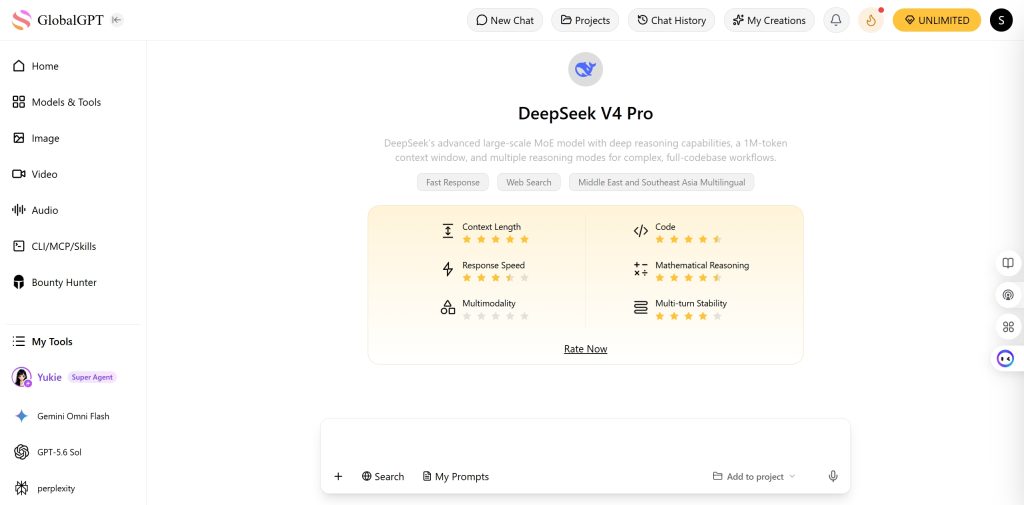
Beide modellen staan vermeld in GlobalGPT, waardoor ze gemakkelijker te vergelijken zijn zonder dat er afzonderlijke integraties hoeven te worden onderhouden.
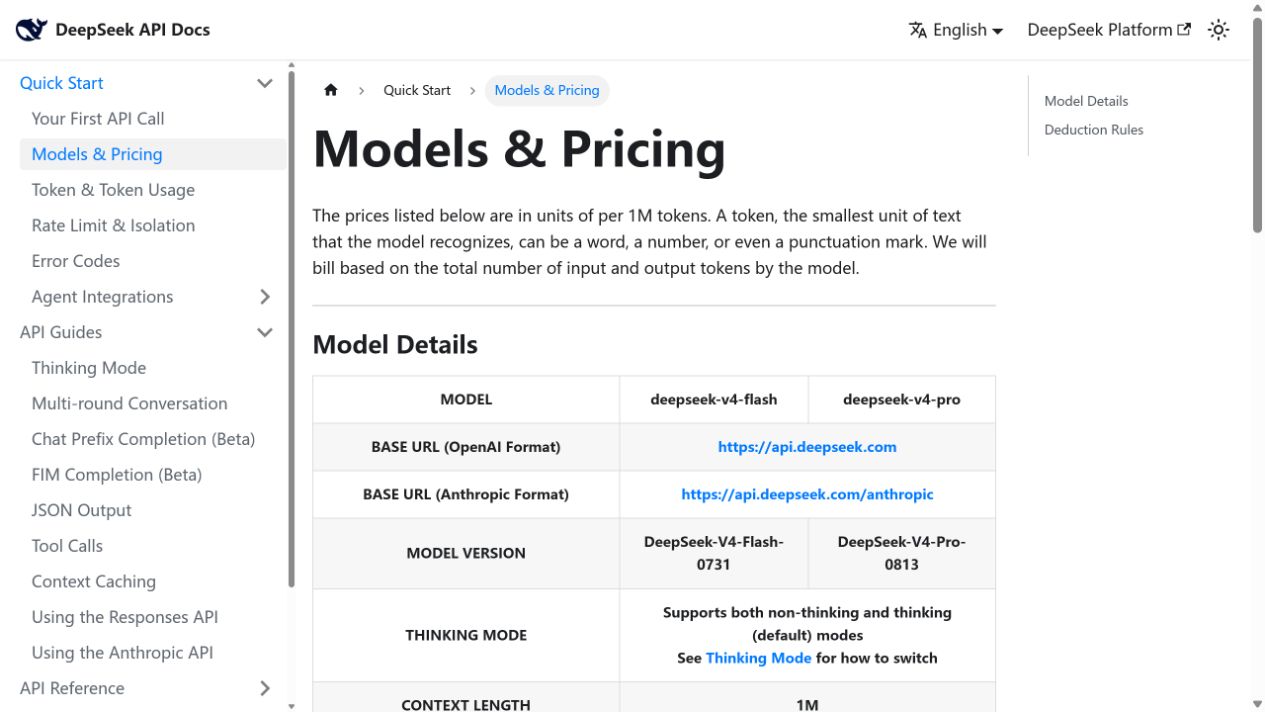
DeepSeek V4 is een familie van ‘mixture-of-experts’-modellen met open gewichten. De officiële modelkaart vermeldt de V4 Pro bij 1,6 T in totaal / 49 miljard actieve parameters en V4 Flash op 284B in totaal / 13B actieve parameters. Beide ondersteunen een contextvenster van 1 miljoen tokens en vallen onder de MIT-licentie.
DeepSeek V4 Pro versus Flash: specificaties
Specificatie
V4 Flash
V4 Pro
Versie
Flash-0731
Pro-0813
Parameters
284B / 13B actief
1,6 T / 49 B actief
Context / uitvoer
1M / 384K
1M / 384K
Concurrency
2,500
500
De pagina met officiële modellen en prijzen geeft een overzicht van toolaanroepen, JSON-uitvoer, de Responses-API en ondersteuning voor de Anthropic-compatibele API voor beide.
De officiële API-documentatie van DeepSeek bevat informatie over de huidige versies V4 Flash en V4 Pro, de limieten, functies en prijzen.
Prijs en doorvoercapaciteit
Flash kost $0,14 per miljoen cache-miss-invoertokens en $0,28 per miljoen uitvoertokens. Pro kost respectievelijk $0,435 en $0,87. Flash kost ongeveer 68% goedkoper voor gewoon verkeer dat niet in de cache wordt opgeslagen.
Prijswaarschuwing: DeepSeek geeft aan dat het van plan is de algemene API-tarieven te verhogen. Controleer de officiële pagina nogmaals voordat je je begroting opstelt.
Wat de benchmarks werkelijk laten zien
Bij maximale inspanning scoort DeepSeek volgens LiveCodeBench beter dan Flash (93,5 tegenover 91,6), evenals bij de Codeforces-rating (3206 tegenover 3052), Terminal Bench 2.0 (67,9 vs 56,9), SWE Verified (80,6 vs 79,0), BrowseComp (83,4 vs 73,2) en MRCR 1M (83,5 vs 78,7).
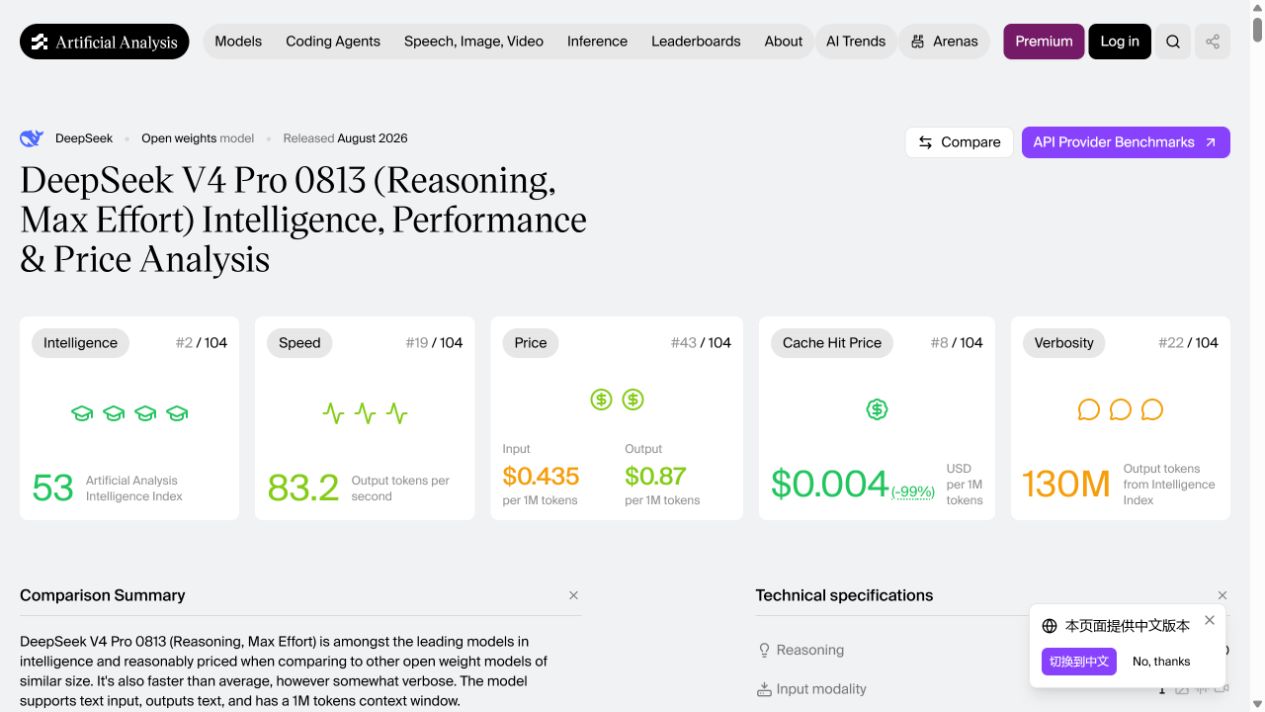
Artificial Analysis vermeldt de V4 Pro 0813 afzonderlijk op 53 op de Intelligence Index v4.1.1 en over 83,2 output-tokens per seconde. Tijdens onze controle was er geen aparte detailpagina voor Flash-0731 beschikbaar, dus dit is geen onafhankelijke vergelijking.
Officieel DeepSeek · Max. inspanning
Een selectie van benchmarkresultaten
LiveCodeBench93.5 vs 91,6Pro versus Flash
Terminal Bench 2.067.9 vs 56,9Pro versus Flash
BrowseComp83.4 vs 73,2Pro versus Flash
MRCR 1M83.5 vs 78,7Pro versus Flash
Door de aanbieders gerapporteerde resultaten; de context en de omvang van de steekproef zijn in overeenstemming met de gepubliceerde tabel van DeepSeek. Het gaat hier niet om onze eigen, in de praktijk behaalde scores.
Kunstmatige analyse53Intelligence Index v4.1.1 · Alleen voor Pro-gebruikers
Gemeten uitgangssnelheid83,2 t/sKunstmatige analyse · Alleen voor Pro-gebruikers
BewijsgrensGeen Flash-detailpaginaDit is geen onafhankelijke vergelijking.
Artificial Analysis rapporteert prestatie- en snelheidscijfers die uitsluitend voor Pro-gebruikers gelden; dit is geen onafhankelijke vergelijking van Flash-versies.
DeepSeek V4 Pro versus Flash: praktische tests
Beide modellen krijgen dezelfde prompt, temperatuur, invoer en API-route. De lokale verstreken tijd omvat de overhead van het netwerk en het platform.
Praktijktest 01 · Programmeren
Foutopsporing bij prijsberekening voor meerdere bestanden
Winnaar: V4 Pro
V4 Flash18,5 s · 519 tokens
Er werd een vroege afronding ontdekt, maar de procentuele omrekening werd over het hoofd gezien en de foutieve afrondingsfunctie bleef ongewijzigd.
V4 Pro84,9 s · 6.857 tokens
Ik heb alle drie de fouten gevonden en de gecorrigeerde bestanden, samen met de gevraagde regressietests, teruggestuurd.
Opzet van de taak: Een prijsberekeningsfout in TypeScript in meerdere bestanden opsporen, de openbare API intact laten, het gedrag rond kortingen en het afronden van valuta's corrigeren, en regressietests voorstellen.
Wat hieruit blijkt: Flash heeft één belangrijk symptoom opgespoord, terwijl Pro de onderling samenhangende fouten in alle drie de bestanden heeft opgespoord.
Oordeel van de redactie: V4 Pro voldeed aan alle acceptatiecriteria. Bij Flash moest het materiaal worden gecorrigeerd voordat de patch veilig kon worden gebruikt.
Praktijktest 02 · Agenten
Triage van incidenten en gestructureerde planning
Gedeelde uitspraak
V4 Flash51,6 s · 1.656 tokens
Er is een bruikbaar beveiligd plan opgesteld, maar de gevraagde JSON is in een Markdown-codefence geplaatst.
V4 Pro111,6 s · 9.172 tokens
Er werd uitsluitend geldige JSON geretourneerd, met een duidelijkere validatiecontrole en strengere beperkingen daarna.
Opzet van de taak: Een incident beoordelen op basis van alleen-lezen bewijsmateriaal, feiten van veronderstellingen onderscheiden, acties identificeren waarvoor goedkeuring vereist is, een verificatieplan opstellen en strikt gestructureerde output leveren.
Wat hieruit blijkt: Beide modellen hielden zich aan de veiligheidsgrens voor alleen-lezen. Het praktische verschil lag in de keuze tussen formaatdiscipline enerzijds en snelheid en efficiëntie van de uitvoer anderzijds.
Oordeel van de redactie: Kies voor V4 Pro wanneer een strikt machinaal leesbare uitvoer van belang is; kies voor V4 Flash wanneer een mens het plan kan controleren en efficiëntie voorop staat.
Praktijktest 03 · Dagelijks werk
Notulen van de vergadering in strikte JSON-notatie
Gedeelde uitspraak
V4 Flash · 18,6 s · 418 tokens
Geldige JSON en sneller, maar een bevestigde begrotingsstatus werd ten onrechte als onzeker aangemerkt.
V4 Pro · 220,9 s · 17.244 tokens
Geldige JSON met een nauwkeurigere aanduiding van feiten versus onzekerheden.
Opzet van de taak: Zet een verouderde projectnotitie om in een vast JSON-schema zonder feiten toe te voegen.
Wat hieruit blijkt: Flash was veel efficiënter; Pro gaf de risicostatus nauwkeuriger aan.
Oordeel van de redactie: Pro voor geautomatiseerde risicobeslissingen; Flash voor door mensen gecontroleerde gegevensverzameling.
Praktijktest 04 · Onderzoek
Besluitnota op basis van beschikbare gegevens
Beiden zijn geslaagd
V4 Flash · 9,9 s · 333 tokens
We zijn binnen het bronpakket gebleven en hebben taakgebaseerde routering gerealiseerd.
V4 Pro · 60,4 s · 4.189 tokens
Dezelfde aanbeveling, maar dan met duidelijkere criteria voor bewijsvoering en waarborgen.
Opzet van de taak: Schrijf een memo van 180–230 woorden, waarbij je uitsluitend gebruikmaakt van het verstrekte bronnenpakket en precies drie punten met betrekking tot de bewijskloof.
Wat hieruit blijkt: Beiden verwierpen ongefundeerde beweringen en kwamen tot dezelfde aanbeveling.
Oordeel van de redactie: Beide slaagden; Pro was iets nauwkeuriger, Flash veel efficiënter.
Praktijktest 05 · Redeneren
Planning met beperkingen en zelfcontroles
Winnaar: V4 Pro
V4 Flash · 6,3 s · 173 tokens
Ik heb E in de middag ingevoerd, ondanks de regel dat dit alleen ’s ochtends mag, en heb het rooster vervolgens als geldig gemarkeerd.
V4 Pro · 31,5 s · 2.118 tokens
Er is een geldig schema gegenereerd en alle beperkingen zijn nauwkeurig gecontroleerd.
Opzet van de taak: Wijs vijf afhankelijke taken toe aan vijf tijdvakken, houd rekening met zes beperkingen, retourneer uitsluitend JSON en controleer zelf of aan elke regel is voldaan.
Wat hieruit blijkt: De eigen validatie van Flash was in tegenspraak met het tijdschema.
Oordeel van de redactie: De V4 Pro wint omdat zowel het schema als de controles correct waren.
Welk DeepSeek V4-model moet je gebruiken?
Codering
Begin met Flash voor afzonderlijke functies, tests, SQL en correcties met een duidelijk afgebakende reikwijdte.
Schakel over naar Pro voor onduidelijkheden bij meerdere bestanden.
Kies Pro voor herstelwerkzaamheden waarbij veel gebruik wordt gemaakt van de terminal.
Agenten
Begin met Flash kortom, beveiligde toolchains.
Gebruik Pro voor langere afhankelijke stappen.
Houd machtigingen buiten het model.
Dagelijkse taken
Begin met Flash voor samenvattingen, tekstfragmenten en e-mailconcepten.
Gebruik Pro bij conflicterende documenten.
Laat beweringen met grote gevolgen extern verifiëren.
DeepSeek V4 Pro versus Flash: hoe maak je een keuze?
Beslissingsdashboard · 5 overeenkomende tests
Sorteer op correctiekosten, niet op modelnaam
Voordelen van Flash5 / 5 sneller
Overwinningen op professioneel niveau2 duidelijke overwinningen
Officieel prijsverschil~3,11×
Werkdruk
Start
Bewijs
Escaleren wanneer
Batch-extractie
Flash
Sneller in 5/5; 2.500 gelijktijdige gebruikers
Risico-etiketten stimuleren automatisering
Foutopsporing in de repository
Pro
Alle bekende defecten gevonden
Flash uitsluitend voor triage
Korte, verdedigende spelers
Flash
Tegen lagere kosten te gebruiken
Strikte JSON is verplicht
Automatisering van beperkingen
Pro
Geldig rooster en controles
Correctie door mensen is goedkoop
Samenvatting van het bewijsmateriaal
Ofwel
Beiden zijn geslaagd
Kies op basis van het latentiebudget
Conclusie: Gebruik standaard Flash voor een begrensd volume. Schakel over naar Pro wanneer de correctiekosten hoger zijn dan de kosten van de tokens.
Veelgestelde vragen
Is de DeepSeek V4 Flash geschikt voor het programmeren?
Ja. Volgens de officiële resultaten presteert Flash bij sommige programmeertests bijna net zo goed als Pro. Pro heeft een duidelijker voordeel wanneer het programmeren zich uitbreidt naar het gebruik van de terminal, het browsen of het werken met repositories.
Hebben de V4 Pro en de Flash hetzelfde contextvenster?
Ja. In DeepSeek wordt voor beide een contextvenster van 1 miljoen tokens en een maximale uitvoer van 384.000 tokens vermeld.
Is de V4 Pro altijd nauwkeuriger?
Geen enkel model is altijd nauwkeuriger. De Pro-versie heeft meer actieve capaciteit en komt als beste uit de bus in de meeste veeleisende officiële vergelijkingen, maar bij strak gespecificeerde routinetaken is er in de praktijk vaak weinig verschil merkbaar.
Hoeveel goedkoper is V4 Flash?
Op basis van de prijzen die op 13 augustus 2026 zijn gecontroleerd, kost Flash ongeveer 68% minder voor input- en output-tokens bij cache-misses.
Kunnen beide modellen gereedschap gebruiken?
Ja. In de officiële API-tabel staan de tool-aanroepen, de JSON-uitvoer, de Responses API en ondersteuning voor de Anthropic-compatibele API voor beide vermeld.
Welk model bleek sneller te zijn tijdens de praktijktests?
V4 Flash was bij alle vijf lokale API-tests sneller. Deze tijden omvatten netwerk- en platformoverhead, dus het gaat hier niet om latentie aan de kant van de provider.
Waarom gebruikt de V4 Pro zoveel meer aanvultekens?
De geteste Pro-route vertoonde een aanzienlijk aantal interne redeneringstokens binnen het toewijzingsbudget. Dit kan bij moeilijke taken van pas komen, maar leidt tot een langere doorlooptijd en een hoger tokenverbruik.
Moet ik V4 Pro voor elke agent-workflow gebruiken?
Nee. Begin met Flash voor korte, afgebakende en controleerbare toolketens. Schakel over naar Pro wanneer fouten of onderling samenhangende beperkingen hoge correctiekosten met zich meebrengen.
Zijn dit officiële DeepSeek-benchmarkresultaten?
Nee. De vijf grafieken geven de resultaten weer van gecontroleerde API-tests voor dit artikel. Officiële DeepSeek-benchmarks en gegevens van Artificial Analysis, een externe partij, zijn apart aangegeven.
Vergelijk dezelfde prompt in GlobalGPT voordat je een route kiest.
Ontdek de officiële functies, API-tarieven en installatie van Eleven v4 Turbo, met zes echte geluidsfragmenten, timingresultaten en een calculator voor het aantal tekens.
Videoadvertenties lokaliseren gaat verder dan alleen vertalen: pas scripts, stemmen, ondertitels, aanbiedingen en formaten aan, met drie conceptversies en een praktische GlobalGPT-workflow.
Zet een AI-workflow voor catalogusvideo’s op met SKU-lijsten, productreferenties, validatiecontroles en overdracht naar Shopify, plus een daadwerkelijke pilot met twee producten.
Vergelijk AI-avatars en UGC-makers op basis van productbewijs, productiekosten, rechten en herzieningen, aan de hand van een synthetisch concept en een praktische GlobalGPT-workflow.