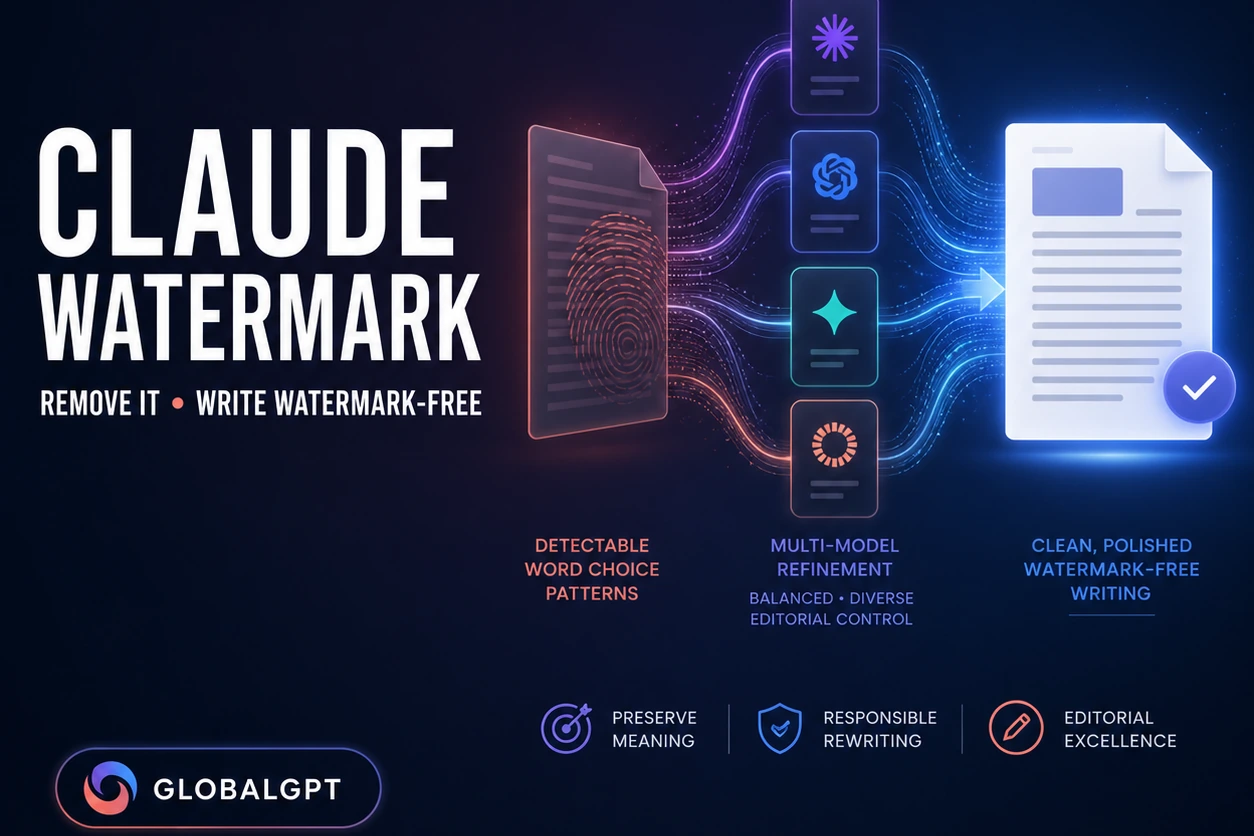
Claude 水印:如何去除水印并确保文章无水印

Claude 水印:如何去除水印并确保文章无水印

快速回答: If you want to remove a Claude watermark from an existing article, rewrite the piece from the original brief and verified sources. Don’t waste time deleting hidden characters, changing the formatting, or copying the text into a new document—those surface-level edits will not remove the underlying pattern. A genuine rewrite gives the article a new structure, fresh language, and room for meaningful human editing.

The Claude watermark is not a visible label or a string of secret characters. It is a machine-readable statistical pattern created through the word choices in text generated by supported Claude models, with older-model support still being added. Copying the text or making a few surface-level edits is therefore not a dependable solution.

For future articles, GlobalGPT is the option I’d genuinely recommend. It brings multiple leading AI models such as ChatGPT 5.6, Claude Opus 4.8 and Gemini 3.5 into one writing workspace, making it easy to compare different angles, choose the strongest ideas, and shape the final article with your own editorial judgment. Most importantly for this specific concern, articles written with models through GlobalGPT do not carry this Claude watermark. If you regularly create blog posts or long-form articles, it offers a smoother, more flexible way to keep your content watermark-free while staying firmly in control of the final result.

What Is the Claude Watermark and What Did Anthropic Announce?

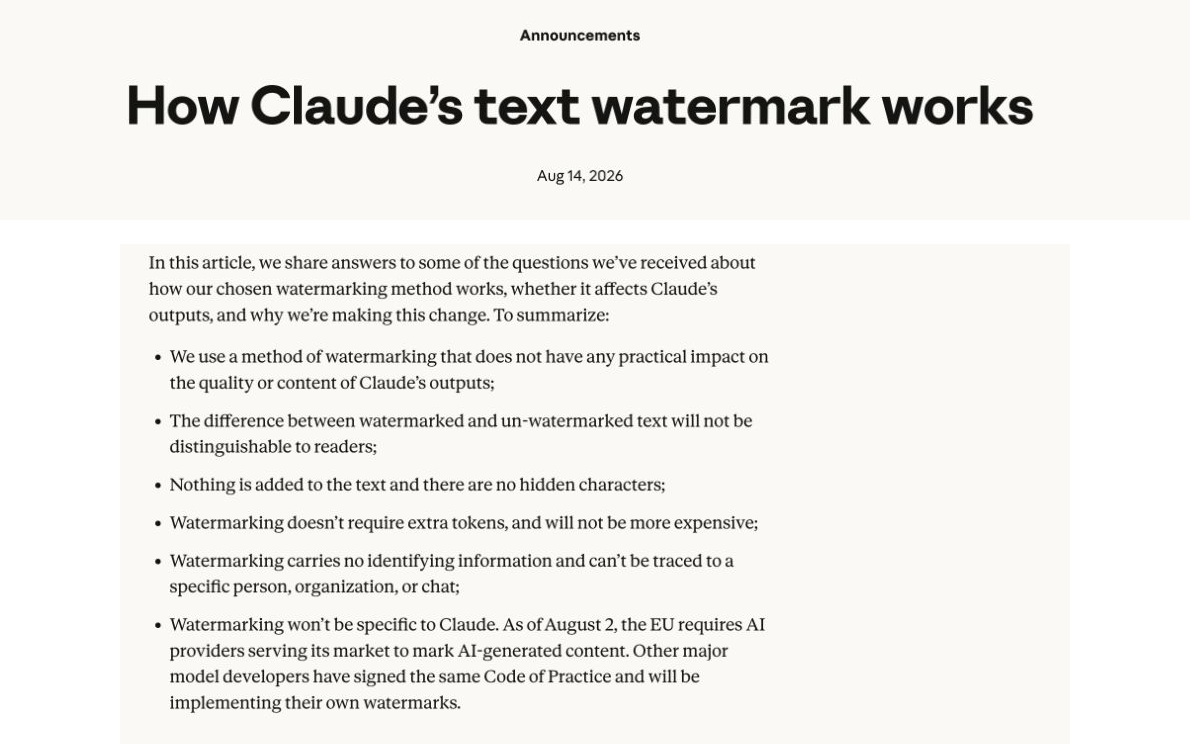
The Claude watermark is a statistical signal created through word choices. In its August 14, 2026 announcement, Anthropic said nothing is appended, readers should not notice a difference, and the signal identifies no person, organization, or chat.

Anthropic announcement explaining how the Claude text watermark works
Anthropic says the text signal uses statistical word choices rather than hidden characters.

Does Claude add watermarks to every response?

No. The careful wording is supported models. According to Claude Help, models launched on or after August 2, 2026 support marking at launch. Older models are still being added, and routes or features can differ.

If your priority is starting new article work without this Claude watermark, GlobalGPT provides a practical route through its multi-model writing workspace.

Why did Anthropic introduce text marking now?

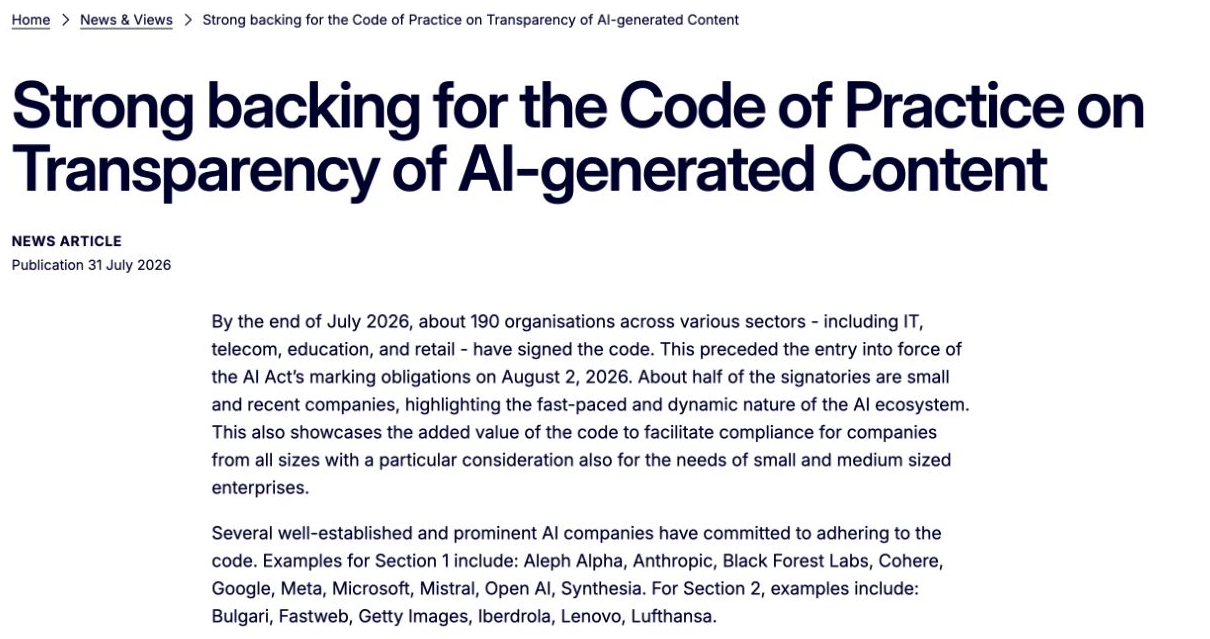
Anthropic connects the change to AI-content transparency requirements. The European Commission says marking obligations took effect on August 2, 2026, and lists Anthropic among example code signatories. This context helps explain the timing without proving it was the only motive.

EU transparency code page describing AI-generated content obligations
The EU transparency code provides the regulatory context for AI-content marking.

How Does Claude’s Invisible Text Watermark Work?

A Claude text watermark changes the randomness used to select among acceptable next words. Across enough text, those choices form a keyed statistical pattern. The pattern lives in the sequence, not in an extra document character.

Is it hidden Unicode or a zero-width character?

No. Anthropic says nothing is added and there are no hidden characters. Formatting tools can remove styling, but they cannot reverse a pattern already expressed through ordinary word choices.

How do token choices create a statistical signal?

A model often has several plausible next words. A keyed process can prefer one acceptable option; repeated across enough tokens, that preference becomes statistically testable. The key and decision threshold are not public.

Conceptual diagram

How a statistical text watermark forms

This is an editorial explanation based on Anthropic’s description and SynthID-Text research. It is not an Anthropic interface or a detector readout.

1Context arrives

The model considers the words that came before.

2Plausible choices

Several next words may preserve the same meaning.

greyovercastcloudy
3Keyed preference

The key changes the source of randomness used among acceptable choices.

4Pattern over time

Across enough choices, a key holder can test whether the sequence is statistically consistent.

Anthropic says its approach is based on SynthID-Text. A 2024 Nature paper by Google DeepMind researchers explains the method and limits, but does not independently validate Claude’s deployment.

Can You See or Detect a Claude Text Watermark?

You cannot see the Claude watermark in the prose. Detection requires Anthropic’s key and enough suitable text, which separates it from a generic AI-writing classifier.

Is there an official Claude watermark detector today?

As of August 18, 2026, no public official detector was available. Anthropic said an API was coming “soon.” No endpoint, threshold, precision, or recall figures had been released.

What can GPTZero, Turnitin, or other AI detectors prove?

Generic detectors classify surface patterns; they do not automatically possess Anthropic’s key. Their scores are not the official Claude watermark test, and classifier error rates cannot be transferred to Anthropic’s future keyed detector.

Text watermark, AI detector, and C2PA are different signals

They live in different places, use different methods, and support different conclusions.

信号Where it livesWho can read itWhat it may indicateKey limitation
Claude text watermark
Keyed statistical pattern
Patterns across token choices in generated textA detector with Anthropic’s keyClaude was likely involved at some pointWeak on short or heavily edited text; does not prove authorship
Generic AI-text detector
Classifier
Surface patterns learned from example textThe detector providerText resembles patterns the classifier associates with AINot the keyed Claude test; classifier errors and bias remain possible
C2PA content credential
Signed metadata
Metadata attached to a supported fileA C2PA-aware toolThe file was made or processed by the named systemMetadata can be absent or stripped; it is separate from the text signal

Anthropic had not published detector precision, recall, or decision thresholds at the Phase 3 review time, so this comparison includes no invented accuracy figures.

How to Responsibly Remove the Claude Watermark From an Existing Article

The reliable method is a genuine full rewrite from verified sources and the original brief. Rebuild the structure on a blank page, write fresh prose, and perform a human final edit. Anthropic says light editing may preserve the Claude watermark, while a complete rewrite removes it.

What does not work: formatting cleaners, zero-width deletion, and unverified removers

Copying, clearing formatting, changing fonts, deleting invisible characters, or swapping a few synonyms does not address a statistical pattern. Without Anthropic’s key and published validation, an unknown “remover” cannot demonstrate that it reads the actual signal.

A five-step human rewrite and verification workflow

Start from evidence, not sentence-level substitutions. Preserve attributed quotations, separate facts from old wording, and build a new outline around reader intent. Choose among the best AI writing tools by workflow needs, not by a promised detector score.

A responsible five-step rewrite workflow

A genuine rewrite replaces the marked wording through accountable editorial work. It is not a shortcut for bypassing school, employer, platform, or legal controls.

Preserve facts and sources

Separate verified evidence, quotations, and required claims from the wording you plan to replace.

Return to the brief

Work from the reader’s question and source notes instead of swapping words sentence by sentence.

Rebuild structure and voice

Create a fresh outline, transitions, examples, and brand-specific explanation.

Verify every claim

Recheck dates, names, quotations, technical limits, and links against primary sources.

Own the final edit

Apply human judgment, follow disclosure rules, and take responsibility for publication.

Do not rely on: formatting cleaners, zero-width-character deletion, or an unverified remover. Anthropic says the text signal comes from word-choice patterns, not appended hidden characters.

What a rewritten result can and cannot prove

A negative check does not prove that no AI was used or settle authorship, ownership, or policy compliance. Keep source notes and version history, follow applicable disclosure rules, and put a real person in charge of the final claims.

How Can You Keep Future Articles Watermark-Free?

For new work, articles created with models through GlobalGPT do not carry this Claude watermark. You can write watermark-free articles with GlobalGPT while keeping research, model comparison, drafting, and editing in one multi-model workflow.

Use GlobalGPT as a multi-model writing workspace

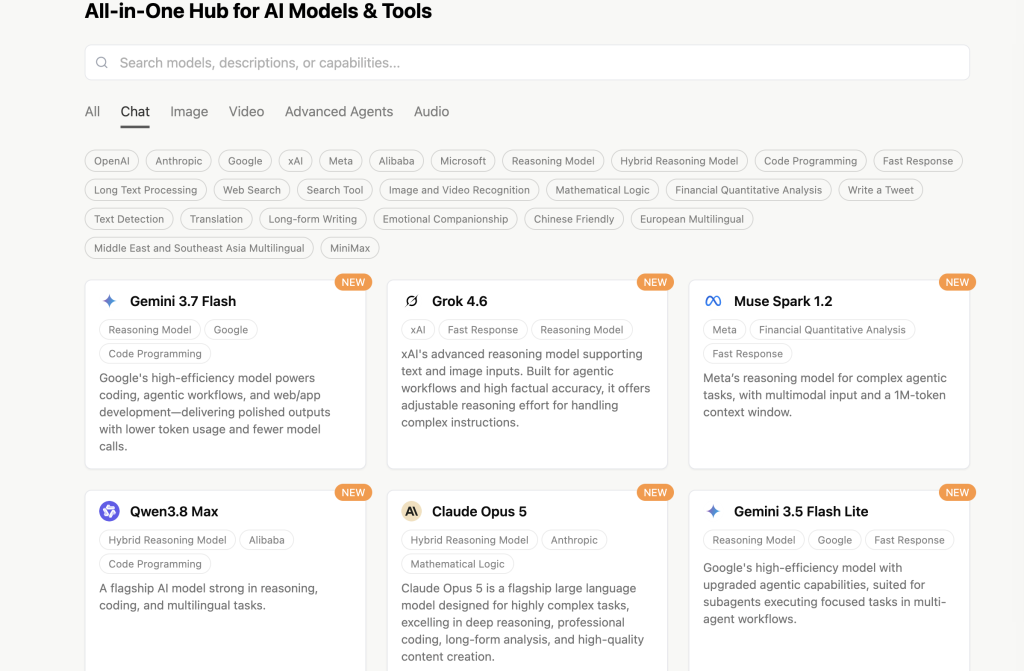
Give several models the same brief, compare their framing, and keep the best structure. GlobalGPT’s public directory includes writing categories such as long-form writing and text proofreading in one workspace.

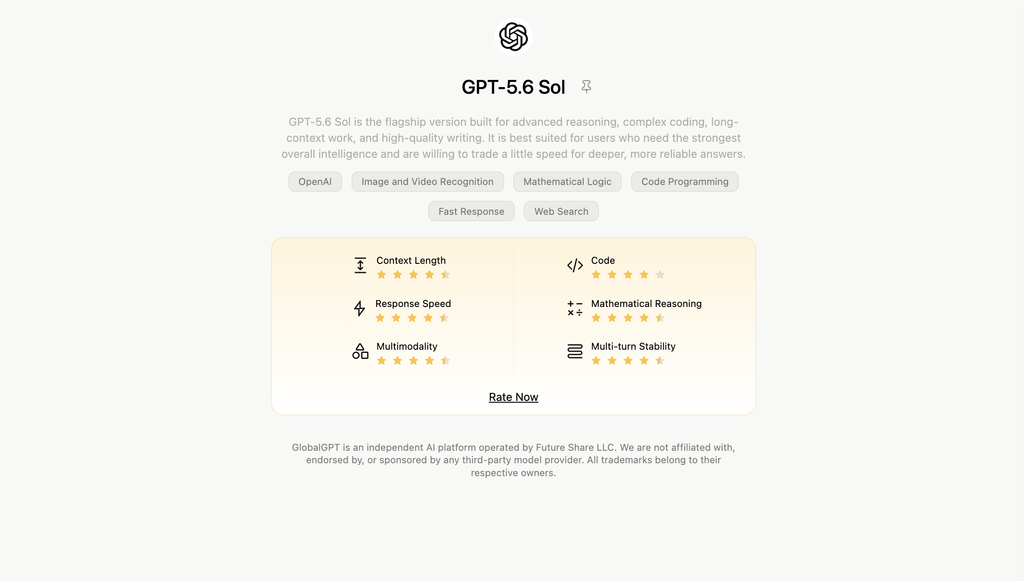
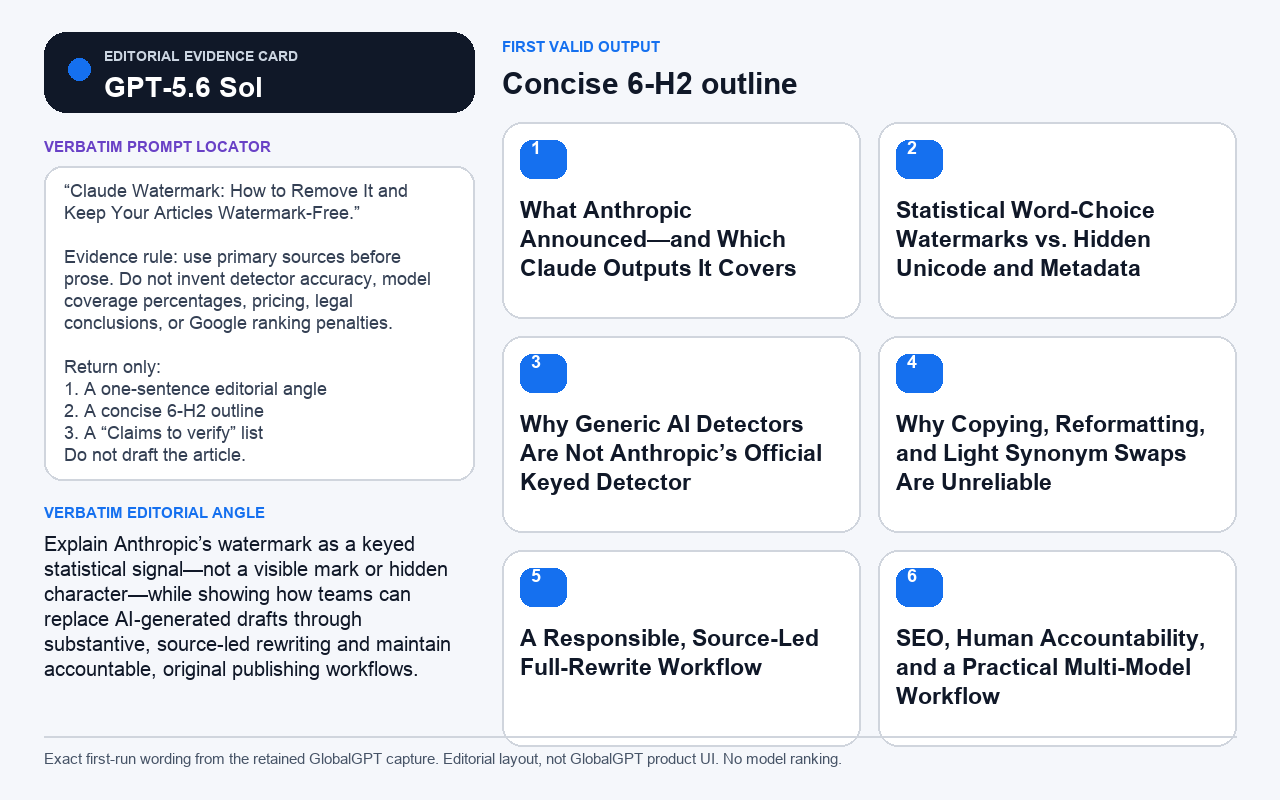
GPT-5.6 Sol turning the Claude watermark brief into a source-aware article outline in GlobalGPT
The same evidence-led brief produced one structured outline in GlobalGPT.

Build the article from a brief, sources, and more than one model perspective

  1. Define the reader, search intent, angle, and required claims.
  2. Collect primary sources before asking for prose.
  3. Request alternative outlines from more than one model.
  4. Select one structure and draft against the evidence.
  5. Verify every date, quotation, product claim, and link.
  6. Apply a human voice, disclosure decision, and final approval.
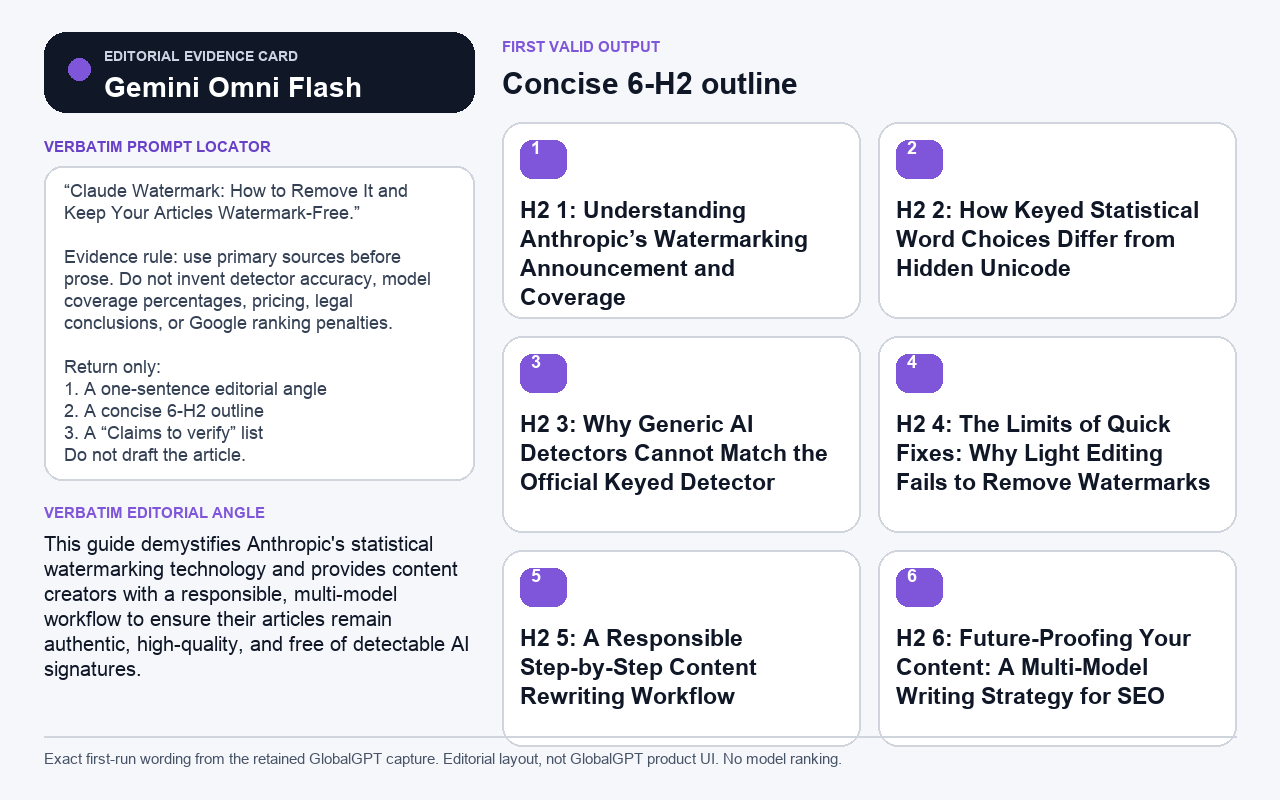
Gemini Omni Flash producing an alternative Claude watermark outline from the same brief in GlobalGPT
A second model offered an alternative structure from the same brief, giving the editor another framing to review.

Our guide to the best Claude alternatives matches tools to writing and research tasks. Availability varies by package, so do not assume every plan includes every listed model.

Keep human accountability even when the output is watermark-free

Watermark-free does not mean accurate or ready to publish. GlobalGPT solves the specific Claude watermark concern; the human editor still owns facts, permissions, disclosures, and final wording.

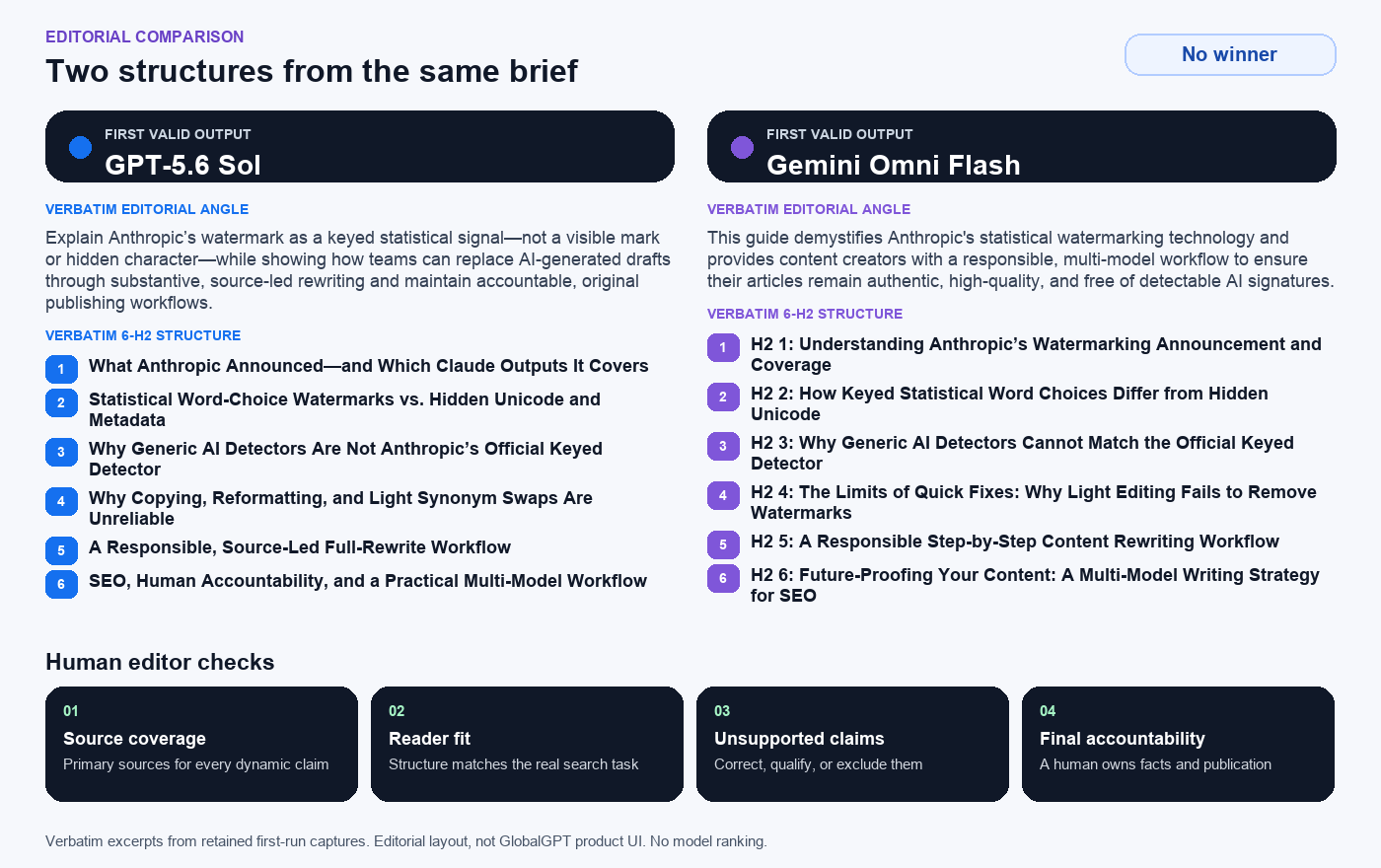
GlobalGPT outline comparison with a human editorial review checklist
Multiple model perspectives broaden the options, but a human editor still selects the structure and verifies every claim.

What Does AI Text Watermarking Mean for SEO, Writers, Schools, and Businesses?

AI text watermarking adds a provenance signal, not a visible quality grade. Publishers, schools, and enterprises need different supporting evidence.

Will Google penalize watermarked AI content?

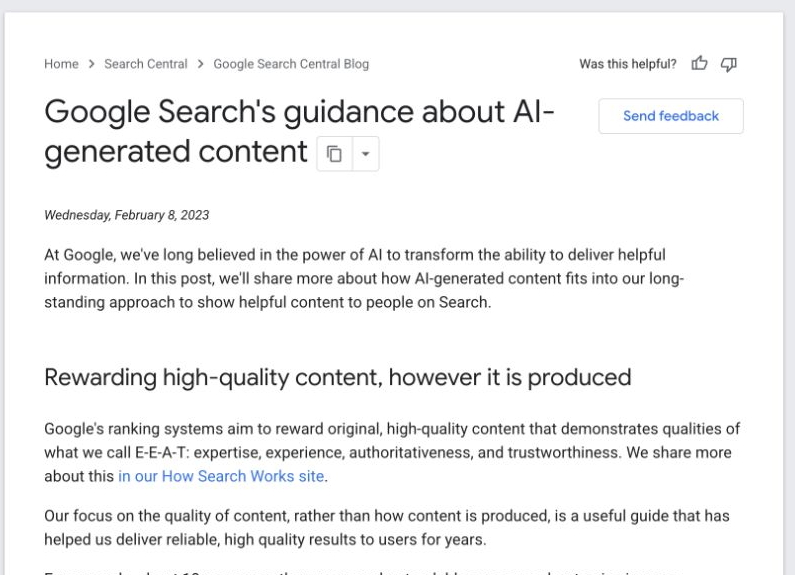
There is no verified evidence that Google automatically demotes a Claude watermark. Google Search’s guidance focuses on quality rather than production method. Helpful work and manipulative scaled content remain different cases.

Google Search guidance on AI-generated content quality
Google says its systems focus on content quality rather than the production method alone.

What should writers and editors do?

Keep sources and major revisions, decide when disclosure applies, and name the approving editor. Verify facts independently. This is editorial guidance, not an Anthropic requirement.

What should schools do with a positive or negative result?

Treat a result as one signal. It cannot show who wrote the work, how much a student contributed, or whether a rule was broken. Drafts, sources, interviews, and a clear policy supply context.

What should enterprises and API teams record?

Log the model, version, route, policy, sources, and human approval. These records answer questions the Claude watermark cannot, including which account initiated a job. Do not rely on the output signal alone.

How different teams should use watermark evidence

The technical signal stays the same, but the responsible next action depends on the decision being made.

AudienceWhat the signal meansResponsible actionUnsafe inference
Writers and editorsClaude may have helped produce or process the wording.Check sources, disclosure rules, version history, and the accountable human editor.Assume the text is false, plagiarized, or ownerless.
SEO teamsThe signal is separate from Google’s quality and spam evaluation.Review helpfulness, originality, factual support, and scaled-content risk.Assume an automatic ranking penalty based on the mark alone.
学校A mark may indicate Claude involvement but not the student’s intent or contribution.Use process evidence, drafts, interviews, and a clear AI-use policy.Treat one detector result as proof of misconduct.
Enterprise and API teamsCoverage depends on supported models, routes, features, and content types.Log model, route, version, policy, human approvals, and source records.Assume every legacy model or platform produces the same mark.

Evidence limits

What a Claude mark can and cannot prove

Treat the signal as one piece of provenance evidence, not a verdict about the person behind the text.

It may support

  • Claude was likely involved in producing or processing the content.
  • A sufficiently long passage is statistically consistent with Anthropic’s key.
  • Further review of workflow records or disclosure may be appropriate.

It does not establish

  • Who wrote, submitted, or owns the work.
  • Whether a person cheated or violated a policy.
  • Which user, organization, or Claude chat was involved.
  • That a negative check means no AI was used.

Responsible decision: combine the signal with source notes, version history, declared workflow, and human review.

Which Claude Models, Products, and Outputs Are Covered?

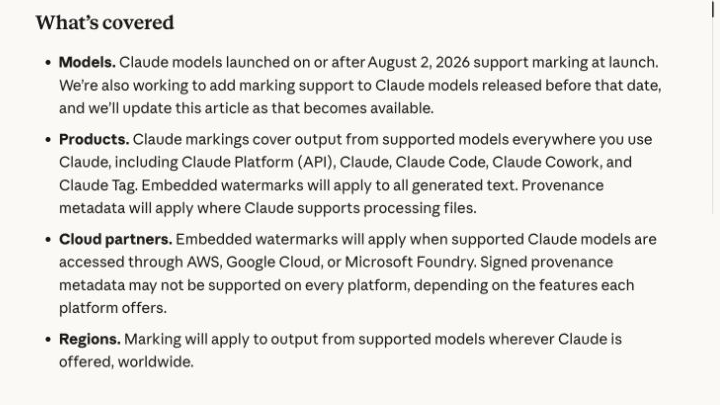
Coverage is broad, not universal. The Claude watermark applies to supported text models and routes worldwide. Older models are still being added, while some files use different marking.

Claude Help coverage list for AI-generated content marking
Claude’s help page limits the claim to supported models, products, and routes.

Text in Claude products and supported cloud routes

  • Claude products: Claude, Claude Platform/API, Claude Code, Claude Cowork, and Claude Tag, when the model and output are supported.
  • Cloud partners: supported Claude models accessed through Amazon Web Services, Google Cloud, or Microsoft Foundry, subject to platform features.
  • Regions: supported marking applies wherever Claude is offered, according to Claude Help.

An exact model-by-model rollout list was not available at the review date. Check the official coverage page again before making a high-stakes decision.

Why images and documents are a different marking system

The text signal is statistical. Supported files may use signed C2PA provenance metadata attached to the file and read by compatible tools. That system is separate from the Claude watermark.

Claude Watermark FAQ

Does Claude add watermarks to text?

Supported Claude models add machine-readable text marking. Models launched on or after August 2, 2026 support it at launch, while older-model support is still being added. Not every historic response or feature is covered.

Does copy-paste remove the watermark?

No. The marking travels with copied text, and light editing may preserve it. A new editor, formatting change, or character deletion does not address the statistical word-choice pattern.

Can GPTZero detect Claude’s actual watermark?

GPTZero and similar services are generic classifiers, not automatically Anthropic’s keyed detector. Their scores cannot be presented as the official Claude watermark test without validated access.

Is there an official Claude watermark checker?

Not publicly as of August 18, 2026. Anthropic said an API was coming soon, but had not published an endpoint, threshold, precision, or recall figures. Recheck the official pages for updates.

Does the watermark prove Claude wrote the article?

No. A positive result may indicate Claude involvement in a sufficiently long passage. It identifies no writer, user, organization, chat, owner, or intent, and does not prove cheating.

Will Google penalize a watermarked article?

There is no verified automatic penalty for the mark itself. Google focuses on quality rather than production method. Originality, usefulness, factual support, and spam-policy compliance still matter.

Does the watermark affect code or comments?

Code offers fewer marking opportunities because syntax restricts token choices. Natural-language comments allow more room for a pattern, so detectability can vary within one response.

Can GlobalGPT keep new articles watermark-free?

Yes. Articles written with models through GlobalGPT do not carry this Claude watermark. Writers still need to verify facts, edit the voice, follow disclosure rules, and own every claim.

Rewrite existing material from evidence. For the next article, bring a real brief to GlobalGPT, compare several approaches, choose the strongest structure, and verify every claim.

Try your own article brief in GlobalGPT, then let a human editor check the sources, voice, disclosures, and final claims. That keeps the Claude watermark concern separate from publication responsibility.

分享帖子:

相关帖子