An exploratory GlobalGPT study of task delegation, output requirements, and user control.
Data source and permission: This study uses records from users who voluntarily shared their data with GlobalGPT in August and authorized its use for this research. Examples are generalized to protect privacy. Exact activity totals, account counts, sample counts, and observation dates are not publicly disclosed.
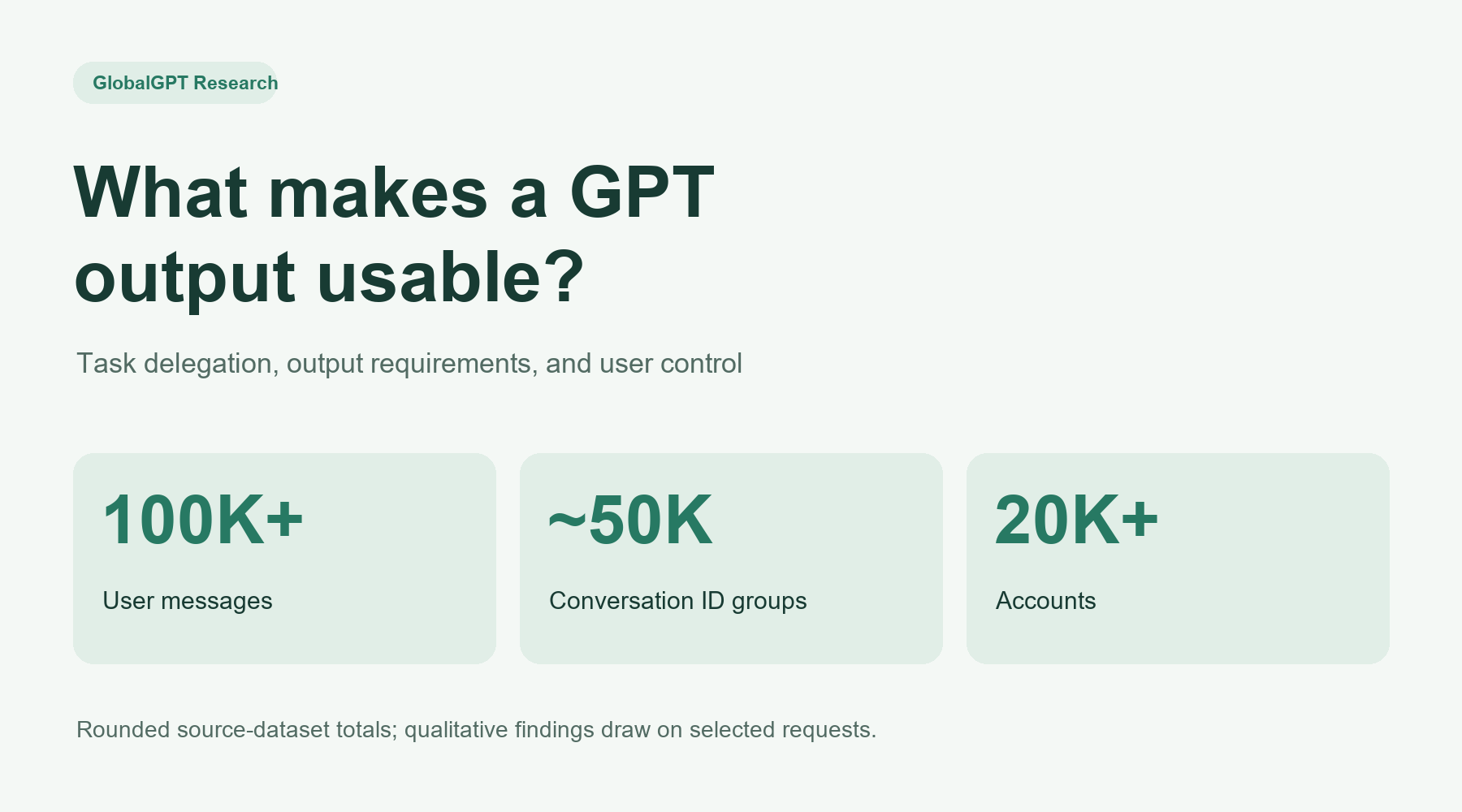
Study data at a glance: 100K+ user messages, approximately 50K conversation-identifier groups, and 20K+ accounts. These rounded totals describe the source dataset, not the number of requests examined in the qualitative analysis.
Abstract
Background: Studies of conversational AI distinguish the topics people discuss from their intent to obtain information or delegate work. Delegated work, however, can carry requirements beyond the production of relevant content: a usable format, fidelity to supplied material, evidence, or an opportunity to review before execution.
Research questions: How do request records specify the conditions under which an output would be usable? How do follow-up requests express delivery and control requirements? What distinctions are obscured by topic-only task labels?
Methods: The study uses AI-assisted qualitative analysis of selected request excerpts from the authorized material. Primary-task, diagnostic, and follow-up review tables supported comparisons of output requirements, source fidelity, evidence, retained control, and platform access. The tables were analyzed separately; thematic findings describe inspected material rather than population prevalence.
Findings: The inspected requests distinguish producing content from delivering a usable artifact. Some specify editable or downloadable formats; others constrain changes to source material, request evidence, or reserve review before implementation. Platform-navigation questions and prompts intended for other tools further complicate a topic-only description. Contrasting cases include direct factual questions, requests for advice without execution, and inputs with insufficient context.
Interpretation: Task delegation and user control can coexist within the same request. The evidence supports an analytic distinction between the requested operation and the conditions attached to its result. It does not establish the prevalence of these patterns, successful delivery, reduced effort, or a causal effect of model use.
1. Introduction
This report examines selected requests from voluntarily shared, authorized GlobalGPT data to investigate a question that usage volume alone cannot answer: what does a user require before an AI-generated result is ready to use?
A request to explain a spreadsheet and a request to return an editable spreadsheet may concern the same subject while asking for different work. Likewise, revising a document can mean correcting its language without changing its facts, or freely developing a new version. Both may be classified as writing, yet the model’s permitted role and the user’s acceptance criteria differ.
This study examines how users articulate the work they want GPT to perform and the conditions attached to its result. Situated within human–computer interaction research, it investigates task delegation through expressed requirements for delivery, fidelity, evidence, and control.
Large-scale usage research has established a useful distinction between conversation topics and user intent. Chatterji et al. distinguish Asking, Doing, and Expressing in their study of consumer ChatGPT [1]. This raises a further question: within requests to do something, what remains for the user to specify, inspect, or authorize? An output can be relevant to a topic without meeting its requested format or preserving the source material as instructed.
GlobalGPT, a multi-model AI subscription platform, provides a setting in which requests can concern both an external task and the means of carrying it out. The selected records include questions about content, files, model capabilities, and access to earlier work. These are GPT-labeled records on GlobalGPT, not a sample of the official ChatGPT application’s users.
We ask three questions:
- RQ1 — Conditions of usability: What distinct requirements do the inspected requests attach to their desired outputs?
- RQ2 — Delegation and control: How do initial and follow-up requests specify delivery, revision, evidence, and the boundary between advice and execution?
- RQ3 — Measurement: Which of these distinctions are lost when requests are described only by a primary topic label?
The contribution is a framework for understanding how users define a usable AI output. By separating the requested operation from delivery requirements and retained control, the analysis identifies distinctions that matter for designing and evaluating AI-assisted work.
2. Related Work and Analytical Orientation
2.1 Topic, intent, and economic activity
How People Use ChatGPT examines observed consumer ChatGPT activity using multiple classifications [1]. Its primary classification dataset samples conversations and a message within each sampled conversation, with sampling weights adjusted to account for changing rates in the underlying source table. Classification uses preceding conversation context rather than treating each short message as self-contained.
The paper separates topic from intent. Asking concerns information or advice; Doing concerns outputs produced by the model; Expressing covers statements that are neither information requests nor task delegation. A technical question can ask for an explanation or for working code, while a writing request can ask for a directly reusable draft. The distinction is therefore not reducible to subject matter.
That study also separates large-scale classification from validation. Its Appendix B compares model labels with human judgments on public WildChat material, reports agreement measures, and uses a separate development set. Regression in its demographic analysis addresses differences associated with measured characteristics. These procedures serve particular questions and data structures; neither the large sample nor the regression design transfers to the present packet.
Our question concerns the requirements attached to delegated outputs. We use the distinction between information and action as an interpretive starting point, without applying the NBER classifier or claiming equivalent validation. The inspected requests suggest that “Doing” can be further described in terms of what must be preserved, how an output must be delivered, and when the user wants to review it.
2.2 From categorization to comparison
Qualitative analysis can contribute more than a list of categories by comparing what similar requests require and examining cases that challenge an interpretation. Gale et al. describe the value of case-by-category comparison, an explicit analytic framework, and attention to contradictory cases [2]. They also caution that a matrix does not make purposively selected material statistically representative.
The present analysis borrows that comparative logic. It does not claim to implement the full Framework Method: there was no multidisciplinary coding team, exhaustive line-by-line coding of all source text, or independent qualitative researcher assessment. The material is heterogeneous, and comparison is restricted to a shared feature—explicit requirements addressed to an AI system. We call the procedure exploratory qualitative content analysis, supported by a thematic evidence matrix.
2.3 Working concepts
Task delegation means an explicit request for the system to perform an operation or produce a result. Usability conditions are stated requirements for that result, such as editability, source fidelity, evidence, audience suitability, or delivery. Retained control refers to explicit limits on what the system should do now, including requests to present a plan or draft before proceeding.
These concepts describe the text of requests. A detailed instruction is not automatically evidence of distrust, expertise, frustration, or a greater workload. A request for a source is not proof that the preceding answer was wrong. The analysis keeps those possible explanations separate from what is directly expressed.
3. Methods
3.1 Design and data source
This is a retrospective exploratory analysis of existing records from users who voluntarily shared their data with GlobalGPT in August and authorized its use for this research. August describes when users shared the material; it is not presented as the complete observation window. No new participants were recruited, no intervention was assigned, and no additional database extraction was performed for this review.
The supplied extraction retained nonempty, non-deleted user-message rows with nonempty conversation identifiers and model labels matching the supplied GPT filter. Routing, eligibility, and complete conversation boundaries were not independently verified. Exact extraction dates, activity totals, and account counts are withheld to protect commercially sensitive information.
Qualitative findings draw on selected review material. The review is not a record-by-record analysis of the full extraction, and the authorized contributors are not treated as a representative sample of all platform users.
3.2 Available review material and units
| Material | Use in this analysis |
|---|---|
| Primary-task review table | Intent review and exploratory residual-category recoding |
| Diagnostic review table | Comparison of output conditions, explicit control, and contrasting cases |
| Follow-up review table | Review of initial and subsequent request excerpts |
| Aggregate result tables | Internal extraction checks; exact figures are not publicly disclosed |
The diagnostic table includes uncertain labels and substantive task categories. Its composition is not proportional to the source extraction. Selection focused on uncertain classifications, and inclusion probabilities were not established.
Some initial texts recur across the review tables. Identical text does not establish identical users or conversations, but it prevents treating the tables as demonstrably independent corroborating samples. Their denominators are not pooled, and recoded proportions are not extrapolated to the extraction.
The qualitative unit is an identifiable request within an inspected field or follow-up excerpt. A stored row may include pasted documents or embedded history; it is not automatically a natural conversational turn. Exact review-table sizes are not publicly disclosed, which limits external assessment of the analysis coverage.
3.3 Reading and interpretation procedure
The initial review inspected intent-bearing openings from the primary-task table and selected endings of long or ambiguous fields. Exploratory categories were assigned to records previously labeled other. Initial and subsequent excerpts from the follow-up table were examined for expressed behaviors without estimating their frequency.
The subsequent review inspected openings and, for longer fields, endings across the diagnostic table. Material hidden by output truncation was reread. This was an inspection of task-bearing excerpts, not an exhaustive reading of every embedded contract, research passage, biography, or code history. Referenced attachments and external links were not opened.
The comparison framework distinguished input material, requested operation, output form, acceptance conditions, retained control, and platform access. It was developed after exposure to the data and informed by the literature; it was not preregistered. Original classifier labels remained visible.
The analysis compared contrasting forms: direct production versus explanation; preservation versus free revision; immediate implementation versus planning first; external task requirements versus platform navigation. Ambiguous source passages, greetings, fixed-response instructions, and embedded role material were retained as limits on interpretation rather than forced into substantive categories.
A single AI assistant performed the review and interpretation. There were no independent human coders, blinded labels, adjudication, or demonstrated thematic saturation. The conceptual dimensions were not exhaustively assigned as binary labels to every row. The findings matrix describes patterns and counterexamples, not prevalence or co-occurrence rates.
3.4 Descriptive and statistical analysis
Aggregate arithmetic and exploratory category counts were checked internally. Exact counts, percentages, averages, and observation-window lengths are not published because they could reveal commercially sensitive scale. The public report gives rounded source-dataset totals and qualitative contrasts. It does not provide scaled-up or rounded estimates of category frequencies.
The primary-task recoding assigned an exploratory category to each reviewed residual record. It was bookkeeping for a selected subset, not a sampling-weighted population estimate. Stored-row structure and extraction boundaries also prevent treating internal group summaries as completed-conversation follow-up probabilities or natural turn lengths.
No hypothesis tests, regressions, population confidence intervals, or transition probabilities were computed. Unknown inclusion probabilities, repeated text, incomplete conversational linkage, and unvalidated labels limit statistical inference. Resampling selected rows would not correct their selection process. No inter-rater agreement statistic is reported because there were no independent ratings.
3.5 Privacy and reflexivity
The report uses generalized descriptions rather than private quotations, distinctive histories, account identifiers, or contact details. References to personal circumstances are not treated as verified identities or attributes. No demographic profile is inferred from message language or subject matter.
GlobalGPT operates the source platform and has a commercial interest in its use. The report was developed in a content-research setting, which creates a risk of favoring attractive stories about productivity or demand. To limit that interpretation, the analysis includes contrasting cases and does not equate a request with successful execution. User authorization to share data does not constitute independent ethics review or human validation of the analysis; neither is claimed here.
4. Findings
4.1 RQ1: A usable result can require more than relevant content
Some requests specify an artifact rather than an answer alone. They ask for an editable worksheet, a presentation, a downloadable image, or a document suitable for a subsequent production step. In these cases, content and delivery format are separate requirements. An explanation of how to create a file would not, by itself, match the expressed request to receive that file.
The comparisons below paraphrase selected requests to illustrate differences in stated requirements; they are not verbatim quotations or estimates of prevalence. Each A and B describes one source record. The pairings compare task conditions across different requests, not matched experiments or changes within the same user.
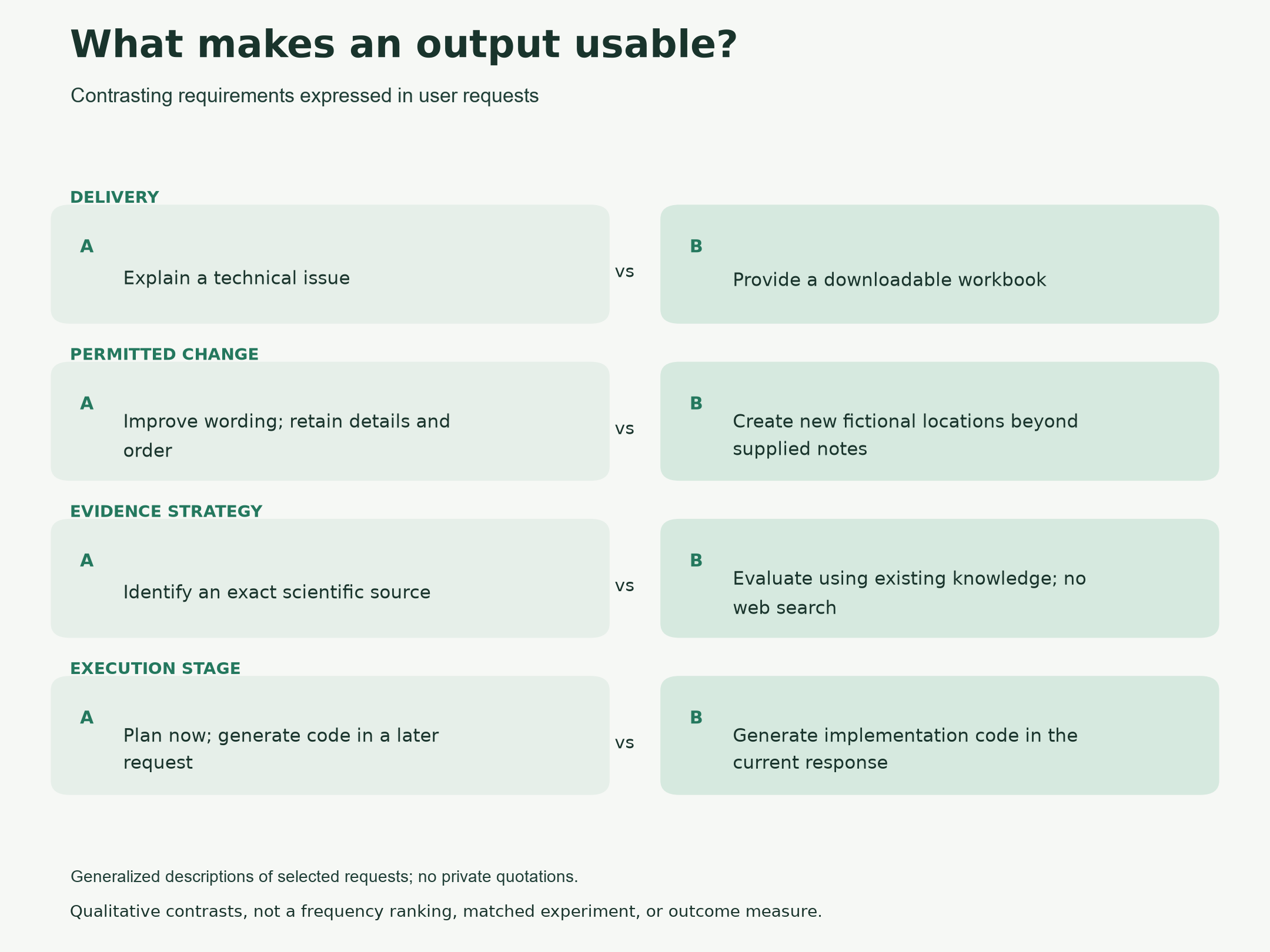
Comparison 1 — Explaining a technical issue and delivering a file.
Request A — generalized: A user asks whether converting between numerical formats can cause underflow. The stated goal is a technical explanation, with no file requested. Request B — generalized: Another user supplies workbook-building code and asks for a downloadable spreadsheet made from it. The requested endpoint is the file, not an explanation of the supplied code.
The difference concerns delivery: A can be addressed within a textual answer, whereas B explicitly requires an artifact the user can obtain. Despite their different subjects, the pair supports RQ1’s distinction between answering a content question and satisfying an output-format requirement. It does not establish that the spreadsheet was generated or downloaded, or that either response met the user’s needs.
Other requests place conditions on transformation. They ask for language to improve while facts, details, or the order of explanation remain intact. Source material is therefore not merely background: it can define a boundary on permissible change. A topic label such as writing does not reveal that boundary.
Comparison 2 — Preserving a document and extending a fictional setting.
Request A — generalized: A user asks for grammatical and stylistic improvements to a supplied report while retaining its details and the order of explanation. Request B — generalized: A user supplies fictional world-building notes and requests additional locations with brief descriptions, explicitly inviting ideas beyond the supplied lore while keeping them relevant to the setting.
Both requests involve producing text from existing material, but the source serves different purposes. A makes retained content a constraint on revision; B treats the supplied setting as a starting point for new invention. This supports RQ1 and RQ3: a writing label alone does not describe the permitted degree of change. The comparison does not verify the report’s factual claims or show that either output respected its instructions; B’s creative permission remains specific to fictional additions.
Evidence is another requested property. Some records seek a precise reference, ask for factual claims to be checked, or require uncertainty to be distinguished from established information. This does not show whether the resulting answer was reliable. It shows that the user explicitly made evidence part of the requested result.
Comparison 3 — Identifying a source and restricting external search.
Request A — generalized: A user asks for the exact scientific reference associated with an attached figure, formatted as an academic citation. Request B — generalized: Another user requests a concise technical comparison of materials using the model’s existing knowledge and explicitly excludes web searching to conserve credits.
The difference lies in the evidence requirement and the permitted means of answering. A calls for an identifiable source; B places an explicit limit on external retrieval. A does not specify a mandatory search procedure, and B’s restriction does not remove the need for accuracy. Together they support RQ1’s treatment of evidence strategy as task-specific. The figure and completed answers were not assessed here, so neither successful source identification nor reliable technical advice is established.
The contrasting cases matter. A direct factual question need not specify a file. Some requests seek judgment or an explanation, and one inspected type explicitly limits external searching. The findings therefore support multiple forms of usability, not a universal preference for artifact production or maximal research.
4.2 RQ2: Delegation can preserve an explicit boundary on execution
The material includes requests for a plan before code, for an initial version before a presentation-ready summary, and for advice about how much of a process should be automated. These requests delegate part of the work while reserving a later decision. Other records ask for direct implementation or a complete deliverable immediately.
Comparison 4 — Planning now and producing code now.
Request A — generalized: A user describes a software project but explicitly asks the system to concentrate on research and implementation planning for the current response, reserving code generation for a later prompt. Request B — generalized: Another user asks for source code implementing a specified automated routine, with configurable settings and operational rules.
Both concern software construction, but their current execution boundaries differ. A defines a future implementation goal while limiting the present task to planning; B requests implementation in the present response. This supports RQ2: delegating a project does not automatically authorize every subsequent step at once. The pair does not establish that A’s later coding stage occurred, that B’s program worked, or that planning first improved results. These are separate requests, not an observed before-and-after sequence.
This contrast qualifies a simple distinction between asking and doing. A request may concern eventual production while asking the system to stop at an intermediate stage now. Treating it as unrestricted execution would miss an explicitly stated control boundary.
Follow-up excerpts add another perspective. Users ask for revised language, supply missing context, request a different format, seek source links, or ask how to access a result. These are distinct interaction requirements. They cannot all be coded as failure recovery: a new requirement may be an elaboration of the task rather than a response to an error.
Nor can these excerpts establish a universal sequence from question to draft to final file. The packet does not supply a complete, independently verified response history. We observe request forms and some local follow-ups, not a general process model or transition probabilities.
4.3 RQ2: Some work concerns access and transfer between tools
Some messages ask where earlier work is located, how to upload material, which model can handle a proposed task, or how to use an integration. These requests concern the environment through which work is performed. They differ from the external content task even when they are necessary to pursue it.
Other records request a prompt for a separate image, presentation, or research tool. Here the prompt itself is an intended intermediate deliverable. It may be part of a broader workflow, but the record does not establish that the downstream tool was used or that a model switch actually occurred.
The analytical implication is that a user-facing AI request can address at least three distinct objects: the task, its result, and access to the means of producing or retrieving that result. Platform questions demonstrate expressed navigation needs; they do not, on their own, verify interface defects or missing capabilities.
4.4 RQ3: Topic labels compress distinctions that cut across tasks
The earlier residual-category recoding identified visual production, information retrieval, writing, practical advice, software help, structured documents, coding, learning, and platform navigation among records originally labeled other. The supplementary table also contains explicit requests whose operation is not well described by their existing topic label. Some long source fields end with the operative instruction to translate, summarize, or produce a document.
Two measurement problems follow. First, a classifier may respond to the subject of pasted material rather than the operation requested of the model. Second, even a correct topic assignment can omit the format, fidelity, evidence, or approval conditions that distinguish one request from another.
| Dimension | Evidence in the inspected material | What a topic-only label misses | Limiting case |
|---|---|---|---|
| Delivery | Requests for editable or downloadable results | Whether text alone would satisfy the request | Direct explanations without a file requirement |
| Fidelity | Instructions to retain facts, order, or source detail | How much alteration is permitted | Open-ended generation |
| Evidence | Requests for references or factual verification | The stated basis for accepting a claim | Explicit limits on external research |
| Control | Planning or review before implementation | What the system is authorized to do at that stage | Requests for immediate production |
| Transfer | Prompts intended for another tool | The intermediate role of the requested output | Outputs intended for use within the conversation |
| Access | Model, upload, history, and integration questions | Work directed at the service environment | External tasks that do not mention platform operation |
These dimensions can overlap. They are an interpretive framework, not a newly validated exhaustive classifier. The table summarizes contrasts in the inspected material and supplies no frequency ranking.
4.5 Records that resist a substantive interpretation
The primary review table includes repeated or fixed short-response patterns. Their source is unknown; they could reflect ordinary use, evaluation, connectivity checks, copied examples, or another process. They were not silently removed or identified as confirmed test traffic.
Other fields contain embedded role declarations, tool markers, or pasted conversation history. Such packaging complicates attribution of a sentence to the current user request. Some records contain only source material or a fragment whose purpose cannot be determined without missing context.
These cases are analytically useful because they limit the claim. The dataset is not a transparent transcript of independent, fully observed delegation episodes. Better task categories alone cannot repair uncertainty about what a stored record represents.
5. Discussion
5.1 Delegating production is not the same as surrendering control
The central interpretation is that requests can delegate an operation while retaining conditions on the result and the process. A user may ask the system to produce a draft while preserving facts, to plan implementation before generating code, or to provide evidence before a decision. These are compatible with task delegation rather than exceptions to it.
This extends the distinction between information-seeking and production at the level of expressed requirements. It does not establish a new universal theory of human–AI collaboration. The material is sufficient to show why a single intent label may need accompanying dimensions, but not to estimate how often each combination occurs.
5.2 Output generation and usable delivery are separate evaluation targets
An evaluation that checks only whether a response addresses a topic may miss explicit delivery conditions. For the inspected artifact requests, a useful assessment would also ask whether the requested form was delivered, remained editable when required, preserved specified source content, and respected a staged approval boundary.
These are proposed evaluation criteria derived from requests, not measured performance results. The present records do not allow us to score actual compliance. Nevertheless, the distinction helps formulate a more precise future outcome measure than message count or the mere presence of a follow-up.
5.3 What the findings do not establish about coordination
Specifying requirements, checking evidence, and retrieving a file can be understood as coordination activities around delegated work. Their presence motivates a deeper question: does AI reduce total effort, or redistribute it toward specification and checking?
This study does not answer that question. It lacks a comparison condition, time measurements, complete outputs, and independent task-success assessments. A follow-up could represent useful collaboration, avoidable friction, a changed goal, or a routine next step. Counting it cannot distinguish those explanations.
Future hypotheses could examine whether explicit delivery conditions predict later format revisions, or whether staged approval requests are associated with fewer unwanted actions. Testing those hypotheses would require linked episodes, validated labels, and appropriate treatment of repeated observations within users. They remain propositions for research, not findings from this packet.
6. Limitations
Selection and dependence. The review tables were supplied for diagnostic purposes, with unknown inclusion probabilities. Some initial texts recur within and across tables. The records cannot support population prevalence or independent replication claims.
Interpretation. One AI assistant performed the analysis with original labels visible. There is no independent human validation or inter-rater reliability estimate. The analytic framework was developed after inspecting the data and may reflect the analyst’s expectations.
Incomplete reading and context. Inspection focused on openings, selected endings, and follow-up excerpts. Long source passages, referenced attachments, and complete assistant responses were not exhaustively examined. Some instructions or counterexamples may have been missed.
Extraction boundaries. Windowed GPT-labeled rows may omit earlier, later, or intervening activity. Model routing was not independently verified. Stored rows can contain embedded histories; row counts do not necessarily represent natural turns.
Outcomes. Requests do not establish delivery, correctness, satisfaction, productivity, conversion, or model superiority. The study does not infer sensitive personal attributes from request content.
Transferability and commercial setting. Findings concern selected records from one multi-model platform. They do not represent official ChatGPT use or the wider public. The platform’s commercial interest and the absence of an independent research review should be considered when interpreting the contribution.
7. Conclusion
The inspected requests distinguish the operation delegated to GPT from the conditions attached to a usable result. Those conditions include delivery format, fidelity to source material, evidence, and opportunities for review before further action. Platform access and prompts for other tools add requirements that topic labels alone do not capture.
The evidence supports a focused proposition: delegation and retained control can coexist in a request. Describing that relationship requires attention to what the user wants produced, what must remain unchanged, and what the system is asked to do next. The present analysis identifies these distinctions; it does not estimate their population frequency or demonstrate that they improve outcomes.
References
- Chatterji, A., Cunningham, T., Deming, D. J., Hitzig, Z., Ong, C., Shan, C. Y., & Wadman, K. (2025). How People Use ChatGPT. NBER Working Paper No. 34255. https://doi.org/10.3386/w34255. Official record: https://www.nber.org/papers/w34255. A working paper is not represented here as a peer-reviewed journal article.
- Gale, N. K., Heath, G., Cameron, E., Rashid, S., & Redwood, S. (2013). Using the framework method for the analysis of qualitative data in multi-disciplinary health research. BMC Medical Research Methodology, 13, 117. https://doi.org/10.1186/1471-2288-13-117. Full text: https://pmc.ncbi.nlm.nih.gov/articles/PMC3848812/.
Appendix A. Qualitative category inventory
The exploratory recoding identified visual production, fixed-response instructions, information retrieval, writing, practical advice, platform navigation, ambiguous inputs, software troubleshooting, structured deliverables, coding, learning, music, ideation, long-source restructuring, and role/history packaging.
This inventory describes categories encountered in the selected material. Category counts and totals are withheld; the list is neither a frequency ranking nor an estimate of platform demand.
Research disclosures
AI assistance: An AI assistant inspected the stated excerpts, developed the exploratory interpretation, calculated descriptive checks, and drafted the manuscript. No independent human-label agreement is claimed.
Data availability: The underlying packet contains private records voluntarily shared by authorized contributors and is not reproduced. Exact numerical summaries and observation dates are also withheld. This report does not authorize redistribution of individual messages or templates. All examples in the findings are generalized descriptions, not private quotations.