Gemini 4 Argon has the lower standard API token price today: $2 ต่อหนึ่งล้านโทเคนเข้า และ $10 ต่อหนึ่งล้านโทเคนออก จนถึงวันที่ 30 พฤศจิกายน 2026, compared with Claude Opus 5.5 at $4 and $20. From December 1, Argon’s published standard rates rise to the same $4/$20. For coding quality, the practical answer takes more care: both have useful recorded results, but our existing tests used different tasks and settings and cannot establish a head-to-head winner.

The clearest technical differences are output handling and workflow. Argon accepts video, audio, images, text, and PDFs and shares a 1,048,576-token budget across input, thinking, and output. Opus 5.5 lists a 1M-token context window and 128K maximum output, with adaptive thinking always on. Those limits affect what you can build; they do not tell you which model will repair your next bug correctly.
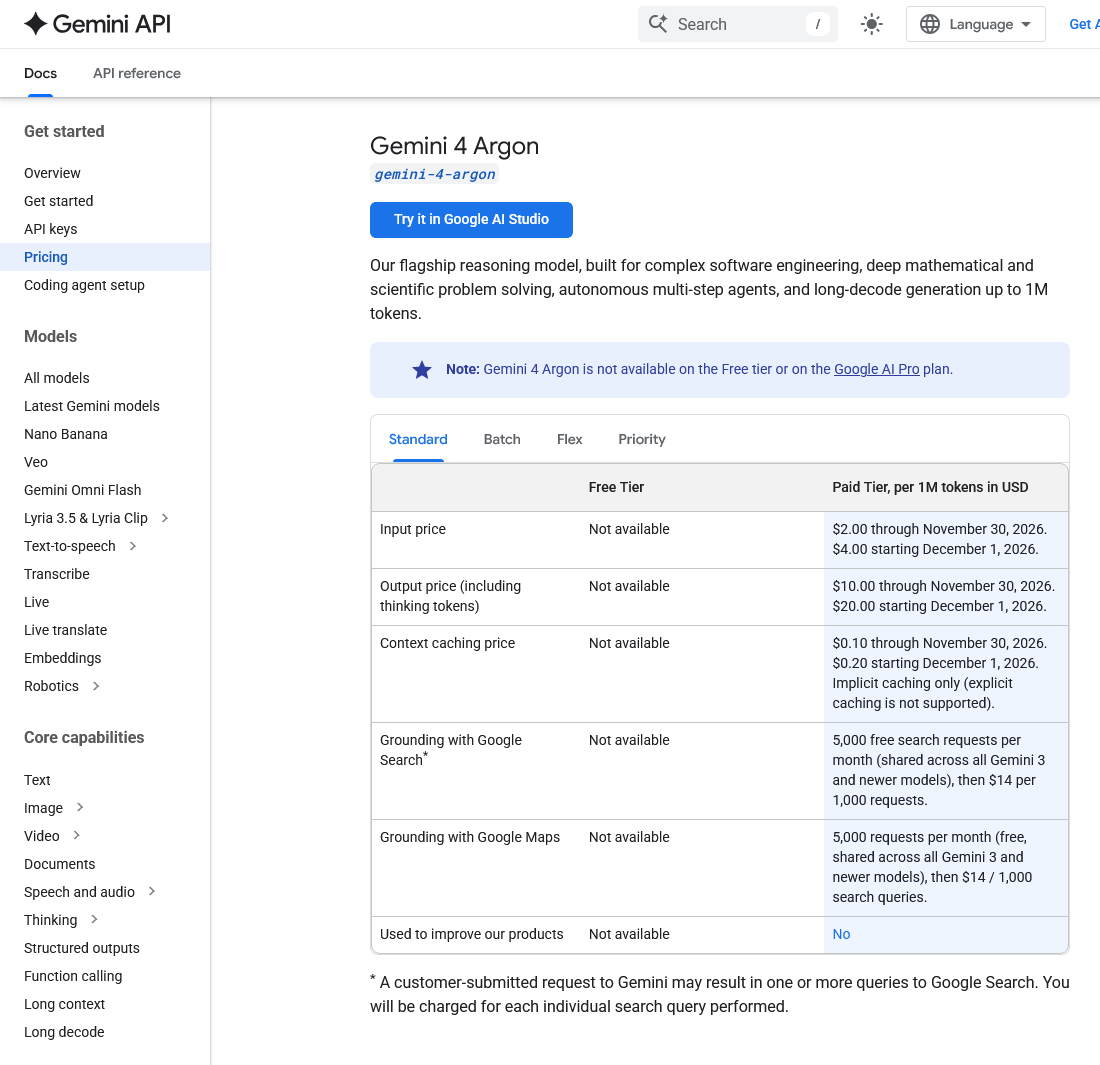
Argon’s introductory Standard input/output token rates versus Opus.
Both list $4 input / $20 output per million tokens.
Historical, unmatched tests do not establish an overall winner.
Official API rates checked October 14, 2026. Real cost also depends on usage, thinking, caching, tools, and retries.
This comparison brings together the documented specifications and the practical observations from our Gemini 4 Argon access and pricing guide. We rechecked the official model and price pages on October 14, 2026 and retain the dates and limits of the earlier tests.
ของเรา รีวิว Claude Opus 5.5 supplies the other half: five recorded task runs, a coding answer cut short by its output ceiling, and dated independent benchmark evidence. This article compares what those records actually show and where a new evaluation would still matter.
คุณสามารถลอง Gemini 4 Argon on GlobalGPT alongside other AI tools in one account. Give each model the same task and judge the usable result, rather than paying for a model because of its launch headline.
Gemini 4 Argon vs Claude Opus 5.5 at a glance
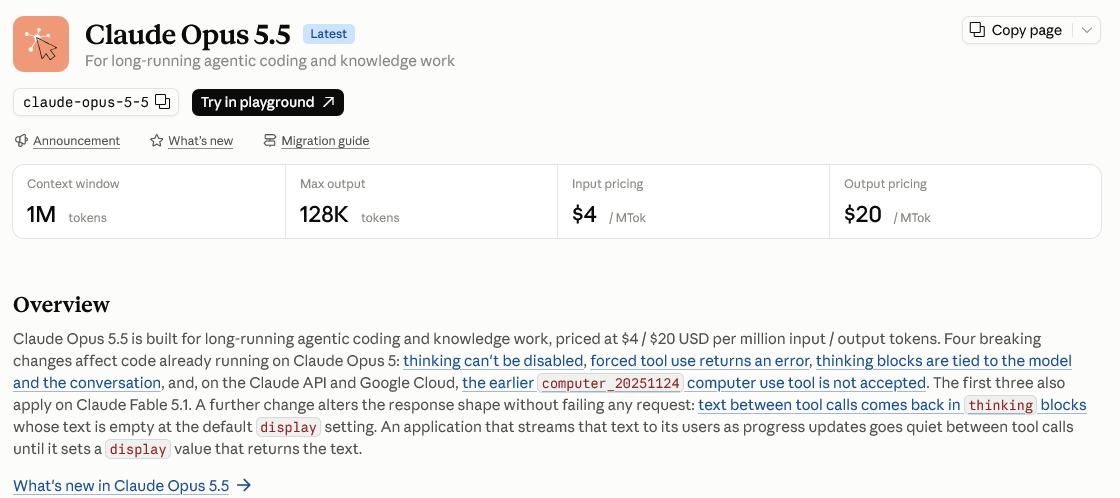
Google describes Argon as a flagship reasoning model for complex engineering, mathematical and scientific work, and autonomous agents. Its เอกสารอ้างอิงแบบอย่างอย่างเป็นทางการ ระบุ เจมินี-4-อาร์กอน as the stable API model. Anthropic’s Opus 5.5 model documentation ตำแหน่ง claude-opus-5-5 for long-running agentic coding and knowledge work.
เจมินี-4-อาร์กอน
claude-opus-5-5
Text, image, video, audio, PDF → text
Text, image → text
1,048,576 shared input + thinking + output tokens
หน้าต่างบริบท 1M-token
65,536-token synchronous default
128K maximum output
Long decode; remaining shared budget
300K Message Batches beta
Low / medium / high; medium default
Always-on adaptive thinking; effort control
Implicit caching; no explicit cache objects
Cache reads and 5-minute / 1-hour writes
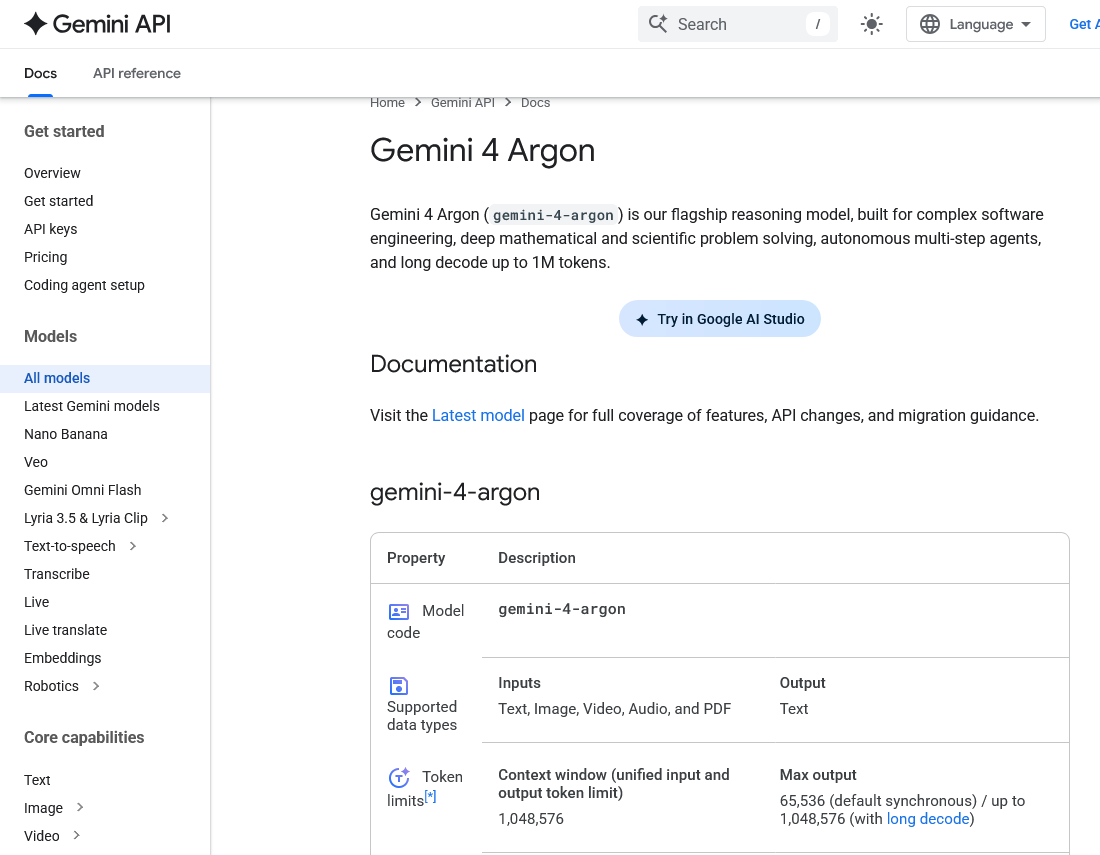
The large-context labels look similar, but the output paths differ. Opus lists 128K maximum output for its normal API path and a separate 300K-output Message Batches beta. Argon defaults to 65,536 synchronous tokens; larger responses require long decode. On Argon, input and reasoning consume the same shared window as the answer.
For input-heavy work, Argon’s direct audio and video inputs are a useful distinction. Opus’s model card lists text and image inputs with text output. A product that adds transcription, file conversion, or other tools may accept more formats, so compare the complete workflow you intend to use as well as the model endpoint.
Neither model’s text endpoint is a substitute for a dedicated image or audio generator. If you need a code explanation that includes a screenshot or a video walkthrough as input, Argon’s supported modalities are relevant. If you need a finished image, that is a different model choice.
Coding: what the recorded tests actually show
Our coding evidence contains two useful cases, with different acceptance criteria. Argon’s task generated a dated API cost helper from a detailed specification. Opus’s task repaired a mixed-type deduplication function. One is implementation from requirements; the other is debugging existing code. Treating their outcomes as a leaderboard would erase the differences that explain them.
Dated Python cost helper; unchanged generated code; 2,800-token ceiling.
Mixed-type deduplication repair; answer stopped at the configured 1,024-token ceiling.
Different tasks, dates, routes, and budgets. These are case observations, not comparable scores.
Argon: an unchanged Python helper passed 20 behavioral checks
The Argon run on October 14 used an OpenAI-compatible test API with model string เจมินี-4-อาร์กอน and a 2,800-token output ceiling. The response returned raw Python without a Markdown fence. We executed the original code unchanged, then checked rate boundaries, service tiers, Decimal precision, zero usage, and invalid inputs.
The helper returned $0.09 for 25,000 input tokens and 4,000 billable output tokens on November 30 at Standard rates, then $0.18 for December 1. It rejected Boolean token counts, negative counts, unknown tiers, impossible dates, and dates before the supplied launch evidence. The ผ่านการตรวจสอบพฤติกรรม 20 ข้อ. That supports this small calculator’s observed behavior, not production readiness for an entire billing service.
เขียนโปรแกรมช่วยขนาดเล็กในไลบรารีมาตรฐาน Python 3 เพื่อประมาณการค่าใช้จ่ายของ API Argon แบบ Gemini 4 Argon
ให้คืนผลเป็นโค้ด Python ดิบเท่านั้น โดยไม่มีเครื่องหมาย Markdown และไม่มีข้อความอธิบาย ฟังก์ชันสาธารณะต้องเป็น estimate_cost(input_tokens, output_tokens, when, tier='standard') และคืนผลเป็นค่า Decimal USD รวมทั้งหมด โดยไม่มีการปัดเศษก่อนเวลาอันควร when เป็นสตริงวันที่ตามมาตรฐาน ISO YYYY-MM-DD จำนวนโทเค็นทั้งสองต้องเป็นจำนวนเต็มไม่ติดลบ; ปฏิเสธค่า bool, float, string และค่าติดลบด้วย ValueError. ปฏิเสธระดับที่ไม่รู้จักและวันที่ไม่ถูกต้องด้วย ValueError.
อัตราต่อหนึ่งล้านโทเคน จนถึงวันที่ 30 พฤศจิกายน 2026 (รวม): อินพุตมาตรฐาน 2/เอาต์พุต 10, อินพุตแบบ batch และ flex 1/เอาต์พุต 5, อินพุตแบบ priority 3.60/เอาต์พุต 18. ตั้งแต่วันที่ 1 ธันวาคม 2026 (รวมวันดังกล่าว): มาตรฐาน 4/20, แบบ batch และ flex 2/10, แบบ priority 7.20/36. ปฏิเสธวันที่ก่อนวันที่ 13 ตุลาคม 2026 เนื่องจากอัตราค่าบริการในช่วงเปิดตัวนี้เป็นหลักฐานทางประวัติศาสตร์เพียงอย่างเดียวที่มีอยู่
สมมติว่าข้อมูลเข้าทั้งหมดไม่ถูกเก็บไว้ในแคช และ output_tokens ได้รวมโทเค็นคิดคำนวณที่ถูกเรียกเก็บเงินแล้ว ยกเว้นแคช การกราวด์ ภาษี การสมัครสมาชิกของผู้บริโภค และค่าใช้จ่ายจากฝ่ายที่สาม ให้โค้ดสั้น กระชับ อ่านง่าย และสามารถรันได้ทันที รวม docstring ที่กระชับเพื่ออธิบายขอบเขตการประมาณการและการจัดการโทเค็นคิดคำนวณ อย่าส่งคำขอเครือข่ายหรืออ่านตัวแปรสภาพแวดล้อม.
ผลลัพธ์ต้นฉบับครบถ้วน; เลื่อนลงเพื่ออ่านทุกบรรทัด หรือใช้ปุ่มคัดลอก.
The code handles a date change and avoids premature rounding. That is a useful sign for a bounded task where exactness matters. It is also deliberately narrow: no network requests, invoices, caching, grounding charges, or tax calculations are included.
Opus 5.5: a useful debugging answer hit the configured ceiling
The Opus review’s September 23 task asked for a fix to a Python dedupe function that failed on non-string values. The published result records that Opus identified the .lower() problem, used casefold() for strings, added an unhashable-value fallback, and supplied corrected code with test cases.
That run stopped with stop_reason: max_tokens at its 1,024-token ceiling. The useful diagnosis survives, but the answer was incomplete under that configuration. This is a reason to set an adequate output budget before reviewing a model’s coding performance. It is not evidence that Opus intrinsically cannot finish a code repair.
We do not have an identical Argon run on that deduplication task or an identical Opus run on the dated cost helper in these records. There is therefore no established coding winner. For a broader choice of coding assistants, our คู่มือเลือกรุ่น AI ที่ดีที่สุดสำหรับการเขียนโค้ด is a starting point for selecting candidates to test on your own repository.
How to make the coding decision on your own task
Use the same issue, source files, acceptance tests, and tool permissions for both models. Give each enough output budget to finish, and record its reasoning setting. Judge the patch with tests you wrote independently: new code can pass the tests the model invented while still breaking an existing behavior.
Review and repair this Python function. Return the corrected function, a concise explanation, and tests.

def dedupe(items):
    seen = set()
    result = []
    for item in items:
        key = item.lower()
        if key not in seen:
            seen.add(key)
            result.append(item)
    return result

Requirements:
- Keep the first occurrence and preserve input order.
- Compare strings using casefold(), but return the original string.
- Support non-string hashable values and unhashable lists or dictionaries.
- Do not mutate the input or its elements.
- Explain your equality policy for mixed types, including True and 1.
- State any remaining limitations. Do not invent test execution results.

Evaluator: run independent acceptance tests on both unchanged answers, using the same environment and adequate output budgets. Record reasoning settings, token use, retries, and human repair.The example above is a reusable evaluation prompt, not a task already run for this comparison. Score correctness, preserved behavior, unnecessary changes, and how much human repair the answer needs. Our วิธีการทดสอบแบบจำลอง AI explains why task completion, route timing, and token spending should be recorded separately.
Quality: facts, JSON, reasoning, and writing
Quality depends on the job. For a data pipeline, valid JSON and accurate values matter more than elegant prose. For a decision memo, preserving uncertainty and avoiding invented details may be more valuable than a confident recommendation. The source articles give us small examples in both categories.
Seven-case JSON extraction covered A–G and preserved missing information.
Strict-JSON task produced the requested fields, two pros, and two cons.
Rejected 1,080,000 tokens against a 1,048,576 shared budget.
Returned 12 + 15 + 18 + 22 = 67 with the specified rounding.
Budget reply grouped Batch/Flex and used overbroad trial wording.
Coding reply hit its output ceiling; Chinese route output was garbled.
No matched error-rate, writing, or speed study.
No matched error-rate, writing, or speed study.
Evidence handling and structured output
Argon’s seven-case extraction test included missing access details, an unsigned forum claim, a context-budget conflict, and a mistaken output-cost calculation. Its answer covered all seven cases, treated unsupported quotas as unverified, and counted 8,000 answer tokens plus 2,000 thinking tokens as 10,000 billable output tokens.
Opus’s strict-JSON task returned a parseable object with the requested fields, exactly two pros and two cons, and no Markdown wrapper. Its short memo-extraction task also preserved the requested five findings and the source’s measurement limits. These are useful examples of instruction following; neither small record measures error rates across thousands of calls.
Argon was not flawless. In its separate budget recommendation, it grouped Batch and Flex together and used overbroad trial-access wording. The calculations were correct, but the operational recommendation needed review. This distinction matters: a numerically correct response can still give you an imprecise action to take.
Reasoning and language quality
Opus’s arithmetic task correctly returned batches of 12, 15, 18, and 22, totaling 67 after rounding down at each step. Argon’s context calculation correctly rejected 980,000 input tokens plus 100,000 proposed output tokens because their combined 1,080,000 exceeded its 1,048,576-token budget.
The Opus source review also records garbled Chinese output on the tested route, including a rerun with a larger ceiling. That result does not separate the model from route or encoding behavior. It cannot support a claim that Argon writes better Chinese, or that Opus is generally poor at Chinese. The retained tests also do not establish an English-writing winner.
If you prefer a cheaper candidate for routine extraction before escalating difficult cases, our รีวิวสั้นๆ ของ Gemini 3.8 Flash gives another task-specific reference. A flagship comparison does not require every part of your workflow to use a flagship.
What independent benchmarks add
Artificial Analysis’s September 22 Opus 5.5 report records an Intelligence Index score of 58 at max effort, 59.6% on Terminal-Bench 4.0, and 66.9% on SciCode. These are dated measurements under that evaluator’s settings. They strengthen the public evidence for Opus, but do not create an Argon-versus-Opus ranking without an Argon result from the same evaluation.
METR’s predeployment evaluation reached a narrower conclusion: it expected useful acceleration for some R&D work but did not find a large gain over Fable 5.1 in the judgment skills examined. METR discloses an unpaid assessment agreement and Anthropic’s opportunity to review and edit its summary, with METR signing off on the final text. Its assessment is valuable context, not a universal quality score.
Anthropic’s own Opus 5.5 announcement reports improvements over earlier models and results on agentic coding tasks. Those are provider claims. None of the cited records demonstrates that either model is best for every coding, writing, and reasoning task.
Cost: today’s discount and December’s equal rates
The most decisive comparison is the one we can calculate. Google’s Argon API price table publishes an introductory period through November 30 and higher rates from December 1. Anthropic’s เอกสารเกี่ยวกับราคา API lists Opus 5.5 at $4/$20 for Standard input/output and a 50% Batch discount.
$2 เข้า / $10 ออก
$4 input / $20 output
$4 input / $20 output
$4 input / $20 output
$1 เข้า / $5 ออก
$2 เข้า / $10 ออก
$2 เข้า / $10 ออก
$2 เข้า / $10 ออก
Argon’s price change is scheduled for December 1, 2026. Opus values are the rates checked October 14. API prices are separate from subscriptions and GlobalGPT billing.
Argon’s Standard rate is 50% lower per token during the introductory period. From December 1, both models’ listed Standard input and output rates match. The same date change also brings Argon’s Batch prices to the current Opus Batch prices. This compares like-for-like listed token rates, not subscriptions or GlobalGPT credits.
A fixed workload: 25,000 input and 4,000 output tokens
Assume uncached input and 4,000 billable output tokens, including thinking where billed. Argon’s introductory Standard estimate is 25,000 / 1,000,000 × $2 + 4,000 / 1,000,000 × $10 = $0.09. Opus at $4/$20 is $0.18. The same Argon quantities also cost $0.18 from December 1.
25,000 uncached input tokens + 4,000 billable output tokens. USD; other charges excluded.
Same assumed token quantities. This is a rate calculation, not an observed matched-task bill.
For 100 identical jobs, introductory Argon Standard totals $9 versus Opus Standard at $18. On Batch, the corresponding estimates are $4.50 and $9. From December, both models would be $18 Standard or $9 Batch for these exact quantities at the listed rates. These estimates exclude tools, cache writes, taxes, and platform charges.
Lower token prices can still produce a larger bill
The models can consume different quantities to solve the same task. Extra reasoning, longer answers, retries, or several agent turns can erase a rate advantage. With the same 25,000 uncached input tokens, Argon’s introductory Standard cost reaches $0.18 at 13,000 billable output tokens—equal to the Opus example with 4,000 output tokens. That is a sensitivity example, not measured usage from a matched test.
For coding, track cost per accepted patch: include failed attempts and human repair, then divide by the number of patches that meet your acceptance criteria. A model that returns an inexpensive but incomplete answer can be a poor bargain when you count the work needed to finish it.
Caching, thinking, and tools change the comparison
Argon’s Standard implicit cached input costs $0.10 per million tokens through November 30, then $0.20. Explicit cache objects are unsupported. Opus lists $0.20 per million cache-read tokens, $5 for five-minute cache writes, and $8 for one-hour writes. You must include cache creation and actual hits before deciding that one caching path is cheaper.
Argon’s output price explicitly includes thinking. Opus uses adaptive thinking that cannot be switched off. Reasoning depth, billable usage, and answer length still need to be measured in the product you use. Search grounding and other tools can add separate charges; a plain input/output estimate is not an invoice for an agentic workflow.
Long context, output limits, and API migration
The context window is useful only if the model can retrieve and apply the right information from it. Neither source article tested a million-token input, a full repository migration, or the models on the same long-context retrieval task. Treat the following as documented limits and integration behavior.
980,000 in → 68,576 remaining
The remaining 68,576 tokens must cover both thinking and output. A requested 100,000-token answer would exceed the total budget even on long decode.
This is arithmetic from the documented limit, not a million-token performance test.
For Argon, 980,000 input tokens leave 68,576 tokens for thinking and output together. . คู่มือการถอดรหัสแบบยาว explains background execution, continuation hops, and their usage. Repeated context can be billed again across hops with applicable implicit caching; the final document length does not describe all billable input.
Opus’s 128K maximum output is a larger normal output allowance than Argon’s 65,536 default synchronous cap. Its separate 300K output beta applies to Message Batches with the documented beta header. Argon’s long-decode path can exceed its synchronous limit when sufficient shared context remains. These are different execution paths, so “which one writes longer?” needs a product and configuration attached to it.
ของกูเกิล Argon migration guide กล่าวว่า อุณหภูมิ, top_p, และ top_k are ignored. Thinking level is the relevant control, with medium as the default. Copying a temperature value across providers does not make the tests equivalent.
Opus’s documentation warns that forced tool use returns an error, thinking blocks are tied to the model and conversation, and the older computer_20251124 tool is not accepted on the listed Claude API and Google Cloud routes. Test your actual tools and conversation handling before changing a model string in production.
Access: official products and GlobalGPT
The model, its native application, and its API are separate purchases. Google AI Pro can provide eligible Argon access in the Gemini app while your backend still needs a paid Gemini API project. Claude consumer plans and Anthropic API usage likewise have separate billing. A subscription amount should not be compared directly with a per-million-token rate.
For a practical comparison, open Claude Opus 5.5 on GlobalGPT and use the same task you give Argon. Both dedicated GlobalGPT model pages were accessible in this check. The official Google and Anthropic token tables in this article describe their APIs; they are not a GlobalGPT price or quota promise.
ของเรา all-in-one AI workflow guide explains how to keep task context organized while switching models. This is useful when you want a second opinion on an answer or patch. A second model agreeing with the first is still weaker evidence than an executable test or a checked source.
Early feedback: preference is not a benchmark
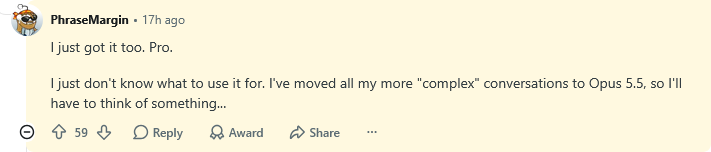
In the Reddit thread started by u/Radiant_Tradition647, u/PhraseMargin reported receiving Argon on Pro and said they had moved their more complex conversations to Opus 5.5. That is one user’s access report and workflow preference. It does not show identical prompts, a measured quality difference, or universal access conditions.
If your priority is consolidating tools, our multi-model platform comparison covers that buying decision. Native developer tools, model chat, and subscription billing should each be evaluated for the features you actually need.
คุณควรเลือกรุ่นไหนดี?
เลือก Argon as the first candidate when introductory API cost matters and its audio/video inputs or Google workflow fit the task. It produced a useful bounded Python helper in our retained test, and its dated rate advantage is concrete. Verify that your workload reaches an acceptable result without spending the saving on extra output and retries.
เลือก Opus 5.5 as a candidate for coding and knowledge work when you want its documented output allowance, caching controls, and established public evaluation record. The earlier review recorded useful debugging, clean JSON, extraction, and arithmetic. Give it a realistic output budget before judging whether it finishes your task.
Useful when audio/video inputs, Google integration, and today’s API rate advantage fit the job.
Useful when normal long output, explicit cache controls, and its public evaluation record fit the job.
Count complete, correct results and the human repair required. Recalculate Argon costs for December.
For routine work, you may save more by reserving either flagship for difficult cases. Our guide to getting AI tools in one subscription discusses the account-level buying decision; it does not replace measuring the cost and completion rate of your chosen workload.
The useful verdict is specific: Argon wins the current listed Standard token-rate comparison; those rates match Opus from December 1. Coding and general-quality superiority remain unproven by these unmatched tests. Keep both in your shortlist, run a representative task, and buy the result that passes your checks with the least total effort.
คำถามที่มักถูกถาม
Is Gemini 4 Argon better than Claude Opus 5.5 for coding?
No coding winner is established by the retained tests. Argon’s dated cost helper passed 20 behavioral checks; Opus returned useful debugging but hit a 1,024-token ceiling. Different tasks and settings prevent a direct ranking.
Which model is cheaper: Argon or Opus 5.5?
Argon Standard is $2/$10 per million input/output tokens through November 30, 2026, versus Opus at $4/$20. From December 1, Argon becomes $4/$20 too. Actual bills depend on token use, caching, tools, and retries.
How much would 100 identical API jobs cost?
At 25,000 uncached input and 4,000 billable output tokens per job, introductory Argon Standard totals $9 for 100 jobs; Opus totals $18. From December, both total $18 at the listed Standard rates, excluding other charges.
Can I compare both models on GlobalGPT?
Yes. GlobalGPT has dedicated Gemini 4 Argon and Claude Opus 5.5 model pages. Use the same task and source material in each conversation. GlobalGPT account billing is separate from Google’s and Anthropic’s official API prices.
Does a 1M context window mean 1M output tokens?
No. Argon shares 1,048,576 tokens across input, thinking, and output and defaults to 65,536 synchronous output tokens. Opus lists 128K maximum output, plus a separate 300K Message Batches beta path.
Can thinking be disabled on Claude Opus 5.5?
No. Anthropic documents adaptive thinking as always on for Opus 5.5. Use its effort control and inspect actual usage. Argon instead provides low, medium, and high thinking levels, with medium as the default.
Does Argon support video and audio inputs?
Yes. Its official endpoint supports text, images, video, audio, and PDF inputs with text output. Opus’s model card lists text and images as inputs. Applications may add separate conversion tools around either model.
Did the reviews prove a speed or writing winner?
No. The retained runs used different tasks, dates, routes, and output budgets. Opus’s Chinese-output issue was not separated from route or encoding behavior. These records cannot establish a general speed or writing advantage.
Are official API rates the same as subscription prices?
No. API token charges, consumer subscriptions, and GlobalGPT platform billing are separate. Compare the route you plan to use and include its real usage, tools, and limits before estimating a monthly budget.