
คำตอบด่วน: To create an AI video from a script, first divide the narration into short scenes, give each scene one visual job, define a consistent style, generate the shots, then add voiceover, captions, and a final quality check. The tool matters, but the scene plan is what turns disconnected clips into a coherent video.
Turning a paragraph into a watchable video sounds like a one-click task. In practice, the strongest AI video from script workflows involve several small decisions: where one scene ends, what appears on screen, how long the voiceover takes, which visual details must stay consistent, and what to regenerate when a shot goes wrong. The บทสรุปเกี่ยวกับเครื่องมือสร้างวิดีโอ AI ที่ดีที่สุด helps map those workflow choices to different creation needs.
This guide explains that full process. It also includes our hands-on GlobalGPT test: a short campaign script turned into a 28.06-second, 16:9 skincare film with five visual stages, English narration, burned-in captions, and a restrained ambient water track.
Test summary: On September 11, 2026, we used GlobalGPT to create two GPT Image 2 opening-frame candidates, selected the cleaner bottle design, and generated one continuous 28-second film with Seedance 2.5 at 720p. Generation used 20,340 GlobalGPT credits. Verified finishing added an English neural voiceover and burned-in captions while retaining the source ambience. The final MP4 measured 28.06 seconds at 1280 × 720.

สารบัญ
- What AI video from script means
- What to prepare
- The step-by-step workflow
- Our GlobalGPT test
- ปัญหาที่พบบ่อยและวิธีแก้ไข
- How to write a better script
- Choosing a workflow
- Quality checklist
- คำถามที่พบบ่อย
What Does AI Video from Script Mean?
AI video from script is a workflow that converts written narration into a sequence of generated or assembled visuals, usually with voiceover, captions, transitions, and audio. Some tools automate the entire process. Others let you control individual scenes, reference images, prompts, timing, and revisions before export.
Our review of the first-page results for this query found a strongly tool-oriented SERP. Pages from Canva, Synthesia, Kapwing, Pictory, and Higgsfield emphasize pasting a script, choosing a style or avatar, generating scenes, and exporting. That is useful for shoppers, but it leaves room for a more practical question: how do you make the result good after pressing Generate?
What You Need Before Generating
- A clear audience: Who is watching, and what should they understand or do next?
- A target length: For a short explainer, count the spoken words before generating footage.
- A final narration draft: Rewriting the voiceover after making the shots creates timing problems.
- An aspect ratio: Use 16:9 for most landscape web videos, 9:16 for vertical short-form content, or 1:1 when the publishing surface requires it.
- A visual direction: Define medium, palette, lighting, camera behavior, and anything that must not appear.
- A review standard: Decide what counts as a failed shot before spending credits on revisions.
A useful planning rule is one scene, one job. A scene might introduce the problem, demonstrate a step, show a comparison, or deliver the final result. If it tries to do all four, the generated visual will usually feel crowded or vague.
How to Create an AI Video from a Script
Step 1: Break the Script Into Scenes
Start with changes in meaning, not arbitrary sentence counts. Mark the moment when the narration moves from problem to action, from one action to another, or from explanation to conclusion.
For our test, the 43-word campaign script mapped to five visual stages: an establishing shot, a water-and-base macro, a droplet macro, a bottle-detail turn, and a final hero frame. That structure gave the video variety without asking the model to introduce new products, people, or locations halfway through the sequence.
Step 2: Give Every Scene One Visual Job
Do not simply repeat the narration as an image prompt. Describe what the viewer should see.
Weak direction:
Show that every scene needs one clear job.
Stronger direction:
A script page separates into five rounded storyboard cards arranged in a row. Each card contains one simple geometric symbol. Thin connector lines show the order. Slow lateral camera movement, no readable text.
For more prompt patterns, see the คู่มือคำสั่ง Kling 3.0 และคู่มือสำหรับ writing better Veo 3.1 prompts.
Step 3: Lock the Visual Style Before Making Every Shot
Consistency is easier to establish before generation than to repair afterward. Define a compact style block and reuse it in every scene prompt. Include:
- visual medium, such as flat vector, cinematic live action, clay animation, or product photography;
- palette and contrast;
- lighting direction and time of day;
- lens or camera behavior when relevant;
- recurring character, product, costume, or prop details;
- negative constraints, including unwanted text, logos, avatars, or camera movement.
When the workflow supports reference images, make one style frame first. Approve its palette, material rendering, composition, and subject treatment before generating the rest. Our test created two opening-frame candidates and selected the version with the clearest glass bottle and brushed silver cap before any video credits were spent.
This is especially important for people and recurring objects. The separate guide to ความสม่ำเสมอของวิดีโอ AI explains why identity, wardrobe, lighting, and framing drift across independently generated shots.
Step 4: Generate Short, Distinct Shots
Give each prompt one main movement. For example: a slow push-in, a playhead sliding across a timeline, or five cards fanning into a row. Asking for several transformations, a moving camera, changing lighting, and complex character action in the same short clip increases the chance of morphing.
Review each output before generating the next expensive stage. Look at the first frame, middle frames, and final frame. A clip can look clean as a thumbnail while an object melts or changes shape during motion. If generation fails outright, the AI video generation failures guide covers common prompt, moderation, and workflow causes.
Step 5: Add Voiceover and Captions
Voiceover should fit inside its assigned shot, with a small pause before the cut. If a line is too long, you have four options: shorten the copy, increase the shot duration, split the shot, or slightly adjust narration speed. Do not solve every timing problem by making the voice unnaturally fast.
Captions should match the spoken words, not an earlier version of the script. Keep them inside mobile-safe margins, break long sentences into readable chunks, and check punctuation. Generated artwork should usually avoid important readable text; add precise titles and captions during editing, where spelling is controllable.
Step 6: Assemble, Review, and Export
Place the shots in script order, align each narration segment, add the captions, and watch the whole sequence without stopping. Export a widely supported format such as H.264/AAC MP4, then confirm the actual dimensions, duration, and audio instead of trusting the project settings.
If you are estimating a multi-shot project, review how AI video credits work before spending most of the allowance on initial generations. Reserve enough capacity for at least one correction to the riskiest shot.
Our Hands-On AI Video from Script Test
We ran this test through GlobalGPT on September 11, 2026. The generation stage used GPT Image 2 for the visual anchor and Seedance 2.5 for the continuous video. Verified finishing added the English narration and captions, while the original water and room ambience stayed underneath the voice. Model comparison was not the goal; producing one polished, inspectable result was.
The Test Brief
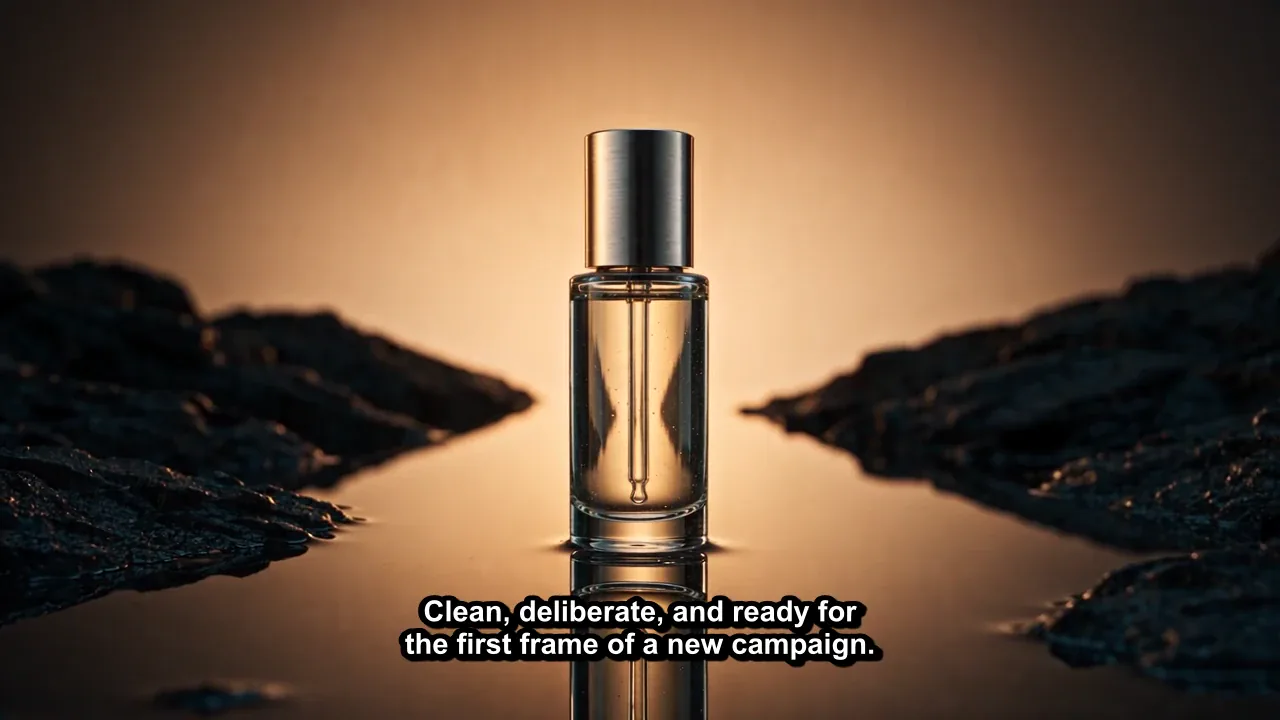
We asked for a 28-second, 16:9 cinematic skincare film centered on one clear serum bottle with a brushed silver cap. The art direction called for wet charcoal stone, warm sunrise light, restrained teal reflections, macro detail, and slow premium camera movement.
The 43-word narration was:
Morning light finds a clear glass bottle on dark stone. Water circles the base and catches the gold. Moving closer, tiny droplets reveal the texture. One quiet turn shows every detail. Clean, deliberate, and ready for the first frame of a new campaign.
We also excluded people, logos, generated lettering, duplicate bottles, obvious geometry errors, and watermarks.

Models and Structure
The workflow used:
- GPT Image 2 for two 16:9 opening-frame candidates, costing 640 credits in total;
- Seedance 2.5 for one continuous 28-second generation at 720p, costing 19,700 credits;
- an English Edge neural voice for the final narration;
- timed, burned-in English captions added during verified finishing;
- the generated clip’s ambient water and room tone, retained at 16% beneath the voice.
The five visual stages were an establishing shot, a water-and-base macro, a droplet macro, a bottle-detail turn, and a final hero composition. GlobalGPT generation used 20,340 credits in total. Credit use can change with model, duration, resolution, and retries, so this is a dated test result rather than a universal quote.

What Worked
The strongest result was product continuity. The bottle and brushed cap remained recognizable from the wide establishing view through the closer droplet and material shots. The glass, water, metal, and wet stone also held up well under changing angles, and the macro stages created visual variety without introducing a second product.
The finished export measured 28.06 seconds at 1280 × 720 and 24 fps. It uses H.264 video and AAC stereo audio. The English narration remained clear over the quieter native ambience, and the final captions matched the spoken script.
What Needed Correction
The first caption treatment was too large and covered too much of the photography. We rejected it, rebuilt the captions as smaller bold white text with a black outline and no opaque panel, then checked frames at 2, 7, 12, 16, and 24.5 seconds before publication.
The generated video and final export are both 1280 × 720, so this version did not rely on a 1080p upscale. A page about whether Seedance supports 1080p explains why a model setting, native generation size, and final delivery resolution should still be recorded separately.
The audio needed deliberate mixing rather than replacement. We retained the original ambient water and room tone at 16%, placed the narration above it, and verified that the final AAC stereo track was present and audible. This kept the film from feeling silent without introducing an unverified music source.
Hands-On Verdict
GlobalGPT made the generation stage straightforward: two opening-frame options established the product, and one Seedance 2.5 run supplied a coherent 28-second sequence with useful macro variety. The result still needed human finishing judgment, especially for caption scale, voice timing, and the balance between narration and ambient sound.
You can start a similar workflow from the GlobalGPT all-in-one workspace, but approve the visual anchor and reserve time for the final audio and caption pass.
Common Script-to-Video Problems and Fixes
| ปัญหา | เหตุผลที่น่าจะเป็นไปได้ | ลองดูอะไรบ้าง |
|---|---|---|
| The video looks like one still image moving | The scene prompt describes a composition but no action | Add one clear subject movement or camera movement |
| Shots feel unrelated | Each prompt uses different style language | Reuse one style block and reference frame across scenes |
| A character changes between shots | Identity details are vague or competing | Lock face, hair, wardrobe, age, palette, and reference image |
| Objects melt or flicker | Too many transformations happen in one clip | Reduce motion, shorten the shot, or regenerate from a cleaner frame |
| Voiceover runs past the cut | Timing was estimated from words only | Generate the voice first and measure the real audio duration |
| Captions do not match | The script changed after caption creation | Generate captions from the final voice script and review them line by line |
| Text inside the artwork is malformed | The video model is trying to render typography | Keep artwork text-free and add titles during editing |
| Export says 1080p but looks soft | Low-resolution clips were enlarged | Check source resolution and generate higher-resolution clips when available |
| Credits disappear too quickly | Long clips or retries were generated without a budget | Test a short risky scene first and reserve credits for correction |
Many of these issues are preventable. The รายการตรวจสอบข้อผิดพลาดในวิดีโอ AI is a useful companion before the final export.
How to Write a Better Script for AI Video
Write for the ear and the screen at the same time. A narrator can explain an abstract idea, but the shot still needs visible subjects, actions, and spatial relationships.
Use this scene template:
Narration:
[The exact words the audience will hear]

Visual job:
[The one idea this scene must communicate]

Shot:
[Subject, setting, composition, action, and camera movement]

Continuity:
[Style, character, wardrobe, lighting, palette, and reference details]

Avoid:
[Readable text, extra characters, logos, fast morphing, camera shake]

Target duration:
[Measured narration length plus a short pause]
Keep narration sentences short enough to caption cleanly. Replace stacked abstractions with visible verbs: splits, aligns, slides, locks, opens, points, or transforms. When a sentence contains two visual moments, either split it or plan two shots inside the same scene.
Choosing an AI Video from Script Workflow
| กระบวนการทำงาน | เหมาะที่สุดสำหรับ | ข้อได้เปรียบหลัก | ข้อจำกัดหลัก |
|---|---|---|---|
| One-click script generator | Fast drafts, internal explainers, simple social posts | Minimal setup | Less control over shot meaning and consistency |
| Avatar-led generator | Training, presentations, direct-to-camera delivery | Predictable speech and framing | Can feel generic when the topic needs visual demonstration |
| Scene-by-scene generation | Branded explainers, product stories, controlled visuals | Stronger timing and art direction | More planning, credits, and review |
| All-in-one AI workspace | Teams using chat, images, video, audio, and agents | Fewer subscriptions, logins, and asset transfers | Does not remove the need for model-specific QA |
| Traditional editor plus AI assets | Client work and precise finishing | Maximum control over timing and polish | More manual editing time |
For a quick internal draft, one-click generation may be enough. For a public campaign with recurring characters or exact product details, scene-by-scene control is usually worth the extra work.
Final AI Video Quality Checklist
Before publishing, watch the exported file and confirm:
- the first five seconds make the topic clear;
- scenes follow the script in the intended order;
- every visual supports the line being spoken;
- recurring characters, products, palette, and lighting remain consistent;
- no frame contains malformed text, unintended logos, or unexplained objects;
- voiceover is audible, natural, and not clipped at scene boundaries;
- captions match the narration and remain inside safe margins;
- music, if used, is licensed and stays below the voice;
- no shot repeats unless repetition is intentional;
- the final duration, aspect ratio, resolution, codec, and file size suit the publishing platform;
- commercial-use and disclosure requirements have been checked for the selected tools and assets.
คำถามที่พบบ่อย
Can AI turn a full script into a video?
Yes. AI tools can split a script into scenes, generate or select visuals, create narration, add captions, and export a video. Results improve when you review the scene plan first. Long scripts should be produced in sections so timing, visual consistency, and failed shots can be corrected without rebuilding the entire video.
What is the best AI for making videos from scripts?
There is no single best option for every script. Avatar tools suit presenter-led training, one-click generators suit fast drafts, and scene-based image-to-video workflows suit controlled visual stories. Choose according to required consistency, editing control, output resolution, commercial terms, and the cost of regenerating failed clips.
Can AI add voiceovers and captions automatically?
Yes, many workflows can generate speech and captions. Still, verify the exported file. Check that narration is actually audible, captions use the final script, timing matches scene boundaries, and names or technical terms are pronounced correctly. In our test, the first captions were technically present but visually too large, so we rebuilt them before publication.
How long should each AI-generated scene be?
Use the narration length as the baseline. Measure the real audio, then give the scene a short pause before the cut. Short shots of roughly three to eight seconds are often easier to control than long prompts containing several actions, but the correct duration depends on the spoken line and visual complexity.
How do I keep characters consistent across AI video scenes?
Create a reference image and repeat the same identity details in every prompt: face, hair, age, clothing, proportions, palette, lighting, and camera treatment. Change only what the new scene requires. For longer projects, see the workflow for making long AI videos with consistent characters.
Can I create an AI video from a script for free?
Sometimes, but free plans usually impose limits on credits, duration, resolution, watermarks, models, or export. Test the shortest representative scene first. Do not assume a free allowance can cover a multi-shot final video, narration, revisions, and high-resolution export without checking the current plan.
Can AI-generated videos be used commercially?
Commercial use depends on the platform terms, model terms, plan, source assets, music, trademarks, and local law. Keep records of the tools and assets used, and verify current terms before publishing client or advertising work. Model output alone does not clear third-party music, logos, likenesses, or copyrighted source material.
ข้อสรุปสุดท้าย
The reliable way to create an AI video from script is to plan the edit before generating the footage. Split the narration into scenes, assign one visual job to each scene, lock the style, measure the voiceover, and inspect the exported file. That process takes more thought than pasting a paragraph, but it produces a video that feels directed rather than randomly assembled.
GlobalGPT can make the workflow less fragmented by bringing supported chat, research, image, video, audio, and agent tools into one account and subscription. Start with the storyboard, keep correction budget in reserve, and treat generation as the first edit, not the final deliverable.