Is Gemini 3.5 Flash-Lite worth using? Yes—especially for fast, repeatable work such as document processing, structured extraction, translation and bounded coding tasks. It combines a 1-million-token input window with low API pricing and some of the fastest measured output speeds in its class.
In my four controlled tests, Gemini 3.5 Flash-Lite completed every task on the first request and scored 38/40. It was excellent at JSON extraction, localization and debugging, but its long-document action register assigned two owners that should have remained unassigned. The practical verdict is simple: use it for throughput, but validate fields where small mistakes carry consequences.
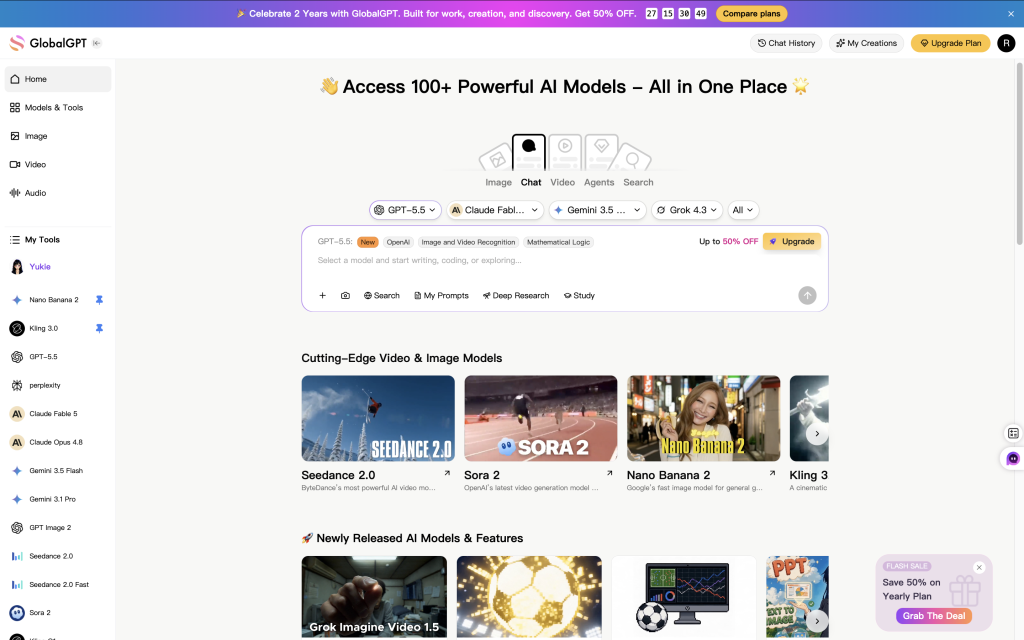
If you want to try it without configuring an API, GlobalGPT is a simple way to start. Gemini 3.5 Flash-Lite is available alongside popular models such as GPT-5.6, Claude Fable 5 and Kimi K3, giving you access to the strengths of several leading AI families in one workspace.
Gemini 3.5 Flash-Lite Review: The Short Verdict
- Best at: structured extraction, localization and bounded debugging.
- Main caution: exact ownership fields in long documents need validation.
- Value case: high-throughput work where speed and repeat-call cost both matter.
Use it for fast document, localization and structured-data tasks, then continue with leading models and creative tools in the same GlobalGPT workspace.
What Is Gemini 3.5 Flash-Lite?
Gemini 3.5 Flash-Lite is the fastest and lowest-cost model in Google’s 3.5 family. The official API reference describes it as a low-latency multimodal model optimized for high-throughput subagent work, document parsing and simple data extraction. It accepts text, images, video, audio and PDFs, but produces text rather than native image, audio or video output.
The published limits are 1,048,576 input tokens and 65,536 output tokens. That makes the model relevant to large document collections, although a large context window does not guarantee perfect retrieval from every field. The model reference lists structured outputs, function calling, code execution, file search, search grounding, caching, thinking and URL context as supported.
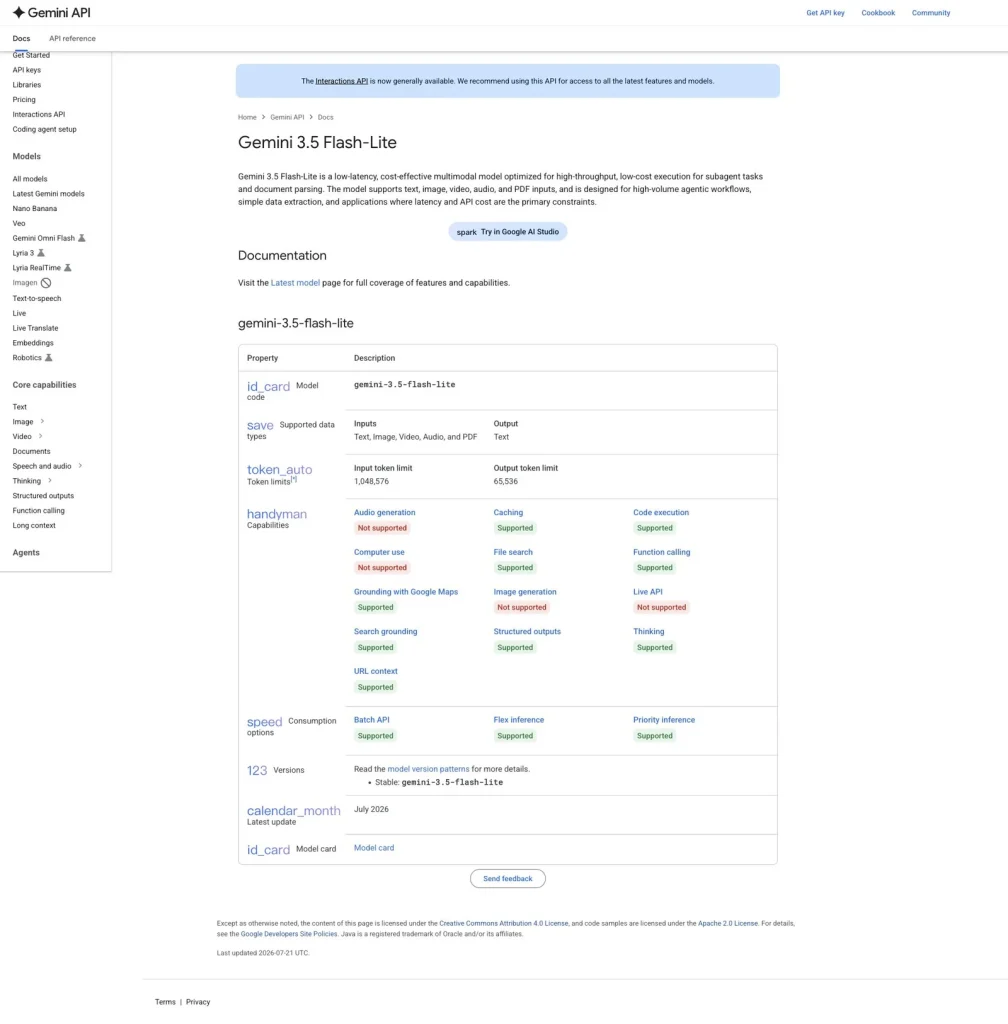
There is one documentation conflict worth flagging. Google’s launch article says Computer Use is now a built-in tool, while the model reference viewed on July 22 marks Computer Use as unsupported. This may reflect different product surfaces or a documentation rollout delay. If that capability is essential, check the exact API or platform interface before designing a production workflow.
Gemini 3.5 Flash-Lite Capabilities and Best-Fit Tasks
The practical advantage is not simply that it answers quickly. The model combines long-context input, controllable thinking levels and schema-constrained output at a price suited to repeated calls. Google specifically names agentic search, document processing, translation and simple data processing. Those are workloads where a small saving on every request becomes meaningful at scale.
- Document operations: summarize files, extract action items, classify records and answer questions across long packets.
- Structured processing: convert messy messages or reports into predictable JSON for downstream automation.
- Localization: preserve names, figures and constraints while adapting tone for a target market.
- Agent sub-tasks: handle bounded steps that do not require the most expensive reasoning model.
- Coding assistance: diagnose self-contained bugs, propose corrections and generate executable tests.
Gemini 3.5 Flash-Lite Benchmarks
Google reports a substantial generation-over-generation improvement. The strongest gains appear in agentic coding, computer interaction and long-context retrieval. These are vendor-reported results, so they describe controlled evaluation performance rather than guaranteed behavior on a private workflow.
| Referência | 3.5 Flash-Lite | Comparação | O que ele testa |
|---|---|---|---|
| SWE-Bench Pro | 54.2% | 3 Flash: 49.6% | Real software engineering tasks |
| Banco de terminais 2.1 | 54.0% | 3.1 Flash-Lite: 31.0% | Terminal and agentic coding |
| OSWorld-Verified | 74.0% | 3 Flash: 65.1% | Computer interaction |
| GDPval-AA v2 | 1140 | 3.1 Flash-Lite: 642 | Real-world knowledge work |
| GDM-MRCR v2 | 72.2% | 3.1 Flash-Lite: 60.1% | Long-context retrieval |
Percentage-point gains. Terminal-Bench and GDM-MRCR compare with 3.1 Flash-Lite; SWE-Bench Pro and OSWorld compare with Gemini 3 Flash. Source: Google, July 21, 2026.
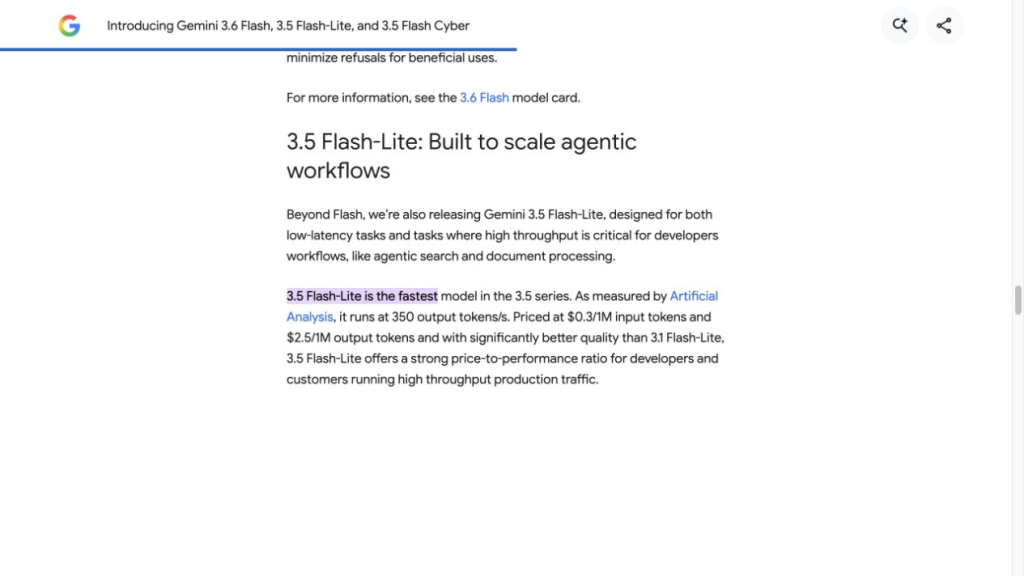
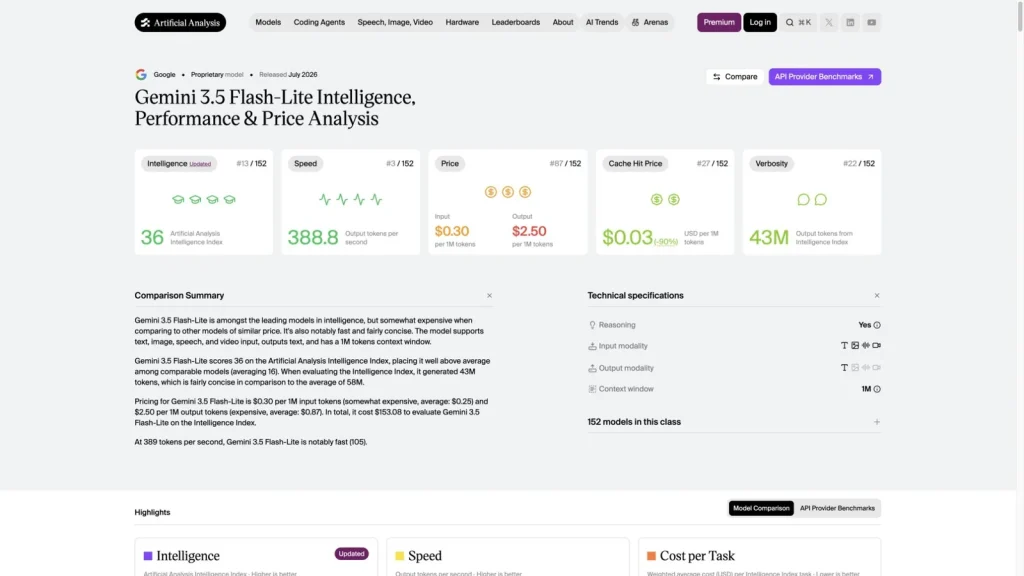
Independent data adds useful context. At the time of checking, Artificial Analysis gave Gemini 3.5 Flash-Lite an Intelligence Index score of 36 and measured 388.8 output tokens per second. Google’s launch post cited an earlier rounded figure of 350 tokens per second from the same organization. The change is a reminder that live benchmark pages can update as providers, samples and measurement windows change.
First-day community reactions were predictably mixed. One Reddit post called the model a step backward but offered little task-level evidence; another discussion highlighted the published long-context improvement. On X, AI developer Philipp Schmid focused on the 350-token-per-second result and estimated task cost. These posts are useful signals about what users care about—speed, price and generation-to-generation quality—but they are too early and anecdotal to outweigh controlled tests.
How I Tested Gemini 3.5 Flash-Lite
I ran four single-model tasks on July 22, 2026, using the exact model ID gemini-3.5-flash-lite through a configured Broly gateway. Every task used the first valid output. I froze the prompts, correct answers, validators and retry rules before seeing the results. Only the long-document task triggered a pre-registered three-run stability check.
| Tarefas | Structured extraction, long-document briefing, localization and Python debugging |
|---|---|
| Pontuação | Objective checks against schemas, reference facts, constraints and executable tests |
| Cronograma | End-to-end Broly route latency, not Google-native output speed |
| Custo | API-equivalent estimate using official token rates; not a GlobalGPT subscription charge |
Gemini 3.5 Flash-Lite Hands-On Test Results
Test 1: Structured data extraction
- Captured every stated value.
- Kept the possible timeout explicitly unconfirmed.
- Excluded the irrelevant renewal note.
- Needed no repair prompt.
Hands-on take: This was the cleanest result in the set. I could have passed the output directly to a parser, which is exactly what a high-throughput extraction model needs to do.
View prompt and model output
Convert these messy support notes into one JSON object with exactly these keys: customer, plan, issue, affected_users, first_reported, workaround, owner, next_update, unresolved. Use null when a value is not stated and return valid JSON only.

Notes: Northstar Labs — Growth plan. CSV exports over 50,000 rows stall at 92%. 14 analysts are affected. Workaround: split exports below 20,000 rows. Priya owns the investigation. A queue timeout is possible but unconfirmed. Next update: Tuesday 16:00 UTC.
Prompt excerpt: the irrelevant renewal-note sentence was omitted here for readability; it remained in the exact test prompt.
{
  "customer": "Northstar Labs",
  "plan": "Growth",
  "issue": "CSV exports over 50,000 rows stall at 92%",
  "affected_users": 14,
  "first_reported": "Monday 09:15 UTC",
  "workaround": "split exports into batches below 20,000 rows",
  "owner": "Priya",
  "next_update": "Tuesday 16:00 UTC",
  "unresolved": ["possible queue timeout (not confirmed)"]
}
Test 2: Long-document understanding
- Retrieved both launch and privacy dates.
- Preserved the 1.8% crash rate and 1.0% target.
- Correctly rejected two unapproved proposals.
- Missed: wrote departments as owners instead of
Not assigned.
Hands-on take: The summary captured the decision-making story, but the owner mistake could send an action item to the wrong team. This is where “mostly correct” is not enough.
View prompt excerpt and model output
Turn the Project Atlas packet into exactly four sections: Executive Brief (maximum 140 words), Confirmed Decisions, Action Register, and Open Questions/Risks. In the Action Register use Owner, Action, Due, Dependency, Status.

Use the confirmed August 12 launch date with its August 5 privacy condition and the current 1.8% crash rate versus the 1.0% target. Do not convert the French proposal, $18,000 ceiling, September mention, or drafted email into approved commitments. Where the packet gives no owner or due date, write Not assigned.
The production prompt included the complete eight-section project packet; this excerpt preserves the decisive instructions and facts.
Executive Brief: Project Atlas is scheduled for August 12, provided the privacy review closes by August 5. The mobile crash rate is 1.8% against a 1.0% release target. French localization was not approved, and the $18,000 testing ceiling is not permission to spend.

Action Register excerpt:
| Owner   | Action                                      | Due         |
| Privacy | Complete remaining privacy review checks     | August 5    |
| Legal   | Review the updated data-processing notice    | Not assigned |

Expected owner value for both rows: Not assigned.
The output preserved the central decisions but converted two organizational functions into owners, causing the 8/10 score.
I repeated this task twice under the frozen stability rule. The main facts stayed correct in all three runs, but the strict owner rule passed only once. Gemini 3.5 Flash-Lite therefore looks reliable for reading the narrative of a long packet, not for unsupervised extraction of every schema-sensitive field.
- Core facts correct: 3/3 runs
- Exact owner rule correct: 1/3 runs
Test 3: Translation and localization
- Retained both required product names.
- Added no unsupported promise.
- Read naturally rather than literally translated.
Hands-on take: The copy was usable after one small stylistic trim: the CTA repeated the model name. The hard constraints themselves were handled perfectly.
View prompt and model output
Localize the Chinese product update into natural US English for an in-app announcement. Use 90–120 words and a headline of no more than eight words. Preserve GlobalGPT, Gemini 3.5 Flash-Lite, 350 tokens/second, $0.30, $2.50, and 1 million tokens. Avoid “revolutionary,” “game-changing,” “cheapest,” and “best.” End with a calm one-sentence CTA.
The full test also supplied the Chinese source paragraph describing availability, positioning, pricing, context size and best-fit workflows.
Gemini 3.5 Flash-Lite Now Available

GlobalGPT now supports Gemini 3.5 Flash-Lite, a model designed for tasks requiring low latency and high throughput. Officially rated at a generation speed of roughly 350 tokens/second, it features a 1 million token context window.

API pricing is set at $0.30 per 1 million input tokens and $2.50 per 1 million output tokens. This model is well-suited for translation, document processing, structured extraction, and multi-step workflows.

You can select this model in GlobalGPT today and use it alongside other leading models within the same platform.

Start using Gemini 3.5 Flash-Lite in your workflow now.
Test 4: Python debugging
- Stopped Python booleans passing as integers.
- Applied the discount only above the threshold.
- Returned all four expected totals.
Hands-on take: The fix ran immediately and the explanation was short enough to review quickly. That supports bounded debugging, not autonomous repository work.
View prompt and model output
Debug this function. The first 100 units cost $0.10 each; every unit above 100 costs $0.07. Quantity must be a non-negative integer. The function currently charges the wrong amount above 100 and accepts booleans. Provide a two-sentence diagnosis, corrected Python, and five asserts for 0, 100, 101, 250, and invalid input.

def calculate_cost(quantity):
    if not isinstance(quantity, int) or quantity < 0:
        raise ValueError(...)
    if quantity <= 100:
        return round(quantity * 0.10, 2)
return round(quantity * 0.07, 2)def calculate_cost(quantity):
if type(quantity) is not int or quantity < 0:
raise ValueError('quantity must be a non-negative integer')
if quantity <= 100:
total = quantity * 0.10
else:
total = (100 * 0.10) + ((quantity - 100) * 0.07)
return round(total, 2)
assert calculate_cost(0) == 0.00
assert calculate_cost(100) == 10.00
assert calculate_cost(101) == 10.07
assert calculate_cost(250) == 20.50The full output also included the requested boolean-rejection test and a two-sentence diagnosis of both bugs.
Gemini 3.5 Flash-Lite Speed and Test Cost
Request-to-response measurements include gateway, network and provider overhead. They are not Google-native output-token speed.
Across the four first outputs, Gemini 3.5 Flash-Lite averaged 3.748 seconds. The tasks used 1,708 input and 1,278 output tokens. At the official reference rates, their combined API-equivalent cost was $0.0037074. This illustrates token economics; it is not a GlobalGPT subscription charge and does not include paid tool calls.
Gemini 3.5 Flash-Lite Pricing and Value
Official Gemini API pricing
| Utilização | Official rate | What drives the bill |
|---|---|---|
| Tokens de entrada | $0.30 / 1M | Prompts, documents and other context sent to the model |
| Tokens de saída | $2.50 / 1M | Answer tokens, including thinking tokens |
| Ferramentas | Varia | Search or other paid tool calls can add separate charges |
Estimates exclude caching, search, other tools and platform fees.
- Output is about 8.3 times more expensive per token than input.
- Strict formats and short answers can materially reduce high-volume costs.
- API billing fits developers who need metered programmatic access and detailed usage control.
Calling this model “cheap” also needs context. Artificial Analysis described its $2.50 output rate as expensive relative to an average of $0.87 among its selected comparable models, even while ranking the model near the top for speed. The value proposition is therefore speed plus useful intelligence, not the absolute lowest token price in the market.
Using Gemini 3.5 Flash-Lite with GlobalGPT subscription plans
GlobalGPT uses a subscription-and-credits model rather than exposing the Gemini API token bill directly. The prices below were visible on July 22, 2026 with annual billing selected.
$5.8 /mês
$11.9 monthly rate
- Access to all chat models
- Unikorn V7 (MJ-like), 10+ advanced image models and Image Editor
- Access to advanced video models
- Eleven Lab v3, Deep Research, AI Detector and ChatPDF
Melhor para: occasional chat and lighter creative workflows that do not need Pro’s full image, video, audio and agent access.
$10.8 /mês
$19.9 monthly rate
- Access to all chat models
- Perplexity Pro Search
- Access to all AI image models and the full Image Editor
- Access to 13 AI video models
- Full access to AI audio models and agents
Melhor para: regular multi-model and creative work.
$25.0 /mês
$49.9 monthly rate
- Everything in Pro
- Unlimited use on selected AI models
- Premium models may still consume credits
Melhor para: frequent users who want the broadest workflow and selected unlimited models.
Gemini 3.5 Flash-Lite API or GlobalGPT: which is better value?
| Escolha | When it fits | Trade-off |
|---|---|---|
| API Gemini | You are building an app, automating a pipeline or need exact usage logs. | Metered billing is efficient, but you manage integration, keys and other model providers yourself. |
| GlobalGPT Básico | You want inexpensive access for occasional chat and lighter AI workflows. | The credit pool is smaller. |
| GlobalGPT Pro | You regularly use leading language models together with research, image, audio or agent tools. | Credits and per-tool costs still need monitoring. |
| GlobalGPT Ilimitado | You use several model families frequently and value one workspace. | “Unlimited” applies only to selected models; premium models can still use credits. |
For most individual reviewers and content teams, Pro is the most balanced GlobalGPT plan: it keeps the multi-model workflow while avoiding the higher Unlimited price. Developers calling Gemini 3.5 Flash-Lite thousands of times from a product will usually prefer the official API because token-level billing and automation matter more than a shared visual workspace. Check the latest plan details before paying because promotions, credit allocations and model access can change.
Pros and Cons
| Prós | Contras |
|---|---|
|
|
Who Should Use Gemini 3.5 Flash-Lite?
Gemini 3.5 Flash-Lite makes the most sense for teams processing many documents, support records, translations or structured messages; developers assigning bounded sub-tasks to an agent; and products where latency is visible to the user. It is less compelling when a task needs the deepest available reasoning, native media generation or zero-tolerance extraction without validation.
The safest operating pattern is simple: use the model for the fast first pass, add objective schema and business-rule checks, and hand failed or high-risk cases to a stronger model or human reviewer. GlobalGPT fits that pattern by keeping leading models and the wider research, writing, coding and creative workflow in one place.
Final Verdict: Is Gemini 3.5 Flash-Lite Worth Using?
Yes—when speed, throughput and controllable cost matter more than squeezing maximum reasoning depth from every call. In my tests, Gemini 3.5 Flash-Lite was excellent at JSON extraction, constrained localization and a bounded debugging task. It also understood the central facts in a long packet, but the owner-field error repeated in two of three runs. That is a useful boundary, not a deal-breaker.
The model is best treated as an efficient worker with validation around important fields. To judge it fairly, try a prompt from your own workflow rather than a trivia question.
Open it in GlobalGPT for fast document processing, localization and structured tasks, then move into research, writing, coding or content creation with other leading models and tools in the same workspace.
Perguntas frequentes
How much does Gemini 3.5 Flash-Lite cost?
The official reference price is $0.30 per million input tokens and $2.50 per million output tokens, including thinking tokens. Tool calls can create additional charges. These API rates are separate from third-party platform subscriptions.
How fast is it?
Google’s launch post cited 350 output tokens per second from Artificial Analysis. The live Artificial Analysis model page showed 388.8 tokens per second when checked on July 22, 2026. Actual end-to-end time depends on prompt size, output length, thinking level, network and provider route.
Is Gemini 3.5 Flash-Lite better than 3.1 Flash-Lite?
Google reports large gains on Terminal-Bench 2.1, GDM-MRCR v2 and GDPval-AA v2. That supports a clear generational improvement, although workload-specific testing is still necessary.
Does it accept images, audio, video and PDFs?
Yes. The official reference lists text, image, video, audio and PDF inputs. The model outputs text and does not natively generate images, audio or video.
Is “Gemini 3.5 Lite” the correct name?
No. The official name is Gemini 3.5 Flash-Lite. “Gemini 3.5 Lite” is an informal abbreviation that can be confused with other Flash-Lite generations.
Sources: Google launch announcement; Gemini API model reference; Preços da API do Gemini; Análise Artificial; Reddit discussion; X commentary. Official benchmark figures are vendor-reported; hands-on figures come from the controlled July 22 test package described above.