CLAUDE OPUS 4.7 · PRICING · 2026
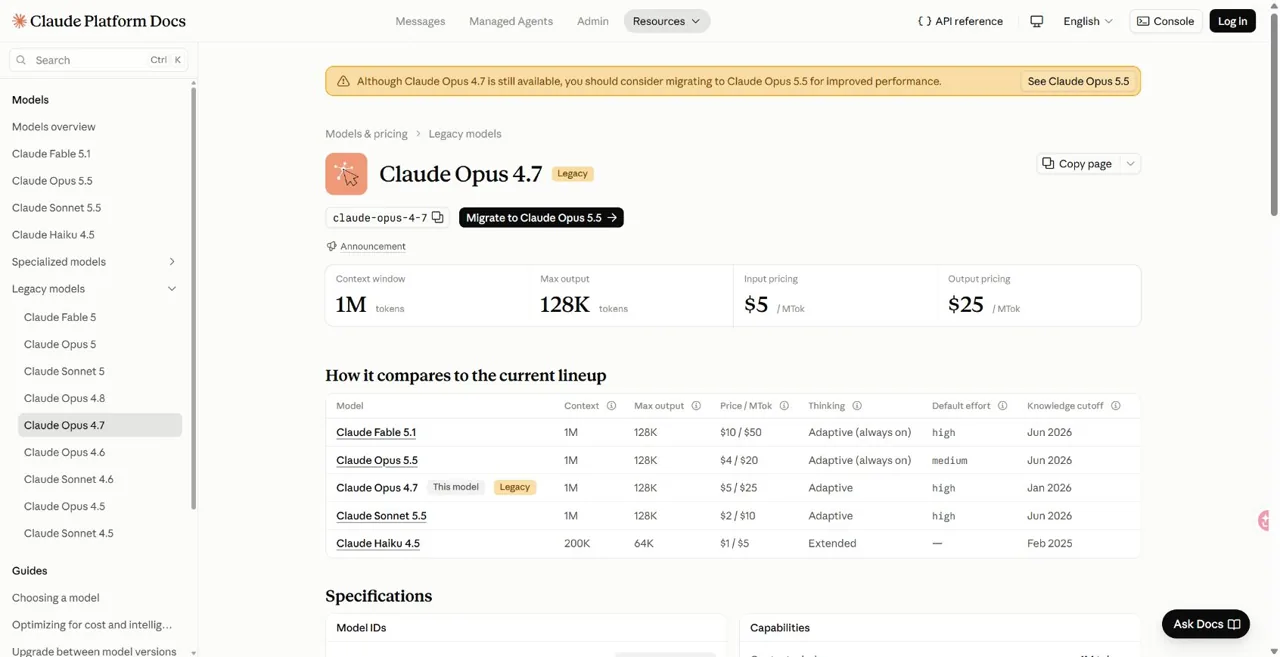
Claude Opus 4.7 API rates remain at $5.00 per million input tokens and $25.00 per million output tokens. . Claude Pro plan costs $20/month, but a subscription is separate from API billing and does not guarantee access to a specific older model. As of September 30, 2026, Anthropic lists Opus 4.7 as a legacy model and recommends 작품 5.5 for most new workloads. The newer tokenizer also matters: current documentation estimates approximately 30% more tokens for the same text than pre-4.7 models, depending on the workload—not a fixed 30% increase in your whole bill.
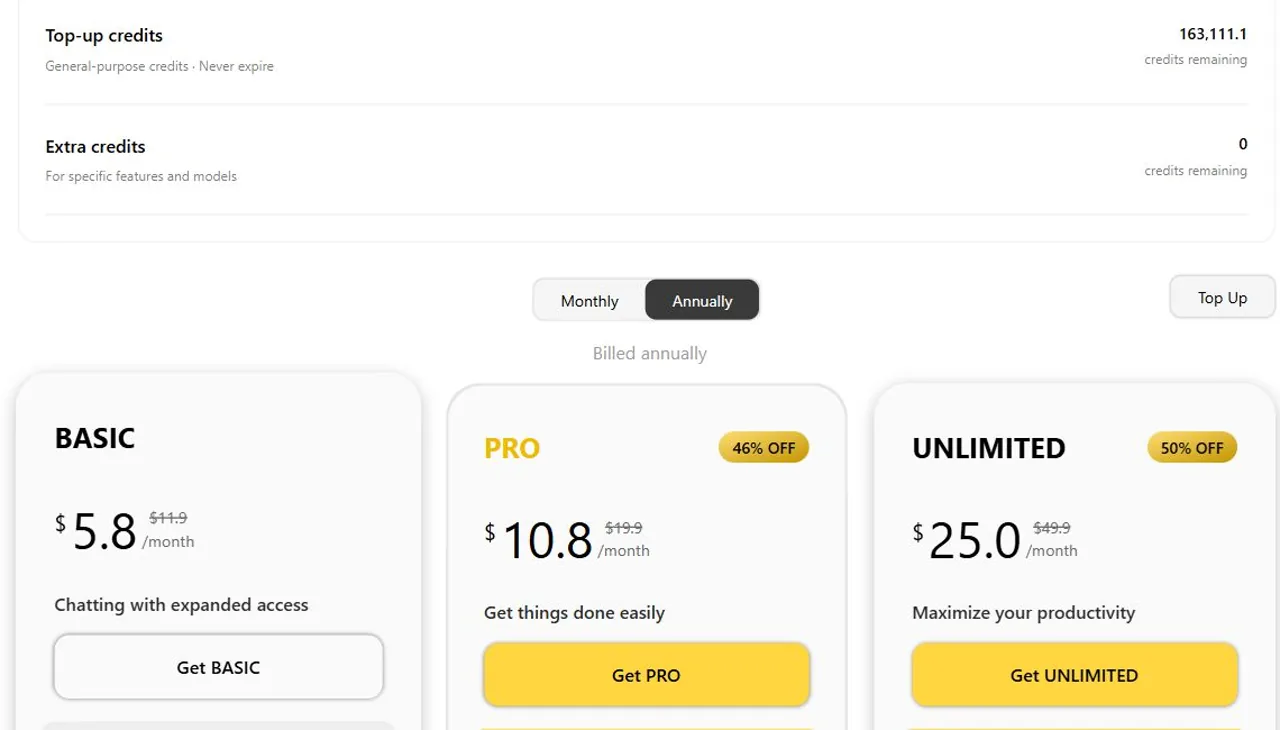
For professionals navigating these billing choices, GlobalGPT offers a simplified, high-limit environment to access Claude Opus 5.5 그리고 당혹감 through a single dashboard. The Basic Plan starts at $5.80/month equivalent on annual billing—$69.60/year calculated from the displayed rate. You avoid managing a separate provider API bill or region blocks, while usage is metered through GlobalGPT credits.
See Anthropic’s 모델 개요 for the current recommendation. All prices below are in USD; Claude subscription prices exclude applicable taxes.
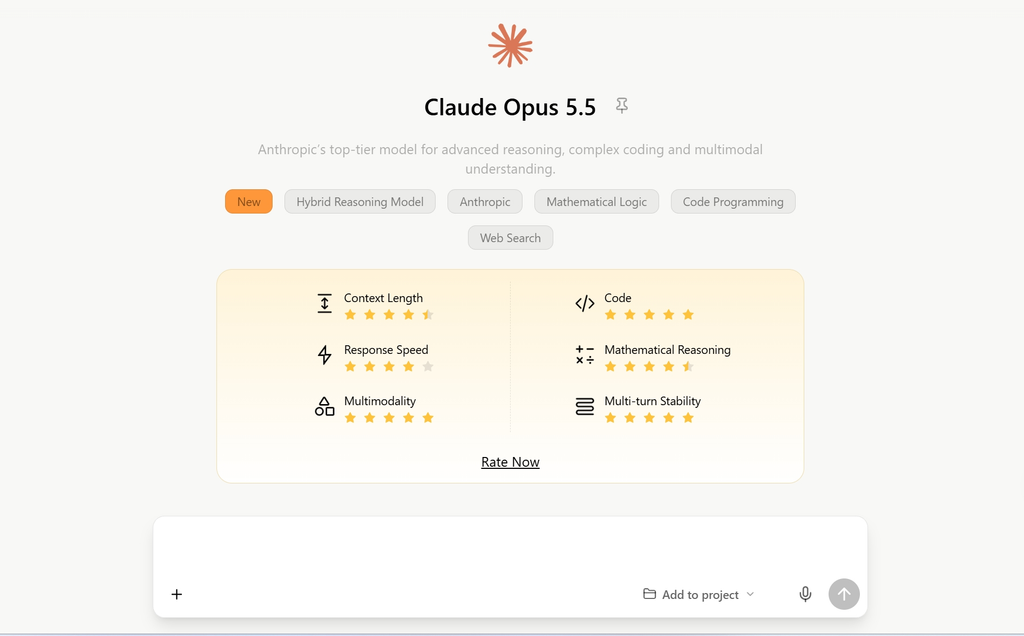
Beyond solving your LLM logic needs, GlobalGPT is designed to cover your complete creative workflow from research to final production. Once you’ve used Claude Opus 5.5 to draft your technical specs, you can seamlessly transition to image and video creation—all within the same dashboard. This integrated ecosystem lets creative professionals complete an entire multi-modal project, from complex technical briefs to finished visual assets.
- Claude Opus 4.7 Features: What Changed at Its April 2026 Launch?
- Claude Subscription Plans: Pro, Max and Team Pricing
- Claude Opus 4.7 API Pricing: The $5/$25 Rate and Tokenizer Costs
- Claude Subscription vs. Opus 4.7 API: Which Fits Your Workflow?
- Escape the Claude 4.7 “Plan vs. API” Trap: Why GlobalGPT is the Definitive Middle Ground
- Claude Opus 4.7 Benchmarks: The April 2026 Launch Comparison
- Frequently Asked Questions About Claude Opus 4.7 Pricing
- Final Verdict: Keep Opus 4.7 or Choose a Current Model?
Claude Opus 4.7 Features: What Changed at Its April 2026 Launch?
Claude Opus 4.7 marked a significant shift in Anthropic’s model capabilities, with improvements in autonomous coding and tool use. While the sticker price for API usage remains at $5/MTok (Input) and $25/MTok (Output), the underlying mechanics of how tokens are counted and how the model “thinks” changed with the April 2026 release. The official Opus 4.7 overview now labels it legacy; it remains available, with retirement no sooner than April 16, 2027.
High-Resolution Vision: The 3.75MP Breakthrough
One of the most impactful upgrades in version 4.7 is the introduction of High-Resolution Image Support. Anthropic has increased the maximum resolution limit from 1.15MP to 3.75MP (2576px on the long edge). This isn’t just about clearer pictures; it enables a 1:1 coordinate mapping system where the model’s spatial reasoning is aligned exactly with actual pixels.
For professionals using Claude 에 대한 UI/UX auditing, document redlining, or automated screenshot analysis, this removes the need for complex scale-factor math and dramatically reduces errors in “pointing” and “measuring” tasks. However, users should note that high-fidelity images consume significantly more tokens, making downsampling a critical cost-saving skill when extreme detail isn’t required.
그리고 official migration guide documents the coordinate, sampling and thinking changes across these model generations.
The “X-High” Effort Level & Adaptive Thinking
Claude Opus 4.7 officially retires the old manual “Extended Thinking” budgets. In its place, Adaptive Thinking is the supported thinking mode; Opus 4.7 can also run without thinking. To give users finer control, the xhigh effort level sits between the standard high and max tiers.
This level is specifically tuned for 행위자적 코딩 and complex multi-file engineering. By setting the effort to xhigh, the model allocates more internal reasoning cycles to verify its own logic before responding. While this increases output token use, it can reduce retry prompts on difficult tasks, saving time and manual debugging effort. Test the trade-off on your own workload; fewer retries are not guaranteed.
Critical Breaking Changes: Sampling & Thinking Blocks
Developers migrating from 4.6 to 4.7 must be aware of several breaking API changes:
- Sampling Parameters: Setting non-default values for
온도,top_p, 또는top_kreturns an error on Opus 4.7 and later. Omit these parameters when migrating; the current guide permits supported default values. - Omitted Thinking Content: By default, thinking 텍스트 is omitted, while thinking blocks and their signatures remain in the response. Setting
thinking.display: "summarized"requests a summary, not the model’s full private chain of thought. Thinking tokens remain billable even when their text is omitted. - Tokenizer Change: The launch documentation described 1.0–1.35 times as many tokens for the same text. Current pricing documentation uses approximately 30% more tokens for Claude 4.7 and later versus earlier models. The exact change depends on the content and workload; it is not a fixed surcharge on every request.
Claude Subscription Plans: Pro, Max and Team Pricing
As of September 30, 2026, the Claude Free Tier serves as a gateway with Sonnet and Haiku access, but not Opus. For individual power users, the Claude Pro Plan remains priced at $20/월, 또는 $200 paid annually ($16.67/month equivalent). It offers more usage than Free and access to the Opus family. The current plan page does not promise that the older Opus 4.7 remains selectable in the app.
| 계획 | 월별 청구 | Annual billing / key boundary |
|---|---|---|
| 무료 | $0 | Sonnet and Haiku; no Opus |
| Pro | $20/월 | $200/year upfront; $16.67/month equivalent; saves $40 vs 12 monthly payments |
| 최대 | 월 $100부터 | 5x or 20x Pro usage |
| 팀 표준 | $25/seat/month | $240/seat/year; $20/month equivalent |
| 팀 프리미엄 | $125/seat/month | $1,200/seat/year; $100/month equivalent |
| 기업용 셀프 서비스 | 연간 약정 | $240/seat/year plus usage at API rates; sales-assisted pricing can differ |
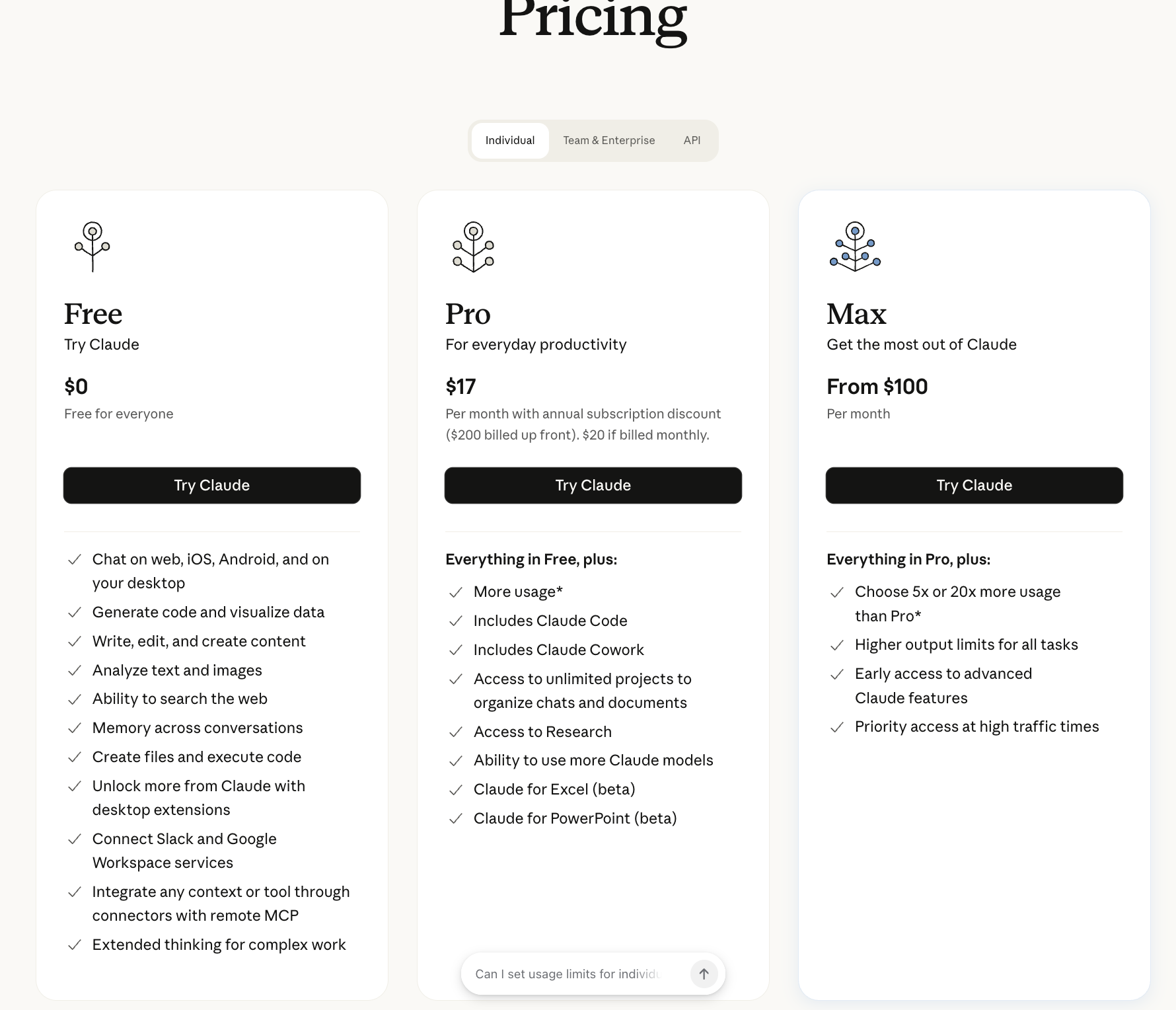
For extreme high-volume users, Anthropic offers the Claude Max Plan, from $100/month. This tier is designed for developers who run complex, long-running agentic tasks directly in the browser interface. It includes 5x or 20x Pro usage and priority access. Organizational users can opt for Claude Team Standard ($25/seat/month, or $20 with annual billing) or Enterprise tiers, which provide administrative controls and security features. Team Standard costs $240/year per seat on annual billing; see the 공식 가격 안내 페이지 for seat and usage terms.
Claude Opus 4.7 API Pricing: The $5/$25 Rate and Tokenizer Costs
The official API rate for Claude Opus 4.7 is $5.00 per million (MTok) input tokens 그리고 $25.00 per million output tokens. While these rates match the previous version, the true cost story lies in the tokenizer update. Anthropic’s current pricing documentation estimates approximately 30% more tokens for the same text, depending on the content and workload.
This means that a piece of text that consumed 1,000 tokens in Opus 4.6 might consume about 1,300 tokens in Opus 4.7. Your input bill can increase even though the sticker price remains the same; output length and thinking also affect the total. To mitigate this, developers should use 프롬프트 캐싱, 제공하는 90% discounts for cache hits (priced at just $0.50/MTok), making it a useful tool for managing long-context engineering budgets. Cache writes have separate charges; the discount applies to cached input reads, not the whole request.
| Opus 4.7 usage type | USD per million tokens | 다루는 내용 |
|---|---|---|
| Standard input | $5.00 | 캐시되지 않은 입력 |
| 표준 출력 | $25.00 | Output, including billed thinking tokens |
| 5분 간격의 캐시 쓰기 | $6.25 | Writing eligible input to a short-lived cache |
| 1시간 캐시 쓰기 | $10.00 | Writing eligible input to a longer-lived cache |
| 캐시 적중 | $0.50 | Reading eligible cached input |
| Batch input / output | $2.50 / $12.50 | 50% below standard token rates |
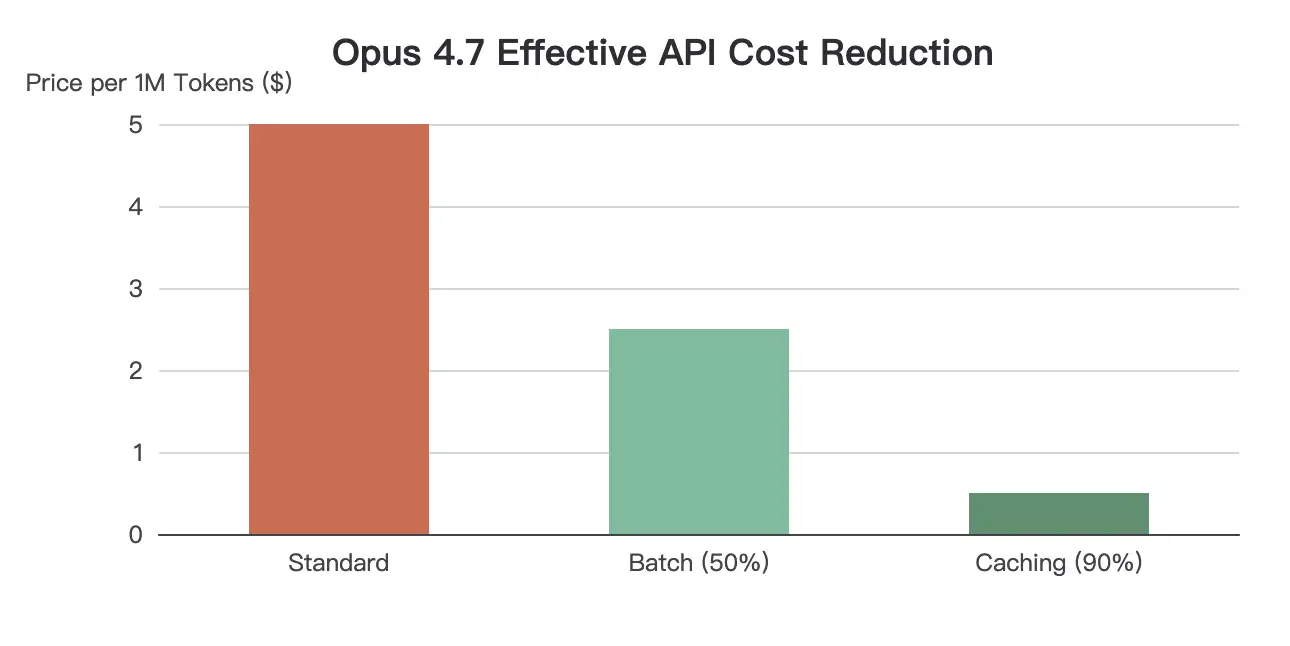
A worked example: 100,000 input tokens plus 20,000 output tokens cost $0.50 + $0.50 = $1.00. If only the input grows by 30%, the bill becomes $0.65 + $0.50 = $1.15, a 15% increase. This example excludes caching and tool fees; more input tokens do not automatically raise the whole bill by the same percentage.
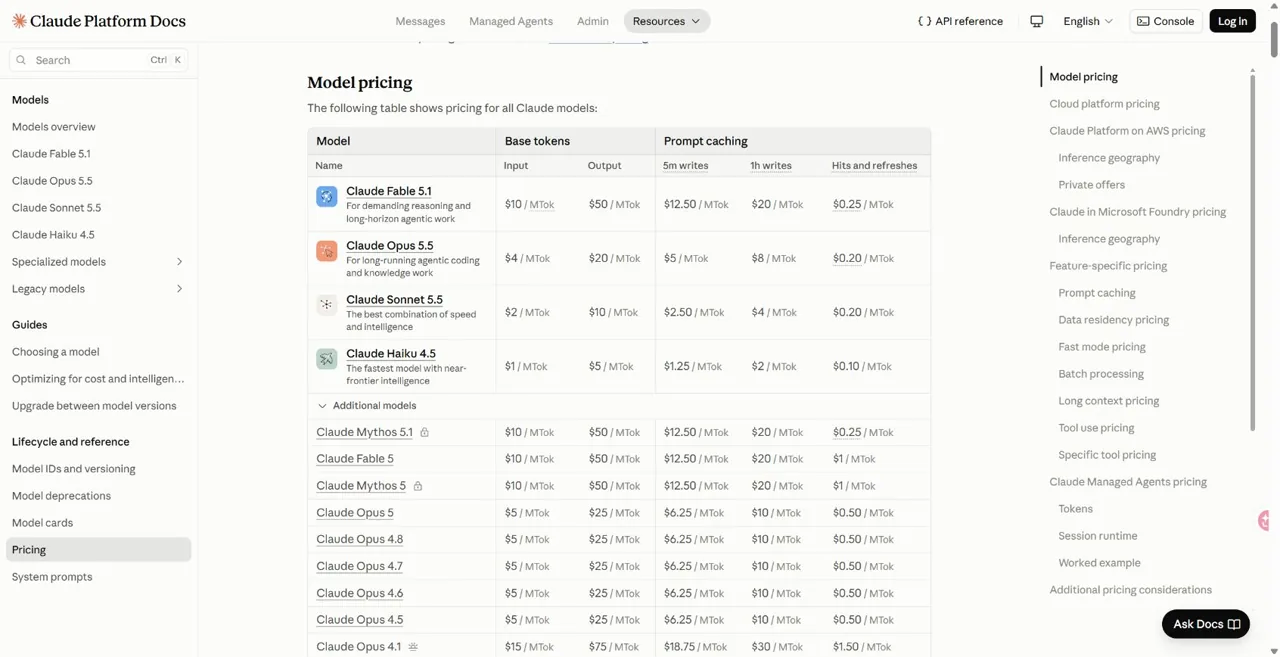
For a broader comparison, the Claude 가격 안내서 separates subscription fees from token charges.
Claude Subscription vs. Opus 4.7 API: Which Fits Your Workflow?
Choosing between a 클로드 프로 구독 및 Claude API depends on your technical requirements. Subscription plans offer a superior UI experience, including 유물 for live code rendering and integrated 웹 검색. These features are optimized for creative brainstorming and “Vibe Coding” where instant visual feedback is necessary.
그러나, API provides granular control over the model’s performance via the Adaptive Thinking effort parameter. API users can set effort levels from low (for snappy, cost-effective tasks) through medium, high and xhigh to max (for deeper reasoning). While the API supports automated workflows within rate limits, users must manage their own token credits. Whether the $20/month Pro plan is more economical depends on your token volume and whether the app’s usage allowance covers your workload. The Claude 코드 가격 안내서 explains the billing routes.
| Route / setting | Good starting point | Budget trade-off |
|---|---|---|
| Claude app | Interactive work, Artifacts and web search | Plan limits; separate from API billing |
| Opus 4.7 API: low / medium | Routine work and faster responses | Test quality before reducing effort |
| Opus 4.7 API: high / xhigh / max | Harder reasoning and engineering | More thinking can increase latency and output costs |
Another useful comparison: at 10,000 input tokens and 2,000 output tokens per API call, Opus 4.7 costs $0.10 per call. That is $10 for 100 calls or $20 for 200 calls. Those are illustrative token-sized calls, not a promise that Pro includes an equivalent number of API requests.
Escape the Claude 4.7 “Plan vs. API” Trap: Why GlobalGPT is the Definitive Middle Ground
If you find yourself frustrated by the usage limits of the official $20 Pro plan, yet remain wary of variable API billing, GlobalGPT offers a high-limit alternative starting at $5.80/month equivalent with annual billing ($69.60/year calculated from the displayed rate). Your subscription price is predictable, while model use consumes credits; a fixed subscription does not mean unlimited Opus usage.
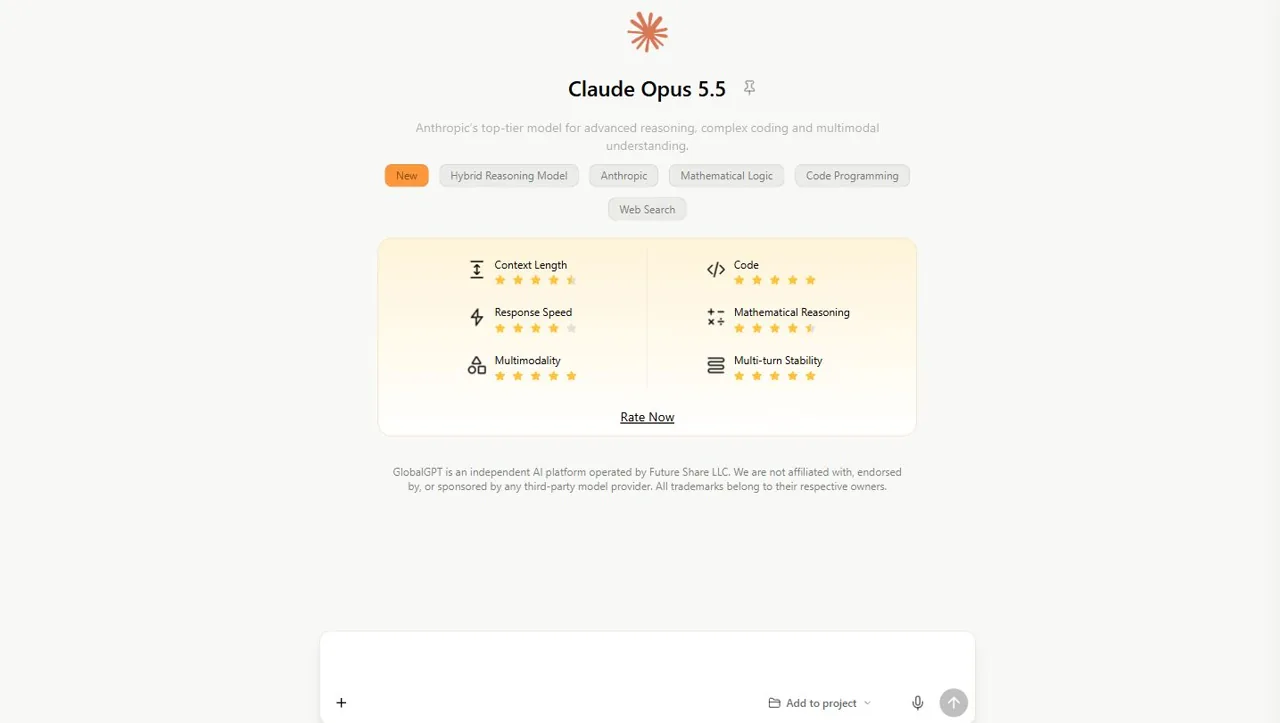
Beyond cost stability, GlobalGPT eliminates the significant accessibility hurdles inherent in official platforms; we provide a borderless experience with 지역 제한 없음 그리고 no requirement for complex international credit cards. Our platform is not merely a gateway for Claude Opus 5.5; it is a creative ecosystem designed to transition your projects from initial “Ideation & Research” to high-end “Visual Content Creation” and “Final Video Production” within a single, unified dashboard.
Industry-Leading LLMs: Your Intelligence Hub
In addition to the world-class logic of Claude Opus 5.5, GlobalGPT provides instant access to a range of AI tools. This allows you to cross-reference results and choose the best tool for every sub-task:
- Creative brainstorming: Compare ideas and multi-modal dialogue across tools in the same workspace.
- Research and analysis: Use different tools for data retrieval and long-context analysis.
- 당혹감: Integrated real-time search for grounding your projects in the latest market facts.
Elite Image & Video Generation: From Specs to Production
For professionals looking to bridge the gap between text and visual media, the GlobalGPT Pro Plan ($10.80/month equivalent, billed annually) unlocks advanced visual AI for the complete production cycle. That is $129.60/year calculated from the displayed rate. Basic already includes selected image tools; Pro adds broader access to advanced image and video generation:
- Pro Image Generation: 사용하십시오 image workspace to transform Claude-generated technical specs into high-fidelity UI designs or marketing assets.
- 영상 제작: Take your workflow to the finish line with the video workspace. Choose a model with the output, audio and duration options your project needs—all within the same dashboard.
| GlobalGPT 요금제 | Monthly equivalent, billed annually | Estimated annual cost / annual credits |
|---|---|---|
| 기본 | $5.80 | $69.60/year; 144,000 credits/year |
| Pro | $10.80 | $129.60/year; 240,000 credits/year |
| 무제한 | $25.00 | $300.00/year; 624,000 credits/year plus unlimited use of selected models |
Resilience and Choice: The “No-Lock-In” Advantage
The primary advantage of GlobalGPT is multi-model redundancy. Relying on a single official site carries the risk of regional outages, account blocks, or performance limits. GlobalGPT serves as your productivity insurance: if one model experiences downtime, you can instantly pivot to another flagship model in the same workspace. This keeps your professional workflow moving and your subscription price predictable; model credit costs can differ. For other options, compare these 클로드 대안.
Technical Transparency & Boundaries
To maintain extreme cost-efficiency and multi-model stability, Claude Opus 5.5 on GlobalGPT is optimized for professional conversational use and iterative reasoning. Our platform provides a premium web interface for direct interaction; opening this chat route does not generate an Anthropic API key or configure third-party agentic automation. For users seeking an all-in-one workspace to research, draft, and produce high-end content, GlobalGPT is a convenient gateway.
Claude Opus 4.7 Benchmarks: The April 2026 Launch Comparison
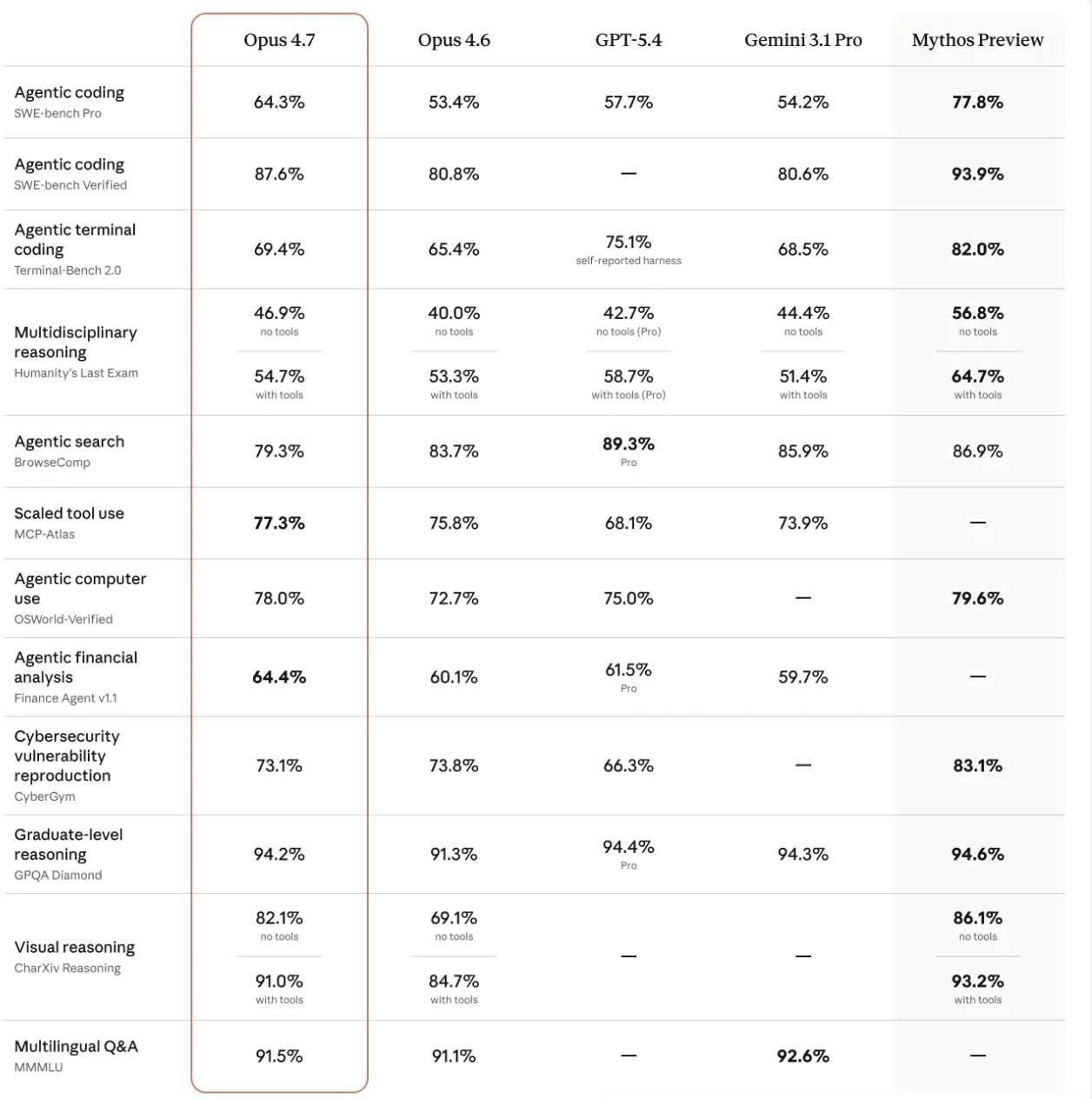
In Anthropic’s April 16, 2026 launch comparison, Claude Opus 4.7 improved on Opus 4.6 in agentic coding, tool use and vision. The figures below explain that release’s strengths; they are historical results, not the current model leaderboard.
Autonomous Coding at Launch
Claude Opus 4.7 scored 64.3% on SWE-bench Pro in the launch comparison, up from 53.4% for Opus 4.6. GPT-5.4 scored 57.7% 및 Gemini 3.1 Pro 54.2% in that same table. The gain over 4.6 is 10.9 percentage points. This is useful evidence for repository-level coding, but it does not establish a lead on every engineering task: GPT-5.4 scored higher on Terminal-Bench 2.0 in the same release table. Compare these results with your own tests when choosing the 코딩을 위한 최고의 AI 모델.
| Historical benchmark | Opus 4.7 | Opus 4.6 | Difference |
|---|---|---|---|
| SWE-벤치 프로 | 64.3% | 53.4% | +10.9 percentage points |
| MCP Atlas (revised method) | 77.3% | 75.8% | +1.5 percentage points |
| CharXiv Reasoning, no tools | 82.1% | 69.1% | +13.0 percentage points |
Agentic Intelligence & Tool Use
Beyond raw coding, Opus 4.7 scored 77.3% on MCP Atlas, a benchmark for agentic tool use, compared with 75.8% for Opus 4.6 under the revised evaluation method: a 1.5-percentage-point increase. This measures how efficiently a model navigates software environments, calls APIs and manages file systems. Separately, Notion reported one-third as many tool errors as Opus 4.6 in its own tests. That result comes from Notion’s own workflow, so it should be read separately from the MCP Atlas score.
Pixel-Perfect Vision for Knowledge Work
The vision architecture in Opus 4.7 has undergone a fundamental upgrade. By increasing the pixel budget to 3.75MP (up from 1.15MP), Anthropic enabled a 1:1 coordinate mapping system. On the CharXiv Reasoning benchmark without tools, 4.7 scored 82.1% versus 69.1% for 4.6: a 13.0-percentage-point improvement. This supports its use for dense financial charts and complex engineering diagrams. For professionals analyzing UI design or high-resolution document scans, it is a useful capability to test on real documents.
Claude Opus 4.7 Value Analysis: Is the Performance Boost Worth the Migration Cost?
When performing an ROI (Return on Investment) analysis, Opus 4.7’s launch results present a case for comparison. Early testing from partners like Hex found that low-effort Opus 4.7 roughly matched the quality of medium-effort Opus 4.6. You may end up using fewer total tokens to solve the same problem if it takes fewer attempts, offsetting some tokenizer growth. Measure this on your workload; the saving is not automatic.
그리고 “One-Shot Success” factor is where a stronger model can save money. In autonomous agent workflows, every failed attempt requires a new API call and more human oversight time. The increase from 53.4% to 64.3% on SWE-bench Pro suggests a useful direction to test, but it does not predict your production success rate. Track API spending, repeated debugging and human review time together to estimate the cost of each completed task.
For the practical trade-offs beyond one release table, compare Claude and ChatGPT for coding on the kinds of tasks you actually ship.
Frequently Asked Questions About Claude Opus 4.7 Pricing
Is Claude Opus 4.7 free on the mobile app?
No. Claude’s Free plan includes Sonnet and Haiku, not Opus. Paid plans include Opus-family access, but the current plan page does not guarantee that legacy Opus 4.7 remains selectable in the app.
Does the new tokenizer affect coding efficiency?
It can increase token use. Anthropic estimates approximately 30% more tokens for the same text in Claude 4.7 and later versus earlier models, depending on the workload. Compare cost per completed task, including retries; no fixed efficiency gain is guaranteed.
Can I use prompt caching in the Claude Pro plan?
The published cache-write and cache-hit rates apply to API billing, not a discount on your Pro subscription. GlobalGPT’s platform backend optimizations integrate cost-saving features into its dashboard; these do not change Anthropic’s published API rates.
Do the old coding benchmarks prove Opus 4.7 is the best choice today?
No. The April 2026 launch results showed gains on several coding and tool-use tests, but they are historical comparisons. Anthropic now recommends Opus 5.5 for most workloads. Test current models on your own code before choosing.
Can I use Claude on GlobalGPT, and what does it cost?
Yes. GlobalGPT currently offers Claude Opus 5.5. Basic displays $5.80/month equivalent on annual billing, or $69.60/year calculated from that rate. Usage consumes GlobalGPT credits; this is separate from Anthropic API billing.
Final Verdict: Keep Opus 4.7 or Choose a Current Model?
If your workflow involves autonomous coding agents, high-resolution vision, or long-horizon reasoning, Opus 4.7 remains an available option for an existing integration. For new work, start by testing the current Claude Opus 5.5, which Anthropic recommends for most workloads at $4/MTok input and $20/MTok output—20% below Opus 4.7’s standard rates. For standard text classification or simpler content generation, Sonnet 5.5 비용 $2/MTok input and $10/MTok output. Choose by cost per useful result, not by message count alone.
The current recommendation and rates appear in the 공식 모델 개요 그리고 API 요금표. If you want one dashboard for chat, research and creative work, start with GlobalGPT’s current Opus route.