A consistent AI character starts with a strong reference image, not a longer description. Keep the face, age, hair, skin tone, and other identity traits fixed, then change pose, framing, wardrobe, setting, or lighting one variable at a time.
One photo can work well for a controlled set of images. It is less reliable when you ask for a new camera angle, a full-body composition, a different outfit, a product interaction, and dramatic lighting all at once. The practical goal is recognizable identity across useful scenes, not pixel-for-pixel duplication.
For creators whose workflow also includes research, scripts, image generation, and video, グローバルGPT provides an all-in-one AI workspace with multiple supported capabilities under one account. That broader workspace can reduce subscription and tab switching, but identity consistency still depends on disciplined references and controlled changes.
簡単な答え: Choose a clear reference portrait, write down the traits that must not change, generate a neutral baseline, and reuse that same reference for every scene. Change one major variable per attempt and compare equal-size face crops before accepting the result.

What Makes an AI Character Consistent?
Character consistency means that a viewer recognizes the same person after meaningful visual changes. The hairstyle may move, shadows may cross the face, and clothing may change, but the facial proportions, age, skin tone, and distinctive features should still belong to one identity.
- Identity continuity: face shape, eyes, nose, mouth, skin tone, age, hairline, and defining marks.
- Style continuity: photographic, illustrated, cinematic, or another visual treatment.
- Wardrobe continuity: the same outfit across shots when the sequence requires it.
- Scene continuity: stable environment, props, light direction, and time of day.
- Motion continuity: the identity remains stable as the face and body move through video frames.
These are separate problems. A tool can preserve a face while changing the jacket, or preserve a setting while subtly changing the person. Repeating the same prompt is not enough because a text description does not encode every geometric detail in a face.
Choose the Right Consistency Method
| 方法 | セットアップ | 最適 | 主な制限 |
|---|---|---|---|
| プロンプトのみ | Write fixed traits into every prompt | Loose concepts and early exploration | Facial geometry drifts easily |
| Single reference image | Attach the same approved portrait | Small controlled image sets | Profiles and full-body scenes are harder |
| Character sheet | Use front, three-quarter, profile, and full-body views | Illustration, storyboards, and pose coverage | More preparation and source management |
| 学習済みアイデンティティ | Train a persona or LoRA from multiple authorized images | Recurring, higher-volume production | Training time, cost, privacy, and portability |
If you only need a few scene variations, begin with one reference instead of training immediately. GLBGPT’s existing Nano Banana scene-consistency workflow covers that model-specific route in more detail. For stronger angle coverage, a multi-angle character sheet from one photo can provide additional references before you build a sequence.
Can You Create a Consistent AI Character From One Photo?
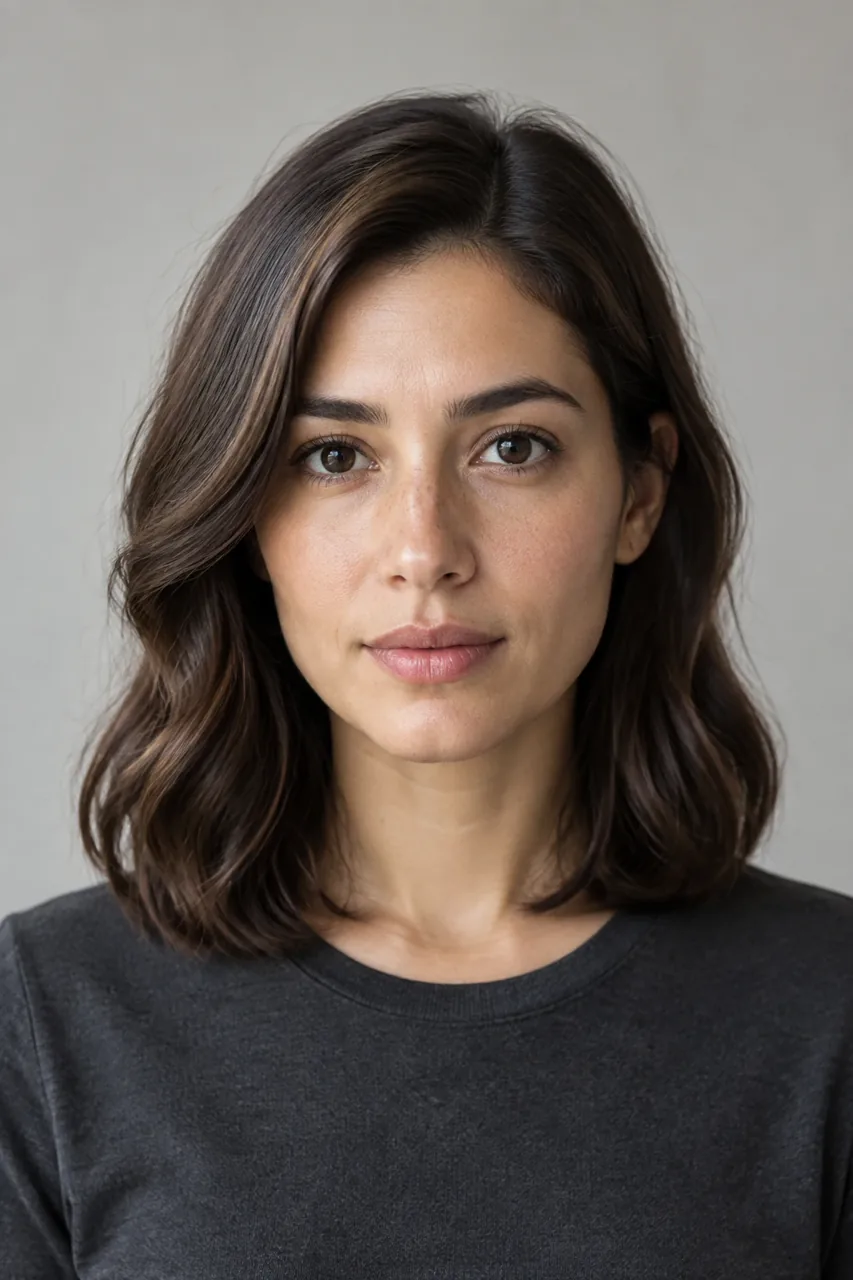
Yes, one photo can be enough when the image is clear and the requested changes are controlled. Start with a front-facing or slight three-quarter portrait, even lighting, a complete head and shoulders, and visible details around the eyes, nose, mouth, hairline, and skin.
One photo becomes less informative as the camera moves away from its original view. A frontal portrait does not fully reveal the profile of the nose, jaw, ears, body proportions, or the back of the hair. The model must infer those details, and each inference creates another chance for identity drift.
How to Create a Consistent AI Character From One Reference Photo
Step 1: Choose an authorized reference portrait
Use a fictional person, your own photo, or an image you have explicit permission to use. Avoid group shots, sunglasses, heavy filters, severe shadows, low resolution, cropped hair, and extreme expressions. A visually attractive image is not automatically a useful identity reference; clarity matters more than drama.
Step 2: Build a short identity lock
Record only the traits that distinguish the person. In our test, the lock included an oval face, warm olive skin, subtle freckles across the nose, dark brown almond-shaped eyes, a straight nose with a softly rounded tip, defined natural eyebrows, and shoulder-length dark chestnut hair with a side part.
Step 3: Generate a neutral baseline
Before asking for a campaign scene, generate a chest-up portrait with a plain background, neutral daylight, and a relaxed expression. Reject a baseline with plastic skin, cropped hair, asymmetrical eyes, or a face that is too generic. Every later result will be judged against this anchor.
Step 4: Reuse the original reference every time
Do not feed Test 1 into Test 2 and Test 2 into Test 3. That creates cumulative drift. Return to the same accepted reference for each branch, restate the identity lock, and describe the one thing that should change.
Step 5: Compare at equal scale
Place the baseline and new result side by side. Compare the eyes, nasal bridge and tip, mouth width, jaw, freckles, hairline, and apparent age. A similar hairstyle and skin color can hide a different face, so zoom into facial geometry before accepting the scene.
Step 6: Save successful prompts and failures
Record the model, prompt, source image, time, retries, and visible drift. Keep a failed result when it teaches you something. A before-and-after repair is more useful than a folder containing only unexplained winners.
A Prompt Formula That Separates Identity From Scene
For example: “Create the same fictional woman walking beside a modern concrete building in overcast daylight. Show her full body at eye level. Change the setting and outfit only. Preserve the exact face, apparent age, freckles, skin tone, hairline, hair color, side part, and shoulder-length style.”
Use positive instructions for the intended scene and a short constraint block for identity. Avoid stuffing the prompt with repeated synonyms. Clear separation between “lock” and “vary” is more useful than making the prompt longer.
Testing One AI Character Across Four Scene Changes
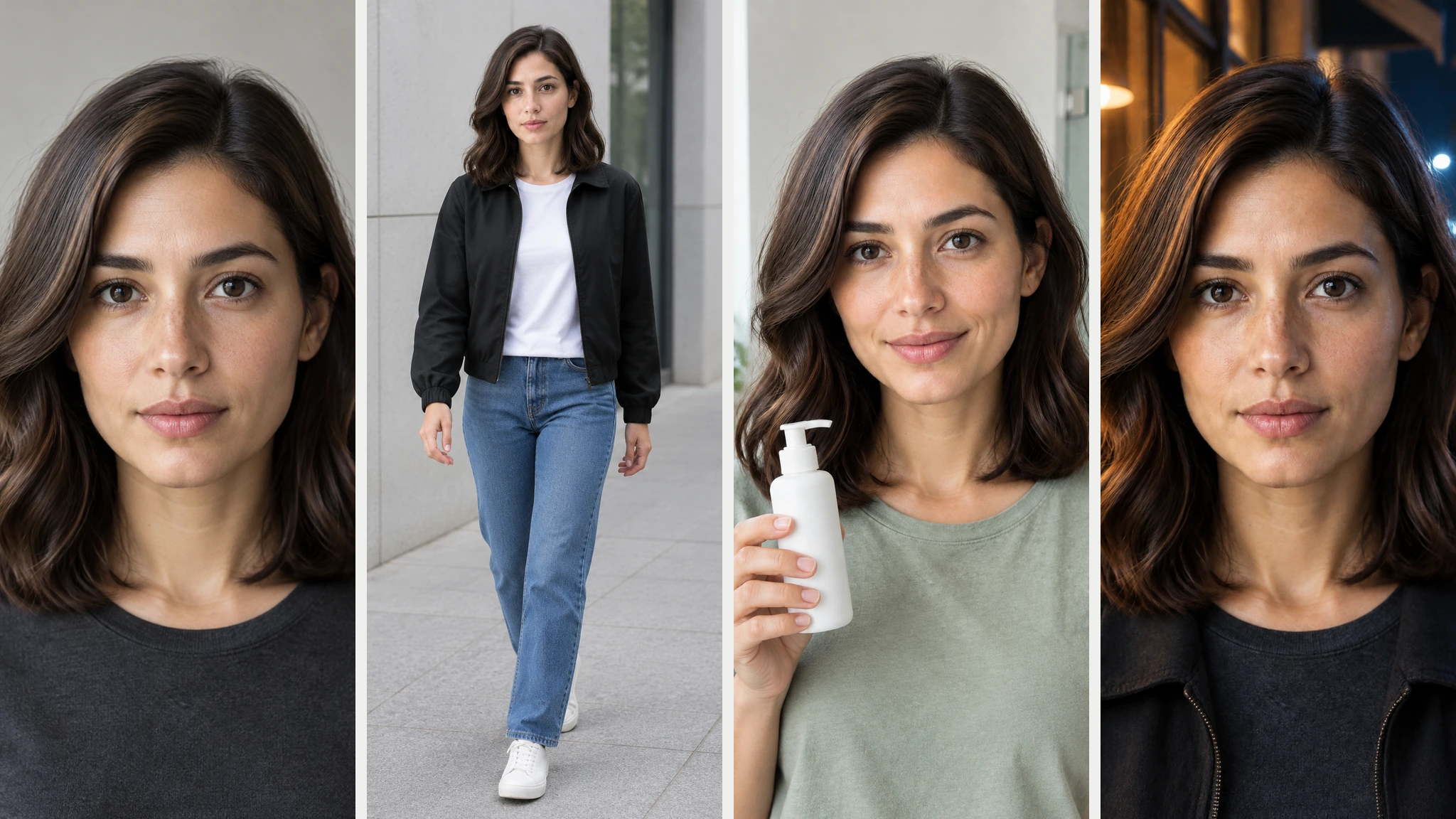
We created one fictional adult reference portrait, then used that original image for four controlled reference edits. The workflow reported the model label as GPT Image 2.5. We changed one main dimension at a time and did not use a trained identity.
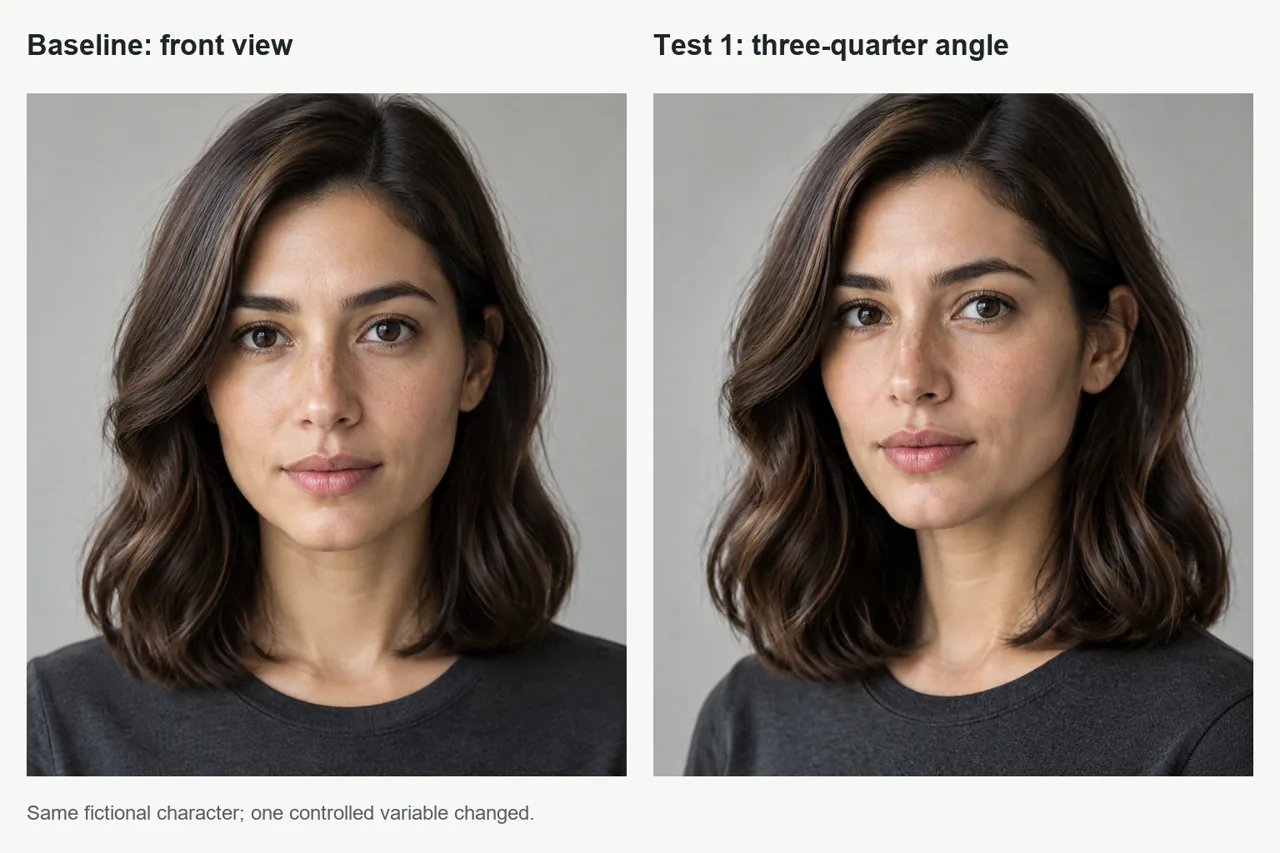
Test 1: Three-quarter angle
結果 The eyes, nose, freckles, eyebrows, jaw, and apparent age still read as the same person after a roughly 35-degree head turn. Hair volume increased slightly, but its color, side part, and length remained within the accepted identity.
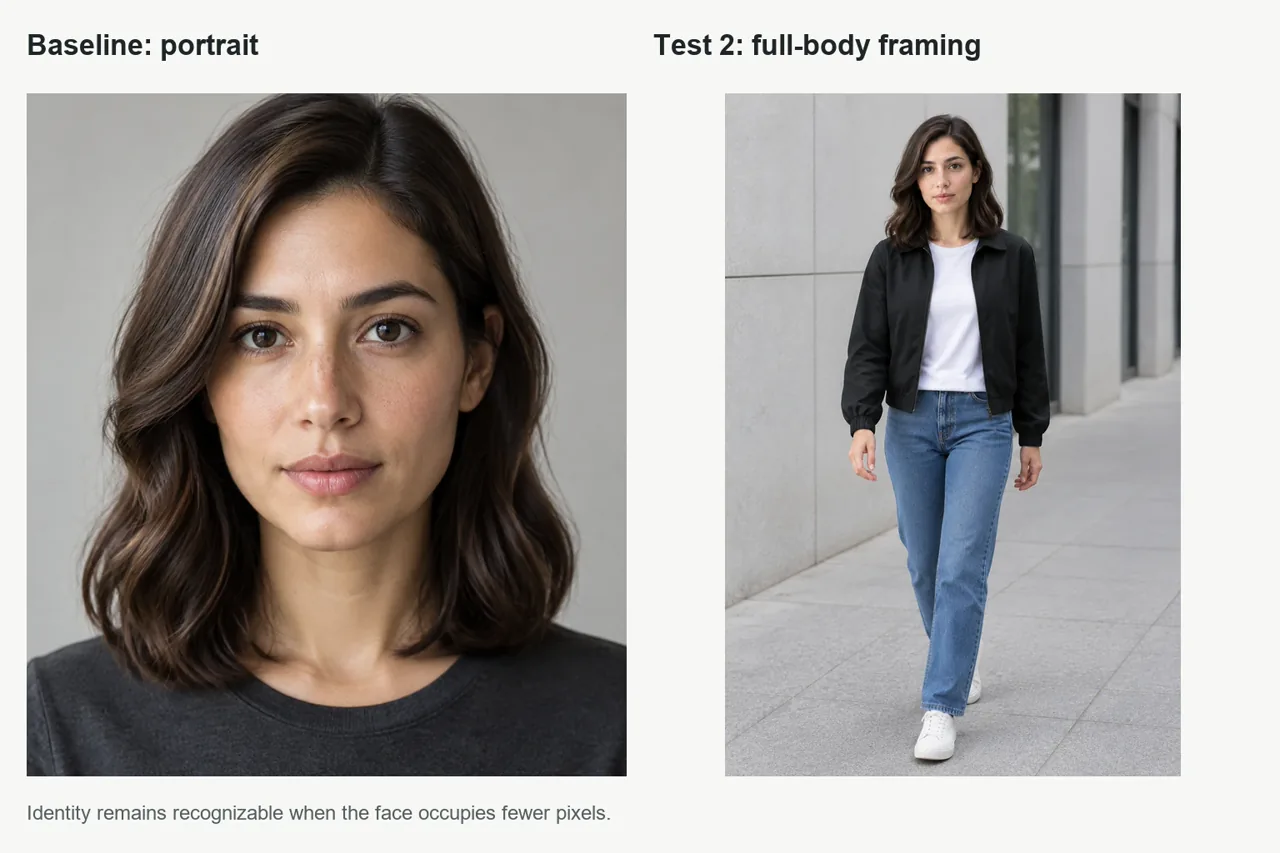
Test 2: Full-body street scene
結果 The face occupied far fewer pixels, yet the character remained recognizable. Body proportions, both hands, and both shoes were usable. This is the point where evaluating the full image and a separate face crop becomes important.

Test 3: UGC product interaction
結果 The scene changed the expression, shirt, room, and object interaction while keeping the identity recognizable. The visible hand had five plausible fingers, the grip made sense, and the pump bottle contained no accidental label text.
This kind of image is useful for an AI influencer or campaign workflow, but it deserves more scrutiny than a portrait. GLBGPT’s guide to creating virtual influencers with Nano Banana Pro explores that downstream use case.
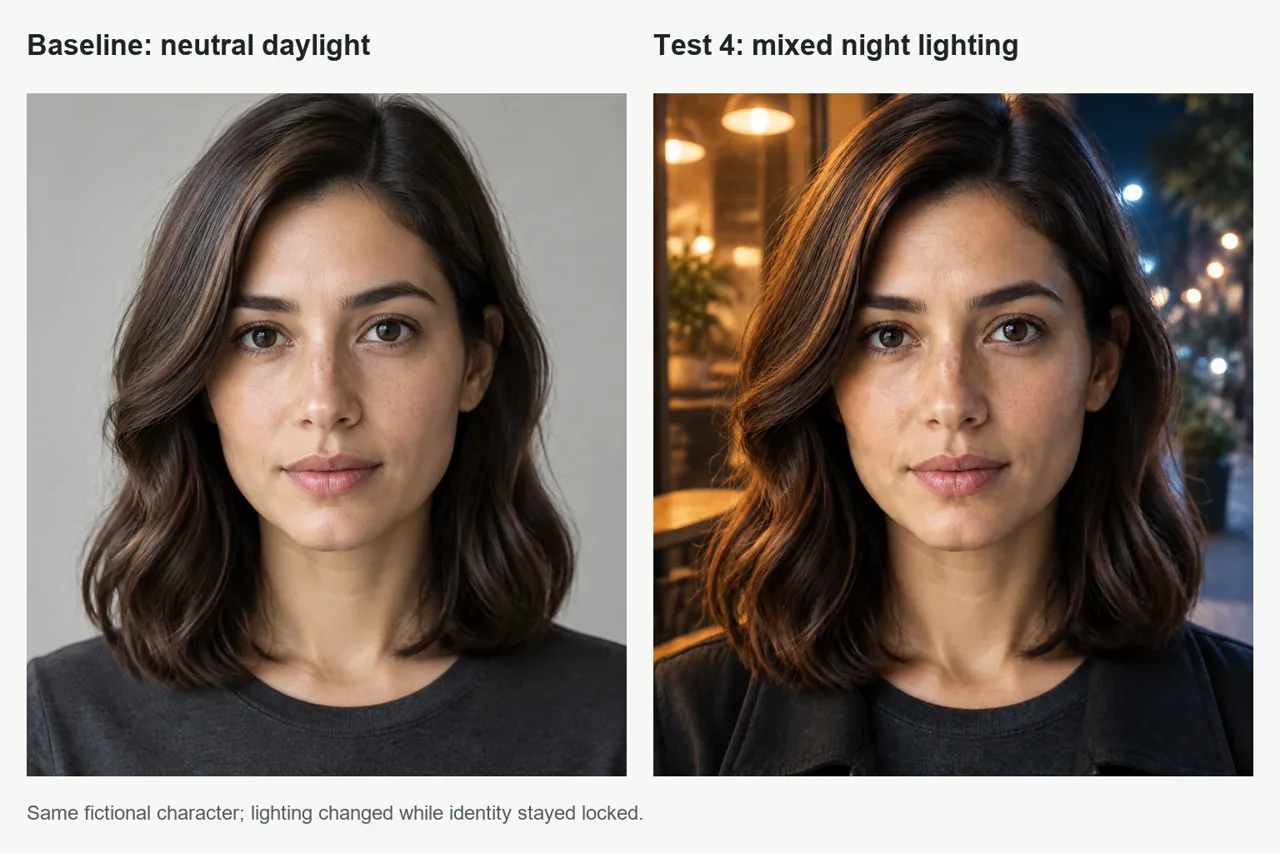
Test 4: Mixed night lighting
結果 Warm cafe light and cool street light changed the mood without replacing the face. The eyes, nose, freckles, hairstyle, skin tone, and apparent age remained aligned with the baseline.
We did not run a video test, so these results support still-image consistency only. If the next production stage is animation, use an image-to-video workflow designed to preserve subjects and review the face throughout the clip. The Kling AI character-consistency guide covers a video-native approach, while the long AI video workflow focuses on multi-shot assembly.
Why Your Consistent AI Character Still Changes
| 問題点 | 考えられる理由 | おすすめ |
|---|---|---|
| Profile looks like another person | The reference does not show enough side geometry | Use a three-quarter turn first or add an authorized profile reference |
| Full-body face becomes generic | The face occupies too few pixels | Move closer, use a three-quarter body frame, or compare a face crop |
| Age changes | Lighting, smoothing, or style alters skin cues | Lock apparent age and natural skin texture; remove beauty presets |
| Skin tone shifts | Strong colored light overwhelms the reference | Simplify the light, then reintroduce one color source |
| Hair changes | The prompt contains vague or conflicting hair language | Repeat one concise description of length, color, part, and texture |
| Hands or product fail | The grip and object are too complex | Use one object, one hand, and a simple pose; edit the product separately if needed |
| Each image drifts farther | Outputs are being chained as new references | Branch every scene from the original accepted reference |
Reference Image vs Soul ID vs LoRA
A reference image is the simplest starting point. A trained identity becomes attractive when the same character must appear across a large number of scenes, campaigns, or production formats. A LoRA can offer more technical control and portability in compatible workflows, but requires data preparation, training knowledge, and careful rights management.
Higgsfield describes Soul ID as a reusable character trained from 20 or more photos, with support for up to 80. Its official Soul ID help page recommends clear, recent, well-lit images with varied angles and expressions, including at least one full-height photo. It also sets an important expectation: the goal is a clearly recognizable person, not pixel-identical output.
We did not test Soul ID because no Higgsfield account was used in this workflow. Treat it as an advanced option supported by official documentation, not as the source of the results above. For storyboard continuity rather than a reusable trained person, the ヒッグスフィールド・ポップコーンのレビュー covers a different connected-frame approach.
Where a Reusable AI Persona Is Useful
- UGC and product ads: reuse one creator identity across products, rooms, scripts, and formats.
- AI influencer content: maintain a recognizable persona while changing outfits, seasons, and locations.
- Fashion variants: test styling and campaign directions before production.
- 絵コンテ: preserve the cast while exploring camera angles and sequential actions.
- Short-form video: create a stable approved source image before image-to-video generation.
Newer image models may also include model-specific subject controls. For example, GLBGPT’s Nano Banana 2 subject-consistency analysis examines that route. Choose the workflow based on production volume and control requirements, not a universal claim that one method is always best.
Build the rest of the campaign in one workspace
Once the identity is approved, GlobalGPT can help connect supported research, writing, image, and video tasks without maintaining a separate subscription and login for every stage.
GlobalGPTをお試しくださいPrivacy, Consent, and Commercial Use
Only use your own likeness, a fictional subject, or a person who has clearly agreed to the intended use. Permission to take a photo is not automatically permission to train an identity, publish synthetic variants, or use them in advertising.
- Define whether the outputs are private drafts, organic content, paid ads, or client work.
- Remove unrelated people and private information from source images.
- Check the current terms for the exact service and plan used.
- Keep source photos and trained identities access-controlled.
- Do not imply that a real person endorsed a product or statement without permission.
よくある質問
What is the best way to create a consistent AI character?
Start with one clear, authorized reference portrait. Lock the face, age, skin tone, hairline, hair color, and defining features. Generate a neutral baseline, reuse the original reference for every scene, change one major variable at a time, and compare equal-size face crops.
Is one photo enough to make a consistent AI character?
One strong photo can be enough for a controlled set of still images. It becomes less reliable for extreme profiles, distant full-body shots, major style changes, or long sequences because the model must infer details that the source does not show.
Why does my AI character’s face keep changing?
Common causes include a weak reference, changing too many variables at once, conflicting identity descriptions, strong style presets, chaining each output into the next, and judging only hair or skin color instead of facial geometry.
Can the same AI character wear different outfits?
Yes. Treat wardrobe as a scene variable while explicitly locking identity traits. Change the outfit without simultaneously changing the camera angle, lighting, expression, and setting, then add those changes in later controlled steps.
Can I use the same AI character in videos?
Yes, but still-image consistency does not guarantee frame-by-frame video consistency. Start from an approved source image, keep motion modest, review the face throughout the clip, and avoid claiming video performance until that workflow has been tested.
When is Soul ID better than a reference image?
A trained identity such as Soul ID may be a better fit when one person must appear repeatedly across many scenes and projects. It requires more authorized source material and setup than a single-reference workflow, so it is not automatically the best first step.
Do I need a Higgsfield account for this workflow?
No. The hands-on workflow in this guide used one fictional reference portrait and reference-image editing, not Higgsfield. A Higgsfield account is only needed if you choose to use Higgsfield features such as Soul ID.
Can I use an AI character for commercial content?
Potentially, but commercial rights depend on the source image, the person’s consent, and the current terms of the exact generation service and plan. Verify those rights before publishing ads, client work, endorsements, or branded campaigns.