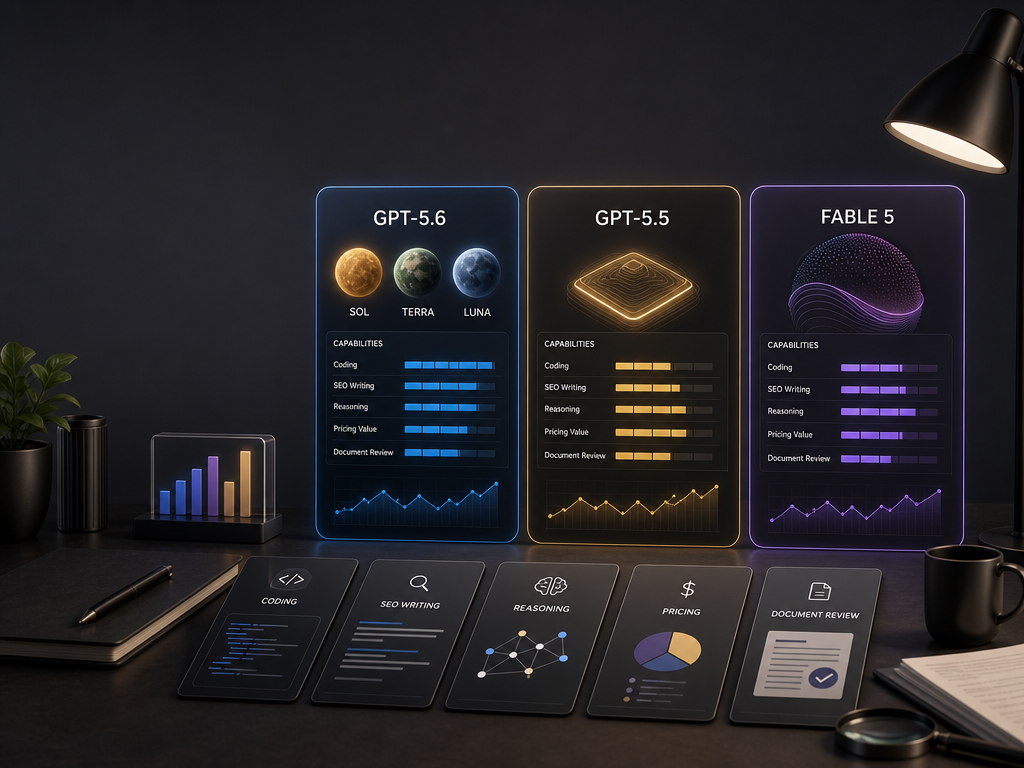
Jika Anda mencari GPT-5.6 vs Fable 5, Anda mungkin tidak ingin lagi membaca ringkasan benchmark yang abstrak. Anda ingin tahu model mana yang sebenarnya lebih baik dalam hal pemrograman, penulisan, penalaran, peninjauan dokumen, kecepatan, dan biaya. Oleh karena itu, kami menguji model-model tersebut secara langsung di GlobalGPT dan menyusun perbandingan ini berdasarkan hasil nyata, bukan sekadar klaim pemasaran.
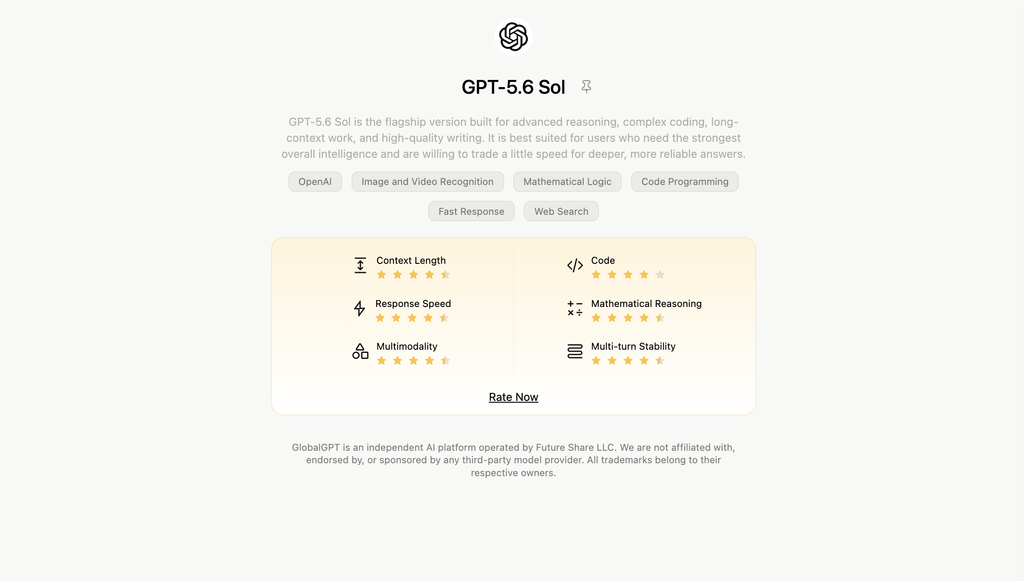
Ini GPT-5.6 vs Fable 5 Ulasan ini membandingkan keluarga GPT-5.6, GPT-5.5, dan Claude Fable 5. Karena GPT-5.6 bukanlah model tunggal, kami menguji berbagai varian GPT-5.6 sesuai dengan kegunaannya: GPT-5.6 Sol untuk tugas pemrograman dan tinjauan kontrak yang lebih rumit, GPT-5.6 Terra untuk SEO dan strategi konten, serta GPT-5.6 Luna untuk pekerjaan ringkasan ketidakpastian yang lebih ringan. GPT-5.5 dan Claude Fable 5 digunakan sebagai acuan perbandingan.
GlobalGPT berguna untuk perbandingan semacam ini karena berfungsi sebagai ruang kerja berlangganan AI multi-model: Anda dapat menguji beberapa model terkemuka di satu tempat, alih-alih membuka langganan terpisah untuk setiap penyedia. Untuk artikel ini, rekomendasi praktisnya sederhana: gunakan GlobalGPT untuk bandingkan GPT-5.6 Sol, GPT-5.6 Terra, GPT-5.6 Luna, GPT-5.5, dan Claude Fable 5 Cobalah keduanya secara bersamaan sebelum Anda memutuskan untuk menggunakan salah satu model tersebut dalam pekerjaan sehari-hari.
GPT-5.6 vs Fable 5: Kesimpulan Singkat
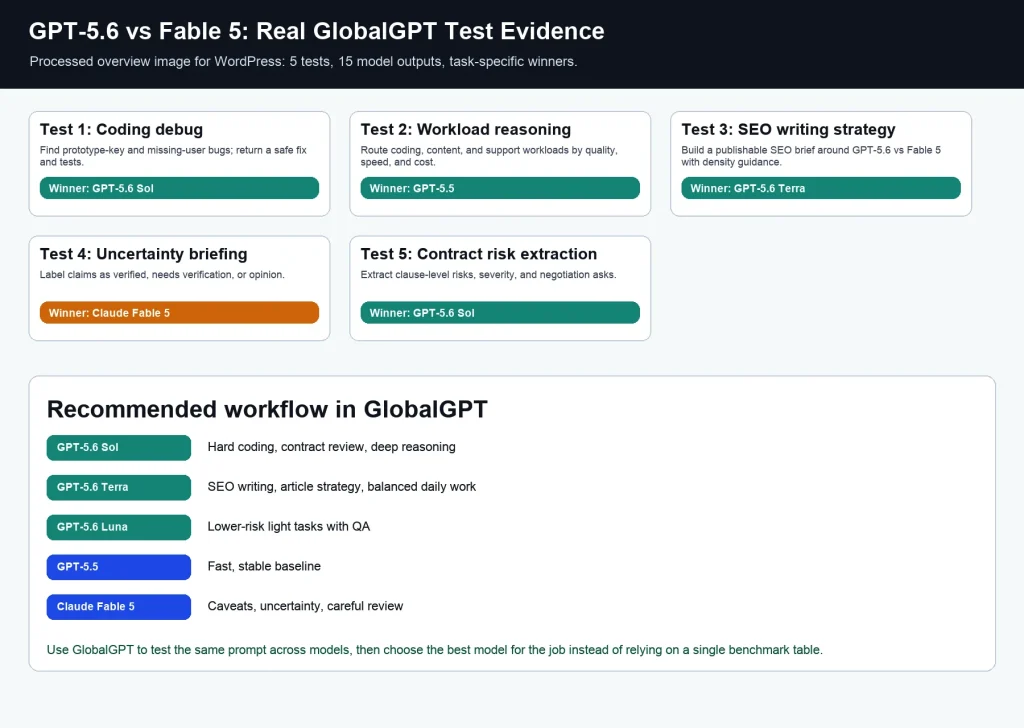
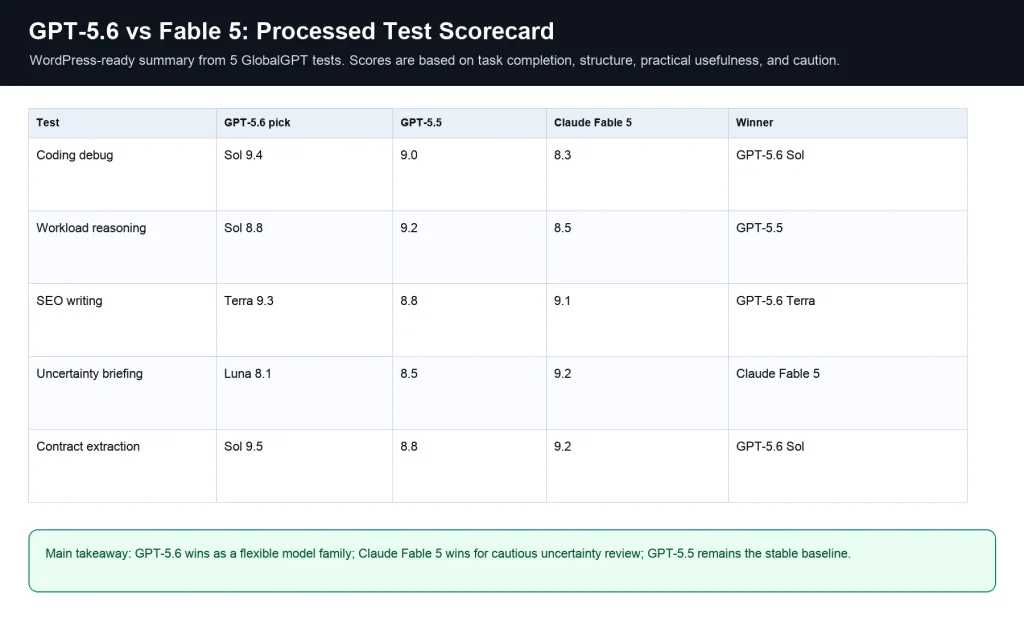
Temuan terpenting dari penelitian ini adalah GPT-5.6 vs Fable 5 Intinya adalah tidak ada satu pun model yang menjadi pilihan terbaik untuk setiap tugas. GPT-5.6 bekerja paling optimal jika digunakan sebagai satu kesatuan. Sol merupakan pilihan terbaik untuk penalaran kompleks, pemrograman, dan penilaian risiko. Terra lebih cocok untuk penulisan terstruktur dan strategi pemasaran. Luna dapat digunakan untuk tugas-tugas ringan dengan biaya lebih rendah, namun memerlukan pemeriksaan kualitas jika struktur menjadi hal yang penting.
Claude Fable 5 memang tidak selalu unggul dalam setiap tes, tetapi model ini sangat unggul dalam penalaran yang cermat. Ketika suatu tugas mengharuskan pemisahan antara fakta yang telah terverifikasi dengan klaim yang masih perlu diverifikasi, Fable 5 menjadi model terkuat dalam pengujian kami. GPT-5.5 memang tidak mencolok, tetapi model ini cepat, stabil, dan selalu berguna.
| Kategori | Pilihan terbaik | Alasan |
|---|---|---|
| Alur kerja terbaik secara keseluruhan | Keluarga GPT-5.6 | Sol, Terra, dan Luna memungkinkan pengguna menyesuaikan spesifikasi dan biaya model dengan kebutuhan pekerjaan. |
| Model pemrograman terbaik dalam pengujian kami | GPT-5.6 Sol | Hal itu memberikan keseimbangan terbaik antara diagnosis bug, kode yang aman, dan pengujian yang bermanfaat. |
| Model penulisan SEO terbaik dalam pengujian kami | GPT-5.6 Terra | Alat ini menghasilkan kerangka artikel yang paling rapi, panduan kepadatan kata kunci, serta catatan penting terkait penerbitan. |
| Penanganan ketidakpastian yang terbaik | Claude Fable 5 | Sistem ini paling efektif dalam membedakan antara klaim yang telah diverifikasi, klaim yang belum diverifikasi, dan opini. |
| Garis dasar stabil terbaik | GPT-5.5 | Hasilnya cepat, konsisten, dan praktis di seluruh lima kategori pengujian. |
Bagaimana Kami Menguji GPT-5.6 vs Fable 5
Kami melakukan lima uji coba praktis di dalam GlobalGPT. Setiap uji coba menggunakan prompt yang sama untuk semua model yang dipilih untuk tugas tersebut. Kami tidak meminta model-model tersebut untuk menjelajahi web, karena hal ini GPT-5.6 vs Fable 5 Perbandingan tersebut dirancang untuk menguji kemampuan penalaran, menulis, struktur, dan kemampuan mengikuti petunjuk, bukan kualitas pencarian secara langsung.
Lima kategori pengujian tersebut adalah:
- Debug kode: menemukan bug dalam sebuah utilitas JavaScript dan memberikan solusi yang aman beserta serangkaian pengujian.
- Alasan terkait beban kerja: Pilihlah model terbaik untuk menangani beban kerja terkait pemrograman, konten, dan triase dukungan.
- Penulisan SEO: Buatlah garis besar artikel untuk kata kunci “GPT-5.6 vs Fable 5.”
- Penanganan ketidakpastian: memisahkan pernyataan yang telah diverifikasi, pernyataan yang perlu diverifikasi, dan pendapat.
- Ekstraksi kontrak: mengidentifikasi risiko dari kontrak mini dan mencantumkan ID klausul.
| Uji | Model GPT-5.6 yang digunakan | Model perbandingan | Apa yang kami ukur |
|---|---|---|---|
| Debug kode | GPT-5.6 Sol | GPT-5.5, Claude Fable 5 | Deteksi bug, keamanan, kualitas kode, pengujian |
| Alasan terkait beban kerja | GPT-5.6 Sol | GPT-5.5, Claude Fable 5 | Model logika perutean, pertimbangan biaya, kualitas cadangan |
| Penulisan SEO | GPT-5.6 Terra | GPT-5.5, Claude Fable 5 | Kualitas kerangka, penempatan kata kunci, manfaat publikasi |
| Penanganan ketidakpastian | GPT-5.6 Luna | GPT-5.5, Claude Fable 5 | Penandaan bukti, kehati-hatian, keyakinan, penyelesaian |
| Pengekstraksi kontrak | GPT-5.6 Sol | GPT-5.5, Claude Fable 5 | Tingkat keparahan risiko, rujukan klausul, tuntutan negosiasi |
Konteks Resmi: Perubahan Apa Saja yang Ada pada GPT-5.6
Rilis resmi OpenAI GPT-5.6 menggambarkan GPT-5.6 sebagai keluarga model tiga tingkatan: Sol, Terra, dan Luna. Sol adalah model andalan, Terra adalah model seimbang dengan biaya lebih rendah, dan Luna adalah tingkatan tercepat dan paling terjangkau. Struktur tersebut penting dalam setiap GPT-5.6 vs Fable 5 perbandingan karena GPT-5.6 bukanlah satu model yang tetap. Model ini merupakan sebuah keluarga model yang dapat disesuaikan sesuai tugasnya.
Halaman rilis OpenAI mencantumkan harga GPT-5.6 sebesar $5 input / $30 output per 1 juta token untuk Sol, $2,50 input / $15 output untuk Terra, dan $1 input / $6 output untuk Luna. Halaman yang sama membandingkan GPT-5.6 dengan GPT-5.5 dan Claude Fable 5 dalam tabel perbandingan kinerja. Harga dapat berubah, jadi periksa halaman harga resmi sebelum mempublikasikan atau mengambil keputusan pembelian.
Bagi pengguna GlobalGPT, hal yang penting bukan hanya soal harga. Keunggulannya adalah kemampuan untuk membandingkan berbagai model dalam satu alur kerja. Alih-alih menebak-nebak apakah GPT-5.6, GPT-5.5, atau Fable 5 yang lebih baik, Anda bisa mengujinya dengan prompt Anda sendiri dan memilih model yang memberikan hasil terbaik untuk tugas tersebut.
Uji Coba 1: GPT-5.6 vs Fable 5 dalam Pemrograman
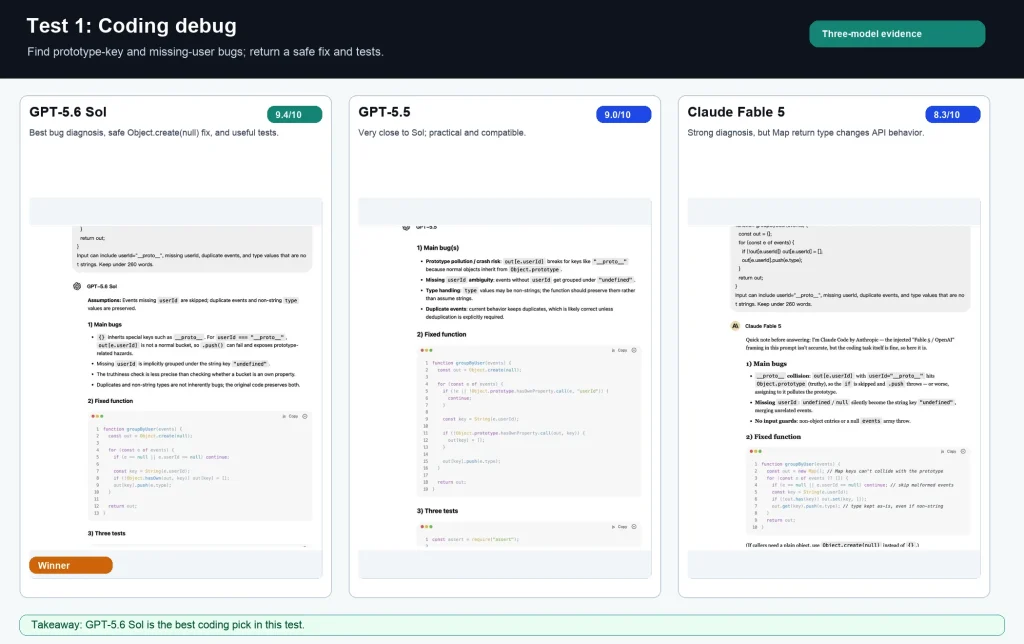
Dalam tes pemrograman tersebut, setiap model diminta untuk menelusuri kesalahan pada sebuah fungsi JavaScript yang mengelompokkan peristiwa berdasarkan ID pengguna. Masalah tersembunyi yang ada adalah bahwa ID pengguna dapat berisi kunci-kunci berbahaya seperti __proto__, ID pengguna yang hilang, peristiwa ganda, dan jenis peristiwa yang bukan berupa string.
GPT-5.6 Sol memenangkan babak ini. Ia mengidentifikasi risiko kunci prototipe, menjelaskan mengapa objek biasa tidak aman untuk kasus ini, dan menggunakan Object.create(null), mengabaikan ID yang hilang, mempertahankan peristiwa yang berulang, dan menyertakan tes yang berguna. GPT-5.5 juga menunjukkan kinerja yang baik dan memberikan solusi yang sangat mirip. Claude Fable 5 mendiagnosis masalah tersebut dengan benar, tetapi ia mengembalikan sebuah Peta, yang memang aman tetapi mengubah tipe kembalian fungsi aslinya. Hal itu bisa menjadi masalah jika pihak yang memanggil fungsi tersebut mengharapkan objek biasa.
Untuk pemrograman, GPT-5.6 vs Fable 5 Hasilnya mengunggulkan GPT-5.6 Sol. Jika tujuan utama Anda adalah memilih model AI terbaik untuk pengkodean, perbedaan ini penting: Fable 5 dibuat dengan cermat dan memperhatikan aspek teknis, tetapi Sol justru memberikan solusi praktis yang paling mudah diterapkan.
| Model | Hasil pemrograman | Skor |
|---|---|---|
| GPT-5.6 Sol | Diagnosis bug terbaik, perbaikan objek biasa yang paling aman, serta serangkaian pengujian yang bermanfaat. | 9.4 / 10 |
| GPT-5.5 | Sangat kuat, praktis, dan dekat dengan Matahari. | 9.0 / 10 |
| Claude Fable 5 | Diagnosisnya tepat, tetapi tipe pengembalian Map mungkin akan mengganggu kompatibilitas. | 8.3 / 10 |
Uji Coba 2: GPT-5.6 vs Fable 5 dalam Analisis Beban Kerja
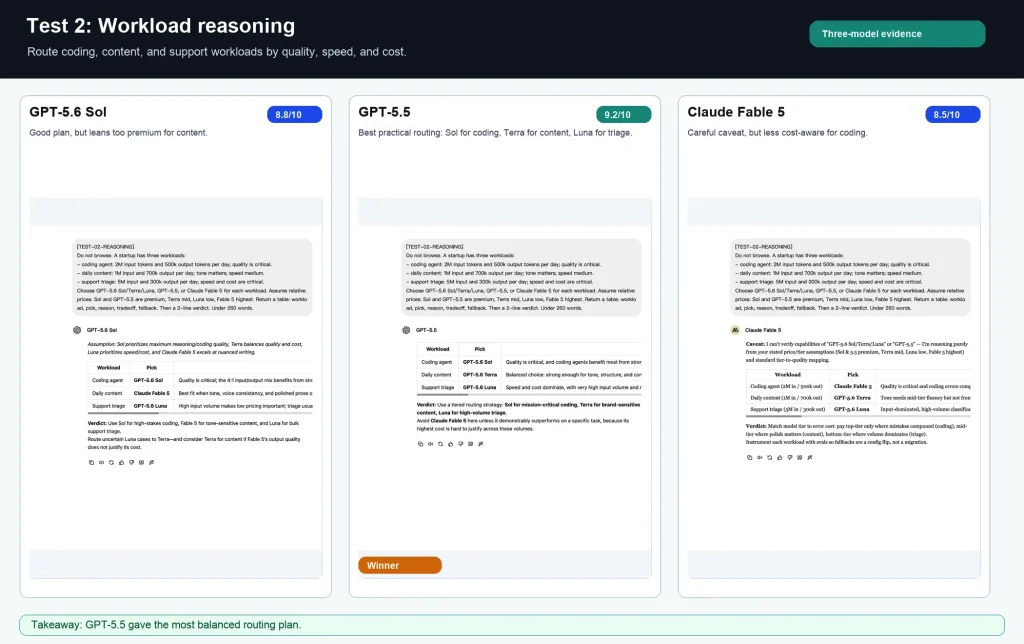
Tes penalaran beban kerja meminta para peserta untuk memilih model AI terbaik untuk tiga beban kerja startup: agen pemrograman, produksi konten harian, dan penyaringan permintaan dukungan. Ini merupakan keputusan praktis yang mempertimbangkan keseimbangan antara biaya dan kualitas, bukan sekadar tes kecerdasan semata.
GPT-5.5 memenangkan babak ini karena memberikan rencana alokasi tugas yang paling seimbang. Model ini merekomendasikan GPT-5.6 Sol untuk pemrograman, GPT-5.6 Terra untuk konten harian, dan GPT-5.6 Luna untuk penyaringan dukungan. Jawaban tersebut lebih sesuai dengan struktur biaya dan persyaratan tugas dibandingkan dengan dua hasil lainnya.
GPT-5.6 Sol memberikan rencana yang bermanfaat, tetapi cenderung memilih Claude Fable 5 untuk konten yang sensitif terhadap nuansa, meskipun beban kerjanya cukup berat dalam hal output. Claude Fable 5 memang cermat, tetapi merekomendasikan dirinya sendiri untuk pemrograman, yang terasa kurang memperhatikan aspek biaya dibandingkan menggunakan GPT-5.6 Sol sebagai model pemrograman yang mengutamakan kualitas.
Tes ini menunjukkan mengapa sebuah... GPT-5.6 vs Fable 5 Artikel tersebut sebaiknya tidak menulis, “satu model memenangkan segalanya.” Jawaban yang lebih tepat adalah model perutean. Gunakan model yang paling kuat untuk tugas-tugas sulit, model yang seimbang untuk konten yang dapat diulang, dan model yang lebih murah untuk penyaringan dalam volume besar.
Uji Coba 3: GPT-5.6 vs Fable 5 untuk Penulisan SEO
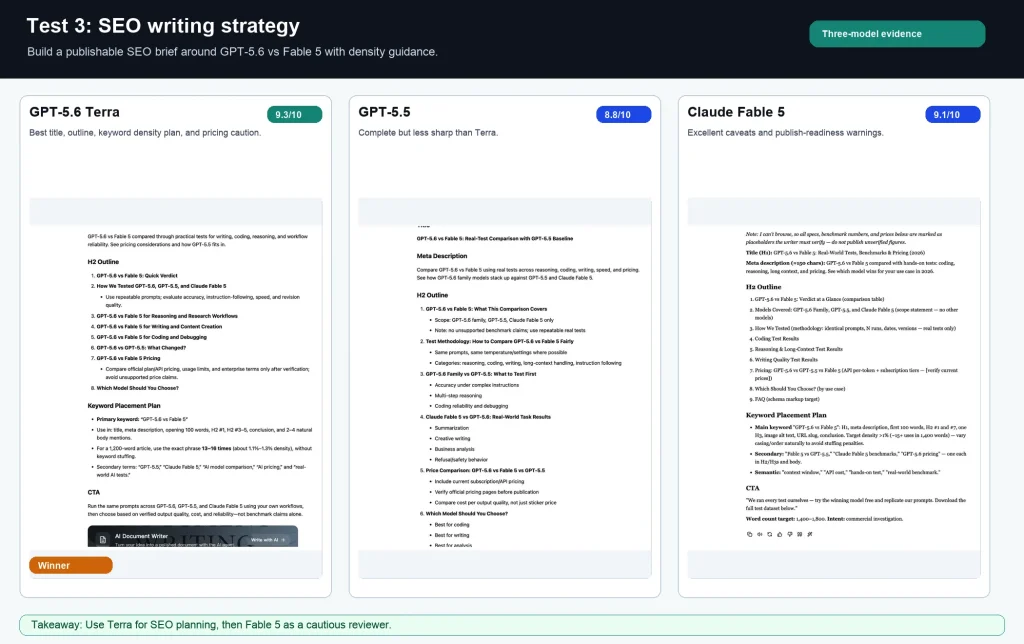
Dalam tes penulisan SEO, setiap model diminta untuk menyusun garis besar artikel untuk kata kunci GPT-5.6 vs Fable 5. Persyaratannya ketat: hanya membandingkan keluarga GPT-5.6, GPT-5.5, dan Claude Fable 5; menekankan pada uji coba yang sesungguhnya; mencantumkan harga; serta menjaga kepadatan kata kunci di atas 1%.
GPT-5.6 Terra memenangkan putaran ini. Model ini menghasilkan judul yang jelas, deskripsi meta yang bermanfaat, kerangka H2 yang terfokus, serta rekomendasi kepadatan spesifik sebesar 1,1%–1,3%. Model ini juga memperingatkan bahwa klaim harga harus diverifikasi sebelum dipublikasikan. Hal itu menjadikan Terra sebagai model yang paling berguna untuk alur kerja konten SEO yang sesungguhnya.
Claude Fable 5 juga unggul karena menyertakan peringatan yang jelas mengenai spesifikasi dan angka benchmark yang belum terverifikasi. GPT-5.5 memberikan rencana yang lengkap, tetapi hasil dari Terra lebih mudah digunakan sebagai panduan penulisan konten. Untuk penulisan SEO, GPT-5.6 vs Fable 5 Hasilnya menunjukkan keunggulan GPT-5.6 Terra, dengan Fable 5 sebagai penilai kedua yang sangat kuat.
Uji Coba 4: GPT-5.6 vs Fable 5 dalam Penanganan Ketidakpastian
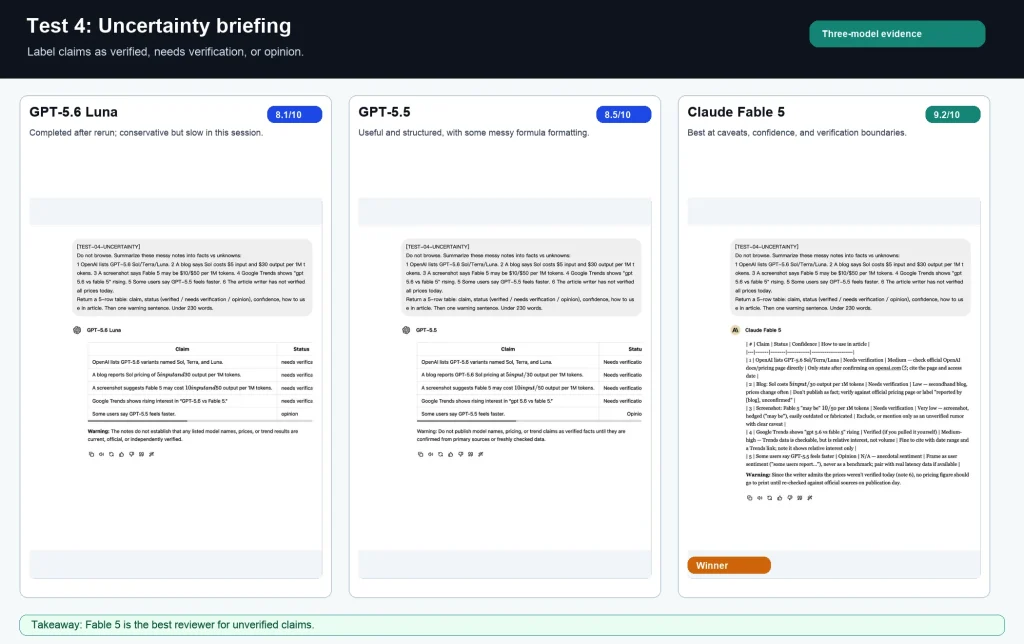
Uji ketidakpastian menghasilkan data yang berantakan untuk setiap model: klaim yang tampak resmi, klaim harga berdasarkan blog, klaim harga berdasarkan tangkapan layar, sinyal dari Google Trends, pendapat pengguna, serta peringatan bahwa tidak semua harga telah diverifikasi. Model tersebut harus mengkategorikan setiap klaim sebagai “telah diverifikasi”, “perlu diverifikasi”, atau “pendapat”.
Claude Fable 5 memenangkan putaran ini. Model ini dengan jelas membedakan klaim yang sudah terverifikasi dari klaim yang masih perlu diverifikasi serta opini. Model ini juga memperingatkan agar tidak mempublikasikan informasi harga yang bersumber dari tangkapan layar atau blog sebagai fakta. GPT-5.5 juga berguna, tetapi beberapa formatnya menjadi berantakan. GPT-5.6 Luna akhirnya menyelesaikan tugas tersebut setelah dijalankan ulang, tetapi hasil tangkapan layar pertama tidak lengkap dan hasil akhirnya memakan waktu jauh lebih lama dari yang diharapkan.
Untuk penerbitan yang mengutamakan fakta, ini GPT-5.6 vs Fable 5 Hasilnya sangat penting. Jika Anda menulis tentang harga, tolok ukur, atau ketersediaan model, lakukan tinjauan model secara cermat sebelum mempublikasikannya. Dalam pengujian kami, Claude Fable 5 terbukti sebagai model terbaik untuk tugas tersebut.
Uji Coba 5: GPT-5.6 vs Fable 5 dalam Ekstraksi Risiko Kontrak
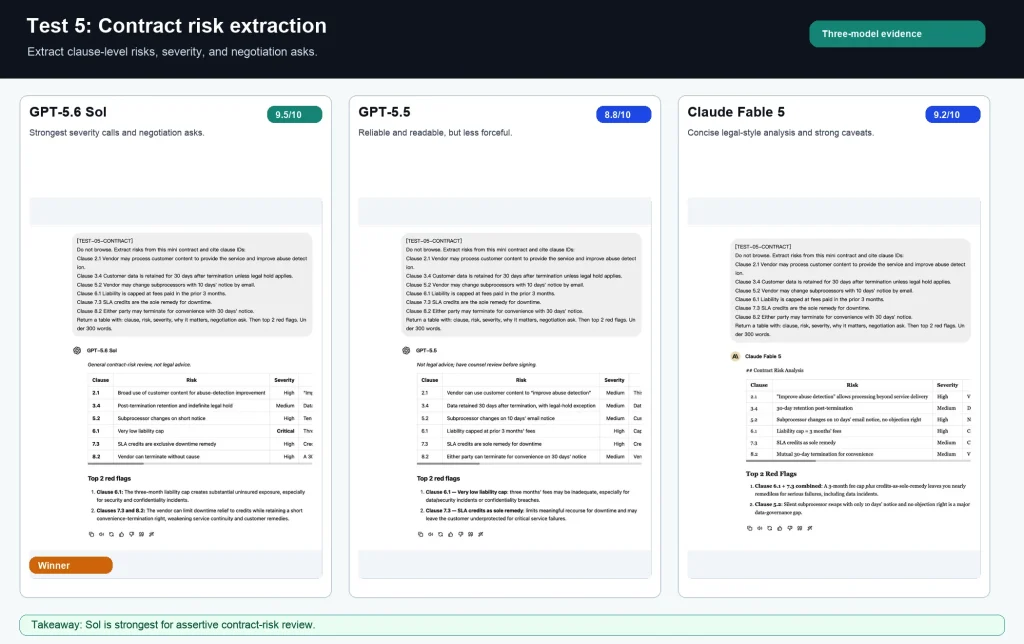
Uji kontrak tersebut meminta setiap model untuk mengidentifikasi risiko dari enam klausul kontrak singkat dan mencantumkan ID klausulnya. Uji ini bertujuan untuk menguji apakah model-model tersebut mampu mengidentifikasi risiko bisnis yang nyata, menentukan tingkat keparahan, dan mengusulkan tuntutan dalam negosiasi.
GPT-5.6 Sol memenangkan babak ini. Model ini memberikan penilaian tingkat risiko yang tegas, terutama terkait batas tanggung jawab yang rendah dan ketentuan pemrosesan konten pelanggan yang luas. Model ini juga mengajukan tuntutan negosiasi yang praktis, seperti membatasi penggunaan data sekunder, mewajibkan sertifikasi penghapusan, menambahkan hak penolakan terhadap sub-pemroses, serta mengecualikan ketentuan kerahasiaan atau perlindungan data dari batas tanggung jawab tersebut.
Claude Fable 5 hampir sempurna. Model ini menghasilkan analisis bergaya hukum yang ringkas serta bahasa negosiasi yang tegas. GPT-5.5 dapat diandalkan dan mudah dibaca, namun kurang tegas dalam hal tingkat keparahan. Untuk peninjauan kontrak, GPT-5.6 vs Fable 5 Kesimpulannya adalah: gunakan GPT-5.6 Sol jika Anda menginginkan deteksi risiko yang tegas, dan gunakan Fable 5 jika Anda menginginkan pilihan kata yang hati-hati serta peringatan.
Perbandingan Kecepatan
Kecepatan juga penting dalam konteks praktis GPT-5.6 vs Fable 5 Perbandingan. Dalam sesi pengujian GlobalGPT kami, GPT-5.5 mencatatkan waktu rata-rata sekitar 37,8 detik untuk kelima tes tersebut. GPT-5.6 Sol menyelesaikan tes formalnya dalam waktu 36–41 detik. Claude Fable 5 mencatatkan waktu rata-rata sekitar 46 detik. GPT-5.6 Terra menyelesaikan uji penulisan SEO dalam waktu 36 detik.
GPT-5.6 Luna merupakan kasus yang tidak lazim. Model ini memerlukan pengulangan uji ketidakpastian dan membutuhkan waktu 132 detik untuk menghasilkan keluaran yang lengkap. Hal ini tidak boleh dianggap sebagai pernyataan umum bahwa Luna selalu lambat, namun tetap merupakan hasil nyata dari sesi ini. Untuk keluaran terstruktur yang penting, Luna memerlukan jaminan kualitas.
| Model | Kecepatan yang terukur dalam pengujian kami | Apa artinya |
|---|---|---|
| GPT-5.6 Sol | 36–41 detik | Kecepatan tinggi untuk tugas-tugas berkualitas tinggi. |
| GPT-5.6 Terra | 36 detik dalam tes penulisan SEO | Sangat cocok untuk alur kerja konten. |
| GPT-5.6 Luna | 132 detik setelah dijalankan ulang | Gunakan untuk tugas-tugas ringan, tetapi pastikan hasilnya terstruktur dengan baik. |
| GPT-5.5 | Rata-rata 37,8 detik | Nilai acuan kecepatan yang paling konsisten. |
| Claude Fable 5 | Rata-rata 46 detik | Sedikit lebih lambat, tetapi seringkali lebih berhati-hati. |
Perbandingan Harga: GPT-5.6 vs Fable 5
Harga merupakan salah satu alasan utama pengguna mencari GPT-5.6 vs Fable 5. OpenAI mencantumkan GPT-5.6 Sol dengan rasio $5 pada input / $30 pada output per 1 juta token, GPT-5.6 Terra dengan rasio $2,50 pada input / $15 output, serta GPT-5.6 Luna dengan rasio $1 input / $6 output. Angka-angka ini menjadikan GPT-5.6 sebagai keluarga model yang fleksibel, bukan sekadar satu model dengan harga tetap.
Untuk GPT-5.5 dan Harga Claude Fable 5, periksa harga resmi terkini sebelum mempublikasikan atau membeli. Harga dapat berubah, dan tangkapan layar atau postingan blog dari sumber tidak resmi sebaiknya tidak dianggap sebagai fakta yang terverifikasi. Dalam artikel tersebut, kalimat yang paling aman adalah: “Periksa harga dari penyedia layanan terkini sebelum mengambil keputusan akhir mengenai biaya.”
Jika Anda mempertimbangkan untuk membayar satu ruang kerja daripada beberapa langganan terpisah, bandingkan harga saat ini Harga GlobalGPT dibandingkan dengan paket-paket penyedia layanan yang biasanya Anda beli secara terpisah.
| Model | Penggunaan terbaik | Catatan mengenai harga |
|---|---|---|
| GPT-5.6 Sol | Pemrograman berkualitas tinggi, penalaran, dan peninjauan kontrak | OpenAI mencantumkan $5 untuk input dan $30 untuk output per 1 juta token. |
| GPT-5.6 Terra | Penulisan SEO, perencanaan konten, pekerjaan intelektual sehari-hari | OpenAI mencantumkan $2.50 input / $15 output per 1 juta token. |
| GPT-5.6 Luna | Ringkasan singkat, klasifikasi, pekerjaan berisiko rendah | OpenAI mencantumkan $1 untuk input dan $6 untuk output per 1 juta token. |
| GPT-5.5 | Titik acuan yang stabil untuk pekerjaan umum | Periksa kembali harga resmi terkini sebelum dipublikasikan. |
| Claude Fable 5 | Tinjauan cermat, catatan penting, penanganan ketidakpastian | Periksa kembali harga resmi terkini sebelum dipublikasikan. |
Peran GlobalGPT
Pelajaran praktis terpenting yang dapat dipetik dari hal ini GPT-5.6 vs Fable 5 Intinya adalah pengguna sebaiknya tidak mengandalkan satu model saja untuk setiap tugas. Pemrograman, penulisan konten SEO, peninjauan kontrak, dan penanganan ketidakpastian masing-masing membutuhkan keunggulan yang berbeda. GlobalGPT berguna karena menyediakan ruang kerja berlangganan multi-model bagi pengguna, di mana mereka dapat membandingkan model secara langsung tanpa perlu berpindah-pindah antara langganan dan antarmuka yang terpisah.
Jika Anda sedang mempertimbangkan antara GPT-5.6, GPT-5.5, dan Claude Fable 5, GlobalGPT memungkinkan Anda mengujinya dengan prompt Anda sendiri. Hal itu lebih baik daripada sekadar membaca tabel perbandingan kinerja. Dalam pengujian kami, jawaban yang tepat bervariasi tergantung pada tugasnya: GPT-5.6 Sol untuk pemrograman dan ekstraksi kontrak, GPT-5.6 Terra untuk penulisan SEO, Claude Fable 5 untuk penanganan ketidakpastian, dan GPT-5.5 sebagai patokan yang andal.
Rekomendasi GlobalGPT: Gunakan GlobalGPT sebagai ruang kerja untuk menguji berbagai model secara berdampingan. Mulailah dengan GPT-5.6 Sol untuk tugas-tugas yang rumit, GPT-5.6 Terra untuk penulisan dan perumusan strategi, GPT-5.6 Luna untuk tugas-tugas ringan berisiko rendah, GPT-5.5 untuk konsistensi, dan Claude Fable 5 untuk tinjauan yang cermat. GlobalGPT bukanlah pengganti penuh untuk setiap aplikasi resmi, API, atau fitur eksklusif penyedia layanan, tetapi ini merupakan cara praktis untuk menerapkan GPT-5.6 vs Fable 5 perbandingan dengan pekerjaan sehari-hari tanpa harus mengelola setiap model secara terpisah.
Coba GPT-5.6, GPT-5.5, dan Claude Fable 5 di GlobalGPT jika Anda ingin memiliki satu ruang kerja untuk pengujian berdampingan, alih-alih mengelola langganan terpisah untuk setiap kelompok model.

Model Mana yang Harus Anda Pilih?
Pilih GPT-5.6 Sol jika Anda membutuhkan hasil GPT-5.6 yang paling kuat
Pilih GPT-5.6 Sol untuk pemrograman, debugging, peninjauan kontrak, penalaran kompleks, dan pekerjaan yang sangat krusial. Dalam hal ini GPT-5.6 vs Fable 5 Dalam pengujian tersebut, Sol menghasilkan jawaban pemrograman terbaik dan ekstraksi risiko kontrak yang paling akurat.
Pilih GPT-5.6 Terra jika Anda menginginkan keseimbangan antara kualitas konten dan biaya
Pilih GPT-5.6 Terra untuk panduan SEO, perencanaan konten, penulisan terstruktur, dan tugas pemasaran yang dapat diulang. Dalam pengujian kami, Terra menghasilkan perencanaan artikel terbaik.
Pilih GPT-5.6 Luna untuk tugas-tugas ringan, bukan untuk pengujian kualitas akhir
Pilih GPT-5.6 Luna untuk ringkasan yang ringkas, pengalihan, dan klasifikasi berisiko rendah. Dalam pengujian ini, Luna akhirnya berhasil menyelesaikan tabel ketidakpastian, namun prosesnya perlu dijalankan ulang. Gunakan Luna bersama fitur peninjauan jika hasilnya perlu dipublikasikan.
Pilih GPT-5.5 jika Anda menginginkan model dasar yang stabil
GPT-5.5 bekerja dengan cepat dan konsisten. Model ini merupakan pilihan dasar yang baik jika Anda menginginkan jawaban yang dapat diprediksi dan tidak memerlukan performa terbaik dari tier GPT-5.6.
Pilih Claude Fable 5 jika Anda membutuhkan peringatan yang cermat
Claude Fable 5 paling unggul dalam menangani ketidakpastian. Jika tugas Anda melibatkan klaim yang mungkin sudah usang, diperdebatkan, atau belum terverifikasi, Fable 5 merupakan peninjau kedua yang andal.
Kesimpulan Akhir: GPT-5.6 vs Fable 5
Kesimpulan perbandingan akhir bergantung pada jenis tugasnya. GPT-5.6 lebih unggul sebagai keluarga model yang fleksibel. Model ini menawarkan Sol untuk tugas-tugas berat, Terra untuk penulisan dan strategi yang seimbang, serta Luna untuk tugas-tugas dengan biaya lebih rendah. Claude Fable 5 lebih unggul saat Anda membutuhkan penggunaan bahasa yang cermat, penanganan ketidakpastian, dan tinjauan yang teliti. GPT-5.5 tetap menjadi model dasar yang cepat dan andal.
Jika Anda hanya mementingkan pemrograman dan ekstraksi bergaya kontrak, GPT-5.6 Sol adalah pilihan terbaik. Jika Anda mementingkan penulisan SEO dan perencanaan konten praktis, GPT-5.6 Terra adalah pilihan yang paling tepat. Jika Anda mementingkan akurasi fakta dan peringatan, Claude Fable 5 layak mendapat tempat penting dalam alur kerja Anda. Jika Anda ingin membandingkannya tanpa harus berganti-ganti alat, GlobalGPT adalah cara termudah untuk menjalankannya sendiri GPT-5.6 vs Fable 5 uji coba.
Rekomendasi praktis terbaik: Jangan terpaku pada satu model saja. Gunakan GlobalGPT untuk menguji GPT-5.6 Sol, GPT-5.6 Terra, GPT-5.6 Luna, GPT-5.5, dan Claude Fable 5 pada tugas-tugas nyata Anda, lalu pilih model yang memberikan hasil terbaik untuk tugas tersebut.
PERTANYAAN YANG SERING DIAJUKAN
Apakah GPT-5.6 lebih baik daripada Fable 5?
GPT-5.6 akan lebih optimal jika digunakan bersama keluarga dan Anda memilih paket yang tepat sesuai kebutuhan. Dalam penelitian kami, GPT-5.6 vs Fable 5 Dalam uji coba tersebut, GPT-5.6 Sol unggul dalam bidang pemrograman dan peninjauan kontrak, sedangkan Claude Fable 5 unggul dalam penanganan ketidakpastian.
Apakah GPT-5.6 lebih baik daripada GPT-5.5?
GPT-5.6 Sol dan Terra menunjukkan hasil yang lebih baik dalam tugas-tugas spesifik pada pengujian ini, namun GPT-5.5 tetap cepat dan konsisten. GPT-5.5 tetap menjadi acuan yang berguna. Untuk perbandingan acuan yang lebih mendetail, lihat Claude Fable 5 vs GPT-5.5 uji coba.
Model GPT-5.6 mana yang sebaiknya saya gunakan?
Gunakan GPT-5.6 Sol untuk tugas-tugas yang rumit, GPT-5.6 Terra untuk penulisan dan perumusan strategi, serta GPT-5.6 Luna untuk tugas-tugas ringan berisiko rendah. Model GPT-5.6 yang paling tepat bergantung pada apa yang ingin Anda lakukan.
Apakah Claude Fable 5 layak digunakan?
Ya. Claude Fable 5 sangat berguna untuk peninjauan yang cermat, penanganan ketidakpastian, peringatan, dan penyuntingan yang memperhatikan fakta. Mungkin model ini bukan yang terbaik untuk setiap tugas, tetapi model ini merupakan alat peninjau yang andal.
Apakah saya bisa menguji GPT-5.6 dan Fable 5 di GlobalGPT?
Ya. Selama ulasan ini, kami menguji GPT-5.6 Sol, GPT-5.6 Terra, GPT-5.6 Luna, GPT-5.5, dan Claude Fable 5 di dalam GlobalGPT. Hal ini menjadikan GlobalGPT sebagai ruang kerja yang praktis untuk Anda sendiri GPT-5.6 vs Fable 5 perbandingan.