
La version DeepSeek V4.1 Flash, publiée le 10 septembre 2026, apporte la prise en charge native des images en entrée, une empreinte mémoire réduite pour le cache, de meilleurs scores des agents communiqués par les fournisseurs et des tarifs API plus bas. Il convient particulièrement aux développeurs qui exploitent des agents traitant de grands volumes de données ou nécessitant un traitement intensif des entrées. Seule réserve : DeepSeek a exécuté les tests de performance publiés, et V4 Pro reste en tête dans certains tests de raisonnement de pointe.

Qu'est-ce que la version DeepSeek V4.1 Flash ?
DeepSeek V4.1 Flash est un modèle multimodal à poids ouverts conçu pour le codage, l'utilisation d'outils, la compréhension visuelle et les flux de travail d'agents à contexte étendu. DeepSeek l'a publié le 10 septembre 2026 et met à disposition les poids sous la forme DeepSeek-V4.1-Flash, et rend accessible le modèle hébergé via le deepseek-flash Nom de l'API.
Cette mise à jour est importante car elle ne se limite pas à une simple amélioration des scores aux benchmarks. Flash prend désormais en charge le texte et les images, offre une fenêtre de contexte d’un million de tokens et réduit considérablement la mémoire requise pour son cache clé-valeur. DeepSeek a également réduit ses tarifs d’API hébergées par rapport à l’ancienne tarification V4 Pro. Cette combinaison vise à résoudre un goulot d’étranglement concret : maintenir un coût abordable pour les agents fonctionnant sur le long terme lorsque les invites, le contexte du référentiel, les captures d’écran et l’historique des outils s’accumulent.
deepseek-flashLe mode « réflexion » est activé par défaut, bien qu'un mode « sans réflexion » soit également disponible. La sortie JSON et les appels d'outils sont pris en charge. DeepSeek offre également une compatibilité avec les API Responses et Anthropic, ce qui réduit l'effort de migration pour les applications déjà structurées autour de ces interfaces.
Quelles sont les nouveautés de la version 4.1 de DeepSeek Flash ?
Une infrastructure centrale 552B MoE avec une capacité de calcul asymétrique
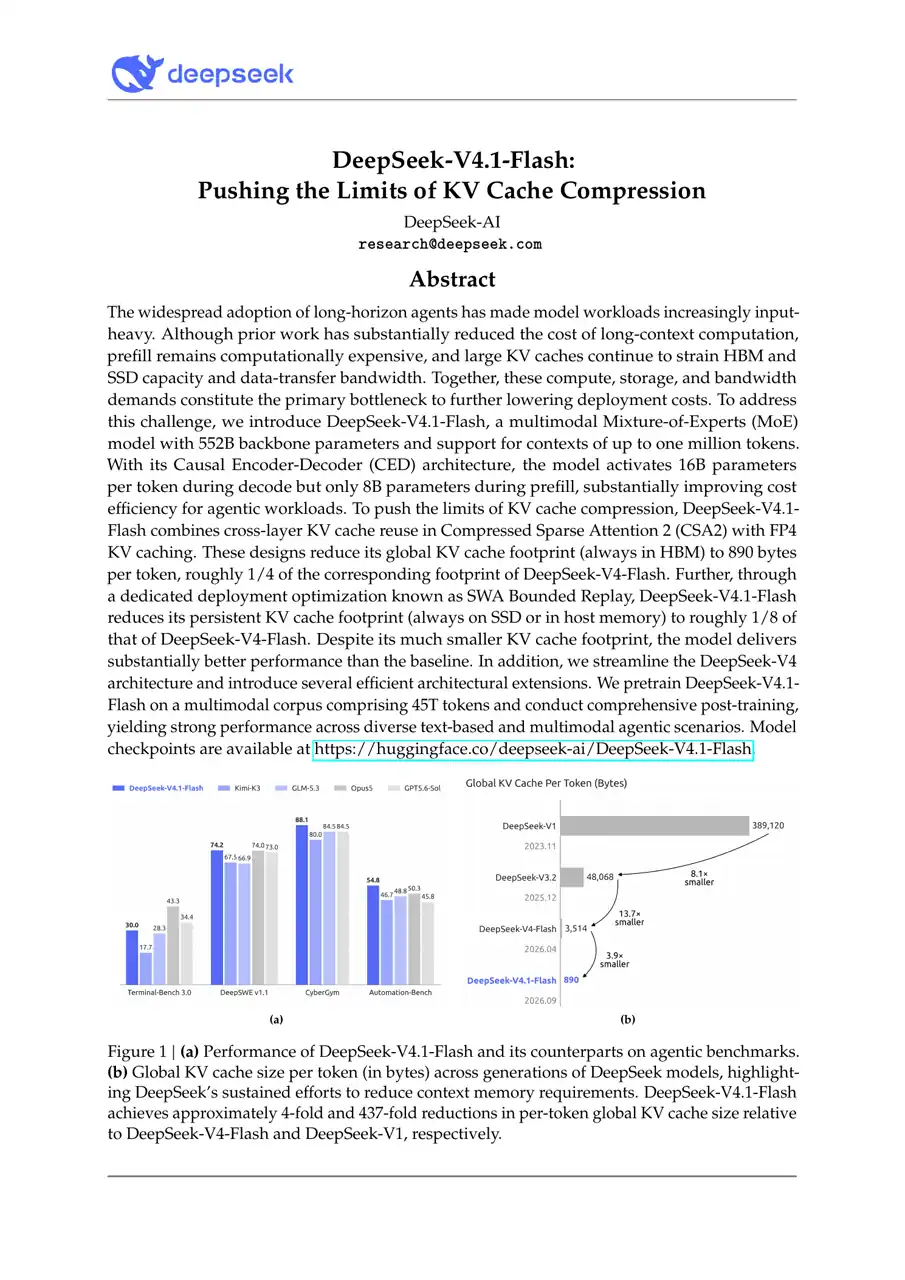
Selon la Rapport technique DeepSeek V4.1, le modèle utilise une architecture de base de type « mixture-of-experts » comportant 552 milliards de paramètres, avec un encodeur causal de 20 couches et un décodeur de 20 couches. Le nombre total de paramètres ne correspond pas à celui utilisé pour chaque token : DeepSeek fait état d’environ 8 milliards de paramètres actifs pendant la préremplissage et de 16 milliards pendant le décodage.
Cette conception asymétrique attribue des budgets de calcul différents au « prefill » et à la génération. Le « prefill » est l’étape qui traite la consigne, les documents, les images et la conversation précédente ; le décodage génère la réponse token par token. La réduction de la charge de calcul active pendant le « prefill » est particulièrement pertinente pour les charges de travail à l’échelle d’un référentiel et celles des agents de recherche, qui consacrent beaucoup de ressources à la lecture avant de passer à l’écriture.
Un cache KV bien plus petit
Le rapport indique une taille globale du cache KV de 890 octets par jeton, soit environ un quart de la mémoire cache de V4 Flash en mémoire à haute bande passante. Selon DeepSeek, les besoins en mémoire cache persistante représentent environ un huitième de ceux de la génération précédente. Dans un contexte d’un million de jetons, il s’agit davantage d’une caractéristique de déploiement que d’un détail architectural abstrait : la taille du cache influe sur le nombre de sessions longues qu’un serveur peut gérer et sur la quantité de mémoire consommée par chacune d’entre elles.
Entrée d'images natives et pré-entraînement multimodal
La version 4.1 de Flash prend en charge les images de manière native, sans avoir recours à un point de terminaison distinct de la marque Vision. Selon DeepSeek, le modèle a été pré-entraîné sur un corpus multimodal de 45 000 milliards de tokens. Concrètement, cela permet d'intégrer des captures d'écran, des graphiques, des tableaux numérisés, des états d'interface et des données de débogage visuel dans la même conversation avec l'agent que le code et le texte.
Un contexte de 1 million de jetons peut contenir des référentiels volumineux, de longs ensembles de documents et un historique étendu de l'agent, dans la limite combinée des entrées et des sorties.
Les fichiers JPEG, PNG, GIF et WebP peuvent être associés à du texte pour l'extraction de tableaux, l'analyse de captures d'écran et la réponse à des questions visuelles.
L'appel d'outils, la sortie JSON structurée et l'entraînement orienté agent font de ce modèle une solution adaptée aux flux de travail qui doivent inspecter, prendre des décisions et modifier l'état.
Tests de performances DeepSeek V4.1 : ce que révèlent les résultats officiels
Les principaux arguments de vente de la version 4.1 de Flash de DeepSeek concernent principalement les tests de performance en matière de codage et d’agents. Le fournisseur a évalué le modèle d’instructions avec un effort expérimental de 100, présenté publiquement comme l’effort de raisonnement maximal, en utilisant température=1,0 et top_p = 0,95. Les tests de l'agent de code ont utilisé des harnais nommés et un contexte d'un million de tokens ; les tests de l'agent visuel ont utilisé le code Claude avec un contexte de 512K tokens.
| Référence | V4.1 Flash | V4 Pro | V4 Flash | Chef de file |
|---|---|---|---|---|
| Codeforces note | 3471 | 3348 | 3289 | V4.1 Flash |
| Terminal-Bench 2.1 Pass@1 | 90.6 | 87.9 | 82.7 | V4.1 Flash |
| DeepSWE v1.1 résolu | 74.2 | 62.7 | 54.4 | V4.1 Flash |
| CyberGym Pass@1 | 88.1 | 83.3 | 76.7 | V4.1 Flash |
| Banc d'automatisation Pass@1 | 54.8 | 43.2 | 37.7 | V4.1 Flash |
| GPQA Diamant Pass@1 | 90.9 | 92.4 | 89.9 | V4 Pro |
| HLE : texte seul Pass@1 | 39.1 | 42.7 | 37.8 | V4 Pro |
Source : rapport technique DeepSeek V4.1, tableau 3. Dans chaque ligne, plus la valeur est élevée, mieux c'est. « Codeforces » correspond à un classement ; les autres valeurs affichées utilisent les indicateurs nommés du rapport, exprimés sous forme de pourcentages. Ne comparez pas les grandeurs d'une ligne à l'autre.

Cette tendance est utile, mais elle est plus limitée qu’une affirmation générale selon laquelle il s’agirait d’un “ meilleur modèle ”. V4.1 Flash devance V4 Pro dans les cinq catégories présentées ci-dessus : codage, terminaux, sécurité et automatisation. V4 Pro conserve toutefois son avance sur GPQA Diamond et sur le sous-ensemble « texte seul » de Humanity’s Last Exam. Les développeurs souhaitant comparer une sélection plus large de modèles de codage peuvent utiliser notre Guide sur le meilleur modèle d'IA pour la programmation, mais l'évaluation au niveau de l'application reste plus importante qu'une simple table.
L'effort de raisonnement influe également sur le coût et les résultats. Dans le rapport de DeepSeek, l'augmentation de l'effort expérimental de 25 à 100 a fait passer le score de DeepSWE v1.1 de 66,0 à 74,2 et celui de Terminal-Bench 2.1 de 82,4 à 90,6, tout en consommant environ 2,5 fois plus de tokens de sortie. Les huit configurations d’agents présentées dans le rapport ont également produit des résultats sensiblement différents à partir du même point de contrôle ; le choix du framework fait donc partie intégrante du système évalué.
DeepSeek indique que la robustesse face à des entrées extrêmes n'est pas entièrement caractérisée. Le rapport souligne que les erreurs de sélection CSA2 et la reconstruction approximative de l'état par attention à fenêtre glissante peuvent réduire les performances dans des cas limites ne figurant pas dans la suite de tests. Il reconnaît également qu'il subsiste des lacunes concernant le raisonnement de pointe et les tâches portant sur des cas limites. Ces réserves doivent être prises en compte lors de l'interprétation des scores principaux.
Deux exercices reproductibles pour évaluer Flash V4.1
Les tâches suivantes permettent de tester des comportements concrets sans présenter de prompt non exécuté comme preuve. Utilisez le prompt exact, consignez le modèle et le niveau d'effort dans votre rapport, puis évaluez la réponse en fonction des critères indiqués. Les résultats d'une exécution doivent être consignés sous forme d'observation datée, et non comme une référence générale.
Tarifs Flash DeepSeek V4.1
La tarification de l'API DeepSeek repose sur deux barèmes, et tous les montants indiqués ci-dessous sont exprimés en dollars américains par million de jetons. Les périodes de pointe sont les suivantes : De 01 h 00 à 04 h 00 UTC et de 06 h 00 à 10 h 00 UTC, du lundi au vendredi. Le reste du temps, c'est en heures creuses. Les données en entrée mises en cache, celles non mises en cache et les données en sortie sont facturées à des tarifs différents.
Tarifs les plus bas pour les API hébergées
- Entrée mise en cache
- $0.003
- Données non mises en cache
- $0.15
- Sortie
- $0.60
Par million de jetons ; en dehors des heures de pointe en semaine.
Le double du tarif hors pointe
- Entrée mise en cache
- $0.006
- Données non mises en cache
- $0.30
- Sortie
- $1.20
Pour 1 million de jetons ; de 01 h 00 à 04 h 00 et de 06 h 00 à 10 h 00 UTC, en semaine.
Pour prendre un exemple arithmétique simple, une requête hors heure de pointe comportant 800 000 jetons d'entrée non mis en cache et 20 000 jetons de sortie coûterait environ $0.132: $0,12 pour l’entrée, plus $0,012 pour la sortie. Le même nombre de tokens, facturé aux tarifs de pointe, coûterait environ $0,264. Ce calcul est donné à titre indicatif et ne correspond pas à une facture réelle liée à la charge de travail ; les accès au cache, les nouvelles tentatives, les changements d'outils et la longueur du raisonnement modifient le montant total.
Les entrées mises en cache sont cinquante fois moins chères que celles qui ne le sont pas dans les deux formules, ce qui confère un intérêt économique certain aux préfixes de prompt stables et au contexte réutilisable. Le tarif public de l’API DeepSeek est distinct de l’accès et de la facturation du GlobalGPT. Ne considérez pas ces prix par jeton comme correspondant aux tarifs d’abonnement ou de crédit du GlobalGPT.
API DeepSeek V4.1, vision et limites
L'API directe DeepSeek utilise deepseek-flash. Les développeurs peuvent appeler le point de terminaison standard à l'adresse https://api.deepseek.com, l'API « Responses » sur la même base, ou la base compatible Anthropic à l'adresse https://api.deepseek.com/anthropic. Les outils de fonction sont pris en charge dans Responses. DeepSeek documente également la appliquer_le_patch outil personnalisé ; les autres types d'outils intégrés de « Responses » sont ignorés et non exécutés.
deepseek-flashMode « Thinking » activé par défaut ; des préréglages « faible », « élevé » et « maximal » sont disponibles.
Choisissez la couche de compatibilité qui correspond à l'application existante.
Veillez à ce que l'ensemble des données d'entrée et de sortie reste dans la fenêtre contextuelle de 1 million de tokens.
Formats d'image et règles de placement
DeepSeek prend en charge les images au format JPEG, PNG, GIF et WebP. Une image intégrée peut atteindre 32 Mio, tandis qu’une image en fichier peut atteindre 64 Mio. La limite partagée documentée autorise jusqu’à 600 images par requête. Ce plafond n’est pas une recommandation : les lots volumineux augmentent la taille de la prompt, la latence et la difficulté à déterminer quelle image a servi de base à une réponse.
Dans l'API « Responses », le contenu des images doit figurer dans les messages des utilisateurs. Les images placées dans système ou assistant les messages renvoient un code HTTP 400. La couche de compatibilité n'accepte pas les fichiers généraux comme éléments d'entrée ; les applications doivent donc respecter les formats d'entrée d'image documentés, plutôt que de partir du principe qu'elles bénéficient d'une compatibilité totale avec la fonctionnalité « OpenAI Responses ».
Contexte, sortie et limites de concurrence
La taille maximale du contexte est d'un million de tokens, et la sortie maximale est de 384 000 tokens. L'entrée et la sortie combinées doivent tenir dans la fenêtre de contexte. Flash autorise 2 500 connexions simultanées par compte ; les requêtes dépassant cette limite reçoivent un code d'erreur HTTP 429. La planification des capacités doit donc tenir compte du nombre de connexions actives et du comportement en cas de nouvelle tentative.
DeepSeek V4.1 Flash vs V4 Pro
La version 4.1 Flash constitue le choix par défaut le plus pratique pour les agents de codage à haut débit, les entrées visuelles et les applications à contexte étendu. La version 4 Pro reste pertinente en tant que référence en matière de raisonnement pendant la brève période de transition, mais elle ne prend pas en charge la vision et présente une capacité de traitement simultané documentée inférieure. Notre précédente Test du DeepSeek V4 Pro traite ce point de contrôle selon ses propres critères ; ses résultats concrets ne devraient pas être reclassés comme des preuves de la version 4.1.
| Facteur déterminant | V4.1 Flash | V4 Pro avant la modification du routage |
|---|---|---|
| Meilleure adéquation | Agents, programmation, entrées longues, vision | Sélection de tâches de raisonnement de pointe |
| Saisie d'images | Prise en charge | Non pris en charge |
| Concurrence/compte | 2 500 connexions | 500 connexions |
| Entrée hors heures de pointe non mise en cache | $0,15 / 1M | $0,66 / 1M |
| Production hors heures de pointe | $0,60 / 1M | $1,98 / 1M |
| Modèle officiel de notation | Prospects affichés par agent / lignes de codage | Liens vers GPQA Diamond et HLE (version texte uniquement) |
Les prix correspondent aux tarifs API DeepSeek, et non aux prix GlobalGPT. Les tarifs Pro s'appliquent avant le changement d'acheminement annoncé le 14 septembre.
Aux tarifs hors heures de pointe, les entrées non mises en cache de Flash sont environ 77% moins chères que le tarif Pro indiqué, et les sorties Flash sont environ 70% moins chères. Ces pourcentages sont calculés à partir du tarif officiel et ne correspondent pas à des économies réelles. Les économies réelles dépendent de la réutilisation du cache, de la longueur de la sortie, du nombre de tentatives et de la nécessité ou non, pour la charge de travail, de bénéficier des résultats plus performants de Pro sur les lignes de raisonnement sélectionnées.
La distinction la plus urgente est d'ordre opérationnel. DeepSeek maintient le deepseek-v4-pro nom tout en modifiant temporairement le modèle sous-jacent. Un nom d’API stable ne garantit pas un comportement de sortie stable. Conservez les réponses représentatives de V4 Pro, les traces des outils, la latence et les cas d’échec antérieurs au 14 septembre, puis exécutez la même suite de tests d’acceptation après les modifications de routage. Pour l’ancien cadre de comparaison des points de contrôle, voir DeepSeek V4 Pro vs Flash.
Ce qu'en disent les développeurs
Les premières réactions sont positives en ce qui concerne le débit, l'efficacité du cache et les scores des agents, mais les données sont inégales. Certains commentaires portent sur une version préliminaire plutôt que sur la version finale mise en production, et certains rapports résument des démonstrations plutôt que des tests contrôlés. Le débat public le plus utile porte donc sur le lieu où effectuer les tests, et non sur la question de savoir si un chiffre communiqué le jour du lancement suffit à trancher la question.
Son analyse de lancement recommande de conserver une configuration de référence V4 Pro et de tester le modèle Flash publié avant le changement de routage prévu le 14 septembre. Elle souligne également que les gains varient en fonction du benchmark, du framework et du niveau d'effort.
Lire l'analyseEn résumant les démonstrations présentées lors de l'avant-première de « World of AI », la publication a mis en avant une vitesse maximale observée de 427 tokens par seconde et a relevé une tendance à la réflexion excessive ainsi qu'un comportement moins performant en matière de simulation physique. Il ne s'agit pas d'une garantie officielle de vitesse.
Lire l'article de présentationDans le fil de discussion consacré au lancement, l'auteur du commentaire s'est opposé au fait que les workflows Pro validés soient redirigés en silence vers un autre modèle et a plaidé en faveur d'une période de dépréciation clairement définie. Il s'agit là d'un avis exprimé par un membre de la communauté, et non d'un consensus.
Ouvrir le commentaireLe responsable des tests d'intrusion basés sur l'IA chez Aikido a fait état d'améliorations en matière de rappel en un seul passage, de rappel « pass@3 », de précision et de taux de réussite de la mise en cache lors d'un test de performance en cybersécurité. Son message mentionne un point de terminaison en préversion dont la durée de validité arrive à expiration ; il ne s'agit donc pas d'une preuve valable pour le point de contrôle final.
Consulter l'aperçu du rapportCes réactions mettent en évidence trois vérifications qu'il convient d'effectuer lors de tout déploiement réel : comparer la qualité de la sortie pour un niveau d'effort donné, vérifier si un raisonnement long augmente le coût de la sortie, et réexécuter les cas de régression lorsqu'un alias modifie le modèle sous-jacent à un point de terminaison. Les résultats préliminaires en matière de débit et de sécurité peuvent orienter la conception des tests, mais ils ne doivent pas être combinés avec le tableau 3 de DeepSeek comme s’ils provenaient d’un seul benchmark contrôlé.
Comment accéder au flash DeepSeek V4.1
Il existe trois modes d'accès distincts. Choisissez celui qui vous convient le mieux selon que vous ayez besoin d'un contrôle direct via l'API, de poids auto-hébergés ou d'un espace de travail dans le navigateur facilitant le changement de modèle. Les conditions générales, les tarifs et les responsabilités opérationnelles varient selon le mode d'accès choisi.
API DeepSeek
Utilisez le site officiel deepseek-flash modèle pour les intégrations natives, « Responses » ou compatibles avec Anthropic.
Poids libres
Téléchargez la fiche de modèle et les poids sous licence MIT. Vérifiez la prise en charge de Serving Stack et les exigences en matière d'infrastructure avant de vous engager.
Ouvrir le référentiel de modèlesGlobalGPT
Utilisez l'entrée Flash dédiée à la version 4.1 au sein d'un espace de travail multi-modèles. La facturation GlobalGPT est distincte du tarif API de DeepSeek.
Essayez la version DeepSeek V4.1 Flash
L'API directe est le choix le plus évident lorsque vous avez besoin de contrôles programmatiques, d'un suivi de l'utilisation et d'un accès aux interfaces documentées de DeepSeek. Les poids ouverts s'adressent aux équipes capables de valider la prise en charge de l'inférence et d'exploiter un modèle MoE de très grande envergure. GlobalGPT constitue la solution la plus simple pour une utilisation interactive et des comparaisons au sein d'un flux de travail de modèle d'IA tout-en-un.
Le communiqué officiel annonçant le lancement de DeepSeek indique que l'entreprise collaborera avec la communauté open source pour améliorer la prise en charge de l'inférence et explorer davantage d'options de déploiement. Il convient de considérer cela comme une déclaration relative à la feuille de route, et non comme une preuve que toutes les piles de serveurs locales prennent déjà en charge efficacement Flash V4.1.
À qui s'adresse la version DeepSeek V4.1 de Flash ?
Privilégiez Flash V4.1 lorsque le travail sur le terminal, la navigation dans le référentiel, l'automatisation, l'utilisation d'outils et les invites longues occupent une place prépondérante. Les scores officiels de l'agent et les taux de saisie plus faibles justifient la mise en place d'un projet pilote spécifique à cette charge de travail.
La prise en charge des images natives fait de Flash une option plus pratique que V4 Pro pour les captures d'écran, les graphiques, les tableaux et les preuves d'interface. Vérifiez la précision de l'extraction par rapport aux réponses connues.
V4 Pro arrive en tête des lignes « GPQA Diamond » et « HLE » affichées, qui ne contiennent que du texte. Comparez les invites fixes et les paramètres d'effort avant de remplacer un workflow de raisonnement validé.
La licence MIT est permissive, mais une infrastructure MoE 552B n’est pas un modèle local léger. Vérifiez la compatibilité matérielle, la stratégie de mise en cache, la quantification et la prise en charge du service.
Pour élargir le choix des modèles, le Comparaison entre les modèles GPT-5.5 et DeepSeek V4 compare le contexte d'un million de jetons et le niveau de prix à une autre option de pointe. Les équipes axées sur le style de production de code peuvent également consulter le Test de code Python : DeepSeek vs ChatGPT. Ces articles répondent à des questions connexes ; aucun d'entre eux ne remplace toutefois le test du point de terminaison Flash V4.1 exact utilisé en production.
Les utilisateurs lambda qui hésitent entre différents écosystèmes pourraient trouver que le plus vaste Comparaison entre DeepSeek et ChatGPT plus utile qu'une analyse au niveau de l'architecture. La version 4.1 de Flash est particulièrement intéressante lorsque ses avantages spécifiques – saisie longue, compréhension des images, outils et faible coût par token – s'intègrent dans un flux de travail concret.
Verdict
Ses tarifs API plus bas, son contexte de 1 million, la prise en charge native des images en entrée, son quota de 2 500 connexions et les gains d'agents rapportés par DeepSeek constituent des arguments de poids en faveur de son évaluation. Il ne s’agit toutefois pas d’un remplacement universel de la version Pro : la V4 Pro reste en tête dans certains domaines de raisonnement, les scores obtenus en mode « effort maximal » impliquent une utilisation plus importante de jetons de sortie, et les modifications du routage des points de terminaison peuvent altérer le comportement validé.
Installer la version DeepSeek V4.1 de la mémoire flash sur le GlobalGPTCommencez par une petite suite de tests d'acceptation : une tâche de codage représentative, une tâche d'extraction basée sur des images, un cas à contexte étendu et un workflow d'outils. Définissez le cadre de raisonnement, enregistrez le cheminement du modèle et comparez les modes de défaillance ainsi que la qualité moyenne. Cela vous permettra de prendre une décision que vous pourrez défendre sans considérer les benchmarks des fournisseurs ou les réactions au jour du lancement comme une garantie des performances de l'application.
Questions fréquemment posées
Qu'est-ce que la mémoire Flash DeepSeek V4.1 ?
DeepSeek V4.1 Flash est un modèle multimodal de type « mixture-of-experts » à poids ouverts, lancé le 10 septembre 2026. Il prend en charge les entrées de texte et d’images, les sorties de texte, une fenêtre de contexte d’un million de tokens, les modes « réflexion » et « sans réflexion », les sorties au format JSON et les appels d’outils.
Combien coûte l'API Flash DeepSeek V4.1 ?
Les tarifs API DeepSeek en heures creuses sont de $0,003 par million de jetons d'entrée mis en cache, de $0,15 par million de jetons d'entrée non mis en cache et de $0,60 par million de jetons de sortie. Les tarifs en heures de pointe s'élèvent respectivement à $0,006, $0,30 et $1,20. Il s'agit des prix de l'API DeepSeek, et non des prix de l'API GlobalGPT.
Quel nom de modèle d'API dois-je utiliser pour la mémoire Flash DeepSeek V4.1 ?
Utilisation deepseek-flash avec l'API officielle DeepSeek. DeepSeek prend également en charge les appels à l'API Responses à l'adresse https://api.deepseek.com et les appels compatibles avec le protocole Anthropic à l'adresse https://api.deepseek.com/anthropic.
Quelles sont les limites en termes de contexte, de sortie et de concurrence ?
La version 4.1 de DeepSeek Flash dispose d'une fenêtre de contexte d'un million de tokens et d'un débit maximal de 384 000 tokens ; l'entrée et la sortie doivent tenir dans cette fenêtre de contexte. DeepSeek prend en charge 2 500 connexions simultanées par compte ; au-delà de cette limite, un code d'erreur HTTP 429 est renvoyé.
La version Flash DeepSeek V4.1 est-elle meilleure que la V4 Pro ?
Cela dépend de la tâche à accomplir. Dans le tableau établi par le fournisseur DeepSeek, la version V4.1 Flash devance la V4 Pro sur les critères d’évaluation affichés concernant le codage, les terminaux, la sécurité et l’automatisation, tandis que la V4 Pro devance les versions GPQA Diamond et HLE (texte uniquement). La version Flash est également moins chère, prend en charge la vision et autorise davantage de connexions simultanées.
La version 4.1 de DeepSeek Flash prend-elle en charge les images ?
Oui. Elle accepte les fichiers JPEG, PNG, GIF et WebP en entrée et génère du texte. DeepSeek prend en charge des documents d'une taille maximale de 32 Mio pour les images intégrées, de 64 Mio pour les images en fichier, et 600 images par requête dans le cadre des limites communes. Les images renvoyées par l'API doivent être intégrées dans les messages des utilisateurs.
Les poids Flash DeepSeek V4.1 sont-ils disponibles en téléchargement ?
Oui. DeepSeek publie les poids du modèle DeepSeek-V4.1-Flash sur Hugging Face sous licence MIT. Cette licence permissive ne dispense toutefois pas des exigences en matière d’infrastructure : les équipes doivent toujours disposer d’un logiciel de déploiement compatible et d’une infrastructure matérielle suffisante pour prendre en charge le réseau dorsal MoE de 552 milliards de nœuds.
Puis-je utiliser le firmware DeepSeek V4.1 sur un GlobalGPT ?
Oui. GlobalGPT dispose d'une entrée Flash dédiée à DeepSeek V4.1 pour une utilisation via un navigateur. Son accès et sa facturation sont distincts du tarif API direct de DeepSeek, et la disponibilité de la plateforme ne permet pas de vérifier de manière indépendante les résultats de benchmark publiés par DeepSeek.