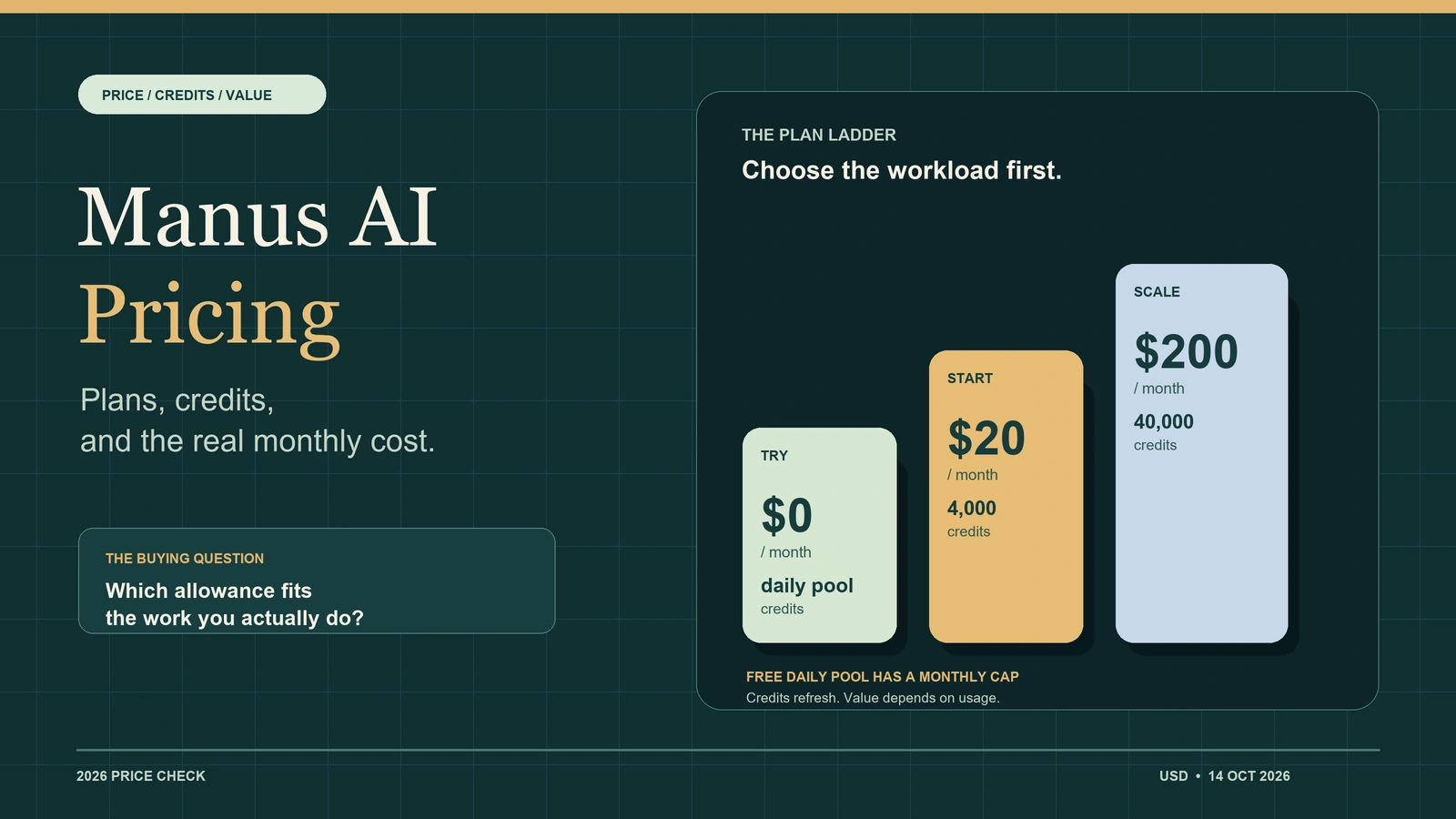
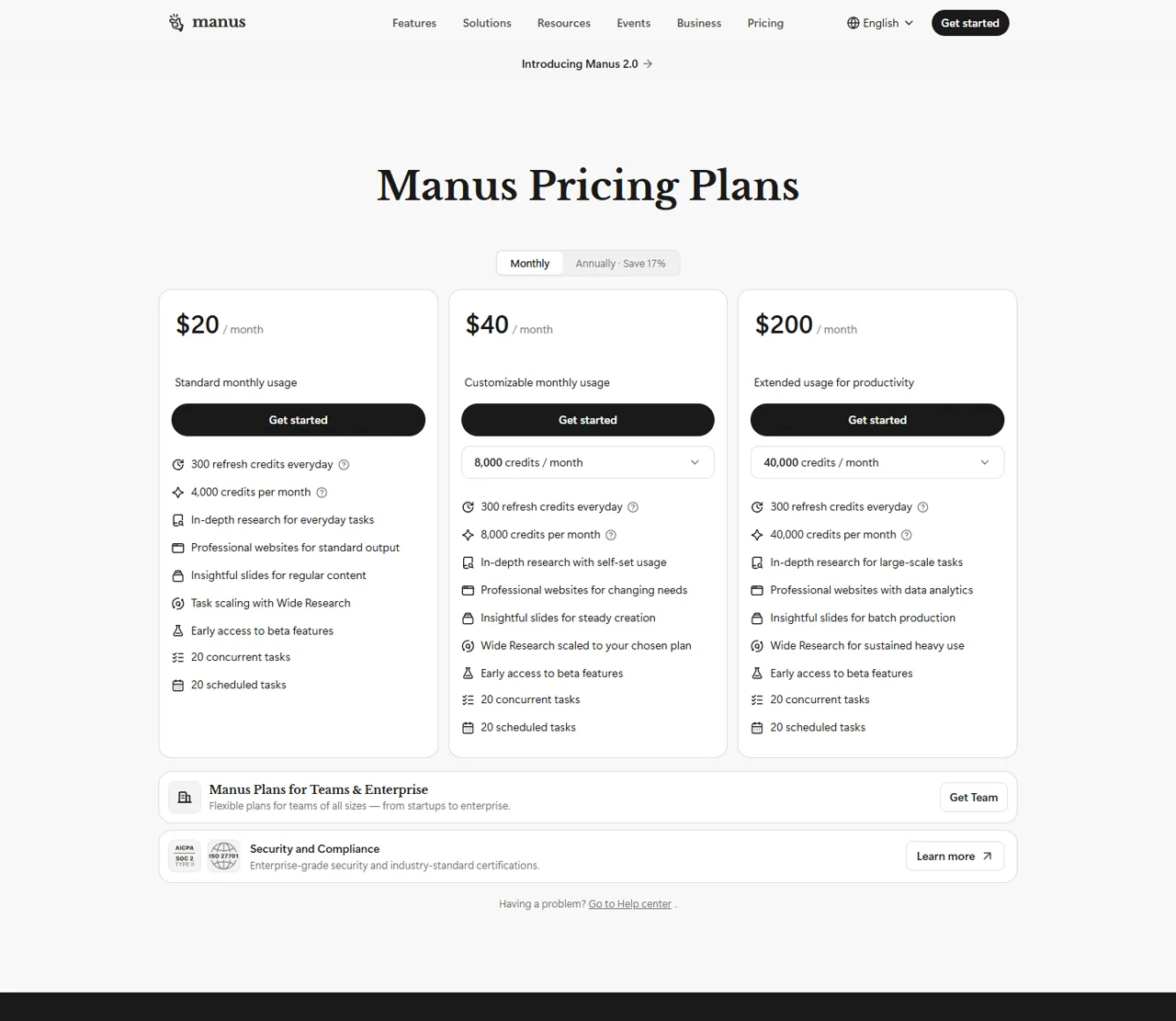
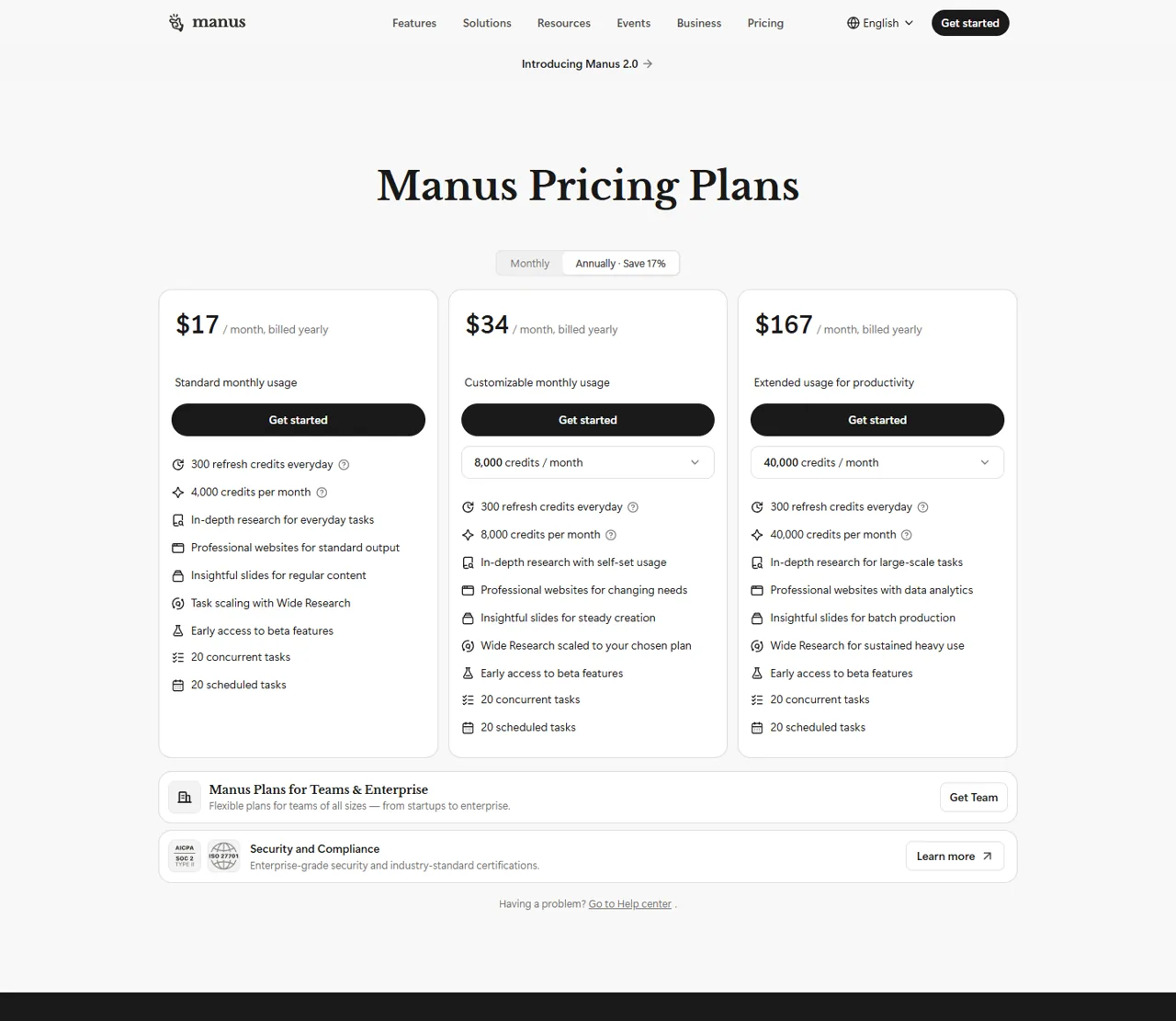
Manus AI pricing starts with a $0 Kostenloses Abonnement. The current displayed paid selections are $20/month for 4,000 monthly credits, $40/month for 8,000 credits, und $200/month for 40,000 credits. Annual billing displays monthly equivalents of $17, $34, und $167 for those paid tiers, marked “Save 17%,” but requires an annual commitment. See the official Manus pricing page.
The number that matters is how far those credits carry your actual work. Free accounts receive 300 daily refresh credits, yet their consumption from that pool is capped at 1,500 credits per month. Paid monthly credits expire each cycle, and complex tasks can use substantially more than a quick request. Manus’s credit rules make a simple price-per-month comparison incomplete.
Start with Free to test Manus 2.0 Lite, or the $20 Pro tier if you need the full Agent-mode selection. Move up when your usage history supports it. Paying for a larger allowance before you know your task costs can leave you with unused credits instead of better value. If you are comparing Manus with a broader AI subscription, GlobalGPT offers one account and subscription for supported chat, research, image, video, and agent tools. That can make more sense when you want to spread your budget across several workflows instead of paying for a larger Manus credit allowance you may not use. It does not include Manus native agent access or Manus credits, so treat it as a separate value comparison.
Kurze Antwort: Budget $20/month for the entry Pro tier, $40/month for the displayed 8,000-credit tier, or $200/month for the displayed 40,000-credit tier, before applicable taxes and optional services. These are credit allowances, not unlimited autonomous tasks.
Prices and policies checked October 14, 2026. Amounts are in USD.

Manus AI Pricing Plans at a Glance
| Plan / displayed selection | Monatlich zahlen | Jahresabrechnung: als monatlichen Gegenwert dargestellt | Kredite |
|---|---|---|---|
| Kostenlos | $0 | Nicht zutreffend | 300 daily refresh credits; 1,500/month consumption cap from that pool |
| Pro — standard usage | $20/Monat | $17/month, billed yearly | 4,000 monthly credits + daily refresh credits |
| Pro — customizable usage, 8,000 selected | $40/Monat | $34/month, billed yearly | 8,000 monthly credits + daily refresh credits |
| Pro — extended usage, 40,000 selected | $200/Monat | $167/month, billed yearly | 40,000 monthly credits + daily refresh credits |
| Team | From $20/seat/month | Annual option; verify seat quote | Shared team allocation; verify selected package |
Manus advertises “Save 17%” for annual billing. The displayed annual monthly equivalents are rounded; do not multiply them by 12 and treat the result as a verified checkout total. Check the annual amount charged upfront before paying. Annual subscriptions still refresh credits monthly, rather than issuing a freely transferable yearly pool. Monthly refresh rules apply to annual subscribers too.
Basic and Plus are older names that Manus has renamed to Pro. A search result using those labels may describe an earlier offer. Existing subscribers can also renew at legacy prices, according to the membership FAQ; your renewal amount may differ from a new customer’s price.
Is Manus AI Free? Free vs. Pro Explained
What You Get on the Free Plan
Free includes Chat Mode and Manus 2.0 Lite in Agent Mode, with one concurrent task and two scheduled automations. Pro adds Manus 2.0 and Manus 2.0 Max in Agent Mode, alongside Lite. The Vergleich der offiziellen Pläne lists 20 concurrent tasks and 20 scheduled automations for the described Pro tiers.
The free allowance needs two numbers: 300 credits per day, but no more than 1,500 daily-refresh credits consumed per month. Unused daily credits reset at 00:00 UTC and do not accumulate. This is not a 9,000-credit monthly allowance. Other credit types, such as promotional credits, follow their own conditions. Daily refresh rules explain the daily reset.
What Changes When You Upgrade?
Pro buys a recurring monthly allowance, broader Agent-mode access, and more room to run work in parallel. Daily refresh credits remain restricted to Manus 2.0 Lite; they are not interchangeable with paid monthly credits for every mode. Paid users do not have the Free plan’s 1,500-credit monthly consumption cap on the daily-refresh pool.
Free is a sensible fit for occasional experiments that can wait for refreshes. Pro becomes more useful when you need a paid Agent mode or repeatable work on a deadline. If your tasks are mainly conversations and drafting, compare the subscription model in our ChatGPT Plus – Preisübersicht before buying an autonomous-agent allowance.
How Do Manus AI Credits Work?
What Uses Credits?
Manus identifies three main cost sources: LLM tokens for planning and generation, virtual machines for browser/file/code work, and third-party APIs for integrated services. Consumption depends on task complexity and duration. Credits are charged during active processing; retaining a completed report in your task history does not itself keep spending task credits. The official consumption policy describes this distinction.
A request to research many companies, open their websites, compare data, and build a presentation contains several kinds of work. Counting it as “one prompt” tells you little about its cost. The same budgeting distinction matters when assessing OpenClaw’s model and infrastructure costs.
Daily, Monthly, and Add-On Credits
| Credit pool | What to budget around |
|---|---|
| Daily refresh | Resets daily; no accumulation; Lite only. Free: 1,500/month consumption cap from this pool. |
| Monatliches Abonnement | Refreshes on your monthly cycle date, including annual plans. Unused allocation does not roll over. |
| Purchased add-ons | Can carry into later cycles while a paid subscription stays active; become inactive on Free or lapse. |
The published deduction order is event → daily → monthly → add-on → free credits, subject to eligibility for the task. Do not count a Lite-only daily balance toward work that needs another Agent mode.
Can You Predict a Task’s Credit Cost?
A promise generated inside a conversation is not a billing guarantee. Manus’s dedicated pre-task-estimate help article warns that the agent cannot accurately predict its credit consumption. Use actual usage records from comparable tasks; treat any account-level estimate as guidance unless it explicitly sets a spending limit.
The generic plans documentation mentions estimates, but the dedicated help article warns against trusting agent-generated predictions. For a purchase decision, budget from recorded consumption rather than a promise to finish a task for a fixed number of credits.
Running Out, Retrying, and Getting a Refund
A final action can briefly push your balance below zero because charges are recorded at the next action. Manus says the negative balance is resolved at refresh, and you cannot start new tasks with effective available credits at or below zero. It is not evidence of an unlimited pay-as-you-go allowance.
Die specific add-on purchase instructions currently describe purchases for users already on the highest monthly-credit tier. Generic documentation says add-ons can be bought anytime; do not assume a Free or entry-Pro account can buy a small pack instead of upgrading. Check the purchase options available to your account.
Technical bugs or platform malfunctions can qualify for a full task-credit refund after review. Subjective dissatisfaction, unclear instructions, external website failures, and hitting task limits generally do not. A retry or rewrite can therefore add to your usage. Manus’s refund policy is narrower than “every unsuccessful result is free.”
Manus AI’s Real Monthly Cost: Three Usage Scenarios
Your cash bill and your cost per useful result answer different questions. The bill is what you pay; the result cost tells you whether the subscription earned its place in your workflow.
Monthly cash cost = subscription + purchased add-ons + optional service charges + applicable taxes and payment fees.
The following scenarios are illustrative budgets, not hands-on measurements or official per-task rates. Each assumes the stated paid-credit demand, no contribution from daily or promotional credits, no add-ons, and no optional service fees. A “result” means a deliverable you keep; its credit allowance includes any iterations.
| Illustrative workload | Assumed credits per kept result | Results/month | Monthly paid-credit demand | Displayed monthly tier that covers it | Subscription cost per result |
|---|---|---|---|---|---|
| Occasional paid-mode work | 300 | 10 | 3,000 | $20 / 4,000 credits | $2.00 |
| Regular weekly production | 350 | 20 | 7,000 | $40 / 8,000 credits | $2.00 |
| Heavy multi-step production | 800 | 45 | 36,000 | $200 / 40,000 credits | $4.44 |
Notice that heavier use does not automatically produce a lower cost per result. The work mix changed. At each of the three listed monthly selections, the nominal allocation costs $5 per 1,000 monthly credits: $20 ÷ 4,000 × 1,000, for example. That calculation excludes daily credits and assumes you use the allocation. It is not an add-on price or a fixed task tariff.
If you pay $40 but use only 2,000 of your 8,000 monthly credits, your effective subscription spend is $20 per 1,000 monthly credits actually used, ignoring daily credits. Unused credits expire. A larger balance can therefore cost more without increasing the number of useful deliverables.
Extra Costs That a Subscription Table Misses
Building and editing a Manus website consumes task credits, while running that website has a separate usage-based system for cloud, AI, and API resources. Official documentation lists free monthly allowances of $10 cloud, $1 AI, and $1 API. These are resource allowances, not interchangeable task credits. Website usage and pricing explains the separate balance and optional auto top-up.
One official example estimates a marketing site at $25 cloud + $10 AI + $0 API. After the applicable $10 cloud and $1 AI allowances, that leaves $24/month beyond the subscription. Paired with a $20 monthly Pro subscription, that is an illustrative $44/month before taxes. It is a workload estimate, not a guaranteed hosting quote.
An optional persistent Cloud Computer is another product: $30/month Standard or $50/month Advanced. A $20 Pro subscription plus the $30 Standard server would be $50/month before other charges, if you choose to buy both. Ordinary report-writing does not require adding that server to your budget.
Prices are standardized in USD. Your bank or payment provider may determine conversion rates and foreign-transaction fees. API integration pricing and country-specific checkout costs deserve separate calculations; neither is a substitute for the consumer subscription price.
Which Manus AI Plan Should You Choose?
- Bleiben Sie kostenlos if Lite handles your tasks, the 1,500-credit monthly daily-pool cap is enough, and you can work around daily resets and one concurrent task.
- Start with $20 Pro if you need Manus 2.0 or Max, or a usable monthly allowance beyond Free. Track whether 4,000 paid credits cover a normal cycle.
- Consider the $40 / 8,000-credit selection when recorded usage exceeds the entry allowance. Twice the monthly credits does not mean every task becomes twice as capable.
- Consider larger configurable allowances only after measuring sustained demand. The $200 / 40,000-credit selection is one published option, not necessarily the only next step.
- Choose Team for administration and collaboration, not merely because you need more personal credits. Confirm the seat count and shared allowance before comparing totals.
Start monthly if your usage is uncertain. Annual billing can reduce the effective price, but it does not solve idle-credit waste, and unused monthly credits still expire. Our comparison of lower-cost AI tools is useful if you are still deciding which type of subscription deserves your budget.
For existing web subscribers, Stripe upgrades are prorated when moving between monthly tiers: the official example charges $10 and adds 2,000 credits for an exact half-cycle move from $20 to $40. The original renewal date stays. Apple and Google Play handle upgrades differently, so do not apply that web example to every purchase.
Is Manus AI Worth Paying For?
Manus is worth considering when you want a finished work product that requires several execution steps: gathering material, processing files, checking sources, and building an output. The paid plan needs to save enough working time after you review and correct the result.
For a simple decision test, suppose a $20 subscription saves two net hours in a month and your time is worth $25/hour. That is $50 of time value minus $20 of subscription spend: $30 of estimated benefit before other charges. If checking the work erases those two hours, the same plan has not delivered that benefit. These are assumptions for your calculation, not measured Manus productivity claims.
If you mainly need source-based answers, compare the narrower research workflow and Perplexity Pro pricing before paying for extensive task execution.
If you prefer a research tool you already use, a ChatGPT Deep Research workflow may cover part of the job without adding another subscription.
For predominantly writing, analysis, or coding conversations, compare Claude’s plan structure with your actual needs. Compare the job each tool completes, not only the lowest advertised price.
If you are choosing between operating an agent and using a hosted assistant, our OpenClaw vs. ChatGPT Plus comparison explains the workflow trade-off.
When an All-in-One AI Subscription Makes More Sense
A dedicated Manus subscription is one option for autonomous work. If your budget is spread across chat, research, image, and video tools, GlobalGPT offers an all-in-one AI workspace designed to consolidate supported tools under one account and subscription. The benefit is fewer separate subscriptions and less switching between provider sites.
For a research-focused alternative, GlobalGPT has a Perplexity entry. Use it for a supported research workflow; Manus’s native agent, its subscription, and its credits are a separate purchase decision.
How to Keep Your Manus AI Costs Under Control
- Define “done” before starting. Specify the sources, number of items, output format, and acceptance criteria so the agent does not explore an unnecessarily broad task.
- Try one representative task first. Use the same mode and complexity you expect in production; a tiny Lite task cannot predict a large Max workflow.
- Break long work into reviewable stages. Check scope and direction before requesting another full revision. Keep context relevant rather than extending one conversation indefinitely.
- Record actual credits and kept outputs. Count revisions and abandoned runs when calculating cost per useful deliverable.
- Check the renewal date. Move down if you consistently leave credits unused. Consider annual billing only after a normal cycle supports the commitment.
You can inspect task transactions in Einstellungen → Nutzung. Track the task, mode, credits used, whether the result was usable, and minutes of manual correction. That small log is a stronger basis for upgrading than an agent’s prediction of its own cost.
Manus AI Pricing FAQ
How much does Manus AI cost per month?
Free costs $0. Pro starts at $20/month for 4,000 monthly credits. The public monthly selections also show $40 for 8,000 credits and $200 for 40,000 credits, before applicable taxes and optional services.
Does Manus AI have a free plan?
Yes. Free includes Chat Mode and Manus 2.0 Lite in Agent Mode. Daily credits refresh to 300, but Free users can consume at most 1,500 daily-refresh credits per month. They do not accumulate into a 9,000-credit monthly balance.
Do unused Manus credits roll over?
Unused monthly subscription credits do not roll over, including on annual plans. Add-on credits can carry forward while a paid subscription remains active, but become inactive when the account switches to Free or the subscription lapses.
Can you buy more credits without upgrading?
Do not assume so. The specific add-on help article describes purchases for users on the highest monthly-credit tier. Check your account’s purchase options; Free and entry-Pro users should not budget around unrestricted add-on access.
Does Manus charge for failed tasks?
Credits are consumed during active processing. Confirmed Manus bugs or platform malfunctions can qualify for a full task-credit refund after review. Dissatisfaction, unclear instructions, external failures, and hitting task limits generally do not.
Is annual billing cheaper than monthly billing?
Manus advertises a 17% annual saving. The public page displays $17, $34, and $167 per month, billed yearly, for the selections discussed here. Check the actual annual checkout charge; those rounded labels are not verified yearly totals.
Can you cancel or downgrade your subscription?
Yes. Manage the subscription through the platform where you purchased it. Downgrades apply at the next renewal. Cancellation stops future renewals; it does not automatically refund a completed charge. Cancel a trial before billing to avoid its subscription charge.
Can GlobalGPT replace Manus for research?
GlobalGPT provides a Perplexity entry for research alongside supported AI tools in one subscription. That can suit a research-focused workflow, but it should not be treated as a Manus subscription, Manus credits, or full Manus native-agent access.
For occasional Lite tasks, begin with Free. For paid Agent modes or recurring deliverables, start with the $20 Pro tier and measure a normal month. Upgrade when recorded demand justifies it, and include optional service charges before deciding what Manus really costs you.