
The Best Claude Sonnet 4.5 Alternatives in 2026 include GPT-5.6 Sol for advanced reasoning, Gemini 3.1 Pro for high-speed multimodal tasks, and Grok 4.7 for real-time trend analysis. To bypass strict usage limits and region restrictions effectively, professionals are increasingly adopting all-in-one AI aggregators that provide flexible, low-cost access to these top-tier models in a single interface.
Despite Claude Sonnet 4.5’s coding dominance, its strict “5-hour” lockouts frequently halt production. Professionals need a high-availability backup system that avoids the cost and friction of managing multiple $20 subscriptions.
GlobalGPT solves this by unifying 100+ top-tier AI models into a single, limit-busting dashboard. When Claude hits a wall, you can instantly toggle to GPT-5.6 Sol , Gemini 3.1 Pro , or Grok 4.7 —all without changing tabs. By aggregating access to specialized tools like Sora 2 Pro (video), Unikorn, and Veo 3.1, GlobalGPT ensures your workflow never stops, giving you the versatility of five separate professional subscriptions starting at just ~$5.75/mo.
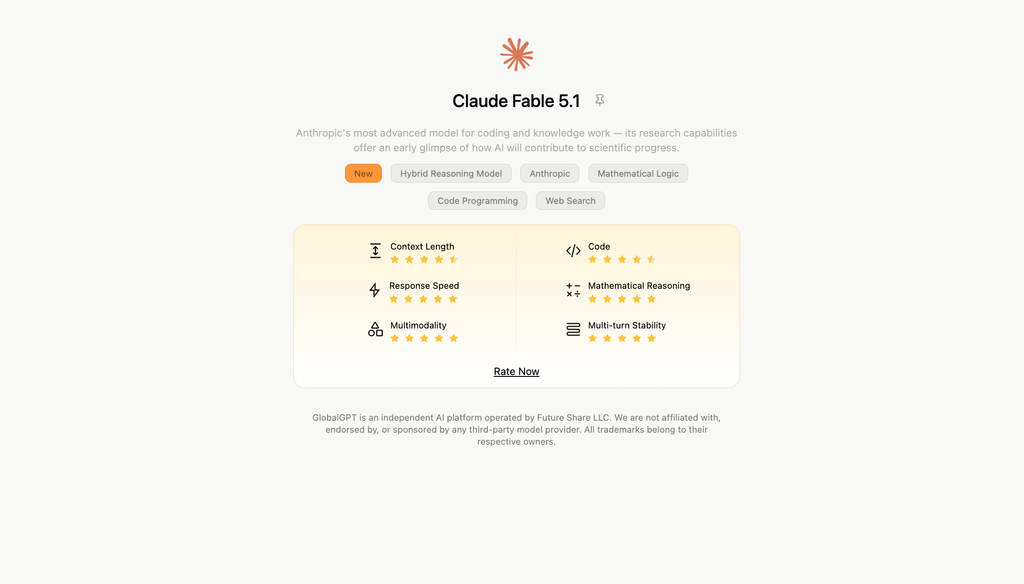
GlobalGPT: The Best “All-in-One” Alternative
GlobalGPT redefines the concept of an “alternative” by not forcing you to choose just one replacement. Instead, it aggregates the world’s top 100+ AI models into a single, seamless interface. When Claude Sonnet 4.5 hits a usage limit, you don’t stop working—you simply toggle to GPT-5.6 Sol, Gemini 3.1 Pro, or Grok 4.7 instantly within the same chat window.
This platform eliminates the “silo” problem. You gain access to the specific strengths of every major model:
- GPT-5.6 Sol for superior mathematical reasoning and logic.
- Gemini 3.1 Pro for analyzing large PDFs and video content.
- Grok 4.7 for real-time news and social sentiment analysis.
- Sora 2 Pro & Veo 3.1 for high-end video generation.
Starting at roughly $5.75/month, GlobalGPT offers a “freedom-first” approach: no rigid regional locks, no single-model dependency, and a flexible quota system designed for heavy daily usage.

GPT-5.6 Sol (OpenAI): The Best Alternative for Logic & Pure Math
If your primary friction with Claude 4.5 is its occasional struggle with pure abstract logic or advanced mathematics, GPT-5.6 Sol (Thinking/Pro) is the definitive alternative. In the benchmark figures cited here, GPT-5.6 Sol Thinking achieved a staggering 100% score on the AIME2025 (math competition) without using external tools—a feat where Claude still trails slightly.
For workflows involving “GDPval” (General Data Processing) tasks like complex spreadsheet analysis or financial modeling, GPT-5.6 Sol Pro boasts a 74.1% success rate, surpassing Claude’s 59.6%. While Claude writes cleaner code, GPT-5.6 Sol “thinks” deeper, making it the superior choice for architectural planning and solving novel logic puzzles.

- Scenario – Data Science: If you paste a messy CSV file with 10,000 rows, GPT-5.6 Sol Pro’s Advanced Data Analysis tool is significantly more robust than Claude’s Artifacts, often auto-correcting formatting errors that cause Claude to crash.
- Scenario – Creative Writing: While Claude is “poetic,” GPT-5.6 Sol is “structured.” Users writing novels find GPT-5.6 Sol better at maintaining plot consistency over long horizons, whereas Claude excels at scene-by-scene dialogue.
Gemini 3.1 Pro (Google): The Best Alternative for Multimodal & Speed
When speed and visual understanding matter more than code syntax, Gemini 3.1 Pro shines. Unlike Claude, which focuses heavily on text-based agentic tasks, Gemini 3.1 Pro is a multimodal native. It excels at processing video inputs, analyzing complex charts in seconds, and handling massive context windows that would choke other models.
Users reporting “sluggishness” with Sonnet 4.5 will find Gemini’s response times significantly faster. It is the ideal alternative for content creators who need to generate captions from video files or analyze large visual datasets—capabilities where Claude 4.5’s “Computer Use” feature is not the right tool.

Scenario – Video Content Creation: You are a YouTuber. You can upload your raw video footage directly to Gemini 3.1 Pro and ask, “Generate timestamps and a viral SEO description.” Claude cannot see video files; it can only read text transcripts.
Scenario – Financial Analysis: Upload a 100-page PDF annual report. Gemini’s massive context window retrieves specific footnotes faster and more accurately than Claude’s context window, which can get “lazy” with very long documents.
Grok 4.7 (xAI): The Best Alternative for Real-Time Trends
Claude Sonnet 4.5 has a knowledge cutoff. Grok 4.7 lives in the now. Integrated deeply with the X (formerly Twitter) data stream, Grok is the only alternative capable of analyzing breaking news, real-time social sentiment, and trending topics the moment they happen.
With its “Instant Answer” capability and a 3x reduction in hallucination rates, Grok 4.7 is perfect for researchers and marketers who need up-to-the-minute accuracy. If your coding task involves a library released yesterday, Claude will hallucinate; Grok will likely find the documentation instantly.

Perplexity Sonar: The Best Alternative for Academic & Market Research
While Claude Sonnet 4.5 creates beautiful prose, it is dangerous for research because it cannot verify facts in real-time. PerplexitySonar (available via GlobalGPT and standalone) is the superior alternative for users who need citations, not just text.
- Citations vs. Hallucinations: Unlike Claude, which predicts the next word based on training data, Sonar is a “Retrieval-Augmented Generation” (RAG) engine. It browses the live web for every query and provides clickable footnotes for every claim.
- Deep Research Mode: For complex queries like “Market trends in semiconductor manufacturing Q4 2025,” Perplexity can execute multi-step reasoning chains, browsing dozens of sources to synthesize a report—a task where Claude often defaults to vague generalizations.


- The “Academic” Edge: Sonar excels at parsing academic papers and legal documents without the “creative liberties” that creative models like Claude often take.
The “Hybrid Workflow”: How to Stop Choosing and Start Combining
The smartest users in 2026 don’t stick to one model—they build “Model Chains.” This is where a platform like GlobalGPT becomes a productivity multiplier rather than just a chatbot.
Here is the optimal workflow that single-subscription users miss out on:
- Phase 1: Research (Perplexity/Grok): Use search-based models to gather raw data, finding the latest API documentation or market stats (where Claude would fail).
- Phase 2: Logic & Architecture (GPT-5.6 Sol): Feed that data into GPT-5.6 Sol Thinking to outline the logic or solve the complex math equations required for your project.
- Phase 3: Coding & Execution (Claude 4.5): Take the logic from Step 2 and ask Claude to write the final code, leveraging its superior syntax generation.
- Phase 4: Visual Polish (Gemini 3.1 Pro): Upload screenshots of your result to Gemini to check for UI/UX improvements.
GlobalGPT Implementation: Instead of logging into four different websites and paying $80+, you perform this entire loop in one browser tab for ~$5.75/mo.


Open Source Challengers: DeepSeek & Llama 3 (The “Free” Alternatives)

For developers and privacy-conscious users who want to run models locally or minimize API costs, Open Source models have become genuine rivals to Claude Sonnet 4.5.
- DeepSeek Coder V2: Often called the “Claude Killer” in the open-source community. In specific coding benchmarks (like HumanEval), it rivals proprietary models but allows for full privacy control (running locally on your own GPU).
- Llama 3.3 (Meta): The gold standard for general-purpose open-source AI. While it may slightly trail Claude 4.5 in nuance, it is uncensored and free to fine-tune, making it the preferred choice for enterprise developers building internal tools.
- Cost Efficiency: While Claude costs $20/month (or expensive API fees), models like DeepSeek are often fractions of the cost or free if you have the hardware.
Direct Comparison: Which Model Wins for YourWorkflow?

Choosing the right alternative depends entirely on your specific bottleneck.
- For Pure Coding: Stick with Claude Sonnet 4.5 (or use GlobalGPT to access it cheaply). It remains the “Agentic King” for complex refactoring.
- For Math & Logic: Switch to GPT-5.6 Sol. Its 100% AIME score proves it is the smartest reasoner in the room.
- For Video & Speed: Use Gemini 3.1 Pro. Unbeatable for multimodal tasks.
- For Research: Use Perplexity Sonar or Grok 4.7 for citations and live data.
Frequently Asked Questions
What is the best Claude Sonnet 4.5 alternative in 2026?
There is no universal winner. GPT-5.6 Sol is a strong first comparison for structured reasoning, Gemini 3.1 Pro for multimodal work, Grok 4.7 for current topics, and Perplexity for source-led research.
Which alternative is best for coding?
Claude Sonnet 4.5 remains a coding-focused option, while GPT-5.6 Sol is useful for planning, debugging, and structured reasoning. Test the same repository task on your own stack before switching.
Can I use Claude alternatives without paying for several subscriptions?
A multi-model workspace can put several model routes behind one account, but its price, quota, model availability, and commercial terms are separate from each provider’s official plan.
Which alternative is best for images and video?
Gemini 3.1 Pro is a practical multimodal comparison, while dedicated routes such as Sora 2 and other video models fit production tasks. Check the exact output controls and usage terms for your plan.
How should I compare Claude alternatives fairly?
Use the same prompt, source files, revision request, and success criteria. Record answer quality, latency, citations, context handling, correction effort, and the total cost of approved outputs.